Scaling Partnerships In Education & Telling Our Story
 I’m so sad to be sitting at the airport because I hate leaving Harvard University. I always learn so much from my friends at the Harvard Graduate School of Education. As always, my thinking as stretched, what I thought I knew challenged, and new creative and innovative ideas developed. As Dr. Mandy Savitz-Romer said last Sunday, “You may not leave here with complete closure, but with new questions.” That is learning at its best! My description for my learning this week is that I have been “coached up!”
 Today’s learning was just as great as the rest of the week. I loved doing a case study on a partnership with the Nike Innovation Fund for improving Oregon student success. Dr. Monica Higgins did a great job of facilitating the case study and I learned a great deal about scaling the impact of public private partnerships. This learning was followed up by a great session by Dr. Irvin Scott on story telling and its importance to teaching and leadership.
As I have done all week in Thriving Students, Developing & Supporting Our Students: Future Identity Versus No Future Identity, and Changing The Narrative For Our Students, I compiled a top 20 list of the things I learned today. Here is my list:
- It’s not just if we do partnerships, it’s how we do partnerships.
- Partnerships should match the core values or mission of the partners.
- Partnerships are great ways for industry to understand education and for education to understand industry.
- It is very important to analyze both sides of all partnerships.
- Partnerships are a psychological contract.
- Everything’s not always explicit (context, risks, et cetera).
- In partnerships everything is not always spelled out.
- Move partnerships from individual to individual to organization to organization. This plays to sustainability.
- Open communication is key to partnerships, even when things go wrong.
- Agenda items versus surface level just for show.
- Eliminate hidden targets in partnerships
- Partnerships need an exit strategy so the innovation can be sustained without the partner.
- Partnerships should be mutually beneficial, with beneficial up for debate.
- In partnerships:
- Make implicit explicit
- Have clarity of roles and limitations
- Have flexibility built in
- Have mutual goals, timelines, and milestones
- Is the voice of the student heard in the partnership?
- You never want to scale until you know you have something that works.
- Need to decide to scale deep or scale out.
- Everyone has a story of how they got where they are. What is your trajectory?
- We need to be warm demanders for our students.
- We need to give an academic press to our students.
- You can’t lead if you don’t read.
- Why story/narrative in leadership?
- Stories are fundamentally human…
- Stories build connection…critical for leaders…
- Stories bring data alive…
- Stories capture what is possible…
Changing The Narrative For Our Students


Yesterday was another powerful day of learning at Harvard University. It started out with Liya Escalera walking us through changing the narrative, valuing the cultural wealth of our underrepresented students in order to achieve equity. Additionally, she taught some great asset-based approaches to leading for student success. The best part was how she had us start this session. She had us reflect on situations in an educational setting that made us feel unwelcome and then reflect on a situation that made us feel welcome. This was a great way to get us in a mode of thinking about changing the narrative for our students. Liya also worked us through asset based communication. Below is a slide that does a great job of showing what our discussion included:  Then we spent time digging into family engagement and making families true partners with Stephany Cuevas of Harvard University. We know that students with engaged families:
- Exhibit faster rates of literacy acquisition
- Earn higher grades and test scores
- Enroll in higher level programs
- Are promoted more and earn more credits
- Adapt better to school and attend more regularly
- Have better social skills and behaviors
- Graduate and go on to higher education
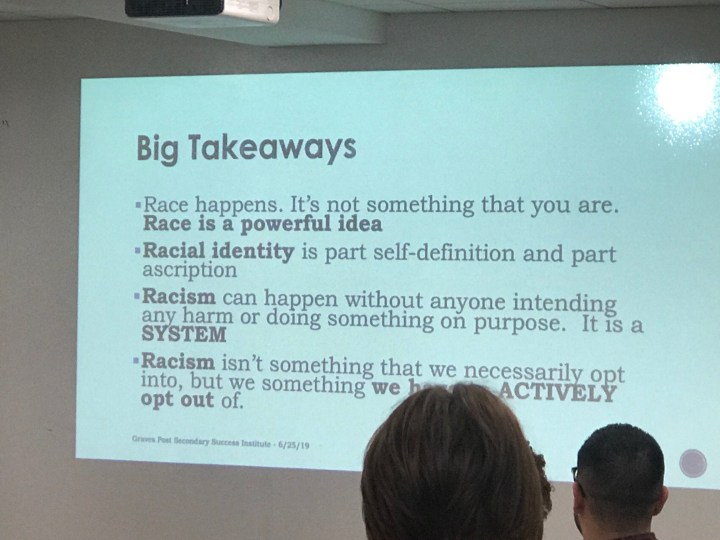
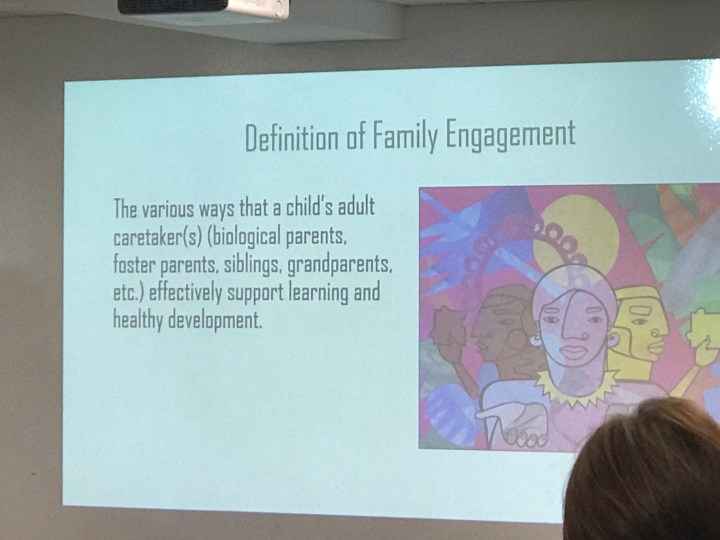 The learning did not stop here. We then spent time with Daren Graves diving into issues of race with intentionality. This was very powerful learning. We discussed how racism can happen without it being intentional. In education we must be diligent in monitoring the areas where we see disparate racial outcomes or impact:
- Curriculum
- Groupings
- Assessment
- Relationships with students and faculty
- Relationships with the community
- Recruitment/Retention
 Just like in Thriving Students and Developing & Supporting Our Students: Future Identity Versus No Future Identity here is the top 30 list from our Tuesday learning:
- Reflect on a situation in an educational setting that made you feel unwelcome.
- Reflect on a situation that made you feel welcome.
- Asset-Based versus Deficit-Based Communication
- It is a bad habit to not look at all our communication through a critical lens.
- What is the problem? The problem is not our students.
- Is the problem that our students aren’t post-secondary ready, or that our education system is not student ready?
- Cultural competence will not cut it. We need to be highly skilled, not just competent.
- We need to make sure all schools are student ready.
- Google Translate™ is a good thing, but must be edited, or those reading will feel disrespected.
- We need information to go to parents as well as the students.
- We need to offer parents parents questions to ask their students.
- Our families are collaborators.
- We need to have parents presenting to parents.
- Have parents talk to each other.
- Students need to be thought of as part of a family, and then the family as part of all the practices of the school.
- Staff needs to view families as collaborators and partners.
- Staff Relationships With Parents + School Knowledge = Family Engagement As Confident Partner
- Staff needs to think of themselves as mentors to their parents.
- Family engagement is a way of thinking, not a practice.
- Family engagement is a value, not just a practice.
- There is no gene for race. Science saved the day!
- Race is an idea.
- Race is not culture.
- Race is something that happens, not something we are.
- It’s not about doing well in school, it’s about doing school well.
- Racism is usually pretty mundane.
- A system that confers privilege and produces disparate outcomes on the basis of race.
- historically-based systems
- actions/beliefs/policies/practices/conceptions
- confers visible and unacknowledged privilege
- Sometimes we set students up for failure by trying to not set them up for failure.
- Start with implicit biases, then move to structural biases.
- Racism can happen without anyone intentionally wanting it to happen.
Developing & Supporting Our Students: Future Identity Versus No Future Identity
On Monday I had the opportunity to dig deep into adolescent development and how this plays into future aspirations, beliefs, and behaviors of our students. I was introduced to identity development by Dr. Mandy Savitz-Romer of the Harvard Graduate School of Education. She advocates that articulating aspirations and expectations, forming and maintaining strong peer and adult relationships, motivation, and goal setting should become a part of our DNA in education.


Mandy has so much knowledge in adolescent development and how to advance student success. In fact, she has quite literally written the book on it. We were given her new book this week, Fulfilling The Promise: Reimagining School Counseling to Advance Student Success. I am almost done with it and have to say it is awesome. I am sure you will be seeing blog post from me about the book in the near future.
 There was also the opportunity on Monday for learning from Roberto Gonzales who is the preeminent academic expert on undocumented immigrant youth and the struggles they face. It was great to spend time with him because he has spent time with these youth getting, as he called it, “a worm’s eye view.” He understands how these issues play out in real-life. Most powerful for me was the idea of our undocumented immigrant youth straddling two worlds: neither from here or there. No one should have to live like that. Additionally, it was so powerful to gain an understanding, and I still have a huge amount to learn and understand, of the undocumented youth’s transition to “illegality.” As Roberto taught, illegality is not a noun but a verb as undocumented students move from protected to unprotected. I really needed this learning and can’t wait to read his book, Lives in Limbo: Undocumented and Coming of Age in America (University of California Press).
 Then, if that was not already a lot of learning in one day, there was Dr. Anthony Abraham Jack. He wrote the book, The Privileged Poor: How Elite Colleges Are Failing Poor Students. Our interactions with students matter. I was struck thinking about how some of our engagement strategies favor a selected few – the students we like, that impress us, and we know. What about making sure we have the chance to know all students, not just the ones that are inherently comfortable interacting with teachers. We need to help all understand how to do that. One way he advocates for is office hours. But not like we have always done office hours. Office hours need to be collaboratively with students understanding exactly how they work. Students also need to be comfortable in asking questions and bringing anything to office hours.
As I did for Sunday’s learning this week in Thriving Students, here is my top 30 list of takeaways from the day of learning:
- Information ≠ Action
- A
college goingfuture identity - Dimensions of identity: groups, roles, self concept.
- Marshaling: how do we use our resources.
- Throwing forward: seeing oneself in the future.
- Self-efficacy is the belief in the ability to accomplish a specific task.
- Self-efficacy is domain specific.
- We all have the ability to build self-efficacy.
- What shapes self-efficacy?
- Mastery of experience
- Vicarious learning
- Social persuasion
- Affect
- The “why” students go to college is very important.
- There is a big difference between wanting to go to college and someone telling you they want you to go to college.
- Motivation = Goals + Beliefs
- Students need to be better planners for obstacles. We need to be their GPS and give them three different routes.
- Control of Thoughts + Control of Emotions + Control of Behaviors = Self Regulation To Attain Goals
- Many students straddle two worlds; they are neither from here or there.
- We need to pay attention to how issues play out in real life.
- We forget how powerful having an I.D. card is to a person.
- Access is not inclusion.
- Beware of unwritten curriculum – the unwritten rules of getting along in an institution.
- We need to teach students how to interact with teachers and faculty.
- Doubly disadvantaged = Lower Income + Attended Public School
- Privileged Poor = Lower Income + Attended Private School
- Secondary school and college officials disproportionately reward proactive engagement strategies. Instead of who deserves reward, it becomes who we like, who we know, and who impresses us most – not necessarily the deserving students.
- Impress upon students it is more than normal to ask for help.
- It is smart
- It is expected
- It is rewarded
- We must inspire students to build an inter-generational support network.
- There is a difference between building a network and networking.
- Language matters.
- We need to make explicit what is now hidden to our students.
- We need to make basic things accessible and digestible for our students.
- We need to partner with families and promote our parents as super heroes.
Think about how great our country’s education system would be if we were able to make all 30 items above values that were in the DNA of our system and not just desired practices or boxes to check?
Thriving Students
 I have been learning at Harvard University this week on post-secondary success. As an exercise to help myself digest all of the information and make some sense of the learning, I like to come up with a top list from each day. This day’s (Sunday, June 23rd) learning came from Mandy Savitz-Romer and Francesca Purcell, and included learning about post-secondary gaps and opportunities and the data and trends behind public policies to increase post-secondary success.
One of the things that really jumped out at me from the reading and learning was the introduction of the Thriving Quotient. I was very interested in the thought and reality is that we always want to measure student success primarily in terms of academic performance and persistence to graduation. I became enthralled when reading “The “Thriving Quotient”: A New Vision for Student Success” by Laurie A. Schreiner, where she introduced this assessment tool. Thriving students are academically successful and also believe themselves to be part of a community and psychological well-being. These things make it possible for the student to get the most out of their educational experience. The thing I like about Academic Thriving is that it goes beyond what I call compliance – attending class, doing homework – going through the motions. In the Thriving Quotient, Academic Thriving students are psychologically engaged in the learning process. What really resonated with me about this was that the idea of making a connection between what the student already knows or is interested in. This connection to relevant contexts helps the student be an engaged learner and THRIVE.
The Thriving Quotient also includes Intrapersonal Thriving. This thriving is about the student having a healthy attitude toward themselves and the learning process. Additionally included is Interpersonal Thriving. We can’t truly thrive without relationships. So, time spent on the Thriving Quotient and so much other discussion on Sunday led to the following top 20 list of things learned:
- Learning with and from each other from different sectors.
- Pull don the walls and step outside our lanes.
- We have to get the singular narrative out of our mind.
- Sometimes we are creating a narrative for students that does not fit their why, or what is best for them.
- Actions of students do not match their aspirations.
- Only 10% of students that drop out of college had below a “C” average.
- Student problems vs. institutional problems
- We highlight student problems, but sometimes instead of highlighting problems, we need to change the process.
- With multiple pathways available to students, we need to make sure we are sorting in a way that is about best fit, not about other factors.
- We need to get better at moving from thinking about student success in terms of just quantitative box checking like graduation rates, number of applying or accepted to college, and test scores by moving to the idea of students THRIVING!
- We can’t think of college as just one singular thing because there are many different outcomes from many different types of colleges.
- The highest stakes tests students take are the placement tests once in college. Then, in some cases, we waste the students’ time in developmental education.
- We must find a way to scale up the things that work!
- A college credential is a solid investment that will pay off over time.
- More likely to give back to the community and vote
- Higher levels of personal well-being (health, et cetera)
- Higher earnings and tax payments
- What is it that the adult wants, versus what the student wants.
- Adults always think we know best, but many times we don’t know all the options, or nor does the student know all the options.
- “College is not for everyone, but it is for everyone that looks like you when you are a school.”
- We maybe need to think about amending the 14th amendment of our constitution to include higher education.
- We are nearing universal enrollment in college. What does this mean?
- A
college goingfuture identity.
As you can see, there was a lot to digest after a single afternoon of work. If any of these statements resonated or made you think, please comment here on this post.
Triageformational Leadership: New Hybrid Definition of Triage and Transformational Leadership
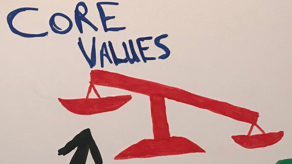 You all know how I like to make words up, so here is my latest: Triageformational Leadership. Actually, I made up the word and the definition over a year ago while in a meeting, but am just now blogging about. Does that give you any indication of how long my “want to blog ideas” list is? Anyway, here is the definition: The process of leading by core values to determine and prioritize needed changes so limited resources can be rationed efficiently and effectively to support the organization’s realization of vision and mission.
The important thing to note about triageformational leadership is that that the transformation is done by triaging by using core values. So many times this is given lip service, but not really done. By putting our core values at the forefront of our triageformational leadership we:
- determine our school or organization’s distinctives.
- dictate personal involvement.
- communicate what is important.
- embrace positive change.
- influence behavior.
- inspire people to action.
- enhance credible leadership.
- shape teaching/employee character.
- contribute to educational/organization success.
…it is clearly necessary to invent organizational structures appropriate to the multicultural age. But such efforts are doomed to failure if they do not grow out of something deeper; out of generally held values. ~ Vaclav Havel
So much goes into truly embodying what it means to be a triageformational leader beginning with the sense of community we develop within an organization. Those that I believe that would make great triageformational leaders place a high value on fostering an environment or community of collaboration. This community is balanced, diverse, and equitable. These leaders build community and culture by truly living out their own core values and the organization’s core values. Just like doing triage in an emergency situation, these leaders are prioritizing what gets done next by matching core values to the situation. This in turn brings about transformation and service oriented leadership.
Welcome To Your New Addiction

What’s At Your Core (Value)?
Where to begin? There is so much I want to say! Yesterday we had a great gathering of our Florida 3D Leadership group outside Orlando at Renaissance Charter School at Boggy Creek. I love going there and spending time with this group. Yesterday’s topic was core values. We spent the morning setting the stage with some cool activities (Emoji tattoos, making graphic mantras) and discussions around core values and what they wanted to do with their lives and what they wanted their legacy to be.
Then, the coolest thing happened – Lunch!

Our lunch was delivered and catered from Fuzzy’s Taco Shop. First of all, as the truck, bright yellow, pulled up, it caught my eye out the window I had immediately seen the shiny object and was off topic. Check out the picture of the truck and you will understand what I am talking about. So, as they were setting up at one end of the room we were in, I asked one of the workers, Mariah Miller, whether she liked working at Fuzzy’s Taco Shop and if she did, why? Well, let me tell you, she jumped right into our core values discussion and said that she liked it because her boss did not act like a boss and did not want to be called a boss. He wanted to be considered a coworker.

Graphic Recording by Amy Reynolds
Then her coworker (boss), or leader, as he likes to be called came in, not having heard me ask the question. I called him over and asked him what his workers would say his mantra was (this was a core values discussion from the morning). He then basically reinforced everything Mariah had told us. We were amazed by the message that David Morales had for us in what became an outstanding extemporaneous luncheon keynote, literally.
 David explained he had ended up in Florida, via Texas, because he quit his job, and I quote, “because my core values did not match those of the company I was working for at the time.” Of course I am beaming at this point and everyone was looking at me like I had set this up, which I had not. We had discussed how individual and organization core values needed to match. I had said earlier in the day that is was just a fact that if at any point your own core values become much different from the organization you work for, that it was time to quit. He was affirming everything we had talked about earlier in the day, but with the flare of personal experience and a lot of passion.
 He then told us about looking for a job and finding Fuzzy’s Taco Shop. He told us how he cut the deal for Fuzzy’s Taco Shop to cater for the Dallas Cowboys and Texas Rangers. He told us about how he has opened 29 businesses. Finally, he explained how core values build communities of commitment. We had been discussing how core values communicate what is important, influence behavior, and inspire people to action. We had also talked about how core values enhance credible leadership. David Morales from Fuzzy’s Taco Shop had become our exemplar. We did not need to spend very much time with his employees to know he was credible.
…it is clearly necessary to invent organizational structures appropriate to the multicultural age. But such efforts are doomed to failure if they do not grow out of something deeper; out of generally held values.” ~Vaclav Havel

Graphic Recording by Amy Reynolds
Core values are what support the vision, shape the culture and reflect what an organization values. They are the essence of the organization’s identity – the principles, beliefs or philosophy of values. Many organizations focus mostly on the technical competencies but often forget what are the underlying competencies that make their organizations run smoothly — core values. Establishing strong core values provides both internal and external advantages to the organization. Clearly, Fuzzy’s Taco Shop and David Morales have mastered this.
Needless to say, we were amazed at this outstanding example of a company and it’s employees living out shared core values. Would you, your organization, or school have been able to extemporaneously keynoted our lunch today with the same level of authenticity related to core values as David Morales, Mariah Miller, and Fuzzy’s Taco Shop were able to?
Angry Teachers
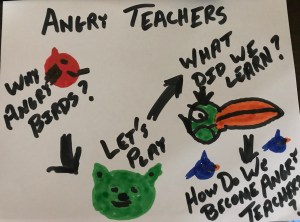 If you follow my blog you know that I am a fan of Angry Birds; both the game and the movies. I have blogged about Angry Birds on four different occasions: Teaching Like Angry Birds, Angry Birds University, The Angry Birds Effect, and “I’m Not A Leader!” ~ Red. Now I am adding a fifth post about this Rovio Entertainment created phenomenon that I love to use as a guide to great teaching and leadership.
This week I did a professional development for Mevers School of Excellence on student engagement. I have been working with this school’s teachers on professional development by customizing a series of professional development units using teacher walk through data and student data. These teachers are phenomenal and deserved a great finale to the year long work we have been doing. So, this professional development unit was titled “Angry Teachers.” Catchy, don’t you think? We certainly don’t want our teachers to be angry, but we do want them teaching using the principles employed by Rovio that have made this game such a phenomenon. The only homework prior to the evening’s professional development was to have the Angry Birds Classic game downloaded on one of their devices.


I led off with the statement, “Everything you need to know about teaching you can learn from Angry Birds.” I think some were skeptical, but I really do believe this statement. Then, of course, I had them play the game with the volume turned up and take notes about what they learned. Needless to say, they had so much fun. I had them take notes on what they were learning that could be applied to great facilitation of learning. Here is what we talked about:
- Make it easy to start the task.
- Show, don’t tell.
- Give useful and immediate feedback.
- Make it easy to recover from failure.
- Complicate the task gradually.
Think about it; if a teacher is getting just those five things done he or she is on the way to providing great facilitation of learning. Then after playing a little more I broke them into groups and had them develop the learning even further. Here are the graphic representations of their learning the 10 groups came up with:
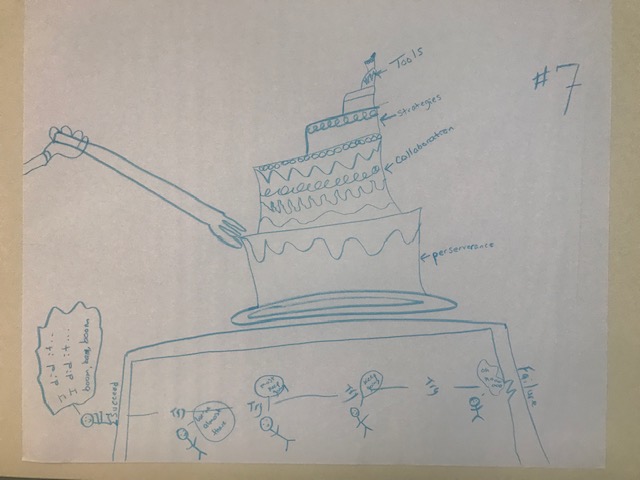
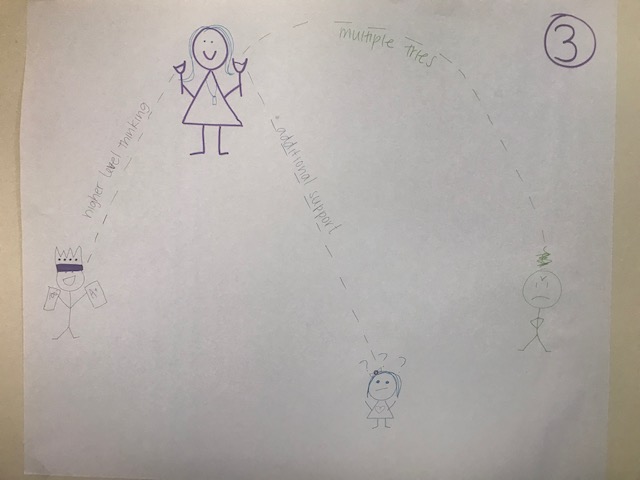
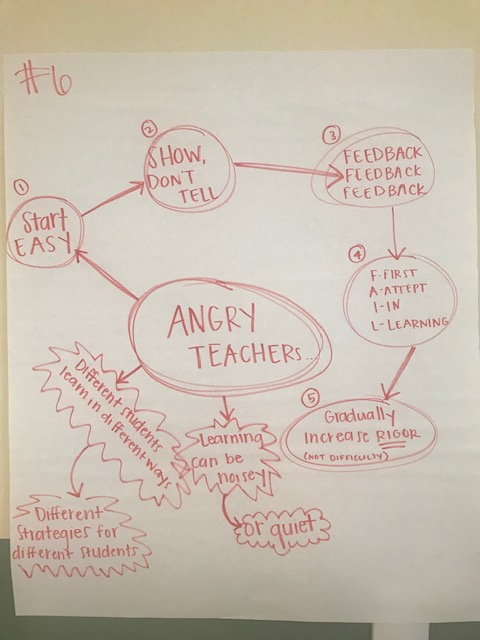
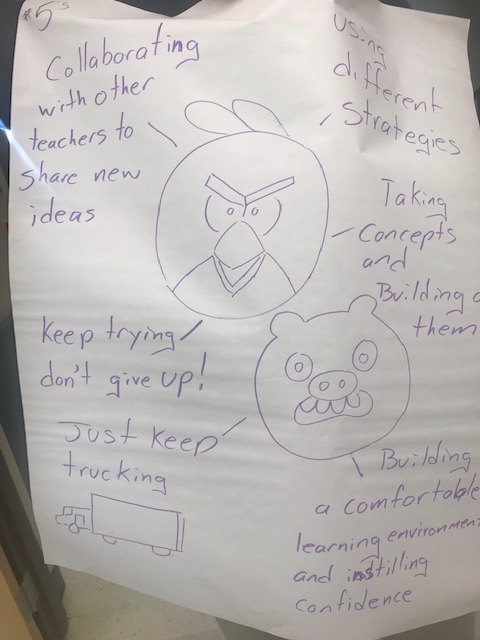
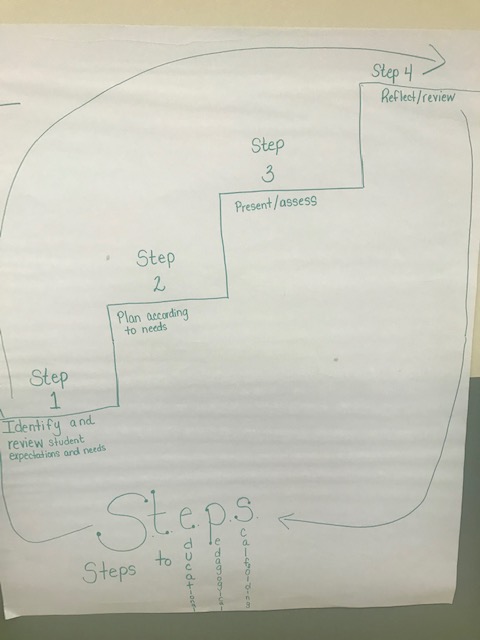
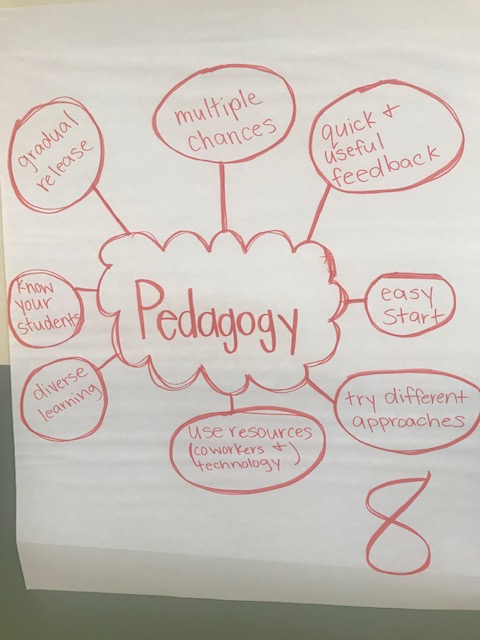
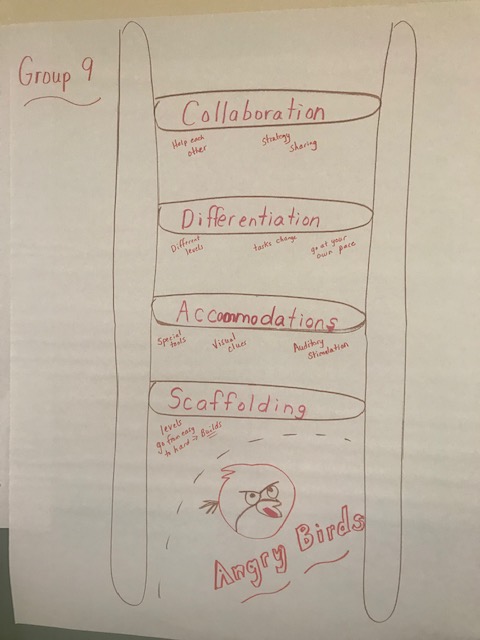
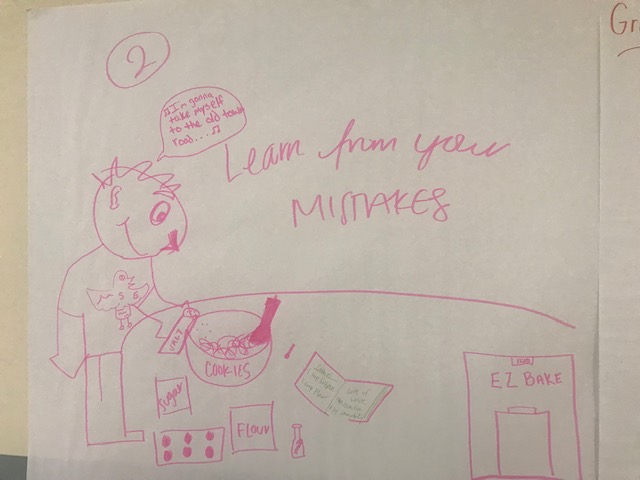
Pretty amazing work! Now, consider the following:
1. Angry Birds involves practice without penalty.
2. Angry Birds offers the opportunity to constant feedback.
3. Angry Birds inherently teaches that different tools have different purposes.
4. Angry Birds has a built in mechanism for knowledge transfer.
5. Angry Birds rewards perseverance.
6. Angry Birds gives no time limit.
No wonder we are all addicted to this game! Now if only we could ensure that our
classrooms are always safe spaces to practice new strategies, offer students a range of possibilities for how to succeed in their learning, give our students constant feedback, and support knowledge transfer within and among our courses. So, do you agree? “Everything you need to know about teaching you can learn from Angry Birds.” Our students deserve us to be “Angry Teachers!”
You’re Not a Fraud!
 Impostor syndrome (also known as impostor phenomenon, impostorism, fraud syndrome or the impostor experience) is a psychological pattern in which an individual doubts their accomplishments and has a persistent internalized fear of being exposed as a “fraud”. This definition came from Wikipedia (retrieved 4/6/2019). To start this post I needed a definition to frame the discussion. The context for this post came from a discussion during one of our Indiana 3D Leadership sessions last year and I am just getting to it on the list of topics I want to blog about. We were discussing how sometimes individuals move quickly to different positions in schools for doing good work. These aspiring leaders were concerned, however, that sometimes they have some imposter syndrome symptoms and believe they might not be as good as others think they are. At first I wasn’t sure I was catching what they were pitching, but then in studying this I have found this really is real.
For example, a perfectionist sometimes falls into this trap. Think about it. The perfectionist sets lofty goals for themselves, tend to be micromanagers, or won’t delegate at all. Then, when things aren’t perfect, he is super hard on himself. This is also the person who had to have straight A’s and the highest scores in the class. I never needed to worry about this and am certainly not a perfectionist. My dad, conversely, was a perfectionist and actually it would keep him from getting things accomplished at times. I remember when he passed away back in 1988 I found several projects not completed around the farm because he was constantly working to make whatever it was perfect. I always said it was like the old adage “measure twice, cut once.” The problem was he kept measuring to try to get it perfect and never got the board cut. Make no mistake, I loved my dad and I respect him more than anyone, but we were very different on the trait of being a perfectionist. I’m not sure I have ever worried about being perfect a minute in my life and have certainly never worried if someone didn’t think I was perfect.
Sometimes people with this syndrome want to know it all. She never believes she will know enough. Remember, to lead a highly effective group or organization you do not want to be the smartest person in the room. Learning has to be agile. There are things we will need to know tomorrow that we don’t know today. Don’t worry about trying to second guess, just be ready to learn when the need arises (which will be always).
If you’ve ever experienced imposter syndrome you need to realize that you have gotten where you are for a reason. It may have been because of your ability to produce, chance, connections, or some other factor, and that is great. Go ahead and embrace your abilities, embrace what makes you different from everyone else, and play off of your own strengths and capabilities. You are not a fraud.
As Leaders, We Create The Weather
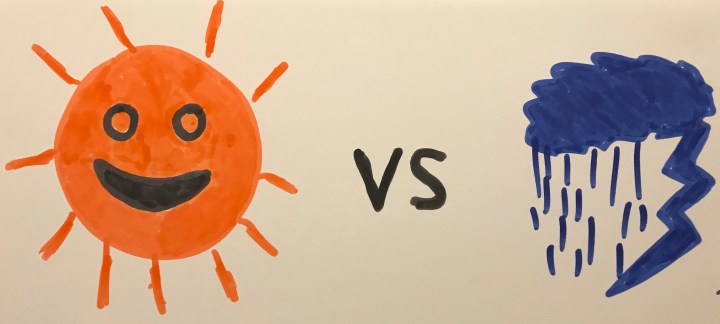 How do you show up? Think about this: do you show up sunny and bright or stormy and cloudy? Bottom line: if you show up as sunshine it will be a shiny happy day for the team. If you show up as a thunderstorm, however, it will be a rough ride. Either way, unlike the weather outside, you have the ability to influence the weather of your organization.
If you don’t believe this think about if you have ever worked with someone who you need to ask others what kind of mood he or she is in before talking to him or her. If you’ve experienced this then you have experienced leaders controlling the weather.
Therefore, we need to be intentional about the weather systems we create. Think about about the extremes: blizzards, hurricanes, extreme heat, or tornadoes. Then think about that sunny day with a calm breeze and moderate temperatures. Which of these weather patterns would you want to be creating?
Your teams and organizations will take their cues from you and whatever weather pattern you are projecting. If your outlook is sunny and bright, the organization is sunny and bright. If your outlook is full of storm clouds, the weather in the organization will be pretty much the same.
Next time you are with your team or people, imagine you are the weather map behind the meteorologist on television and she is about to give the weather report. If you take this moment of being mindful, it will help you to calm any storm fronts and bring sunshine and calm breezes to your organization.
Don’t forget, you are your organization’s meteorologist. As leaders, we create the weather. What kind of impacts do your weather systems have on your organization?
Hailey’s Energy Bus
 Several years ago I read the great book, The Energy Bus, by Jon Gordon. It is an outstanding book written as a fable. The book is written from the perspective of a middle manager (George) who is leading a team heading nowhere. Through a series of events he ends up riding a city bus with a positive motivation guru at the helm and a group of “energy” converts in the seats. After riding the bus for two weeks he has learned 10 lessons.
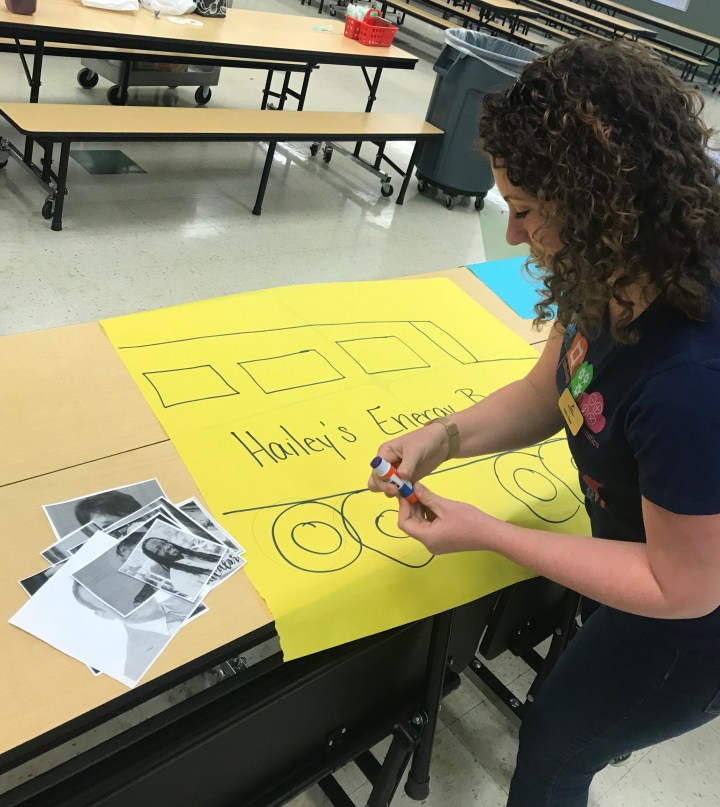
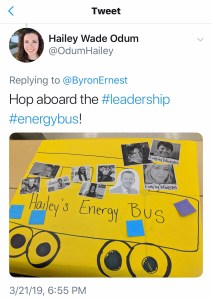 I was reminded of this book this past Thursday night while working with our Carolinas 3D Leadership participants in Kannapolis, North Carolina. The participants were working on a creative activity of putting 10 of the top influencers of leadership in their lives into a collage. Low and behold as I’m circulating I find Hailey’s Energy Bus. It immediately took me back to The Energy Bus book. Hailey Wade Odum realized that these leaders who influenced her, gave her energy. The energy to be a great teacher leader and K-5 STEM Lab instructor at Cabarrus Charter Academy Elementary School. She even tweeted, “Hop aboard the #Leadership #EnergyBus.” Jon Gordon would have been proud!
This really made me think about the ten lessons in The Energy Bus. They all applied to Hailey’s picks of her top ten influencers. Here’s the ten lessons (rules):
- You’re the driver of your bus.
- Desire, vision, and focus move your bus in the right direction.
- Fuel your ride with positive energy.
- Invite people on your bus and share your vision for the road ahead.
- Don’t waste your energy on those who don’t get on your bus.
- Post a sign that says, “No Energy Vampires Allowed” on your bus.
- Enthusiasm attracts more passengers and energizes them during the ride.
- Love your passengers.
- Drive with purpose.
- Have fun and enjoy the ride.
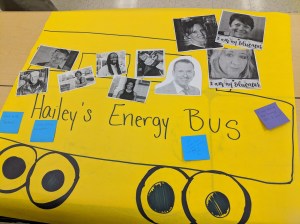 All of these rules I’m sure went into Hailey’s picks of her influencers, but in listening to her report out I believe that rules 2, 3, and 9 were pretty important in the decision. It’s all about personal responsibility. We are each responsible for the direction of our lives. And the direction of our lives is shaped by each day, each thought, and each person we use as a mentor or exemplar. If we are complacent in our lives we let others drive for us. We need to be driving our own energy bus. Have you ever felt out of control? Well, it’s time to take charge and drive your own bus. In my experience, the realization that my efforts now can reap big rewards in the future has always been very empowering.
 The other thing we spent time visiting about is that people are constantly being added to our bus. As our lives evolve and we continue to iterate and reinvent ourselves, some of our influencers will change. Unlike like the real Mount Rushmore that is literally carved in stone, our personal Mount Rushmorean leaders should be molded such to be constantly evolving. Who’s on your ENERGY BUS?
 Byron's Babbles
leave a comment