The Power of Ping-Ponging Ideas: Enhancing Community Collaboration

Today, during a discussion in the final day of a weeklong training of National FFA Teacher Ambassadors, one of the Ambassadors shared she loved the ping-ponging of ideas we did during the sessions. I was so proud to hear this because I really believe our work gets better in community. There is such power in heuristic learning and sharing. When I think of community and collaboration, I’m reminded of C. S. Lewis’s Inklings who provided J. R. R. Tolkien with encouragement and Lewis the right story.
In any vibrant community, innovation and progress often stem from dynamic conversations and the free exchange of ideas. One particularly effective method to foster this exchange is ping-ponging ideas — a process where thoughts, suggestions, and feedback bounce back and forth among members, much like a lively game of table tennis.
What Is Ping-Ponging Ideas?
Ping-ponging ideas involves collaborative brainstorming where participants actively listen, respond, and build upon each other’s contributions. Instead of linear discussions, this approach encourages a rhythm of giving and receiving, allowing ideas to evolve organically through continuous dialogue.
Why Is It Valuable for Communities?
- Encourages Creativity and Innovation: When ideas are bounced around, they often spark new perspectives and creative solutions that might not emerge in solitary thinking or one-sided discussions.
- Builds Collective Ownership: Engaging everyone in the idea-generation process fosters a sense of ownership and commitment to the community’s initiatives, leading to increased participation and support.
- Strengthens Relationships: Regular exchange of ideas creates connections among members, building trust and understanding that can translate into stronger collaboration.
- Facilitates Inclusive Decision-Making: Ping-ponging ensures diverse voices are heard, helping the community make more well-rounded and inclusive decisions.
- Accelerates Problem-Solving: As ideas bounce around, potential issues are identified early, and innovative solutions are quickly developed through collective input.
How Does Effective Ping-Ponging in Our Communities Make Our Work Better?
- Create Safe Spaces: Encourage open-mindedness where all members feel comfortable sharing their thoughts without judgment.
- Use Structured Formats: Organize brainstorming sessions with clear prompts or questions to guide the idea exchange.
- Leverage Technology: Utilize online platforms that facilitate real-time discussion and idea-sharing, especially for remote or hybrid communities.
- Promote Active Listening: Remind participants to attentively consider each contribution before responding, ensuring meaningful exchanges.
- Follow Up: Keep the momentum by revisiting ideas, giving feedback, and implementing viable suggestions.
Ping-ponging ideas is more than just a metaphor; it’s a powerful technique that nurtures collaboration, sparks innovation, and deepens community bonds. By embracing this dynamic exchange, communities can grow stronger, more creative, and better equipped to face challenges together.
Experiences Over Experience

Today during a discussion with National FFA Teacher Ambassadors about who we influence and how we influence others, a teacher commented that sometimes she worried she lacked influence because others viewed her as not having enough years experience. This teacher is going into her third year of teaching and went on to say she has had a lot of experiences that others with more years of experience have not had. Did you catch the distinction here? I loved this and it is something I have always told teachers I’ve coached or mentored: Experiences trump experience!
While the number of years someone has spent in a field can give a general sense of their exposure, it doesn’t necessarily reflect the depth, quality, or relevance of their experiences. Considering the actual experiences of others allows us to understand their challenges, problem-solving approaches, and lessons learned in specific situations. This deeper insight helps us evaluate their true expertise and adapt their knowledge to our own circumstances more effectively. Ultimately, focusing on meaningful experiences fosters more genuine learning and growth than simply counting years.
Watercolor Leadership
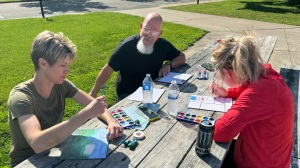
Painting with watercolors can help us reflect on our personal and development. By creating art, we can express our emotions, thoughts, and experiences in a visual form, no matter our talent or level of skill, allowing us to explore and understand ourselves on a deeper level. Today, I used watercolor painting for a professional development retreat with Wabash River Career and Technical Education (WRCTE) teachers. We were at the beautiful Turkey Run State Park in Marshall, Indiana. I told them to find a spot anywhere in the park and paint a picture that represents the great aspects of their year getting students ready for their next steps.
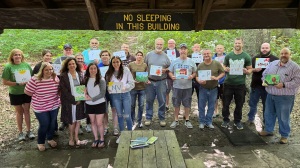
The process of watercolor painting can be meditative and calming, providing a space for self-reflection and introspection. So, by engaging in this creative activity, the teachers gained insights into their own journey of growth and development. When we were sharing out, one of the participants shared he had painted the Turkey Run Inn because it was a challenge that made him reflect on his own journey growing as a teacher this past year. Every teacher’s description of their painting was very inspiring.

Painting with watercolors can be compared to leadership in the sense that both require creativity, vision, and the ability to adapt to changing circumstances. Just as we must carefully choose our colors, brushes, and techniques to create a beautiful masterpiece, a leader must make strategic decisions, inspire others, and navigate challenges to achieve success. Both activities also require patience, practice, and the willingness to learn from mistakes. Overall, painting with watercolors and leadership both involve bringing a unique vision to life through skillful execution and thoughtful guidance.
Opportunity To See More Opportunities 
One student said, “This program and the teachers give us the opportunity to see more opportunities!” When I heard this student on the Student Advisory Committee of the Vision Corner Learning Center in Union City, Indiana say this, I wanted to jump up and cheer. Randolph Eastern School Corporation is giving students the opportunity to see more opportunities – is that not what education is all about. It means that when a student is open to new experiences, perspectives, and possibilities, they are more likely to recognize and take advantage of opportunities that come their way. Then, teachers encouraging and creating space for the students to be curious, adaptable, and proactive, enable the students to expand their horizons and make the most out of their educational journey and future career prospects. This all goes hand in hand with and is part of students learning to learn.
We can best provide opportunities for students by creating a positive and inclusive learning environment that encourages curiosity, critical thinking, and creativity. They can incorporate hands-on activities, real-world examples, and group projects to allow students to explore different perspectives and enhance their problem-solving skills. Additionally, teachers can provide mentorship, guidance, and support to help students navigate challenges and seize opportunities for growth and development. Ultimately, fostering a collaborative and engaging educational atmosphere can empower students to maximize their potential and discover new possibilities for success.
Teaching Learning Ability
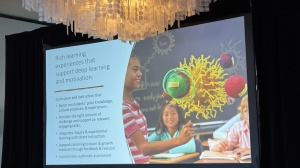
Yesterday in our National Association of State Boards of Education Annual Conference opening session, my friend, Dr. Linda Darling-Hammond made the comment that we need to teach our students learning ability. This enablement of learning is important to Linda and I and we even coauthored an article on opportunity to learn. Click here to read it. I spent some time this morning thinking on teaching learning ability. Teaching our kids learning ability means providing them with the skills and tools to become effective learners. This includes teaching them how to think critically, problem solve, and communicate effectively. It also involves fostering a growth mindset, where they understand that intelligence and abilities can be developed through hard work and effort. Additionally, teaching learning ability involves promoting curiosity, creativity, and a love for learning.
I definitely believe we can teach love for learning. Encouraging a love for learning starts from an early age by creating a positive and engaging learning environment. Providing interesting and relevant content, incorporating hands-on activities, and giving students the opportunity to explore their own interests can help foster a love for learning. Additionally, praising effort and celebrating achievements can also help motivate learners and make the learning experience enjoyable. It’s important to create a supportive and encouraging atmosphere where students feel empowered and excited about learning.
Listen More
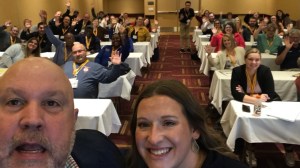
This past week at the National FFA Convention here in Indianapolis, Indiana I had the opportunity to do teacher workshops with our National FFA Teacher Ambassadors. One of my roles is to help our ambassadors be the best presenters possible. After each workshop I did a reflection so that during next year’s ambassador trainings I can point out positive practices that really work during workshops. One such practice was done by Lindsey Lasater of Silex, Missouri. She is incredible at leading workshops. When leading discussions with workshop participants, Lindsey would write down each participants’ comments word for word on tear sheets. I used to do this in my classroom when teaching and now also use it when facilitating. I love this strategy. One, it helps the teacher/facilitator listen better, and two, it shows the student/participant that what they have to say is valued. And, a third plus is that it helps the other participants know what was added to the conversation.
In Simple Truth #43, “Since We Were Given Two Ears And One Mouth, We Should Listen More Than We Speak” in Simple Truths of Leadership: 52 Ways To Be A Servant Leader and Build Trust, Making Common Sense Common Practice, Ken Blanchard and Randy Conley we are reminded that good listeners are interested in what you are thinking and feeling. Some great ideas were being shared last week during Lindsey’s workshop and she honored and captured those thoughts by actively listening and writing them down. We are a good listener if we are focusing on the other person. Bad listeners focus on themselves. If we get the listening right, those we serve will share their best thoughts and ideas with us.
Be Like Potatoes Not French Fries
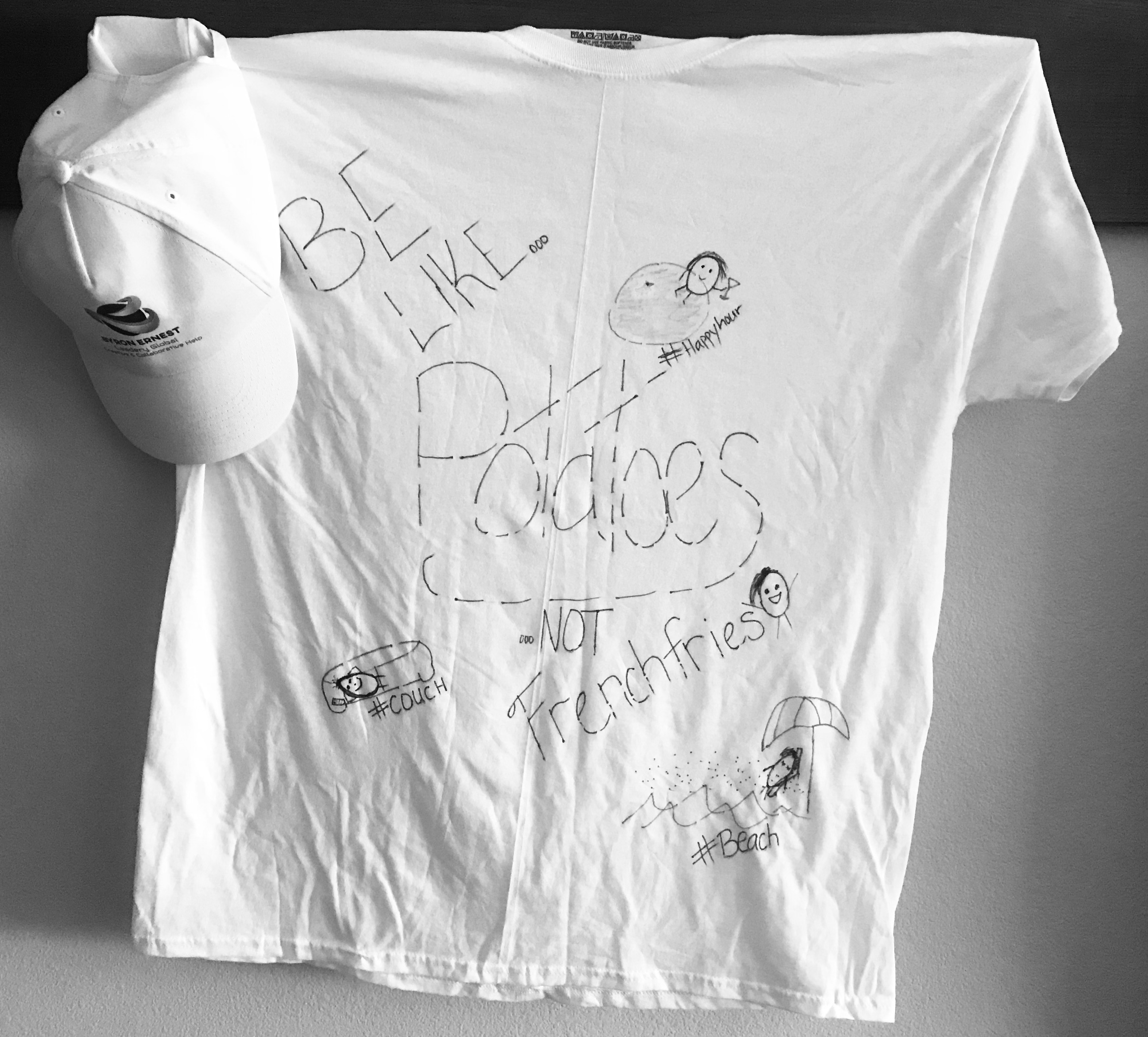
This week, a breakout group who was developing a self-care club t-shirt (see featured picture) as part of a project for a professional development I was facilitating came up with an incredible theme: “Be Like Potatoes, Not French Fries.” This was an interesting metaphor and not something I had heard before. The thought was to do everything possible to be a whole person and not processed/fried pieces. The theme was really pretty genius and I couldn’t stop thinking about it and what it meant to be a like a potato. When I studied the shirt I found it was okay to sometimes just relax and be a couch potato. Sometimes it is okay to take part in a happy hour or spend time on the beach (hard for me on a daily basis, but I was facilitating in Florida).
The point was that we don’t have to spend every moment processing and transforming every moment like becoming a French fry. To be the whole person and stay like the potato we need to make sure and schedule time for what another group called “Self Care A La Carte. Check out their list of a la carte self care items on their t-shirt:
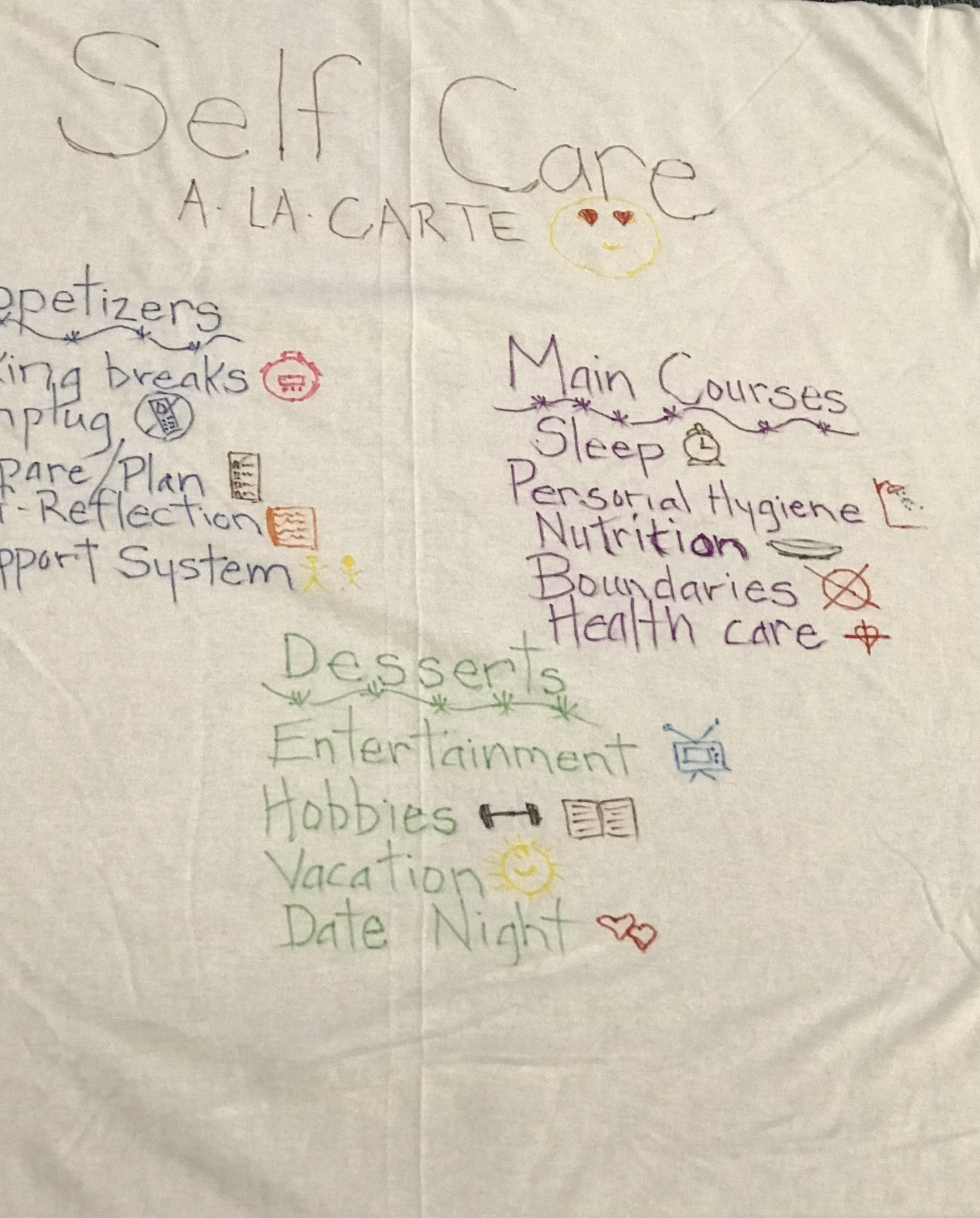
These were educators I was working with and one of the important things we discussed was the importance of focusing on self so we could effectively focus on others. As educators we provide support, how well we provide that support depends on how well we take care of ourselves. Here are some tips for having a good day:
- Get one important thing done
- Plan your perfect daily timetable
- Listen to a great music playlist (of course this should include some KISS songs)
- Go for a walk
- Leave your bad mood at home
How will you take care of yourself?
How Do I Teach That?

I’m not sure when I had last been in an actual movie theatre before last night for Top Gun: Maverick. It had been several years, though. My son was home and the family decided we would go. Great experience. Great movie. 🎥 Great popcorn with all the butter. 🍿 It really was a great movie. It was incredibly well-made and had many great leadership and teaching lessons. There were a couple of great lines that Maverick (Tom Cruise) made in the movie that jumped out at me. The one we will explore here is:
“It’s not what I am, it’s who I am. How do I teach that?”
Pete ‘Maverick’ Mitchell to Ice
At first Maverick rejects and dismisses the idea of being a teacher. In the end his students prove him wrong. The best leaders I’ve experienced have been teachers – they have worked to help develop me or give me development experiences. The leaders who are the worst at teaching or the ones that worry that someone will exceed them are the ones that have great talent slipping through their fingers. This idea of how to teach “who you are” is one I have contemplated over and over in education. In this movie it came down to the timeline of the mission being compressed so much that it sets off a wave of despondency and doubt within the ranks. The possibility of mission success seems hopeless. Maverick proves it can be done, however, by doing it. He stretches himself almost to the breaking point to serve as an inspiration to his young recruits, who now see what’s possible.
Do you model and set an example for those you serve? These are both great strategies for teaching.
It All Comes Back To Relationships
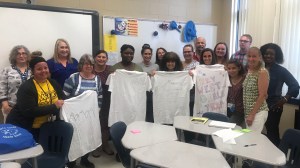
I’ve had the honor of spending the past two days in Florida facilitating professional development for teachers. It was so inspiring to work with teachers who were so positive and clear in their purpose for serving scholars. Interestingly, as we come back even better after the pandemic years one theme came out in every one of my sessions: relationships are the key to everything. No matter how tough things are, we have to remember that building the meaningful relationships with students is number one. We have known for a long time that the relationship with a teacher can be critically important to how well students learn. We also know these meaningful relationships are much deeper than social interactions. Great teachers engage with students around their curiosity, their interests, their habits of mind through understanding and approaching material to really be an effective teacher. Research also tells us that the teachers that form these relationships are happier and experience the true joy of teaching.
When I was teaching I actually had the personal mission statement of, “I strive to use rigor, relevance and relationships to be a steward of high student achievement.” I blogged about that in Drumming Up Relationships. We must learn our students and connect with them on a real level, showing respect for their culture and affirming their worthiness to receive the best education possible. Our relationships with students matter more than we might ever know. Our abilities to show empathy and compassion are crucial. We must also continually hone our skills at practicing perspective-taking: actively imagining how a student might perceive or be affected by a situation. This can help us reduce bias and deepen our relationships with students. With deeper relationships comes trust, and with trust comes more engagement in learning.
A Scholar’s Book Of Life

Yesterday, we used pumpkins in our leadership development workshop in Georgia. Participants carved out an image of their leadership mantra on one side and their leadership legacy on the other. I always love seeing these and hearing the explanations. They were all very meaningful and inspiring, but one really caused me to pause as an educator and leader. The participant had carved a book into the pumpkin (the featured picture of this post).
The teacher leader then went on to explain that the book represented each students’ book of life and she wanted her legacy to be entered in the book as having taught the student something and having positively influenced her or his life in some way. I thought this book was a pretty great metaphor.
In some professional development at another school this week we discussed how every teacher needs to own every scholar in the school regardless if she or he is in your class or not. The pumpkin carving reminded us that we are impacting students even when we don’t know it. Here’s the best part: to make it in a student’s book of life, teachers don’t have to be perfect.
Students remember teachers for all kinds of reasons. Students might be inspired by teachers who were kind, funny, brilliant, or passionate. The kids we serve remember the teachers who really cared about them. Our scholars remember teachers who were supportive or encouraging or saw something in them no one else did and then challenged them and made them think. Finally, our students also remember teachers who were maybe just a little quirky. Thank goodness!
Every staff member in the school represents the next entry or chapter of our scholar’s stories. Let’s fill up the pages of those books!
 Byron's Babbles
leave a comment