Container Pioneer: How Innovative Leadership Shaped the Future of Global Trade

Yesterday I had the opportunity to learn first hand about the Port of Savannah and container ship transportation. I posted about that experience in The Modern Container Port. That experience caused me to dig in and learn more about how the whole container shipping industry evolved. I learned that Malcolm McLean was the innovative, systems change leader who invented and patented containerized shipping. Over 90% of global shipping now happens using the TEU (Twenty Foot Equivalent Container Units) containers. That invention and standardization was said to have improved shipping efficiency by 25%. Now that’s innovation!

McLean’s invention of the shipping container and the semi trailers the containers can be mounted on offers a powerful leadership lesson in innovation and systems leadership by exemplifying how vision, boldness, and systemic thinking can revolutionize an entire industry. Here are some key takeaways:
- Challenging the Status Quo: McLean identified inefficiencies in traditional break-bulk cargo handling and questioned existing practices. Great leaders aren’t afraid to challenge conventional methods and look for transformative solutions.
- Innovative Thinking for Large-Scale Impact: His idea to standardize cargo into containers was groundbreaking, demonstrating the importance of thinking big and considering how innovations can positively impact multiple facets of an industry.
- Commitment to Vision: McLean persisted despite initial resistance, showing that dedication and resilience are essential for turning innovative ideas into reality.
- Systemic Change and Leadership: His invention didn’t just improve efficiency; it redefined global trade logistics, illustrating how visionary leadership can effect widespread change through strategic innovation.
- Embracing Risk and Learning: McLean’s journey underscores the importance of taking calculated risks and being open to learning from failures, which are vital traits for innovative leaders.
Malcolm McLean’s story teaches us that effective leadership involves recognizing opportunities for innovation, daring to challenge existing paradigms, use systems thinking to disrupt markets, and having the perseverance to implement game-changing solutions that benefit industries and communities worldwide.
Change Leadership: The Iceberg Analysis and Perception Versus Reality
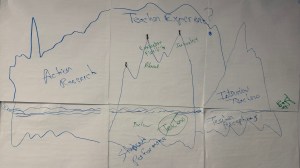
Back in August, a group of leaders and I got to do a presentation on next steps in a change leadership case study. Our task was to make a pitch promoting next steps using one of the five key tools of change.
The five key tools of change are:
- Problem statement;
- Stakeholder mapping;
- Iceberg analysis;
- Causal loops;
- Iteration and testing.
Our team chose to use an iceberg analysis. The iceberg analysis is a key tool in change leadership that helps identify underlying issues that are not immediately visible. Just like an iceberg, only a small part is seen above the surface, while the larger, more significant concerns lie beneath. By exploring these hidden aspects—such as underlying beliefs, assumptions, and cultural patterns—leaders can address root causes of challenges, fostering meaningful and sustainable change within our organizations’ systems.
In the context of the case study we were given, we chose to expand the metaphor of the iceberg (which is the point of this post) even further by creating a bigger iceberg (see the featured photo to see my graphic recording of the presentation) that encompasses the original. Sometimes we consider the iceberg as what we see above the surface and imagine is below the surface, but sometimes the iceberg is bigger than what we see above and below the surface. We called this perception versus reality.
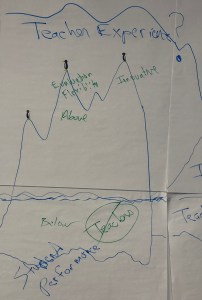
All the data in the case study we were using, which was related to systems change in a school educational system, had been collected qualitatively using administrator perceptions. We wanted to know if the positive perceptions held by administrators was reality for the teachers. Check out our graphic perceptions/realities in the photo inset (don’t miss our penguins).
This iceberg analysis that includes perception versus reality is such an important part of change leadership. Does perception meet reality? Great leaders care whether perception is reality. In the context of the case study, we needed to know if all the changes being made in this school’s systems were being experienced by the teachers in the same way as the administrators perceived them to be. Furthermore, this speaks to another key tool of change, stakeholder engagement. The teachers are an important internal stakeholder in the community that was being formed in the case study school.
 Byron's Babbles
leave a comment