Leadership Echolocation: How Big Are Your Ears?
 This week’s leadership lesson (#17) from John Parker Stewart in 52 Leadership Lessons: Timeless Stories For The Modern Leader, used the analogy of how big bats ears are to help inform us as leaders. Bats have the best hearing of all land mammals. They often have huge ears compared to the rest of the body. Instead of relying on their sense of sight for night-time vision, bats make rapid high-pitched squeaks called “ultrasounds”. These sounds are too high for most people to hear. If these sounds hit something, they bounce back — sort of like when you hear your echo in a mountain or a bathroom when you shout. The bat hears the echo and can tell where the object is. This is called “echolocation”. Therefore, bats actively listen instead of passively listening. In other words they listen for the feedback. Not every species of bat is able to echolocate, but most can.
I don’t know about you, but I wish I could use “echolocation” to really listen to those I serve. This story really resonated with me as we are studying deep listening in the Developing Myself course I am taking at Harvard University right now. We are doing exercises and case studies to develop true listening skills. Think about it… Would it not be great if we always concentrated on receiving the feedback instead of spending the time when others are talking with us to be devising our response. We need to spend time developing our listening skill to be that of a bat. In other words, we need to develop “leadership echolocation.”
“The bat’s two assets are listening and receiving feedback. How do you assess yourself in those two areas?” ~ John Parker Stewart
A useful tool I was taught to use at Harvard is that of the Ladder of Inference developed by Chris Argyris. The Ladder of Inference (shown here in a drawing I did for a professional development workshop on norming for teacher evaluation – I think you will be able to see how this would be valuable for those observing teachers) has six rungs:
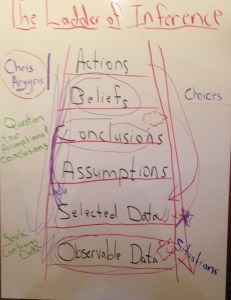
- Observable Data
- Selected Data
- Assumptions
- Conclusions
- Beliefs
- Actions
The idea is to stay low on the ladder. As you move up the ladder away from observable data you begin to make your own meaning of what you are hearing. The problem is, this meaning may not be the same as the person you are listening to. Then some recursive loops begin to come into play. As we begin to form beliefs, we only listen and select data that supports our beliefs. See the problem? The other recursive loop that if we move to the top of the ladder and begin to take action, we only look for observable data that supports the meaning we have made out of the dialogue or situation. Again, the idea is to stay low on the ladder and keep moving back down the ladder.
So, how do we do we hone and perfect our “leadership echolocati0n?” As we find ourselves moving up the Ladder of Inference there are three things that will intentionally enables us to move back down the ladder:
- Question your assumptions
- Question your conclusions
- Seek contrary data to support or refute the meaning we are making
Most of us struggle with deep listening. Next time you want to have true dialogue with someone, consider where you are on the Ladder of Inference. Doing so will increase the feedback you receive from those you serve and have dialogue with.
Allowing Leadership
 Leadership lesson #16 from John Parker Stewart in 52 Leadership Lessons: Timeless Stories For The Modern Leader, told the story of Robert Townsend, CEO of Avis Car Rentals in the 1960s and 1970s. From reading this story and then getting his book Up The Organization (2007), I would say Townsend was ahead of his time in an error of command and control leadership. He broke decisions down as being either expensive (critical) or non-expensive (non-critical). His idea was that critical decisions take time to decide and should be handled by upper-leadership and the non-critical, less expensive decisions should be handled closest to the source affected by the decisions. This is very much intent-based leadership except that with intent-based leadership all information for decision making flows up from those affected.
“The whole organization may be out of business while you oscillate between baby-blue and buffalo-brown coffee cups.” ~ Robert Townsend
I love the example given that Townsend was reported to have said, “The whole organization may be out of business while you oscillate between baby-blue and buffalo-brown coffee cups.” In other words, decisions need to be made where they can most efficiently and effectively made. In other words, leaders need to intentionally and strategically think through who is in the best position to make decisions – both critical and non-critical. Doing this will give those in our organizations stronger sense of value, ownership in what is going on, and the sense of contributing to the organization as a whole.
Don’t get caught in the delegation trap. You’re busy doing everything yourself. You know you need help, but to find and train someone would take more time than you have. So you keep working harder until you break. In order to delegate effectively make sure your people know how you go about making decisions. This is also why have core values is important. If individuals are making decisions using the organization’s they are more likely to be in alignment. I also believe even making sure that the common values of the organization and myself are known by everyone is important. For example, I believe that making sure my blog posts are readily available to those in my organization is important. I encourage them to read my posts and send links often to particular posts because I want those I lead to know what I am thinking and what is important to me. I believe this helps them to make decisions that are in alignment with the vision and mission of the organization.
Next time you are making decisions think about whether you are the right one to be making that decision. Are you the one most impacted by that decision? If not, you probably shouldn’t be making it.
Social Complexity
 For each of the last two days I blogged about Dynamic Complexity and Generative Complexity respectively. My inspiration for these posts has been the book by Adam Kahane titled Solving Tough Problems: An Open Way of Talking, Listening, and Creating New Realities. I feel compelled to write about the third complexity he offered in the book: Social Complexity. As Kahane (2004) taught us: “[S]ocial complexity requires us to talk not just with people who see things the same way we do, but especially with those who see things differently, even those we don’t like. We must stretch way beyond our comfort zone” (p. 75). Wow, how true this is. Think about this for a minute; how many times when trying to solve complex issues do we really listen to those who think differently, see the world differently, or just flat-out don’t like us?
“Roughly, by a complex system I mean one made up of a large number of parts that interact in a nonsimple way. In such systems, the whole is more than the sum of the parts, not in an ultimate, metaphysical sense, but in the important pragmatic sense that, given the properties of the parts and the laws of their interaction, it is not a trivial matter to infer the properties of the whole. In the face of complexity, an in-principle reductionist may be at the same time a pragmatic holist.” ~ Herbert Simon in his 1962 article, “The Architecture of Complexity.”
I look at social complexity as being complicated by the very nature that we cannot provide a simple model of the system that adds up and makes sense of, or can predict the independent behaviors of the parts; rather, the parts are influenced in their behaviors by the behaviors of other people, groups, organization, governments, or even populations. This is in contrast with the simple system of an internal combustion engine. It might seem very complex, but really it is simple because every part, both moving and not, has a function and order in which to do that function.
In a spark ignition engine, the fuel is mixed with air and then inducted into the cylinder during the intake process. After the piston compresses the fuel-air mixture, the spark ignites it, causing combustion. The expansion of the combustion gases pushes the piston during the power stroke. In a diesel engine, only air is inducted into the engine and then compressed. Diesel engines then spray the fuel into the hot compressed air at a suitable, measured rate, causing it to ignite. This all very hierarchical in that everything happens in a specific order that never changes.
Let’s now contrast this with the social complexity and causal processes (sub-systems) that make up our education system. And consider some aggregate properties we may be interested in such as state law and policy, federal law and policy, political dynamics, local community social differences, socio-economic factors, race, mobility, or the social and emotional needs of our students to just name a few. Some of the processes that influence these properties are designed (Every Student Succeeds Act, school boards {both state and local}, school management systems), but many are not. Instead, they are the result of separate and non-teleological processes leading to the present. And there is often a high degree of causal interaction among these separate processes. As a result, it might be more reasonable to expect that social systems are likely to embody greater complexity and less decomposability than systems like an internal combustion engine.
“To create new realities, we have to listen reflectively. It is not enough to be able to hear clearly the chorus of other voices; we must also hear the contribution of our own voice. It is not enough to be able to see others in the picture of what is going on; we must also see what others are doing. It is not enough to be observers of the problem situation; we must recognize ourselves as actors who influence the outcome.” ~ Adam Kahane
This reminds me of a legislative panel I am on right now to look at and make recommendations to our state legislature on our high stakes summative state testing (required by the Every Student Succeeds Act – ESSA). This committee is made up of 23 different individuals and appointed by different entities. My appointment comes as being the representative of the Indiana State Board of Education. Needless to say, we have lots of social complexity. Needless to say it has been awkward and tenuous navigating on this panel. Here are some things I have learned from Kahane (2004) to help us as leaders:
- To solve a complex problem, we have to immerse ourselves in and open up to its full complexity.
- Our core tasks need to be to “widen the circle” and “deepen the bench.”
- Tough problems can only be solved if people talk openly, and in many situations this takes real courage.
- Listen openly.
I close with Kahane’s (2004) definition of listening: [T]he process of taking in something new and being unsettled and changed by it” (p. 69). I ask you: Are you a leader who listens?
References
Kahane, A. (2004). Solving tough problems: An open way of talking, listening, and creating new realities. San Francisco: Berrett-Koehler.
Generative Complexity
 Yesterday I blogged about Dynamic Complexity after reading in the book by Adam Kahane and is titled Solving Tough Problems: An Open Way of Talking, Listening, and Creating New Realities. Another type of complexity worth organizing our thoughts about is Generative Complexity. Kahane (2004) said, “Generative complexity requires that we talk not only about options that worked in the past, but also about ones that are emerging now” (p. 75). To me this is all about not getting caught up in thinking about how things have always been done, but about how no one has ever thought about doing them.
“We cannot develop creative solutions to complex human problems
unless we can see, hear, open up to, and include the humanity
of all the stakeholders and of ourselves. Creativity requires all
of our selves: our thoughts, feelings, personalities, histories,
desires, and spirits. It is not sufficient to listen rationally to inert
facts and ideas; we also have to listen to people in a way that
encourages them to realize their own potential and the potential
in their situation. This kind of listening is not sympathy, participating
in someone else’s feeling from alongside them. It is empathy,
participating from within them. This is the kind of listening
that enables us not only to consider alternative existing ideas but
to generate new ones.” ~ Adam Kahane
We need to remember that there are many interdependent parts of a complex system. Additionally, a complex systems world view highlights that interactions between parts of the system and the behavior of the system as a whole are critical. As leaders, we must learn to do a better job of seeking out, fostering, and sustaining generative relationships that yield new learning relevant for innovation.
When discussing leadership we tend to focus on leaders’ individual characteristics rather than on the dynamics of interactions between leaders, group members, and the context in complex organizational systems over time; and we certainly do not do enough toward our own professional growth as leaders, or those on our teams, to create conditions that allow their organizations to evolve (2006). We must also find ways to improve our own and organizations’ ability to learn continuously and implement learning in action as projects proceed.
References
Kahane, A. (2004). Solving tough problems: An open way of talking, listening, and creating new realities. San Francisco: Berrett-Koehler.
Surie, G. & Hazy, J.K. (2006). “Generative leadership: Nurturing innovation in complex systems.” E:CO Issue Vol. 8 No. 4 2006 pp. 13-26.
Getting Nowhere!
 I learned about a creature that I didn’t know much about in Lesson #9 of 52 Leadership Lessons: Timeless Stories For The Modern Leader by John Parker Stewart. The lesson used the analogy of the Processionary Caterpillar. You know how I love analogies and this one is a good one for what happens in all organizations at some time or another. These cool little creatures feed on pine needles. The interesting part is, though, that they travel like a train with their eyes half shut, head to tail fitted right against each other. So, wherever the first one goes (let’s call her the leader) the others go blindly. Are you getting the analogy here? According to the lesson, you can place them in a circle and it can take up to 10 hours for them to realize they are going nowhere. Again, are you catching the powerful analogy?
“Don’t become processionary. Question the status quo. Work smarter, not harder.” ~ John Parker Stewart
We all have become Processionary Caterpillars at some time or another. Either as the 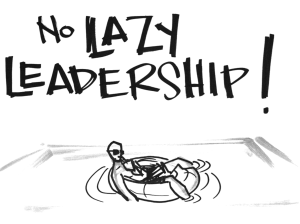 leader, or one of the followers. This is something I have called Lazy Leadership. You can read about it here. The big thing to keep in mind here is to avoid blindly, without question, performing tasks the “way it has always been done,” with no regard on how to improve or change for the betterment of the organization. I actually was discussing this last night at one of our family events after I had spoken to some of our teachers about ways to improve some processes. Our teachers are very talented and knowledgeable, and we need to continue to find ways to tap into that knowledge gained. We can then take that knowledge and improve as a learning organization.
 If we find ourselves resembling the Processionary Caterpillar more than we would first think or want we need to make adjustments. If you fear that you share some of the style of the Processionary Caterpillar, here are some questions Stewart suggested to ask:
- Why are we doing this?
- Don’t answer with, “That’s the way we have always done it.”
- Don’t ever do something because, “We’ve always done it that way.”
We need to avoid mistaking activity for accomplishment. We do not want to act like the Processionary Caterpillar. We possess an intelligence that enables us to be different from all the lower forms of life. Be all you can be by learning from the pitiful Processionary Caterpillar. My takeaway is that we need to assume there is always a better way. That does not mean we redo everything, or we would never get anything done, but we do need to question the status quo. Remember, if better is possible then good is not enough.
Everyone is Watching!
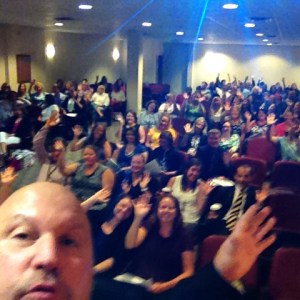 One of my leadership heroes, John Wooden, was a great coach and an amazing person of true character. One of many of his quotes was:
“The true test of a man’s character is what he does when no one is watching.” ~ John Wooden
While I totally agree with this quote, I also believe that leaders need to remember that everyone is watching as decisions are being made. This past week I have had several situations happen where I have had to make decisions and take action knowing that everyone is watching. Honestly, I was was very aware that everyone was watching and was actually taking this into account. It seems to me that a leader’s character and core values are tested most when EVERYONE is watching and it is in that environment that many leaders fail the test of true character and walking the walk. I wish Coach Wooden was still alive to ask him if: Perhaps character and great leadership is better defined by what you do when everyone is watching, just as much as it is when no one is watching?
Whether we know it or not, people are paying attention. The way we act today, influences how we all act tomorrow. And those actions influence others – whether they know it or not. Whether we’ve chosen to recognize it yet or not, we are an example to others by the actions we take and decisions we make – for ourselves and those around us. Either of how to act or how not to, or how we walk the talk of what we say we believe in. In this sense we are all leaders and you know I believe everyone is a leader. Every choice we make, big and small, is a chance to lead. We are either an example of high standards and what’s possible, or another contributor to the complacency. I have been preaching, for example, in our schools that we must tighten the ship and make every decision based on what is best for students. Therefore, my decisions this week have had to be with this in mind, knowing everyone is watching and using the metric of, “Is he tightening the ship?” Remembering this unavoidable principle has always helped make decisions quite clear for me. If my actions (or inactions) aren’t something I’d want those I lead to take, then they probably aren’t what I need to take.
We must even pursue the decisions and actions we cannot make or do today because this makes it a lot more likely to pursue it tomorrow. And as others notice, it enables them to do the same. Remember, everyone is watching. We must realize that we all are a personal example of what’s possible to someone, or a whole group of someones – however small and subtle those decisions and actions might be on a day-to-day basis. They add up. And to be that same example for those around us. For the people you might not realize are watching… because someone and everyone always are.
My actions and your actions are training ourselves and others. Are we living up to our organization’s vision, mission, and core values? Are we living up to our own personal core values? Everyone is watching! What will they see us do next?
Letting Go Leadership
 As an organization grows, evolves, and develops, it needs a leader who knows how to give autonomy to different stakeholders who can be leaders more effectively in all areas. In other words, it needs a leader who can let go of needing to push all decisions out and do it all. I believe most leaders have a hard time letting go is because they believe that they can do it better. I also believe that many leaders have a narcissistic fear that somehow they won’t get credit for the successes of the organization or it won’t be exactly like she envisioned it. Guess what? It probably won’t be. It will probably be better. If you want to read a little more about this fear thing, click here to take a look at a post entitled “The Fearless Leader” by a great teacher leader, Ann Semon.
The best leaders, however, learn how to do it – let go. In fact, they often learn to love doing it once they start bringing in people who are even better than they are in key areas–people who know more than they do, and from whom they can learn. When that happens, it can push organizations forward to a whole new level. This strategy in a sense “unlocks” the entire organization to continue evolving in a much faster and healthier way.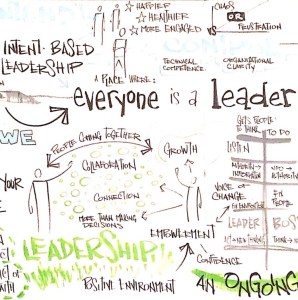
As part of letting-go, the best leaders learn to trust the people they’re bringing into the organization to become the future leaders. Leaders must be a part of building this trust by being actively involved in, and owning, the leadership development of those in the organization. Let me emphasize here – Development of the leadership pipeline is crucial here. This can only happen if you’re willing to give all in the organization ample control. Ask yourself these questions:
- “Do I really trust them to the point that I’ll let them make tough decisions?”
- “Do I trust them to learn?”
- “Do I trust them to grow?”
- “Do I trust them to experience their own failures?”
Can you answer yes to all these questions? If you can get to yes on all these it will be an incredibly powerful force for your organization. The culture you want to build is one that gives other leaders full autonomy without micromanagement. So let’s talk about this empowerment and autonomy…
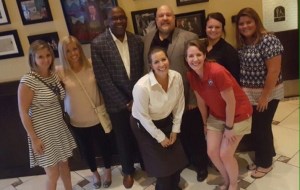
 I was fortunate to take a group of teachers and new principal to Harry and Izzy’s last night as a planning and team building. So, you know me, we don’t just talk about empowerment and intent based leadership, we practiced it. I wrote about what I like to do already this week in “Imagine A Place Where Everyone Is A Leader!” Click here to read the post. I literally would not let our group even look at the menu and told them we were going to empower our amazing waitress, Jen Becknell, to pick our meals for us. We gave her any boundaries, such as being pregnant, food allergies, et cetera. We even gave her permission to pick our drinks for us. Then, off Jenn went to put together one of the most incredible meals ever. I would love for Jenn to post a comment to this post as to what she chose and how she chose the dishes for us. Having done this now multiple times I am struck that I have never had a bad meal. We asked Jenn how she became so knowledgeable and she explained all the professional development Harry and Izzy’s had given her. Even things like going to their meat supplier in Chicago to understand the different types of aging processes in beef. This is a great example of Harry and Izzy’s giving Jenn the technical skill necessary to be fully empowered to be a great ambassador for the organization.
If you develop your leaders properly you will be able to trust the people who you hired to do their jobs with full autonomy, you may be surprised by how well it works out. Letting Go Leadership is nothing more than empowering your employees and teams to make their own decisions. As long as everyone has a shared vision and is committed to doing what’s best for the organization and those you serve, it can lead to bigger and better things. This certainly the environment I strive to create for every staff member in our school.
The Leadership Journey
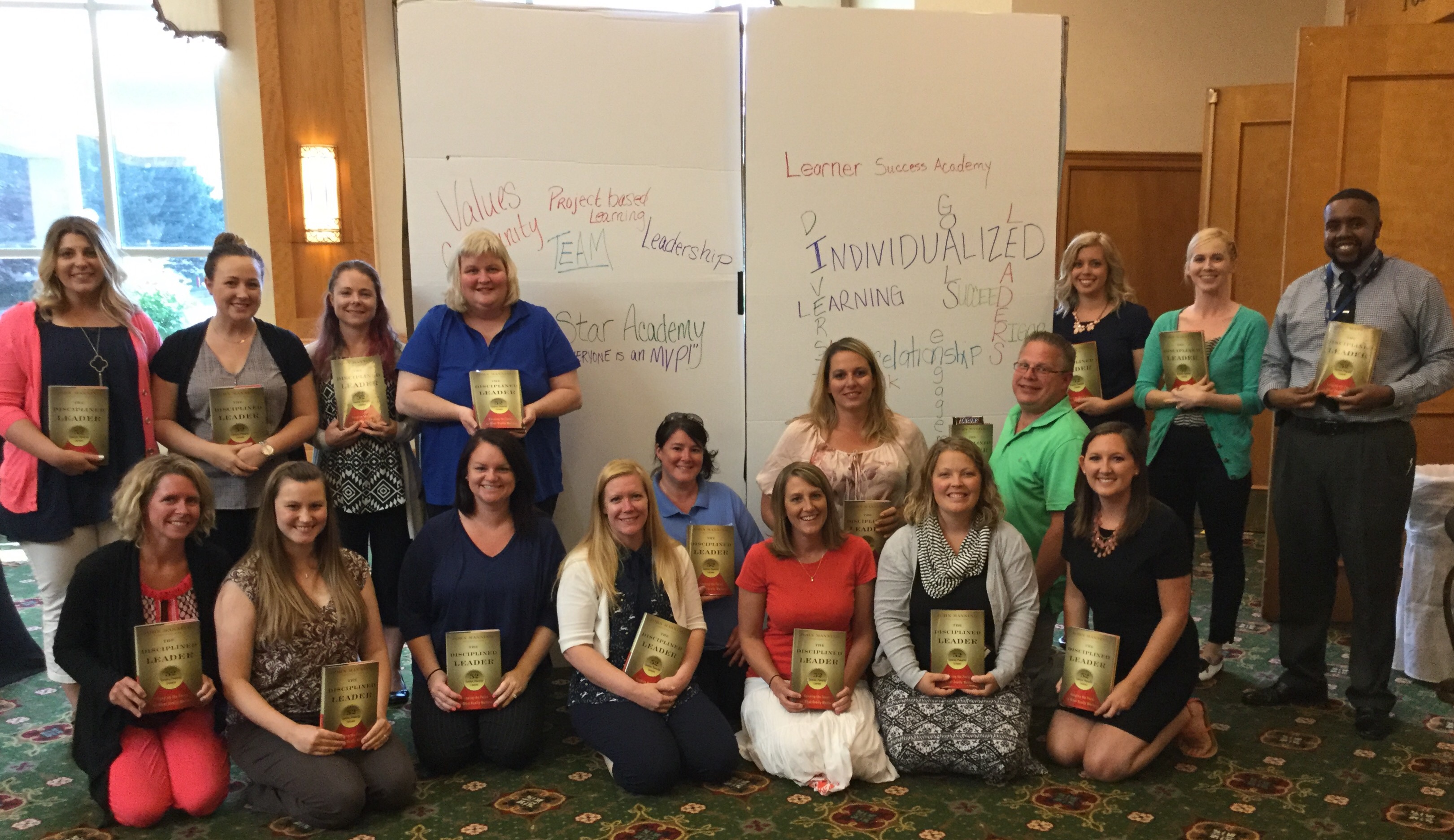
Unprecedented levels of complexity and unpredictability are part of our current world, particularly in education. If we are to continue to effectively lead organizations, transform schools, or assist others in creating positive change in their lives, or in the lives of others, we need adaptable and proven tools and practices to utilize now and well into the future. Leadership development, mentoring, and coaching provide the ability to be flexible and relevant no matter the situation and time – in other words adjusting to the current context in real-time. These leadership growth and development opportunities are valuable and effective methods for assisting others in discovering what they need to thrive to be happy, healthy and motivated.
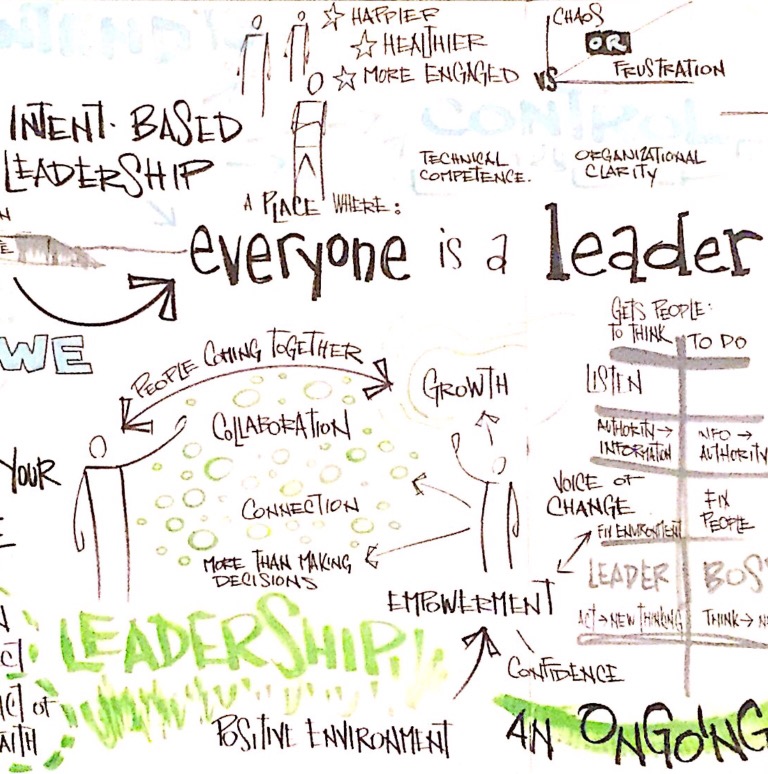 Our Focused Leader Academy (FLA) at Hoosier Academies Network of Schools provides leadership skills the ability that are flexible and relevant no matter the situation and time. We want to inspire with valuable and effective methods for assisting our teacher leaders in discovering what they need to become focused and disciplined leaders. What we are attempting to do is enhance growth of the pre-frontal cortex of the brain, thus increasing the teacher leaders resilience, creativity and belief in self. If we do it right our developing leaders experience making decisions that honor their own values and true potential ultimately living the life they have only imagined. In turn this puts him/her in a position to change the lives of the students we serve.
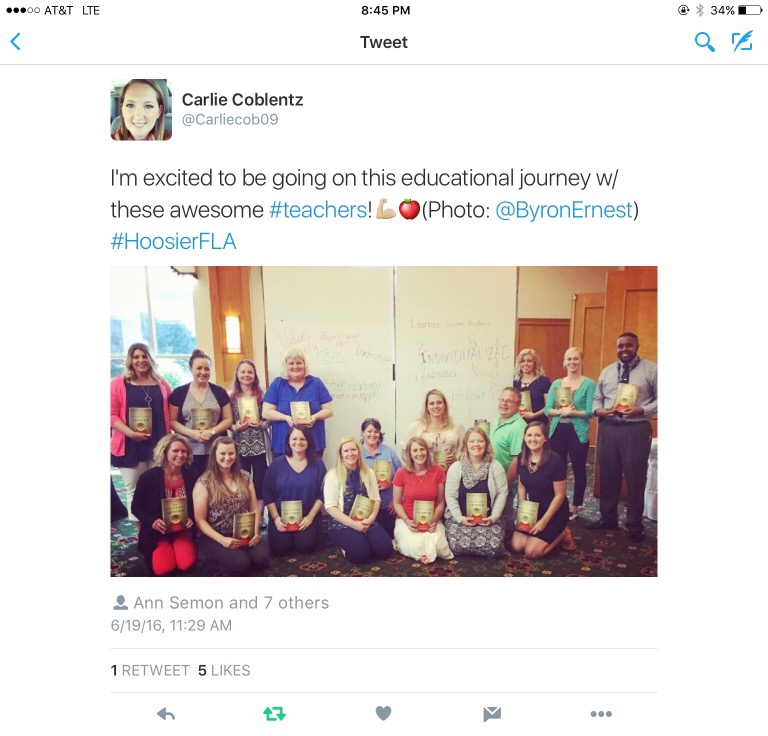
 It was exciting to see a tweet from one our FLA participants, Ann Semon, after session yesterday. She said, “What an inspiring day with @ByronErnest today. Excited for the leadership journey. #HoosierFLA” I’m so glad Ann recognizes this is a journey. Then another tweet from Carlie Coblentz stated, “I’m excited to be going on this educational journey w/ these awesome teachers!” Again, I’m thrilled that Carlie recognizes this as a journey.
 I’m pretty pumped we are using John Manning’s (2015) The Disciplined Leader as our book for leadership blogging and guide of our vital few again. As Manning (2015) stated, “Your leadership path is like a present. Whether you chose the path intentionally or ended up on this journey by accident, you are receiving an opportunity that not everyone gets in life. However, with this gift of Disciplined Leadership comes a unique responsibility. We believe that responsibility is to ‘pay it forward,’ helping others grow by sharing your knowledge and wisdom” (Kindle Location 2692). My most rewarding moments, and times when I’ve felt most significant, have been about helping people in a meaningful way, particularly helping grow those I’ve worked alongside. I appreciate John Manning’s partnership in making this journey of creating disciplined leaders possible.
 Through our Focused Leader Academy, our teacher leaders are discover powerful leadership competencies, tools, and techniques to assist others in broadening their vision of self. They are learning methods for disbanding limiting beliefs, embracing expanding beliefs, recognizing barriers, stretching potential, shifting behavior, holding people accountable and much more. Our teacher leaders are experiencing rigorous training as well as energizing experiences that are broadening their perspectives and enhancing their creativity while working with fellow employees, peers, students, and families.
ESSA Opportunity #8: Title IV, Student Support & Academic Enrichment Grant
 The Every Student Succeeds Act (ESSA) consolidates a number of existing federal grant programs into a new Title IV state block grant that may fund district activities to:
- provide all students with access to a well-rounded education.
- improve school conditions for student learning.
- improve the use of technology to improve academic achievement and digital literacy.
States could use this block grant to create an innovation fund for districts interested in scaling personalized learning strategies. ESSA would reconstitute Title IV, Part A into the Student Support and Academic Enrichment program, and would authorize the new program at $1.6 billion annually through 2020. That authorized amount comes in addition to the authorized $1.1 billion in Title IV, Part B, which funds the 21st Century Community Learning Centers Program. Part A would then require states to spend 20 percent of those funds on “well-rounded educational opportunities,” 20 percent of those funds on “safe and healthy students,” and a portion of the funding on the “effective use of technology.” Part B authorizes $1.1 billion for 21st Century Community Learning Centers that offer after-school academic enrichment programs. Part C includes federal funding for charter schools, which would increase from $253 million in 2015 to $300 million by 2020. Funding is similarly increased for magnet schools, which Part D of Title IV would increase from $92 million in 2015 to nearly $109 million by 2020.
In addition, Part E of Title IV would allow for education innovation. These innovations could include programs like: Promise Neighborhoods, full-service community schools, arts education, Ready to Learn television, and gifted and talented education programs. As you can see there are some tremendous opportunities for our students with ESSA.
ESSA Opportunity #7: Reservation for School Leaders
 This opportunity is one that is near and dear to me. I really believe in job embedded professional growth/development. Under ESSA, states may reserve up to 3% of their Title II, Part A funds to build a workforce of leaders with the skills to help schools transition to personalized learning environments. Priority funding should go to support leaders serving in schools identified for comprehensive support and improvement. As a school leader who has now taken on a high school and now a school system that fits this priority, I can attest to the need for this development of teacher leaders. ESSA also requires that professional development programs should be customized, embedded, and align to statewide professional competencies so leaders can advance along individualized career pathways.
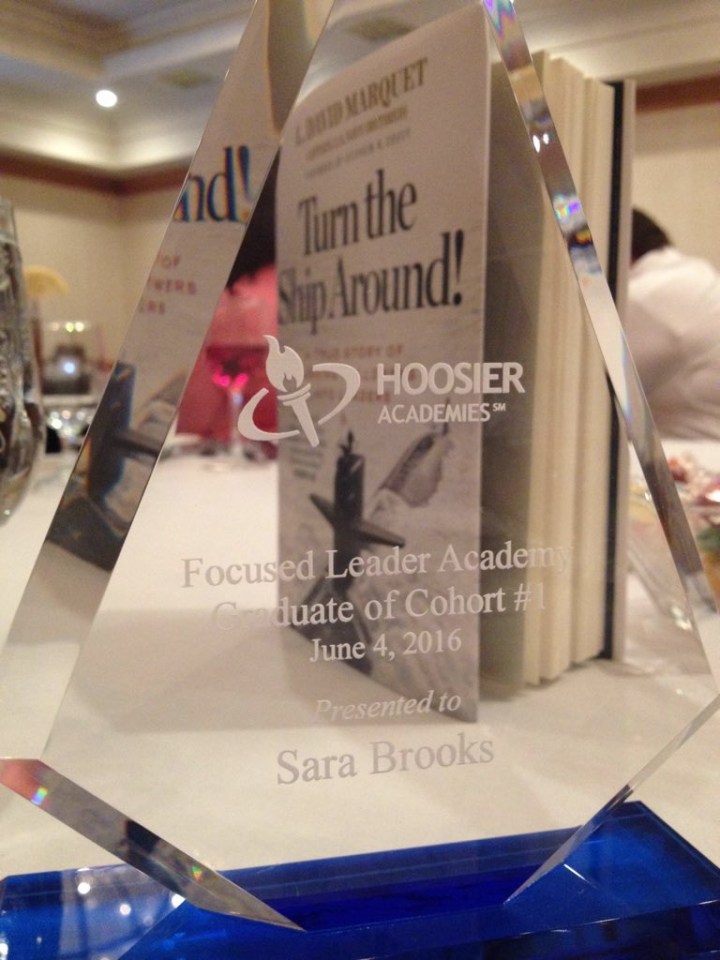
I believe programs like what we have started at Hoosier Academies Network of Schools in our Focused Leader Academy really fit the bill. This is an employee development and engagement program. The idea is that great minds and great motives still matter. Teachers with school leadership aspirations have the opportunity to become part of a cohort which will take part in monthly leadership training and be part of supervised leadership projects of the school. Cohort size is at least 10-15% of teacher leaders per year. The Vision is: Leadership will be born out of those who are affected by it. The Mission is: Leadership will appear anywhere and anytime it is needed. Our Theory of Action is: If we empower our teachers through leadership skill development…Then we will have teacher leaders ready to contribute to the success of Hoosier Academies Network of Schools and be an important part of our talent pipeline. I believe states should endorse and help schools develop programs such as this in order to have approaches required by ESSA that build and strengthen professional learning systems aligned to teachers’ learning needs. This would allow schools to do what I call “hyper-personalizing professional growth.” Click here to see ESSA’s Definition of Professional Learning & Title ll Allowable Uses of Funds.
Also, Learning Forward and National Commission on Teaching and America’s Future have come up with an Agents for Learning competition related to state planning for Title II funds. These competitions are great ways to collaborate for best practices and to get a lot of ideas for how best to use the funding. Click here to get more information on the competition. I, for one, hope they get lots of applications. Teachers are in the best position to contribute recommendations for the best use of federal funding for professional learning, the successful implementation of ESSA, and the improvement of student learning.
 Byron's Babbles
1 comment