Creating A New Future: Practice Before Theory
 “The important thing is to identify the ‘future that has already happened.'” ~ Peter Drucker
As an “Energetic Change Agent,” I was really into the week 19 lesson in Maciariello’s (2014) A Year with Peter Drucker: 52 Weeks of Coaching for Leadership and Effectiveness. If you have not begun the journey of reading this book, let me recommend it again. This week’s lesson dealt with identifying emerging trends and how that is different from trying to forecast the future. Identifying trends concentrates on directions and patterns. We must, as leaders, discern patterns from emerging trends, and separate fads from real changes (Maciariello, 2014). I have blogged about change before in other posts, but really dug into this topic in a post entitled: Change Creation is Proactive. You can read that post by clicking here.
Leaders who are effective at facilitating change capitalize on emerging trends and use them to create a new future for their organizations, thus providing a competitive advantage in times of rapid change, This is proactive, not reactive! Again, as was stated in the Drucker quote, this is an exercise in “seeing the future that has already happened.” To create the future any other way is reacting rather than acting, which is what one does if one grows quickly. We need to make sure to study the trends and look for the ‘certainties’ of the future. One place to look for this is in the demographics. One important part of change that I believe was left out of this lesson, and may be discussed in future weeks, is how some organizations ability to create the new future will be impaired by legislation and other government misunderstanding or slowness to adjust. An example is my own: education. As I look back to this year’s legislative session here in Indiana there was a lot of work around education. It is interesting to me that our House of Representatives is very pro “school choice” and innovative practices such as online education, but our Senate is not. Some of our legislation passed is helpful toward the ‘new future,’ but part of it still does not necessarily hinder practices for facilitating futuristic change, but certainly does not serve as a catalyst either.
Therefore, it will be important for us, as leaders of these affected organizations, to help all involved in decision/policy-making to understand the methodology that Drucker outlines to identify “the future that has already happened.” As I describe what Drucker calls the “seven windows of opportunity,” (Maciariello, 2014) think about online education as an example. Online education is already here and I believe everyone would agree it is not going away – nor should it go away. Amazingly, however, there are those that continue to try to block any legislation or policies that help to improve or make online education more effective. So we (and leaders of other such change) will need to help all of those involved understand the seven sources that Drucker outlines as: (1) unexpected success or failure, (2) incongruities, (3) process need, (4) a change in industry or market structure, (5) demographics, (6) changes in perception, (7) new knowledge (Maciariello, 2014). I believe you can extrapolate the implications of the seven windows to your organization. I believe in my own case we have done a pretty good job beginning to work on windows 5, 6, and 7, but we need to continue to put the whole package together to continue to move our cause for the students we serve forward.
“Theory organizes the new realities, it rarely creates them.” ~ Peter Drucker
As a rule, theory does not precede practice (Maciariello, 2014). Decision and policy-makers in government and organizations need to remember this. They need to understand, and few do, that events that have already occurred do not fit their present-day assumptions, and thereby create new realities. We must make sure our policies and structures support “the future that has already happened.”
What steps are you taking to turn future trends and needs into your advantage?
Look for “the future that has already happened” and turn it into an opportunity for innovation. If you do this, you can become an effective change leader. If you are a policy or decision-maker, please make sure you are thinking about how you can support “the future that has already happened.”
Reference
Maciariello, J. A. (2014). A year with Peter Drucker: 52 weeks of coaching for leadership effectiveness. New York, NY: HarperCollins Publishers.
Talkin’ Turkey About Sunk Cost Bias
 I am always amazed at how much I learn on my son and I’s annual turkey hunt. First let me answer the big question on everyone’s mind. Did you get one? I am happy to report that my son did! I did not. For the second year in a row Heath got a turkey and I didn’t. This was his fifth turkey in the seven years we have been hunting together. Not bad for a fourteen year old. In my defense, I did not even take a shot. I saw a bunch of turkeys and witnessed some great wildlife shows, but never a gobbler close enough to harvest.
When turkey hunting there is a great deal of time in solitude for thinking. My favorite time is the first thing in the morning. We get to the woods at 5:00 a.m. and then watch and listen as the woods comes alive. First there are the birds, then the occasional deer, and then the gobble of a roosted turkey. Our two days of turkey hunting each year remind us of all the wonderful creations that God has made. Though my seat attached to my turkey vest is not as comfortable as a yoga mat, I am not any less mindful when in this state of thought and meditation. There are so many things that run through your mind when sitting in total silence and not being able to move. It is exhilerating and I am already looking forward to next year.
On our first morning of the hunt, Saturday, we went to the river bottom along the levee. My son, Heath, set up along the field’s edge that separated the levee from a woods (the turkeys typically come off the levee and graze the field while heading to the woods for the day). I set up about a mile south of him. We both had a great show of turkeys that first morning. I even had a hen come right past me close enough that I could of reached out and touched her. Those that know me are probably amazed that I am able to sit that still in my full camo glory! Anyway, neither of us got a long beard (tom turkey) close enough for harvesting.
Later that afternoon, my wife took Heath to a baseball game (he pitched a save, by the way), and I went back near where we had hunted in the morning. There was a tremendous showing of birds. There was a group of 11 that appeared – four long beards, three jakes (young male), and four hens. They worked the field in front of us for two hours, but we could never call them in close enough for a shot. Then there was a single Tom who strutted around the field like he owned it, but again, not close enough. It was a tremendous show that Walt Disney would have been proud to have filmed for his nature films. But, still, they stayed along the levee side.
The next morning, you guessed it, I went back to the levee. Heath, on the other hand, went to another location. You guessed it, at 8:30 he harvested a bird. I was texted a picture (seen at the top of this post) and was thrilled – the goal is always for Heath to get a bird – I am secondary. Once again, however, I had the greatest show ever. Turkeys were coming off the levee right and left – lots of them. You guessed it, though, they were not interested in coming to me. The Toms were with hens and not interested in what I had to offer. Anyway, it was another great morning of solitude and thought. At least I kept telling myself that!
Toward the end of the morning, as the turkeys were moving out of site I got to thinking about “sunk cost bias.” Was I falling into the trap that leaders fall into. As I thought about this I realized that turkey hunting might be one of the greatest case studies to teach this because I kept getting drawn back to this same area. I knew there were lots of turkeys here. In fact three of Heath’s turkeys he harvested in past years had been taken very near where I was sitting. Also, I had already spent a lot of time there this year. This year, however, the turkeys were just not moving across the fields in the same way – this is what really makes turkey hunting so exciting and facinating. The turkeys never act the same from year to year. Does this sound like any of the organizations you lead? Yet, for some reason I was drawn to this place. Part of it was the fact that it is one of the most beautiful places in the world. Hemlocks were blooming, Blue Jays were playing in the trees above me, a squirrel was hopping from tree to tree, and a Bald Eagle was soaring above. It is just a glorious place to be.
Still, there were all these turkeys. When we regrouped for the afternoon and Heath’s turkey had been processed it was decided to go to another location for the afternoon. “Sunk Cost Bias” had been resisted; at least for now. At 4:30 p.m., after not seeing or hearing any turkeys, it was decided, you guessed it, to go back to the levee. I know what you are thinking: this guy is an idiot because he knows the turkeys won’t come close enough. You are right, I was giving into sunk cost bias. I knew we would see birds, but I would never get a shot. Yet, I was drawn by the fact I had invested so much time there and knew there were turkeys. I had become the poster child of what sunk cost bias is: The sunk cost bias is manifested when we have a greater tendency to continue an endeavour once an investment in money, effort or time has been made.
I was first introduced to this thinking at Harvard University by Dr. Monica Higgins when studying a case study of the 1996 Mount Everest tragedies. Reasoning that further investment is warranted on the fact that the resources already invested will be lost otherwise, not taking into consideration the overall losses involved in the further investment. During the Mount Everest tragedy the sunk cost bias was carried out on two fronts: 1. At the time of starting for the summit, some thought the conditions were not right, but they had come all this way and were not going to wait; and, 2. Many that died did not summit by the 2:00 p.m. cutoff time (the time set to turn around if a summit had not been made yet) but went ahead and summited as much as two hours late. Again, the thought of “I’ve invested all this time, money, effort, et cetera and by golly I am going to summit Mount Everest” was at play there.
Obviously, my life was not on the line, but by going back to the levee for one last ditch effort at the end of our last day of hunting was giving into sunk cost bias. You guessed it, too, we saw a lot of turkeys but none came close enough. What I was failing to realize is that moving back to the levee would most likely result in the loss of much more time and not getting a turkey. I was thinking short-term, not long-term, and simply trying to avoid not getting a turkey, which was fallacious thinking. It was really thinking from a defensive posture and not an offensive one. This experience has really caused me to think about the strategic and academic plans we are carrying out in the schools I lead. Do we have areas of sunk cost bias? It begs taking an introspective look.
When we make a hopeless inventment of time, treasures, or talents we sometimes reason: We can’t stop now, otherwise what we have invested so far will be lost. This is true, of course, but irrelevant to whether we should continue on with the plan. If the plan will not work that everything invested will be lost regardless. Therefore, it really is irrational to continue, but yet we (at least me) continue on anyway. The rational thing for me to do on our turkey hunt would have been to try a new spot. Why didn’t I make the rationale choice: Our decisions are tainted by the emotional investments we accumulate, and the more we invest in something the harder it becomes to abandon it. As an emotional human, my aversion to loss often leads me right into the sunk cost bias. We need to instead look at the loss from a growth mindset and consider it learning and knowledge gained.
Luckily, we all have the ability to reflect, study, and regret past actions. So, in my case, I need to remember what I did on this turkey hunt and apply it to my professional life as a leader. Do you have areas in your personal or professional life where sunk cost bias is hurting your ability to move forward? If you’re not sure, might I suggest an early morning meditation time in a woods as it comes to life at the start of the day?
Spirit of Performance
 Drucker believed that the spirit of performance in an organization is led by leaders who are committed to getting the right things done (effectiveness) and doing the right things (efficiency) (Maciariello, 2014). These leaders must posses integrity of character, a vision for the organization, and focus. They must also be able to lead change. Drucker called those who could lead change agents “disturbing elements” (Maciariello, 2014). A disturbing element in an organization is a leader who seeks to change its culture and practices to prevent bureaucratic behavior from settling in. These leaders bring energy and spirit to the organization.
Drucker also believed that the purpose of an organization is to “make common men do uncommon things” (Maciariello, 2014). We all hire from the same pool of common people. Face it, we are all just common people. Why do some achieve greatness in the companies, organizations, and schools they work for? Because there has been at least one leader in that institution who prodded people to develop, improve, innovate, and sustain the spirit of performance. Organizations must see being entrepreneurial and innovative as a duty. As such, organizations must develop their people to be entrepreneurial and innovative. This ca be accomplished with “conscience” activities. Those activities that remind the organization what it should be doing and what it isn’t doing.
Those leaders who provide the sustaining spirit for an organization are forever watchful for bureaucratic tendencies allowing people to drift into repetitive routines and lose focus on primary results. I was really reminded in this week’s lesson, how much all of this really deals with people. It deals with hiring the right people and then providing the right opportunities and a culture of performance. Furthermore, it is important to remember that decisions that affect people, their placement and pay, promotion, demotion, and severance, must represent the values and core beliefs of the organization. As businesses, organizations, and schools, innovate and evolve there will be people who are just not the right fit. This poor fit may be because of skill level, personality or any number of things. Drucker teaches us this is natural. We must work to make conscience decisions about how to get them the professional development they need, help them understand the gap in fit, or come to an understanding together that it is just not in the best interest of either party to continue. I liked the suggestion by Maciariello (2014) that we should always ask the question, “What can they do?” Many times there are adjustments that can be made.
Are you providing the spirit of performance in your organization?
Reference
Maciariello, J. A. (2014). A year with Peter Drucker: 52 weeks of coaching for leadership effectiveness. New York, NY: HarperCollins Publishers.
Leading Together By Working Together

We are increasingly moving towards multinational, transnational organizations that are held together by two factors: control of mission and strategy, and enough people who know and trust each other. Distributed leadership and a flattened hierarchies are key to accomplishing this. In this week’s lesson on Peter Drucker, and example of how the Coca Cola Argentina division had to make a decision that was right for helping the people of Argentina, but not good for the bottom line of the company based in Atlanta Georgia (Maciariello, 2014). Coca Cola understood that performance measures for foreign subsidiaries should be adapted to local political and economic realities.
As leaders we must learn to balance having a bold vision with what to do next. We must also learn to lead together by working together. Everyone in the organization must understand the values, objectives, and expectations of the organization. This is why it is important to build a team that is competent. Empowerment without competence is chaos. Wherever you sit in the organization, there is many times a tendency to wait for others to lead. We need to create an environment where everyone in our organizations can lead from where they sit.
Trust-based relationships must replace command and control mechanisms as coordinating mechanisms. This will allow effective leaders time to perform important duties. We must create enough autonomy for our teams to meet the local realities they face. Maciariello (2014) closed this week’s lesson by posing a great question that we all, as leaders, need to answer. Does your organization have resilient trust networks, that allow individuals to transfer information to and from one another?
Reference
Maciariello, J. A. (2014). A year with Peter Drucker: 52 weeks of coaching for leadership effectiveness. New York, NY: HarperCollins Publishers.
The Leadership Bottleneck!

“The bottleneck is at the head of the bottle,” so the old saying goes. In other words, no business or organization is likely to be better than, or perform better than, its top management and leadership. As a management innovator, Peter Drucker built off of the existing knowledge of others to create and integrate missing knowledge into the organization. He called this practice “integration” (Maciariello, 2014). Top management and leadership is responsible for creating and for maintaining the spirit of the organization, which includes values, standards of conduct, and standards of quality.
So, the first task in designing and assessing an organization is the presence of an effective top management and leadership team with a strong spirit of performance. Close behind in importance is a program for developing talent to fill open management positions. Most call this the building of a bench. This athletic team analogy is appropriate. Study any successful athletic team and you will find a strong bench of players ready to perform at a moments notice. This year’s NCAA Tournament has given us many examples. Not the least of which would be Kentucky who just had their 38th season win defeating Notre Dame last night. I had the opportunity to watch this Kentucky team play in person during the tournament and it doesn’t matter who is on the floor for them – they are all great. We can certainly learn from them as we build our teams.

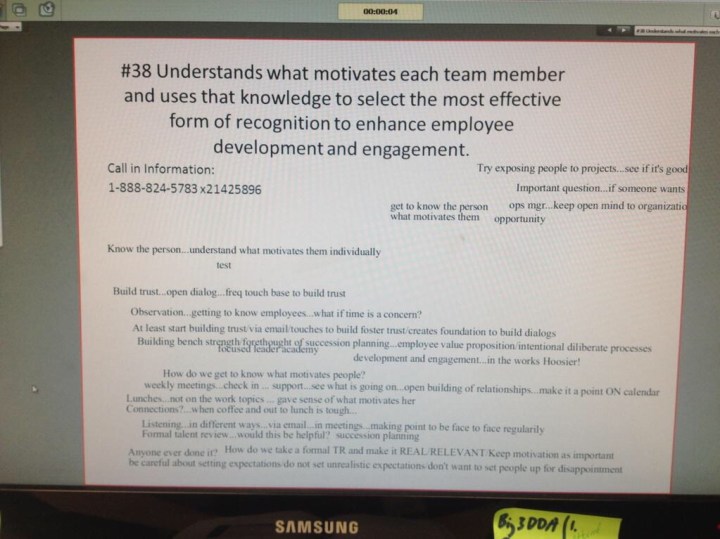
This building of a bench is very important to employee engagement. One of the things I am working very hard on for the school I now serve is a leadership academy for building our talent bench. We are going to take a group of our talented teacher leaders each year and put them through a program that will be individualized for their specific needs and interests. We are in the planning stages of this and I am sure I will blog about this in the future. In the meantime I will share a picture of a screenshot of some notes from a meeting about this, just this week.
In any major institution, such as a school corporation, the finding, developing, and proving out of leaders of tomorrow is an essential job to which the best leaders must give fully of their time and attention. Maciariello (2014) asked some great questions in this week’s reading:
- Is your organization preparing future leaders by giving significant responsibility and authority to lower level executives?
- What has been the organization’s track record of finding successors for key positions inside versus outside?
These are certainly questions I will want to use as guides as we develop our bench. How about you?
Reference
Maciariello, J. A. (2014). A year with Peter Drucker: 52 weeks of coaching for leadership effectiveness. New York, NY: HarperCollins Publishers.
Leading Beyond The Walls
This 12th week reading in A Year With Peter Drucker (Maciariello, 2014) may have resonated with me more than any yet. Drucker was a fan and student of the Federalist Papers. As a student of Patrick Henry you all know I am a believer in state’s rights and the 10th Ammendment to our nation’s constitution which reads: “The powers not delegated to the United States by the Constitution, nor prohibited by it to the States, are reserved to the states respectively, or to the people.” I believe Drucker took the last part of that Ammendment very seriously. We as leaders have a responsibility to provide leadership and be involved in government and civic organizations.
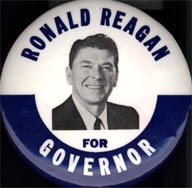
Drucker argued that while each organization should fulfill its primary mission, it should seek to “lead beyond borders.” (Maciariello, 2014). We, as leaders are responsible for our institutions and be concentrated and focused on them, but Drucker believed we must be focused on the community as a whole. In his first year as governor of California, Ronald Reagan used 200 top CEOs, as volunteers on sabbaticals from their companies, to solve the budget crisis. Reagan said, “For every problem their are 10 people waiting to volunteer if someone could give them the lead and show them where they can be useful.” We, as leaders, need to also be seeking areas where we can provide insight and be useful.
Leadership and management of businesses was where Drucker began, but his first love, I believe, was the management of nonbusinesses like hospitals, churches, and schools. He was very involved with social sector management and leadership, particuarly with non-profits. He found these interesting because it is very difficult to define what the results should be. How do you define the results of a school, for instance? This is a very important question that I believe is yet to be answered. Drucker would have said it is my responsibility, as a school leader, to lead beyond the walls of my school and help to solve this question. I also believe it is very important to be involved civically and be an agent of social change. Drucker defined civic responsibility as: “giving to the community in the pursuit of one’s own interest or of one’s own task.” (Maciariello, 2014, p. 100)
Results are more difficult to define for social sector organizations, like schools, than for business organizations. This is because the social sector institutions are involved in changing lives of individuals for the better. Results must be more than merely good intentions, but must also be tailored to fit the organization. We must be acutely aware of the importance of defining results in terms of our own mission and effectively manage the fulfillment of that mission. This is why I believe schools should have a role in determining the accountability metrics of their individual school. Each school will be stronger the more clearly it defines its objectives. Organizations are more effective the more yardsticks and measurements there are against which the performance can be appraised. Our product we are producing in schools is a changed human being. We are human change agents. Our product is a child that learns.

Some questions for pondering from this week’s lesson are:
- What needs are your organization meeting as a part of your primary mission?
- How effective and efficient are you in carrying out your mission?
- How effective are you at changing lives for good?
- Are you leading beyond the borders of your organization/business?
- Are you mentoring other leaders or managers?
Reference
Maciariello, J. A. (2014). A year with Peter Drucker: 52 weeks of coaching for leadership effectiveness. New York, NY: HarperCollins Publishers.
Effective Leaders Make Effective Decisions
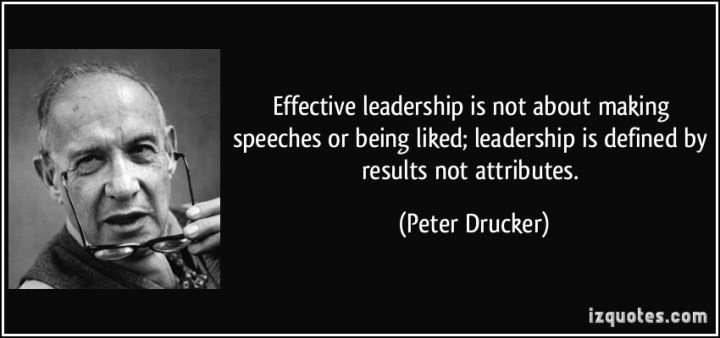
“Leadership is lifting a person’s vision to higher sights, the raising of a person’s performance to a higher standard, the building of a personality beyond its normal limitations.” ~ Peter Drucker
Drucker was confident that people could be taught to be effective executives (managers), but wasn’t as sure we could teach other to be leaders. Interesting, however, in the week 11 reading in Maciariello’s (2014) book he talked about how Drucker believed the climate in the organization needed to be right for leaders to develop and emerge. “Nothing better prepares the ground for such leadership than a spirit of management that confirms in the day-to-day practices of the organization strict principles of conduct and responsibility, high standards of performance, and respect for individuals and their work (Drucker in Maciariello, 2014, p. 79).” I wrote in the margin of the book, “So if the operations and processes are in place and being executed effectively, then leaders can grow and emerge.” I really do believe this is true. I have a saying I use in school turnaround and transformation and that is: “We need to become a REAL SCHOOL.”
The question you will ask next is, “What is a REAL SCHOOL?” My answer is quite simple: “A real school is one that has its operations and processes in place and being managed by an effective individual and team to make sure that the normal day to day activities (eg. Safety procedures, student handbook components, discipline, financial processes in the case of a school) are being carried out efficiently and effectively. I was very blessed to have just such a person in my first turnaround school. Don Burton was our Assistant Principal of Operations. Let me tell you, without him the school would have never come off the “F” list. He was the operations manager dream of a lifetime. The great part about Don was he managed the operations flawlessly and implemented our processes with the best interest of our students and staff in mind.
Mr. Burton’s awesome abilities and work ethic then allowed the teachers to teach and me to do the numerous activities as a building leader: establishing a vision, defining the mission, making sure that resources are applied to the right tasks, making effective decisions, implementing and following up on these decisions, taking criticism, keeping track of and navigating the legislative and governmental affairs, and working diligently to maintain a functioning board of directors. Imagine trying to do this in a disfuctional organization. Believe me this is not an easy task, nor did we have it perfect, but Don had us in a great place. There is a reason why schools fail, and one of the commonalities of the schools that need to be turned around is the disfuctionality and lack of the right operational practices to make it a “real school.” I’m sure you could tie common operations and practices that would make businesses and organizations “real businesses” and “real organizations.” I am positive education is not alone in this.
Again, I cannot say enough how much credit for our success goes to Don Burton. He enabled the day to day operations to go smoothly which then allowed me, and him, to grow as leaders. This truly allowed the environment to be right for leadership growth. Don certainly grew, as he now is leading a middle school in Arizona as a principal. I consider Don a dear friend and I always said we never had to schedule time, we were always catching up before or after school or on the weekends. It was just such a natural relationship. Therefore, I really think Peter Drucker’s belief that teaching someone to be a leader is very hard, if possible at all, is warranted. More importantly, however, is the lesson he has taught us that if the operations, processes, and day to day activities of the organization are highly functioning, the leader has the chance to learn and grow. In other words, the conditions must be right for growth.
I believe this point is even driven home further when we look at one of the most important attributes of leading effectively – effective decision making. Making effective decisions depends on the definition of the problem being faced and thus the appropriate conditions that have to be met for the decision to be effective. Drucker taught us that these are always the two critical issues in decision making (Maciariello, 2014). It would very hard to define or know the appropriate conditions for a decision to be effective in a disfunctional organization, operationally. I know that without the sound operational practices Don instilled in our school that I would not have been able to make the decisions I was able to, of which many turned out to be the right and effective decision.
So, as you look at growing leaders and great schools, businesses, and organizations, look first to what your definition of a “REAL” school, business, or organization is. Then make sure you’ve got the right team to manage the operations effectively.
Reference
Maciariello, J. A. (2014). A year with Peter Drucker: 52 weeks of coaching for leadership effectiveness. New York, NY: HarperCollins Publishers
The Knowledge Organization: Acting On Information
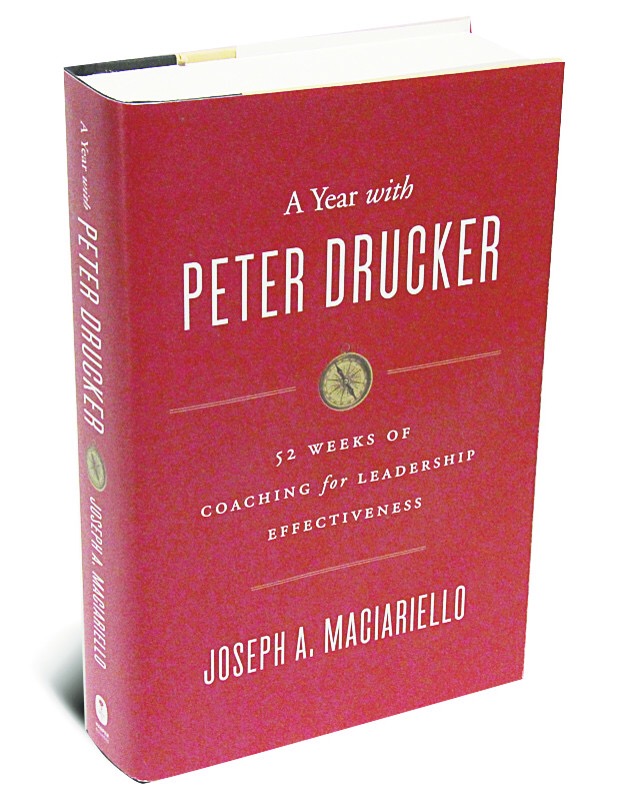
The “knowledge organization” is structured around information, not hierarchy. This week’s lesson from Maciariello (2014) really affirms the case for distributed leadership. Drucker believed that knowledge organizations were best made up of specialists who direct their own and the organizations work with the feedback of colleagues, customers, and headquarters (2014). Drucker called this an “information-based organization.” This means that the proper people in the organization must be able to transfer data into information.
This converting of data into information is a crucial step that many organizations leave out or don’t figure out how to do well. This is especially true in education. I think about all of the data we have, but it is only important if we can turnip into actionable information. Maciariello (2014) used Brad Stevens, former Butler University and present Boston Celtics, basketball coach as an example. He breaks down all of the available data and then looks for trends. For example, how many three point attempts per field goal attempt. Again, he is turning the data into information. It is then the coaches jobs to make sure the players understand the information. Then the players must act on the information. If the players do not understand the information, or don’t act on it then the data/information is worthless. This is the flow of information to information literacy to information responsibility.

I really like the idea presented this week of moving from data literacy to information literacy. This really involves the asking of two questions: What information does my organization need? And What information do I need? This really places the emphasis on creating useful information, not just showing a bunch of data. A major problem in education. So, for example, in education everyone always wants to look at growth data. I contend the more valuable information is the benchmark data of where the student is performing right now. Isn’t that what I really need (information), if I am a teacher, right now to create a plan to get that student where she needs to be academically. If we are doing that properly, the growth will take care of itself. Trust me, it works! Remember, you must convert raw data to true information.
True information is those data that are important to the solution of specific problems faced by the organization. The question is not “Are the data interesting?” but rather “Are the data important and useful for making decisions to solve problems and seize new opportunities?” This truly makes the conversion from data to information. Therefore we must focus data on the information needed for decision making.
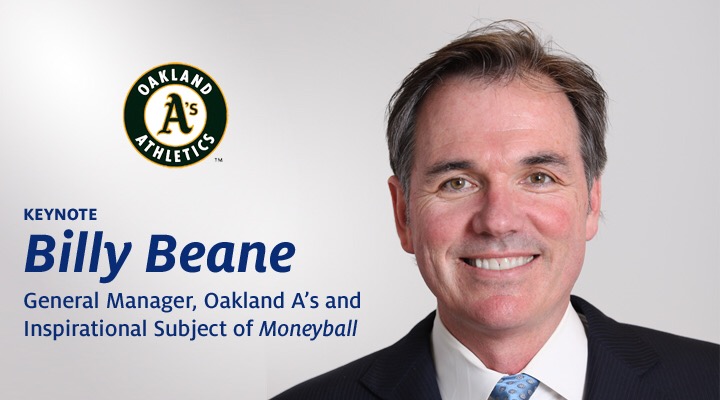
I also really like thinking about sabermetrics here, too. This was the precursor of Billy Beane’s Statcast, developed by Bill James. Billy Beane’s system took data generated by sabermetrics and turned it into useful information. His Statcast enabled him to assemble players so that their individual abilities were able to complement one another. This enabled them to “measure a player’s value in the context of the rest of the team (Macariello, 2014, p. 76).”
Eliminate data you do not need for decision making. Eliminate data that do not pertain to the information you need. Organize, analyze, and interpret the data you need so that they become true information.
Reference
Maciariello, J. A. (2014). A year with Peter Drucker: 52 weeks of coaching for leadership effectiveness. New York, NY: HarperCollins Publishers
Resist Multitasking: Cut The Pattern To Fit The Cloth
I am almost a week behind on my reflection of week nine in A Year With Peter Drucker: 52 Weeks of Coaching for Leadership Effectiveness (Maciarello, 2014). I usually read the week’s lesson and write the post on Sunday mornings. Last week, however, I had to fly out to be at Harvard University early Sunday morning so I packed my book and was going to do the work Sunday night. Well, long story short, the airline lost my bag and I just had it returned last night – a full day after returning home. That entire experience and adventure may be the topic of another post.
The basic premise of last week’s lesson was to organize our personal work and the work we delegate to others effectively. We should attempt to plan our time, making sure that our most important tasks are done first, and, as much as is possible, resist pressures to engage in multitasking (Maciariello, 2014). Both empirical evidence and common practice confirm that multitasking really isn’t possible. In other words, we should fit our most important tasks into our available time. Or, “Cut the pattern to fit the cloth.”

Andy Grove, one of the three founders of Intel, put it this way: “What am I doing that I shouldn’t be doing (Maciariello, 2014, p. 66)?” Grove also offered four other great questions to help guide us in resisting multitasking:
- Should I still be doing it?
- Am I doing it well?
- Am I adding enough value to what I am doing?
- Is it more worthwhile or less worthwhile than anything else?
Grove shared that after answering these questions he then negotiates with himself.

So how do we make this all happen? We must learn to delegate certain activities, abandon other activities, or relax the frequency of the performance of repetitive duties. To do this we must have the strongest followers. Successful leaders are not afraid of strong subordinates. We must assemble the most talented team available develop their competency and capacity, and then, get out of their way. When we develop others we simultaneously develop ourselves because we have to figure out how to raise the capacity of the people we are trying to develop. This will serve as a stretching activity for us, too.
Therefore, resist multitasking, develop your team with “A” players, and determine what are the most important tasks for you. As Peter Drucker said, “Effective leaders delegate, but they do not delegate the one thing that will set the standard. They do it (Maciariello, 2014, p. 70)!”
Reference
Maciariello, J. A. (2014). A year with Peter Drucker: 52 weeks of coaching for leadership effectiveness. New York, NY: HarperCollins Publishers.
Until Every Child Is Well

I was struck this week while at Harvard University by the story of Boston Children’s Hospital’s vision/mission: Until Every Child Is Well. Really, I guess it would be more of an anthem, as Sally Hogshead would call it. What an anthem it is, though! Think about how simple and abstract “Until Every Child Is Well” is. In my studies this week I was reminded how important it is to make sure that our vision, or anthem, is broad enough to enable us to change as the world changes. What a simple, yet powerful statement Boston Children’s Hospital has made. Who could argue with, “Until Every Child Is Well?”
If we were to write it the way Joseph Michelli taught me, using the word “Wowful,” it would be “Wowful Child Wellness.” Regardless, both statements allow for cutting edge theories of action and strategery. I was also reminded this week of the 1942 Harvard MBA graduate, John Fisher, who was the CEO of Muncie, Indiana company Ball Corporation (you probably know them for Ball Jars). He worked for the company starting in 1941 and was CEO from 1970 to 1981. After World War II the glass jar business was booming, but later Fisher purchased and developed an aerospace business. Everyone thought he was crazy, but it led to the development of the plastic water bottle. I’ll bet you would agree that was a pretty savvy move. When asked about the shift from glass at a Harvard reunion, he stated that their vision had nothing to do with just glass, it was, “we want to be the best container company.” Again, simple, broad, abstract, and agnostic. John Fisher had learned well from his Harvard MBA. He learned you must exploit your present capabilities, but you must at the same time explore. We must learn about the future quicker than anyone else.

So, since my personal wow statement is “Delivering Wowful Educational Leadership” and my anthem is “Energetic Change Agent,” I set out reflect on what these two statements should be for my school; given my learning this week. Remember the goal is to be simple, broad, abstract, and agnostic. Let’s define agnostic. The dictionary defines agnostic as: a person who holds the view that any ultimate reality is unknown and probably unknowable; broadly one who is not committed to believing in anything being for sure. Think about that for removing all barriers of thinking things will stay status quo or need to be done the same way.
Here’s what I came up with:
Delivering Wowful Learning
Until Every Child Graduates
I would welcome your feedback on these two statements. It would be great to here how you would change them. These statements allow us to change as the world changes to do what the Indiana State Constitution says in Section 8 where it states: Section 1. Knowledge and learning, general diffused throughout a community, being essential to the preservation of a free government; it should be the duty of the General Assembly to encourage, by all suitable means, moral, intellectual scientific, and agricultural improvement; and provide, by law, for a general and uniform system of Common Schools, wherein tuition shall without charge, and equally open to all. It is important to pay particular attention to the statement, “by all suitable means.” We have a constitutional obligation to make our delivery of knowledge and learning to our students distinct and effective. I love the statement, “by all suitable means.” That is simple, broad, and abstract.
Schools have growing alternatives for delivering education. Choices range from presentations and discussions in the classroom to online, blended, and hybrid courses. As facilitators of learning, teachers will increasingly turn the process of teaching and learning into a partnership, with students and teachers constantly learning from each other. Self- learning will be seen as a bonus— and encouraged. Also, think about the online world where the greatest minds are just a click away and readily available. This open access has tremendous possibilities for many of our US underserved populations as well as third world countries. Pretty exciting, don’t you think?
I encourage you to take some time and think about your school or organization vision, mission, and anthem. Does it allow you to be nimble and change as the world changes? Remember: Leaders need to be consistently inconsistent. We have to constantly explore who we are and what we do!
 Byron's Babbles
1 comment