Indiana Assessment Vision
 Yesterday, we had our third legislative panel meeting studying alternatives to the ISTEP Program Test. This is part of our working toward the assessment plan under the Every Student Succeeds Act (ESSA) for Indiana. One of the things we worked on yesterday was the vision statement of the group. Using suggestions from panel members, the panel legislative staff came up with the following draft statement:
“Indiana looks to design an assessment system that is student-centered and provides meaningful and timely information to educators and parents on both a student’s on-grade proficiency level and growth toward Indiana’s College and Career Ready standards. The assessment needs to be viable, reliable, research-based, and meet the requirements of both state and federal law, while meeting the needs of all students across Indiana.”
Now, being the vision guru I am, I immediately realized it did not meet the 35 words or less rule of thumb. I did, however, quickly underline what I thought were the most important parts of the vision statement that our panel needed to do to meet the needs of our students, families, and schools (I have underlined above). Here are the points:
- student-centered
- meaningful
- timely
- information to educators and parents
- on-grade proficiency level and growth
I suggested we eliminate the last sentence, “The assessment needs to be viable, reliable, research-based, and meet the requirements of both state and federal law, while meeting the needs of all students across Indiana.” because I do not believe it is at all visionary to be valid, reliable, researched based and meeting the letter of the law. We have that obligation to Indiana and the federal government through ESSA. We don’t need a vision for that.
So, my proposed vision statement would be:
“Indiana looks to design an assessment system that is student-centered* and provides meaningful and timely information to educators and parents on both a student’s on-grade proficiency level and growth toward Indiana’s College and Career Ready standards.”
You will notice the * with student-centered. I believe we should have a definition for student-centered following the vision statement. For me, that definition could be:
*A Student-centered assessment system, which includes student performance, academic growth, and multiple measures, sets challenging items and tasks that are intended to encourage deep learning and create a sense of high expectations and mutual accountability.
Then, I believe it is even more important to develop a set of belief statements associated to this process. I took pieces from what individuals submitted as vision statements to make a list of possible belief statements. I really believe that many of what panel members submitted were belief statements, not vision statements. This was a good things because we should have belief statements guiding our work.
Here is the list I came up with:
- New assessment must be implemented with fidelity
- Timely results
- Empowers students, parents, educators, and administrators
- Includes college and career readiness metric
- Meets the needs of all students
- Cost effective
- Accurately assesses students’ learning and growth over time
- Takes less time away from instruction and learning
- Equity for all students in how they take the assessment (technology/modality)
So, put all together, here’s what my draft would look like:
“Indiana looks to design an assessment system that is student-centered* and provides meaningful and timely information to educators and parents on both a student’s on-grade proficiency level and growth toward Indiana’s College and Career Ready standards.”
*A Student-centered assessment system, which includes student performance, academic growth, and multiple measures, sets challenging items and tasks that are intended to encourage deep learning and create a sense of high expectations and mutual accountability.
Indiana’s new assessment system must:
- be implemented with fidelity.
- provide timely results.
- empower students, parents, educators, and administrators.
- include college and career readiness metric.
- meets the needs of all students.
- be cost effective.
- accurately assesses students’ learning and growth over time.
- take less time away from instruction and learning.
- provide equity for all students in how they take the assessment (technology/modality).
Because ESSA requires us to have a summative assessment in grades 3-8 and a high school component our conversation must shift from all the chatter about whether wanting to test or not or whether it is right to test. Really, that is irrelevant. What is important is that we make sure all of our stakeholders understand “why” assessment is happening and exactly how the data will be used. I believe we are on the right track to developing a vision and belief statements that can drive this work. I would love to hear feedback on additional belief statements or edits to make the belief statement suggestions better.
ESSA Opportunity #10: New Community Support for School Successs Grants
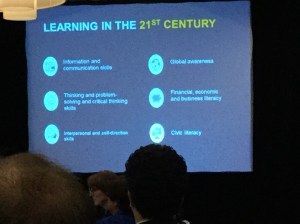 ESSA establishes a new grant program that will enable community partners to play an important role in personalized learning environments.
The program supports the following goals:
- Promise Neighborhoods – significantly improve the academic and developmental outcomes of children living in the most distressed communities of the United States by providing access to a community-based continuum of high-quality services. ESSA defines Promise Neighborhoods strategies as “pipeline services” and utilizes this term to refer to “a continuum of coordinated supports, services, and opportunities for children from birth through entry into and success in postsecondary education, and career attainment.” The goal of Promise Neighborhoods to to do the following:
-
1) high quality early childhood education programs
-
2) high quality school and out of school time programs and strategies
-
3) transitions from elementary school to middle school, from middle school to high school, and from high school into and through postsecondary education and into the workforce
-
4) family and community engagement and support
- 5) postsecondary and workforce readiness
- 6) community based support for students who are either living in the community or who have attended schools serviced by the pipeline
- 7) social, health, nutrition, and mental health services and supports
- 8) crime prevention and rehabilitation programs for youth.
-
- Full Service Community Schools – provide support for schools that improve the coordination and integration, accessibility, and effectiveness of services for children and families, particularly for children attending high-poverty schools.
ESSA Opportunity #9: Modernized 21st Century Community Learning Centers Grant
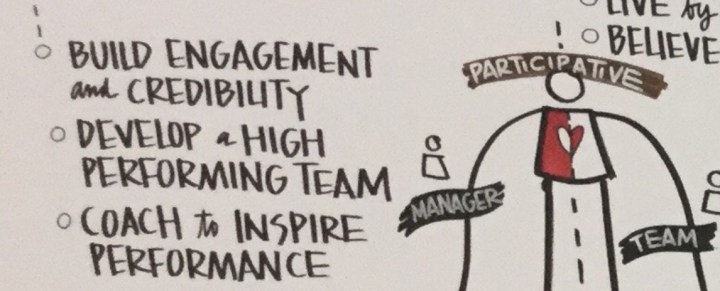 The 21st Century Community Learning Centers grant program supports academic enrichment activities in after school or extended day settings. This part provides opportunities for communities to establish or expand activities in community learning centers that provide opportunities for academic enrichment, offer students a broad array of additional services, programs and activities, and offers families of students served by community learning centers opportunities for active and meaningful engagement in their child’s education, including opportunities for literacy and related educational development.
Funding is made available for continuation of certain current grants; there are reservations for national activities, and for Bureau of Indian Education schools. There is a local competitive subgrant program. The program is authorized at $1,000,000,000 for FY 2017 and $1,100,000,000 for each of FYs 2018-2020. States should give priority to applicants that will provide high quality credit bearing opportunities outside of the traditional classroom environment. Priority should also go to applicants that will serve students attending schools identified for comprehensive and targeted support and improvement.
ESSA Opportunity #8: Title IV, Student Support & Academic Enrichment Grant
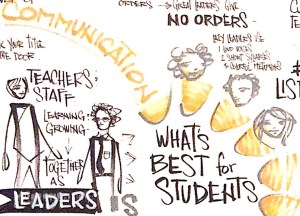 The Every Student Succeeds Act (ESSA) consolidates a number of existing federal grant programs into a new Title IV state block grant that may fund district activities to:
- provide all students with access to a well-rounded education.
- improve school conditions for student learning.
- improve the use of technology to improve academic achievement and digital literacy.
States could use this block grant to create an innovation fund for districts interested in scaling personalized learning strategies. ESSA would reconstitute Title IV, Part A into the Student Support and Academic Enrichment program, and would authorize the new program at $1.6 billion annually through 2020. That authorized amount comes in addition to the authorized $1.1 billion in Title IV, Part B, which funds the 21st Century Community Learning Centers Program. Part A would then require states to spend 20 percent of those funds on “well-rounded educational opportunities,” 20 percent of those funds on “safe and healthy students,” and a portion of the funding on the “effective use of technology.” Part B authorizes $1.1 billion for 21st Century Community Learning Centers that offer after-school academic enrichment programs. Part C includes federal funding for charter schools, which would increase from $253 million in 2015 to $300 million by 2020. Funding is similarly increased for magnet schools, which Part D of Title IV would increase from $92 million in 2015 to nearly $109 million by 2020.
In addition, Part E of Title IV would allow for education innovation. These innovations could include programs like: Promise Neighborhoods, full-service community schools, arts education, Ready to Learn television, and gifted and talented education programs. As you can see there are some tremendous opportunities for our students with ESSA.
ESSA Opportunity #7: Reservation for School Leaders
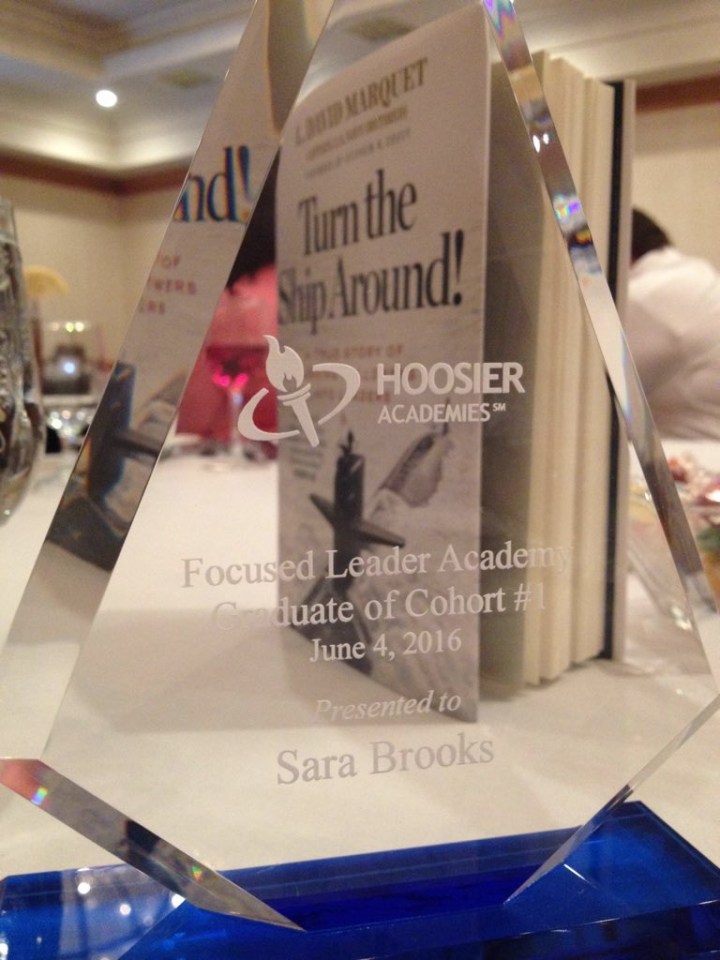 This opportunity is one that is near and dear to me. I really believe in job embedded professional growth/development. Under ESSA, states may reserve up to 3% of their Title II, Part A funds to build a workforce of leaders with the skills to help schools transition to personalized learning environments. Priority funding should go to support leaders serving in schools identified for comprehensive support and improvement. As a school leader who has now taken on a high school and now a school system that fits this priority, I can attest to the need for this development of teacher leaders. ESSA also requires that professional development programs should be customized, embedded, and align to statewide professional competencies so leaders can advance along individualized career pathways.
I believe programs like what we have started at Hoosier Academies Network of Schools in our Focused Leader Academy really fit the bill. This is an employee development and engagement program. The idea is that great minds and great motives still matter. Teachers with school leadership aspirations have the opportunity to become part of a cohort which will take part in monthly leadership training and be part of supervised leadership projects of the school. Cohort size is at least 10-15% of teacher leaders per year. The Vision is: Leadership will be born out of those who are affected by it. The Mission is: Leadership will appear anywhere and anytime it is needed. Our Theory of Action is: If we empower our teachers through leadership skill development…Then we will have teacher leaders ready to contribute to the success of Hoosier Academies Network of Schools and be an important part of our talent pipeline. I believe states should endorse and help schools develop programs such as this in order to have approaches required by ESSA that build and strengthen professional learning systems aligned to teachers’ learning needs. This would allow schools to do what I call “hyper-personalizing professional growth.” Click here to see ESSA’s Definition of Professional Learning & Title ll Allowable Uses of Funds.
Also, Learning Forward and National Commission on Teaching and America’s Future have come up with an Agents for Learning competition related to state planning for Title II funds. These competitions are great ways to collaborate for best practices and to get a lot of ideas for how best to use the funding. Click here to get more information on the competition. I, for one, hope they get lots of applications. Teachers are in the best position to contribute recommendations for the best use of federal funding for professional learning, the successful implementation of ESSA, and the improvement of student learning.
Vital Leadership Learnings
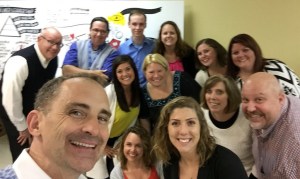 A couple of weeks ago we had the honor of having Will Pemble from MAP Vital Factors Solutions work with our Focused Leader Academy on being disciplined leaders. This day was set up by John Manning, author of The Disciplined Leader (2015). As you know from previous posts, our Focused Leader Academy read the book, that is set up in 52 lessons, and blogged about each lesson. We then had a discussion about what we felt were the vital few leadership focuses we needed more work on for each section of the book and overall. Really, that pre-exercise was an incredible discussion and experience. It was very interesting to hear the individual vital few from the FLA participants and then hear the discussion of narrowing down to the group’s vital few. This allowed for a rich discussion about how individual vital leadership skills affect the vital few of an organization.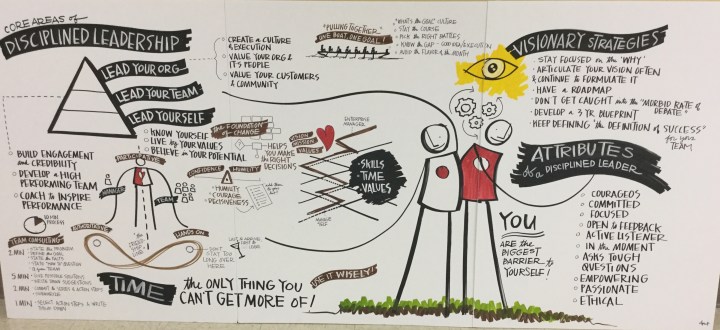

Here are our Focused Leader Academy Vital Few (I have included the lesson number from the book, in case you want to check it out and follow along):
Part 1:
Our top 2 were…. #4 Know Yourself and #13 See Mistakes as Opportunities. Then we were torn between #14 Listen More, Talk Less and #11 Drop Defensiveness.
Part 2:
Our top two were…. #30 Empower Employees and #37 Advocate for Your Team. Then we settled on #31 Give Effective Performance Feedback because we knew what we were getting ready to embark on with redesigning our entire performance evaluation system. We also had #26 Honor Your Commitments high on our list.
Part 3:
Our top three were….#39 Develop a “What’s the Goal?” Culture, #43 Put More Weight on “Why?” and #46 Avoid the Dangerous Gap Between Good Ideas and Execution. We also had a strong feeling for #51 Keep Ethics Strong.
So then we went back and voted to come up with our TOP THREE VITAL FEW…
Part 1: #13 See Mistakes as Opportunities
Part 2: #30 Empower Employees
Part 3: #39 Develop a “What’s the Goal?” Culture
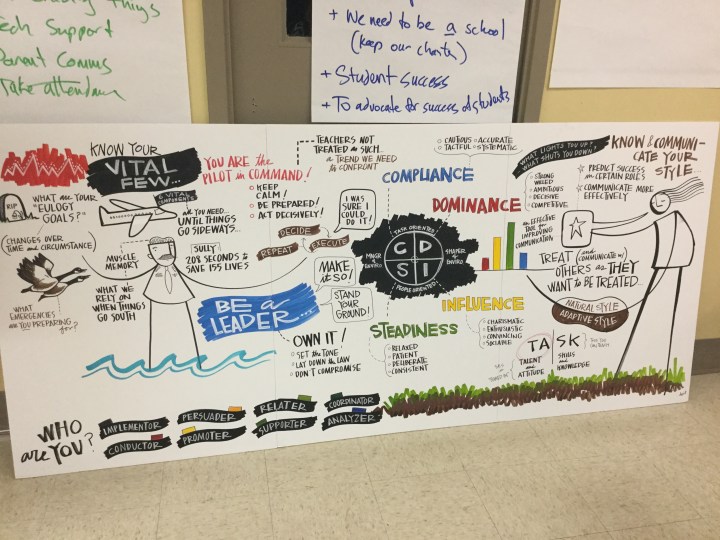 Will Pemble started out our workshop by have us develop a list of all the qualities of a disciplined leader. Here’s our list:
- Runs toward a challenge
- Decisive
- Listener
- Reflective
- Active participant
- Clear values that the leader sticks to
- Loves what he/she does
- Commitment
- Communicator
- Risk-taker
- Willing to be uncomfortable
- Willing to suffer (What’s your suffer score? How much are you willing to suffer for something?)
- Willing to fail… a lot
- Learner
- Accepting
- Courageous
- Focused
- Empowering
- Open to feedback
- Passionate
- Ethical
- In the moment
- Asks the tough questions
Pretty awesome list, huh? Of course, if we could all be great at all those, we would be the most incredible leaders ever. Well, I’ve got some work to do…I don’t know about you. I’m guessing we all have some work to do.
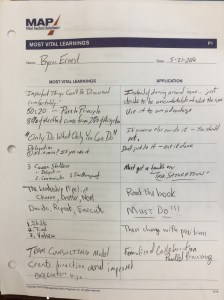 We had a cool sheet that we kept individually during the day that was titled: “Most Vital Learnings.” I really liked having this sheet that had spaces for 10 vital learnings (see photo). In keeping with the vital few mantra of The Disciplined Leader, I have selected my vital few most vital learnings. Here they are:
- “Important things can’t be discussed comfortably.” Instead of dancing around issues, we need to decide to be uncomfortable and hit the issue head on and solve it.
- “Pareto Principle”… 80:20 – 80% of the effect comes from 20% of the system. We need to use this to our advantage. We must focus on the vital few and ignore the trivial many.
- Decide, repeat, execute. Need we say more? This is definitely a vital few.
As you can see, our experience with the book, The Disciplined Leader, and Will’s great facilitation of our workshop was incredible. It was also incredible to be back together with Sita Magnusun doing our graphic facilitation for this program. I first met Sita at my first Harvard University class and have been both blown away by her work and continue to believe in graphic facilitation as a component of effective facilitation of learning. Two of her graphics are posted here.
ESSA Opportunity #6: Elimination of Highly Qualified Teacher
 Every Student Succeeds Act (ESSA) has revised a key element of No Child Left Behind (NCLB) related to teachers. NCLB referred to “highly qualified teachers” 67 separate times. When NCLB was written in 2001 it was an important piece of the legislation that every child should be instructed by a “highly qualified teacher.” The terminology was ambiguous and it put a strain on schools really being able to put effective teachers in every classroom. ESSA solves this problem by deleting any reference to “highly qualified” teachers. Instead, it refers to “effective” teachers.
The law replaces the “highly qualified teacher” requirements with a requirement that states ensure teachers meet the applicable state certification and licensure requirements. ESSA eliminates the NCLB language prohibiting emergency or provisional certification. In fact, ESSA does allow for provisional certification and the waiving of licensing criteria for states and schools receiving Title I funding.
This provides states with an opportunity to design a new strategy for educator quality that aligns to a vision for personalized learning. Specifically, states could align their certification and licensing requirements to reflect new teaching roles and competencies for instruction in personalized learning environments.
ESSA Opportunity #5: New Direct Student Services

My fifth entry of the top 10 opportunities that Every Student Succeeds Act (ESSA) deals with the new direct student services provision. States may reserve up to 3% of their Title I, Part A grant to provide grants to school districts for direct student services. States must prioritize districts serving the highest percentage of schools identified for comprehensive and targeted support and improvement.
Activities must include:
- Enrollment in courses not available at a student’s school
- Credit recovery and acceleration courses
- Activities that assist students in completing postsecondary credit
- Components of a personalized learning approach
- Transportation for students who wish to switch schools
Leading & Giving In The Community
 In his final and 52nd lesson in The Disciplined Leader, John Manning (2015) talked about giving back. I am a big believer in this as an educational leader. We must take care of our students, families, and communities. Many of our families have needs that must be met for learning to happen and I believe we, as a school, have an obligation to do what we can. Can we take care of everything? No. But we must do our part. We have two wonderful staff members, Carol Sepaniak and Lacy Spears that have started a program to aid Hoosier Academies Network of Schools families.This is in keeping with our Core Value of
  building strong community relationships for success.
“Your responsibility as a leader is to personally demonstrate your commitment through your actions inside and outside your organization.” ~ John Manning
Hoosier Helpings Food Pantry began through a collaboration to sponsor a canned food drive. A contest was created for K-6 and 7-12 Hybrid students to incentivize them to participate. The class that brought in the most cans won a pizza party and the second place winner won a donut party. The canned food drive was promoted to benefit Hoosier Academies’ families through the FAST Outreach Program. The canned food drive was such a success, that steps were taken for Hoosier Academies to open its own food pantry called Hoosier Helpings.
 We decided to visit the Center Grove Care Pantry to observe how another school corporation runs a food pantry. The visit helped us to develop pantry guidelines, check-in procedures, and a food box distribution list. An application was submitted to Hope Pascoe with Gleaners in order to become a school-based pantry. Our application is currently under review. To become a community partner with Gleaners, Lacy Spears and Carol Sepaniak obtained their food handler license through ServSafe. Another requirement is to have cold storage units. A freezer has been donated and we are currently looking to secure a refrigerator. As we are waiting to hear from Gleaners, several events have been held to benefit the Hoosier Helpings Food Pantry.
Events are listed below: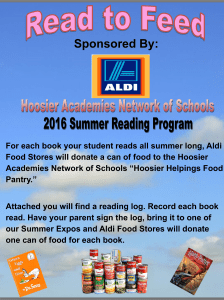
- $25 Starbucks gift card given to the teacher to bring in the most canned food during on site professional development.
- Canned food donation at Bowl to Enroll where staff and families could bring donations to the event.
- Personal Hygiene drive for both students and staff.
- Partnership with Aldi for Summer Reading Program “Read to Feed.” One can of food will be donated to the Hoosier Helpings Food Pantry for every book that is read.
- NJHS and NHS students worked in the pantry organizing shelves, painting freezer and creating signs.
Competitive Advantage
 It is no secret that I do not believe in neighborhood assigned schools for all children, especially low-income families. Children deserve and need their parents to have educational choice—not just what others think is good for them. School choice is all about empowering informed parents to make the best choice for the education of their children. With school choice, however, comes responsibility for leaders to not just start schools that look like all the others. As a charter school leader it is important for us to differentiate our school to meet the needs of our families and students.
I was reminded of this last Friday night when we honored our outstanding parents who serve as outstanding learning coaches. I blogged about this in Driving Decision Making. Every student has a story and needs some type of differentiation to make the school experience right for him or her. We must do all we can to make school information widely available so parents can make informed choices. Education is a complex, highly personal endeavor, which means that what happens at the individual level—the level of the teacher and the student—is the most crucial factor in realizing success. In education, I always say we need to work very hard to make policy meet reality. The Every Student Succeeds Act (ESSA), which sends key decisions back to the states, allows us an opportunity to collaboratively bring the state legislature, state boards of education, departments of education, schools, teachers, and families together to do what is best for our children.
In Lesson #50 of The Disciplined Leader John Manning (2015) posited, “Don’t limit competitive information to what’s obvious. Dig deep to understand your competitors’ people, their products, their services, what they do well, and what they don’t. Plug this competitive analysis into your business plan and see how it fits against the backdrop of what’s happening in your industry.” (Manning, 2015, Kindle Locations 2566-2568) This same philosophy holds true for school choice. We must study what other schools are doing and make sure that our own schools are not just doing the same things the same old way, but truly doing things that are making a positive impact on student achievement and performance.
“Leadership needs to drive activities and invest resources to study their competition and use this information to develop a competitive advantage.” ~ John Manning
We need to create transformational disruptions that create innovative opportunities for our teachers, students, and families. Instead of being customers, let’s consider our students and families as end users of what we offer in our schools. What promising approaches could we be bringing into our schools to give us a competitive advantage?
 Byron's Babbles
leave a comment