The Artwork of Stories & Relationships
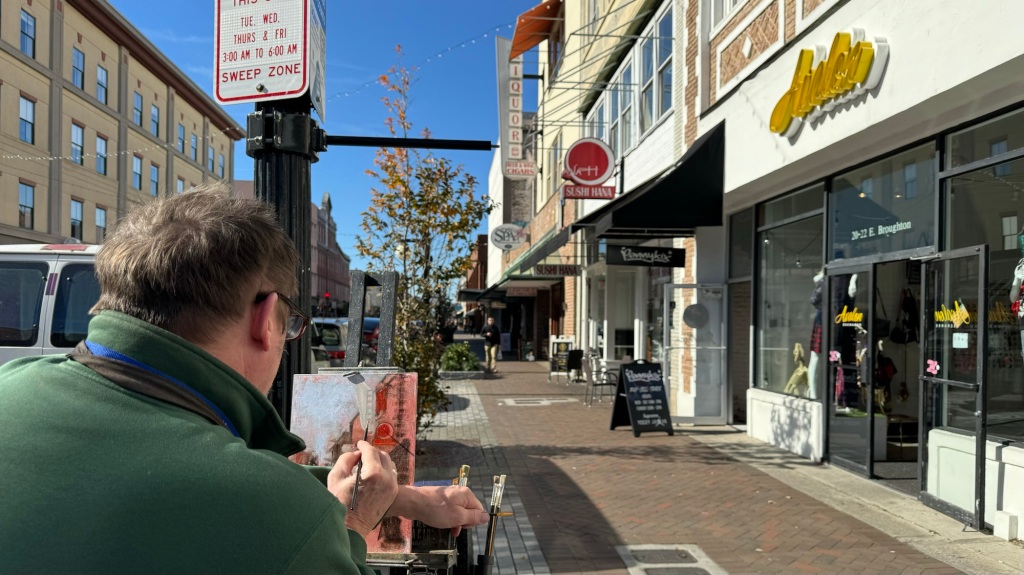
I love the opportunities that chance encounters bring for making new and valuable connections. Last week as we were going into Sushi Hana in Savannah, Georgia for lunch, I noticed an artist painting a streetscape in front of the restaurant. Those of you who know me well, know I can’t resist watching an artist practice their craft. He was just getting started, but I could tell this painting was going to be special (like I really know anything about it). The artist and I exchanged hellos and I told him I liked his work. My family and I went into Sushi Hana’s and ordered and I told them I had to go back out and meet the artist. I met Jeffrey Baumgartner, who coincidentally is from Chicago with Indiana connections. Small world! We immediately connected and he informed me it would take about three hours to complete. I told him I wanted to buy the painting. Then my wife came out and told me I needed to come in and eat. Imagine that!

After lunch I was back out to check the progress of “my” painting. It was coming along nicely and Jeffrey and I talked some more and made a plan for me to call him and 3:00 and see where he was on completing the painting. So, at exactly 3:00 as I stood along the Savannah River, I called my new artist friend back to see how my painting looked. He was just painting his signature on it as I called. Jeffrey told me it looked awesome. So I left my family to explore and climbed those old uneven steps up from River Street with some newfound energy and enthusiasm. Over to Broughton Street to see this exquisite piece of artwork (see photo). It was wonderful and I wanted it.

We agreed on a price then proceeded to talk, laugh, and share stories. Two students from the Savannah College of Art and Design (SCAD) came by who had watched and talked to Jeffrey earlier. He proceeded to give them an art, business, and leadership experience like no college professor could give. This artist was living it. He had driven his van (that he says is a “VanGo,” pun intended) to Savannah, set up in a campground, and was painting a new streetscape every day for a living. If that isn’t a real world and relevant context for teaching I don’t know what is. Not only was he schooling these young and aspiring artists, he was forming relationships. As a believer and teacher of building relationships as the most important leadership trait, I was watching and learning. Jeffrey was a master at it.
As I was complimenting him on his relationship-building prowess he told me that he came from the theater. “It’s all about the story, Byron,” he told me. So true; it is all about the story. I had gotten my painting, made new friends in Jeffrey and the students, and expanding my knowledge in leadership and creating an ideal customer experience. Jeffrey’s ability to connect had made the experience of buying this painting memorable and with a tremendous story.
Being able to build relationships is an important trait to have developed for a painter selling paintings, or any leader for that manner, because it helps in establishing trust and rapport with potential buyers. By building relationships, we can understand the preferences and tastes of our customers, tailor their artworks accordingly, and creating a personalized experience for the buyers. This lesson can also be transferred to all of us as leaders. We are creating experiences for those we serve.
Additionally, building relationships allowed Jeffrey to form a network of loyal clients who most likely will provide repeat business and recommend the artist to others. In Jeffrey’s case, he has a loyal following. This can help in expanding the reach and recognition of the painter’s work.
Moreover, through building relationships, we can also receive feedback and constructive criticism, which can be valuable for growth and improvement. By understanding the needs and desires of our clients and clients and those we serve, can better fulfill their expectations and create artworks that resonate with them.
Overall, being able to build relationships enables a painter to connect with their audience on a deeper level, promote their work effectively, and establish a strong presence in the art market.
A Honey Of A Deal For Being Interested In Learning

I remember being told that being interested makes us interesting. I believe this applies to being curious as well. Yesterday, I spent time at the Savannah Bee Company learning about honeybees, beekeeping, education, stewardship, and love. It was a reminder of just how curious and interested I get about a great number of subjects. Some have even called me eclectic. Guilty! Being interested in something can make us more interesting When we have a genuine passion for a subject or topic, it shows in our conversations and interactions with others. It can make us more engaging and knowledgeable, and can also spark curiosity and interest in those around you.

Yesterday, working with honeybees, I was reminded why I am such a believer in using real world and relevant contexts for learning. The Bee Cause Project introduces children to the science of bees and giving them a hands-on connection between these magnificent pollinators and their own lives. Founder and CEO, Ted Dennard is committed to the mission of building the buzz for integrating bees into education. By incorporating honeybee-related activities into STEAM (science, technology, engineering, agriculture/arts, and math) education, students not only learn important scientific principles but also develop skills in critical thinking, problem-solving, and data analysis. Additionally, they gain an appreciation for the natural world and a sense of responsibility towards sustainable practices.
It was exciting to take a deeper dive into learning about the, ecology, life cycle of bees, their and environmental behavior, and science. I was able to observe the bee’s hive and students in schools who are a part of The Bee Cause Project can also observe their own beehive and the bee’s role in pollination. And, by the way, produce a pretty sweet (honey) product in the process of learning. A relevant context at its best.
And, I can’t leave out the importance of Agriculture: honeybees are essential for pollinating crops, making them crucial to agriculture. By learning about beekeeping, students gain insight into agricultural practices and the importance of sustainable food production.
Being interested in STEAM subjects, for example, can lead to fascinating discussions and opportunities to share ideas and knowledge with others. So, integrating honeybee-related activities into the curriculum, is a great way educators can help students develop an interest in STEAM subjects while also promoting environmental awareness and sustainable practices. So, yes, being interested can definitely make you more interesting.
How Did You Learn Today?

What gets learned is very different than
“how” the learning happens. If we only focus
on the “what” we miss tremendous
opportunities for learning to occur. Think about when you were a kid or when you ask your own kids today, “What did you learn at school today?” Answer: “Nothing.”
But how about those days when some activity, project, or lab really tripped your trigger? Were you learning? Yes. What made it impactful was how you learned. We all learn differently whether we are adults or kids and there must be a variety of engagement strategies used. Even better is to give the student choice and agency in deciding the “how.”
Our scholars learn in a complex social environment and we have rapidly changing contexts. When teaching with relevance and how students learn, four important learning criteria are enhanced: core academics, stretch learning, learner engagement, and personal skill development. Students need to develop skills in information searching and researching, critical analysis, summarizing and synthesizing, inquiry, questioning and exploratory investigations, and design and problem solving.
While facilitating some student focus groups recently, the students pointed out that some teachers fail to provide a context through observations, inferences, and actions appropriate for students to make the connection to the real world. These connections help the students to understand higher-level science concepts. Students, now more than ever, want to understand how they will use what they are learning today in life or in a career. We adults are the same way, we want to learn things we can use immediately in what we do.
We need to remember to frame learning as a process rather than merely an outcome. Additionally, meaning making, is at the core of how we learn. Finally, how we learn includes the role of prior experience and interpretation of that experience. This is where we must help in providing experiences to give real world context. Thus, why I am such a proponent of work-based learning, apprenticeships, and internships. How we learn matters!
The Real-World Inspires
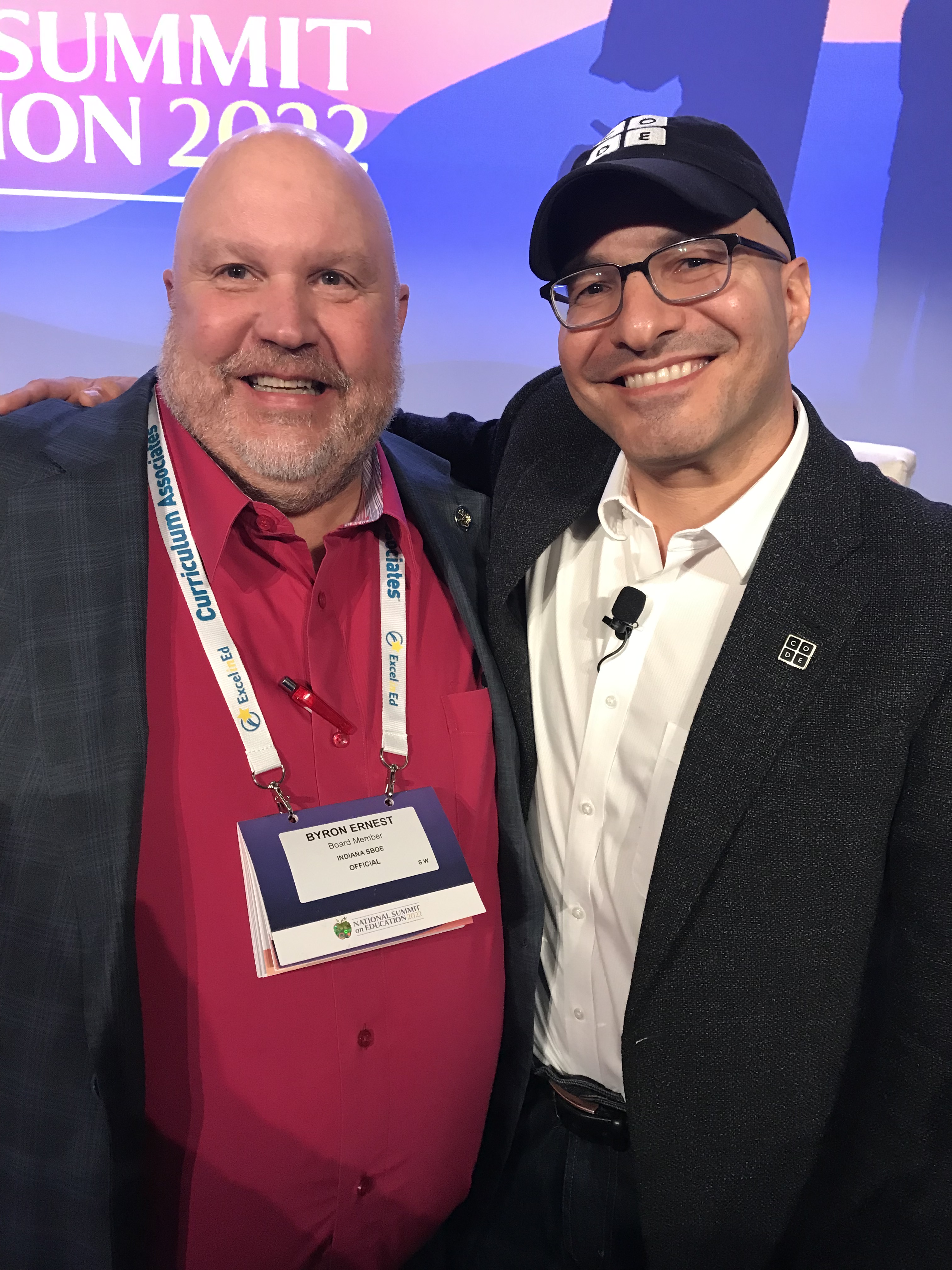
Don’t you just love it when something you advocate a lot is affirmed by someone else? Well, I do! Anyway, yesterday during the keynote lunch panel discussion at the Excelin Ed National Summit on Education 2022 entitled “A 21st-Century Education: Critical Skills for Every Student’s Success” the rest of the attendees at Table 18 kept looking over at me and kept saying things like, “you say that all the time.” And, yes, that was true! I have known one of the keynote panelists, Hadi Partovi, for a long time. Hadi is CEO of the education nonprofit Code.org. I have always known Hadi to be very insightful as what our scholars need to know when continuing the learning journey after high school. Notice I call it a “learning journey” because no matter whether a scholar chooses enrollment, employment, or enlistment, they will be continuing on a learning journey. I am approaching the six decade mark and I am still on an incredible learning journey. In fact, I am not so sure I haven’t learned more in the last year than at any point in my life. How cool is that?
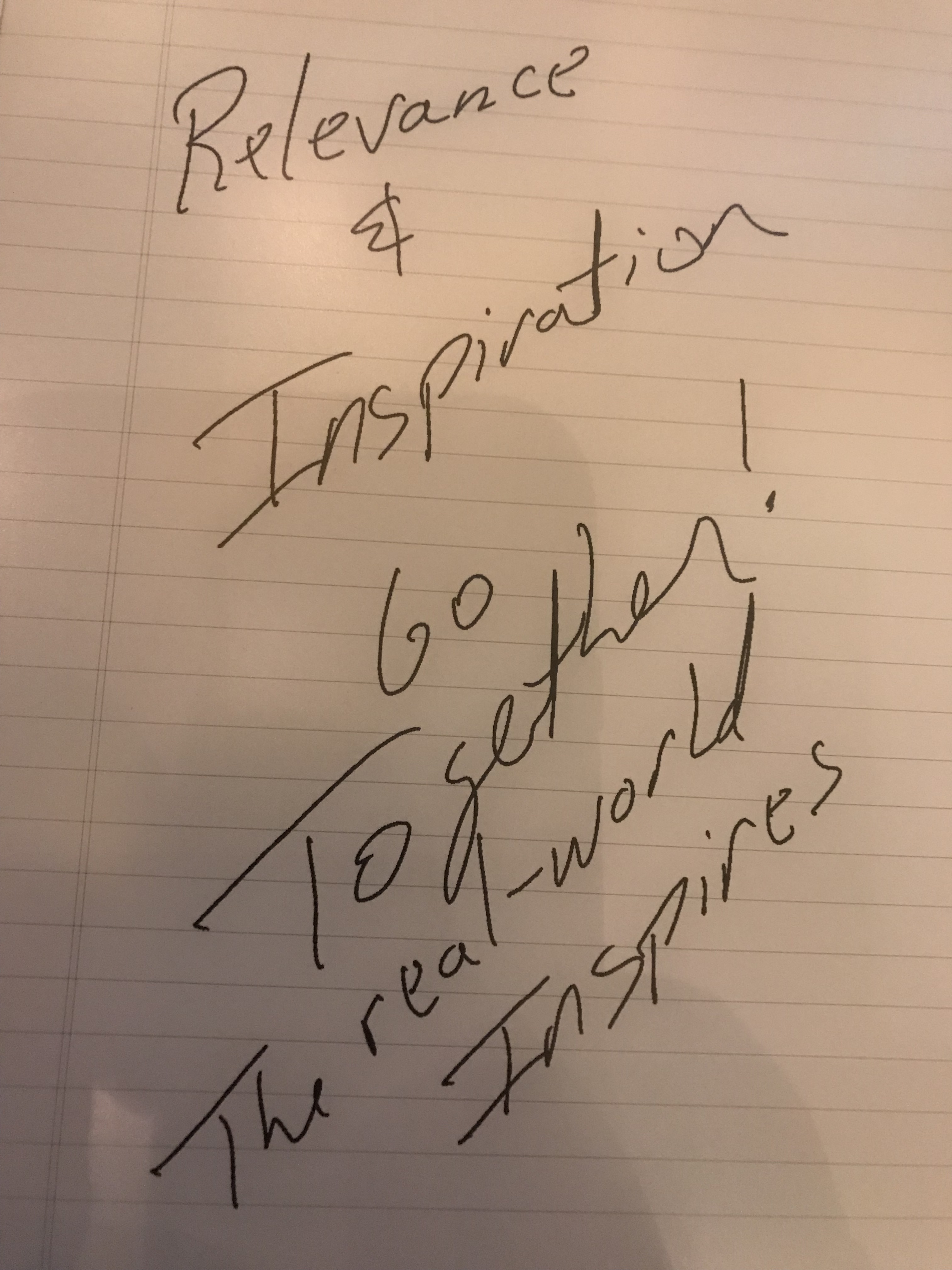
Back to Hadi because some of his comments are the focus here. He said:
- “If kids are excited to learn something, they will go learn it.” – I am thinking TikTok here. I am pretty sure none of our students took a TikTok course in their school.
- “Don’t worry about the order in which we schedule scholars to learn things; more importantly, we need to be inspiring students to go learn.” – Personally, I always advocate that how students are learning is at least as important, if not more important than what they are learning. Learning howto learn is the most important thing we can do in the world today.
- “Relevance and inspiration go together!” – Who knew? Every scholar in every school in the world! They might not say it, although they do, when they say things like, “Why do I need to know this?” If that Hand in the Back of The Room can’t be answered there will be NO inspiration to learn. Trust me, I know because I was that student with his hand up in the back of the room almost six decades ago now.
Bottom-line: we must remember that the real-world inspires. Our students are the expert in their own life in context, no one else is. Our kids are learning in a complex social environment. Our students will inherit the future and we need to do everything we can to have them ready to learn and have the creative designs to solve the future issues.
Learning From Action Not Abstraction
As a person who has lived six decades now, the world feels like a more perilous place. I don’t really think the modern world is any more dangerous than it was fifty or sixty years ago. I do, however, believe we are in a much more risk averse world today. I think a lot about whether this risk aversion is inhibiting children’s development of autonomy, competence, confidence, and resilience. Growing up on a farm I had many opportunities to test observations, to experiment and tinker, to fail and bounce back. Nothing was treated like a major risk, and I was not prevented from learning how to judge the truly dangerous, from the simply unfamiliar. Please know I am not in any way suggesting putting our children in harms way. I just worry we we are ensconcing children in a life of abstraction rather than action. I guess the old agriculture teacher in me will always believe in “learning by doing.” “Doing” always comes with some inherent risk. Riding a bike carries the inherent risk of falling off. Thank goodness we have not made it illegal to ride a bike.
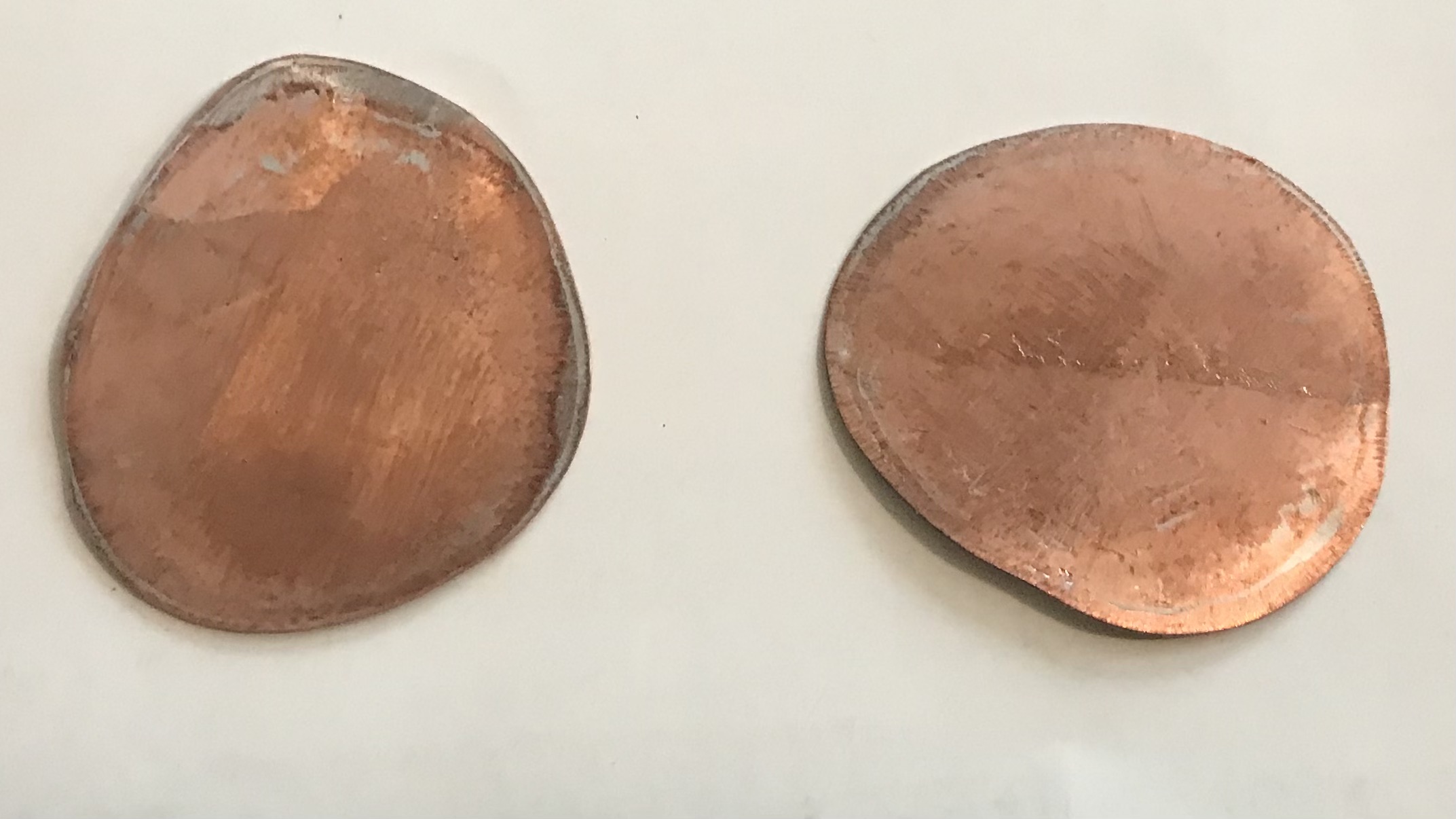
Case in point; yesterday my son was telling about things he had done as a kid growing up on our farm and his girlfriend was amazed. She asked if I knew he was doing all that. Well, yes and no. Was he doing anything bad? No! Case in point: having been in North Carolina during the recent gas shortage, I saw firsthand all the stupid ways some people were hoarding gas. I can guarantee you my son understands why you don’t put gas in a trash bag lined trash can with no lid. Enough said! And, yes I did see that done. Somehow, last evening, the subject of putting pennies on a railroad track came up. My son’s girlfriend had never heard of doing that. What? She then went on to talk about having some of those pennies you get flattened in a machine at vacation destinations. What? That’s no souvenir. I’m not going to say whether we did or did not smash pennies on a railroad track last night, but those would be a souvenir she would never forget making. Besides just plain being fun, we need to let children grapple with a little bit of healthy risk. Doing so can help teach motor skills, develop confidence, and get our young scholars acquainted with the use of tools and some of the basic principles of science. Let’s add some action to all the abstraction.
Precisely What Students Need

Yesterday I had the opportunity to spend the morning at Heartland Career Center with the Mark Hobbs, Director; Lori Dubois, Precision Agriculture Specialist; and, most importantly, students of the new Precision Agriculture Program at Heartland Career Center. I say I was at Heartland Career Center, but actually the bulk of our time was spent 15 minutes from the school in the field.

We were out on McKillip AgVenture land learning about seed genetics and the start to finish process of their seed corn operation. Last week the students had sorted seed corn as it was being harvested. This is just one of many partnerships that has been formed so that students can get real world and relevant content for learning.

This all took me back to my days as an Agriculture Science Teacher and our partnerships with AgReliant Genetics and our students doing real research for the company in our school greenhouse alongside geneticists. As I always say, “School work must look like real work.” I talk about that a lot in my book, The Hand In The Back Of The Room.
I am passionate about this program and have had the opportunity to be part of many of the planning meetings, served as a champion, have helped remove obstacles along the way, and helped make connections where I could. One of the many things I love most about this program is that it was developed shoulder to shoulder with business and industry. The very businesses that will be hiring students from this program, helped design the program. Novel idea I know, but you’d be surprised how often this does not happen. Students are able to leave this two year program with an Unmanned Part 107 Drone Certification, Chemical Applicator License, and a Class A Commercial Drivers License (CDL).

Yesterday, I had the opportunity to experience drone flying first hand. In fact this was the very first time I had ever flown a drone. We’re not talking some toy drone, but a commercial drone like would be used in precision agriculture businesses. I was shocked at how quickly I was able to learn to fly the drone. The students did an incredible job of teaching me. Here are two videos of me piloting the drone:
This two year program of study prepares students for careers that bridge the gaps between agronomy, agriculture, machinery management, and data analytic sciences caused by the rapid evolution of high-speed sensor agricultural technology. This is all stuff that fascinated me. We even got into a discussion about artificial intelligence, which is an area I have been exploring with some of the work I have been doing with SMART Factory League, globally.
This program is truly making school work look like real work! Well done!
“Sticky” Learning
 I made the comment last week that relevance makes the learning “sticky.” This really caught on and caused quite a bit of discussion. As an old Agriculture Science teacher I have preached about using relevant and real-world contexts for facilitating learning for years. In fact, I even wrote a book about it: The Hand In The Back of The Room: Connecting School Work To Real Life. This book is all about how we (four agriculture science teachers at one school) went about teaching science in the relevant context of agriculture. The great part of the story is the statistically significant impact leading learning in a relevant context had on student learning. In other words, there was proof that relevance makes learning “sticky.”
 In the book I state, “It has always been my belief that there are three worlds that a student exists and learns in; school world, real world, and virtual world. While these three worlds can be drawn as three separate circles, I believe that for true learning to take place we must, as educators, help connect the circles for them. This means finding a way to facilitate learning in a way in which the student uses real world contexts where the student plays an active role” (location 320 on Kindle). Right now, during the Global Pandemic (we are in day 165) we have some real opportunities to make use of these world colliding. I wrote about this yesterday in When Worlds Collide. I also argued in the book that, “…facilitating learning in a relevant context enables the work to be student centered and for there to be a connection made between the student’s real world and school world for learning” (location 331 on Kindle). This connection is what makes the learning so “sticky.”
“We have to make sure that all our students have access to these kinds of challenging and hands-on activities. Although much of the focus has been on the new technology that is fueling the maker movement, even more important are the values, dispositions and skills that it fosters, such as creativity, imagination, problem-solving, perseverance, self-efficacy, teamwork and “hard fun.” ~ Secretary of Education, John King Jr.
I proposed at time of writing the book and would still advance six ideas for improving learning (Ernest, 2016):
- Knowing what the end product needs to be before practicing the parts
- Study content and apply it to authentic real world predictable and unpredictable problems/issues
- Applied learning opportunities must be afforded to the students
- Students must participate in active exploration of real world problems
- There must be opportunities for students to make adult connections
- We must make schoolwork more like real work and real life.
If we intentionally use the six ideas, we will make the learning be what former Secretary of Education, John King Jr. called “hard fun.” The nature of using relevant contexts makes the learning more rigorous. I love the term “hard fun” over rigor. If our students are learning to adapt what they have learned by addressing real world situations they will be more motivated and the learning will stick with them.
The bottom line is that education can be inspiring for our students. I believe agriculture education has an important place in creating a real world context for our students to learn in. I also believe that there are many ways for cross-curricular collaboration to be done in all subjects. At the very least, we have an obligation to our students to find ways to give our students hands-on, real life lessons that answer the questions of the hand in the back of the room and make the learning sticky for our students.
More Smithsonian Exploration
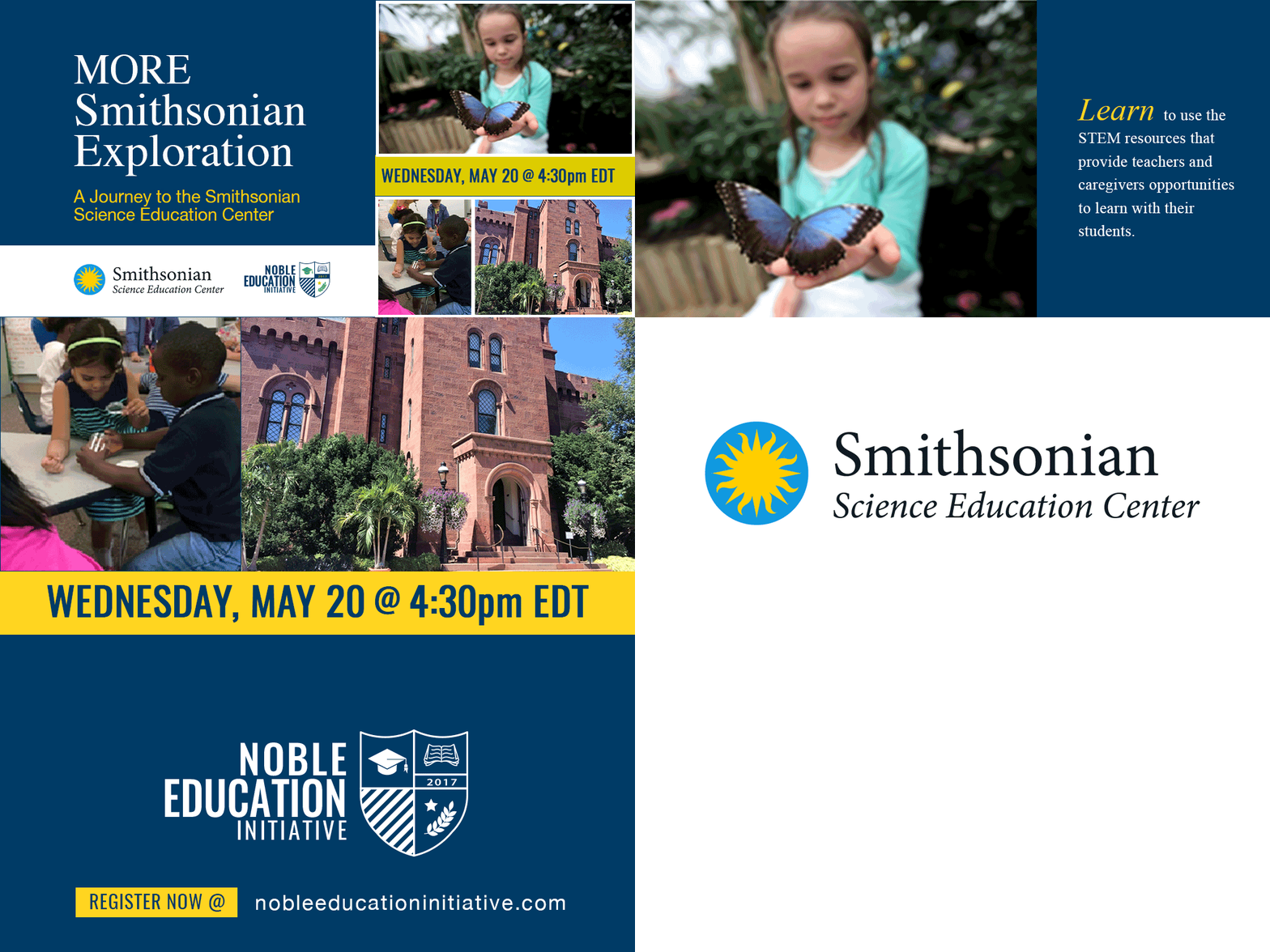 As a former Smithsonian Teacher Ambassador, I am very excited to be partnering with the Smithsonian Science Education Center (SSEC) to provide a webinar in our series of Noble Education Initiative opportunities for learning. Back in April we partnered with the Smithsonian Learning Lab and had two fantastic webinars and were able to provide outstanding resources to educators. I blogged about these webinars in Bringing The Smithsonian To You. Since then, we have continued to be asked for more from the Smithsonian Institution.
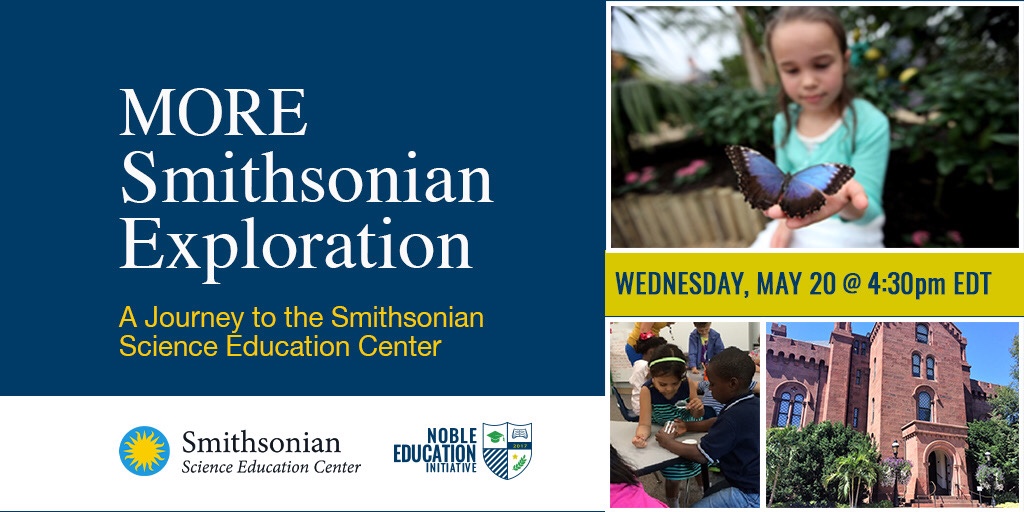 Tomorrow, May 20th, we will do just that with More Smithsonian Exploration: A Journey To The Smithsonian Science Education Center. We want educators and caregivers to join us to learn to use the resources that provide tremendous opportunities to learn with their students. The SSEC offers curriculum and digital resources that support educators and caregivers in providing authentic STEM experiences. EVERYONE is welcome and can still register here: https://m.signupgenius.com/#!/showSignUp/60b0b44a5a92ca7fe3-more.
I am really proud of this partnership to bring make this free webinar possible because of the aim of the SSEC to transform and improve the learning of science for K-12 students. Click here to view the SSEC fact sheet to learn how the world’s largest museum, education and research complex is bringing an interdisciplinary approach to education using science, history, art, and culture.
The SSEC is also providing tremendous resources and support to teachers who work with newcomers from all over the globe and English Language Learners (ELLs). Our webinar will be engaging and inquiry-based to model the strategies that are effective for effective learning with our ELL students. We will also get a first hand experience with the SSEC’s real world and relevant featured curriculum dealing with COVID-19: COVID-19! How Can I Protect Myself and Others.
Join us tomorrow and see how the Smithsonian Science Education Center is transforming science education.
Bringing The Smithsonian to You!
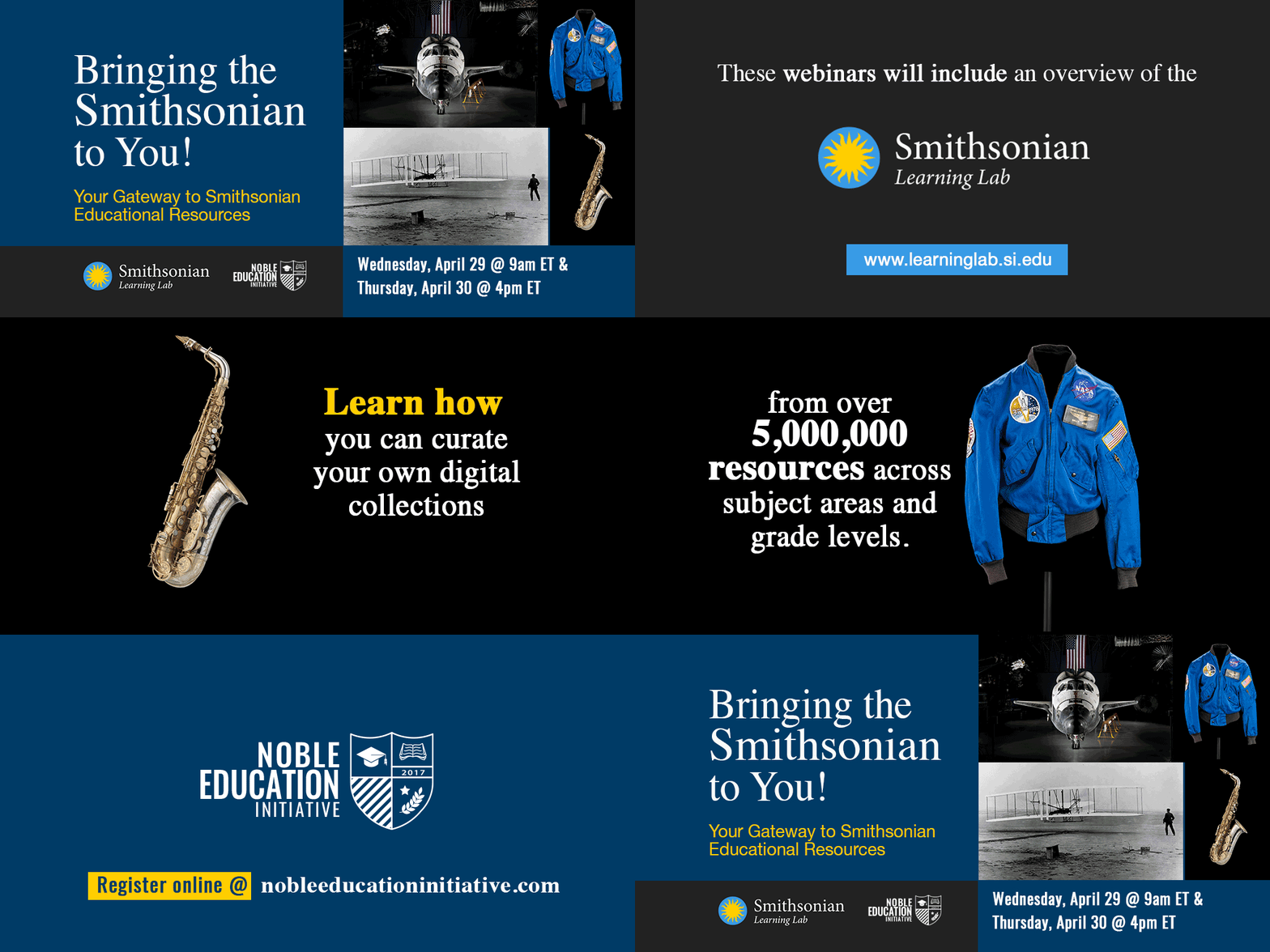
During the COVID-19 Pandemic and the many webinars we have been doing to support teachers as they facilitate learning virtually, I keep commenting that the Smithsonian Institution is a tremendous resource. Or, should I say, plethoras of resources and services. Then I got to thinking that if I was going to keep saying that educators needed to check out the Smithsonian, we needed to do a little “show and experience” for them. As a former Smithsonian Teacher Ambassador, I really value all the resources available for educators. So, I decided to reach out to Ashley Naranjo, Manager of Educator Engagement at the Smithsonian Learning Lab, and ask if she would be interested in doing a webinar together. She was quick and enthusiastic to respond in the affirmative. Needless to say, I was excited.
Ashley and I had a great planning session where she had great ideas for engaging webinar participants in actually navigating and using resources. In fact, she and I will be modeling an activity at the beginning – I can’t wait! As I mentioned earlier in the post, I was a Smithsonian Teacher Ambassador back in 2010 and 2011. During that ambassadorship I was talking to groups of educators and organizations about the over 1,600 Smithsonian resources available. I told Ashley this asked how many there were now; she laughed and said, “Over 5,000,000.” Boy did I feel outdated.
Bottom-line: educators won’t want to miss this free webinar. This interactive and engaging webinar will include an overview of the Smithsonian Learning Lab and how teachers can curate their own digital collections of resources across subject areas and grade levels. The great part is that educators will learn, by doing, how to use Smithsonian Education museum resources in their own teaching and learning contexts. Please join us for this journey of bringing the Smithsonian to you!
❤️ Kids Having Ownership!
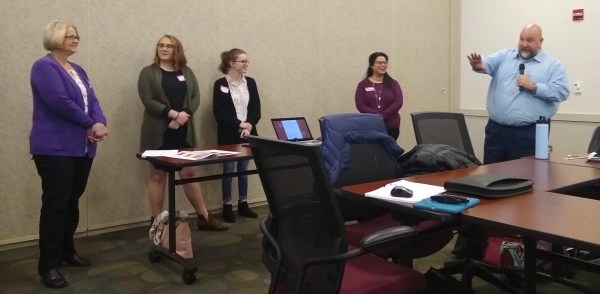 This past week I had the honor of doing a day long professional development for teachers from all schools corporations in Elkhart County, Indiana. I am representing Noble Education Initiative carrying out this customized professional development. This was part of an ongoing Project Based Learning partnership created by Horizon Education Alliance to bring business/industry and education together to best educate students. I love doing professional development workshops, particularly when they are on topics that I am passionate about. Project Based Learning (PBL) is one of those topics. It is also energizing to be with a group of educators who are very engaged. Groups like this always remind me and validate what Gallup® finds teachers value in question 12 of the Gallup Q12 Index©: “In the last year, have you had opportunities to learn and grow?” These teachers have been given this opportunity and very much value the opportunity, and are taking advantage of the opportunity to learn and grow.
The group last week was both passionate and engaged. We started the day with what I called “Level Setting.” I had them work in pairs to talk about their PBL experience now that we were half way through the school year. I wanted them to talk about what they had learned, “wow” moments, what they still had questions about, and what they still needed help with. They were to represent this on a tear sheet and put it up on the wall. Here are a few of the tear sheets that were put up:


Did you see the comment “❤️Kids Having Ownership”? That’s what this is all about. The next few paragraphs will dig into that a little deeper.
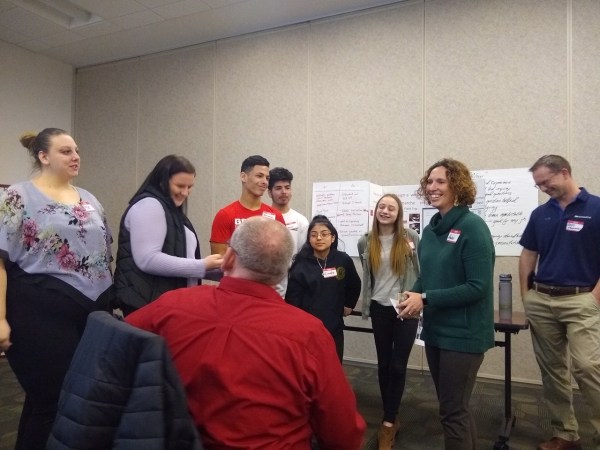
Aubri Mosness with her students
We then had everyone individually do a gallery walk and pick one thing that stood out to them. This was an awesome discussion when the group came back together. There were questions like, “who wrote… I would like to know more,” or “I had that same experience because…,” or “I am so glad you wrote that because that same thing happened to us, and we are still trying to figure out…” You get the idea. One comment really stood out to me during this discussion; It was by Goshen High School Teacher, Aubri Mosness. She said, “I have felt the transition from me doing most of the work to the students doing most of the work. At first I was a little uncomfortable because I felt like I was doing much, but then I realized how much the students were getting out of it.” I was so excited by this. This is such a revelation in teaching. Great teaching should have the students doing most of the work. She was truly facilitating with a student managed classroom and the students have student agency and choice.
Then, at lunch Ms. Mosness’ students presented to the whole group and business/industry representatives that had joined us, on their project and I led a little Q&A. The students were incredible. During the presentation Ms. Mosness commented, “When I give my students too much, too much information, too much guidance, I am taking away opportunities for learning.” This was a drop the mic opportunity as far as I was concerned. The students all concurred. I then asked the students to give a thumbs up or thumbs down on the following question: “School work should look more like real work?” All six students gave me a thumbs up. Our students deserve to learn in an environment that is facilitated in a real world and relevant context.
 These students were giving first hand testimony affirming the research I did for my book, The Hand In The Back Of The Room: Connecting School Work To Real Life.” In the book I talk about that the hand in the back of the room was mine, and probably yours too, that was raised wanting to know why I needed to learn what I was being taught. In other words school work must be connected to real life. This is why PBL is so great. Using PBL teaching principles will make school work look and feel like real work. In other words, the question from “the hand in the back of the room is answered as to why she needs to learn what she is being taught. When teachers are allowed to make student learning the ultimate test of facilitation of learning, then instruction improves to produce better learning. The results of my research showed improved achievement/performance in science when students are taught in a relevant context. For me that context was agriculture, but there many other real world contexts to be used. This is why the partnerships with business/industry is so important for our students. The challenge to all of us in education is to find ways to make learning visible by connecting school work and real life for the students we serve.
 Byron's Babbles
leave a comment