Reflecting On Our Presidents

“The Republican Club,” by artist Andy Thomas, was personally chosen by President Donald Trump to be displayed in the White House.
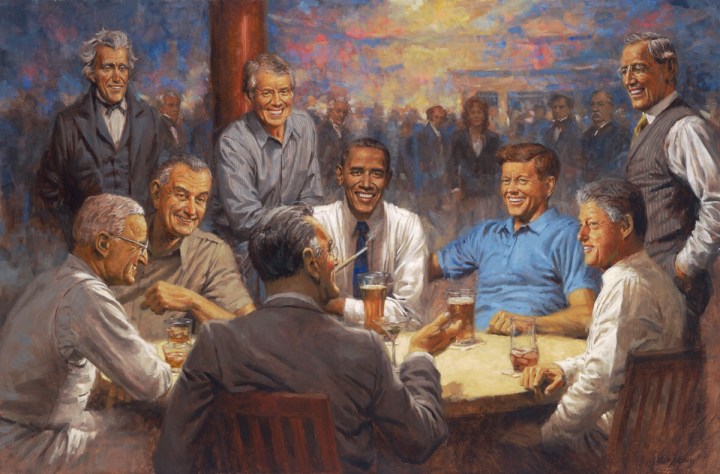
Andy Thomas Democratic Club presidents painting Image of “The Democratic Club” painting by Andy Thomas
It has been an incredible 2020 President’s Day. I had to drive to Nashville, Tennessee this morning so I had lots of time to reflect on our Presidents. My son and I were together this past weekend and reflected on the Presidents in the paintings displayed in this post. We pondered what they were discussing and thought about how great it would be to have conversations with these Presidents. As I got closer to Nashville, I reflected on the leadership of Andrew Jackson. I had the chance to go to The Hermitage last year and to the site of The Battle of New Orleans the year before that. There are certainly things that I would not have agreed with Andrew Jackson on, but there is no question he was a great leader. I blogged about his leadership in “Old Hickory” Leadership.
 I had a great day tweeting questions every hour or so related to our Presidents. There was some great interaction. Here’s the questions I asked throughout the day:
- Who was our U.S. President the day you were born?
- Who were the U.S. Presidential candidates the first time you were able to vote?
- If you could have dinner and a conversation with any past or present/living or deceased United States President, who would choose?
- If you care to share, who was the first U.S. President you ever voted for?
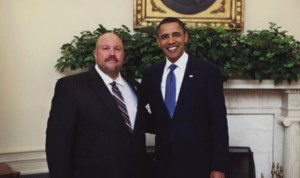
- Who has spent time in the Oval Office with a U.S. President? Is so, which one?
- If you could add another U.S. President to Mount Rushmore, who would you add?
- Are you reading about any U.S. Presidents right now? If so, which one(s)?
- Have you finished any great President autobiographies or biographies lately?
- What is your favorite Presidential Library you have been to?
- What do you consider the best book by or about a First Lady of our great nation?
 Wow, until I typed them out here, I had not realized I had asked 10 questions today. I can’t resist telling you that our 10th President was John Tyler. He became President in 1841 when William Henry Harrison died. He was the first Vice President to succeed to the Presidency after the death of his predecessor. How about that for some President’s Day learning? It was sure fun reflecting on the past and how our Presidents have affected our lives and this great country we call home.
Passion At Ambition’s Command
 We teach that having passion is a key to success, particularly when linked with purpose. History, however, teaches us that passion can become destructive. Research in psychology describes this destructive passion as “obsessive passion.” The good passion is “harmonious passion.” My recent reading has given examples of two individuals where obsessive passion drove the individuals to become power hungry.
“His passions were at ambition’s command.” ~ James A. Caro in The Path To Power
 In The Path To Power, Robert A. Caro said that Lyndon B. Johnson‘s passions were at ambition’s command. Johnson was obsessed with power and couldn’t get enough of it. The ambition for power and becoming president took over and clouded any purposeful passion for helping the people of our country. Everything he did and anyone he helped was dependent on what he could get out of it, or what power could be derived. When obsessive passion takes over with ambition calling the shots, the person’s self-worth becomes validated by whatever the ambition is. In the case of Lyndon Johnson that ambition was power.
 Another person I recently studied who let obsessive passion take over was Elizabeth Holmes, Founder and CEO of Theranos. I read about her in Bad Blood: Secrets And Lies In A Silicon Valley Startup by John Carreyrou. She had purpose and passion for a world changing blood testing and analysis machine that only needed a drop or two of blood to run a myriad of tests. Her company wasn’t able to meet performance standards or efficacy. She is still involved in legal actions against her including criminal charges. Her ambition was for success as defined by celebrity, power, and greed instead of purpose for significance. To read more about this check out When Purpose and Passion Turn Into Ambition.
A Time To Fish & A Time To Mend Nets


During my reading time this week, the story was told about Sam Rayburn in The Path To Power by Robert A. Caro that he liked to use the Biblical axiom, “There is a time to fish and a time to mend nets.” I had heard this axiom before, but really got to thinking about it after I read this. What he was saying, I believe, was that there was a time to be getting the work done and making the deals and there was a time to be building relationships and helping others to grow as leaders. I have already blogged about the inspiration from Caro about Sam Rayburn in “Sam, Be A Man” and Silence Is Golden.
 In Mark chapter 1 in the Bible, one set of brothers, Simon and Andrew, were busy casting. They were fishing. The other set of brothers, James and John, were mending. All four of these men were fishermen, but at the time, they were not all occupied in the same activity of their profession. Two of them were casting and two of them were mending. I believe that there are some important lessons that can be learned from this story. You don’t catch fish while you are mending. In the lives of those fishermen mending time was considered a necessary evil. No fisherman wanted to be mending, all fishermen wanted to be casting.
Mending nets was/is tedious work. It was/is routine, likely daily work. Spreading out the nets, sifting through them. It involves repairing holes, retying knots, and cleaning out debris. To say the least it is tedious and monotonous. This was the “grind” behind the glamour of fishing (if there is glamour in that). Just like fishermen, leaders have tedious and mundane work that has to be done in order to be effective. But, it’s the little things that must still be done. Furthermore, sometimes we keep doing the mending work and things still don’t go the way we want. We need to remember to go back and keep mending nets. We must keep trying. In Luke 5 we find another story where Jesus tells the fishermen to go out to deeper water after having fished for hours without catching anything. They followed the advice and caught so many fish their nets were full and breaking. This teaches us to keep trying and not give up. We also need to lead like Jesus and keep cheerleading our teams to keep trying.
Fishing is a powerful leadership metaphor. Fishermen are courageous and dedicated. If you’ve ever fished you know how frustrating it can be. My son and I have fished all day and caught nothing. We’ve also fished all day and not caught anything till the last hour. It was a good thing we kept fishing. I am sure you can compare this to whatever leadership work you do. Additionally, we cannot forget the teamwork that fishermen exhibit. They do not let one person do all the work. So, what have we learned from these fishermen and there being a time to fish and a time to mend net? The importance of staying at it, in good weather and bad, in lean times and lush times. They also knew there was a time to mend the nets and prepare for the next load of work.
Silence Is Golden
 I love it when one of my favorite Presidents is quoted in books that I am reading. Robert Caro included a quote from former United States Speaker Of The House Sam Rayburn credited to former President Calvin Coolidge is his book The Path To Power. I‘ve already blogged about Sam Rayburn in “Sam, Be A Man.”
Rayburn was credited with saying that one of the wisest statements outside of those written in the Bible was when Calvin Coolidge said, “You don’t have to explain something you never said.” This speaks to the wisdom of our 30th President. Coolidge matters and was a role model of great leadership. Sometimes the smartest thing is to say nothing at all.
“You don’t have to explain something you never said.” ~ Calvin Coolidge
This can keep us from ending up negotiating and debating against ourself. Additionally, being silent at the right times can keep there from being misunderstandings. Just because there is silence does not mean we need to talk, especially if we are not completely knowledgeable on the subject being discussed. I’ll bet if you are like me you have had times where you have wished you hadn’t said something – because you ended up having to explain it and then couldn’t.
It is also important to listen to what has already been said. Often, in meetings I say, “Everything has been said, just not by everyone yet.” I’ll bet you’ve been in meetings where everyone keeps saying the same thing or making the same point over and over, too. Robert Caro teaches us that reading biographies of leaders offers us great learning. I am certainly learning a lot from reading his work.
“Sam, Be A Man”
 I have been in the Rayburn House Office Building many times in Washington D.C. I had not, however, really ever given much thought to the great man the building was named after, former Speaker Of The House Sam Rayburn. Robert Caro did a whole chapter plus on Sam Rayburn in the great book I’m reading right now, The Path To Power. I am now researching biographies on Rayburn and I am going to study his life, service, and leadership.
 The part that Caro vividly portrayed is the integrity with which Sam Rayburn lived and led. He wrote the story that Rayburn told of what his dad told him when he left home for college. His dad held his hand and told him four words, “Sam, be a man.” That’s pretty powerful when you think about it. What does it mean to be a man? For Sam Rayburn it was about living and leading with honor and integrity. Rayburn would say, “There are no degrees of honorableness. You either are or you aren’t.” A very powerful two sentences to live by.
“There are no degrees of honorableness. You either are or you aren’t.” ~ Former U.S. Speaker Of The House Sam Rayburn (Texas)
This reminds me of what my good friend, former U.S. Congressman Steve Buyer, used to tell me and my students each year when we visited him in room 2230 of the Rayburn House Office Building: “Your character is your legacy.” That was always so moving. My students would talk about that and try to define it for the rest of our time at the National FFA Washington Leadership Conference, and the trip home. I was so proud, as an Indiana FFA Advisor to take students to this conference every year for so many years and have my students get to meet with such a great leader. It was so impactful for me to read about the man who lived with such honor that the building was named after that housed the office of a man that was such a great leadership role model for myself and my students.
“Your character is your legacy.” ~ Former U.S. Congressman Steve Buyer (Indiana)
Our legacy grows with each new experience. Our leadership is not shaped nor our legacy defined at the end of our career or life, but rather by the moments shared, the decisions made, the actions taken, and even the mistakes made along the journey. It’s about a continual reinvention of ourself with new learning, experience, relationships, and wisdom. We need to be thinking about our personal growth and continual improvement.
Every Day We Are Making Memories


 What got me thinking was when Caro wrote about Lyndon reflecting on loving the times when he and his father would travel in the Ford Model T to and from the Statehouse in Austin, Texas. He shared that his father would bring a crust of bread (I am comparing that to bringing a loaf of bread) and a jar of homemade jam. When they got hungry or tired, they would stop and spread some jam on bread and eat. I got a visual of that great dad and lad time when reading this. I’ll bet those were some of the best meals of Lyndon’s life.
This made me remember and reflect back of some great travel times as a young (notice I didn’t say small, because I was never small) boy with my own father. Specifically, I remember our three hour trips south to Louisville, Kentucky for the National Farm Machinery Show. He and I would stop and get a loaf of bread and some cheese. We would always buy bulk cheese and have the person at the deli counter slice it real thin for us. I remember those cheese sandwiches being the best sandwiches I have ever had. I loved spending this time with my dad. We had such great conversations while eating those cheese sandwiches.
I have tried to do things like that with my son and spend quality one on one time with him. We actually talk about what our next dad and lad time will be. Now that he is away at college, that time becomes more and more precious. Hopefully, he will remember those moments with fondness and he will do the same for his children some day. Needless to say, dad and lad, dad and lass, mom and lad, mom and lass time is very special and important. In the case of Lyndon and Sam Johnson this was time that Lyndon was learning about politics. Caro wrote that if kids were playing and asked Lyndon to join in he would never join them if he was talking to his dad at the time.
So, why blog about this? For one it was great to reflect on great past moments with my dad. Secondly, it is a reminder to us all just how important the touch points with our kids are, however seemingly insignificant they are. At the time my dad was buying a loaf of bread and a hunk of cheese it was to save money and because there weren’t the places to stop and get food on the way to Louisville along I-65 that there are now. Amazingly, Louisville, Kentucky seemed like it was on the other side of the world. My, how small of world we have become! Don’t forget, make the most out of every moment you have with your children. These times are precious and are very important to their formative years. Always remember, every day we are making memories.
“Remember, Freedom Is Yours Until You Give It Up”


 But let’s look deeper into this thought of “…freedom is yours until you give it up.” Freedom means different things to different people. Personally, I have always broken freedom down into two main categories: 1) Freedom To, and 2) Freedom From. To me, everything comes down to those two things. We need to distinguish between what it means to be free from something and to be free to be or do something. For example, freedom to might be described from a political standpoint of having the opportunity to vote for particular ideas, people, or parties which best represent our views. Examples include the right to bear arms or to assemble and speak freely. Or, something as simple as leaving the hotel room I am in right now in Murray, Kentucky and pick anywhere my son and I want to go eat lunch. Freedom from could mean the notion of freedom from environmental hazard or some other preventable hazard. This should not be confused with licentious freedom. To be free, and remain free, we must become responsible human beings.
 Interestingly, however, “freedom to” and “freedom from” have always been an area of civic and political tension. The preamble of the Universal Declaration of Human Rights states that, “…freedom from fear and want has been proclaimed as the highest aspiration of the common people.” In striving to achieve these goals, we often face resistance from those who are focused on “freedom to,” who see an aspiration towards “freedom from” as a threat to individual liberty. This is being outlined in another great book I am reading right now by one of my favorite authors, Amity Shlaes, in Great Society: A New History. The book told of President Johnson’s commencement speech at the University of Michigan when he said, “The truth is, far from crushing the individual, government at its best liberates him from the enslaving forces of his environment” (Slaes, 20, p. 98). I, for one, do not believe that more government is the answer to any issue.
Johnson’s Great Society, however, is a great case study for the tension of “freedom to” and “freedom from.” Our country’s move toward socialism during that age was marked by our government’s effort to end poverty which drove federal spending to unsustainable heights. “America,” Shlaes wrote, “morphed into a country that could afford nothing.” Harry Truman always spoke of the nuances of leadership, and the Great Society must be studied, which Shlaes did, in the nuanced context of the relationship of the Vietnam War, poverty, and civil rights. It has been debated whether what was being proposed was socialism, but whether one believes that production being controlled or distribution of wealth being controlled is socialism, one thing is clear; the Great Society created a tension of “freedoms to” and freedoms from.” One of the most interesting comments from Shlaes in the book so far (because I’m only on page 124 of 513) is an interpretation of how Senator George Smathers of Florida was thinking: “A law that defined new rights at the national level was taking away from individuals the authority of their own conscience, and substituting a federal, national conscience to overrule them. And who knew whether the federal government’s conscience would always be better? (Shlaes, 2019, p. 116). This is an interesting question to ponder.
If I bring this full circle back to where we began with the fiction novel, The Warehouse where we found that a business named Cloud had basically taken over everything – it controlled the markets, what products people were able to buy, how they lived, et cetera. Certainly, I do not want that any more than I want the government becoming my conscience, controlling markets, or dolling out huge amounts of money for programs that don’t work. Alexander Hamilton believed, as do I, that the people are very capable of governing themselves based on reflection and choice. We also need to stay true to the desire of framers Washington, Jefferson, and Madison who insisted that governments were instituted for the people, not the rulers. So, freedom really is ours until we give it up. We need to be very careful how we balance this tension.
Interestingly, Isaiah Berlin (1909-1997) studied this very issue. Berlin called what I am calling two types of freedom in this post, two concepts of freedom: 1) Negative freedom – freedom from control by others, and 2) Positive freedom – freedom to control oneself. Berlin referred to our two selves: a lower self, which is irrational and impulsive, and a higher self, which is rational and far-sighted. That certainly does describe each and every one of us. Because of the two selves Berlin posited that negative freedom and positive freedom can both be abused. This was and is an issue that continues to be debated. And, it needs continual debating. This debate is the essence of the statement “Freedom is yours until you give it up.” This is why we must have the tough conversations about issues and why we all need to be involved in our local communities, states, and nations. As I said earlier, I believe as Hamilton did, people are very capable of governing themselves. Some individuals might need help understanding their best interests and achieving their full potential, and some would believe that government has a responsibility to help them do so. The question becomes “Who decides what counts as a rich and fulfilling life?”
There are no easy answers to these questions. Berlin never came up with the exact answer, only new questions. This is one of those conundrums that will continue to be debated, but at least we have distinctions like Berlin’s to help us navigate the tension and contemplate the realization that freedom is ours until we give it up.
REFERENCES
Hart, R.W. (2019) The warehouse. New York, NY: Crown Publishing Group.
Shlaes, A. (2019) Great society: a new history. New York, NY: HarperCollins Publishing.
366 Page Best Selling Autobiography
 In the past few days there has been plenty said and written about New Year’s Resolutions. Why do people bother? I even saw (notice I didn’t say “read”) a blog with 15 steps to keeping your resolutions. Really! Why do we put ourselves through that process for failure.
If I was going to have a New Year’s Resolution, however, it would be to appreciate my friends every day and catch more fish. Pretty doable, I believe. And, unlike where we do things like get an accountability partner (which, by the way, just adds stress to someone else’s life) this resolution is fun for your friends. Who wouldn’t want to go to lunch and catch up, or go fishing?
In my morning motivational message, that I tweet and post on LinkedIn (notice it’s not an email I force people to deal with – it’s a choice for someone to go look at it) each day, I said, “Today is the first blank page of a 366 page autobiography. Make it a best seller.” I really believe if we approach every day as a page to a best seller we could write a pretty good book.
 Best selling and Pulitzer Prize author Robert Caro says, “I have to produce every day.” Caro has written massive volumes about Robert Moses, New York City shaper, and President Lyndon B. Johnson. He will tell you these books are not about the men, but about power – getting it, using it, becoming abscessed with it, and abusing it. I have read The Power Broker and it is awesome. I am planning to start the series on Lyndon Johnson this year.
 Many have asked Caro over the years about his work habits, and there have even been interviews. Therefore, even though he was not done with the last volume of his books on Lyndon B. Johnson, he took time to write Working. In this book, which is a great read by the way, he outlines how he goes about doing the work of writing these in-depth books on power. What stuck out to me was when he wrote that he writes 1,000 words per day. Then at the beginning of the next day he reviews and revises the writing of the previous day and writes another 1,000.
See where I’m going here? What a great metaphor on this New Years Day! We need to approach this New Leap Year as a blank pad to write 1,000 words per day for a 366 page best selling autobiography. Each day we can reflect on the previous day, but then get to work on the next 1,000 metaphorical words that are our life. So maybe, just maybe it’s this simple: produce every day.
 Byron's Babbles
leave a comment