Be Consistent, Not Clever!
 I am very excited about a new book I started reading this morning. It will actually take me all year to read it. The book is A Year With Peter Drucker: 52 Weeks of Coaching for Leadership Effectiveness by Joseph A. Maciariello. From the title I am sure you understand why I said it was going to take me a year to read the book. It is set up to take the year with 52 lessons, one for each week. I am dedicating time each Sunday in 2015 to study the lesson for the week. Each week I am also going to do a reflection post in this blog – I will post the picture of the book so you will know it is the reflection on my year-long book read.
Actually, I found this book because of the inspiration of one of my 2015 reread books. You will remember I have committed to rereading 12 books (one each month) that I have already read. My first reread book for 2015 was Turn The Ship Around!: A True Story of Turning Followers Into Leaders by L. David Marquet. I have written and tweeted a great deal about this book and believe lessons learned have had some of the greatest impact on my latest successes as a leader as any professional growth exercise I have done. I will be doing a post about my fourth reread of this book later in the month. However, in the book Marquet references learning from the teachings of Peter Drucker. I have read some of Drucker’s work and because of my affiliation with the American Society for Quality and the American Society for Quality Education Division I have been exposed to a great deal of his work. So, I decided I was going to find a Drucker book to read and gain more insight. Off to Barnes and Noble I went to get a Starbucks and look through the books. Right away I found the book that I believe Maciariello wrote just for me (even though I have never met him I am sure he wrote it just for me!). Amazingly, in doing the first week’s reading I found some correlation between Marquet and Drucker. It turns out leaders are readers! Who’d of thought?
 The connection I found between Marquet and Drucker right away was the idea of empowerment. Marquet talks about empowerment just being a word and you can’t just tell those you lead they are empowered. We must, as leaders, develop everyone in our organizations to be effective based on competence and trust. Without this competence and trust all we really have are what Drucker referred to as “functionaries” (Maciariello, 2014, p. 4). In other words just going through the motions and doing what they are told to do. Empowerment is really a delegation of authority. Marquet described, however, that delegation alone is not the answer. We must also be committed to increasing the technical knowledge of those on the team. As Marquet said, “When authority is delegated, technical knowledge takes on greater importance at all levels” (Marquet, 2013). He went on to say, “Control without competency is chaos” (Marquet, 2013). I love this quote because it drives home the point that leaders must consistently provide an environment of professional growth that builds the competency of all in our organizations. This means that leaders cannot be self serving.
Another point in this week’s reading was the idea that to be a leader you must have followers. This is much easier said than done. For this to happen you must get things done and you must have the trust of those you lead. Again, sounds easy but in reality is very tough to achieve. “Trust is built on communication and mutual understanding.” “To achieve mutual understanding you must understand what information your colleagues need from you to perform their function, and they must understand what you need from them” (Maciariello, 2014, p.6). This is where the consistency comes in. In other words what I say and what I do must be congruent. This is an area we must all continually work on.
There are four questions in the “Practicum-Prompts” section of the weekly lesson that really jumped out at me. I will close by sharing them with you and telling you that I am going to print these out and post them at my desk and use them as a barometer for my leadership in the coming weeks and months. These questions are on page 8 (Maciariello, 2014):
Is the authority of the leadership group in your organization grounded in responsibility, integrity, and service?
Does it bring out whatever strength is present in each person?
Does it foster a sense of community and citizenship?
What can you do enhance the legitimacy of the leadership group in your area?
I know right now I need to really work on bringing out the strengths and building the technical knowledge of all I serve. I find that this is very easy to do with some and extremely tough with others. Have you noticed there are many individuals (I include myself in this category) that are “sponges?” They want to learn everything. These individuals are easy to work with. The individuals I need to spend more time with are the ones that believe they have arrived and know everything already. After my study this morning, I believe the answer to working with these individuals is to truly developing the sense of community and citizenship. This will in turn bring legitimacy to their leadership.
Remember, it’s about being consistent. You do not need to be clever!
References
Maciariello, J. A. (2014). A year with Peter Drucker: 52 weeks of coaching for leadership effectiveness. New York, NY: HarperCollins Publishers.
Marquet, L. D. (2013). Turn the ship around!: A true story of turning followers into leaders. New York, NY: Penguin Group.
Group Intelligence
 My first book read of 2015 has been a great one. I am reading Eleven Rings: The Soul of Success by Phil Jackson. During his storied career as head coach of the Chicago Bulls and Los Angeles Lakers, Phil Jackson won more championships than any coach in the history of professional sports. I have taken a great deal of notes during the reading of this book. One thing that has really jumped out at me though is the idea of what Jackson calls, “group intelligence.” Many also call this collective intelligence. When we form teams we commit to work together for a common goal.
“The strength of the team is each individual member. The strength of each member is the team.” –Phil Jackson
Jackson stated: “Basketball is a sport that involves the subtle interweaving of players at full speed to the point where they are thinking and moving as one… a powerful group intelligence emerges that is greater than the coach’s ideas or those of any individual on the team.” Really, coach and leader are interchangeable terms in this quote. One thing I’ve learned is that the only way to lead any school or organization with great success and scale is to build a great team. No matter how smart, talented, driven, or passionate you are, your success as a leader depends on your ability to build and inspire a team. A successful leader is one who can inspire his or her team members to work better together toward a common vision and goals.
“Talent wins games, but teamwork and intelligence wins championships.” –Michael Jordan
What we know as an individual is actually a dynamic collection of a lifetime interactions and knowledge sharing with all those we have collaborated with. Collective intelligence strongly contributes to the shift of knowledge and power from the individual to the collective. In education we have been modeling this with professional learning communities and the way educators are learning to participate in knowledge cultures outside formal learning settings. To be successful we must continue to embrace and find ways to make a a culture of group intelligence common place.
Idea Bee
We have all seen honey bees flitting from plant to plant spreading pollen and gaining much needed nectar for producing honey. As you read this post I also want you to imagine yourself as the leader going from person to person pollinating ideas – being an “Idea Bee.” One mouthful in three of the foods you eat directly or indirectly depends on pollination by honey bees. The value of honey bee pollination to U.S. agriculture is more than $14 billion annually, according to a Cornell University study. Crops from nuts to vegetables and as diverse as alfalfa, apple, cantaloupe, cranberry, pumpkin, and sunflower all require pollinating by honey bees. But the bees’ importance goes far beyond agriculture. They also pollinate more than 16 percent of the flowering plant species, ensuring that we’ll have blooms in our gardens. Of course, there is also the honey. More than $100 million worth of raw honey is produced each year in the United States.
The honey bees interdependence with plants makes them an excellent example of the type of symbiosis known as mutualism, an association between unlike organisms that is beneficial to both parties. We must develop this same type of symbiosis between our customers (in my case students), our different departments, our suppliers, or those we supply. The honey bee is very much like those of us in education; They are imbued with true creative intelligence because their purpose is to produce work that is noble and useful. No matter what organization we lead, should that not be our greater purpose?
Just as the value of the activity of honey bees is important to our agriculture industry and food supply there is also another important leadership lesson that can be taken from the bees. This is the thought that we, as leaders, should imitate the honey bees and go from team or team member to team or team member and pollinate ideas that will go toward the vision and mission of the organization. I call this being an “Idea Bee.” Then we must back away and just as the plant is then responsible for creating the seed, our teams must be responsible for taking the idea through to action. It is not enough just to plant the idea though. As the “Idea Bee” we must also make sure that all of the other team members understand their role in carrying out that part of the vision, mission, or strategy. We must also make sure that our team members have the resources necessary and the technical knowledge to carry out the ideas. Many leaders forget the very import capacity building act of making sure there is the technical knowledge necessary to do the job. It is a very important part of our leadership duties. Without competency there is chaos.
Experiments at Cornell University in the 1990s showed honey bee colonies had striking group-level adaptations that improved foraging efficiency of colonies, including special systems of communication, and feedback control. This research revealed that evolution of honey bees has produced adaptively organized entities at the group level. Think about it. This could could not have happened without there being “Idea Bees” in the hive to make this happen.
We must as leaders be the “Idea Bee” and make sure we are giving the support for the ideas to grow into flourishing organizational structure, processes, and products. We must also encourage all on our teams to become “Idea Bees” as well. Think about what your organization might look like if idea evolution were to produce adaptively organized entities at the group level.
Rudolph & Elf Fascinating Leadership
 Every year, we see movies move their way into a regular rotation as part of the Christmas Season culture. Movies like…”It’s A Wonderful Life“, “Home Alone“, “Miracle On 34th Street“, “National Lampoon’s Christmas Vacation“, “A Christmas Story“…and a whole bunch of others. These movies are touching, funny, and in some cases even action-packed…they’ve become holiday classics that we look forward to each year. This year, however, after having read Sally Hogshead’s incredible book, How The World Sees You: Discover Your Highest Value Through The Science of Fascination, and taking the Fascination Advantage Assessment, two of the Christmas classics really stuck out as having leadership lessons for us all.
Sally’s great work helps reveal who we are when we are at our best. She helps us to confidently and authentically communicate, based on our natural personality advantages. Most importantly, and the premise for this post, she teaches us that to be successful we don’t have to change who we are. We have to become more of who we are. When thinking about this two great Christmas movies come to mind as lessons of this. The first is Rudolph The Red Nosed Reindeer.
From Rudolph we learn we must leverage our strengths. We tend to spend most of our time and energy at work, and in life, trying to shore up our weaknesses. If we focus on building upon our strengths and minimizing the instances our weaknesses come into play, we tap into more joy, engagement, and success in our work. Rudolph had a strength no other reindeer possessed, a bright red nose, and found success because he discovered and leveraged that strength. In other words, he learned how to fascinate by becoming more of who he was. Ultimately, he’s offered the opportunity to save Christmas by leading the reindeer team through the terrible blizzard with his shiny nose, and he says yes! Think about it. He says yes to Santa, the man who said Rudolph would never make the sleigh team. When Santa utters those famous words, “Rudolph, with your nose so bright, won’t you guide my sleigh tonight?” he replies with humble conviction, “It would be an honor, sir.”
 The other great Christmas movie to learn leadership lessons from is Elf. In 2003, Jon Favreau directed an instant classic, not to mention my son’s favorite Christmas movie, that was immediately embraced as a yearly Christmas must-see. The story, if you haven’t seen the movie, is of a human (Will Ferrell), named Buddy, who was raised by elves in the North Pole…and eventually left to seek out his real father living in New York. He finds his father and there is a happy ending, but the important leadership lesson is at the beginning of the movie just before Buddy realizes he is not an elf.
Buddy makes a profound statement at the beginning of the movie that many of us have made in our own ways. “Why don’t you just say it…I’m the worst toy maker in the world. Seems like everyone has the same talents, except for me.” – Buddy the Elf. If this is not a field day for someone like Sally Hogshead and her “How To Fascinate Team,” I don’t know what is! Like Buddy, sometimes we feel like the odd person out on our teams or in our organizations. Especially when our ideas and talents don’t necessarily match up with the organizational mainstream. You can begin to feel a bit like an outlier. Buddy the Elf had incredible talents, but because he was trying to be someone he was not, he was not successful.
As leaders we have to be able to not only notice this happening to ourselves, but also make sure we strategically put the people who we serve strengths to work. To find ways for each person in the organization to contribute positively to their team, as individuals. When we do this, we not only avoid creating an echo chamber of thoughts and ideas, or group think, we allow the strengths, talents and diversity of our people and teams to be utilized to their highest benefit. For this to happen, it requires that a leader not only notice, but differentiate and intentionally engage the variety of strengths and talents around them.
So what have we learned from Rudolph and Buddy the Elf? Rudolph transformed himself from a reindeer who lacked self-confidence to the leader of Santa’s sleigh team because he refused to let his assumed constraints hold him back, leveraged the unique strengths he possessed, prepared diligently, and took a risk when the opportunity presented itself. Buddy learned that we cannot be someone who we are not. We need to be more of who we are. Outstanding lessons for all of us this holiday season.
Wouldn’t it be great to have Sally Hogshead and her team way in on what they think the How To Fascinate Anthems of Rudolph and Buddy the Elf would be?
Merry Christmas and Happy New Year to all!
Distress Patterns
 “Unfortunately, you don’t just have people on your staff; you also have distress patterns. The art of managing people includes the challenge of managing their distress patterns; people are very different from their distress patterns.” This statement by Dorothy Stoneman, President, YouthBuild USA is so true. Leading a school staff or any other group involves managing irrational distress patterns in other people, stress in yourself, and attacks on you. Being mindful of these distress patterns will enable you, as a leader, to navigate your organization.
I am a major believer in the power of context. With distress patterns, context certainly matters. Everyone experiences negative and positive feelings. The tendency to respond to a certain type of situation with a specific emotion, the intensity of our emotional responses, the ways in which we express our feelings, the balance between positive and negative feelings, and the duration of a particular emotion are all characteristic of each person as an individual. People differ, then, in regard to the inner experience (feeling) and in the outward experience (behavior) of emotions. I am learning how important understanding these distress patterns is. We all have behavior patterns and attitudes rooted in painful past experiences.
Sometimes these distress patterns undermine our ability to lead or function as a team. You can tell a distress pattern when you see one because it is behavior that is repetitive, that occurs whether or not it is appropriate for the situation, whether or not it achieves positive goals, whether or not it hurts other people or oneself. It is not flexible; it almost always occurs under certain circumstances. What we have to realize as leaders is that behind every distress pattern is a past experience that causes a repetitive or unproductive behavior develop. What I learned from Dorothy Stoneman is, “it is always useful to separate people from patterns, never blaming people for patterns they happen to have, always relating to the people rather than the patterns.” Remember, these patterns come from their past personal and professional experiences.
As turnaround school leader I have experienced these distress patterns related to the culture of the organizations. Lack of trust, self serving leadership patterns, divisiveness. personal attacks or other negative behavioral patterns can be major detriments to developing a positive environment. Sometimes leaders are criticized not based on the decisions made, but on the distress patterns experienced in the past. Fair and unfair criticism, including attacks, will come to anyone who takes the visible leadership in any situation. It’s part of the territory. We need to stand up for anyone willing to take, in good faith, for good purposes, the stress of being in charge.
Values In Action: Viva VIA!
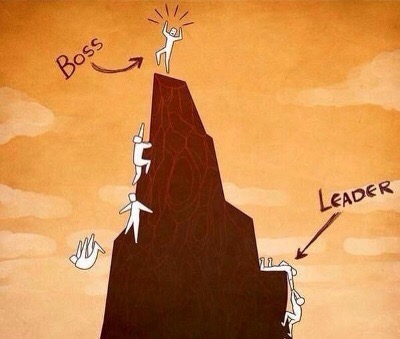 Yesterday at Harvard University I had the opportunity to learn from and work with Jerry Murphy, former Dean of the Harvard Graduate School of Education. He is doing exciting work around the idea of ‘Dancing In The Rain.’ His idea is he wants us to flourish as a leader. The ‘Dancing In The Rain’ metaphor comes from wanting us, as leaders, to have an upbeat and realistic way of living in stressful times. I have actually played in the rain and I can tell you it is an upbeat experience. Jerry is currently writing a book on this and I cannot wait till it is published. Trust me, it will be a must read!
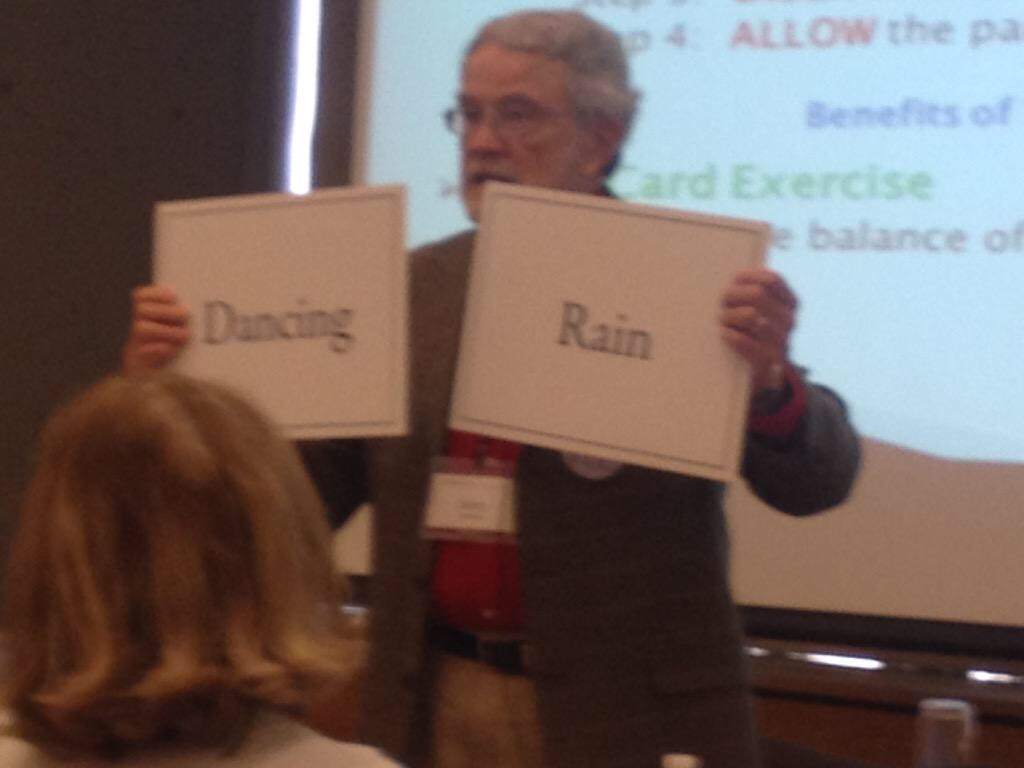 Jerry Murphy has developed a framework called ‘MY DANCE.’ Without going into much detail in this post, I would like to just share the framework.
MY DANCE FRAMEWORK:
Step 1: M – Do what MATTERS
Step 2: Y – Say YES to here and now
Step 3: D – DISENTANGLE from upsets
Step 4: A – ALLOW the pain life brings
Step 5: N – NOURISH myself
Step 6: C – Practice Self-COMPASSION
Step 7: E – EXPRESS feelings wisely
This post is really about Step 1: M – Do what MATTERS. It is the idea that what really matters are your core values. We cannot let our circumstances or discomforts that are thrown our way hijack us from what is important to us. During our time with Jerry Murphy he had us do an exercise called, ‘The Retirement Party.’ For this exercise you first imagine yourself retiring and you are attending your retirement party. Secondly, you spend a few minutes writing down four or five things that you like for people to say about your values as a trustworthy leader.
As you can imagine this exercise caused a great deal of reflection for me. I would like to share my points that I would want people to be able to say about me. Here are the four I cam up with:
1. Byron is just the kind of guy you are glad he is your friend and he has added value to your life because he has helped you grow.
2. Byron pulled me and enabled me to get to the places in my life I wanted to be. He has helped me be all I can be.
3. Byron certainly ‘Walked the Talk.’
4. Byron was able to bend in the breeze and navigate difficulties.
5. Byron was a lifelong learner.
This is not an easy exercise because sometimes you have to discover your values instead of just pulling them out of the air.
Then came the most powerful part of the exercise. He had us pick one of the statements that we wrote and think about if we were really doing and acting on that value. Then, we were to develop and action plan to truly carry out that value for everyone I serve as a leader and translate the value into action. Jerry call this Viva VIA! VIA – Values In Action. In fact he created buttons that he gave each of us. I have included a picture of the button here in this post.
My action step was for value number two: Make sure I do all I can for every staff member I serve according to their goals and professional growth plan. Sometimes it is easy to work with just a few, particularly those who are most aggressive with their own personal professional growth plans. I need to make sure and collaboratively identify those areas where the faculty I serve need to be pulled up to reach the goals they desire. This exercise really reminded me to lead my life shaped by what matters most to me. In other words what make me come alive and inspires me to lift those up which I serve.
We must remember that our values give meaning, purpose, and resolve to everything we do. As leaders, we must have a commitment to take action, even when it hurts. No matter how big the storm, the sky is big enough to handle it. Much like our storms as a leader, we must be big enough to handle them.
Bending In The Breeze: Being A Mindful Leader
 Today, while learning to be a more mindful leaders while at Harvard we did a meditation exercise looking out the window. This exercise was done in the Gutman Library at the Harvard Graduate School of Education during a session of Inner Strengths of Successful Leaders. I looked out and saw the tree that I have included a picture of in this post. It was a little windy out and the tree was gently bending in the breeze. It made me think about how as mindful leaders we must bend as the winds of difficulties blow in our everyday lives. I have seen wind break a tree that does not bend while leaving others that bend untouched.. After every windstorm there are broken branches scattered everywhere. I think, just like a tree we have a choice to either bend or break, or duck behind a windscreen.
While I agree with the observations regarding flexibility, resilence, and being adaptable. There is a fact that everyone must recognize. The tree that is highly flexible must also be rooted deeply or in a forest where the root systems intertwine and provide additional strength. A high rise building that moves up to 9 meters at the top requires a very strong foundation. A person who can bend with the circumstances must have core values and mindsets that are deeply rooted. Sometimes we need to take our mind for a walk, which was the whole purpose of the meditation at the window. We need to be aware of those things that are serving us well.
When we have difficult meetings, phone calls with difficult people, or are thrown difficult circumstances (which we will be) we need to take a mindful moment. In this mindful moment we are bending like the tree in the breeze. We need to be aware, take a moment to breathe, and show some compassion for ourselves. Also, in difficult situations we must recall what matters most to us as leaders. Another great leadership skill to remember is that when you feel the impulse to explain, LISTEN! Remember, act out of your values.
Furthermore, don’t try to get rid of difficulties, but build a bigger playing field so your values can be brought to the forefront. The leadership reality is that we will get overwhelmed. When thrown, we need to ratchet down the reaction just like the tree bends in the breeze. When thrown, our bend will be listening, looking inside to explore patterns and identify where we might be wrong, and take responsibility.
Finally, mindful leaders are poised. When we practice mindfulness we are able to bend with difficulties because of our presence and clarity to know what is happening. A great quote is, “What you resist persists.” Think about it; if the tree resists the wind and does not bend, it will break.
Driven By Data
 This morning I was so honored to have the opportunity to present at the Fusion East NWEA Education Conference in Charlotte, North Carolina. The conference theme was “Tomorrow Starts Here” and my topic was How High-Performing Schools Develop a Culture Driven By Data. It was exciting to have a standing room only crowd and I hope I lived up to their expectations.
Here is the powerpoint I used for the presentation: Ernest_NWEA_FusionEast
Here are the handouts from the presentation: Ernest_NWEA_HOOSIER HYBRID 7-12 DATA MEETING PROTOCOL Ernest_NWEA_k-8_Data Meeting Protocol Ernest_NWEA_Data Meeting Rubric final
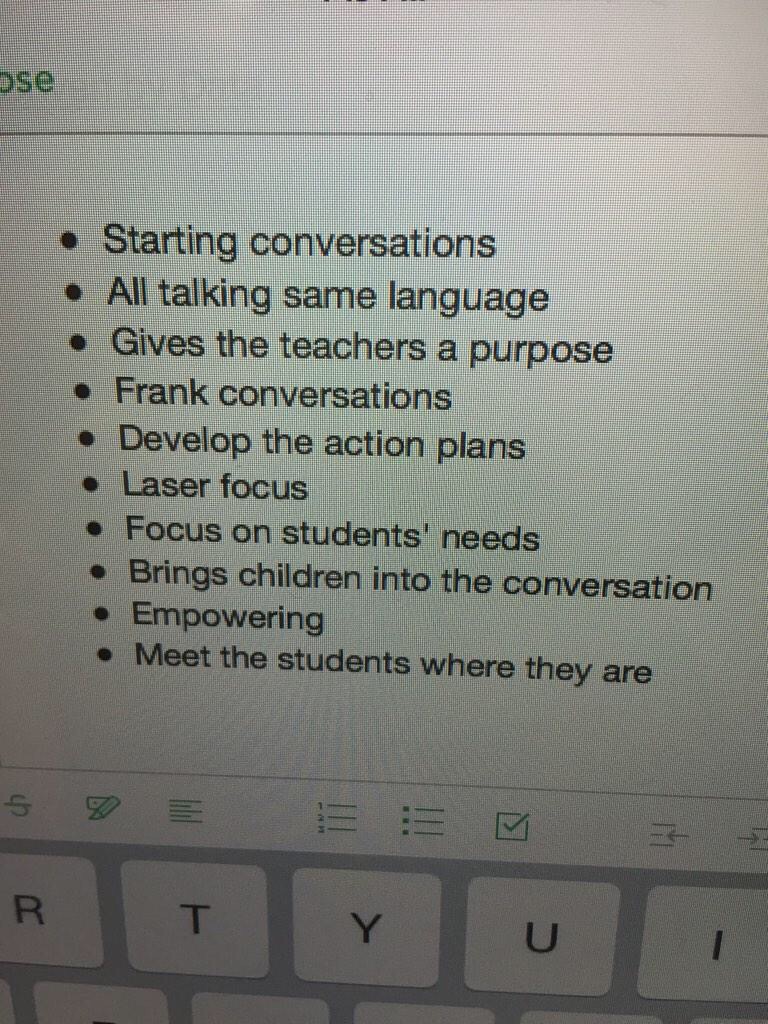
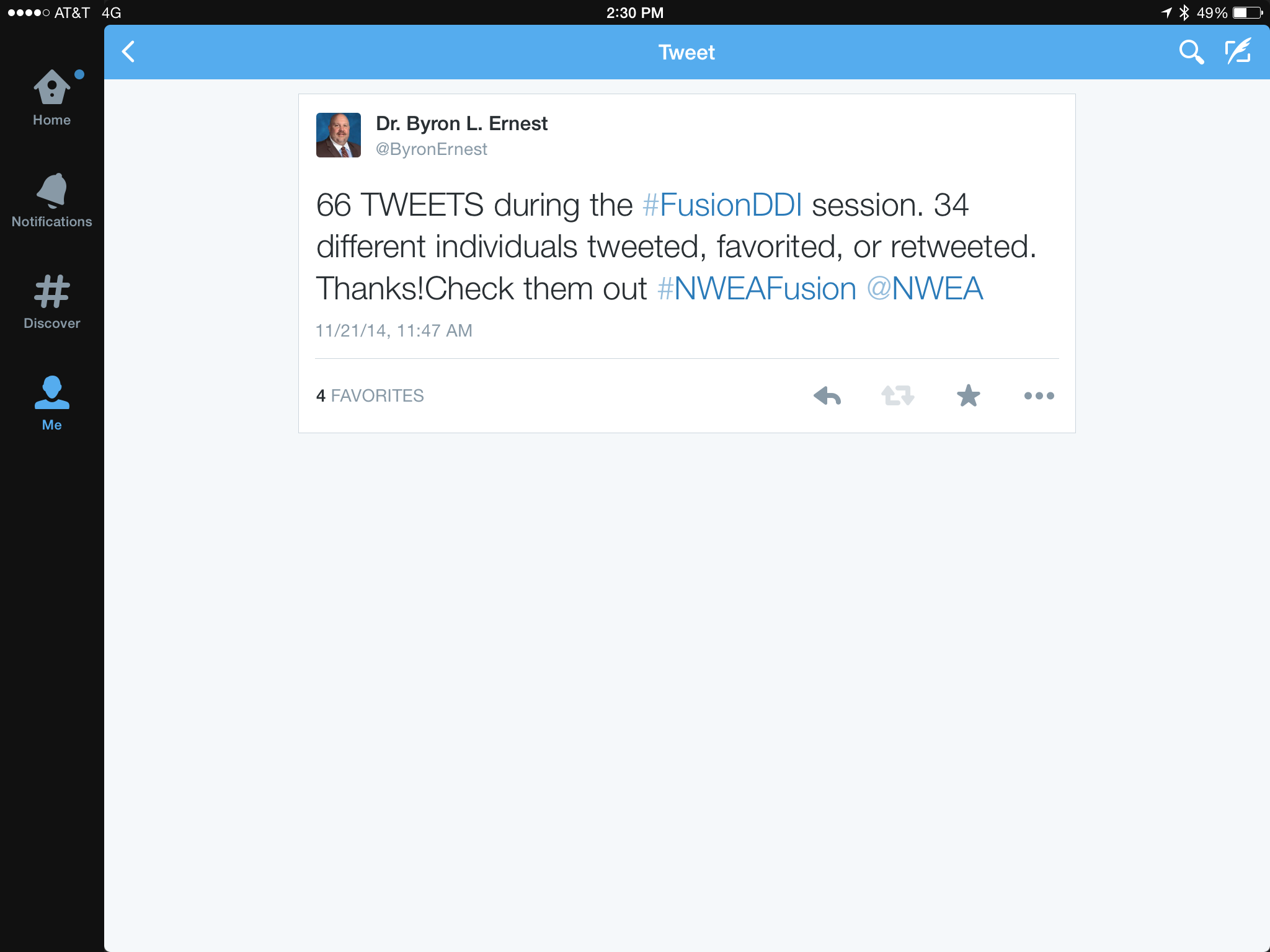
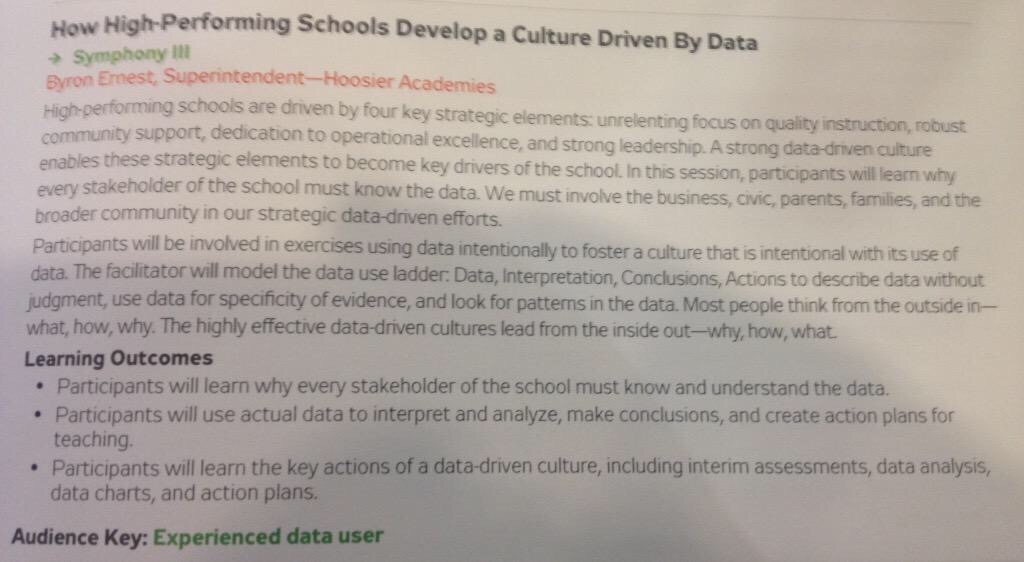 I learned a lot from this group and have shared a list of reasons why we need to create a culture driven by data as a picture in this post. This list was the guide for a very lively discussion. We also had some outstanding tweeting going on during the program using the hashtag #FusionDDI. I am proud to say that we had 66 tweets during the program from 34 different individuals. This was outstanding and further proof of the power of twitter as a professional development tool. In fact I awarded the top five tweeters during the session with copies of the two books I referenced during the session.
 The books I referenced were Driven By Data by Paul Bambrick-Santoyo and Mindset: The New Psychology of Success by Carol Dweck. Both of these books offer so much toward developing a culture driven by data.
Finally, I want to give you some bullets of top tweets from the program:
-“If you don’t have time to do it right, when will you have time to do it over.” ~ John Wooten
-Data chats must be a regular part of your school culture.
-Data chats should be a safe place for teachers
-If your teachers change their teaching, can your students describe how it changed their learning?
-For a data driven culture to really work – there has to be coaching, observation, and feedback.
-Action plans developed after data analysis can be more effective if they are shared with your students.
-You have to describe the data without judgement
-If you don’t see it, it doesn’t exist.
-Assessments are about growth, not gotcha!
-Effective analysis – dive deep! What happened and WHY?
-Effective interim assessments should revisit material from earlier in the year, not just graded unit tests.
-Assessments must be cumulative
-We tend to assess what we taught best
-Data driven instruction gives proof that what we are doing is working, or not.
-Just because you’re teaching…it does not mean they are learning
-I wanna be a Sherpa! Let’s get good at using data! Not just me…but the culture of our schools.
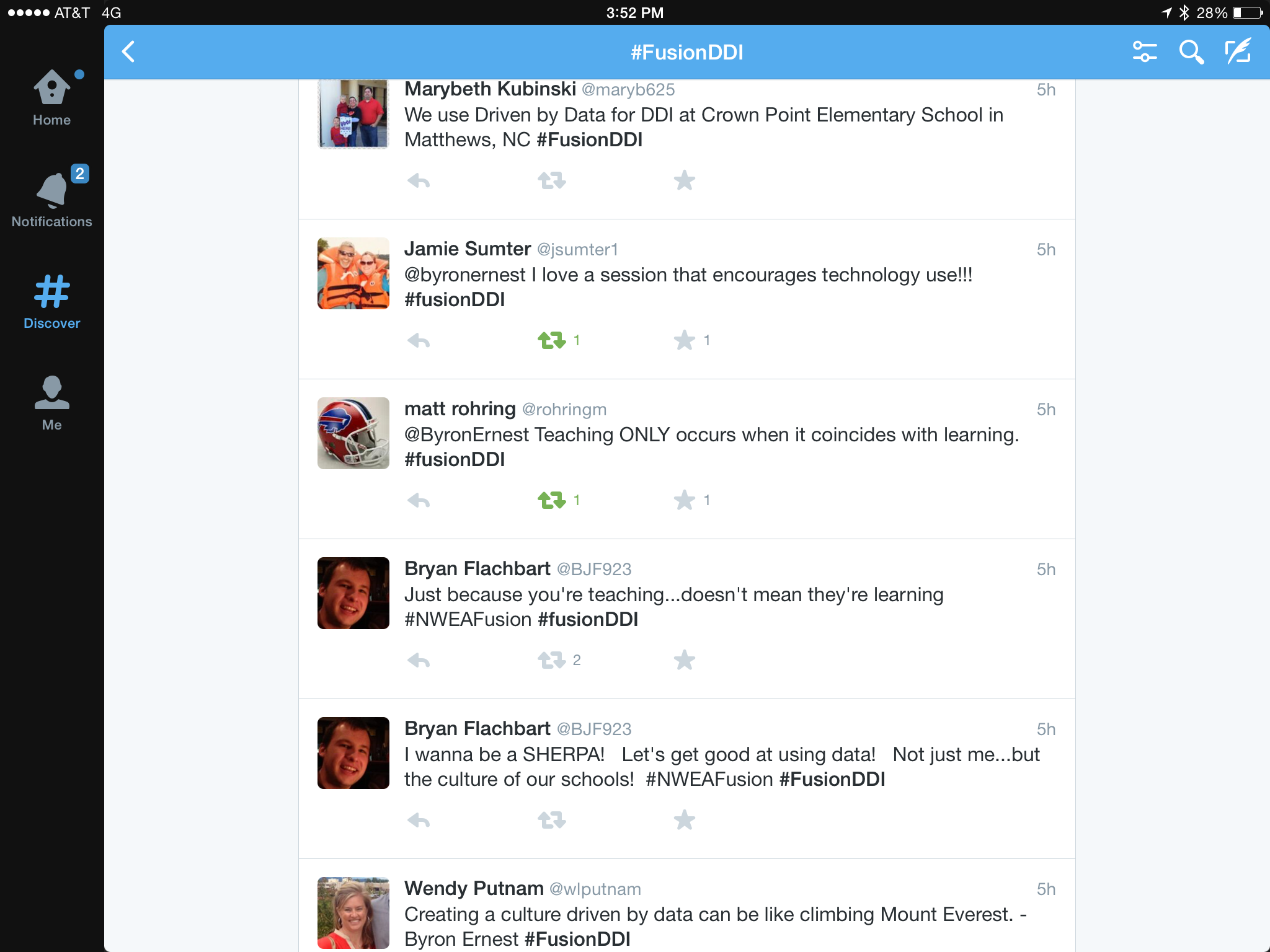 As you can see this was a pretty thoughtful group this morning. I hope I had a small part in helping them be Sherpas of their students’ learning.
“Deer In The Headlights”
 I have been to several great conferences lately and I realized something about some of the so called “experts” that present at the conferences. Now I have to be careful here because I was a speaker at all of these conference. But, I realized that in some cases the person doing the presenting has not had the experience of being the “deer in the headlights.” Usually this term is associated with being a bad thing, but I have come to realize that it really is a great thing. To really become an expert or great at leading in a certain area or circumstance you really have had to be the “deer in the headlights.”
Having successfully served as a principal for a takeover/turnaround school that broke the failing school cycle and came off the “F” list; I can say I truly was that “deer in the headlights.” I still remember that first day of the students coming in, the looks on their faces and saying, “what have I got myself into?” Then a week later after our first round of NWEA testing and seeing that only 19% of our students were on grade level, I was not only the “deer in the headlights,” but the deer smashed in the front grill of your car. Then we began to navigate and I fell in love with our students, as did the whole staff, and we turned the school around. That experience is truly at the top of my list for my career.
My experience under fire really honed me as an educational leader. I learned so many things that I could have never learned had I been in an “A” school. There were so many issues to navigate: students not on grade level, behavioral issues, staffing issues, students’ personal and family issues, operations issues, facility issues, extracurricular issues, teacher coaching, and many, many more. Don’t think for a minute that I believe myself to be an expert leader in all of those areas, but let me tell you I did have to lead the charge on all of these areas and I did learn and grow from it.
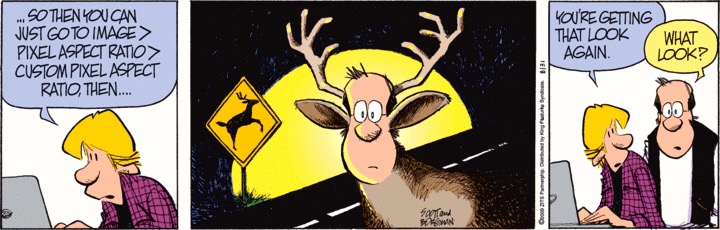 So, my point in this post to my blog is to not be afraid to be the “deer in the headlights.” Don’t be afraid to take on projects or career changes where you will be that “deer in the headlights.” I seem to have moments like that every day, but I am better and growing from it each and every day. I can think of many leaders who have become very status quo about their own professional growth and development. Really, those individuals are like old farm equipment sitting in the fence row rusting. Don’t let yourself become rusty.
I have been reading Water the Bamboo: Unleashing the Potential of Teams and Individuals by Greg Bell. I am so excited to be speaking at the same conference (NWEA Fusion East) this weekend in Charlotte, North Carolina. I can’t wait to have him autograph my book. In his book he suggests developing a personal mission statement. I did. It is: In my professional life, my vision is to always be the “deer in the headlights.” As Bell says, “To accomplish a great vision you will need laser-like focus.” Just imagine the learning I will be doing!
Eliminating Hoops & Hype in Education
 I have had an absolutely incredible first day at the 2014 National Quality Education Conference in Milwaukee, Wisconsin put on by the American Society for Quality and the ASQ Education Division. I was excited to speak on my research of connecting school work to real life, but was more excited to hear the other speakers. Additionally, as always, I learned a great deal from visiting with the other program participants. This post is a compilation of my learning from the first half of the day. You can also check out my tweets from the day by using the hashtag #ASQEd or following my tweets at @ByronErnest.

The day started with Lee Jenkins as the keynote speaker. Lee is education’s expert in continuous improvement. He started by talking about removing the hoops and hype from education. Hoops were described as waste in a school’s time, money, and enthusiasm (staff and students). Hype is a change with no way of know if we’ve improved. The secret to removing hype, according to Jenkins, is to have baseline data to know if an intervention is working or not. Much of Jenkins thoughts on this come from the book: The Toyota Way To Continuous Improvement by Jeffrey Liker.
It is very important that we take an attitude of wanting to be superior to our former selves. If you think about this from a school improvement standpoint it makes perfect sense. We have a starting point and just need to keep getting better from there. Our goal here needs to be to outperform the year before. The secret to this improvement is root cause analysis. When you dig into root causes you find things you never expected to find. When we know the root causes we are able to remove what Jenkins calls “Blamestorming.”
Think about that term “Blamestorming.” We have all done it. We can blame the legislature, political leaders, school leaders, lack of time, too many standards, standardized tests, lack of money, too much money, too many programs, et cetera. But, these are not really root causes. We must dig down deep and find the root causes. Think about this question: Was it the reading program we purchased that improved reading, or the fact that the program required that we triple the amount of time spent reading every day? Think about that. If the root cause was needing to triple the amount of time reading we could have done that without any new program cost, professional development cost, or all the other woes that come with implementing a new program. It is why programs and initiatives don’t work – teachers do! That’s me talking there; not Jenkins.
Remember, if we eliminate the hoops and hype we can optimize our systems for our students and employees and optimize the delivery of our curriculum.
 Byron's Babbles
2 comments