Leading Learning
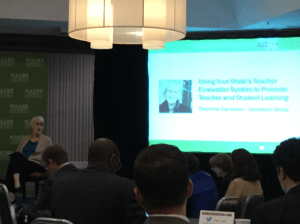
Charlotte Danielson Speaking to NASBE Members on April 4, 2016
This past week I had the opportunity to take another deep dive into the new Every Student Succeeds Act during the Legislative Conference of the National Association of State Boards of Education (NASBE). It was also great to not only listen to Charlotte Danielson of the Danielson Group, but I was also able to have a lengthy personal conversation with her about innovation in education, teacher evaluation, and teacher leadership. The thing that impresses me most about Charlotte is that she is always thinking continual improvement and innovation. She made a few comments that are appropriate as we consider leading learning. Let’s face it, students learning is the ultimate goal we need to be achieving in education. The phrases that Charlotte said that resonated with me were, “Learning is done by the learner,” and “Teaching is cognitive work.” As we lead learning I believe it is very important that we keep these two thoughts in mind.
The goal must be to shift the thinking on the student and how the instructional environment supports student thinking. Teaching is a constant work of improvement – a career that involves learning and rethinking our approaches daily. It’s a very interesting concept if we reconsider that we’re always developing our practice. If we are to be successful we must start with the student as the focus and lead the learning from there. The student must always be at the center – this is always critical to success in leading learning.
In my studies at Harvard University around leading learning, I have had some key takeaways that came from the idea that, “Learning might be best described as the process by which information becomes knowledge” (City, Elmore, & Lynch, 2012, Chapter 6, p. 153). This when put together with the thought that, “Knowledge…is information plus meaning, where meaning is acquired through experience or education” (Chapter 6, p. 153) frames a fertile environment for innovation in education. It allows us to take education outside the walls of the traditional schoolhouse. It allows school to be any modality where some combination of information, knowledge, and learning flows from some portal to the learner (City et al, Chapter 6, 2012). As a leader of learning I want to continue to use the lens of education as learning instead of school as a physical place of learning. (City et al, Chapter 6, 2012). These key takeaways came from studies of the book The Futures of School Reform (2012) edited by Mehta, Schwartz, and Hess.
As a state board of education member and someone that works in education leadership and policy development, I want to continue to make sure and educate fellow policymakers on the learning core and make sure we are leading learning and not just leading school as usual. I want to continue to improve leading learning from a policy side to help others understand how to make policy meet reality.
Leading Innovation in Education
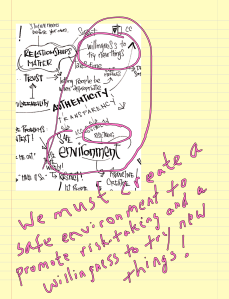 Being involved as a school leader of a network of schools offering fully virtual enrollment, as well as blended learning centers, I have experienced both the joys and challenges of being involved in innovation. Keep in mind online learning is very much still in the pioneer stage of development. Through this experience I have learned first hand the push back from individuals, organizations, and policymakers who will not even accept trying innovating in the space of online education and school choice. The same holds true for many other innovations in education as well. This makes it extremely hard at times to reach consensus for having education policy, accountability systems, and funding meet reality.
Some of the push back I refer to is well founded. When you think that we have been educating our children in much the same way for two centuries, it is natural for there to be some resistance to change. Interesting to me, however, is that an analysis of data from all the traditional means by which we deliver education to our children suggest we should be pushing back on some of those means as well. By their very nature, innovations are new and untested. Therefore, it is unreasonable to expect that all innovations become immediate success stories and be evidence-based. At the same time, the education field has a long history of promoting the latest fads and “flavors of the month” that turned out to be, at the least, ineffectual, and at the worst, have children falling further behind. I am certainly not suggesting we contribute to this unintended consequence either. Sometimes, though, I worry that we have not given some very effective and innovative ideas enough time to see if learning gains will be experienced.
In the world of education, innovation comes in many other forms than just the online world. There are innovations in the way education systems are organized and managed, exemplified by charter schools or turnaround academies being managed by education management organizations (EMO). There are innovations in instructional techniques or other delivery systems. We need ongoing innovation in the area of customizing learning for every student. This is very important in serving every student. There are innovations in the way teachers are recruited, prepared, and compensated. I have had the opportunity to work with Teach for America teachers and would put them up against any teacher preparation program. The training and disposition of these teachers to work with struggling urban students who are behind on both skill and grade level is outstanding.
We must continue to encourage creativity and innovation in addressing our most important challenges in education. I believe we need more opportunities for innovations to pass through a peer review process focused on the project’s design. This would provide an opportunity for vetting of the ability of the innovation to be brought to scale and be duplicated. Schools and other innovators of learning must place rigorous, experimental evaluation designs in place so that, over time, we can learn if practices are effective.
Additionally, we need to continue to think about how to accelerate innovation time and evaluation of the effectiveness of those innovations. I believe collaboration is the key here. Innovations are best designed when they are a direct result of a need in a specific school context. We need to make sure our teachers and staff have the necessary time and resources to reflect and be creative in developing customized solutions for the students he or she serve. Finally, we need to continue to develop robust networks for sharing innovations and best practices.
Big Opportunity Leadership
 On my flight home from Washington DC last night I had many things on my mind. One of which was the newly signed into law Every Student Succeeds Act, or ESSA as most people refer to it. ESSA was the reason I was in our Nation’s Capitol for the National Association of State Boards of Education (NASBE)Legislative Conference. We had the opportunity to work through what state boards’ role will be in the implementation of ESSA. I was reflecting on how much work there was to be done implementing this new and great bipartisan law that gives a great deal of power back to the states – Patrick Henry would be proud. Consensus has been reached to pass ESSA into law and now it is time for implementation. John Manning (2015) referred to this as execution in Lesson #40 of The Disciplined Leader. As I was reflecting, the pilot came on and said we had 327 miles left to Indianapolis. Because the Wright Brothers are my idols, I could not help but say a quick thank you to them for executing their plan for first flight. They took advantage of what John Kotter calls the “Big Opportunity.” Because of them, I am able to be home from Washington DC in a little over an hour. That is one big opportunity!
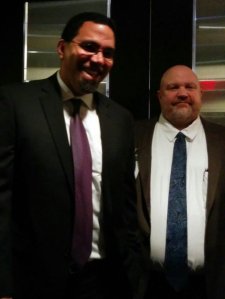
Secretary of Education John King & I
Manning (2015) discussed creating ownership in solutions. ESSA empowers many to take advantage of the big opportunities. I had the opportunity to be with our recently confirmed Secretary of Education John King, yesterday morning and we discussed the opportunities for state legislatures, state boards of education, schools, and many other stakeholders to work together for implementation of ESSA. This implementation really plays into John Kotter’s Dual Operating System approach to change. As we implement ESSA in Indiana I hope we will use the five premises from Kotter as our guide for taking advantage of the “Big Opportunity” – equity in education for all students. Secretary of Education King also left us with this very important thought, “Schools save lives!” Again, that is one big opportunity. These five guiding principles are:
- Having many change agents – by having state legislatures, state boards of education, state departments of education, and many other stakeholders involved in the collaborative implementation we should have innovation and creativity for coming up with the best practices for our students.
- Creating a “want to” not “have to” mindset – Now that the power has been placed in the state’s hands for implementation of ESSA, we must be excited and have a “get to” approach.
- Head and heart, not just head – This is easy when we are implementing law to serve our children.
- Leadership, not management – This is important for me as an Indiana State Board of Education member. I must do my part to provide the leadership to keep the strategy of ESSA implementation in tact.
- Many systems, one organization, lose the hierarchy – everyone must be a part of the “big opportunity.” Again, there must be collaboration from many different stakeholders.
 Manning (2015) taught us to “stay the course” and execute. What “big opportunities” do you have on the horizon for implementation?
Jenga Masters Leadership
 This has seemed to be the year of Jenga for our school as we build our leadership capacity. You know, the great balancing game with the rectangular blocks. The metaphor of the game of Jenga continues to pop up everywhere in our school’s leadership journey. Click here to watch a video of Jill Landers and I playing a wicked game of Jenga recently – we are the Jenga Masters! We used Jenga as a way to represent our vision and mission earlier in the school year as a way to make sure everyone understood the parts of our vision and mission. Then, we decided to completely redo our vision and mission and add core values as a project of our
 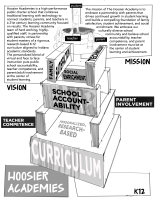 Focused Leader Academy. To do this we started by using a “Design Thinking” model. I cut 18” pieces of tongue and groove lumber and the teams built models of the ideal vision, mission, and core values. The exercise made learning visible. As the project progressed our Focused Leader Academy members were learning how to develop a vision, mission, and core value.
To understand the illustration of the Jenga metaphor, you need to get on board with a few ideas:
- Imagine the whole of the tower is the total sum of your entire organization, including leadership capacity.
- Imagine each block is some sort of capital (leadership, a moment/shared experience/word/deed, student, family, teacher, leader, curriculum, technology, et cetera) that is part of entire organization, school, or business.
- A block-in would be an organization building action while a block-out would be a situation whereby the organization would be weakened or damaged.
- When using the Jenga model, one must assume all capital mentioned in the second bullet point are equally important.

Click here to watch a video of our journey building our own Jenga models when creating a new vision, mission, and set of core values for Hoosier Academies Network of Schools.
Here are some thoughts on why Jenga makes such a great model to use for leadership training, creation, and “Design Thinking:”
- Strong leadership everywhere in the organization equals well-built Foundations. The potential height of the tower depends a great deal on how well you build the foundation and how many blocks you commit to it. The stronger the shape, the more intentional the design and placement and the more blocks you have, the higher you can build.
- Removing just one block weakens the structure. When you remove one of the blocks, the entire structure becomes more unstable. So when you don’t have strong leadership developed in every individual in the organization, everything gets a bit more shaky. Each subsequent move not only feels more risky, but actually does put the organization at risk.
- We have to be careful of “piling on” too many initiatives or tasks for our teams and organizations to do. If the structure is weakening or is weak, it does not help to pile on the top.
- When leadership capacity needs to be developed, the bench needs to be developed at the individual level, not somewhere else. I call this hyper-personalization of developing the team professionally. Otherwise, new attempts at building the leadership bench can seem out of place and lead to destabilization instead of continual improvement.
- No matter what, if we remove enough blocks it results in eventual collapse. The tower can only handle a certain amount of pieces being removed. We learn how to work around it, even though it hurts the overall strength and potential of the organization. But eventually, our schools, businesses, and organization cannot hold under the pressure of “weak links” so to speak; whether individuals, teams, supporting organizations, or departments. Eventually, the entire organization will falter and this can be disastrous – just as when the entire Jenga model falls.

As you can see, there is a lot to be learned from Jenga. It has certainly been a great model for us to use as we rethink our school and use “Design Thinking.” If you were consider your organization as a Jenga model, how stable is your structure?
What’s The Goal?
 Effective leaders, of the past and present, carefully articulate what the end goal is and have a robust plan to get them there. Leaders understand that they are working with scarce resources – people and capital. Their imperative is to prioritize initiatives based on the impact and the ease of implementation and then allocate their resources appropriately. I was always taught to “Under promise and over-deliver”. It may seem exceedingly obvious, but this is hard to put into practice. Many leaders, including myself, want to appear as able to do everything, but sometimes the best strategy is evaluating the end goal and choosing what not to do. Remember, the most important decisions we make are what to say “no” to.
 In Lesson #39 of The Disciplined Leader, John Manning (2015) argued for developing a “What’s the goal?” culture. By specifying goals clarity is achieved, the direction is clear, and the team stays focused. This past week we had a task force go to Arizona for school planning. While we used the best practice of a collaborative agenda building exercise, I gave them my desired end goal of solidifying our plans and doing what I called, “moving action items from being written in pencil to written in ink.” The team also set goals for what was needed to be accomplished, both for our time in Arizona as well as our overall school launch project. This vital few item of goal setting helped us to stay disciplined and get an incredible amount accomplished. It also helped us to say no to initiatives which would have caused us to lose our focus and take the eye of the ball. Are you taking the time to develop a “What’s the goal?” culture?
“Defining ‘What’s the goal?’ before taking action will save time and also form greater direction and improve execution. Drive this habit through your organization, and employees will be more productive, goal-oriented, and results-focused.” ~ John Manning
Our String History Timeline of Leadership

Chase Field – Phoenix, Arizona
I spent the past four days in Phoenix, Arizona with three of our teacher leaders working on a task force project for our school. My next post will have more about this, but there was a conversation last night during the Arizona Diamondbacks game that prompted this post. Our teacher leaders and I had the distinct honor of going to the Diamondbacks vs. Kansas City Royals game last night. We had awesome seats right behind home plate. By the way, the Diamondbacks won the game. Before the game we went to Alice Cooperstown – not really a part of the post, but I believe it was really cool to have been there! Everyone needs to go there at least once in their life.

Alice Cooperstown in Phoenix, Arizona
One of our teacher leaders, Jill Landers’, brother David Meek, who lives in Phoenix, was able to go to the game with us. David is an incredible guy and I consider myself privileged to have gotten to know him and have the chance to visit during the game. We talked, Arizona history, Barry Goldwater running for President, politics, favorite books, favorite authors (mine is David McCullough), the Wright Brothers, and the fact that Thomas Edison had a workshop in Indiana. In fact, Thomas Edison’s first invention happened in Indianapolis, Indiana. Who knew? Click here to read about Thomas Edison’s connection to Indianapolis, Indiana.
 Anyway, at one point David pointed up at the clock that is above the Jumbotron at Chase Field and said, “Imagine if there was a string stretching from us to that clock. Then imagine that the string is the timeline from the beginning of human existence. Now, recognize we are living in the last two inches of that timeline. Think about all the things we have seen invented and happen in that last two inches.” Wow, this was some pretty powerful imagery! We then reflected that you wouldn’t have to go much more than another inch to see the invention of the airplane. On December 17, 1903, Orville Wright piloted the first powered airplane 20 feet above a wind-swept beach in North Carolina. The flight lasted 12 seconds and covered 120 feet. Three more flights were made that day with Orville’s brother, Wilbur, piloting the record flight lasting 59 seconds over a distance of 852 feet. Wilbur had flown a glider in earlier tests Kitty Hawk, Oct. 10, 1902.
The brothers began their experimentation in flight in 1896 at their bicycle shop in Dayton, Ohio. They selected the beach at Kitty Hawk as their proving ground because of the constant wind that added lift to their craft. In 1902 they came to the beach with their glider and made more than 700 successful flights. I am still in awe of what these two men created and the leadership grit it took to successfully invent the design of the flying machine. Much of that design is still being used on the plane I am comfortably sitting in right now as I fly home from Arizona.

We Made It On The JumboTron
This caused a great deal of deep thought as we sat and discussed the past. Jill caught her brother and I in deep thought looking up at the clock and imagining the string and the last two inches we are occupying. In fact, Jill tweeted a picture of us to the Arizona Diamondbacks and it made it on the Jumbotron and has received several favorites and retweets. Jill and I had actually spoke earlier in the week about how things we were doing at our school, work we are doing in relation to the new Every Student Succeeds Act and other legislation in our state are historic. It is exciting to be working with talented teacher leaders, like Jill, who want to build their circle of influence and want to be significant. I want so bad for my legacy to be helping them to develop their leadership capacity and be significant to affect the future string timeline.
 As I write this post I am thinking about all of the great leaders who have gone before us, just in my lifetime. Much of the news in the United States in the year I was born (1963) was dominated by the actions of civil rights activists and those who opposed them. Our role in Vietnam was being defined, along with the costs of that involvement. It was the year the Beatles began their leadership role in beginning the rock and roll movement, and the year President John F. Kennedy visited West Berlin and delivered a famous speech. Push-button telephones were introduced, 1st class postage cost 5 cents, and the population of the world was 3.2 billion, less than half of what it is now. The final months of the year I was born, 1963, were punctuated by one of the most tragic events in American history, the assassination of President John F. Kennedy in Dallas, Texas. Here are a few other events that took place in that special year that I began my tight walk journey on that string David Meek and I were imagining stretching from our seats behind home plate to the clock above the Jumbotron at Chase Field:
Civil rights leader Reverend Martin Luther King, Jr. waved to supporters on the Mall in Washington, DC during the “March on Washington,” on August 28, 1963. King delivered his “I have a dream…” speech and said the march was “the greatest demonstration of freedom in the history of the United States.” He was a great leadership example to us all.
Astronaut Gordon Cooper took off in a Mercury Atlas 9 rocket from Launch Pad 14 at Cape Canaveral, Florida, on May 5, 1963. This was the final manned space mission of the U.S. Mercury program; the precursor to the Apollo program. Cooper successfully completed 22 Earth orbits before splashing down in the Pacific Ocean. Then, on July 20th, 1969, history was made when men walked on the Moon for the very first time. The result of almost a decade’s worth of preparation, billions of dollars of investment, strenuous technical development and endless training, the Moon Landing of the Apollo program was the high point of the Space Age and, arguably, one of the single greatest accomplishment ever made. Because they were the first men to walk on the Moon, Neil Armstrong and Edwin “Buzz” Aldrin are forever written in history.
Women were playing an important leadership role the year I was born, as 26-year-old Valentina Tereshkova, became the first woman to travel in space, on Vostok 6, on June 16, 1963
Here is a list of a few things invented just in the decade in which I was born:
- Acrylic paint
- Permanent-press fabric
- Astroturf
- Soft contact lenses
- NutraSweet
- Compact Disk
- Kevlar
- Electronic fuel injection
- First handheld calculator
- Computer mouse
- RAM (Random Access Memory)
- Arpanet (first internet)
- Artificial Heart
- ATM machine
- Bar-Code scanner
To look at more great inventions from your 0wn decade of birth, click here.
The metaphor of the timeline string stretched from our seats to the clock at the baseball game also caused me to reflect on how leadership styles have evolved over time, with a prominent shift from the autocratic, command and control leadership of the 20th Century to a more flattened and distributive style of collaborative leadership. I believe the definition of effective leadership has changed to one that includes the learning organization and the leader being a servant. These changes to leadership styles can be attributed to a combination of issues including a shift in people’s attitudes as well as advances in technology. There is an imperative for leaders of organizations, to plan ahead and adapt to the movement of evolving trends to ensure the best outcomes for their organizations. The move has shifted from authoritarian leaders who believe in top-down management, strict rules and exact orders, to a progression to what Peter Drucker called the knowledge society, with more individualized thinking and individual ownership over tasks. It was here that the participative and collaborative leadership styles of the learning organization settled in, and this style is now one of the most common leadership styles in contemporary society.
This flattened hierarchy also allows for teacher leaders to thrive and improve our schools and education system. It is with this philosophy that I brought our teacher leaders to Arizona. The task force was able to get advice from another school. We learned best practices and failures from our counterparts. This in turn provided a hyper-personalized professional development opportunity for our teachers as well. There is no workshop that could have provided the growth our teachers experience from the work they did these past four days. My hope and dream is that someday in the future others will be sitting in Chase Field, or some other Field of Dreams, and be discussing the string timeline stretched from their seats to some point like the clock on the wall. My hope and dream is that their discussion will include the example we were setting of hyper-personalized development of teacher leaders where everyone in the organization is able to provide leadership from where they are. Leadership should happen anywhere, by anyone, and at anytime it is needed.
The style of leadership I practice is where our team is central to the decision making process, and not the leader alone. Leaders need to feel at ease in regards to drawing on the knowledge of experienced followers. Today’s leaders speak in terms of “open” dialogue, “discourse,” and “collaboration,” and indeed if you ask the great leaders of today they will invariably point to their close collaborators and mentors as being part of the leadership.
What do you want your legacy to be on the string timeline of your leadership journey?
Extending Your Significance
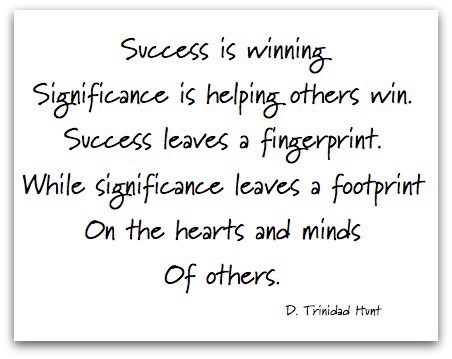 I think about and discuss a lot with team members about the idea of being significant versus successful. We tend to spend so much time striving for success; position, salary, deals, great education, degrees, et cetera that we forget about being significant. Significance is really about extending the reach of our leadership far beyond ourselves. I am working very hard at this point in my life to make everything I do about lifting others up and helping them reach the personal goals and peaks of their professions they are striving for. This in turn will create another generation of leaders to be significant for others. This would be a pretty ok legacy, don’t you think?
As I began Part III in The Disciplined Leader by John Manning (2015) I was reminded of how important it is for us to extend the reach of our leadership. Here are some great points made by Manning (2015) in the introduction to Part III:
- Leading your organization is about extending your leadership reach beyond yourself and your team to a degree that’s much further from you yet still critically connected to your organization’s center: you.
- We must grow our impact on the organization through key mindsets, strategic practices, and supportive habits you adopt, implement, and execute.
- There must be an alignment of values and people.
- We need to lead a culture of excellence creating an empowered organization of people who, led by you, believe in their organization enough to do their jobs well and build relationships with the customers who will support it.
- Significant leaders accelerate influence and expand their reach.
One way I have found to lift others is to, what I call, hyper-personalize their professional growth opportunities. Just as companies are paying more attention to customer profiles and interactions as they begin to chart out ideal buyer personas for future engagement allowing marketing teams to send out the right message at the right time to the right person, leading to more sales; we need to do the same with those we lead. We must focus on defining the individuals on our teams, their likes and dislikes, and most importantly their issues, challenges, areas in need of growth, and areas of desired,personal/professional growth. By understanding these intricate details, you can get an in-depth look at the individual, and also the factors that affect their personal and professional journey.
Are you playing a significant role in the development of those you serve?
The Vital Few of Leading My Team
 It is now time for my favorite activity that John Manning (2015) has readers do as part of reading the 52 lessons in The Disciplined Leader. The book is divided into three different parts and Manning (2015) instructs readers to pick their own three vital few from each part that he/she needs to work on. I really like that this is a part of the reading, as it provides a way to reflect on what has been learned in the reading and a chance to put the learning into my own real world context. In other words, the learning meets reality.
Click here to read my reflection and my vital three from Part I, The Responsibility To Lead Yourself. This post will be a reflection of Part II, The Responsibility To Lead Your Team. Part II included the following lessons:
- Choose the right words
- Put your game face on
- Be in the moment
- Focus on what is right, not who is right
- Don’t cross the line
- Treat everyone fairly
- Honor your commitments
- Don’t overuse the “I” word
- Surround yourself with great talent
- Hire who is right
- Empower employees
- Hold your team accountable
- Check up on daily goals
- Give effective performance feedback
- Spot opportunities to coach
- Demand more solutions
- Encourage disagreement
- Advocate for your team
- Recognize your employees
As you can see, Part II in The Disciplined Leader had some pretty heavy stuff. It took some studying and long reflecting to decide what my vital three would be. Since I had blogged about all 19 Part II topics, I also went back and studied all my posts. Here are my vital three:
- Empower employees
- Surround yourself with great talent
- Give effective performance feedback
Anyone who works with me or has spent very much time with me will probably not be surprised by these vital three. Empowerment and being surrounded with great talent is essential to the success of any organization. Performance feedback makes the top three because this is an initiative I just formed a task force of teachers to begin working on.
Empower Employees
This is a huge deal for me. I strive to create a “make it so” culture. Our team members are encouraged to be creative, innovative, and self starting. My desire is to have team members come to me with such great, thought out ideas that all I have to do is say, “Make it so!” What I have found is that the more I say “Make it so!” the more innovative and great ideas I get. This is such a powerful tool for employee engagement. We know that employees being engaged and and believing that what she is doing makes a difference is the number one item on the job satisfaction list.
Just last night we had the perfect example of this: A team of teachers presented our new vision, mission, and set of core values to our school board. This was a project of our Focused Leader Academy and our teachers worked through whole rewrite process as well organizing a board retreat session and other stakeholder feedback sessions. The beauty of the process is that the teachers owned it. And, one of the byproducts was the learning and professional growth that went along with the project. Therefore I would add to Manning’s (2015) on empowerment and say that with empowerment also comes professional growth. In fact, empowerment and professional growth are one of our core values:

Surround Yourself With Great Talent
This is so easily said and much tougher done. I am somewhat of a subscriber to the theory that talent is overrated. Skills must be developed. None of the great athletes, musicians, or artists were born with skills and talent at the top of their games. We all have had to be bad at something to get good and go on to be great. Therefore, surrounding ourselves with great talent also means we have the responsibility to help our team members grow and develop. I call this hyper-personalized professional development. This takes work. This takes a lot of work to imbed in cultures where this has not been a part before. It is, however, crucial for a culture of excellence.
This also relates to empowering our team members. If we want to empower our team members to make decisions and have autonomy to get the work done, then we must provide the hyper-personalized professional development necessary to help them become the great leaders they can be and have the necessary skills to do their jobs at the highest level. It would be ludicrous to empower employees to the level of a “make it so” culture without also provide the necessary knowledge to do the job. This would be the definition of chaos. Therefore, a vital part of my role as a disciplined leader is to go after top talent and then do everything possible to provide for the utmost personal professional growth.
Give Effective Performance Feedback
This vital part of being a disciplined leader is so related to my other vital three in this part of the book because at the core of performance feedback is professional growth. Our teacher performance evaluation process and tool that I inherited leave a lot to be desired. The reason for the deficiencies is how it was developed – top down. Basically, it was a “here it is” development process. There is pretty compelling research that suggests that affected by the performance feedback process should be heavily involved in the development. Leadership needs to come from those affected by it.
My goal for the task force I mention earlier is to come up with an evaluation process that is much more formative than punitive. There must be more regular check-in conversation and not just the once or twice per year evaluations. We are doing our teachers a disservice if all our principals do is check up on teachers once or twice a year. I am looking forward to seeing the work that our teachers do this.
Now that you have had the chance to learn about my vital few, what would you choose as your vital few?
COW Awards
 Imagine a room full of teachers “mooing” for their colleagues. That’s just what you get at Hoosier Academies Network of Schools, whether it is a face to face assembly or an online meeting. I have to admit I stole the idea from Zappos. They created COW (Creator of Wow) Awards for their employees. As an old ag teacher and farmer, I thought the idea was genius and instantly saw the possibilities. Now, I can’t attach the huge monetary value that Zappos has on their COW awards, but ours has become a just as coveted award. Think about it, wouldn’t you want to be considered a COW – Creator of Wow? Who wouldn’t?
Here’s how it works. This is an anonymous, peer nominated award. There is no limit to how many can receive the award each month and there is no limit as to how many times you can receive the award. The only qualification is that the nominator must write a justification for why the recipient should receive the award. Then each month we ceremoniously give out the awards by reading the COW nomination. What does the COW get? A COW medallion for their first COW, a trophy for the second COW, a bigger trophy for the third, and so on. This is becoming an important part of our culture. Our staff looks forward to the ceremony each month (sometimes we do it twice during the month because of the way the meetings fall) and, literally, there is “mooing” when the names and nomination justifications are read. It doesn’t get any better than that!
The COW Awards really do what John Manning (2015) suggests in Lesson #38 of The Disciplined Leader:
“Practice making your praise specific for your staff members. Give details about what was done right.” ~ John Manning (Kindle Locations 1997-1998)
Praise from COW Awards is very specific and comes from peers. The justifications have evolved into very specific descriptions of what the teacher has done to create wow. Let me share two examples of COW Award nominations (I have changed the names of the recipients):
I would like to recognize Angela for a COW Award for her FLA project. I have really enjoyed collaborating with other schools and teachers on best practices to increase attendance at class connects during our first session and on data (usage, collection, implementation) during our second session. It is so nice to collaborate not only within our school but across other K12 schools to continue to improve. We were able to share some of our ideas that they found helpful and they shared some great ideas with us as well. We now have a shared folder in google drive to continue that collaboration in between sessions and I look forward to our next meeting!
As you can see, it is a quick description of what was done. The best part, again, is that it comes from a peer. Also, I believe it is important for it to be anonymous. There should not be the feeling of obligation to thank or reciprocate the award from the recipient. Here is another example (again, I have changed the name of the recipient):
I would like to nominate Betty for a Cow Award. She initiated the African-American History event this month. Last night we held an online event to look at African-American history. The presentation she created was wonderful! It included a virtual Museum that was interactive, detailed, and very educational. The students were engaged and interacting the entire hour and a half. Today the students are invited to attend an event at Crispus Attucks to continue learning about the history. This was a huge event for Hoosier Academies Network of Schools to recognize African-American History month and due to her initiative, I’m sure it will become an annual favorite. I was proud to be a part of Hoosier last night. Thank you, Betty!
Manning (2015) reminds us that recognition is a strategy. While this is not our only recognition strategy it has become an important part of our culture of excellence. What are the best practices of your recognition strategy?
Leading Shoulder To Shoulder
 In Lesson #37 of The Disciplined Leader, John Manning (2015) wrote on how to advocate for your team. I call this pulling up shoulder to shoulder with your team. The best way to advocate for your team is to work right alongside of the people. This comes down to having a philosophy of a flattened hierarchy. I believe leadership must happen whenever and wherever necessary, by whomever can best provide that leadership. With this type of culture it is important to lead shoulder to shoulder with the team.
I like the flat organizational structure because the employees work in smaller teams and have more voice and power over how they work. Many exemplars of this structure can be found in the business community. The term I use here of being shoulder to shoulder comes from a teacher from another school district other than my own, who said to me, “You know, I’ve never seen an administrator who is so involved in every piece of the school like you are. It is not that you are micro-managing, you are just working ‘shoulder to shoulder with everyone.” Honestly, I took this as a huge compliment. I do believe it is important to work right next to those you lead. 
I have always said one my most important roles is serving as a blocker. Manning (2015) called this “overcoming obstacles.” The only way to truly advocate for your team and give them the support they need is to be right on the line (using a football analogy) with them ready to block. The other real advantage to being shoulder to shoulder with your team is the opportunity to learn the micro-knowledge of the organization from those doing the important work.
How about you; are you shoulder to shoulder with your team?
 Byron's Babbles
leave a comment