The American Commonwealth
 The American Commonwealth, part 1 by James Bryce
My rating: 5 of 5 stars
This book is for anyone who wants to better understand the experiment in democracy that has become our great United States. Every aspect of our local, state, and federal government is covered in great detail from the Declaration of Independence to the turn of the 20th Century (I read the 1914 edition). It was interesting to learn Bryce’s views on Lincoln, the Civil War, and how our Constitution served as the navigational guide. I particularly valued the Part V Chapters on Public Opinion, Colleges & Universities, and voter suffrage.
This is a very academic read that causes reflection and further study. It took me almost a year to read (keep in mind I was reading other books at the same time), but it is well worth the investment. Every leader who wants to serve their community, state, and nation positively and significantly should read this book.
Blue Heron Leadership
 The Blue Heron is one of my favorite birds. Because of some ponds on our farm we see them flying over and walking in the water often. We also see them gleaning through our fields. They are beautiful and majestic birds. After reading Lesson #19 in in 52 Leadership Lessons: Timeless Stories For The Modern Leader by John Parker Stewart I realized just how beautiful and awesome the Blue Heron really is. In fact they follow a very participatory and holacratic organization structure like I believe in. Most generally we only see Blue Herons one at a time. This is because, as Stewart pointed out, they like to stay in small groups or by themselves until nesting. At nesting time Heronies are formed to cooperatively get the work of raising young accomplished.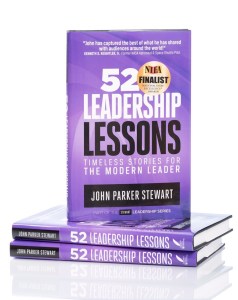
“When there is commitment and a willingness to do whatever is needed, success is far more likely. As the Blue Herons were true to each other in following through with their part, so can we as we follow their example and remain ‘true blue’.” ~ John Parker Stewart
Both male and female work together to get the nest built. After the eggs hatch both parents take care of feeding, teaching them to fly, and teaching them to catch fish. Notice there is no hierarchy here – this is about as flat a structure as you can get. There is only an eagerness to complete the task. The Blue Herons are not concerned about status or position. Furthermore, there is no complaints about fairness, equity, or doing undesirable tasks. This is the huge advantage of an intent-based environment where everyone is considered a leader. If we want our team members to work cooperatively together like Blue Herons then we must create an environment where they are able to move up the rungs of the Ladder of Leadership (created by David Marquet). The rungs are as follows (also check out the graphic pictured here):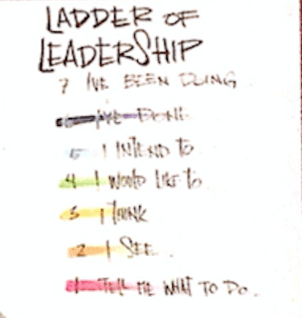
- Tell me what to do
- I see
- I think
- I would like to
- I intend to
- I’ve done
- I’ve been doing
Are you modeling an intent-based environment where everyone works cooperatively and is concerned with getting the work done, not in titles and hype?
“Go Ask Your Mother”
 I have a coworker who will occasionally comment after working with staff members that she just wants them to go ask their mothers. Usually I chuckle at this comment, but after reading Lesson #18 titled “The No-Brain Stage”by John Parker Stewart in 52 Leadership Lessons: Timeless Stories For The Modern Leader. I realize this is probably not funny. In this lesson, Stewart pointed out the basic needs of a two-year-old child. Here they are:
- They need to be cared for.
- They need security and protection
- They need to be listened to and included.
- They need their questions answered.
- They need love, reassurance, entertainment, attention, praise, and discipline.
- They even need age-appropriate responsibilities.
“If your people are acting like two-year-olds, ask yourself which of their ‘two-year-old’ needs you may have neglected.” ~ John Parker Stewart
So… if you have ever said, “I work with a bunch of two-year-olds.” You’re right. That list of what a two-year-old needs is spot on for any age group we serve as a leader, don’t you think? This lesson really caused me to think about whether I am doing my part to meet the needs of all those I serve. We all need to take time and listen deeply to our team members and make sure we are meeting their current needs. Remember, their needs do change over time.
My challenge to you and myself is to take some time and analyze the needs of those who report to me and see if those needs are being met.
Conflict Creates Energy!
 Conflict Without Casualties by Nate Regier
My rating: 5 of 5 stars
Conflict is always difficult, but it leads to growth and change, which is good. No one likes pain, but pain wakes you up and tells you when to react. This book is a guide for leaders on how to navigate conflict so it is not an energy drain but an energy source. Some level of organizational conflict is actually desirable — it’s not always dysfunctional. When conflict exists, it generally indicates commitment to organizational goals, because the players are trying to come up with the best solution. Dr. Regier gives us three critical steps to follow for creating positive energy with conflict:
- Be open and transparent about how you are feeling and what you want.
- Show a non-judgmental curiosity to explore options and look for creative solutions.
- Gain clarity about your boundaries and principles. This is a must read for leaders that want true open dialogue and dissent to find the best solutions for our global challenges.
This is a must read for leaders that want true open dialogue and dissent to find the best solutions for our global challenges.
Finding Your Leadership Voice
 This post is an excerpt from Paul Larsen’s new book, Find Your Voice as a Leader.
What Does It Mean To Be Courageous?
As you exert your influence to rally your team to your outcomes aligned with your values, finding your voice as a leader necessitates developing the courage to take steps forward, no matter how small the steps. Courage takes many forms. To stand up for what you believe. To speak up when no one else will. To test new behaviors. To change directions. To alter your opinion. To be visible. To stand alone in a crowd. To get comfortable with being uncomfortable. And the courage to believe in yourself. Though we most often associate courage with the battlefield, according to the Ivey Business Journal, courage is essential in the boardroom as well.
Although some may have a greater aptitude for it than others, courage isn’t something you’re born with. Anyone can learn to be more courageous. Some say courage is like a muscle—the more you use it the stronger it becomes.
Getting Comfortable With Being Uncomfortable
I think most people would like to believe they live a life that stands for something. That they have a job that makes a difference. That if push comes to shove, they would stand up for what they feel is right. In reality, those words and phrases are always easier to say but not always the easiest actions to take.
Not everyone is willing to be courageous if they fear any repercussions. It means taking a risk, no matter how small, being in an uncomfortable place. Did you know that when you feel uncomfortable, there might be an opportunity for growth? But with human nature being what it is, the minute we feel uncomfortable, we immediately seek an escape path back to our safety zone, our “zone of comfortableness.” So the next time you find yourself in an uncomfortable situation, stay in it, and become aware of why you feel uncomfortable. There might be something for you to learn. To try on a new skill or a new behavior. To challenge yourself. To seek a new path. To explore a new opportunity. To develop a new capability. To find your voice.
Not being afraid of discomfort is one of the key ways to learn to be more courageous, according to Forbes magazine. Not being afraid to “rock the boat” makes it much easier to stand up for what you believe. As a courageous leader, you need to have more than just a good vision and a good plan. You need to be brave enough to stand up for your team and your beliefs even when they may go against the accepted norm. You may need to challenge your traditionally held beliefs and those of others to empower yourself and your team to recognize new opportunities.
Think About This
When was the last time you remained quiet when you knew you should have spoken up? When was the last time you had an idea but didn’t say anything only to hear that same idea come from someone else later on? How many times have you wanted to speak up but didn’t? Why? What excuse did you use? Have you been feeling stuck in a rut but continue to do the same things? How does this make you feel: frustrated? disappointed? inadequate?
Now Think About This
When was the last time you stood up for what you believed in? When did you voice an opinion that was contrary to what the majority of other people were saying? When have you taken a risk and did something new: a new skill, a new activity, a new behavior? How did this make you feel: scared? excited? uncomfortable? satisfied? Probably a combination of all those and a few more feelings mixed in there. What was the outcome? Do you want to follow or lead? Do you want to remain quiet when you should speak up? That’s what courage is about: taking small, baby steps into the unknown, making yourself known, giving your opinion, asserting your feelings for what you believe is right, having an impact—having a voice.
******
Paul N. Larsen, MA, CPPC, is a Certified Professional Performance Coach and an experienced leadership consultant and speaker. He has over 30 years’ business experience with executive and senior-level responsibilities within small and large companies, including being the Chief Human Resources Officer for a $3 billion organization. Paul partners with industry-wide leaders and teams from Fortune 100, start-up, and high-tech environments to find their unique leadership “VOICE” and create compelling and purposeful outcomes for their organizations. He has a proven track record with organizations such as SAP, Electronic Arts Twitter, and Walmart. Read more about Paul and his latest book, Finding Your VOICE as a Leader at www.paulnlarsen.com.
Be A Leader!
 If you aspire to be a great leader, the first requirement is that you look and listen, so that you can find out the true needs that a situation demands to be fulfilled. It seems to me there is a general myth that leaders are born rather than made, that somehow nature produces a peculiar species of human being who is bigger, more powerful, smarter, braver, and more charismatic than the rest. During this presidential election year I have been reflecting more and more on this. I have caught myself saying, “Is the right person even out there to lead our country for continued greatness?” A democracy, more perhaps than any other form of government, needs great men and women to lead and inspire the people. Now, there are lot’s of different theories out there as to why we might lack great leaders, such as:
- Our system of government does not always lend itself to the best people being elected to office.
- We seem to linger in a perpetual leadership vacuum.
- Are we open to having dialogue with leaders who are going to bring the spark of creativity to the situation?
- Are we open to having dialogue about new and tranformative ways of doing things?
- Ego causing leadership failure.
Americans, however, myself included, maintain that when the hour comes, it brings the right person. For example, it brought Abraham Lincoln. When he was nominated by the famous convention of 1860 his name had been little heard of beyond his own state. But he rose at once to the level of the situation, and that not merely by virtue of strong clear sense, but by his patriotic steadfastness and noble simplicity of character. If this was luck, it was just the kind of luck which makes a nation hopeful of its future, and inclined to overlook the faults of the methods by which it finds its leaders.
I believe we can all be great leaders, with all the rewards this carries, while still serving the needs of the whole group. We must, however, take an introspective look at ourselves and the areas for improvement we need to make. Having looked and listened, you will know the situation you are in and the need that is crying out to be fulfilled. This deep listening coupled with the criterion values and not compromising those values shapes a model of successful leadership.
We also need to have someone else…share with us the way they experience us…because it’s hard to see our own blind spots or limiting assumptions. We need to get feedback from trusted folks we either know or do not know. Here is my challenge to you: Connect to your top professional priority. Ask yourself: What is the one thing I could get better at that would help me most with my most important professional priority? Create a personal improvement goal around this professional priority. Does the goal implicate you? Your goal implicates you if it is clear that you must get better at something. Your goal should focus on something you can control. It should focuson something specific about yourself that you want to improve. Let’s all own being a better leader.
Are You A Begonia?
 I am reading a great, award winning, and Pulitzer Prize winning book right now. The book is The Education of Henry Adams by Henry Adams. This book has such great insight into our life, what Henry Adams calls our education. His theory was we spend our entire life being educated. One of the metaphors he used in the book was of people who were like Begonias. These are beautiful plants known for their brilliant flowers and fancy foliage. The begonia has both of these lovely features. You probably get the idea; he was describing people who are all show and no substance.
When raising Begonias you must place them where they can be in the light. Do you know people like this, that need to constantly be in in the limelight? Begonias like a lot of light so place them on windowsills that face east or west so that your plants get several hours of sunlight each day. I believe this is one of the reasons Henry Adams chose this powerful metaphor.
In doing a little studying on Begonias I also found that they became a staple of many bedding schemes, and in some cases, were quite over-used. Begonias became as disliked as euonymus is as a municipal shrub. Begonias became the lazy choice for parks and gardens up and down the country, often with the same old, tired varieties; either a mushy begonia semperflorens or the superb, but over-bright ‘Non-stop’ series! Sound like any people you know that are all talk and no action?
In my research, one botanist described using Begonias as having a desire for instant color and makeover effects … one-stop gardening – disposable, dramatic and needing no knowledge beyond which way up to stick the plant in the ground. Pretty good metaphor for all we do not want to be as a leader, don’t you think? Therefore we need to strive, as leaders, to not just be seen as bright flowers and foliage in delicate vases or as great explosions of leaf and flower, all brought indoors as theatre and decoration. But when they start to fade, they all go on to the compost heap.
Leadership Echolocation: How Big Are Your Ears?
 This week’s leadership lesson (#17) from John Parker Stewart in 52 Leadership Lessons: Timeless Stories For The Modern Leader, used the analogy of how big bats ears are to help inform us as leaders. Bats have the best hearing of all land mammals. They often have huge ears compared to the rest of the body. Instead of relying on their sense of sight for night-time vision, bats make rapid high-pitched squeaks called “ultrasounds”. These sounds are too high for most people to hear. If these sounds hit something, they bounce back — sort of like when you hear your echo in a mountain or a bathroom when you shout. The bat hears the echo and can tell where the object is. This is called “echolocation”. Therefore, bats actively listen instead of passively listening. In other words they listen for the feedback. Not every species of bat is able to echolocate, but most can.
I don’t know about you, but I wish I could use “echolocation” to really listen to those I serve. This story really resonated with me as we are studying deep listening in the Developing Myself course I am taking at Harvard University right now. We are doing exercises and case studies to develop true listening skills. Think about it… Would it not be great if we always concentrated on receiving the feedback instead of spending the time when others are talking with us to be devising our response. We need to spend time developing our listening skill to be that of a bat. In other words, we need to develop “leadership echolocation.”
“The bat’s two assets are listening and receiving feedback. How do you assess yourself in those two areas?” ~ John Parker Stewart
A useful tool I was taught to use at Harvard is that of the Ladder of Inference developed by Chris Argyris. The Ladder of Inference (shown here in a drawing I did for a professional development workshop on norming for teacher evaluation – I think you will be able to see how this would be valuable for those observing teachers) has six rungs:
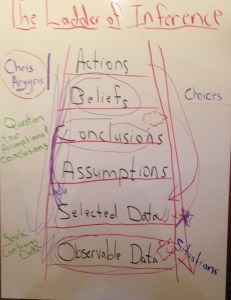
- Observable Data
- Selected Data
- Assumptions
- Conclusions
- Beliefs
- Actions
The idea is to stay low on the ladder. As you move up the ladder away from observable data you begin to make your own meaning of what you are hearing. The problem is, this meaning may not be the same as the person you are listening to. Then some recursive loops begin to come into play. As we begin to form beliefs, we only listen and select data that supports our beliefs. See the problem? The other recursive loop that if we move to the top of the ladder and begin to take action, we only look for observable data that supports the meaning we have made out of the dialogue or situation. Again, the idea is to stay low on the ladder and keep moving back down the ladder.
So, how do we do we hone and perfect our “leadership echolocati0n?” As we find ourselves moving up the Ladder of Inference there are three things that will intentionally enables us to move back down the ladder:
- Question your assumptions
- Question your conclusions
- Seek contrary data to support or refute the meaning we are making
Most of us struggle with deep listening. Next time you want to have true dialogue with someone, consider where you are on the Ladder of Inference. Doing so will increase the feedback you receive from those you serve and have dialogue with.
Allowing Leadership
 Leadership lesson #16 from John Parker Stewart in 52 Leadership Lessons: Timeless Stories For The Modern Leader, told the story of Robert Townsend, CEO of Avis Car Rentals in the 1960s and 1970s. From reading this story and then getting his book Up The Organization (2007), I would say Townsend was ahead of his time in an error of command and control leadership. He broke decisions down as being either expensive (critical) or non-expensive (non-critical). His idea was that critical decisions take time to decide and should be handled by upper-leadership and the non-critical, less expensive decisions should be handled closest to the source affected by the decisions. This is very much intent-based leadership except that with intent-based leadership all information for decision making flows up from those affected.
“The whole organization may be out of business while you oscillate between baby-blue and buffalo-brown coffee cups.” ~ Robert Townsend
I love the example given that Townsend was reported to have said, “The whole organization may be out of business while you oscillate between baby-blue and buffalo-brown coffee cups.” In other words, decisions need to be made where they can most efficiently and effectively made. In other words, leaders need to intentionally and strategically think through who is in the best position to make decisions – both critical and non-critical. Doing this will give those in our organizations stronger sense of value, ownership in what is going on, and the sense of contributing to the organization as a whole.
Don’t get caught in the delegation trap. You’re busy doing everything yourself. You know you need help, but to find and train someone would take more time than you have. So you keep working harder until you break. In order to delegate effectively make sure your people know how you go about making decisions. This is also why have core values is important. If individuals are making decisions using the organization’s they are more likely to be in alignment. I also believe even making sure that the common values of the organization and myself are known by everyone is important. For example, I believe that making sure my blog posts are readily available to those in my organization is important. I encourage them to read my posts and send links often to particular posts because I want those I lead to know what I am thinking and what is important to me. I believe this helps them to make decisions that are in alignment with the vision and mission of the organization.
Next time you are making decisions think about whether you are the right one to be making that decision. Are you the one most impacted by that decision? If not, you probably shouldn’t be making it.
H2O Leadership
 Water is key to the existence of life as we know it. That may sound dramatic, but it’s true—and dramatic things that are true are what make life interesting! The human body is 60 to 70% water. So, since we humans are already bodies of water that means when you put a team of people or organization together you have a large body of water – kind of like a lake, river, or ocean. Cool to think of it that way isn’t it?
Water has unusual chemical properties that make it very good at supporting life. Here are those properties:
-
Solvent properties of water: water dissolves many polar and charged molecules.
-
Cohesion and adhesion of water: Water can stick to itself (cohesion) and other molecules (adhesion).
-
Specific heat, heat of vaporization, and density of water: Water has a high heat capacity and heat of vaporization, and ice—solid water—is less dense than liquid water.
Water owes these unique properties to the polarity of its molecules and, specifically, to their ability to form hydrogen bonds with each other and with other molecules. Thanks to their polarity, water molecules happily attract each other. The plus end of one—a hydrogen atom—associates with the minus end of another—an oxygen atom.
“Is your team a group of separate atoms, or one giant, interconnected molecule.” ~ John Parker Stewart
In Leadership lesson #15 from John Parker Stewart in 52 Leadership Lessons: Timeless Stories For The Modern Leader, Stewart uses the metaphor of the water molecule to describe how the bonds of our team members provides the strength of our organization. Just like water molecules, our team members need strength and flexibility to form strong interwoven molecular bonds. Basically, because of water ability to stick to itself a lake or ocean becomes one big molecule. Isn’t that what we wa²²nt our organization’s people to do? In other words bond to become one single structure.
We, as leaders, must also act like water. The most successful authentic leaders are like water, instead of being powerful they are essential. Since nothing can survive without water, it’s imperative that we learn from water. How can you strengthen the bonds of connection among your organization’s team?
 Byron's Babbles
leave a comment