Be Like Potatoes Not French Fries
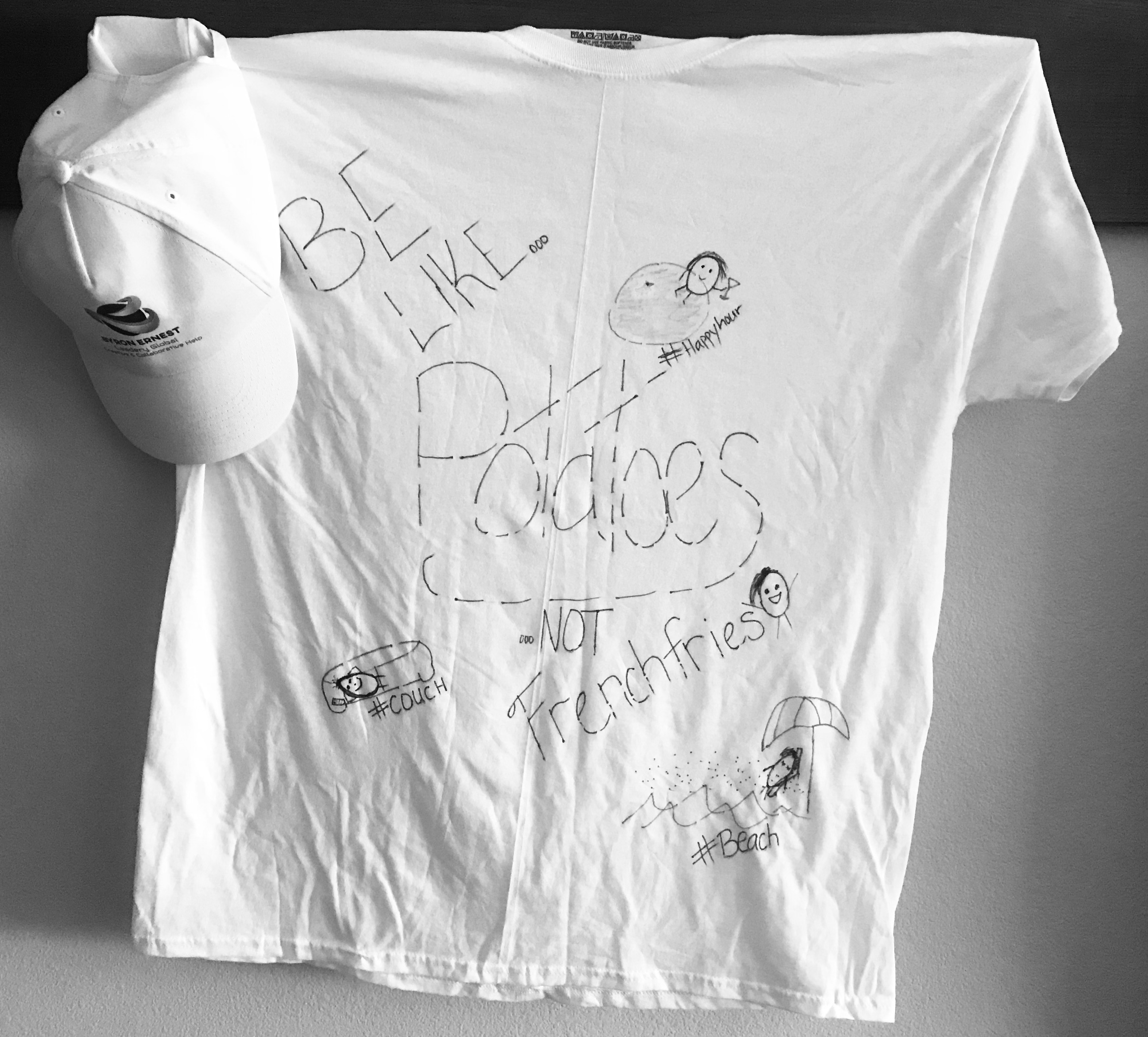
This week, a breakout group who was developing a self-care club t-shirt (see featured picture) as part of a project for a professional development I was facilitating came up with an incredible theme: “Be Like Potatoes, Not French Fries.” This was an interesting metaphor and not something I had heard before. The thought was to do everything possible to be a whole person and not processed/fried pieces. The theme was really pretty genius and I couldn’t stop thinking about it and what it meant to be a like a potato. When I studied the shirt I found it was okay to sometimes just relax and be a couch potato. Sometimes it is okay to take part in a happy hour or spend time on the beach (hard for me on a daily basis, but I was facilitating in Florida).
The point was that we don’t have to spend every moment processing and transforming every moment like becoming a French fry. To be the whole person and stay like the potato we need to make sure and schedule time for what another group called “Self Care A La Carte. Check out their list of a la carte self care items on their t-shirt:
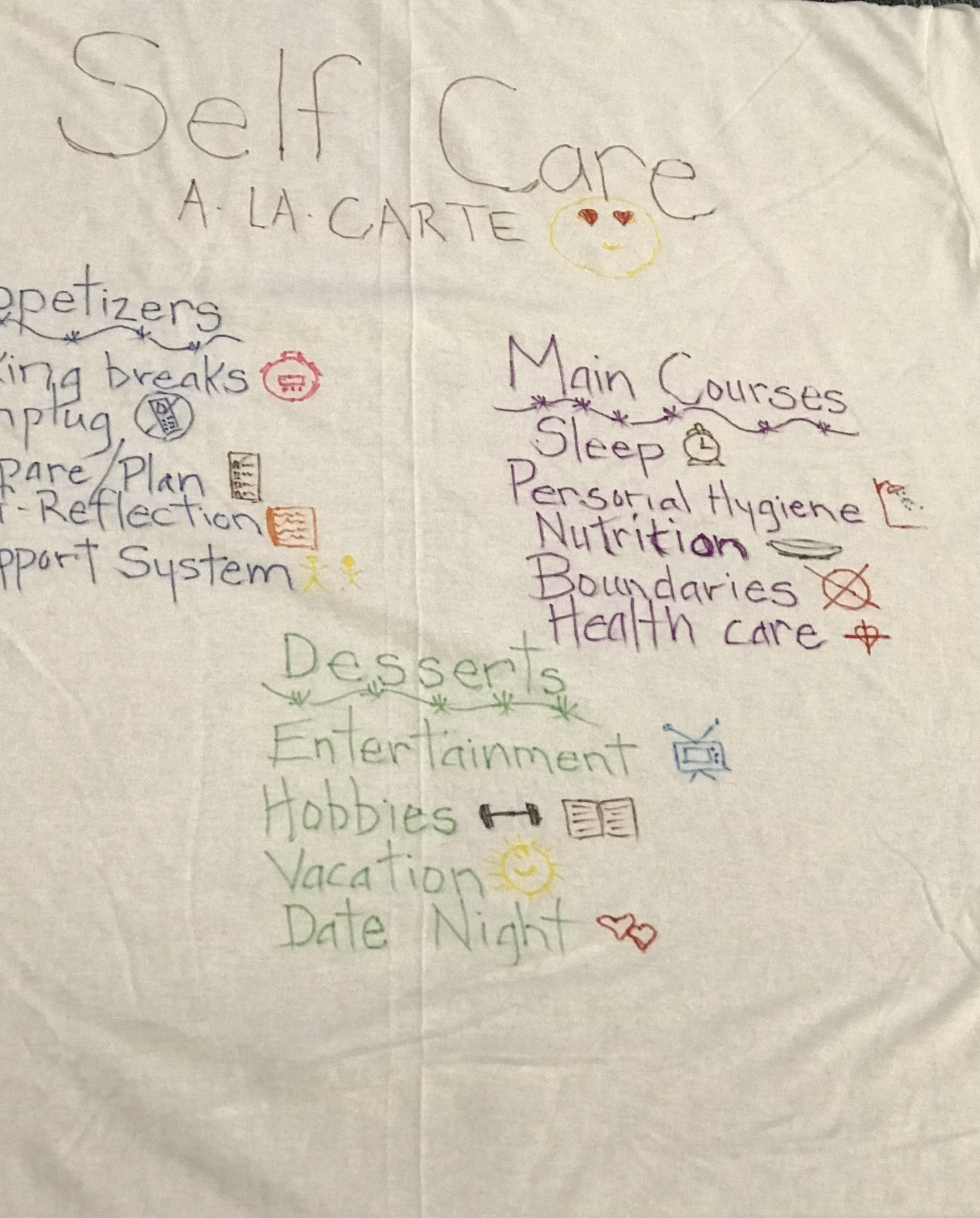
These were educators I was working with and one of the important things we discussed was the importance of focusing on self so we could effectively focus on others. As educators we provide support, how well we provide that support depends on how well we take care of ourselves. Here are some tips for having a good day:
- Get one important thing done
- Plan your perfect daily timetable
- Listen to a great music playlist (of course this should include some KISS songs)
- Go for a walk
- Leave your bad mood at home
How will you take care of yourself?
Fearmongering Leaders

“I’ve observed many leaders manage people through fear and intimidation” (p. 89). Randy Conley said this in Simple Truth #33: “Fear Is The Enemy Of Trust” in Simple Truths of Leadership: 52 Ways To Be A Servant Leader and Build Trust, Making Common Sense Common Practice, Ken Blanchard and Randy Conley. Unfortunately, we have all probably experienced it. Conley also rightly pointed out that this fearmongering can take many forms. Many times this undesirable behavior is triggered by the leaders own fear and inadequacies. Leading from fear can create a toxic culture in which people play safe, avoid mistakes and lay low in effect creating an organization that does not grow due to mediocre performance and unrealized potential. I have experienced leaders leading by fear and it caused a profound impact on whether people in the organization felt connected, cared for and empowered, or pushed aside, constrained to make decisions and held back to voice their opinions. I’ve even experienced people getting yelled at for bringing up something they had observed or heard someone asking. The leader doing the yelling failed to recognize the importance of the perception in the field she was be made aware of. All she did was cause the person getting yelled at to say later, “I’m never giving her a heads-up again.” Clearly, the empress did not want to know she had no close! A team had been created that would do things they knew would fail because they no longer wanted to say anything for fear of being berated. Not a good community to be building.
The other thing I have noticed about fear-based leaders is that the best and brightest don’t advance. One, the bad leader does not want an “A” person to possibly be showing them up, so they advance “C” and “D” people. Instead, projects and promotions go to those who have “drank the Cool-Aid” and embrace the toxic culture and agree with whatever the leader says. Our job as leaders is to make those we serve feel secure. It is also important for us to love those we serve by keeping them safe and supporting them.
Are You Invisible?

Clayton M. Christensen said, “There is no single right answer or path forward, but there is one right way to frame the problem.” Ever since having the opportunity to meet Dr. Christensen at Harvard, I’ve been a fan of this quote because I have always advocated for teaching our scholars in ways that there is no single answer. If we want to make school work look like real work it can’t all be single right answers, because our real-life problems don’t have single right answers. I was reminded of this yesterday in a meeting when someone said, “All of these answers could be right.” Therefore, how we frame the problem is crucial.
I’ve come to believe there are very few absolute right or wrong answers when it comes to decision making. There are only the best choices given the circumstances. There are good and bad decisions based on our core values, beliefs, and morals. But, again, there are very few absolute right or wrong answers when it comes to decision making. Sometimes, this keeps people from making decisions – even ones that will affect our lives. This causes us to be invisible and miss out on creating our own story. Thus why we need to be teaching our young scholars how to be decision makers in a world of no single right answers.
How do we do this for our scholars and ourselves? Here is a pretty basic four step approach:
- Frame the problem or choice to make
- Consider all the possible choices/solutions. Consider a pro/con approach
- Do the research
- Make a decision
As adults we worry we’ll make a decision that will be judged by others as “the wrong one”. I believe this fear was developed in us because our curiosity for learning is thwarted because our main goal in school was to find the “right answers” to achieve an A on the exam. By not making decisions, stepping into our strengths, knowledge, or confidence, we, and our students, become invisible.
Put The Us In Trust

As I continue my summer study of Ulysses S. Grant it has been interesting to compare the polarized political and social order of that time with today’s. We have had many periods of polarized social unrest. As I study Grant’s relationships, it becomes evident how important the “us” in trust is. This is the topic of Simple Truth #32: “There’s No Trust Without Us” in Simple Truths of Leadership: 52 Ways To Be A Servant Leader and Build Trust, Making Common Sense Common Practice, Ken Blanchard and Randy Conley. Conley pointed out that trust is a psychological and emotional construct between two people. Conley said, “There’s no trust without us – you and me, two people willing to take a risk and be vulnerable in front of each other with the expectation that the other won’t take advantage” (p. 87). Think about the greatest relationships you have; that comment by Conley pretty much sums up why those relationships are great.
“I don’t like that man. I must get to know him better.” ~ Abraham Lincoln
I love the above quote from Abraham Lincoln. We need to take the initiative to get to know others better and try to build relationships that enable putting the us in trust. Lincoln and Grant became great friends in the very short time they were able to be together. One thing my study has revealed is that the Lincoln/Grant friendship was built completely on trust. The two of them worked hard to nurture trust. Who do you need to work harder at nurturing trust with?
Give Them A Chance To Surprise You

Last night while watching Major Crimes I heard a great line from Rusty about Buzz: “The more I get to know him the more I get surprised by him.” This jumped out at me because this happens a lot and should remind us how important it is to get to know those around us. I once heard someone say, “Don’t assume a person you don’t know is just like you expect them to be! Give them a chance to surprise you!” This is so important with students. There is so much there we cannot see. We must realize that most groups, even people in “our own group,” are quite heterogeneous, and can be very different in background and beliefs.
This begs us to take care with our assumptions and always test them out. Let people explain and demonstrate who they are and what they think. I’ve often found that “enemies” are actually very similar to me in surprising ways and actually could be “friends.” At the same time “friends” turn out to not be very much like me at all. We must make an effort to get to know everyone better and give them the opportunity to surprise us.
Leading Like WD-40

Sometimes it really is “rocket science.” Pretty much everyone knows WD-40® is the go-to product for silencing squeaks, displacing moisture, preventing rust, and loosening stuck parts. You probably have a can sitting in your house, garage, or bike toolkit right now. You can find several cans in multiple locations here on our farm. Back in the day we even used more cans than now when we had to regularly pop distributor caps off and spray in WD-40® to displace condensation. In fact, WD-40’s nickname is “toolkit in a can.” What a great product!
The product itself was invented in San Diego back in 1953 to stop corrosion in the umbilical cord of the Atlas space rockets, so the product actually came out of the space era. So, yes, it is rocket science. It’s called WD-40® because there were 39 formulas that didn’t work and the 40th one did, so that’s why it’s called water displacing 40 formula. A few years ago at a leadership development gathering I was doing where participants were to bring pictures of leaders who had influenced them, we had a participant bring a picture of a can of WD-40. I loved it! What a great leadership metaphor.
The participant explained how WD-40® could help you solve almost any issue around the house. Great leaders help us and stand with us on all the everyday issues. Also, the product has stayed consistent over the years with improvements and innovations on how to best deliver, such as the Smart Straw™️ (so you don’t lose the little red straw) and No-Mess WD-40 pen. Or, my personal favorite: WD-40 EZ Reach™️ (check out the featured picture in this post). Remind you of any great leaders you’ve been associated with?
Do you have sticky sticky/rusty/inactive levers or individuals in your organization. Consider leading like WD-40® and help disperse the distractions keeping those you serve from achieving greatness.
Are You Headed For Extinction?

It probably says something about a movie that I am now writing a third blog about in as many days. I just really enjoyed Top Gun: Maverick. Maverick (Tom Cruise), still a captain, is now in his fifties and after yet again demonstrating his rule breaking ways, is tasked with what is said to be his final mission. Maverick has been ordered to train a new group of pilots for what amounts to a suicide mission. As I referred to earlier, I have already blogged about this movie in “How Do I Teach That?” and “Top Leaders Are Single Faced Not Two Faced.” Maverick has matured since 1986, when he was a young hotshot pilot. In 2022, he is a much more mature individual with regrets and a level of humility. Maverick had mature, but still had the core value of helping others. In the beginning of movie a Navy general was looking to shut down a new Stealth airplane project unless Maverick could fly it at 10 Gs. Maverick’s friend, “Hondo” Coleman said to him, “You know what happens if you go through with this.” Risking his safety and career, Maverick responded, “I know what happens to everyone if I don’t.” He did fly the plane at 10 Gs, and of course went past 10 Gs. While I won’t spoil what happened if you haven’t seen the film, teams respect someone who can get results and performs.
A rear admiral tells Maverick, “Thirty-plus years of service. Combat medals. Citations. Only man to shoot down three enemy planes in the last 40 years. Yet you can’t get a promotion, you won’t retire, and despite your best efforts, you refuse to die. You should be at least a two-star Admiral by now, yet here you are. Captain. Why is that?… The future is coming and you’re not in it. Your kind is headed for extinction.” Maverick responded, “Maybe so, sir. But not today.” Maverick proved himself relevant by personally demonstrating how the mission he was training the pilots for could actually be accomplished. When leaders lead by example, it gives their teams hope and inspires them to do likewise. As Maverick said, “It’s not the plane, it’s the pilot.” Maverick also taught us with, “What is achievable comes down to the pilot in the box.” We learned that what is achievable in our organizations comes down the team and having the right people in the right seats on the plane (pun intended).
Top Leaders Are Single Faced Not Two Faced

Yesterday I blogged about the great movie Top Gun: Maverick. In “How Do I Teach That?” I discussed the great line from Maverick (Tom Cruise): “It’s not what I am, it’s who I am. How do I teach that?” Today, I want to post about the other great line that jumped out at me. Twice during the movie two different people said to Maverick, “Don’t give me that look.” Maverick’s response is so telling. His response showed his genuineness and was very endearing, when he simply said, “It’s the only one I got.” How about that for authenticity? Pun intended here; top leaders are single-faced, not two-faced.
Two-faced leaders are actually selfish. Unfortunately we all have probably experienced the two-faced leader who projects “My desire to take all glory and not be inconvenienced is infinitely more important than your personal and professional development.” Sometimes I’m not sure that’s how they truly feel, but that’s the message being screamed from the two-faced leader to everyone.
Maverick did not forget everyone is human. In the case of flying a fighter jet their must be excellence and perfection. Yet, we all know humans make mistakes. Therefore Maverick developed pilots to, in his words, “Don’t think. Do.” Now, that mantra got Maverick in trouble at times, but he was his authentic self. He also wanted pilots he would ultimately be flying with to be able to respond with spit second accuracy without thinking.
The other thing that showed Maverick’s authenticity was his genuine concern for people. The higher ranking officers would have considered the mission a success even if the pilots had not returned. This was unacceptable to Maverick. No one was dispensable. No one! We must maintain a painfully imperfect and human working environment that embraces excellence. This allows people to do their best because they can be themselves. Remember, like Maverick, we only have one face.
How Do I Teach That?

I’m not sure when I had last been in an actual movie theatre before last night for Top Gun: Maverick. It had been several years, though. My son was home and the family decided we would go. Great experience. Great movie. 🎥 Great popcorn with all the butter. 🍿 It really was a great movie. It was incredibly well-made and had many great leadership and teaching lessons. There were a couple of great lines that Maverick (Tom Cruise) made in the movie that jumped out at me. The one we will explore here is:
“It’s not what I am, it’s who I am. How do I teach that?”
Pete ‘Maverick’ Mitchell to Ice
At first Maverick rejects and dismisses the idea of being a teacher. In the end his students prove him wrong. The best leaders I’ve experienced have been teachers – they have worked to help develop me or give me development experiences. The leaders who are the worst at teaching or the ones that worry that someone will exceed them are the ones that have great talent slipping through their fingers. This idea of how to teach “who you are” is one I have contemplated over and over in education. In this movie it came down to the timeline of the mission being compressed so much that it sets off a wave of despondency and doubt within the ranks. The possibility of mission success seems hopeless. Maverick proves it can be done, however, by doing it. He stretches himself almost to the breaking point to serve as an inspiration to his young recruits, who now see what’s possible.
Do you model and set an example for those you serve? These are both great strategies for teaching.
Just You Leadership

“No pretenses, no masks – just you.” ~ Randy Conley in Simple Truths of Leadership: 52 Ways To Be A Servant Leader and Build Trust, Making Common Sense Common Practice, Ken Blanchard and Randy Conley. This is the 31st week of the year and I am on Simple Truth #31: “People Admire Your Strengths, But They Respect Your Honesty Regarding Your Vulnerability.” When we allow ourselves to be seen as less than perfect, others get to really know us beyond title or position. When others see us modeling this, they are more inclined to do the same.
“I think when you’re vulnerable, people realize that you, too, are human. And, perhaps even more importantly, they love your ownership of your personal positive and negative characteristics.”
Colleen Barrett, President Emerita of Southwest Airlines
I was actually discussing this with a group of teachers last week. We were discussing how back in the day, teacher educators would tell you to never let the students know if you didn’t have/know the answer. I hope no one is still giving this terrible advice. From experience, let me assure you that showing some vulnerability with students is valuable. Some of the greatest labs we did in my agricultural science classes were ones that didn’t work. Student would say, “What happened?” I would then say, “I have no idea, but l’ll bet we can figure it out together.” We would proceed to “figuring it out” and a series of learning moments would follow. Let me tell you, Colleen Barrett, president emeritus of Southwest Airlines was right; the students loved that show of vulnerability and it made our relationship stronger. Vulnerability is very powerful when it is authentic. Are you willing to be “just you?”


leave a comment