Selfish Or Self-Centered

As C. S. Lewis put it in Surprised By Joy: The Shape Of My Early Life, “The distinction is not unimportant.” He was referring to the distinction between being selfish or being self-centered. He preferred being selfish over self-centered. In fact I believe he was really on to what we now talk about being self care. Being selfish and being self-centered are not interchangeable. Lewis discussed that to find joy we need to have some selfishness. We need to prioritize our own needs, desires, and interests. These are the things I talk about when discussing self-care. This includes setting up the boundaries in a working relationship. The self-centered leader wants us to give up our personal priorities to make themselves look good. Is it selfish to not take emails after 5:00? Probably, but probably good for your well-being and your family’s well-being. Does it mean you are selfish if you may have to give up some of the above and beyond things you do as a great school principal during the next year to spend time finishing your dissertation for your PhD? Yes, but there is no way that milestone in your life will be met otherwise. These are completely acceptable forms of selfishness.

Conversely, being self-centered means having an excessive focus on oneself, often accompanied by a lack of interest or concern for others. This is the person that always needs to be in the limelight. It involves being preoccupied with one’s own thoughts, concerns, and desires, disregarding the needs and perspectives of others. Lewis explained that the self-centered person can never find joy. A self-centered person wants to hear about themselves. This person will constantly steer conversations towards themselves or dominate social situations without regard for others’ interests or feelings. The self-centered person is also unwilling to share or compromise.
I’m glad that in Surprised By Joy: The Shape Of My Early Life C. S. Lewis caused me to contemplate this difference between being selfish and being self-centered. The selfish person can have a healthy focus on himself versus the self-centered person’s complete disregard for others’ well-being and perspectives. This distinction is not unimportant. We must care for ourselves and make sure we are prioritizing our own needs and desires.
Being Curious Not Judgmental

I loved hearing one person tell another yesterday, “I’m being curious not judgmental.” I loved that because it means that the person saying that is expressing interest in understanding or learning more about something, without passing any negative or critical judgments. The individual was approaching the situation with an open mind and a genuine desire to gain knowledge or information, rather than making assumptions or forming opinions based on preconceived notions.
Curiosity invites us to ask questions, explore new ideas, and engage in meaningful conversations. By embracing curiosity, we create a culture of continuous growth and development, both individually and as a society. Honing our curiosity allows us to challenge our own assumptions and biases. When we are curious, we actively seek out different viewpoints and opinions, even if they differ from our own. This helps us overcome stereotypes and preconceived notions, promoting inclusivity and reducing discrimination. If we can approach others with curiosity, we show genuine interest in understanding their perspectives, experiences, and beliefs. This fosters empathy and enhances our ability to relate to others.
Watch Out For Getting Our Tongue Into Our Cheek

In his essay, “On Three Ways of Writing for Children,” Of Other Worlds in the book On Writing (and Writers), C. S. Lewis spoke of a complement an author had gotten. He said, his tongue “never once got into his cheek” (p. 79). He was pointing out the author didn’t use sarcasm or irony in their writing. Their words were sincere and straightforward, without any hidden meanings or humor.

When speaking about writing for children he said, But only such good as involves treating them with respect. We must not imagine that we are Providence or Destiny (p. 80). I believe this holds true for all ages. Sometimes when we try to use sarcasm whether in writing or in-person oratory it can be taken wrong. I am not one that prescribes to no humor or sarcasm, as anyone who knows me will attest. But I do know we have to watch that. One, in-person we must know our audience. When in-person with a group we know well or have a relationship with, it can be effective. In written works where we can only predict who our audience will be we have to be very careful – it can be taken wrongly and not even in the context we mean it. This also holds true for groups we are in-person with. I know I have to really watch this and wanted to share.
Love In Leadership

Loving those we serve is an important part of leadership because it creates a positive and supportive environment. If we genuinely care about the well-being of our team members, this love fosters trust, collaboration, and motivation. It’s more than having people feel valued and appreciated; it’s about their leaders truly having their best interests at heart and acting on their behalf. First, this love in leadership is the right thing to do for others. Second, this love leads to higher job satisfaction, increased productivity, and stronger loyalty towards the organization. Finally, love in leadership helps build strong relationships and enables leaders to better understand and meet the needs of their team members.
Yesterday at a reception I was attending in Tucson, Arizona I told a table of full of teachers, “thanks for being so engaged during sessions I had done during the day.” Then after we had chatted for a bit and I was getting ready to move along to chat with others, I told them that I loved them. One in the group was impressed with my use of love. We then got into a discussion of what “love” means in the context I was using it in. I love, pun intended, having that discussion because I believe we must love others. It means we are practicing both the golden rule and the platinum rule. So, how do we really provide love for others?
A friend of mine Dr. Lindan Hill shared Ashley Montague‘s definition of love, “Profound involvement in the well-being of others,” with me. Dr. Hill and I have had many a discussion about this and we are both very committed to loving those we serve. I believe Montague’s definition refers to a deep and genuine concern for the welfare and happiness of other people. It suggests that love goes beyond superficial feelings or attachment and is a genuine desire and commitment to support and care for others. This love is selfless. I want to emphasize here the active engagement that love entails, rather than simply a passive affection or attraction. Ultimately, loving those we serve allows for effective and compassionate leadership that brings out the best in everyone involved.
Testing Our Beliefs

In A Grief Observed, C. S. Lewis said, “Only a real risk tests the reality of a belief.” This really jumped off the page at me. Lewis used the metaphor of easily believing a rope could support and save you until you actually needed the rope to support your weight – then doubt sets in. This was a reminder to me that in order to truly understand the validity or truthfulness of a belief, one must be willing to take risks and put that belief to the test. It suggests that simply believing something without any real-world experience or evidence is not enough to determine its truth. Only by facing the consequences of a belief can we truly evaluate the reality or accuracy of a belief.

Another thing I learned from Lewis in this book is that it is okay to question our beliefs. Ultimately, this can make our beliefs stronger. Lewis’ questioning of his own faith and beliefs at the time of losing his wife did not mean he was going to change his beliefs. This curiosity about our own beliefs can be healthy in helping us understand how we came to have a certain belief. It can also help us to understand others’ beliefs. By educating ourselves on issues we can better understand our our beliefs and the origins of those beliefs.
Learning Compassionate Accountability
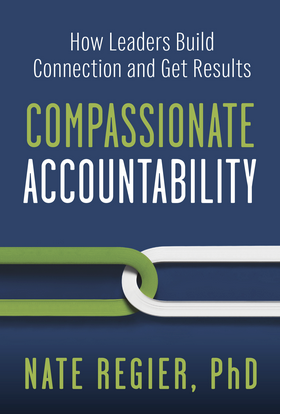
Compassionate Accountability: How Leaders Build Connection and Get Results by Nate Regier
My rating: 5 of 5 stars
In the leadership development work I do, we talk about empathy not being enough. For empathy to work there must be action. That action is compassion. In this book we learn that compassion is a leadership skill we can learn and improve. Most importantly, we learn, “compassion without accountability gets you nowhere, and accountability without compassion gets you alienated.” This book gives us a plan for honing our skills in compassionate accountability.
View all my reviews
Nobody’s Looking

A phrase I heard recently, although I can’t remember where I heard it or who said it, reminded me that we often worry too much about what others are thinking; or that we perceive they are thinking. In general, people are primarily invested in their own experiences and struggles. Others are not watching or paying attention to what we are doing near to the extent we think they are. People are generally more focused on their own lives and concerns rather than constantly monitoring or critiquing others. The phrase I am referring to was, “Nobody’s looking at your gaps. Everybody’s in their own story.” If you think about it, this is really true. This implies people are generally focused on their own lives, challenges, and experiences.
I know it is difficult to take the attitude of not worrying what others think, but as the quote I have shared here suggests, not as many as we think are watching anyway – if anyone at all. Individuals tend to be more concerned with their own flaws and struggles rather than constantly scrutinizing others for their weaknesses or shortcomings. The quote highlights the importance of not dwelling on your perceived faults or worrying about how others perceive you, as everyone is preoccupied with their own personal narratives and issues. As my dad used to say, “Their opinion of me isn’t any of my business.” There you have it from the wisest person I’ve ever known.
Knowing The Difference

I had the opportunity to watch an episode of The Virginian (1968, Season 7, Episode 182) recently. Trampas (Doug McClure) made a comment that really stuck with me. He said, “We need to improve the bad things, leave the good things alone, and know the difference between the two.” With so many things changing around us, I believe we sometimes forget that change for the sake of change can take away some of the great things we already enjoy. I do recognize how difficult it is at times to find the balance of promoting growth and progress while also appreciating and valuing the strengths and positives already present. Finding the right balance between change and preservation ensures a holistic approach that leads to sustainable and positive outcomes.
To “improve the bad things, leave the good things alone, and know the difference between the two” means we need to recognize and address the aspects of a situation or problem that are negative or need improvement, while appreciating and maintaining the positive aspects that are already working well. It emphasizes the importance of discerning between the two and making informed decisions on what to change and what to preserve. It is essential to recognize and appreciate the strengths and positives already present, as they serve as a foundation for progress and can provide motivation and inspiration.
Imaginative Versus Imaginary

In C.S. Lewis: A Life: Eccentric Genius, Reluctant Profit, by Alister E. McGrath, we are told that C.S. Lewis believed “imaginative” and “imaginary” are two very different things. Imaginative relates to the creative capacity of a person, while imaginary pertains to things that are fictional or nonexistent in reality. There really is a difference and the two terms deserve to be considered.
Imaginative refers to someone’s ability or tendency to imagine, create, or come up with new ideas, concepts, or images. It is often associated with creativity, originality, and the ability to think outside the box. For example, a person with an imaginative mind may be able to envision new possibilities or solutions to problems.

On the other hand, imaginary refers to something that exists only in the imagination or fantasy, and not in reality. It describes things that are not real or tangible, but are created or perceived in the mind. As examples, imaginary friends, creatures, or places are figments of the imagination and do not exist in the physical world.
Eternally Out Of Date

I am loving reading the great book, C.S. Lewis: A Life: Eccentric Genius, Reluctant Profit by Alister E. McGrath. In the book, he gives context to C.S. Lewis’ saying, “All that is not eternal is eternally out of date.” Lewis was expressing the idea that things that are not timeless or everlasting in nature eventually become obsolete or irrelevant. In other words, anything that does not have eternal value or significance will eventually fade away and lose its relevance in the grand scheme of things. I believe we must live in the present with a view toward the eternal. By viewing life this way it completely flips our priorities. Life becomes less about instant gratification and more about purpose and significance.

While it appears that Lewis believed that true wisdom and meaning could only be found in eternal truths and principles that transcend time and temporal concerns, I also believe that he was referring to being open to changes in the non-eternal. His own life took many twists and turns – even his own conversation from atheism to believing in Christ. Lewis had a deliberate intellectual strategy of open-mindedness. It has been said that Lewis had a passion for people and arguments. He could separate the person from the person’s opinion – not easy to do. Remember, if it’s not eternal it is eternally out of date! Lewis was not always this way and recognized he had to develop this ability to hear and seek to understand others’ opinions in himself. Others’ perspectives help supplement, iterate, and sometimes even change our own. Lewis understood this in both his personal and professional life, and provides an example for us to follow.


3 comments