Reconnecting
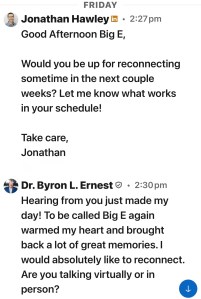
Yesterday I got to do something that I believe every educator reading this post would say are some of the greatest moments as an educator: reconnecting with former students. On Friday of last week I got this message from Jonathan Hawley:
Good Afternoon Big E,
Would you be up for reconnecting sometime in the next couple weeks? Let me know what works in your schedule!
Take care,
Jonathan
That message absolutely made my day. One, because it has been a lot of years since someone called me, “Big E.” Back in the day that was what all my students called me. Of course, I responded immediately that I would love to reconnect (see the featured photo).
Yesterday, we spent nearly an hour reconnecting. It was like no time had passed at all since we were last together. The point of this post is not to retell those stories, because those would be out of context for you. My point is however to reinforce how important building relationships is, particularly for teachers with students, and the tremendous value in reconnecting that Jonathan so wonderfully modeled for me.
As an agriculture science teacher I had the opportunity to really get to know our students and their families. In Jonathan’s case I was able to travel overseas with him not once, but twice. Those relationships then transform into incredible learning. It was so great to hear Jonathan share things he uses yet today that he learned from those experiences.
This reminder of the importance of relationships goes beyond education to all organizations and leadership. I am a believer in taking relationships beyond the surface level. Relationships matter. Relationship that go beyond surface level are built on a solid foundation of trust and mutual understanding. Those deeper connections provide emotional fulfillment and satisfaction that transcends mere service or reciprocity.
Reconnecting with people from our past can be incredibly fulfilling and wonderful because it allows us to rediscover shared memories, regain a sense of belonging, and see how both we and our relationships have evolved over time. It was so awesome to reconnect and get to know the Jonathan of today – a father of three and successful leader and professional.
Moments like yesterday bring an inspiring reminder of the bonds and experiences that shaped us, fostering feelings of nostalgia, gratitude, and renewed connection. This reconnection also offered new perspectives and insights, enriching our understanding of ourselves. For example, it inspired this post and me to think deeply about others I need to reconnect with. How about you? Is there someone you need to reconnect with?
Balancing Ambition and Realism: Strategies for Sustainable Success

The other night I got caught up watching the 2010 classic The A-Team movie. If you haven’t seen it, it is awesome. The line that always causes me to pause and reflect is when Colonel John ‘Hannibal’ Smith, played by Liam Neeson, says, “Overkill is underrated.” As a person who often gets credited for turning ordinary things into big deals or events, I love the comment. Now, I get the fact that in the movie as Hannibal makes the comment that he is dumping an entire box of fireworks into a distraction that probably only needs a couple, but stay with me for the analogy.
Sometimes, going above and beyond or exceeding expectations can be more effective than just meeting minimum standards. In leadership, this reminds us the value of thoroughness, extra effort, and attention to detail—showing commitment and inspiring confidence. It encourages us to deliver more than what’s necessary to achieve excellence and foster trust. I like going into this mode on projects because of the shock and awe effect of it. I’m reminded of going big or going home!
While the idea of “overkill” can often lead to high-quality results and demonstrate dedication, I would be remiss if I didn’t recognize there are situations where it might not be the best approach. There have been times where I have caught myself going into “overkill” mode and was in jeopardy of overextending efforts or using excessive resources on a task that doesn’t require it can lead to inefficiency and waste.
While ambitious dedication is admirable, and I believe a good thing, it’s important to balance effort with practicality and context to ensure that striving for excellence remains sustainable and appropriate.
Leading a Stronger Team: Embracing Diversity Like a Vibrant, Harmonious Beach Scene

Yesterday was an absolutely beautiful day on Tybee Island. Sunny, no wind, and 70°F (degree Fahrenheit) or 21°C (degree Celsius). The beach was full all day and it was fun to watch people come and go. Some were coming as individuals, some as couples, others as groups of friends, and others as families. Some came with fishing gear, others with beach gear to camp out for the day, others with games and kites, and some just to take a walk. Many had just stopped to walk out and stick their toes in the Atlantic Ocean. Then at the end of the day, as the sun was going down, people in bathing suites were leaving meeting others just arriving in sweatshirts and coats.

As I witnessed all this it got me thinking about how we all experience nature in different ways. Some of how we show up is dictated by how we like to show up at the beach, but for others showing up is dictated by the group they are a part of. This made me reflect on how our workplaces and organizations are not much different. Do we have a culture that invites belonging and differences in how we show up?
Think about it. Just as each person brings their unique mindset and goals to the beach, team members come with their own backgrounds, motivations, and expectations. Our teams show up based on the makeup of the team. As leaders it is important for us to recognize and respect these differences, allowing us to create an inclusive environment where everyone belongs and feels valued and understood.
Some team members may seek collaboration and connection, much like those enjoying socializing at the beach. Others might prefer solitude or focused work, similar to someone peacefully reading alone. Some may be adventurous and eager to try new things, akin to exploring tide pools or surfing.
By understanding these varied ways of showing up, we can practice adaptive leadership by providing support, setting appropriate challenges, and fostering a culture that appreciates diversity. This ensures all voices are heard and empowered, leading to a more dynamic, resilient, and cohesive group—just like a lively, harmonious beach scene where everyone’s presence contributes to the overall experience.
Reflections of Success: How Mentors Help Mentees Recognize and Leverage Their Strengths

This morning as I was watching the sun come up and how the ocean was serving as a mirror of the sun reflecting its brightness and beauty, I was reminded how important it is for us, as leaders to reflect those we serve strengths back to them. As I worked with a group of mentor teachers this past week, we discussed how being a great mentor and leader involved reflecting strengths back to mentees. Just what does that mean, though?
It means the mentor is aware, recognizes and reinforces the individual qualities, skills, and potential that each mentee possesses. Highlighting these strengths, by reflecting them back, the mentor helps the mentee see their own capabilities more clearly, boosting their confidence and encouraging further growth. This acknowledgment not only validates the mentee’s efforts but also empowers them to leverage their strengths in future challenges, fostering self-awareness and resilience along their development journey.
So, as we reflect on our own personal and professional lives, let’s not forget to turn the mirror around and reflect the strengths of those we serve back to them.
Flocking Together: How Community and Camaraderie Boost Creative Success

Those that follow me know that I love Pelicans. They are amazing birds and there are so many leadership lessons we can learn from them. I have blogged previously about them in Pelican Leadership Lessons and Leading From The Optimal Height. I am in Georgia doing some work right now and yesterday was watching these incredible creatures while spending some time on Tybee Island.
Lately, I have been doing a lot of studying the literary discussion group from the 1930s and 1940s at Oxford University that included C. S. Lewis and J. R. R. Tolkien – the Inklings. As the tide came in yesterday morning there were groups of Pelicans putting on a show of their collaboration and holding each other accountable. Both the Inklings and Pelicans served, in my mind, as analogies to each other, and leadership.
The Inklings were known to be a close-knit, supportive community where members shared and critiqued each other’s works regularly, fostering mutual growth. The accountability that came from this included honest feedback, but the strong relationships and camaraderie enabled encouragement, cheerleading, and a collective pursuit of artistic and intellectual excellence—much like a flock of pelicans working together while fishing or migrating.
Pelicans are social birds that travel and hunt in groups, relying on cooperation for survival. They often communicate and coordinate their actions, holding each other accountable to stay organized and effective. Pelicans collaboratively move fish into groups for successful hunting of food. Pelicans, just like the Inklings did, thrive on their relationships to collaborate and work together toward a common goal —literary creation or efficient foraging.
The synergy of the relationships encouraged the support of one another in the Inklings. This support provided accountability; not in the form of punitive pressure, often associated with accountability, but by ensuring progress through collaboration. The Inklings shared purpose can be compared to that of the Pelicans. While the Pelicans shared purpose is survival, we know from research that many of the great literary works from Inkling authors would not have happened without their social group of accountability.
So, let’s be cognizant of the power of cooperative, communicative, and mutually supportive relationships that enhance our efforts through camaraderie and shared accountability.
Finding That Perfect Shell On The Beach

For 2026 I have chosen George MacDonald’s Diary of an Old Soul, Annotated Edition (2024) to guide my daily devotion and study time. MacDonald first self-published these poems (one for every day) in 1880. I have become a fan and student of George MacDonald because of my deep studies of C. S. Lewis. Lewis was deeply influenced by MacDonald at the age of 16 when he purchased a copy of Pantastes.
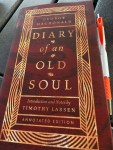
The edition of Diary of an Old Soul I am studying was expertly annotated by Dr. Timothy Larsen. I loved Larsen’s use of metaphor in the introduction, which was an incredible read in and of itself. Using metaphor, he said, “Your chosen path is the rocky bed of a stream that has temporarily gone dry. With each step you sweep past scores of stones – all of them ordinary, uninteresting, unworthy of your time.” Larsen then goes on to say, “Then a particular one catches your eye.” He was using this metaphor to cause us to think about poetry.
Larsen explained how every poem an author does, including MacDonald’s 365 in Diary of an Old Soul, will not necessarily jump out at us like the stone that catches our eye. Larsen explained this is not our fault nor the authors. Some poems will resonate with us and not others and visa versa. This reminded me also of how some musical artists songs really inspire us, but do not inspire others. This why there are so many songs on an album.

Then yesterday, when walking on the beach at Tybee Island, Georgia, I found myself walking in a bed of shells (see featured photo). They all looked unremarkable. All of the sudden, however, one jumped out at me. See the photo to the left. It caught my eye as beautiful and I took a photo of it.
There are so many lessons that can come from the stones and shells metaphors. First, it reminded us not to look at everything from a purely holistic viewpoint. We need to make sure we are looking for those individual pieces that inspire, motivate us, or cause us to pause and reflect deeply. Think about a book you are reading. Every chapter may not be exciting to you, but there may be those individual pebbles (pun intended) that jump out at you and inspire. A perfect example is how Larsen’s use of the bed of stone metaphor inspired this post.
Also, consider a conference you have recently participated in. Every session may not provide something for immediate use, but I’ll bet we can think of parts that we have copious notes from that we will immediately put to use. We need to be watching intently for those moments so we don’t miss the beautiful shell (again, pun intended).
It is all about how we show up. We must truly be present in every moment to find those gemstone moments that catch our eye and attention. As Larsen said, “The very act of attending to it deepens your admiration for it.” I am finding myself having to read MacDonald’s poems multiple times to fully understand the 1880 language they were written in. But I have been deeply moved to reflection by four of the six daily poems already. Are you staying alert for inspiration that may be right in front of you?
Always Evaluating Everything

Jerry Jones, owner of the Dallas Cowboy’s was on Netflix Christmas Gameday before the Dallas Cowboys vs Washington Commanders game. Jones made the statement, “We are always evaluating. We evaluate everything,” It was interesting to hear him talk about evaluating and offers several valuable leadership lessons. Here’s where my mind was going:
- Continuous Improvement:
Emphasizing ongoing evaluation encourages a culture of constant growth and refinement. Leaders who regularly assess processes, strategies, and team performance foster an environment where improvement is a continuous goal rather than a one-time thing. - Adaptability and Flexibility:
By stating the Dallas Cowboys evaluate everything, Jones was highlighting the importance of being adaptable. We must stay open to change, recognizing that what worked yesterday might not be effective tomorrow. This mindset allows organizations to pivot and evolve as circumstances shift. - Data-Driven Decision Making:
Constant evaluation often involves analyzing data and feedback. When we prioritize evaluation, we rely on facts and insights rather than assumptions, leading to more informed decisions. - Accountability and Excellence:
Regular assessment signals a commitment to high standards. Organizations that evaluate everything demonstrate accountability at all levels and foster a culture where striving for excellence is embedded in daily operations. - Learning from Failures and Successes:
An environment of ongoing evaluation encourages learning from both successes and failures. This enables us to identify what works, address issues proactively, and celebrate achievements, thereby motivating our teams. - Transparency and Trust:
Open evaluation processes can promote transparency within our organizations, building trust among team members because everyone understands that outcomes are scrutinized fairly and constructively.
Jones’ approach reminds us we must remain vigilant, curious, and dedicated to progress, ensuring our own teams stay competitive, resilient, and aligned with the purpose, vision, and long-term goals of our organizations.
Rising Above The Situation

“It is a peculiarity of man that he can only live by looking to the future—sub specie aeternitatis” (p. 72). This declaration by Viktor Frankl in Man’s Search for Meaning really jumped out at me and is so true. Frankl went on in the book to say, “And this is his salvation in the most difficult moments of his existence, although he sometimes has to force his mind to the task” (p. 72). He then went on to share how he would imagine himself in a warm and comfortable lecture hall lecturing attentive students rather than worrying about all the trivial tasks of being in a concentration camp.

I am one of those people who always loves having things to look forward to. I love having the next trip, next big project, next goal, or next big vision to imagine. This is, I’m sure an over simplification, but it seems to me that these futuristic imaginations can also take up space in our brains that would otherwise be vulnerable to stress and anxiety. Anticipation is a powerful feeling. That giddy excitement we all get when looking forward to something helps us feel more capable of dealing with what’s on our plates.
“…it did not really matter what we expected from life, but rather what life expected from us.” ~ Viktor Frankl
This also made me think about vision boards being such a powerful tool. Frankl was creating a vision board in his mind of being back in a lecture hall doing what he loves to do – which he ultimately accomplished. When we visualize what we want and are looking forward to, we put it into our universe. We are essentially telling ourselves what we want and bringing it into our surroundings.
“Life ultimately means taking the responsibility to find the right answer to its problems and to fulfill the tasks which it constantly sets for each individual.” ~ Viktor Frankl
When we have a clear picture of what we want to achieve and why it matters (our purpose) we’re more likely to stay focused and committed to taking action. Research also tells us to focus on the process and journey, not just the ultimate goal. Frankl was practicing mental rehearsal or visualization, which research now shows can significantly influence beliefs and decision-making, akin to real experiences.
Tears Give The Courage To Suffer

It turns out that crying is good for us. There was a great article in Harvard Health Publishing titled “Is Crying Good for you?” (2021). It is a very insightful article and I highly recommend reading it. In Man’s Search for Meaning Viktor Frankl said, “But there was no need to be ashamed of tears, for tears bore witness that a man had the greatest of courage, the courage to suffer. Only very few realized that” (p. 78). Frankl believed that crying is a natural and healthy emotional response, and there is no need to feel ashamed of it.

Furthermore, Frankl saw tears as a genuine expression of our human sensitivity and vulnerability, which can be an important part of the healing process. He emphasized that acknowledging and expressing our feelings, including crying, allows us to confront and process pain, suffering, or joy authentically. In Frankl’s view, suppressing tears or emotions might hinder personal growth and resilience, whereas embracing them fosters a deeper understanding of oneself and can provide emotional relief.
I have spoken often about how we used to cry when I was leading the turnaround of schools. Almost every day someone was crying. I mention this in Fireside Chats. For those teachers, and myself, it truly had the affect Frankl spoke of. That time spent crying together, allowed us to confront and process pain, suffering, or joy authentically. We needed that emotional outpouring.
A Why To Live For Can Bear Almost Any How
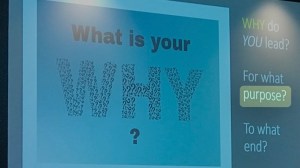
In my post, “Would I Have Done The Same Thing?,” I mentioned that Angela Duckworth suggested either reading for the first time or rereading Viktor Frankl’s seminal book, Man’s Search for Meaning. This book has a treasure trove of great content causing deep reflection and contemplation. Three times in the book so far, Frankl has quoted Nietzsche, who said “He who has a why to live for can bear almost any how.” Frankl argued these words were a motto which holds true for any psychotherapy.

Frankl went on to say, “In the Nazi concentration camps, one could have witnessed that those who knew that there was a task waiting for them to fulfill were most apt to survive” (p. 104). Frankl believed that when we discover our “why,” or our personal meaning, we can withstand suffering, hardship, and adversity because our purpose sustains us emotionally and psychologically. This idea aligned with Frankl’s own psychological approach, known as logotherapy, which centered on the search for meaning as the primary motivational force in human life. Therefore, he saw Nietzsche’s words as a powerful reminder that purpose can serve as a guiding light, helping us navigate life’s challenges with resilience and hope.
 Byron's Babbles
leave a comment