Ring Of Power

I am reading J. R. R. Tolkien’s The Fellowship of the Ring right now as part of my Continuing Scholar work at the Marion E. Wade Center. In the story Gandalf told Frodo, “A Ring of Power looks after itself, Frodo. It may slip off treacherously, but its keeper never abandons it. At most he plays with the idea of handing it on to someone else’s care – and that only at an early stage, when it first begins to grip.” Even though J.R.R. Tolkien did not like the use of allegory or intentionally use allegory, the “Ring of Power” can serve as a powerful metaphor with valuable lessons. For example, it can illustrate the dangers of absolute power and corruption, the importance of humility and restraint, or the idea that what seems to offer power and control can ultimately lead to destruction.

Using the “Ring of Power” as a lesson encourages us to reflect on how the pursuit of power influences behavior and decisions, emphasizing caution, self-awareness, and the need for integrity in leadership and personal choices. Just like the ring and the power the ring possessed were almost impossible to give up, so are the many powers we often possess impossible to give up and become all consuming and fuel a desire for more.
The “Ring of Power” can also symbolize the seductive nature of material possessions and the way they can influence our values and priorities. Just like the ring grants immense power, material things can seem to offer security, status, or happiness. However, they can also become sources of obsession, greed, or distraction from what truly matters. The lesson is to recognize how attachment to material possessions can lead us astray, encourage moderation, and remind us to value inner qualities like integrity, humility, and meaningful relationships over fleeting material wealth. Ultimately, the ring serves as a reminder that true strength and fulfillment come from within, not from external possessions.
Learning System


Yesterday, during a leadership development gathering we got into a discussion about developing a coherent “high-quality learning system.” We then talked about defining a learning system. Here is what I came up with:
A high-quality learning system is a structured framework designed to facilitate effective education by incorporating key components that enhance the learning experience. It is differentiated to meet diverse learner needs, responsive to feedback and changing circumstances, relevant to real-world applications, transferable across contexts and disciplines, rigorous to ensure depth and mastery of content, and usable by learners to apply knowledge confidently in practical situations. Together, these elements create an environment that promotes meaningful, adaptable, and enduring learning outcomes.
A few other elements of a high-quantity learning system that I subsequently considered for addition were:
- Consider the development of the adults facilitating learning. This would be andragogy – the method and practice of teaching adult learner.
- Making sure an environment, with the necessary supports, is created so students belong.
- Provide a supportive learning ecosystem – culture, family, community, resources
All of these considerations should help lead to a responsive learning environment.
Leading With Clarity And Certainty

Can providing clarity and certainty be crucial in providing safety and a safe environment? This came up in a discussion today and it really got me thinking about how much clarity, certainty, and safety are related. Providing clarity and certainty is essential for creating a safe environment for working and learning.
When individuals know what to expect, understand the rules, and feel confident in procedures, it reduces anxiety and confusion. This fosters a sense of security, encouraging people to take risks, ask questions, and engage fully without fear of hidden dangers or misunderstandings. Clear communication, consistent policies, and well-defined boundaries all contribute to building trust and safety, which are fundamental for effective collaboration and growth.
Vertical alignment is an essential component of creating a clear and cohesive environment. When organizational goals, values, and expectations are aligned from top to bottom, it fosters transparency and consistency. This helps build trust among team members, as everyone understands how our individual roles contribute to the bigger picture.
By ensuring that we communicate effectively and support consistent policies, vertical alignment reinforces a sense of security and predictability. This clarity encourages those we serve to take risks, ask questions, and engage more fully, knowing they are working within a well-defined framework.
Lead More Like Sprite, Not With Spite!

I am always in awe of great artists. Particularly the meaning created by musical artists from lyrical interpretations and symbolism. Most recently, I have become enthralled with the recent release of “2 Liter Spite” by Point North. The play on words between “2 liter Spite” and a “2 liter Sprite®️” is a clever and artistic pun that adds layers of meaning to the song. Since “Spite” sounds like “Sprite,” it might symbolize something refreshing or appealing on the surface, much like the soda. However, “Spite” carries a negative connotation—resentment or malice—which contrasts with the light, bubbly, and refreshing image of Sprite. This contrast could suggest themes of deception, superficial appearances hiding darker feelings, or the idea that what seems appealing or harmless might actually contain bitterness or hostility underneath.
In the context of the song’s themes about masks and facades, this pun could emphasize how appearances can be deceiving—things that seem “sweet” or innocent on the outside may hide true intentions or emotions. It encourages listeners to look beyond surface-level impressions and question what’s genuine versus what’s fabricated.
The song explores themes of frustration, regret, and the desire for change. A lesson from this song could be about the importance of self-awareness and recognizing when our emotions or actions are harming us or others. It encourages listeners to reflect on their feelings and find healthier ways to cope with anger or resentment instead of letting those feelings fester. Additionally, the song highlights that acknowledging our mistakes is a step toward growth and moving forward.
The lyrics “Left is right, it might be fabrication; Hide a different side in different places” jumped out at me and I believe suggest themes of deception, duality, and misdirection. “Left is right” could imply that what appears to be correct or true (right) is actually incorrect or misleading (left), highlighting the idea that appearances can be deceptive. To me, “It might be fabrication” signifies that some truths or perceptions might be fabricated or false, emphasizing doubt about what is real. “Hide a different side in different places” suggests that someone might conceal various aspects of themselves or their true intentions, presenting different facades depending on the situation or audience.
If “spite” means intending to hurt, annoy, or offend another person, this song explores how people can manipulate perceptions and hide their true selves. The song encourages us to look beyond surface appearances and question what we’re told or see.
Leadership Lesson: The White Rabbit — Embracing the Journey into the Unknown

Yesterday I did a post stimulated by the song “The Great Unknown” by the band Ice Nine Kills. The song was inspired by The Matrix. In the song it says, “Down the rabbit hole we go; Can you take me away to a faraway place?; Where you go, I will go; Not a moment too late (moment too late)”. This and The Matrix reference to “follow the white rabbit” are literary allusions back to Alice’s Adventures in Wonderland (Alice In Wonderland) by Lewis Carroll. Just like Alice following the white rabbit down the rabbit hole, effective leaders must be willing to venture into uncharted territories. The white rabbit symbolizes curiosity, courage, and the willingness to explore beyond comfort zones—traits essential for innovative leadership.
The white rabbit leads Alice into the unknown, prompting her to question reality and societal norms—mirroring how, as bold leaders, we should inspire our teams and those we collaborate with to rethink established practices and embrace change. Leaders who follow the white rabbit foster a culture of curiosity, encouraging team members to ask questions, experiment, and learn from failures.
By challenging the norms and venturing down the rabbit hole, we can open pathways for groundbreaking ideas and transformative solutions. Thus leading and driving innovation. Just as Alice’s journey is unpredictable, leadership involves navigating uncertainty. Success often requires stepping into the unknown with confidence and resilience – taking us to the metaphorical “far away place.”
Like the white rabbit leading Alice into Wonderland, truly visionary leaders guide their teams into new realms of possibility. Embrace the journey into the unknown, challenge the status quo, and inspire those we serve to discover innovative horizons.
Leading By Venturing Into The Unknown

“The Great Unknown” by the band Ice Nine Kills, was inspired by The Matrix. Both the song and the movie offer some compelling themes that can be translated into leadership lessons. The song’s title, “The Great Unknown” themes artistically highlight venturing into the unknown. Effective leaders must be comfortable navigating ambiguity, taking calculated risks, and guiding their teams through uncertainty.
The Matrix, which as I said the song is based on, challenges the characters—and us as viewers—to question what they perceive as reality. For leaders, this underscores the importance of critical thinking, challenging assumptions, and embracing new perspectives to innovate and adapt. The Matrix also questions societal norms. Leaders who challenge the status quo can drive innovation, inspire change, and lead our teams toward groundbreaking achievements.
In The Matrix, the protagonist Neo, faces choices that define his path. We, as leaders, must recognize the power of decision-making and inspire our teams to take ownership of their actions, fostering a culture of empowerment. Neo’s journey is one of self-discovery and resilience. We should encourage continuous learning, resilience in the face of setbacks, and personal growth within our teams.
Change Leadership: The Iceberg Analysis and Perception Versus Reality

Back in August, a group of leaders and I got to do a presentation on next steps in a change leadership case study. Our task was to make a pitch promoting next steps using one of the five key tools of change.
The five key tools of change are:
- Problem statement;
- Stakeholder mapping;
- Iceberg analysis;
- Causal loops;
- Iteration and testing.
Our team chose to use an iceberg analysis. The iceberg analysis is a key tool in change leadership that helps identify underlying issues that are not immediately visible. Just like an iceberg, only a small part is seen above the surface, while the larger, more significant concerns lie beneath. By exploring these hidden aspects—such as underlying beliefs, assumptions, and cultural patterns—leaders can address root causes of challenges, fostering meaningful and sustainable change within our organizations’ systems.
In the context of the case study we were given, we chose to expand the metaphor of the iceberg (which is the point of this post) even further by creating a bigger iceberg (see the featured photo to see my graphic recording of the presentation) that encompasses the original. Sometimes we consider the iceberg as what we see above the surface and imagine is below the surface, but sometimes the iceberg is bigger than what we see above and below the surface. We called this perception versus reality.
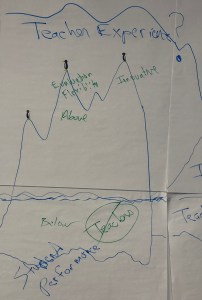
All the data in the case study we were using, which was related to systems change in a school educational system, had been collected qualitatively using administrator perceptions. We wanted to know if the positive perceptions held by administrators was reality for the teachers. Check out our graphic perceptions/realities in the photo inset (don’t miss our penguins).
This iceberg analysis that includes perception versus reality is such an important part of change leadership. Does perception meet reality? Great leaders care whether perception is reality. In the context of the case study, we needed to know if all the changes being made in this school’s systems were being experienced by the teachers in the same way as the administrators perceived them to be. Furthermore, this speaks to another key tool of change, stakeholder engagement. The teachers are an important internal stakeholder in the community that was being formed in the case study school.
I Hear You

I really enjoy the show Chicago PD. All the characters in this show are very involuted. One of the hardest to understand is Sergeant Hank Voight (Jason Beghe). He is often portrayed as a tough, no-nonsense detective who prioritizes justice and protecting his team and community. While Voight exhibits strong leadership qualities—such as decisiveness, resilience, and a sense of responsibility—his approach to the relationships with those on his team and empathy are more complex.
In an episode I was watching tonight Voight was listening to some problems one of his team members was having and he stopped her and said, “I hear you.” I love that phrase when it is real and authentic. In this case it showed he understood and knew what he needed to do to help. This reminded of me of the research done by University of Virginia psychologist James A. Coan that showed empathy and leadership are linked to feelings of compassion, emotional understanding, and supportive behaviors that foster trust and connection. Coan’s studies often highlight the importance of emotional support and empathic engagement in effective leadership.
When someone hears us, they are showing compassion by seeking to understand and appreciate our current condition. While Voight’s methods are sometimes more pragmatic and involve tough love, confrontation, or even emotional detachment, especially when he’s pursuing justice or dealing with personal struggles, he does show moments of concern and protective instincts toward his team and victims, which can be seen as empathetic traits.
Coan said that “If a friend is under threat, it becomes the same as if we ourselves are under threat. We can understand the pain or difficulty they may be going through in the same way we understand our own pain.” So when the Chicago PD character, Hank Voight says, “I hear you” this really is something that that we can do. We can understand as if the problem were our own. This is once again proof that relationships matter and relationship-building is a core part of our work as leaders.
Don’t Let The Moment Get Too Big

With the start of the college football season, I have heard the phrase “Not allowing the moment to get too big” said of quarterbacks a couple of times over the last couple of weekends. We can learn from this phrase that maintaining perspective and staying calm in a situation that might seem overwhelming or emotionally charged is an important attribute. Being a college football quarterback is a perfect example for this. A maturing quarterback and other maturing leaders learn to not let the significance or intensity of a moment escalate to the point where it causes unnecessary stress, anxiety, or impulsive reactions.
Essentially, it’s about keeping composure and not letting the moment’s importance overshadow good judgment or personal stability. The quarterback/football game example here reminds us that maintaining calmness, composure, and steady decision-making amidst high energy and intensity is the name of the game (pun intended).
Leading With Convivial Conversations

Last night, at a gathering of Marion E. Wade continuing scholars at Wheaton College, we discussed having convivial conversations. In fact it is one of the norms of our continuing scholars. I love it! It is what I strive to facilitate in everything I do. The word convivial means friendly, lively, enjoyable, and respectful. Convivial conversations are all about fostering a warm, friendly, engaging, and respectful environment where everyone feels comfortable sharing and connecting.
Here are the important aspects of convivial conversation and why I believe these conversations should become a part of our norms:
- Warmth and Friendliness: Use a friendly tone, smile (even if virtually), and show genuine interest in the other person’s thoughts and feelings.
- Active Listening: Pay full attention, listen without interrupting, and show that we value others’ input through nods, affirmations, or follow-up questions.
- Respect and Openness: Respect different viewpoints, avoid judgment, and be open-minded in discussions.
- Light-heartedness and Humor: Incorporate appropriate humor to create a relaxed and joyful atmosphere.
- Inclusivity: Encourage everyone to participate, making sure no one feels left out.
- Mindful Language: Use positive, considerate language that fosters trust and comfort.
Cultivating convivial conversations can be accomplished by doing the following:
- Ask Open-Ended Questions: Encourage dialogue by asking questions that invite elaboration rather than yes/no answers.
- Share Personal Stories: Appropriately share our own experiences to build connection.
- Express Appreciation and Gratitude: Acknowledge contributions and express thanks.
- Be Present: Minimize distractions, focus fully on the conversation at hand.
- Create a Comfortable Environment: Whether in person or virtual, ensure the setting feels welcoming.
- Practice Empathy: Show understanding and compassion for others’ perspectives and feelings.
Making convivial conversation a norm requires consistent practice and genuine intention. If we’re not already doing this, we need to start with small interactions, be mindful, and gradually cultivate this approach in all our conversations. It can truly transform our relationships and create more meaningful connections!
 Byron's Babbles
leave a comment