Greed Is An Exception

I love the band, Deadlands, and I can’t wait to meet them on August 2nd. I also love their new EP, SEVEN. This EP is about the 7 deadly sins. I’ve already blogged about their song about pride, “Villain,” in Pride – The Unpopular Fault. Now, I’m writing about greed, inspired by their great song, “Die In Paradise.”
There are a couple of thought provoking lines that jumped out at me in the lyrics. The first was, “Thе more I gain then the morе I crave.” This line highlights a common paradox about greed: the more we acquire, the more insatiable our desires become. This suggests that chasing after material possessions or external gains often leads to a never-ending cycle of longing, which can be ultimately unfulfilling.
In contrast, qualities like contentment, gratitude, and meaningful relationships tend to foster genuine happiness and inner peace. Recognizing this contrast can encourage us to focus on pursuits that nurture our well-being and personal growth rather than fleeting, hollow gains.
Another line that really stood out was, “All but avarice never blooms.” I interpreted this as suggesting that almost everything in life can flourish or have significance—except greed (avarice). In other words, greed is an exception—it doesn’t truly grow or thrive in a meaningful way. The line might be emphasizing that greed is ultimately hollow or unproductive, contrasting it with other qualities or pursuits that can flourish and bring fulfillment.
I love how these metalcore artists have broken down the seven deadly sins for us! Keep an eye out for future posts on these SEVEN songs.
Glass Half Full

One of my favorite bands is Nothing More. A few years ago I was honored to spend some time with them on their tour bus discussing the deep meaning and lessons they put in their songs. One of the many great songs of theirs that has caused me to do a great deal of thinking about is “Just Say When.” One of the lines in the lyrics in particular has caused me pause. The line is: “The glass was half full when we stopped pouring in.” In the song the metaphor is referring to a relationship that is at the end. The relationship is now at the point where the couple is saying “Just say when.” In this case, neither person is putting anything into the relationship.

This makes me ask the questions, “Should they have stopped pouring?” or “Should they have kept pouring?” Then I always start pondering other situations like this as a leader. Imagine pouring water into a glass. You pour until it reaches the halfway point. When you stop there, have you achieved a state of perfect balance—neither overflowing nor empty? This simple act mirrors our lives: knowing when to push forward and when to pause. It reminds us that progress isn’t just about continuous effort but also about recognizing the right moment to stop, appreciate, and reflect. Maybe, just maybe, sometimes, halting at the halfway point allows us to conserve energy, avoid burnout, and cultivate contentment. I tend to be a full the glass and ask for a bigger glass person. But is this the best way to operate? Definitely something to ponder.
There can be potential harmful implications of stopping pouring prematurely, depending on the context. In collaborative settings, stopping too early without clear communication might cause misunderstandings about progress or expectations. What if we’ve let a glass go from full to halfway because we have stopped pouring in? Considering when to add to the glass or pause is an important balance to consider.
Once the metaphorical pouring stops at half full, it opens up possibilities: to refill, to reassess goals, or to enjoy what’s currently available. It emphasizes that stopping isn’t necessarily final but can be strategic. Stopping once the glass reaches half full underscores the importance of recognizing when enough is enough, fostering mindfulness, and making thoughtful choices about continuation versus pause. It reminds us that progress isn’t always just about pushing forward relentlessly but also about knowing when to pause, reflect, and conserve.
The Power of Ping-Ponging Ideas: Enhancing Community Collaboration

Today, during a discussion in the final day of a weeklong training of National FFA Teacher Ambassadors, one of the Ambassadors shared she loved the ping-ponging of ideas we did during the sessions. I was so proud to hear this because I really believe our work gets better in community. There is such power in heuristic learning and sharing. When I think of community and collaboration, I’m reminded of C. S. Lewis’s Inklings who provided J. R. R. Tolkien with encouragement and Lewis the right story.
In any vibrant community, innovation and progress often stem from dynamic conversations and the free exchange of ideas. One particularly effective method to foster this exchange is ping-ponging ideas — a process where thoughts, suggestions, and feedback bounce back and forth among members, much like a lively game of table tennis.
What Is Ping-Ponging Ideas?
Ping-ponging ideas involves collaborative brainstorming where participants actively listen, respond, and build upon each other’s contributions. Instead of linear discussions, this approach encourages a rhythm of giving and receiving, allowing ideas to evolve organically through continuous dialogue.
Why Is It Valuable for Communities?
- Encourages Creativity and Innovation: When ideas are bounced around, they often spark new perspectives and creative solutions that might not emerge in solitary thinking or one-sided discussions.
- Builds Collective Ownership: Engaging everyone in the idea-generation process fosters a sense of ownership and commitment to the community’s initiatives, leading to increased participation and support.
- Strengthens Relationships: Regular exchange of ideas creates connections among members, building trust and understanding that can translate into stronger collaboration.
- Facilitates Inclusive Decision-Making: Ping-ponging ensures diverse voices are heard, helping the community make more well-rounded and inclusive decisions.
- Accelerates Problem-Solving: As ideas bounce around, potential issues are identified early, and innovative solutions are quickly developed through collective input.
How Does Effective Ping-Ponging in Our Communities Make Our Work Better?
- Create Safe Spaces: Encourage open-mindedness where all members feel comfortable sharing their thoughts without judgment.
- Use Structured Formats: Organize brainstorming sessions with clear prompts or questions to guide the idea exchange.
- Leverage Technology: Utilize online platforms that facilitate real-time discussion and idea-sharing, especially for remote or hybrid communities.
- Promote Active Listening: Remind participants to attentively consider each contribution before responding, ensuring meaningful exchanges.
- Follow Up: Keep the momentum by revisiting ideas, giving feedback, and implementing viable suggestions.
Ping-ponging ideas is more than just a metaphor; it’s a powerful technique that nurtures collaboration, sparks innovation, and deepens community bonds. By embracing this dynamic exchange, communities can grow stronger, more creative, and better equipped to face challenges together.
Experiences Over Experience

Today during a discussion with National FFA Teacher Ambassadors about who we influence and how we influence others, a teacher commented that sometimes she worried she lacked influence because others viewed her as not having enough years experience. This teacher is going into her third year of teaching and went on to say she has had a lot of experiences that others with more years of experience have not had. Did you catch the distinction here? I loved this and it is something I have always told teachers I’ve coached or mentored: Experiences trump experience!
While the number of years someone has spent in a field can give a general sense of their exposure, it doesn’t necessarily reflect the depth, quality, or relevance of their experiences. Considering the actual experiences of others allows us to understand their challenges, problem-solving approaches, and lessons learned in specific situations. This deeper insight helps us evaluate their true expertise and adapt their knowledge to our own circumstances more effectively. Ultimately, focusing on meaningful experiences fosters more genuine learning and growth than simply counting years.
Embracing Imperfection: How Progress and Patience Drive Meaningful Growth

The thought of perfection or being perfect has always been intriguing to me. While watching an episode of Yellowstone (Season5 Episode 6), after a great day on a cattle drive, John Dutton (Kevin Costner) tells his friend, Emmett Walsh (Buck Taylor), as he laid down on his saddle to sleep under the stars, “I’ve come to believe that perfection only lives in little moments. Can’t be sustained over hours, just instances, little wisps of time and the world becomes imperfect again.” I believe this suggested that true perfection is rare and often occurs in small, fleeting moments rather than as a constant state. He went on to say, “This day damn near proved me wrong,” pointing out the near perfect day of herding cattle, fishing, spending time with old friends, and gazing at the stars. Emmett app-lie responded, “Well, John, if it wasn’t perfect, it was damn close.” Check out the featured photo of this post to see the perfect end to a day for me – sitting on the back porch watching dairy cows graze and corn and soybeans grow.
When you think about it, perfection isn’t usually found in entire projects or life itself but rather in brief, special moments where everything aligns perfectly. These tiny instances of perfection can be cherished as meaningful and beautiful highlights amidst the imperfections of everyday life. The problem is that we so many times hunt for ‘perfect,’ and the more we hunt the more elusive it becomes. Then we crave perfection. That craving yields disappointment.
This does not mean we should not strive for excellence and personal growth, but we need to do it without becoming obsessed with perfection. The key is to recognize that perfection is an ideal, often fleeting and subjective, rather than a realistic or necessary standard. By focusing on progress, learning, and appreciating small successes, we can pursue our goals with passion and dedication while maintaining a healthy balance. Embracing imperfection and understanding that mistakes are part of growth helps us stay motivated and resilient, making the journey more fulfilling and less stressful.
Leading As A Joy Giver
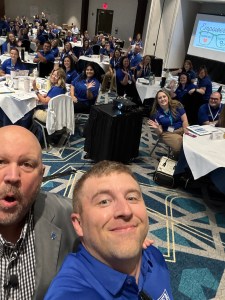
Yesterday I was meeting with one of our great National FFA Mentor Teacher Ambassadors, J. R. Pierce, from Montana. I am excited to be going to his school in August to do a two day leadership program for the student leaders in his school. As we were finalizing the plans, J. R. shared one of his profound thoughts that I have grown to appreciate him for. He said, “I see how teacher joy goes out the window!” I then said that he couldn’t just make that statement and us not discuss it.
I asked him, “How do we keep that from happening?” I loved his answer and it was so true. He said “We need to quit killing the joy in other teachers; especially our younger teachers.” His solution for this was to keep our opinions to ourselves. An example he gave was when a teacher is working on a bulletin board and another teacher rants that it is a waste of time and they’re not taking the extra time to do that. That ranting teacher was killing teacher joy and needed to keep their opinion to themself.
These “joy killers” are what I also call a “buzz kill.” Beware of the buzz kill! That person who is in your organization, community, class, school, or government who takes a perfectly good idea, concept, or change and shucks it off as being worthless or not meeting their own values. The thing about buzz kills is they are usually smart, respected, and rationale people. They appear to be very noble in their actions and may not even know they are killing someone’s joy. Can you think of a time when sharing your opinion killed someone’s joy? I can!
Think about it. If we hear that something we are doing is stupid enough times, we will lose our joy. I have continued to ponder J. R.’s thoughtful solution of keeping our opinions to ourselves. Keeping our opinions to ourselves can help prevent unnecessary conflict and preserve harmony in our relationships. When we choose not to voice every thought, especially if it might be critical or dismissive, we create a more respectful and understanding environment. This consideration allows others to feel valued and free to express themselves without fear of judgment or negativity, which in turn helps maintain their happiness and confidence. Essentially, sometimes silence acts as a gentle gesture that protects others’ joy and fosters kindness and peace.
Everyone has joy killers in their lives, but we all have joy givers too. The challenge for us is to identify the joy killers to avoid, and replenish with the joy givers. Thanks J. R. for inspiring these thoughts. The world needs more great teachers like you! Here is our challenge: be a joy giver, not a joy killer.
We Are Not Nameless Nor Faceless

Today I heard the great song by Papa Roach, “Born For Greatness.” This song always reminds me of C. S. Lewis’s Till We Have Faces. Both the song and book remind us how important a clear and honest understanding of ourselves is. We are encouraged to live authentically and confidently knowing our uniqueness is our power.
I love the lines in “Born For Greatness,” “So if you’re running, stop running; One life, one chance, start living; Sing it louder just to let the world know; No we’re not nameless, we’re not faceless; We were born for greatness.” We cannot avoid life or opportunities out of fear or hesitation. We need to face things head-on.
We have only one life, so we need to make the most of it and live each day in a meaningful way. We are also reminded to be confident in showing who we are and sharing our voice. Every person has worth and unique qualities. We are not nameless. We are not faceless. As C. S. Lewis said in Till We Have Faces, “How can they meet us face to face till we have faces?” We were ALL born for greatness!
The Dynamic Nature of Time

Today, I heard the phrase “The minutes fight the second hand.” This was a poetic or metaphorical way of describing the ongoing battle between different measures of time. The “second hand” is the movement that tracks seconds, symbolizing fleeting, rapid moments, while “the minutes” are longer units that symbolize more substantial periods. It emphasizes the dynamic nature of time—how brief moments can feel intense or urgent, yet they are part of the slower, more measured passage of longer durations.
It might mean that the passing of time (the second hand) constantly challenges or interacts with longer periods (the minutes), perhaps suggesting a tension between fleeting moments and extended durations. It can also imply that as seconds tick by quickly, they are in a kind of struggle with the slower progression of minutes, highlighting the dynamic and sometimes conflicting nature of how we perceive and experience time.
Practically, the phrase suggests that the second hand on a clock moves quickly and continually, constantly changing and challenging our perception of time. Meanwhile, the minute hand moves more slowly, representing longer periods. This interaction highlights how small, fleeting moments (seconds) are always in motion, often overshadowing or competing with the larger blocks of time (minutes) we experience.
Turtles On Fenceposts

This week I have been steeped in some of my favorite work of the year – training National FFA Teacher Ambassadors. I always love getting to introduce National FFA Officers to the teachers and listening to the officers comments. Yesterday, National FFA President, Thad Bergschneider from Illinois, said that he was like a “turtle on a fence post.” I had not heard that metaphor in a long time. Clearly, turtles can’t climb fenceposts; someone would have to put them there.
The saying “Turtles on fenceposts” is a metaphor used to highlight the idea that something or someone is in a position or situation they did not create themselves. It often refers to the phenomenon where we see evidence of past efforts or occurrences, but you recognize that the current state is not the result of original intention or effort.
For example, if we find a particular solution or idea that seems out of place or unusual, it might be like seeing a turtle sitting on a fencepost—it’s there, but it didn’t get there by itself; it was placed there or arrived there through external influence or circumstances. The phrase can also suggest humility—acknowledging that we often inherit situations or knowledge that we didn’t personally build or understand fully.
In essence, it encourages us to think about the origins of what we observe and recognize the complex histories or unintended consequences behind appearances or current states.
Additionally, the phrase can definitely extend to the idea that others have played a role in our journey. Sometimes, our progress or circumstances are shaped not just by our own efforts, but also by the help, support, or influence of people around us—mentors, friends, family, or even societal factors. Recognizing this helps us appreciate the collaborative nature of growth and success, reminding us that we’re often part of a larger interconnected web of influence and assistance.
Going To Newer and Higher Levels

I’ve got another post inspired by the song “I Won’t Bow Down” by P.O.D. My first two posts about this song were Standing Strong: Staying True to Your Path and Every Peak Has Its Valley and Every Ending Is Just a New Beginning. Now I’m thinking deeper about the lyrics “Activate, initiate; Go to a new level, see me levitate; Watch me elevate to a better mind state; In a positive dimension of a better fate; Talk about it, be about it.” These lyrics are all about activation and initiation. The phrase “Activate, initiate” encourages us to take action and start something new. It suggests that growth begins with a conscious decision to move forward.
Another phrase in the song, “The pain today is power tomorrow” also reminds us that the struggles and hardships experienced in the present can lead to strength, resilience, and growth in the future. It emphasizes that enduring suffering or challenges now can ultimately empower us to overcome obstacles and become stronger later on. These awesome lyrics inspire us to activate our potential, pursue personal growth, maintain a positive outlook, and ensure our actions reflect our aspirations.
 Byron's Babbles
3 comments