My New Leadership Talent: Spinning Plates!
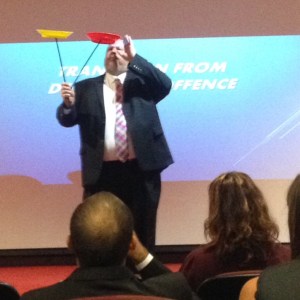 Coming to grips with the multiple parts to any organization is invaluable for leaders trying to keep their people and priorities in balance at a time when cultural and leadership change sometimes seems an existential imperative. Just as a circus performer deftly spins plates or bowls to keep them moving and upright, so must leaders constantly intervene to encourage the sorts of behavior that align an organization with its top priorities. Masters in this circus manipulation art can barely keep 100 plates spinning at a time. How many plates can any harried player-manager handle? Typically, less than a dozen.
Today, for the first time in my life I did a plate spinning act for our entire school staff. I had been using the metaphor for a few months now because of all of the things we have going on. In fact, I would many times just make a motion like I was spinning a plate. Therefore, I decided in my opening session that I would spin plates. For being my first time it went very well – I think. I even used the act introduce our newest administrators by passing them a poll with a spinning plate as an act of passing the torch, so to speak. The plates really represent all the facets, initiatives, paradoxes, parts of an organization a leader must be focused on. Spend to much time on one plate and the others fall. Left too long without attention, they run out of energy, start spinning out of control, and may come crashing to the floor. Personal development, coaching, performance management, addressing team dynamics, and reinforcing objectives are all forms of plate spinning. The leader must find the exact right balance.
Embracing the paradoxes can be uncomfortable. Yet the act of trying to reconcile these tensions helps leaders keep their eyes on all their spinning plates and identify when interventions are needed to keep the organization lined up with its top priorities. I believe approaching leadership much like plate spinning makes it possible to avoid the frustration of many leaders I’ve witnessed, who pick the extremes by either trying to stifle complex behavior by building powerful and rigid top-down structures, or by looser, more laissez-faire styles of management that expose the messy realities of human endeavor. Far more centered and high performing, in my experience, are those leaders who welcome the inconvenient contradictions of organizational life.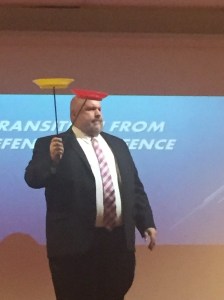
This is why I am such a believer in engagement and empowerment of everyone on the team. With an intent-based leadership philosophy where everyone is a leader, all individuals have a role in keeping the plates spinning. Empowerment is fundamentally an individualized equation, or what I call hyper-personalized. What might make one employee engaged might turn off the next person – we, as leaders, must be able to read these turn-ons and turn-offs. There are many variables that can impact any one person’s engagement, and the mix is individually unique. You can’t just become a better plate spinner. You have to find ways to keep the plates spinning on their own.
Leaders As Non-Conformists
 This morning I just started reading the incredible book, Originals: How Non-Conformists Move the World by Adam Grant. As a card carrying non-conformist I am really taking in all the stories and research in this book. It also goes right along Lesson #6 in 52 Leadership Lessons: Timeless Stories For The Modern Leader by John Parker Stewart. This lesson titled “Hooks and Loops” was about George de Mestral. Ok… be honest, do you know who he is? Or, what he is famous for? I didn’t until I read this lesson.
George loved to hike, but hated coming back with burrs stuck all over his clothes. He decided one day to study the burrs under a microscope and discovered that they were made up of little hooks that would, well, hook the fabric of your clothes. He was struck by the idea that he could create a hook and loop fastener out of fabric. Long story short, everyone thought he was crazy and even ridiculed him about his idea. He finally found a French fabric maker to help him manufacture a prototype. His original prototype did not hold up to continual use, but then after more research and trial he learned he could treat nylon with infrared light and it would hold up under use. He then combined the words “velvet” and “crochet” to, yep you guessed it, name the product we all use today – Velcro®.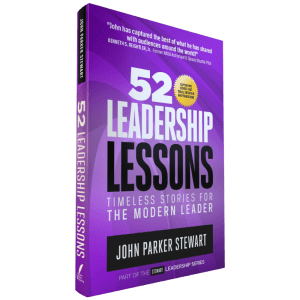
“The reasonable man adapts himself to the world; the unreasonable man persists in trying to adapt the world to himself. Therefore all progress depends on the unreasonable man.”
~ George Bernard Shaw
We are all faced with opportunities dressed up as problems or challenges. How we deal with those opportunities is up to us. I prefer to run toward those challenges and face them head on. Think about it – George de Mestral found a tremendous opportunity that literally changed the world in an annoyance during hiking.
“We are continuously faced with opportunities disguised as insolvable problems.”
~ John Parker Stewart
- What do our people need in order to resolve challenges?
- Who is the best qualified to help those we lead?
- What is our attitude toward new ideas that are non-conformist?
- What is our attitude when faced with opposition to our own ideas?
Letting Go Leadership
 As an organization grows, evolves, and develops, it needs a leader who knows how to give autonomy to different stakeholders who can be leaders more effectively in all areas. In other words, it needs a leader who can let go of needing to push all decisions out and do it all. I believe most leaders have a hard time letting go is because they believe that they can do it better. I also believe that many leaders have a narcissistic fear that somehow they won’t get credit for the successes of the organization or it won’t be exactly like she envisioned it. Guess what? It probably won’t be. It will probably be better. If you want to read a little more about this fear thing, click here to take a look at a post entitled “The Fearless Leader” by a great teacher leader, Ann Semon.
The best leaders, however, learn how to do it – let go. In fact, they often learn to love doing it once they start bringing in people who are even better than they are in key areas–people who know more than they do, and from whom they can learn. When that happens, it can push organizations forward to a whole new level. This strategy in a sense “unlocks” the entire organization to continue evolving in a much faster and healthier way.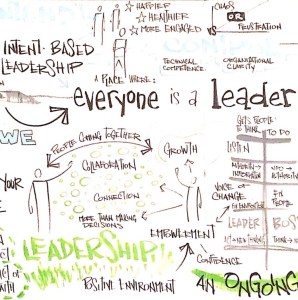
As part of letting-go, the best leaders learn to trust the people they’re bringing into the organization to become the future leaders. Leaders must be a part of building this trust by being actively involved in, and owning, the leadership development of those in the organization. Let me emphasize here – Development of the leadership pipeline is crucial here. This can only happen if you’re willing to give all in the organization ample control. Ask yourself these questions:
- “Do I really trust them to the point that I’ll let them make tough decisions?”
- “Do I trust them to learn?”
- “Do I trust them to grow?”
- “Do I trust them to experience their own failures?”
Can you answer yes to all these questions? If you can get to yes on all these it will be an incredibly powerful force for your organization. The culture you want to build is one that gives other leaders full autonomy without micromanagement. So let’s talk about this empowerment and autonomy…
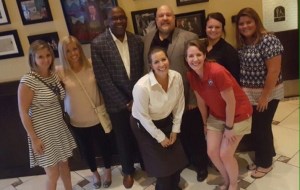
 I was fortunate to take a group of teachers and new principal to Harry and Izzy’s last night as a planning and team building. So, you know me, we don’t just talk about empowerment and intent based leadership, we practiced it. I wrote about what I like to do already this week in “Imagine A Place Where Everyone Is A Leader!” Click here to read the post. I literally would not let our group even look at the menu and told them we were going to empower our amazing waitress, Jen Becknell, to pick our meals for us. We gave her any boundaries, such as being pregnant, food allergies, et cetera. We even gave her permission to pick our drinks for us. Then, off Jenn went to put together one of the most incredible meals ever. I would love for Jenn to post a comment to this post as to what she chose and how she chose the dishes for us. Having done this now multiple times I am struck that I have never had a bad meal. We asked Jenn how she became so knowledgeable and she explained all the professional development Harry and Izzy’s had given her. Even things like going to their meat supplier in Chicago to understand the different types of aging processes in beef. This is a great example of Harry and Izzy’s giving Jenn the technical skill necessary to be fully empowered to be a great ambassador for the organization.
If you develop your leaders properly you will be able to trust the people who you hired to do their jobs with full autonomy, you may be surprised by how well it works out. Letting Go Leadership is nothing more than empowering your employees and teams to make their own decisions. As long as everyone has a shared vision and is committed to doing what’s best for the organization and those you serve, it can lead to bigger and better things. This certainly the environment I strive to create for every staff member in our school.
Killer Whale Leadership
 I am so excited to be bringing you another post inspired by the great book 52 Leadership Lessons: Timeless Stories For The Modern Leader by John Parker Stewart. Lesson #5 was entitled “How To Train Your Killer Whale.” In this story, Stewart, told us how trainers of Killer Whales will spend up to three years training before even getting in the water with these incredible creatures weighing six tons and measuring in at 26 feet. The amazing part is, though, that once a trust is built the relationship between whale and trainer is a thing of beauty. Trainers get to know the whales and a relationship is built as they begin to work together. I believe this is a powerful metaphor to us as leaders. Trust is not something you can go to a workshop, learn, and suddenly have. In fact, I laugh when I see workshops advertising trust building and relationship building. You simply cannot do that in a workshop. Are you telling me that the person you really don’t know that well that catches you in the falling backward game that all of those workshops have you do will catch you when everything falls apart back at your organization? She may or may not, but I want the person I have formed the relationship with and built the trust to know she has my back. Additionally, I want her to know that I have her back.
“When there is mutual trust, there will be quality performance.” ~ John Parker Stewart
So, how do we build this trust with our people? I believe it is working shoulder to shoulder with those we lead. You can only build true trust in the context within which you work. Here is my list of how leaders build trust:
- Being competent. It is very important for everyone to see that we know what we are doing.
- Walking the Talk and Walking the Walk. Do we do what we say and say what we mean? Do we live our own and the organization’s core values?
- Be passionate about what we do.
- Be self aware and show behavioral integrity.
- Care about those you lead.
- Wanting the best for others, even to the point of recommending them for another job that might take them away from you.
- LISTEN!
- We must have perspective and understand the context of our people and organization.
- Manage direction and work, not people. Lead people.
- Say thank you and give credit where credit is due.
- See beyond self.
Effective leaders nurture and grow trust in many ways. How do you build trust with those you work with? Here’s what I’ve learned: leaders who build trust are magnets for the best talent, ideas, and contributions.
Creating or Draining Energy?
 This post is an excerpt from the introduction to Leaders Ready Now: Accelerating Growth in a Faster World.
Instead of creating energy, your processes are draining it.
The fastest, most powerful learning experiences convert fear and uncertainty into pride and wisdom. Consider several examples:
- A young, inexperienced leader takes on an assignment to lead a team of people older and more experienced than she.
- An operations executive is suddenly given responsibility to run the IT function, which he knows nothing about.
- A new CEO faces a sudden market crisis that requires a major strategic and cultural shift in direction.
Big first-time challenges like these administer a shock, instantly bringing the leader to attention. It’s a jolt of uncertainty that carries a current of doubt; but with effort, discipline, and support, that doubt transforms into action and movement. Ultimately, if and when the challenge is conquered, a backward glance leaves the leader with confidence and insight that can be applied to the next challenge. It is in conquering difficult assignments such as these that leaders become ready to take on bigger leadership roles.
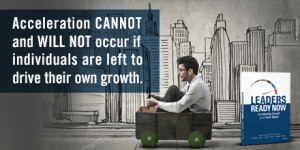
The challenge is scaling this concept beyond isolated, reactive incidents and creating a repeatable dynamic that causes entire cadres of leaders to become ready. For most organizations, scale becomes structure, but structure without energy kills acceleration. It’s not uncommon for management to roll out learning initiatives to groups of anywhere from 10 to 10,000 people, after which those new processes become burdened with guidelines, meetings, documentation, mandatory events, and progress checks. Participants—often the company’s busiest people—work diligently to make time for a process that has many moving parts but little connection to what they view as mission critical. Soon, what was built to generate the energy of growth dissolves into apathy and annoyance at processes that seem (and may well be) devoid of business importance.
It is not the process itself that is failing—it is the absence of energy to fuel it. Without energy, any processes you put in place will be unsustainable. How to rally the initiatives? By reexamining the architecture of your acceleration efforts and rewriting the rules of the game so that more is at stake, more is to gain, and all the players have a clearer understanding of their roles and how they will have an impact on success. You must be far more aggressive in the use and application of your existing approaches, setting bigger development targets for more people earlier in their careers.
*****
Matthew J. Paese, Ph.D., is Vice President of Succession and C-Suite Services for Development Dimensions International (DDI). Matt’s work has centered on the application of succession, assessment, and development approaches as they apply to boards, CEOs, senior management teams, and leaders across the pipeline. He consults, coaches, speaks, and conducts research around all those topics and more.
Audrey B. Smith, Ph.D., is Senior Vice President for Global Talent Diagnostics at DDI. Audrey’s customer-driven innovation and global consulting insights have helped shape DDI’s succession, selection, and development offerings, from the C-suite to the front line. She has been a key strategist and solution architect, encompassing technology-enabled virtual assessments and development aligned to current business challenges.
William C. Byham, Ph.D., is Executive Chairman of DDI. He cofounded the company in 1970 and has worked with hundreds of the world’s largest organizations on executive assessment, executive development, and succession management. Bill authored Zapp!® The Lightning of Empowerment, a groundbreaking book that has sold more than 3 million copies. He has coauthored 23 other books, including seminal works on the assessment center method.
 Byron's Babbles
1 comment