Being Kind

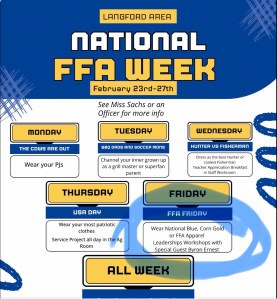
This past week I had the opportunity to be in Langford, South Dakota for National FFA Week. The Langford Area School District FFA Officers had the great idea to provide leadership workshop sessions designed for every grade level in the school. Their amazing agriculture teacher/FFA advisor and National FFA Teacher Ambassador, AnnaMarie Sachs, made the students’ idea a reality. I’m also very proud that the students requested that I be the provider of all these sessions. I’d had the opportunity to work with some of the Langford FFA members at National FFA Convention, so they had experienced my work.

I shared on social media last week that I am always inspired by the leadership dispositions that young people always seem to have for leadership. The Langford students really inspired me. Remember the show Are You Smarter Than A Fifth Grader? Let me tell you, I met some pretty smart fifth graders last week that I wish I could have some adults I know learn from. One fifth grader really impressed me with her Play-Doh creation that was to represent her as a leader. She made the word “Kind,” using a heart to dot the “i” (see photos). Very cool!
I asked her to talk about her creation. She said that she believed she was a leader because she tried to be kind to everyone. She also stated that she believed that if everyone would just practice being kind the world would be a better place. Pretty smart fifth grader, don’t you think? Are you as smart as this fifth grader?
“Be kind whenever possible. It is always possible.” ~ Dalai Lama

As an advocate of loving those we serve as a leadership attribute, this fifth grader made me reflect on what being kind really means. Being kind means genuinely understanding the impact our words and actions have on others. Another word that gets used a lot when defining being kind is “helpful.” I love this because providing help covers so many things. Being kind or helpful is about going that extra mile for others.
Now, taking this discussion a little deeper, I want to describe being kind as a vital leadership attribute because it fosters trust, loyalty, and a positive environment where team members feel valued and respected. Kind leaders are able to build strong relationships, which encourages open communication and collaboration. When leaders show genuine kindness, they inspire others to follow suit, creating a culture of empathy and mutual support. This not only enhances morale but also motivates individuals to perform their best, knowing they are appreciated and understood. Ultimately, kindness in leadership helps cultivate a cohesive and resilient team capable of overcoming challenges together.
Being Kind

I am continuing to learn from my reading in The Lincoln Highway by Amor Towles. There has been so much talk and many articles written about kindness in the last year. Additionally, there has seemed to be a great deal of hypocrisy where organizations, companies, and leaders would be lauded one day for acts of kindness and be reported for being unsafe the next. Or, articles about kindness is more than providing for basic needs, the lowest wage possible, or most bare bones of benefits. One thing is clear: being kind is necessary and the right thing to do. It’s even a bit intriguing to me that we even need to talk about it, but here we are.

We’ve all seen the buzz word ridden definitions of kindness that people/leaders love to give. You know, the ones that have words like considering, balancing, satisfying needs, fostering group well-being, innovation, potential, and productivity. What? It’s got to be simpler than that. It is! A character, Sally, in The Lincoln Highway likes to make strawberry preserves using the recipe and technique taught to her by her mother. When asked why she goes to the hours of hard work to make the preserves when you can go to the store and buy a big jar for 19 cents (the novel takes place in the 1950s), she says because she can and precisely because it takes so much effort. She explains she does it because it does take so much labor and it is a kind thing to do.
Furthermore, Sally defined kindness as being “where necessity ends.” Let’s read that one more time: “For kindness begins where necessity ends.” Now there’s a definition we can understand. If we let that sink in it’s pretty basic – kindness kicks in after basic necessities are met. Kindness is also a part of our everyday interactions.
As it also asks in the book, “For what is kindness but the performance of an act that is both beneficial to another and unrequired?” To me that puts a whole new light on kindness. Sometimes we pat ourselves on the back for being kind when really we’ve just begun to provide for necessities. Let’s not ever forget this lesson: kindness begins where necessity ends!
 Byron's Babbles
leave a comment