What’s Possible When You Dream Big with Passion, Purpose, and Joy
 Originally published on the Flynn Heath Holt Blog by Diana Faison
When my younger daughter graduated from college. Her accomplishment got me thinking about how graduation is an opportunity to reflect on what’s possible.
As you reflect, I want you to explore big dreams and move forward with a sense of purpose. And I want you to seek joy along the way.
 EXPLORE BIG DREAMS
My daughter has big dreams to be the world’s best third grade teacher. Her passion and drive remind me of my early career. On my first day working at a small women’s college, I was passionate, legacy-driven, committed. The women I served were my top priority, and I wanted to make a difference in each of their lives.
Early on in that job, I met a high school senior with limited resources. I encouraged her to apply for a full scholarship. Over her four years with us, I watched her bloom and gain confidence. We still stay in touch, and she’s grown into a successful entrepreneur in her own right. I cannot help but feel we can all make a difference one conversation at a time. She had big dreams, and so did I; we supported each other.
MOVE FORWARD WITH A SENSE OF PURPOSE
You may feel a strong sense of purpose on day one of this new life adventure following graduation. I felt a calling early – I knew I was a born coach. I knew I was a teacher, an educator.
But it took me years to realize that my work was fulfilling my purpose to coach and lead high-talent, women leaders. I was able to get here now because I had key women and men who gave me a chance. The Academic VP at a woman’s college hired me. A mentor made me teach large university classes at a young age. Two female executives at a large financial institution gave me my first significant contract which launched my solo practice. Now, I am in partnership with three talented women leaders and we own a multimillion dollar company.
Embrace that person who believes in you and wants to show you the ropes; ask them questions; let them know what you’re “doing”. The dots will connect much faster, and your purpose will reveal itself to you sooner than you think.
SEEK JOY
In her recent commencement address at Berkeley, Facebook’s Sheryl Sandberg talked about joy as ever present; we forget about it because we are bombarded with negativity. So we must SEEK joy. Turn off anything that’s reminding you of the world’s problems or bad news. Yes, work gets hard and life throws mean curve balls. But, there are things for which we are grateful. Before I left for my freshman year of college, my childhood home burned to the ground. It was a devastating loss for our family. But my mother’s response shifted everything for us. “Well, now at least we can rebuild the house we dreamed about,” she said. I could have been trapped in that burning house, but I survived. We survived. I am forever grateful.
Seeking joy means seeking gratitude. I reflect each and every day and ask, “For what am I grateful?” My kids hated this ritual at the dinner table. But, today they would say it paid dividends. They are joyful adults exploring big dreams, moving forward with purpose, and making a difference.
The future is simple: It’s shaped by the magic that comes from your passion, purpose, and joy.
*****************************************
About Diana Faison:
Diana Faison is a partner at FHHL and worked with the firm as a consultant for over 10 years prior to her partnership. She began her career as a teacher of Leadership Development studies and a Dean in Student Affairs at Queens University and the University of North Carolina—Charlotte. Diana is a sought-after keynote speaker on business leadership topics such as political savvy, brand, personal power, authentic leadership, and well-being. She is also the co-author of The Influence Effect: A New Path to Power for Women Leaders.
Reflections Of A Leader
 In my most recent post, The Leadership Symphony, I mentioned that I had just finished the great book 52 Leadership Lessons: Timeless Stories For The Modern Leader by John Parker Stewart. This book was truly 52 lessons that made me think about my own leadership and how to practice continuous improvement and honing of those skills. This is a book that prompted reflection and thought on my own leadership style and that style’s impact on those I lead.
Additionally, many of the lesson prompted ideas for blog posts. Here is a link that will take you to a run of all of them: https://byronernest.blog/?s=john+parker+stewart. All the lessons were easily adaptable to the real life leadership situations I was and am experiencing. As a guy who believes everyone is a leader, I love the Lead Now!™ model that is used to guide this book. As leaders we have a responsibility to create purpose and deliver excellence. Furthermore, if we intend to have those we serve leading from where they are we must continually develop others, as well as ourselves. Finally we must lead change.

 The four quadrants were developed using data from 360° leadership feedback, so it is no wonder that the lesson caused a great deal of reflection and self inflection. The stories in this book and the thoughts provoked enable the leader not to observe leadership, but to hone and develop leadership skills. These lessons increased my awareness of how I am perceived, and how I can make adjustments. As leaders we have scores of experiences from which to draw learned knowledge. I believe it is important to develop a habit of stopping the action occasionally to reflect and write about what happened, what worked, what didn’t, and what am I learning – thus my blog. I believe we have, literally, thousands of learning experiences. Without some type of guided reflection we lose thousands of learning opportunities. What are you doing to guide your reflection and continuous leadership improvement?
How’s Your Attitude?
 This post by Mark Nation originally appeared on www.nationleadership.com.
“Life is 10% what happens to you and 90% how you react to it.” – Charles R. Swindoll
I’ve noticed that when I say “Hi” to some people I pass by these days, they’re more than likely to use a popular street-speak reply that sounds more like, “Howru” Or, “’Sup.” Note the absence of a question mark. They’re not asking. Feeling not so much acknowledged as texted, it’s easy to feel a bit saddened, or even annoyed, at the lack of any real interaction. It’s phony caring, a leftover from preceding generations that used to go, “How are you?” meaning, I care.
If caring among strangers is endangered, years ago I devised a fun solution to keep it alive. With many folks I meet, both friends and unknowns such as waitpersons in restaurants or service personnel who work on my house, I play a sort of game. I ask the person, “How’s it going?” Whatever their answer, I assign it a number.
If the person says “Okay,” then I listen for the tone of their voice, and say, “Sounds like about a Six.” Getting right away that I’m putting their attitude on a Zero-to-Ten happiness scale, they either agree thoughtfully, or say, “No-o, I’d say a seven; maybe even an eight.” So, some truly self-upgrade my rating. If, to my query they answer, “Great!” and I know they mean it, then my answer is, “Wow! Is that a Nine, or a full Ten?” And we laugh, sharing our mutual satisfaction in their happiness report.
Why on earth would I take the occasion to “number” people’s moods?
Several reasons:• People appreciate someone’s actually taking the time to tune in to their feelings.
• Some will choose to open up and share information about circumstances in their lives.
• It gives them instant feedback on what they’re putting out into the world.
• It invites them to upgrade their own feelings on the spot.
So, more than just a game, it’s actually a way to share the power of a famous observation made over a century ago by psychologist William James:
“The greatest discovery of any generation is that a human can alter his life by altering his attitude.”
One theory in psychology research suggests that we all have a happiness “set-point” that largely determines our overall well-being. We oscillate around this set point, becoming happier when something positive happens or the opposite, afterwards returning to an equilibrium point.
But this set-point, to a certain extent, can be reset. Although our general mood levels and well-being are partially determined by factors like genetics and upbringing, roughly 40 percent of our happiness is within our control. In fact, a large body of research in the field of positive psychology has shown that happiness is a choice that anyone can make.
So, how’s your attitude? How are you?
••••••••••••••••••••••••••••••••••••••••••••••••••••
Mark Nation is a globally-recognized management expert, leadership consultant, executive coach, author, and speaker. He is personally driven to discover what makes individuals, teams, and organizations amazing—those elements which power the heart and soul of individuals and businesses worldwide. His new book, Made for Amazing: An Instrumental Journey of Authentic Leadership Transformation, helps people to identify and optimize their unique talents.
Tuning in to Your Life
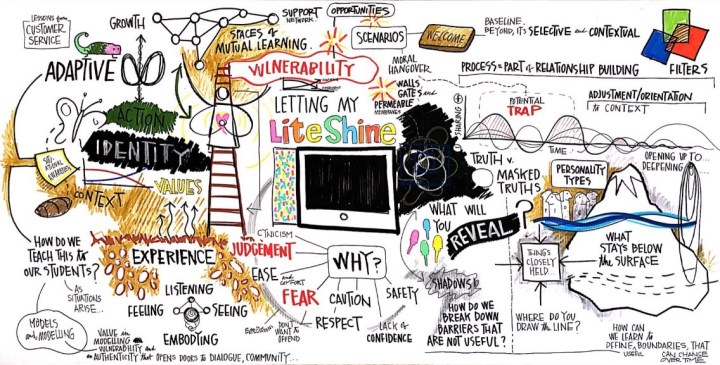 Super excited to have this guest post from Mark Nation. I just read his new book, Made for Amazing: An Instrumental Journey of Authentic Leadership Transformation. It is amazing!
 I met a woman who didn’t sing until she was forty because her kindergarten teacher told her before a performance, “Just move your mouth, dear.” How horribly tragic. The truth is, this woman had a wonderful voice, and it was clear she loved to sing. Who would have known she was silenced for decades, refusing to believe she possessed an incredible gift that was literally dying to be released?
Maybe you are one of those who say, “I have no musical ear,” or, “I can’t carry a tune,” because, like my friend, somewhere along the line you’ve come to mistrust the lyrical, melodic expression of yourself. To you, I would say, Stop! Listen to me! There is something critically important I need you to understand.
Not to believe in the music you came to play is not to believe in yourself.
You are not only musical, you are a musician, a melody-maker. Like all of us, you have a special song to sing; it’s the way you “do yourself,” the way you come across to others, the way you live your existence. Perhaps you have not realized it nor thought about it this way, but you are a vital part of a grand symphony, the harmonious expression of life.
Music is the beat of your life, the unique vibratory algorithm embedded in all you do and all you are. There is music in your voice, music in your face, music in your soul, in your thoughts, and in every throb of your heart. It can be a boisterous dance, a march, a sonata or even a lullaby. It’s not only okay for your music to change over time—it’s necessary, and beautiful. It’s you.
Everything you do expresses the one-of-a-kind melody that you bring to life.
Decide now to believe that you not only love music, but love making it. Explore this song of yourself. Take more pleasure in its expression, and follow the melody to see where it takes you. This is your journey, and your music. Therefore, you owe it yourself to develop your craft and take good care of the sounds you release into the world. We are all waiting for the song you bring, for we are your fans. Please don’t deprive us of those notes which only you can add to the harmony of life. Join in now.
**************************************************************************************
Mark Nation is a globally-recognized management expert, leadership consultant, executive coach, author, and speaker. He is personally driven to discover what makes individuals, teams, and organizations amazing—those elements which power the heart and soul of individuals and businesses worldwide. His new book, Made for Amazing: An Instrumental Journey of Authentic Leadership Transformation, helps people to identify and optimize their unique talents.
No Expiration Date On Success
 We hear or say the phrase, “It’s never too late” all the time, but do we really mean it? Or, do we just say it? Additionally, we talk about being life-long learners, but would we really still mean it at age 65? In Lesson #50 entitled “65 Years Young” in 52 Leadership Lessons: Timeless Stories For The Modern Leader by John Parker Stewart tells the story of Harland Sanders. We know him best as Colonel Sanders of Kentucky Fried Chicken.
“I’m still learning.” ~ Michelangelo at age 87
Let’s get to know the man behind the phrase “Finger Lickin’ Good” a little better. Colonel Harland Sanders was born on a farm outside the town of Henryville right here in my own great state of Indiana on September 9, 1890. The Colonel first prepared meals for truck drivers at an old family dining room table wheeled into the front of his Corbin, Kentucky, service station in 1930, fried chicken was not on the menu. After Duncan Hines put his restaurant that Sanders later open across the street from the service station, in his 1935 road-food guide, the colonel began to perfect his fried chicken secret recipe of 11 herbs and spices. This was in 1939 – he was age 49.
Then, in 1952 Pete Harman, who was a friend of Colonel Sanders who operated one of the largest restaurants in Salt Lake City, Utah, became the colonel’s first franchisee. Harman came up with the “Kentucky Fried Chicken” moniker and pioneered the restaurant’s famous bucket container. It wasn’t until Sanders was age 65 that he incorporated Kentucky Fried Chicken and began signing up new franchisees. He used is $105-a-month Social Security check to begin his franchise businesses. In 1964 at the age of 74 he sold Kentucky Fried Chicken and in 1968 at the age of 78 started another restaurant in Shelbyville, Kentucky. Wow, it really isn’t ever too late.
“There is no expiration date on our ability to succeed.” ~John Parker Stewart
Remember this: however old you are, there is an abundance of wonderful things waiting to happen for you. If you have the right attitude, you will not let them pass. Go out there and keep learning and succeeding!
8 Tips for Riding the Mood Elevator
 This is a guest post from Larry Senn:
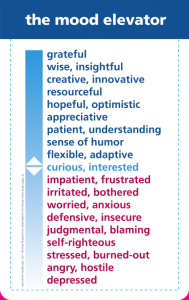
The Mood Elevator is an illustration of the human condition; it is our moment-to-moment experience of life. We all ride the Mood Elevator every day, take a moment and identify what floor you are on right now.
The Mood Elevator map is based on my own experience, as well as input from hundreds of groups and tens of thousands of people who have attended seminars that Senn Delaney, the culture shaping firm has put on over the past few decades.
Look at the top of the Mood Elevator and think of the times you’re more likely to be at those levels. It could be when you hug your children at the end of the day, it could be spending quality time with your significant other, or it could be when you accomplish something at work. We all, of course, would love to live on the higher levels but that’s just not realistic. As part of the human condition we will experience loss, stress, financial insecurity and other events that will cause us to drop down to depression, anger, and stress.
In my new book The Mood Elevator, I provide a variety of tips and tools that will help you better understand your human dashboard as well as help you navigate the daily up and down ride of the Mood Elevator.
Here are 8 tips to help you better ride The Mood Elevator:
- Know that to be human means you will ride the Mood Elevator and visit each and every floor. Don’t expect to live at the top of the Mood Elevator all of the time, cut yourself some slack when you drop down.
- Learn to recognize the feelings that accompany any unhealthy normal thinking or thought patterns, and make them a loud bell. When you start experiencing feelings like: impatience, anger, anxiety, excessive intensity, neediness, disconnection, and self-righteousness it’s a good indication that you’re sliding down the Mood Elevator. When you recognize this, you can take some corrective action to avoid an unhealthy normal.
- Use pattern interrupts to change your thinking and your feelings. Pattern interrupts are anything healthy tactics that can help you escape your spiraling negative thoughts. They can include exercise, calling a good friend, watching a funny YouTube video, or getting a good night sleep.
- Feed the thoughts you favor, not those that drop you to the lower floors on the Mood Elevator. If you find yourself reminiscing on a negative event in the past, or fixating on a mistake you made at work or might make at work in the future- recognize that your thoughts are going negative. You can identify your thoughts based on your feelings, if you’re feeling worried- it’s probably because you’re having worried thoughts. Use a pattern interrupt or think about something you are grateful for to break that train of thought.
- Take better care of yourself and remember to stretch and recover with exercise, sleep, and time off. We are more likely to catch colds if we are run down physically, and we are also more likely to catch bad moods when we are run down physically. Exercise has many mood boosting benefits and eating the right foods can help keep our energy levels up which improves our moods. Have you ever noticed how life can look so much better after a good night sleep? Getting at least 7 hours of sleep per night can drastically help us stay up the Mood Elevator.
- Maintain a gratitude perspective, count your blessings daily and be grateful for life itself. Even when life doesn’t look as good as we would like it to, there are always things to be grateful for. Those who choose to look at life with gratitude are happier than those who don’t. Try starting a gratitude practice by making a daily list of what you are grateful for.
- Remember that your thinking is unreliable in the lower mood states; delay important conversations and decisions; don’t act on your unreliable thinking, and don’t take your lower mood state out on other people.
- Have faith that when you are down the Mood Elevator; this too shall pass-just like the weather. The sun is always up there; the clouds can obscure it, but they will pass as will your low mood.
**************************************************************************************
About Dr. Larry Senn
Dr. Larry Senn pioneered the field of corporate culture and founded in 1978, Senn Delaney, the culture shaping unit of Heidrick & Struggles. A sought-after speaker, Senn has authored or co-authored several books, including two best-sellers. His newest is The Mood Elevator (August 2017), the follow up to his 2012 book, Up the Mood Elevator. You can learn more about Larry and his work at his website, www.themoodelevator.com.
Growth Vs. A Fixed Mindset
 The following is a guest post by Dr. Larry Senn:
The Mood Elevator is an illustration of the human condition; it is our moment-to-moment experience of life. We all ride the Mood Elevator every day, take a moment and identify what floor you are on right now.
Of course, the goal is to stay at the top of the Mood Elevator more often and there are some techniques that can help you do that. Most of those tricks involve a switch in thinking and changing your perspective.
One of those perspective shifts is focusing on having a growth mindset versus having a fixed mindset. This was researched by Carol Dweck and written about extensively in her book called Mindset. In her writing she explains that if someone has a fixed mindset they believe that their intelligence and talents are fixed traits and they won’t get any better. Compare that to someone with a growth mindset who believes that they can always improve through hard work and dedication. They believe they can always be learning something new and where they are right now doesn’t need to be where they are forever.
This growth mindset can help tremendously in getting you out of the basement of the Mood Elevator. Let’s take a look at the bottom floors and see how you might apply this:
Impatient/frustrated: Let’s say you’re stuck in traffic or waiting for your turn at the DMV. Most people will sit there frustrated at the time wasted waiting, but if you take on a growth mindset you could be catching up on reading that article or listening to that podcast that you claim you never have time for.
Irritated/bothered: When you’re working from home or doing chores around the house and your child keeps bugging you to listen to a story they want to tell you or to go play with them outside- instead of going to irritation or bother, take 5 minutes and listen to them or play with them, you never know what you might learn about them (or yourself) in that short time.
Worried/anxious: Imagine your boss just asked you to take on a new project you’ve never done before and you’re worried you’ll mess it up. Instead think about all that you’ll learn by doing this and how you can translate that to your next project and you might even be able to add a new skill to your resume.
Defensive/insecure: Many of us tend to shut down or get defensive when we’re offered constructive criticism. Instead, take a deep breath, set your ego aside, and look at it through the growth mindset lens. Focus on what you can learn from it and how you can improve.
Judgmental/blaming: Your spouse is driving and is taking (in your eyes) the “wrong way” to the restaurant you’re having dinner. Instead of immediately telling them how wrong they are, don’t give unsolicited advice and just relax. You might learn a new and faster way to your favorite restaurant.
Self-righteous: When you’re talking with a friend and they say something wrong about a current event happening (at least in your head it’s wrong). Instead of pointing that out to them, you might ask why they see it that way. Part of growing it hearing new perspectives on things, and again you’ll probably learn something new.
Stressed/burned out: Stressed with an upcoming deadline at work? Chances are this isn’t the first deadline you’ve been stressed about. Think back to a time this happened before and remember how you grew from it and what you learned.
Angry/hostile: Is someone you know being rude or mean towards you? Instead of getting angry back at them, try asking them how they’re doing. You might learn something they’re going through and you’ll grow more as an empathetic person.
Depressed: If you’re going through something that is tough and seems unfair, ask yourself “why is this happening for me?” instead of “why is this happening to me?” You probably have a great growth opportunity or a blessing in disguise coming out of this tough situation. Focus on how you can grow from it instead of sitting in the discomfort.
Changing floors on our Mood Elevator is a matter of simply changing the way we think or having a change in perspective. It is simple, but by no means easy. It will take time to start automatically thinking like this but with enough time it will come!
*************************************************************************************
About Dr. Larry Senn
Dr. Larry Senn pioneered the field of corporate culture and founded in 1978, Senn Delaney, the culture shaping unit of Heidrick & Struggles. A sought-after speaker, Senn has authored or co-authored several books, including two best-sellers. His newest is The Mood Elevator (August 2017), the follow up to his 2012 book, Up the Mood Elevator. You can learn more about Larry and his work at his website, www.themoodelevator.com.
Hands On & Hands In Leadership
 While doing my doctoral dissertation I had the occasion to do an in-depth review of the academic and practical literature on leadership. Make no mistake it is impossible to read it all. There have been tens of thousands of books written on leadership and there are several academic journals devoted entirely to the subject. The task of reviewing the leadership literature, and acting on it as leader, isn’t to understand it all (that is impossible). It is up to us, as leaders, to develop a point of view on the few themes that matter most.
One of the phrases that has always stuck with me from my leadership studies is from the brilliant Warren Bennis. He said, “Managers are people who do things right and leaders are people who do the right thing.” Furthermore, in Learning to Lead: A Workbook on Becoming a Leader he asserted, “There is a profound difference between management and leadership, and both are important. To manage means to bring about, to accomplish, to have charge of or responsibility for, to conduct. Leading is influencing, guiding in a direction, course, action, opinion. The distinction is crucial.” I believe there is a distinction between leadership and management, but I also believe that the best leaders do something that might properly be called a mix of leadership and management.
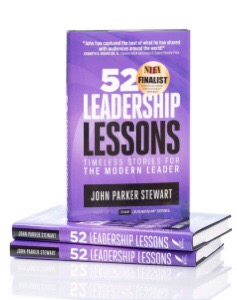 Lesson #42 entitled “The Right Job, Done Right” in 52 Leadership Lessons: Timeless Stories For The Modern Leader by John Parker Stewart really drove home the fact that we must make sure the tasks we are doing are the best use of our and our team’s time. Being efficient does not mean anything if we are not doing the right things, or more importantly, things that matter. Remember, the content matters more than the form.
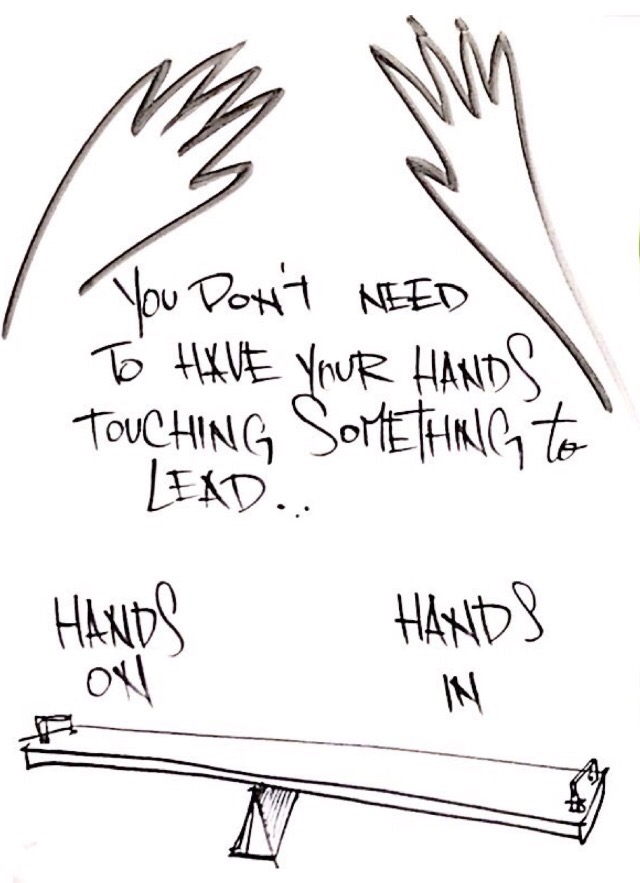
So, to be a great leader I would argue we need to understand what it takes to do things right, and to make sure they actually get done. It’s really a balance of mastering seeing the big picture and selecting the right strategies. I always say my job is to know what to have my hands on and what to have my hands in.
Inspiration of Herbert Hoover Leadership
 Today, my family and I had the privilege of visiting the Hoover Historic Site in his birthplace of West Branch, Iowa. The historic site is well done with the home Herbert Hoover was born in, his dad’s blacksmith shop, his one room schoolhouse, the Quaker Meeting House, and many other buildings set to the time of his birth on August 10, 1874. He was born in a two-room cottage and could have been any small town boy. Orphaned at age nine, he left West Branch, never to live here again.


 We also visited the Herbert Hoover Presidential Library and Museum in West Branch, Iowa, and we took the opportunity to learn some leadership lessons from our 31st president. Values learned in his hometown of rural West Branch guided Herbert Hoover throughout his life of service to the nation and the world.
 Herbert Hoover was President during the early years of the Great Depression, others may know him as a complex public servant, the “Great Humanitarian” whose career spanned a remarkable seven decades. A graduate of the Pioneer Class of Stanford University, Hoover became a successful mining engineer before organizing relief programs for the starving victims of World War I.
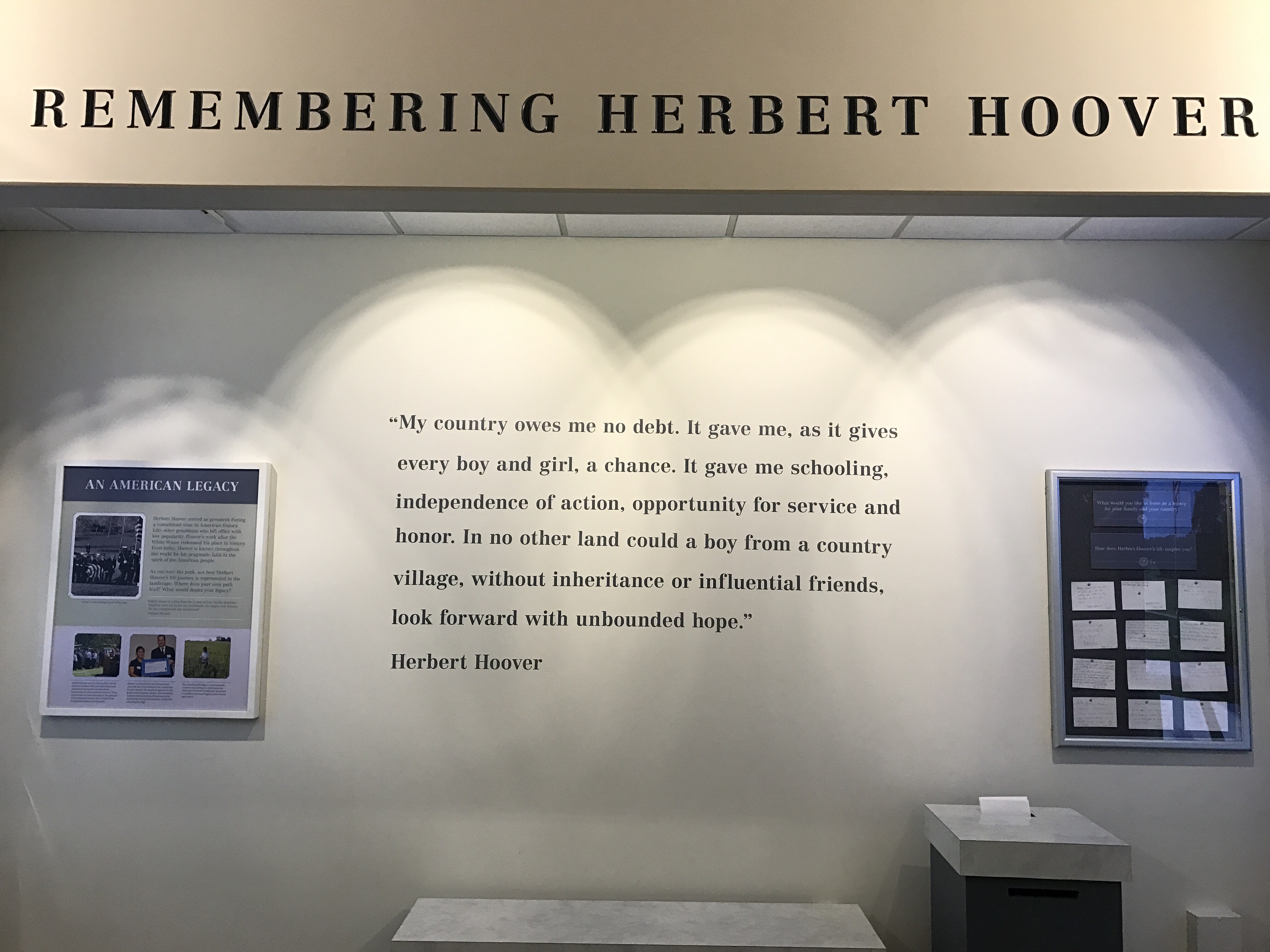 Herbert Hoover was a man of action. When he saw a need, he took action to meet it; when he saw a wrong, he did his best to rectify it. Hoover didn’t wait to see if someone else would take care of it – he recognized need and took initiative to resolve it. Hoover was a responsive leader.
In addition to being responsive, Hoover was also understanding and compassionate. Though later in life he became a millionaire, Hoover was born into poverty and orphaned as a young boy. It was only through hard work and determination that he was able to make a better life for himself. Because of his personal experience with poverty and hardships as a boy, Hoover empathized with the less fortunate. Turning his attention to the woes of the world, Hoover used his wealth and influence to become an international humanitarian; under his charge, millions of starving men, women and children were fed and lives saved.
As Secretary of Commerce under Presidents Harding and Coolidge, he helped to create safer highways and aircraft, better health care for children, and the standardization of commercial products. And, in 1927, he mustered a fleet of 600 boats and 60 airplanes to rescue 325,000 Americans who were left homeless during the catastrophic Mississippi River flood.
“There is no joy to be had from retirement, except in some type of productive work. Otherwise you degenerate into talking to everybody about your pains and pills. The point is not to retire from work or you will shrivel up into a nuisance to all mankind.” ~ Herbert Hoover
President Truman chose Hoover to help the hungry people of Europe at the end of World War II, and he spent his “retirement” years as an amazingly prolific author, speaker, and government adviser. Continuing his life-long desire to help needy children, he also served as chairman of the Boys’ Clubs of America, helping to open 500 new chapters throuhgout the United States.
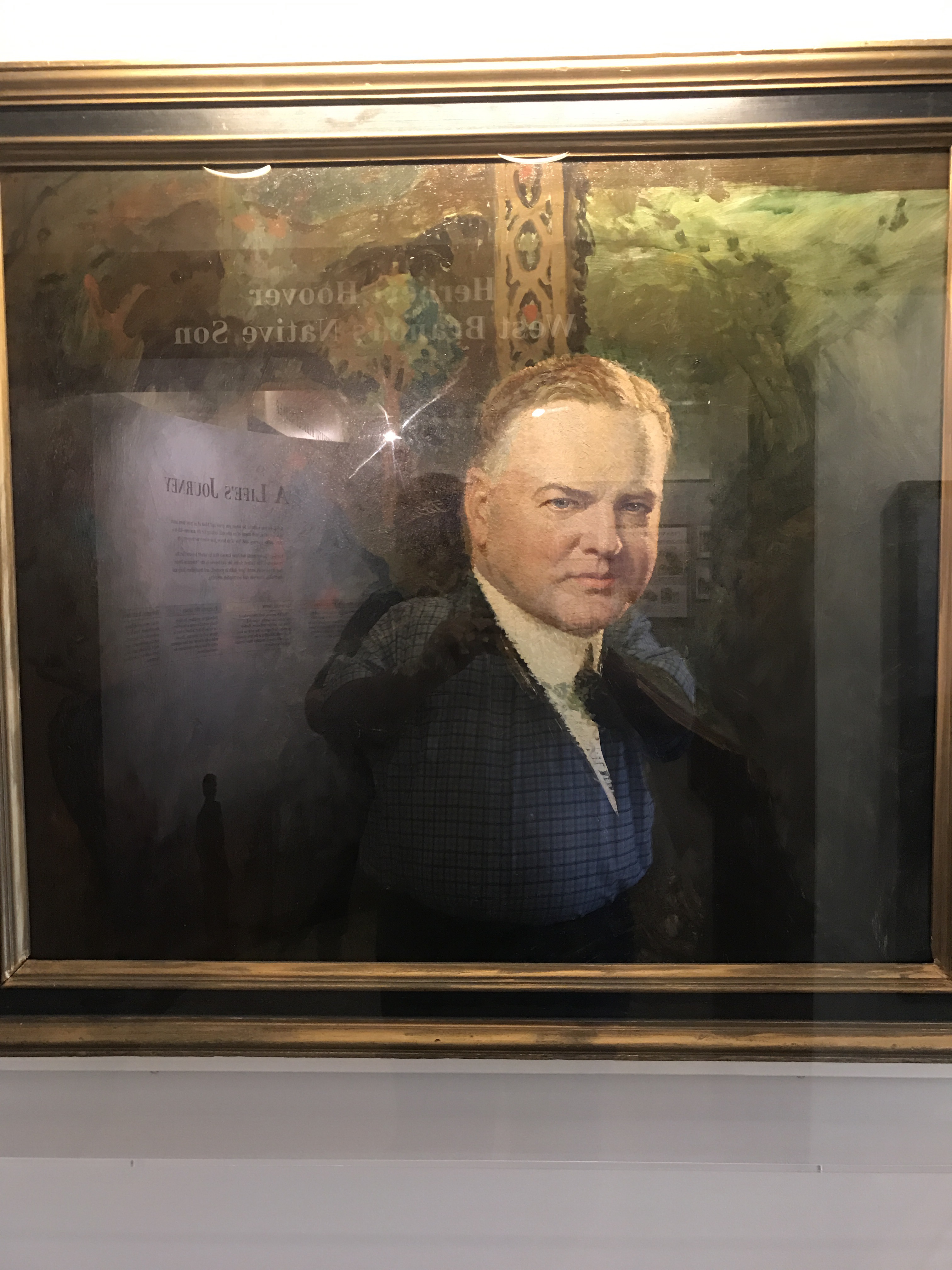 Hoover really never retired. I admire him for that. Hoover really understood that significance is much more important than success. With success leaders add value to themselves. Make no mistake we have to work toward success innour careers, but I believe significance comes when you add value to others—and you can’t have true success without significance. Hoover truly worked toward significance, where he asked himself, “What else is there in life beyond professional, political, and monetary success? He, in my opinion, made the world a better place.
It also strikes me how Hoover did not make ideological differences personal. He always said to attack the problems and differences, not the person. We need to take this lesson and apply it to our world today. Especially in the field I am in of education. We always make differences so personal. We all want the same ends for our children; we just have different means by which to get there.
As you can see there are many leadership lessons to take from the historical leadership playbook of Herbert Hoover. What areas do you want to work on? What would you like to have as a legacy for your family and country? How does Herbert Hoover’s life inspire you?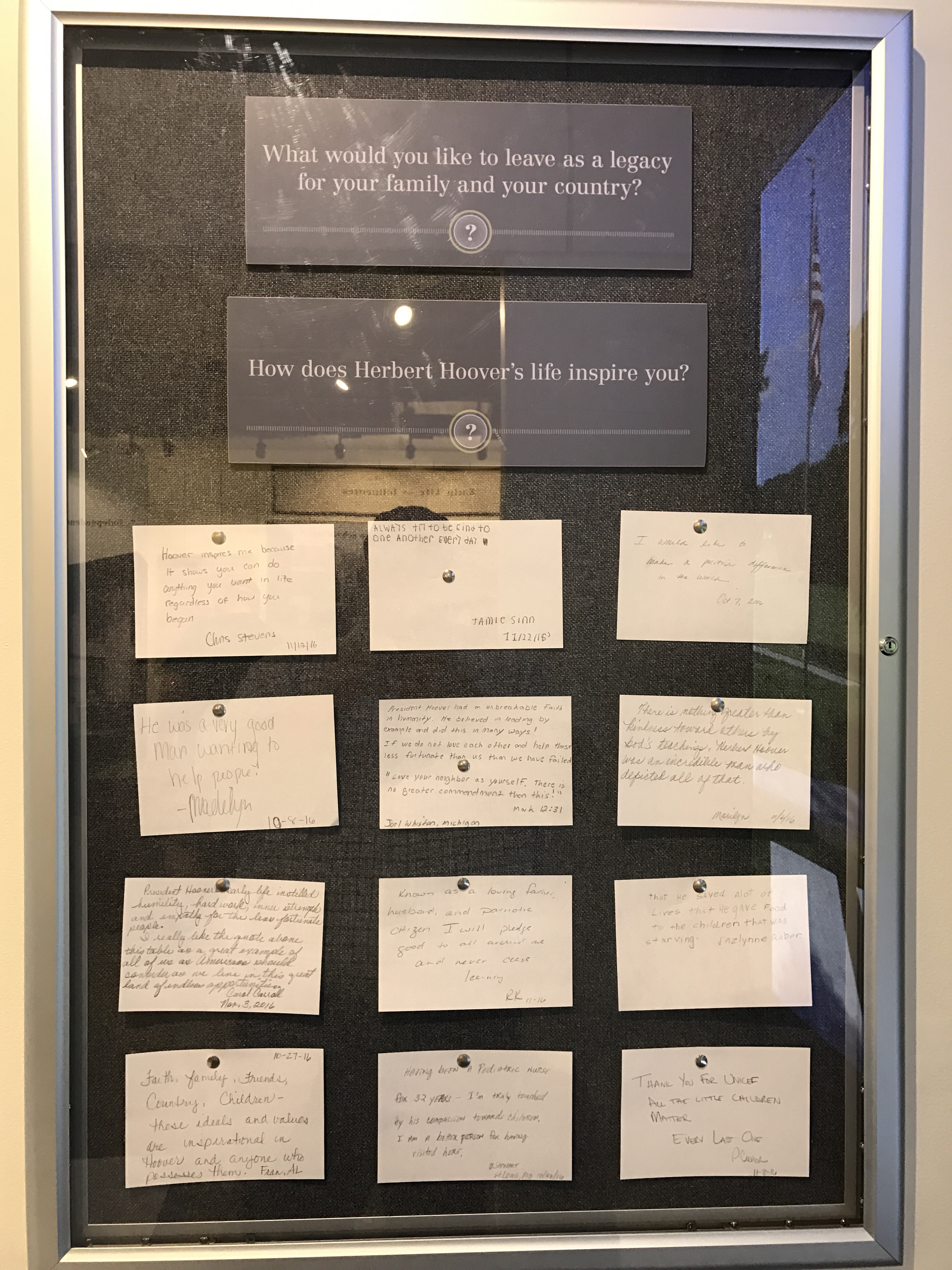
Making Cultural & Spiritual Connections
 Yesterday, my family and I went to see Devils Tower National Monument in Wyoming. It was part of a four state excursion in one day, which included Wyoming, Montana, North Dakota, and South Dakota. What a day. On our trip that started last Friday night, we have seen some incredibly beautiful parts of our great country, majestic and powerful wildlife, National Parks and Monuments, and awesome people. Fly fishing Spearfish Creek from Belle Fuersch, South Dakota then all the way through Spearfish Canyon was a truly incredible experience with nature for my son, Heath, and I.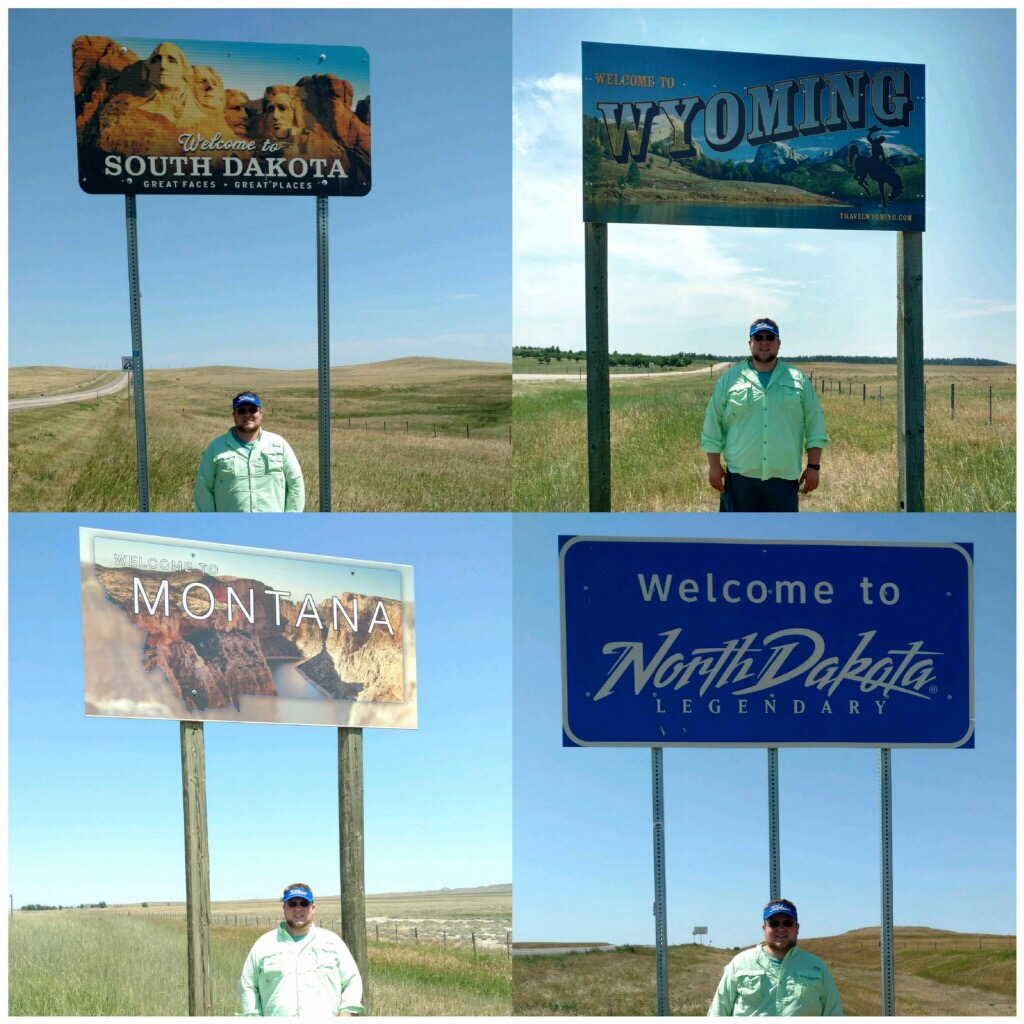

Many times on this trip I thought, “Wow, what beauty God has created.” As I have studied Native American history and culture and had the honor to visit personally with Native Americans on this trip, I have come to realize I don’t appreciate what I believe to be God’s creations enough. Today, at Devils Tower I had the opportunity to learn how sacred places are in the Native American culture and spiritual life. The connections which tie American Indian culture Devils Tower are both ancient and modern. Oral histories and sacred narratives explain not only the creation of the Tower, but also its significance to American Indians. They detail peoples’ relationships with the natural world, and establish those relationships through literal and symbolic language. The Northern Plains tribes, including the Kiowa, Lakota, Cheyenne, Crow, Arapahoe, and Shoshone have the closest ties to the Black Hills area where Devils Tower is located, but there are some 24 other tribes that have a connection there.

 The connection to nature, and specifically Devils Tower, is not only about the creation of the place, but also the people’s relationship to the place. I find this interesting because I don’t think those in my culture think enough about our relationship to nature and our place in it. Particularly our responsibility to what God (as I believe) created. In doing some studying I found that a key difference between American Indian religions and many other contemporary religions (“western” or “near eastern” religions) is the importance of places that dominate the religion of American Indians, as opposed to the sense of time that dominates many western religions. Instead of a focus of chronological events and the order in which they are presented, American Indian religion focuses on a place and the significant events that are connected with that location. Now to be sure, Christianity in my case, has important places, but we do not hold the level of sacredness associated with the important places of American Indian religions.We had the chance to experience one of the most common ritual that takes place at Devils Tower: prayer offerings. Colorful cloths or bundles are placed near the Tower – commonly seen along the park’s trails – and represent a personal connection to the site. We saw many tied in the trees. They are similar to ceremonial objects from other religions, and may represent a person making an offering, a request, or simply in remembrance of a person or place. As with many religious ceremonies, they are a very personal act. My family and I spent many hours hiking on the trails and in the boulders of Devils Tower. I overheard one young child ask his parent why there were red ribbons tied in the tree. The parent actually replied, “Don’t pay any attention to that it is just something those ‘Indians’ do.” Wow, what a missed opportunity to help our children understand other cultures, religions, and our fellow man.
 We must take more time to truly understand and have courageous conversations with those with customs and beliefs different than our own. I so believe in the principles OUR (that means all of us) country was founded on. Freedom of religion is one of those and we need to respect others’ cultural and spiritual beliefs. Take some time and learn others’ beliefs and help our young people understand those beliefs as well.
 Byron's Babbles
leave a comment