Memorial Day Reflections
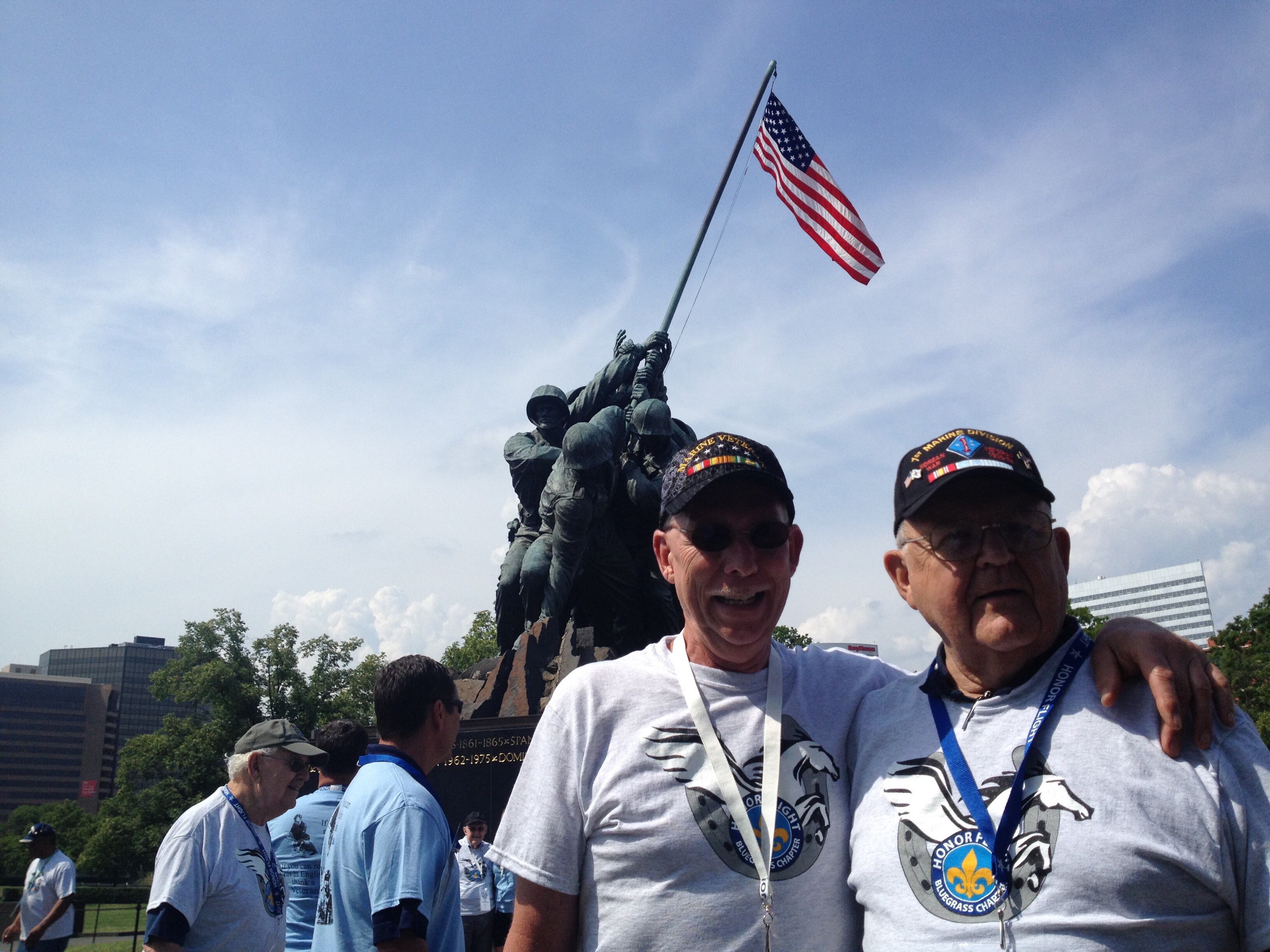 This year’s Memorial Day is different for me. It has more meaning and has a more real context than any time in my life. I am so blessed to have had the opportunity to serve on The Honorable Order of Kentucky Colonel’s Honor Flight on May 16th as a Guardian. That experience changed my life forever. In my family growing up we always celebrated Memorial Day, or “Decoration Day” as my dad called it. That was actually the holiday’s first name. It began in the years immediately following the Civil War, at which time it was observed primarily as a day for “decorating” military graves with flowers and commemorating the fallen Union and Confederate soldiers. By the twentieth century, Memorial Day had been extended to honor all Americans who died in all wars while serving in the U.S. Armed Forces.
I’m often astonished at the lack of honor some display toward our Veterans. For us who sacrifice little—if anything—and yet have no qualms about enjoying the luxury and freedom provided by this country we belie our lack of gratitude with our cavalier attitudes toward those who have served our country. We should hold to the true meaning of this day. Alas, for too many Americans, Memorial Day has come to mean nothing more than another three-day weekend, albeit the one on which the beaches open, signifying the beginning of summer. Unfortunately, the tendency to see the holiday as merely an opportunity to attend a weekend cook-out obscures even the vestiges of what the day was meant to observe: a solemn time, serving both as catharsis for those who fought and survived, and to ensure that those who follow will not forget the sacrifice of those who died that the American Republic and the principles that sustain it, might live. Some examples might help us to understand what this really means.
 These examples were plentiful for those of us taking part in the Honor Flight. Hearing of the sacrifices and seeing the emotions of the veterans on this trip were life changing for me. It was also a life changing experience for the Veterans as well. Allow me to share an excerpt from an email the Veteran I served as a Guardian for sent me yesterday:
“This morning particularly have been reflecting on our trip to DC . For me sharing that experience together produced a bond that seems to transcend the time we’ve known each other. At any rate reflecting today & tomorrow on the sacrifices of our fallen comrades . It seems the meaning of the day has become lost . Much like Christmas we forget it’s the celebration of our Savior’ birth. Finally 2 things: 1. YOU made our honor flight very special; 2. My life is richer having met & got to know you. God sure dealt us a good hand when he put us together. I don’t know what I would have felt if you hadn’t been with me.” ~ Dr, Jerry McCandless, Korean War Veteran
I am humbled at the thought of those who have put themselves in harms way on my/our behalf…people they don’t know. The beauty of the Honor flight is it gives us the chance to really get to know one another. The Honor Flight gave me the opportunity to better understand our nation’s history and appreciate the price paid for our freedom. I encourage all to find some way to serve our Veterans, whether through serving on an Honor Flight, or some other volunteer service. We need to all commit our time, talents, or treasures to our Veterans. Thank you to everyone who has served and those who are serving us through our military and our great country. I am in awe of all our heroes on this Memorial Day!
Nothing Works Forever: Perpetuating the Mission & Values of the Organization!

“Nothing works forever. Our purposes never change – but our methods and tactics must constantly change. It is amazing how quickly a successful organization can deteriorate into mediocrity.” ~ Rick Warren, Pastor and Founder of Saddleback Church in Lake Forest, California.
This week’s lesson in Maciariello’s (2014) A Year With Peter Drucker was based on an interview with one of my hero’s – Rick Warren. Dr. Warren founded Saddleback Church in Lake Forest, Calif., in 1980 with one family. Today, it is an evangelical congregation averaging 30,000 weekly attendees. Peter Drucker and Dr. Warren were friends and this week’s lesson was based on a 2003 interview. They discussed that organization must innovate and change. Organizations also tend to become bureaucratic and need to have conscience activities for maintaining and transmitting its core values (Maciariello, 2014). These principles should be implemented in a way that will perpetuate the mission and values of an organization and provide continuity, while also facilitating change.
The key here is facilitating needed innovative change, but at the same time having continuity. Tough order, huh? Drucker posited that we all need people committed to our vision our our teams, but we also sometimes need radical change (Maciariello, 2014). Drucker also argued that change and continuity are not opposites, but a continuum (Maciariello, 2014). If an organization does not change, it will die of being status-quot. In order to achieve continuity, therefore, an organization must be designed to change. Change and continuity are thus poles rather than opposites. Interestingly, I just spoke on this last week at the American Federation for Children National Education Policy Summit. In our panel I stated that in education and “school choice” that we were in danger of the new beginning to look like the old. In other words as a believer in “school choice,” we must make sure that the choices are not just some of the same old thing in a new wrapper. We must create schools that have the core value of all students can learn, but are differentiators in the way we do that. We need schools that educate better than anyone else and that have an “edge” or “niche” in doing so. In other words, a constant stream of incremental improvements will lead to substantial change and great schools over time. Schools, and all organizations, should therefore seek and reward continuous improvement activities. Continuous improvement must be one of our “BIG” initiatives to be working on in education, and all organizations for that matter. 
According to Maciariello (2014) change can occur in two forms: 1.) creating new wealth through innovation; 2.) creating wealth by moving resources from low to high productivity. Competition speeds this process up. This is why I am such a believer in school choice. We cannot predict the future, so it is our job, as leaders, to have the core values in place to allow for changes in products, processes, and services that will continue to meet the needs of our customers in the future.
As an “Energetic Change Agent,” I know that change is risky and creating the future is a lofty goal, but it is much more risky to leave the future to chance. Are your organization’s core values strong enough and believed by all to make it possible plan for change? Are your own core values and change agent abilities such that you will be able to maintain organizational cohesiveness during necessary changes? Isn’t it excited to be creating the new future?
Reference
Maciariello, J. A. (2014). A year with Peter Drucker: 52 weeks of coaching for leadership effectiveness. New York, NY: HarperCollins Publishers.
Our Origins, Legends, & Heroes
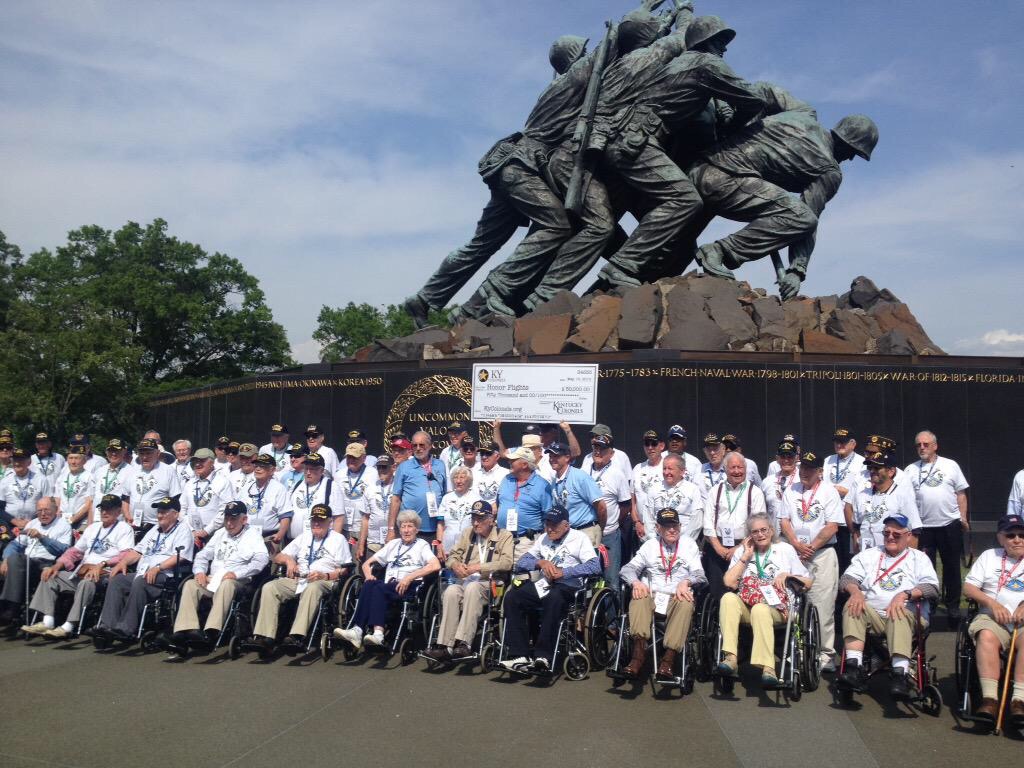
2015 Kentucky Colonel Honor Flight
“Not to know what happened before we were born is to remain perpetually a child. For what is the worth of a human life unless it is woven into the life of our ancestors by the records of history.” ~ Cicero
People living in democratic republics should know not only of its origins but also of the imperfect democratic struggle it spawned. Such appreciation might alleviate the taking of one’s way of life for granted. Americans understand the embodiment of heroic virtue in everyday life, for legends runs deep in American history.
Yesterday I had the privilege of serving our Veterans as a Guardian for our Honorable Order of Kentucky Colonels Honor Flight to Washington DC. This was a very emotional experience and I still, 24 hours later, hardly have the words to describe or reflect on the day. As a Kentucky Colonel, this was something I really wanted to do, but did not know what to expect. Well, let me tell you, it exceeded my expectations. This opportunity to serve provided the best lessons in selflessness and servant leadership one could receive anywhere. The Veterans taking part in the Honor Flight, all of whom were Kentucky Colonels, were transformers in life; they thought not of themselves but of a higher cause – America and global freedom.
“Kentucky Colonels are unwavering in devotion to faith, family, fellowman and country. Passionate about being compassionate. Proud, yet humble. Leaders who are not ashamed to follow. Gentle but strong in will and commitment. The Honorable Order of Kentucky Colonels, as a Brotherhood, reaches out to care for our children, support those in need and preserve our rich heritage.” ~ The Honorable Order of Kentucky Colonels Credo

Water Cannon Salute
Everywhere we went the Veterans were met with mobs of crowds cheering and thanking them for their service. There was even a “Water Cannon” salute at Reagan International Airport for our plane as we landed in Washington D.C. As I watched in amazement, these heroes practiced our Kentucky Colonels Credo of being, “Proud, yet humble.” These Veterans were truly touched by the outpouring of support and cries of, “Thank you for your service!” For me it was the first time of truly being in a role of 100% servant leader. Because I am not a Veteran, I did not matter to anyone yesterday, and should not have. This was incredibly satisfying and humbling. The entire day was about serving the Veterans as a group and the Veteran I was responsible for as a Guardian, Jerry McCandless (more about him later). I have always prided myself in walking the talk as a servant leader, but this provided the opportunity to be 100% servant. I have to tell you, I am a changed man.
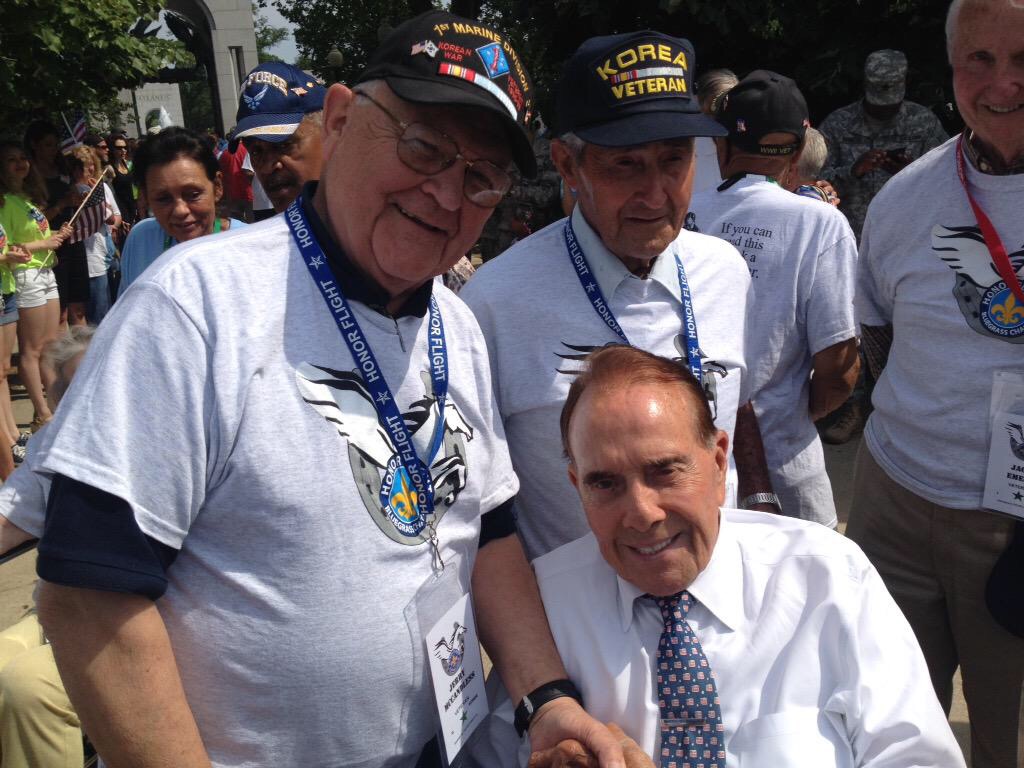
Jerry McCandless With Former US Senator Bob Dole
Amazingly, after returning to the bus someone asked me if I had my picture taken with former U.S. Senator Bob Dole. He comes out and personally greets Veterans from the Honor Flights at the World War II Memorial. Honestly, I had not even thought of getting a picture of me with him. In fact, I don’t even care to have a picture of me with him. I am, however, very proud of the picture I took of Jerry with Bob Dole. Remember, as a servant, I was to have no wants or needs on this trip – and I’m still amazed I had none, except for our Veterans to have the greatest day of their lives. As I said before, this experience really changes you and gives you the chance to fully understand what it means to be a servant leader.
These Honor Flight participants are heroes and legends. Legends serve two purposes: they provide a shared cultural experience for a people, and they symbolize the aims and ideals of that people’s common history, religion, culture, or institutional authority. As a legend, Lucius Quinctius Cincinnatus is a great example. Having stirred the passions of Republican Rome, later citizens of the Roman Empire and eighteenth century America, and men and women of contemporary times, he has been revered throughout history. His life is one of legendary accomplishment and character. Not merely legendary, Cincinnatus is also heroic. While fellow ancient warrior Alexander the Great or fellow Roman leader Julius Caesar are legendary, they do not impart the timeless moral lessons of a hero.
The hero sacrifices himself for something—that’s the morality of it. He gives his life to something larger than himself. In further contrast, the hero symbolizes our ability to control the irrational savage within us, whereas the leader may exploit the savage to gain his ends. One of the many distinctions between the celebrity and the hero…is that one lives only for self while the other acts to redeem society.” ~ Joseph Campbell
George Washington, one of our American heroes, like Cincinnatus, was a man of great accomplishment, but character, not achievement or genius, is also his most honored legacy. Character sets them apart from others. Children in schools all over Italy still recite the Cincinnatus story in the same way children of the United States learn of George Washington and the “cherry tree.” Another great American hero, Patrick Henry asked repeatedly of the role of the citizen in a Republic. He sought much more than a far removed vote in regularly scheduled elections.
Having met the living legend, a British soldier penned the following observations of Washington’s quest to live as Cincinnatus:
“Altogether he made a most noble, respectable appearance, and I really think him the first man in the world. After having had the management and care of the whole Continental army, he has now retired without receiving any pay for his trouble. he knows how to prefer solid happiness in his retirement. I admire him as superior to even the Roman heroes themselves. I am told during the war he was never seen to smile. he had only the good of his country at heart. his greatest pride now is, to be thought the first farmer in America. He is quite a Cincinnatus, and often works with his men himself—— strips off his coat and labors like a common man .”
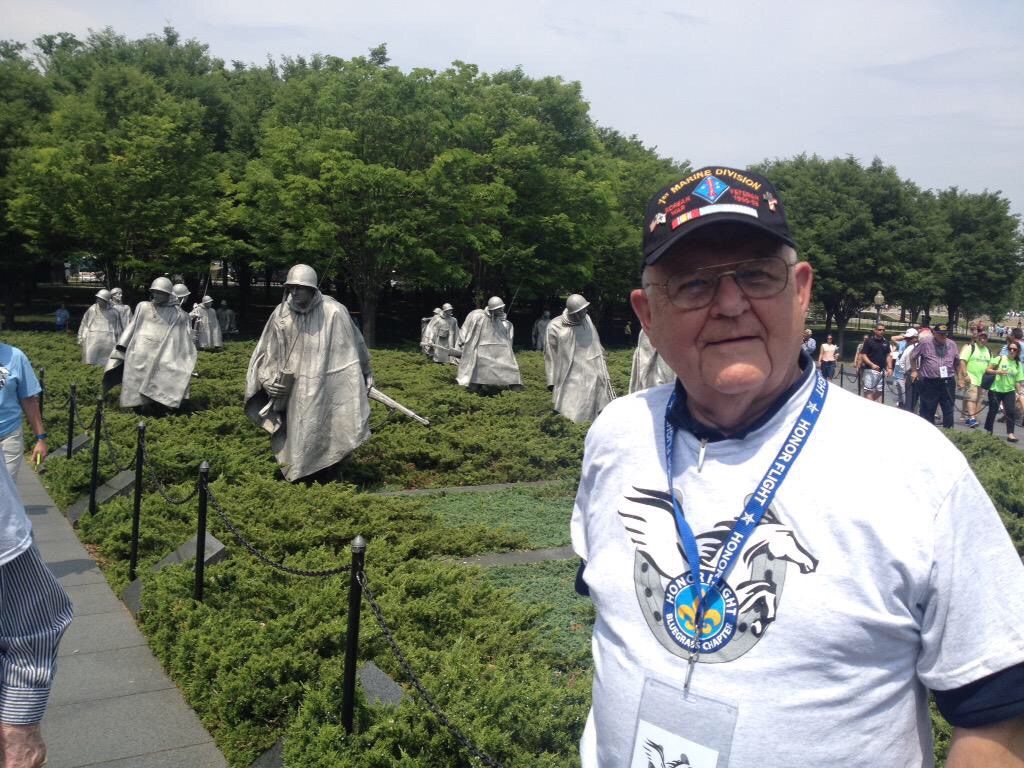
Jerry McCandless At The Korean War Memorial
This was exactly the kind of person I found in the Veterans we served for our Honor Flight. I promised I would tell you about Jerry McCandless. Jerry and I both, as Christians, believe God hand picked us to be together on this flight – God does do that you know! Jerry is a Korean War Veteran and lives on a farm. That agrarian connection got us started on the right foot. I learned so much from Jerry during our whirlwind tour of Washington D.C. I particularly loved watching him interact with young people. He brought history and a sense of patriotism alive and real for all those around him. Jerry truly is a hero who embodies the selflessness and character of George Washington and Cincinnatus. I also still get chills thinking of him telling the story of how, while on active duty in the Marine Corps, he donated $2.00 to the Marine Corps War (Iwo Jima) Memorial. He is very proud to have played a part in our country having that memorial and I believe he should be. There really are heroes who live up to the legends of countries founding heroes and we had the opportunity and honor to serve them yesterday. I would encourage you to seek out opportunities to serve our nation’s heroes!
Reference
Hilliard, M.J. (2001). Cincinnatus and the citizen-servant ideal. Xlibris Corporation.
Talkin’ Turkey About Sunk Cost Bias
 I am always amazed at how much I learn on my son and I’s annual turkey hunt. First let me answer the big question on everyone’s mind. Did you get one? I am happy to report that my son did! I did not. For the second year in a row Heath got a turkey and I didn’t. This was his fifth turkey in the seven years we have been hunting together. Not bad for a fourteen year old. In my defense, I did not even take a shot. I saw a bunch of turkeys and witnessed some great wildlife shows, but never a gobbler close enough to harvest.
When turkey hunting there is a great deal of time in solitude for thinking. My favorite time is the first thing in the morning. We get to the woods at 5:00 a.m. and then watch and listen as the woods comes alive. First there are the birds, then the occasional deer, and then the gobble of a roosted turkey. Our two days of turkey hunting each year remind us of all the wonderful creations that God has made. Though my seat attached to my turkey vest is not as comfortable as a yoga mat, I am not any less mindful when in this state of thought and meditation. There are so many things that run through your mind when sitting in total silence and not being able to move. It is exhilerating and I am already looking forward to next year.
On our first morning of the hunt, Saturday, we went to the river bottom along the levee. My son, Heath, set up along the field’s edge that separated the levee from a woods (the turkeys typically come off the levee and graze the field while heading to the woods for the day). I set up about a mile south of him. We both had a great show of turkeys that first morning. I even had a hen come right past me close enough that I could of reached out and touched her. Those that know me are probably amazed that I am able to sit that still in my full camo glory! Anyway, neither of us got a long beard (tom turkey) close enough for harvesting.
Later that afternoon, my wife took Heath to a baseball game (he pitched a save, by the way), and I went back near where we had hunted in the morning. There was a tremendous showing of birds. There was a group of 11 that appeared – four long beards, three jakes (young male), and four hens. They worked the field in front of us for two hours, but we could never call them in close enough for a shot. Then there was a single Tom who strutted around the field like he owned it, but again, not close enough. It was a tremendous show that Walt Disney would have been proud to have filmed for his nature films. But, still, they stayed along the levee side.
The next morning, you guessed it, I went back to the levee. Heath, on the other hand, went to another location. You guessed it, at 8:30 he harvested a bird. I was texted a picture (seen at the top of this post) and was thrilled – the goal is always for Heath to get a bird – I am secondary. Once again, however, I had the greatest show ever. Turkeys were coming off the levee right and left – lots of them. You guessed it, though, they were not interested in coming to me. The Toms were with hens and not interested in what I had to offer. Anyway, it was another great morning of solitude and thought. At least I kept telling myself that!
Toward the end of the morning, as the turkeys were moving out of site I got to thinking about “sunk cost bias.” Was I falling into the trap that leaders fall into. As I thought about this I realized that turkey hunting might be one of the greatest case studies to teach this because I kept getting drawn back to this same area. I knew there were lots of turkeys here. In fact three of Heath’s turkeys he harvested in past years had been taken very near where I was sitting. Also, I had already spent a lot of time there this year. This year, however, the turkeys were just not moving across the fields in the same way – this is what really makes turkey hunting so exciting and facinating. The turkeys never act the same from year to year. Does this sound like any of the organizations you lead? Yet, for some reason I was drawn to this place. Part of it was the fact that it is one of the most beautiful places in the world. Hemlocks were blooming, Blue Jays were playing in the trees above me, a squirrel was hopping from tree to tree, and a Bald Eagle was soaring above. It is just a glorious place to be.
Still, there were all these turkeys. When we regrouped for the afternoon and Heath’s turkey had been processed it was decided to go to another location for the afternoon. “Sunk Cost Bias” had been resisted; at least for now. At 4:30 p.m., after not seeing or hearing any turkeys, it was decided, you guessed it, to go back to the levee. I know what you are thinking: this guy is an idiot because he knows the turkeys won’t come close enough. You are right, I was giving into sunk cost bias. I knew we would see birds, but I would never get a shot. Yet, I was drawn by the fact I had invested so much time there and knew there were turkeys. I had become the poster child of what sunk cost bias is: The sunk cost bias is manifested when we have a greater tendency to continue an endeavour once an investment in money, effort or time has been made.
I was first introduced to this thinking at Harvard University by Dr. Monica Higgins when studying a case study of the 1996 Mount Everest tragedies. Reasoning that further investment is warranted on the fact that the resources already invested will be lost otherwise, not taking into consideration the overall losses involved in the further investment. During the Mount Everest tragedy the sunk cost bias was carried out on two fronts: 1. At the time of starting for the summit, some thought the conditions were not right, but they had come all this way and were not going to wait; and, 2. Many that died did not summit by the 2:00 p.m. cutoff time (the time set to turn around if a summit had not been made yet) but went ahead and summited as much as two hours late. Again, the thought of “I’ve invested all this time, money, effort, et cetera and by golly I am going to summit Mount Everest” was at play there.
Obviously, my life was not on the line, but by going back to the levee for one last ditch effort at the end of our last day of hunting was giving into sunk cost bias. You guessed it, too, we saw a lot of turkeys but none came close enough. What I was failing to realize is that moving back to the levee would most likely result in the loss of much more time and not getting a turkey. I was thinking short-term, not long-term, and simply trying to avoid not getting a turkey, which was fallacious thinking. It was really thinking from a defensive posture and not an offensive one. This experience has really caused me to think about the strategic and academic plans we are carrying out in the schools I lead. Do we have areas of sunk cost bias? It begs taking an introspective look.
When we make a hopeless inventment of time, treasures, or talents we sometimes reason: We can’t stop now, otherwise what we have invested so far will be lost. This is true, of course, but irrelevant to whether we should continue on with the plan. If the plan will not work that everything invested will be lost regardless. Therefore, it really is irrational to continue, but yet we (at least me) continue on anyway. The rational thing for me to do on our turkey hunt would have been to try a new spot. Why didn’t I make the rationale choice: Our decisions are tainted by the emotional investments we accumulate, and the more we invest in something the harder it becomes to abandon it. As an emotional human, my aversion to loss often leads me right into the sunk cost bias. We need to instead look at the loss from a growth mindset and consider it learning and knowledge gained.
Luckily, we all have the ability to reflect, study, and regret past actions. So, in my case, I need to remember what I did on this turkey hunt and apply it to my professional life as a leader. Do you have areas in your personal or professional life where sunk cost bias is hurting your ability to move forward? If you’re not sure, might I suggest an early morning meditation time in a woods as it comes to life at the start of the day?
Wright Brothers Fascination
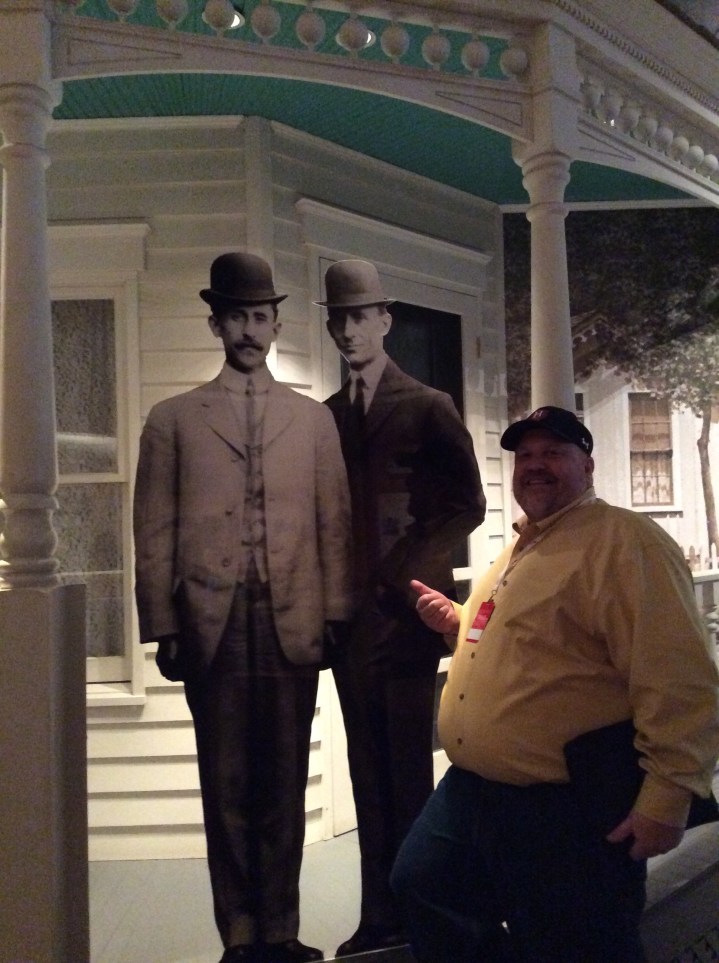
You all know I am fascinated and obsessed with the Wright Brothers. They are members of my personal Mount Rushmore. This past week when I had the opportunity to travel to Washington D.C. with Hoosier Academies students and families I took a group to my favorite Smithsonian Institution exhibit – The Wright Brothers and 1903 Wright Flyer, in the Smithsonian National Air and Space Museum. I am such a student of the Wright Brothers because of the audacious leadership they displayed. Imagine the audacity to think they could build a machine that would fly. Remember, people made fun of them. Also, the audacity to know what being able to fly would do to affect all generations to come. In other words, WHY being able to fly would be advantageous to the human race. Basically, everything in the Smithsonian National Air and Space Museum is there as a result of the Wright Brother’s innovative leadership!
Additionally, the Wright Brothers were controversial, which according to Sally Hogshead, makes them fascinatining. Some of this controversy was a simple rivalry between the Smithsonian Institution and the Wright Brothers, and their claims of who was the first to fly. The Smithsonian at the time was primarily a research facility rather than a museum and Dr. Langley, the leading competitor in the race for first flight, was America’s most respected scientist, and the keader of the Smithsonian Institution. In 1928, Orville Wright loaned the Flyer to the London Science Museum, where it stayed for 20 years. It was not until 1948 that the Smithsonian received the airplane. I for one am glad it is where it belongs and the Wright Brothers are serving as an example of American enginuity for all who come to the Smithsonian National Air and Space Museum.
Malcolm Gladwell said it takes 10,000 hours of practice to become great at something. Imagine if the Wright brothers had “tried” flying for a couple of months and then gave up saying “we are just no good at flying.” It sounds humorous, but many people do this when starting a new project. From something as simple as getting into shape to the more complicated endeavor of pioneering and inventing new products, achieving high levels of success in anything is less dependent on talent and more dependent on tenacity. Sometimes we forget that anything we are now good at, we were once not proficient. In other words, we must be bad at something before we can get good at it. The Wright brothers set out with a dream and worked vigorously to make the impossible a reality. It wasn’t easy and took hard work with thousands of failures to get the success they were looking for. After only four years, the vision they had cast was actualized by their own actions. 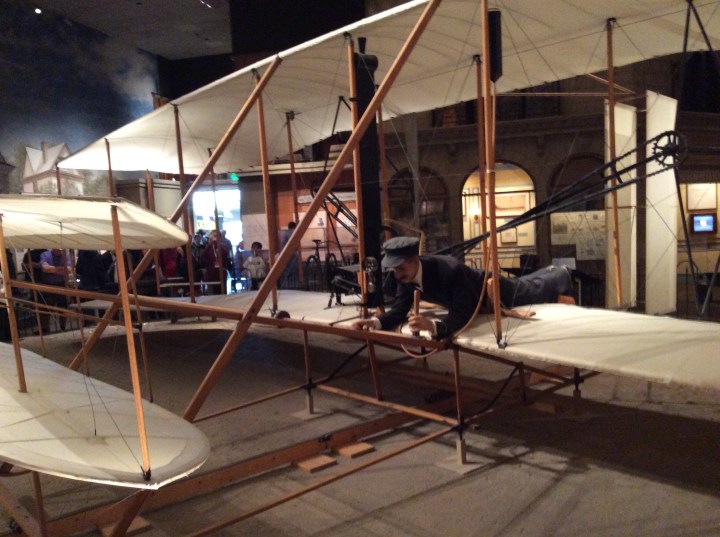 The more amazing part though is the business story that followed. It took them several more years to hammer out the safety issues with flight and then had a multimillion dollar earning year in 1910. What is truly unbelievable is that after only another 5 years, Wilber Wright was able to sell the company for not only $36,000,000, but also received another $600,000 for serving as the chief consulting engineer during the first year of the new company’s operation. We severely overestimate what we can accomplish in one year and strictly underestimate what we can do in 10. I am also always amazed to remember that neither of the Wright brothers had diplomas or collegiate courses, instead they were encouraged heavily by their parents with a “classics” education focus and read hundreds if not thousands of books from their family library. Pontific knowledge, tenure, and certificates does not equate to being educated.
Remember, every big success requires first a dream, then a struggle, before the victory. Think about this: “If I take away your struggle, I will also take away your victory.”
Responding With Mindfulness
Being mindful in our responses ensures integrity in our interactions and solutions to opportunities (what I call challenges and problems). Absence of mindfulness raises the likelihood of emotional reactions and unproductive arguments instead of thoughtful and effective responses. We need to gain control through attentiveness and awareness, centering ourselves to lead our solutions and conversations fruitfully, honestly, and fully. It is easy to be pulled into reacting, and it takes more effort to respond. However, with mindfulness practices, I believe exchanges can be more productive and greater integrity can be maintained.
As we maintain our mindfulness through inner calmness and strength, we listen to what is being said more intently, and we watch the way in which it is being said. Also, we truly can begin to look at the challenge as an opportunity. We become more aware as we formulate our response. Our raised attentiveness enables us to respond more thoughtfully and, if needed, begin to direct the exchange in a direction of collaboration or more productive areas of discussion. Our mindful and responsive solution can truly become a new adventure and great journey.
Let me tell you the story of my morning. I am in Washington D.C. with a group of our Hoosier Academy families. They really wanted to go to the Smithsonian National Zoo. Well, as a former Smithsonian Teacher Ambassador and Smithsonian Diffusion Award Winner, I was ready to do anything Smithsonian! We arranged for our charter bus to take us there in the morning. Then we were going to have the bus take us at noon to the Smithsonian Castle and Enid A. Haupt Garden to meet up with some of my Smithsonian friends for a research experience. On the way to the zoo, our staff person coordinating the trip got an email telling her that we could not use the bus at noon. Ok, I’m not going to lie, my first thought was to react, but then I practiced mindfulness. Keep in mind the zoo is 3.8 miles from the Smithsonian Castle. Not an easy walk for a group of 55. Also keep in mind that almost all in the group had never been to Washington D.C. – certainly, never been on the Metro!
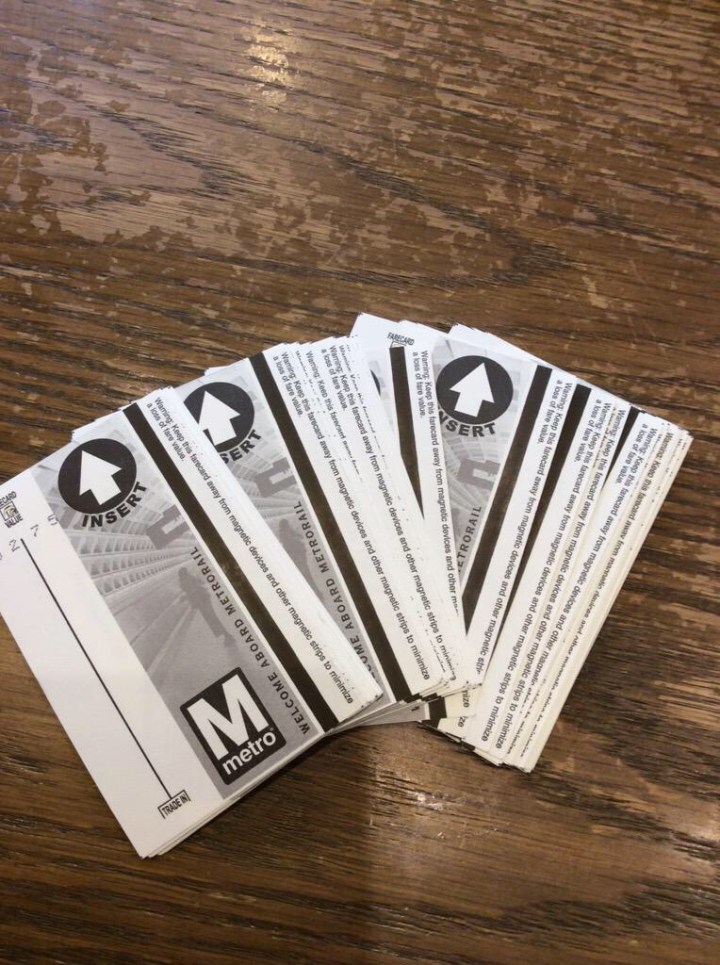
As I took a moment to become mindful, however, I decided that with a Metro station two blocks from the zoo at Woodley Park, and then a short ride with one change from the Red Line to the Orange or Blue Line at Metro Center, it would be a cheap, $2.75 per person, experience and journey for our students and families. So, what did I do? While the group was exploring at the zoo, I went and purchased 55 Metro passes. What a great experience and adventure it was! Bottom line: we all got to Enid A. Haupt Garden on time for our program (see picture below)! I had students telling me it was the greatest thing they had done. All of our participants were glad to have had the experience. What a great lesson for our students to learn how to use mass transit. 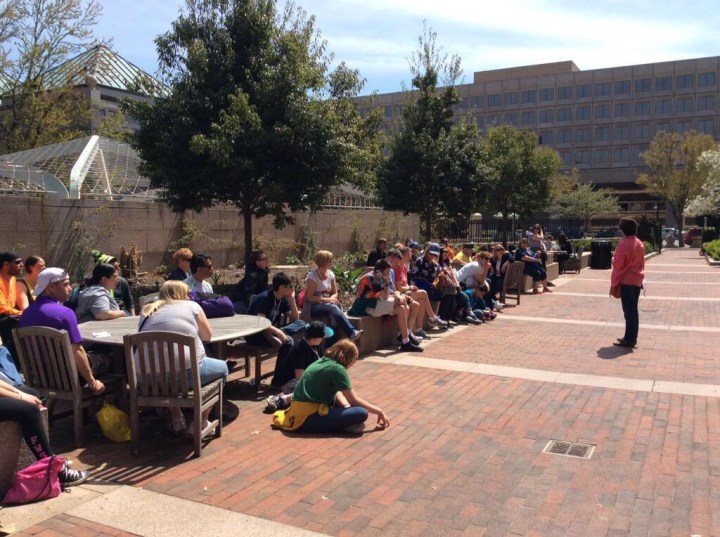 While there may only be a slight difference between the words react and respond. In practice, there seems to be a gulf of difference. When people react, it seems to be defensive and snap, poor decisions are made. By practicing mindfulness, however, responding is more thoughtful. Mindful responses contain reasoning. If mindfulness is being more centered within and aware of others, then this is a practice we need to embrace to prevent reacting and focus on responding. Being mindful in our responses ensures integrity in our interactions. It might even enable us, as leaders, to provide opportunities of great adventures for those we serve!
The Good Samaritan Marathon

This past Thursday I had the opportunity to go with good friend, Kevin Eikenberry, to the NCAA tournament game where Purdue played Cincinnatti. The game was held in the KFC Yum Center in Louisville, Kentucky. I was excited to be going because it was my first NCAA Tournament game. Kevin had been to many of these and got tired of me saying, “We are in the house!” Sorry Kevin!

Obviously the outcome of the game was not what we wanted, but that really turned out to be a lesser story of the trip. Something astonishing happened and we were both reminded how important it is to help your fellow-man. Long-story-short, we hit something in the road and it literally punctured the tire and went through the rim on my friend’s BMW. We tried to change the tire along the interstate, but had some difficulty. That’s a whole other story that the two farm boys in the BMW are still figuring out how to tell! Anyway, we called AAA, and then (since the tire and rim were both already ruined) drove to the next exit – Exit 41 on I 65, the Uniontown/Crothersville, Indiana exit.
We then limped into the exit, pulled into the Marathon station, and began working on the car again. Remember, you have two farm boys here wanting to fix the tire. We then got a message back from AAA that it would be an hour before help arrived. This would have got us to the game late. Little did we know there were Good Samaritans at Exit 41.
An interesting thing happened at the gas station, Uniontown Marathon- RMD 64 (pictured here in the post) on the way to the tournament. Every single person that pulled into that gas station/mini mart while we were there attempted to help us. No lie – every single one. We were amazed! One lady knew BMWs and was explaining the wheel locks and another was googling BMWs for us. Then we had a car full of fellow Purdue Boilermaker fans wanting to make room in the car for us and get us to the game. I looked at Kevin and said, “I’ll see you at the game!” Really, I did say that, but I did not leave him.
Then, along came a man that knew exactly what to do. Bottom line: he made it possible for us to change the tire and get on the road. We are both so appreciative of everyone who asked to help us. We are both also still astonished that every single person who pulled into that station asked to help. How many times have you pulled in somewhere and seen someone with a broken down car or some other need and thought you were too busy to help? I am ashamed to say I have. But, from the modeling and coaching of our friends at the Uniontown/Crothersville exit, I hope to be a better neighbor!
In reflecting on and deciding how to tell this story (there is quite a bit more and gets quite funny), I thought of the ultimate story/parable teller: Jesus. I believe it would be a good reminder for us to review the story of the Good Samaritan found in the book of Luke. Luke 10: 25-37.
“Jesus told many stories, or parables, to help people learn the truth. One day a leader of the Jews asked Jesus what he must do to have eternal life. The Savior asked him what the scriptures said. The leader said that a man should love God and also love his neighbor. Jesus said that he was right. Then the leader asked, “Who is my neighbour?”
Jesus answered by telling the man a story. One day a Jewish man was walking on the road to the city of Jericho. Thieves robbed and beat him. They left the man on the road, almost dead. Soon a Jewish priest came by and saw the man. The priest walked by on the other side of the road. He did not help the man. Another Jewish man who worked in the temple came by. He saw the injured man. But he did not help the man either and walked by on the other side of the road.
Then a Samaritan man came along. The Jews and the Samaritans did not get along. But when the Samaritan saw the man, he felt sorry for him. He took care of the man’s wounds and put clothes on him. The Samaritan took the man to an inn and cared for him until the next day. When the Samaritan had to leave, he gave money to the innkeeper and told him to take care of the man.
After Jesus told this story, He asked the Jewish leader which of the three men was a neighbor to the injured man. The leader said that the Samaritan was because he had helped the man. Jesus told the Jewish leader to be like the Samaritan.”
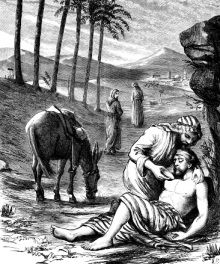
So what do we learn from this story? We must be willing to get involved. Good intentions don’t cut it! None of the people at the Uniontown Marathon – RMD 64 were just saying they wanted to help; they all truly got involved in some way. They were “walking the talk.” We may quote scripture and recite platitudes on love and God, but unless we are willing to get involved in the lives of others, we are only blowing smoke. The Samaritan treated and bandaged the wounds. He set the injured man on his donkey. He took him to an inn and cared for him throughout the night. The Samaritan could have said to himself, “I give regularly to my church. I donate to the Salvation Army every Christmas. I have done my part.” But he didn’t. As the scriptures say, he had compassion…and he acted on it.
So here are three things we need to do:
1. Don’t refuse to help when you are able.
2. Never assume someone else will do it. Take personal responsibility.
3. You may suffer for doing well, but helping someone in need is truly worth it.
Next time you have an opportunity to serve someone in need (a motorist in distress on the highway, a person under a cloud of depression, a friend in a financial bind, a single parent being overwhelmed by a rebellious child, a stressed-out coworker…) what will your reaction be? Will you be the religious law-speaking type or the proactive law-living type?
Thanks again to the folks in Uniontown and Crothersville last Thursday evening for giving us a modern day parable to live by.
Stretching The Vessel of the Mind

It is hard to think about the brain and learning without reflecting on Albert Einstein. Reading Walter Isaacson’s book, Einstein, causes one to think about whether every individual has the ability to develop and use his or her brain in the way Einstein did. From an educator’sperspective I found it amazing that Einstein always believed that he had no special talent – he was just as he said, “passionately curious.” This points to the important fact that we have atremendous obligation to help our students develop and find their curiosity. Einstein posited the brain was wired and set up as it was, but we all have the ability to develop the mind (Isaacson,2008). This reinforces the belief that every student can learn. It is important for us to develop and create minds that question. Individuals with intuition and imagination are crucial to our future.
So, how do we develop a student mind that is curious, questions, and has imagination? If learning was as simple as pouring the pitcher of knowledge into the empty vessel of a student’s brain then all education would require was a person to speak didactically on a subject, and students would listen and gain the knowledge themselves. Unfortunately, learning takes a lot more than merely listening to an authority speak, regardless of his expertise and reliability.
There are two types of learning: informational and transformational. The first type (informational) is that which we use as a lower level form of learning. We are just gaining new information. During the learning process this informational learning is placed in short term, or what is also known as immediate memory. Immediate memory acts as a temporary site whereinput is briefly stored until the brain decides whether to erase the memory as unimportant or toprocess the memory. To use the metaphor of the pitcher of knowledge filling the empty vessel used earlier, informational learning will only fill our vessels so full.
We then need the second type of learning, transformational, in order to stretch our learning (Mezirow, 2000). The unique quality of human beings is our ability to think flexibly about new situations, comparing them intelligently to all past experiences, and then to do something that is uniquely appropriate, bringing about desired objectives (Taylor, 2007). When educators facilitate this type of learning the brain is stimulated to put the information learned into working memory where processing of the information begins. In order to engage the working memory the students must begin to work with and actively use the information learned. By engaging the working memory by using the learned knowledge the long term memory then creates meaning enabling the student to make sense of the material. Ron Ritchhart promotes thinking through the use of “thinking routines” (Ritchhart, Church, & Morrison, 2011). These routines then help teachers to establish a classroom culture that supports thinking (Ritchhart, 2014). Relating lessons to real-life situations, and being enthusiastic creates meaning for the students. We must know our learners’ backgrounds so that we can relate to the student’s past learning and allow the learner to understand and make sense of the material being presented.
Transformational learning provides us with new ways of thinking (Taylor, 2007). This can actually change the form of the metaphorical vessel of the mind. In fact this new stretch, and.extending of thinking actually gives more room in the vessel of the mind for greater and more magnificent thinking. Creating lessons using real-world contexts that the student can beenthusiastic about and make sense of immediately can do this. Think about the student who says to their teacher: ”I was confused before you started…now I am confused at a higher level.” This is not to say that educators should teach by confusing students, but students do need to be appropriately confused. In order to achieve this stretching of the vessel of the brain, teachers must facilitate learning is such a way as to use all parts of the students brain by including reading, writing, verbal processing and images in lessons and other modes of learning. Because the mind is tethered to what our bodies are doing and the senses being used, educators must be cognizant of making sure that our students’ bodies and brains are in sync.
Many educators believe it is important to teach students to think. These same educators teach thinking (reasoning skills and problem solving skills) skills, which are important, but if we want students to use these skills we will need to do more than just teach the skills. Research shows that motivation, values, cultural context, and alertness to opportunity are factors important to developing intellectual behaviors (Boix-Mansilla & Jackson, 2011). These factors make up thinking dispositions, which are important characteristics of good thinkers. To become educated and worthwhile citizens, our students must learn a wide range of skills. Brain research must continue to be linked to facilitation of learning. We must use what we know about the brain to effectively engage students so they are motivated, creative, and understand the relevance to their personal lives.
References
Boix-Mansilla, V., & Jackson, A. (2011). Educating for global competency: Preparing our youth to engage the world. New York: Asia Society.
Fischer, K, & Immordino-Yang, M.H. (2008). he Jossey-Bass reader on the brain and learning. San Francisco, CA: John Wiley & Sons.
Isaacson, W. (2008). instein: His life and universe. New York, NY: Simon & Schuster Paperbacks.
Mezirow, J. (2000). Learning as transformation: Critical perspectives on a theory in progress. San Francisco: Jossey Bass.
Ritchhart, R. (2014). Creating Cutlures of Thinking: The 8 forces we must master to truly transform our schools. San Francisco: Jossey-Bass.
Ritchhart, R., Church, M., & Morrison, K. (2011). Making thinking visible: How to promote engagement, understanding, and independence for all learners. San Francsico: Jossey-Bass.
Taylor, E. W. (2007). An update of transformative learning theory: a critical review of the empirical research (1999-2005). International Journal of Lifelong Education, 26 (2), 173-191.
Why Pi?
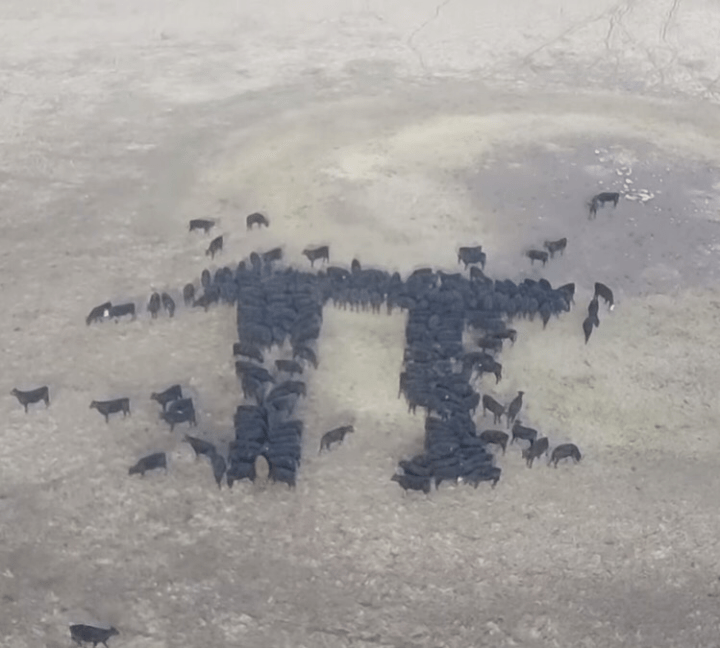 On this special Pi Day, 3.14.15, I thought it would be appropriate to ask the question I always love to ask, Why? Why Pi? Why Pi Day? Why all the fuss? No number is more famous than pi. But why, exactly?
Defined as the ratio of the circumference of a circle to its diameter, pi, or in symbol form, π, seems a simple enough concept. But it turns out to be an “irrational number,” meaning its exact value is inherently unknowable. Ancient mathematicians apparently found the concept of irrationality completely maddening. It struck them as an affront to the omniscience of God, for how could the Almighty know everything if numbers exist that are inherently unknowable? Pi (π) is the ratio of the circumference of a circle to its diameter. It doesn’t matter how big or small the circle is – the ratio stays the same. Properties like this that stay the same when you change other attributes are called constants.
The symbol pi has only been used in a mathematical sense since the mid-18th century. For those of you who weren’t in Greek life in college, π is the Greek symbol for the letter “p.” Oh, to go back to fraternity life!!! It was taken from the Greek word for “perimeter.”
Historically, Pi Day was started by Larry Shaw, a physicist who started celebrating Pi Day at the San Francisco Exploratorium in 1988. It was his idea to celebrate the day by eating pies and marching around circular spaces. In 2009 House Resolution 224 of the first session of the U.S. 111th Congress was passed, designating every March 14 as a day to encourage “schools and educators to observe the day with appropriate activities that teach students about Pi and engage them about the study of mathematics.” Wouldn’t Albert Einstein be proud?
Knowledge is limited. Imagination encircles the world. — Albert Einstein
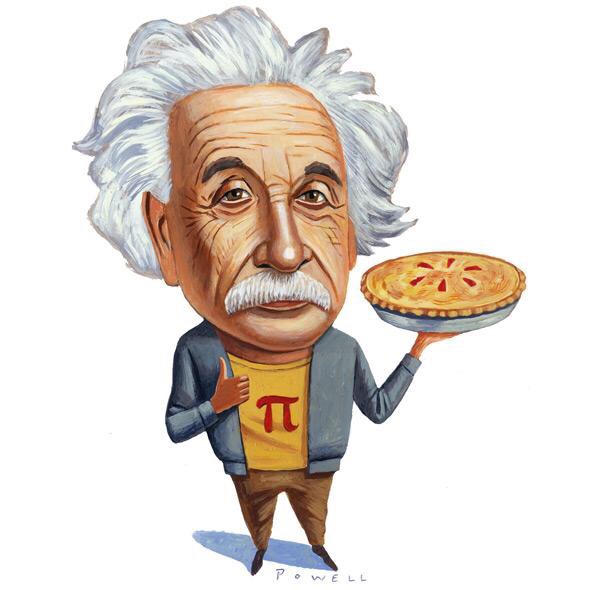
Speaking of Albert Einstein. March 14 is not only easy to remember, it has the added bonus of being the birthday of Albert Einstein, born in 1879 in Ulm, Germany. Happy 136th birthday, Albert! Einstein did not discover Pi, but he shares his birthday with Pi Day. Einstein’s life in science and mathematics started early, with him writing his first scientific paper when he was only a teenager. In 1905, Einstein published several influential works, tackling such topics as relativity and introducing his most famous equation on mass and energy E=mc2. And, in 1921, he earned the Nobel Prize in physics.
No one is really sure who should be credited with discovering Pi. The Babylonians estimated pi to be about 25/8 (3.125), while the Egyptians estimated it to be about 256/81 (roughly 3.16). The Ancient Greek mathematician Archimedes of Syracuse (287-212 BC) is largely considered to be the first to calculate an accurate estimation of the value of Pi. It is also interesting that an approximation of Pi is used in the Bible. The approximate ratio for Pi appears in the Bible in 1 Kings 7:23:
“And he made a molten sea, ten cubits from the one brim to the other: it was round all about, and his height was five cubits: and a line of thirty cubits did compass it round about.”
Until Every Child Is Well

I was struck this week while at Harvard University by the story of Boston Children’s Hospital’s vision/mission: Until Every Child Is Well. Really, I guess it would be more of an anthem, as Sally Hogshead would call it. What an anthem it is, though! Think about how simple and abstract “Until Every Child Is Well” is. In my studies this week I was reminded how important it is to make sure that our vision, or anthem, is broad enough to enable us to change as the world changes. What a simple, yet powerful statement Boston Children’s Hospital has made. Who could argue with, “Until Every Child Is Well?”
If we were to write it the way Joseph Michelli taught me, using the word “Wowful,” it would be “Wowful Child Wellness.” Regardless, both statements allow for cutting edge theories of action and strategery. I was also reminded this week of the 1942 Harvard MBA graduate, John Fisher, who was the CEO of Muncie, Indiana company Ball Corporation (you probably know them for Ball Jars). He worked for the company starting in 1941 and was CEO from 1970 to 1981. After World War II the glass jar business was booming, but later Fisher purchased and developed an aerospace business. Everyone thought he was crazy, but it led to the development of the plastic water bottle. I’ll bet you would agree that was a pretty savvy move. When asked about the shift from glass at a Harvard reunion, he stated that their vision had nothing to do with just glass, it was, “we want to be the best container company.” Again, simple, broad, abstract, and agnostic. John Fisher had learned well from his Harvard MBA. He learned you must exploit your present capabilities, but you must at the same time explore. We must learn about the future quicker than anyone else.

So, since my personal wow statement is “Delivering Wowful Educational Leadership” and my anthem is “Energetic Change Agent,” I set out reflect on what these two statements should be for my school; given my learning this week. Remember the goal is to be simple, broad, abstract, and agnostic. Let’s define agnostic. The dictionary defines agnostic as: a person who holds the view that any ultimate reality is unknown and probably unknowable; broadly one who is not committed to believing in anything being for sure. Think about that for removing all barriers of thinking things will stay status quo or need to be done the same way.
Here’s what I came up with:
Delivering Wowful Learning
Until Every Child Graduates
I would welcome your feedback on these two statements. It would be great to here how you would change them. These statements allow us to change as the world changes to do what the Indiana State Constitution says in Section 8 where it states: Section 1. Knowledge and learning, general diffused throughout a community, being essential to the preservation of a free government; it should be the duty of the General Assembly to encourage, by all suitable means, moral, intellectual scientific, and agricultural improvement; and provide, by law, for a general and uniform system of Common Schools, wherein tuition shall without charge, and equally open to all. It is important to pay particular attention to the statement, “by all suitable means.” We have a constitutional obligation to make our delivery of knowledge and learning to our students distinct and effective. I love the statement, “by all suitable means.” That is simple, broad, and abstract.
Schools have growing alternatives for delivering education. Choices range from presentations and discussions in the classroom to online, blended, and hybrid courses. As facilitators of learning, teachers will increasingly turn the process of teaching and learning into a partnership, with students and teachers constantly learning from each other. Self- learning will be seen as a bonus— and encouraged. Also, think about the online world where the greatest minds are just a click away and readily available. This open access has tremendous possibilities for many of our US underserved populations as well as third world countries. Pretty exciting, don’t you think?
I encourage you to take some time and think about your school or organization vision, mission, and anthem. Does it allow you to be nimble and change as the world changes? Remember: Leaders need to be consistently inconsistent. We have to constantly explore who we are and what we do!
 Byron's Babbles
leave a comment