Imagining The Complex Unique Individual
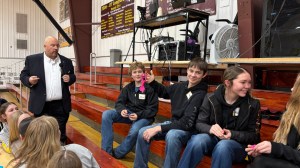
In a great discussion following Dr. Jim Beitler’s Hansen Lecture, “The Horns of Elfland: On Fairyland Justice” we talked about justice and how the novels from Tolkien and Lewis help us develop an understanding and appreciation of others, particularly through our imagination. We even discussed justice in leadership being about how we imagine the person in front of us. Do we imagine them as just a collection of data or a complex unique individual. This really caused me to reflect about how we imagine those we serve, those we are just meeting and making friends with for the first time, and anyone we come in contact with.
It was suggested to read Elaine Scarry’s “The Difficulty of Imagining Other People.” This essay offers valuable insights for leaders aiming to cultivate a more human-centered approach. Here are some key lessons that we can draw from Scarry’s work:
- Recognize the Challenge of Empathy: Scarry emphasized how difficult it is to truly imagine and understand the experiences of others. Leaders can learn to acknowledge this challenge and intentionally develop empathy by actively listening and seeking diverse perspectives, rather than assuming we fully understand others’ realities.
- Value of Fragility and Vulnerability: The essay highlights the delicate nature of human identity and perception. Leaders who appreciate this fragility are more likely to foster environments of trust, compassion, and psychological safety, encouraging team members to be authentic and vulnerable.
- Importance of Imagination in Leadership: Effective leadership involves imagining the lives and struggles of others beyond immediate interactions. By cultivating our capacity to imagine different realities, leaders can make more compassionate decisions that genuinely serve the needs of their teams and communities.
- Counteracting Objectification: Scarry discussed how difficulty in imagining others can lead to objectification or dehumanization. We need to be conscious of this tendency and work actively to see team members as whole persons with aspirations, fears, and complexities—not just roles or functions.
- Fostering Being More Human-Centered:
Understanding the hurdles in imagining others encourages leaders to create practices that validate diverse experiences, promoting belonging within organizations.
Studying Scarry’s work encourages us to deepen our capacity for empathy, vulnerability, and imaginative understanding—fundamental elements of being truly human-centered. This approach not only enhances ethical leadership but also builds stronger, more resilient, and engaged teams.
The Gift of Imagination

On Saturday, I wrote about Our Gifts & Force Multipliers. Today, as I think about all of us being gifts I consider George MacDonald’s view on imagination. He believed that everything of us humans must have been of God first. MacDonald said, “We discover at once, for instance, that where a man would make a machine, or a picture, or a book, God makes the man that makes the book, or the picture, or the machine. Would God give us a drama? He makes a Shakespeare.” I love this from from MacDonald’s essay, “The Imagination: Its Function and its Culture,” because it suggests that God created us all as gifts. MacDonald believed God created us in his own image to imagine all the things we do.
“We discover at once, for instance, that where a man would make a machine, or a picture, or a book, God makes the man that makes the book, or the picture, or the machine. Would God give us a drama? He makes a Shakespeare. Or would he construct a drama more immediately his own? He begins with the building of the stage itself, and that stage is a world–a universe of worlds. He makes the actors, and they do not act,–they are their part. He utters them into the visible to work out their life–his drama. When he would have an epic, he sends a thinking hero into his drama, and the epic is the soliloquy of his Hamlet. Instead of writing his lyrics, he sets his birds and his maidens a-singing. All the processes of the ages are God’s science; all the flow of history is his poetry.” “The Imagination: Its Function and its Culture” by George MacDonald first published 1867 in A Dish of Orts
MacDonald asserted “The imagination of man is made in the image of the imagination of God.” He suggested that human creativity and imagination reflect a divine quality. MacDonald believed that just as God is the ultimate creator, humans, being made in His image, possess the capacity for creativity and imaginative thought. We are gifts – every one of us! This idea emphasizes the notion that our ability to envision and create—whether through art, literature, or innovation—is a gift from the divine. MacDonald believed that the act of imagining something new is not merely a human endeavor but also a way to connect with the divine nature of creation.
MacDonald described imagination as the faculty that allows humans to give form to their thoughts, creating images and ideas that can be expressed in various ways. MacDonald suggested that our creative power highlights the significance of imagination in our capacity to create and understand the world around us.
Thoughts & Imagination

In my quest of studying C. S. Lewis and reading all that he has written, I am reading The Search For God right now. I love these compilations of his writings, speeches, and sermons because it provides the opportunity to re-read some material and hear new material. This is a great mix that causes deep reflection. Lewis spent a great deal of time addressing our conscious and rational minds versus our imagination. It is from the conscious mind that we predominantly operate each day. But, much of our behavior, attitudes, and decisions are influenced, if not ruled, by our imaginations. This is not a bad thing, and actually for those who fully embrace it, who we call artists, it is a great thing. Lewis argued and continually contemplated our need to balance out our bias toward rationalism and create space for the imagination. Or, at the very least recognize the role imagination plays in our thinking.

In The Search For God C.S. Lewis said, “What you think is one thing, what you imagine while you are thinking is another,” and I believe he was referring to the idea that our thoughts and imagination are not always aligned. While we may have conscious thoughts and beliefs about something, our imagination has the power to create different scenarios or possibilities that may diverge from our initial thoughts. This statement suggests that we should be aware of the distinction between our conscious thoughts and the imaginative possibilities that can arise during the thought process.
The example Lewis gave was how he imagined the University of Oxford before he had actually been there was different than what he actually saw. That wasn’t necessarily a bad thing, especially since he was there for academic reasons, not how the University. This made me think of all the times I have said things like, “This is not how I had imagined this” or “I’m not really sure what I thought this was going to be like, but this is not what I was imagining.” Has this ever happened to you? Our imagination is so powerful. It can work for us and can also work against us at times. Bottom line: we need to allow our minds to wander and wonder.
Our Wandering Minds

Our imaginations allow us to be in multiple places at once, even if it’s just in our minds. So true! And, my mind has been transported to so many new and excited places because of the books I’ve been reading the past couple of weeks. This post is another one of several these past few days inspired by Patti Callahan Henry. Here, in the month of April, I have read three of this best-selling author’s books:
The latter two were written out of Patti Callahan Henry’s love of C.S. Lewis‘ writings. Her work is incredible! Patti has the ability transport us to the setting of the story. I am not just reading the story, I am there. I always come away inspired by her work and in a state of reflection about what I’ve learned. In fact, I just started reading Lewis’ fantasy novel, The Lion, The Witch, and The Wardrobe, which was the through line of Once Upon A Wardrobe. I read The Lion, The Witch, and The Wardrobe years ago, as a youngster, but I am reading it now in a totally new and exciting frame of mind. C.S. Lewis would be proud I am now old enough to read fairy tales again.
“Some day you will be old enough to start reading fairy tales again.” ~ C.S. Lewis
In Once Upon A Wardrobe, Padraig Cavender told Megs and George Devonshire that, “We are never just in one place at one time. Because of our imaginations we are in many places at any given time.” Meaning that our imagination allows us to be mentally present in many different places and situations at the same time, even though we are physically only in one place. Our minds can wander and imagine different scenarios, which helps us to be more creative and innovative in problem-solving and decision-making. Can you think of a time when you used your imagination to problem-solve or make decisions?
Imagining Narnia

Have you ever had an experience where your imagination helped you understand or appreciate something in a way that reason could could not? Megs and George Devonshire did in, Once Upon A Wardrobe, by Patti Callahan Henry. George wanted Megs to get C.S. Lewis to answer the question, “Where did Narnia come from?” George’s question refers to Lewis’ fantasy novel, The Lion, The Witch, and The Wardrobe. In one of Megs’ visits to The Kilns it was stated that, “Reason is how we get to the truth, but imagination is how we find meaning.” This phrase in the book suggests that reason is a useful tool for discovering the truth, but imagination is essential for finding deeper meaning and significance in our experiences. George reminded us in this great historical fiction work of Patti’s that Albert Einstein said, “Imagination is more important than knowledge. For knowledge is limited to all we now know and understand, while imagination embraces the entire world, and all there ever will be to know and understand.” Imagination can truly take us beyond what we know, or think we know, and help us see the wider world.

Mere facts and information may not be enough to fully understand and appreciate the world around us; we need to use our creative and imaginative faculties to uncover the more profound truths and connections that often lie beneath the surface. I love how Once Upon A Wardrobe and all of Patti Callahan Henry’s great historical fiction works models this so perfectly for us. She takes historical facts which always seem to have gaps or facts that are not known and she uses her extensive research to guide her imagination to making sense out of all of it. We always need to remember that our imagination can help us find meaning.
Being Childlike

The other day during a Zoom meeting I said that I thought that I had matured a little over the last year. Then, one of the participants said, “Well, just don’t quit being childlike.” I thought about that and actually wrote it on my notepad. Now, as I come back to that note I guess I look at being childlike having all to do with growth, curiosity, and feeling free enough as individuals to be ourselves without unduly formed restrictions. Those things really have nothing to do with maturity and all to do the positive qualities related to children. Things like innocence, trusting, unguarded, or being vulnerable like a child. It also means taking off the many masks of propriety imposed within our society that limit our creativity and sense of exploration. I do allow myself to play, and to be silly.
I probably wouldn’t have written a blog post about this, but when reading yesterday in Mo Rocca’s awesome book, Mobituaries, yesterday he wrote that someone had described Sammy Davis Jr. as being childlike, not childish. This made me think more about the difference. Sammy certainly was fun, relaxed, spontaneous, creative, adventurous, and silly. At the same time that he was entertaining us he was doing a lot of great things in the world. Certainly not childish behavior. Childlike, yes; childish, no.
Therefore, being childlike has everything to do with growing, being curious, and being ourselves without those unduly formed restrictions that society wants to place on us. I sure hope I don’t grow out of being childlike!
Imaginative Play Zones

Albert Einstein famously said, “To stimulate creativity, one must develop the childlike inclination for play.” And even Pablo Picasso said, “Every child is an artist. The problem is how to remain an artist once we grow up.” If children are more creative than adults, it’s not because they have a superior imagination. They just don’t suffer from self-doubt and fear to the extent that adults do. In this respect, at least, we could all afford to be more like children. We don’t question kids being more creative than adults; we all intuitively just know it’s true and we view it as a natural state for children.

So why do kids have the aptitude for creativity? Play! And, remember they have not yet developed, or been taught the self doubt and fear part to the extent we adults have, either. In studying the work of Dr. Stephanie Carlson, an expert on childhood brain development at the University of Minnesota, she taught us that kids spend as much as 2/3 of their time in non-reality— in imaginative play. This is why when I am providing development for adults I always try to spend some time channeling their inner child. Adults want to, and effectively, learn like kids. We want the play, time for imagination, and a safe place for trying new things.
As I worked with teachers this past week we discussed creating psychologically safe places for our students to learn and try new things (the things we are teaching are new). But, we must also not forget our adults – we need a psychologically safe place as well. How about we create imaginative play zones?
What Will You Regret When You Are 80 Years Old?

I finished the great book, Alien Thinking: The Unconventional Path To Breakthrough Ideas, this past week. In the book, authors Cyril Bouquet, Jean-Louis Barsoux, and Michael Wade presented an incredible framework for innovation and creativity. The framework is based on five strategies that do NOT need to be accomplished in any linear fashion:
- A – Attention – look with fresh eyes to observe problems that need to be solved, opportunities worth addressing, and solutions that can be dramatically improved or revised
- L – Levitation – step back from the creative process to gain perspective and enrich your understanding
- I – Imagination – recognize hard-to-see patterns and to connect seemingly disparate dots to imagine unorthodox combinations
- E – Experimentation – test ideas quickly and smartly, with the goal of improving – not just proving – your idea
- N – Navigation – deal with potentially hostile environments and adjust to the forces that can make or break your solution
At the end of the book, the authors helped the reader work through some important hindrances to innovation like human emotions and personality traits. I was struck by the discussion of “regret” that can easily derail even the most ALIEN of thinkers. In Alien Thinking we are taught that “When setting off on a journey of innovation or discovery, you will have to overcome your fears about what might happen.” These fears come in the form of “anticipatory regret” and “existential regret”. Having just founded my own business and making the decision to go out on my own, this discussion in the book really resonated with me.

In addition to overcoming fears of what might happen, most of us, when innovating or trail blazing, will have to deal with “anticipatory regret.” This is the regret we imagine ourselves feeling if the decision we make or don’t make ends up being a mistake. This is pretty powerful stuff. Science can help us with this, however, because the science says that we tend to regret actions not taken far more than we regret failed attempts.
This is where Bouquet et al. explained that “existential regret” can be used as a tool. Existential regret is the regret of how we will later feel if we don’t try; or play it safe. While doing some further studying in this I found the stories of Jeff Bezos when he was trying to decide if he would quit his great job to start what is now the Amazon empire. He used a framework he called “regret minimization.” He projected himself out to the age of 80 and imagined what he would regret. He found that he would deeply regret not having tried to make big on that thing called the internet. Now that is Alien Thinking. Now that is “levitation”- all the way to the age of 80.
We must learn to channel our fears and thoughts of regret to be a positive driver and help us work out the kinks in our wild and alien ideas. Using existential regret can help us sift through our own personal goals and core values to make a weighty call.
Testing Everything & Conceiving Different Outcomes

While this post will probably pose a controversial idea to those “Scientific Method” purists, my post is meant more to be thought provoking. As a person who taught the Scientific Method to agriculture science students for years, I understand why hypotheses have been a part of the method since the 17th century. But, some, okay a lot, of things have changed and advanced since the 17th century. In the great book Alien Thinking: The Unconventional Path To Breakthrough Ideas, authors Cyril Bouquet, Jean-Louis Barsoux, and Michael Wade argued that the use of hypotheses are, in many cases, no longer necessary given the immediate and real-time abilities for data analysis we now have in a digital world. Think about all the things we used to have to wait long periods of time to get data back on, that are now immediate.

This made so much sense when we think about confirmation bias, the tendency to process information by looking for, or interpreting, information that is consistent with one’s existing beliefs. If we make no assumptions and just let the data go where it goes, would that not be better – and more accurate? Granted, I have not completely thought through all this. The way we would traditionally set up the hypothesis test is to formulate two hypothesis statements, one that describes the researchers prediction and one that describes all the other possible outcomes with respect to the hypothesized relationship. With the aid of artificial intelligence, augmented reality, digital twinning, and many other digital capabilities could we find relationships, or lack there of, that we would have never thought of in a world using the alternative and null hypothesis? The point to remember here about stating hypotheses is that a prediction (guess) is formulated (directional or not), and then a second hypothesis is formulated that is mutually exclusive of the first and incorporates all possible alternative outcomes for that case. When the study analysis is completed, the idea is that we will choose between the two hypotheses.

Bouquet, et al. posited that “The Alien experimenter doesn’t need to formulate a hypothesis – just come up with an experiment and then measure the results.” This will better allow us, they went on to say, “…conceive different outcomes, as well as the ability to measure and learn from them.” So maybe, just maybe, it is time to rethink the long tradition called the hypothetical-deductive model, and begin a new tradition of Alien Thinking.
Imagining In Your Mind’s Eye

I am sure this is going to be the first of many posts about the new book I am reading by one of my favorites, Malcolm Gladwell. The book is The Bomber Mafia and it is awesome! One of the topics that came out in the book was the idea of seeing things in your mind’s eye. Gladwell discussed that this is something that engineers do very well – seeing something in your mind that hasn’t even been created or creating an image in your mind of something you are not presently looking at or have never even seen. Being the husband of an engineer I can tell you this is a trait – her mind just seems to work differently at times. It turns out, however, we are all able to do this to a certain extent. I just had to dig in and learn more about this.

It has always been amazing to me how I can run into a former student and my mind maybe can’t come up with the name, but I can remember where she liked to sit in the classroom and see the classroom as if I am standing there 25 years ago. Then I sometimes imagine a completely redesigned classroom. Neuroscientists have shown that imagining an object activates some of the same brain regions as looking at that object. When we look out at the world around us we depend on light to bounce off objects and enter our eyes. This light is then converted it into electrical signals. These electrical signals travel to our brain where basic visual features, such as lines, angles, and previously seen patterns are processed. The electrical activity then goes to the front part of our brain where visual areas perform complex processing, and in a few hundred milliseconds of light entering the eye, a perception of the object is created in our brain. This is where the brain takes our previous memories and patterns to form the image.
The latest research suggests that when we imagine an object, the brain activates the entire representation of that object at once rather than building it up in the steps outlined above. The context for this learning in Gladwell’s great book was Carl Norden, a Swiss engineer, who developed the Norden Bombsight. Norden believed the device would lower the suffering and death toll from war by allowing pinpoint accuracy during bombing runs. He imagined the design for the device, that used 64 algorithms, in his mind’s eye. It even had an algorithm taking into account how much the earth would spin in the time it to a bomb to reach earth from 30,000 feet. Gladwell stated that you find paperwork descriptions or drawings. He did all his work in his head.
Gladwell pointed out that these great developments happen from someone becoming obsessed. What are you obsessed with?
 Byron's Babbles
1 comment