Our Many Faces
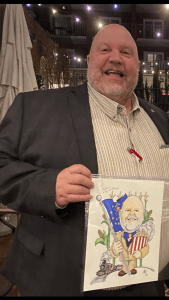
This week I was reminded how important our ability to read faces is. And, how important the faces we make are. First, on Monday, I was given a caricature and was described as Jupiter, the bringer of jollity, from The Planets. I blogged about this in Leading With Jollity. I have always taken pride in being able to read faces. It is such an important skill when teaching and facilitating learning. I love to read and interpret the feelings and expressions of those around me. It turns out we are all born with this intuition. Within a few hours after we are born, we recognize the face of our mother.

I am reading the fascinating book, Read The Face: Face Reading For Success In Your Career, Relationships, and Health by Eric Standop right now. Face reading, according to Standop, is our first language. As a master face reader, Standop is able to read personality, character, emotions, and even the state of a person’s health. This can all be done from simply glancing at their face. While certainly not trained in this, I still believe it is important for us to be able to pick up on the clues of face reading and continually work at paying attention and honing this skill. When I am facilitating learning for a group I always try to watch for the facial cues of the participants. I can tell when someone has something to say, a question, agreement, or is in disagreement. These cues help me to let the discussion deepen organically and play out.
My many years of teaching agriculture science gave me the opportunity to hone these skills. In the past few years, working with adults, I have had the chance to hone them further. And, one of the perks of virtual meetings is that we can really study the faces of others. Clearly, if you read Leading With Jollity, you’ll find that Christine Benson had the caricature done of me, and described me as Jupiter, bringer of jollity, from only getting to know me through Zoom meetings. Actually, that was a pretty accurate description. To me this proves that we can get to know people well in a virtual setting. In many cases I have been able to get to know people even better. Sometimes discussions go even deeper online. I am not saying that I do not want to be in person, because that is still my preference, but if we use our innate ability to face read to the fullest we can form even deeper relationships. What are you learning from others’ faces? What is your face telling others?
My Memories Matter

As I wrote the rough draft of this post I was on a plane taxiing to the runway at Reagan National Airport in Washington D.C. As I looked out window I saw the dome of our Capitol and the Washington Monument (see my pictures). This caused several moments of reflection. I thought about all 12 U.S. Presidents that have been in office since I was born. I thought about the Vietnam War that happened during my lifetime. I thought about President Nixon and his resignation. I thought about the first President I voted for, Ronald Reagan. I thought about the first Gulf War. I thought about 9/11. I thought about wars in Afghanistan and Iraq. I thought about all the time my son Heath and I spent in Washington D.C. when he was growing up when I brought him with me to the Washington Leadership Conference of the National FFA Organization every year. I thought about getting to pay my respects to Ronald Reagan as he was lying in state in the Capitol rotunda. I thought about being with President Obama in the Oval Office. I thought about spending time with, then Vice President, Joe Biden and Dr. Jill Biden at Number One Observatory Circle. I thought about being awarded the Smithsonian Diffusion Award in the Smithsonian Castle. I thought about the fall of the Berlin Wall, the end of the Cold War, and getting to stand at the Brandenburg Gate where President Reagan told Gorbachev to tear down the wall. I thought about being in Vice President Pence’s White House Office. A lot of memories were running through my mind. I realized I’ve experienced a lot in my almost six decades.

That’s a lot of history. That’s a lot of memories. But what does it all mean? Does living through all that matter? Yes, all those memories matter! Our memories make us who we are. They create our worldview in ways we hardly realize. It is why we must be always creating the situations to create memories for our children. We also need to be creating memories for our students. All that we have ever learned, from how to get along and play with others, how to read, and even how to resolve conflicts, makes us who we are. That is why who taught us and our experience of the things we have learned are all embedded in the memories themselves.
Our memories are essential because they allow us to grow and learn to be a better person. Our memories help us understand why we are who we are. When we understand why we are who we are, we become empowered to create ourselves intentionally. Oscar Wilde said, “Memory is the diary that we all carry about with us.” I am so glad that my peek out the airplane window caused me to open my mind’s diary and begin reflecting on who I am.
Leading With Jollity

My dear friend, Christine Benson, who is chair-elect for the National Association of State Boards of Education (NASBE) has introduced me to a new piece of culture: The Planets. This work took three years to compose (1914-1917) by Gustav Holst. Basically, the composer attributed characteristics to the seven planets of Mars, Venus, Mercury, Jupiter, Saturn, Uranus, and Neptune. Christine told me that I reminded her of Jupiter, the bringer of jollity. She told me that as the round-faced cheery uncle of all the planets, and king of the gods, Jupiter is impressive and majestic. I guess I lead with jollity. I love the fact that Holst was a student of astrology and horoscopes in the context of the planets inspiring music.

One description of the musical representation of Jupiter was that it took us on a whirlwind of emotions which was full of climatic passion, zeal and triumphant feelings. I was beginning to understand where Christine was coming from thinking this described me. With Jupiter, the air is full of life, joy, heroic and majesty. Jupiter brings jollity and is an up-lifter because it signifies happiness and abundance, expansion and brings a disposition of mirth, joyousness, hopefulness and trustworthiness, expectant and confident, and a desiring for devotion through service. Jupiter also transforms the mercurial, logical mind, bringing wisdom and understanding which promote nobility of thought and aspiration.
To immortalize my jollity, Christine had a caricature done representing me. I especially love that she had the artist do it using images she screenshot during Zoom meetings and things I have talked and mused about during meetings. This just goes to show that we really can get to know each other well in a virtual setting. That has been a silver lining of the pandemic that I do not want us to ever lose sight of. I love the substantive conversations in the virtual world that come from making a real connections with those who we are on line with. The power is always in the dialogue. It is about being human no matter whether we are in person or online; the power in interactions is to take time to truly and more deeply understand what each other is experiencing. Over the past couple of years we have created new patterns and rituals together. These new patterns and rituals bring a sense of structure, unity, and collaboration. Understanding what matters most to us and discovering who we might become, and then help as a result, is the real work of our lives. Let’s approach all this with jollity.
The Proof Of The Pudding Is In The Eating

As a person who lives by metaphor and idiom, I love that English is a language rich with imagery, meaning, and metaphor, and when we want to express ourselves we can draw upon a catalog complete with beautifully turned phrases, drawing from the language’s Latin, French, and Germanic roots. I was reminded of this last night when presented the most beautiful piece of cheesecake I had ever seen (see featured photo). When I said this, the person giving it to me said, “Well, the proof is in the pudding.” Then he immediately said, “What does that mean, anyway, the proof is in the pudding?” Umm…let’s see. I believe this might be an idiom.
So I guess this phrase originated in 1605 as a proverb that went, “The proof of the pudding is in the eating.” That actually makes much more sense, don’t you think? At least now I don’t think I have to dig in pudding looking for a proof – I was having awful flashbacks from geometry class in high school.
I believe understanding this phrase is pretty simple: It doesn’t matter how fancy the decoration and presentation, the true test of a pudding is in how it tastes. In other words, success of something can only be judged by putting it to its intended use or experiencing in its final form. It’s all about results.
Leading Like A Orchestra Conductor

A few weeks ago I got a very nice complement (in the form of a tweet) from Lauren Berry, a participant in one of my leadership development sessions that said, “Fireside chats and pumpkins galore! This crew had a blast reflecting on our time with the #NEI3DLeadership program! The biggest shoutout to @ByronErnest as our fearless leader. We have learned so much from you!” This tweet meant a great deal to me and I responded, “Words can’t express my appreciation for your tweets. Thank you! I am merely the conductor guiding the performance, not making it happen, not bringing it into being – YOU & the others in your cohort are making the beautiful music that makes these gatherings so special.” Then I got to thinking, as I always do, shouldn’t we be striving to be conductors instead of leaders?

I heard it said once of orchestra conductors that the music flows from the pages through them, they are avatars of a bigger purpose, conduits of a bigger collective goal. The idea of being conduit is also huge for me. Think about that metaphor: a conduit is something that channels or conveys something. Think about water or electricity being moved to everyone who needs it. That’s what I strive to do. Help everyone be better conductors of their orchestras (aka organizations). I hope your catching all of this play on words. But, it’s really not just words; we are on to something here.
Back to our conductor. They don’t tell the musicians how or what to play, they set the pace, cue them in, and guide. They do not bring the the beautiful music into being or make it happen. They are merely the conduit. The conductor has a premium vantage point to help bring about optimum collaboration of the entire orchestra.
Great conductors let the performers thrive in a framework that evolves as the composition progresses. The conductor is only a part of a magnificent performance. They have helped bring out the talent of every musician and cued in every resource with perfect timing. Then after taking a quick bow to the applauding audience, diverts all credit to the musicians in the orchestra (watch a conductor sometime). Are you leading like a conductor?
Being Kind
I am continuing to learn from my reading in The Lincoln Highway by Amor Towles. There has been so much talk and many articles written about kindness in the last year. Additionally, there has seemed to be a great deal of hypocrisy where organizations, companies, and leaders would be lauded one day for acts of kindness and be reported for being unsafe the next. Or, articles about kindness is more than providing for basic needs, the lowest wage possible, or most bare bones of benefits. One thing is clear: being kind is necessary and the right thing to do. It’s even a bit intriguing to me that we even need to talk about it, but here we are.

We’ve all seen the buzz word ridden definitions of kindness that people/leaders love to give. You know, the ones that have words like considering, balancing, satisfying needs, fostering group well-being, innovation, potential, and productivity. What? It’s got to be simpler than that. It is! A character, Sally, in The Lincoln Highway likes to make strawberry preserves using the recipe and technique taught to her by her mother. When asked why she goes to the hours of hard work to make the preserves when you can go to the store and buy a big jar for 19 cents (the novel takes place in the 1950s), she says because she can and precisely because it takes so much effort. She explains she does it because it does take so much labor and it is a kind thing to do.
Furthermore, Sally defined kindness as being “where necessity ends.” Let’s read that one more time: “For kindness begins where necessity ends.” Now there’s a definition we can understand. If we let that sink in it’s pretty basic – kindness kicks in after basic necessities are met. Kindness is also a part of our everyday interactions.
As it also asks in the book, “For what is kindness but the performance of an act that is both beneficial to another and unrequired?” To me that puts a whole new light on kindness. Sometimes we pat ourselves on the back for being kind when really we’ve just begun to provide for necessities. Let’s not ever forget this lesson: kindness begins where necessity ends!
Picking Your Moments

I just started reading the incredible new book The Lincoln Highway by one of my favorite authors, Amor Towles. As a believer in the importance of storytelling as a skill, reading an Amor Towles’ book is like taking a clinic. Besides becoming completely engrossed in his books, I become very reflective and end up learning a great deal about myself.

A line in the book already jumped out at me: “Sometimes the moment is picked for you.” I tell leadership development groups I work with all the time that we sometimes forget that we need to control the clock. Think about it; the best coaches control the clock from beginning to end. You might be thinking how does the moment being picked for you translate to controlling the clock. Well, it means using that moment to the fullest. This means we need to keep our attention focused on the present. One thing is for sure, whatever we are attending to in this moment will change. This change could give us the opportunity to practice accepting whatever it is that will emerge in the next moment. There is wisdom in cultivating acceptance.
I heard it said once that the reason we can fully appreciate sunsets is that we can’t control them. But, even though we can’t control when sunset happens each day (the moment is chosen for us), we can plan to be standing on the beach at the right moment to experience its glorious moment. So remember, make the most out of those moments that are chosen for you.
Leading FOR Others

I had the chance to go visit three Indiana schools this past week and see some great things happening for students in our state. I visited the International Soccer School of America, Stable Grounds, and Millersburg Elementary Middle School. I love getting out into schools and seeing programs that I have not visited before. This is an important part of my own development as a citizen leader and being part of the Indiana State Board of Education. It is impossible to understand others and build relationships without taking the time to visit and listen. At all three stops I saw communities of people who were innovating to serve our young scholars. They were meeting them where they were and preparing them for the future they choose.
When we lead as a community we foster an environment for inspiration, success, trust, and teamwork. I want to lead FOR others, to provide thought and care, develop strong relationships, support others in their own successes and consciously act with integrity. When we develop as leaders FOR others, we grow in grace, understanding, and self awareness.
Being Childlike

The other day during a Zoom meeting I said that I thought that I had matured a little over the last year. Then, one of the participants said, “Well, just don’t quit being childlike.” I thought about that and actually wrote it on my notepad. Now, as I come back to that note I guess I look at being childlike having all to do with growth, curiosity, and feeling free enough as individuals to be ourselves without unduly formed restrictions. Those things really have nothing to do with maturity and all to do the positive qualities related to children. Things like innocence, trusting, unguarded, or being vulnerable like a child. It also means taking off the many masks of propriety imposed within our society that limit our creativity and sense of exploration. I do allow myself to play, and to be silly.
I probably wouldn’t have written a blog post about this, but when reading yesterday in Mo Rocca’s awesome book, Mobituaries, yesterday he wrote that someone had described Sammy Davis Jr. as being childlike, not childish. This made me think more about the difference. Sammy certainly was fun, relaxed, spontaneous, creative, adventurous, and silly. At the same time that he was entertaining us he was doing a lot of great things in the world. Certainly not childish behavior. Childlike, yes; childish, no.
Therefore, being childlike has everything to do with growing, being curious, and being ourselves without those unduly formed restrictions that society wants to place on us. I sure hope I don’t grow out of being childlike!
What Is Your Essence?

I am reading the great book, Mobituaries: Great Lives Worth Reliving, by Mo Rocco right now and while discussing Sammy Davis Jr., he posited that when Sammy did an imitation he had a way of getting to the essence of the person. Our core essence is what makes us uniquely “me”, and is what separates each person in their individuality. This thought of essence is pretty deep. Essence is our style and what seems to show up in every one of our stories. Just as important to discovering our essence is to unraveling the mysteries of our actions, it is also important to explaining the mistakes we make. But, I was also reminded this weekend how important understanding essence is to effective relationships.
I was reminded of this during a discussion yesterday during our Carolinas 3D Leadership gathering. Two participants did some deep soul searching and were discussing how they hated to hear things from their principals or team members like, “your doing to much” or “not sure why you are doing that” or “why in the world did you add so many features to that spreadsheet.” I added that last one because I’m guilty of saying things like that. I am so glad that these two opened up, though, because I believe it opened all our eyes – I know it did mine. We were hearing their essence in their stories. Glad we were listening to understand!
I asked them what it was they wanted to hear. They said they just wanted to hear, “Great job on this” or “This is very helpful” or I really appreciate having this.” For these two, their essence is something like being three steps ahead or going above and beyond or striving for success. What we learned from this discussion was that it is not helpful for those whose essence is to build the over the top spreadsheet to say, “Um, not sure why you spent so much time on this, we don’t need all the bells and whistles.” We just need to acknowledge and recognize the person’s essence. You all know me, I asked what do you want to hear? They told me instead of “you shouldn’t have” they wanted to just hear “thank you, I appreciate all the extra work you have done.” Otherwise, we are not respecting their essence.
Since our essence is our style we don’t want to let a story overwhelm our style. That would mean to lose touch with ourselves. When work becomes more important than the living of your own life, or a relationship overshadows your individual needs, or expectations are so prescriptive that you are no longer in control of your life or how you do your job, we are not living by our essence.
It’s amazing to me how a simple word like “essence” can cause such deep thought. But, just as Sammy Davis Jr. could catch the essence of others, we too have an obligation to listen and watch for the essence of those around us understand the essence of those we work with and have relationships with. Essence is a part of each of our stories and follows us no matter which forms we may take. To truly understand the essence of another is to have power in how we work and flow with other. Finally, we also need to understand our own essence and embrace it because to do so will keep us from working against ourselves.
 Byron's Babbles
leave a comment