Wanna Into Gonna

As I was flying home from facilitating a leadership professional development gathering yesterday I noticed what was written on the Southwest Airlines napkin. The Southwest business model has always been intriguing to me and I was struck by what was on the napkin, “In 1971, a triangle scribbled on a napkin transformed a dream into an airline and a wanna into a gonna.” I love the thought of a wanna becoming a gonna. This is also a reminder that it takes action to make dreams realities. We also, can’t do it all ourselves.
Whether it is making the plan visible and real on a napkin or just getting to work, the point is we have to start somewhere. There is a whole lot to what Herb Kelleher had to do to get Southwest Airlines off the ground (pun intended). I’ll let you do all the reading on that, but the point is we need to plan out turning our wanna into gonna. Also, remember, in this age of crediting everything to rugged individualism, no-one accomplishes things by themselves. We all need someone that provides us with the assist. It is very disingenuous to tell our kids that if they just work hard they will succeed. That is simply not true. It is an important part, for sure, but not the end-all-be-all. We all need those that provide us with privilege for accomplishing our dreams. Yes, Kelleher had tenacity and stuck with it, but he had people all around him, including his employees who he cared for deeply helping him get it done.
What dream triangle do you need to scribble on a napkin, and who can help you turn your wanna into a gonna?
Being Treated Well
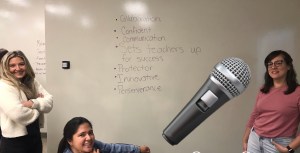
Today I was reminded of something I heard Steve Jobs say, “Leadership is about inspiring people to do things they never thought they could.” A participant in a leadership development gathering I facilitated actually said it better when she said, “Leadership is not about a title. It is about the actions you take for others and the example you set for others.” That was a drop the mic moment given that we had been discussing the leaders who had the most influence on us. We had also been reflecting how how well we had been doing influencing others.
As we develop our own leadership style we must understand that those we serve want to be given opportunities to lead themselves. I’m a huge fan and student of Richard Branson. In an interview with Inc. he said, “If the person who works at your company is 100% proud of the job they’re doing, if you give them the tools to do a good job, they’re proud of the brand, if they were looked after, if they’re treated well, then they’re gonna be smiling, they’re gonna be happy and therefore the customer will have a nice experience.” The key words there are treated well. To me that means loving those we serve. It also means being set up for success. In that same interview Branson discusses putting staff first so everything else can fall into place. I have often said in education we must put teachers first so students can be first. Let’s treat everyone well!
Insane Plans

One of my favorite books this year has been The Martian by Andy Weir. There were many great lines in the book that caused me to think. Here’s one I pulled to blog about today: “This was an insane plan and somehow it worked. I spent the last three months being the loneliest man alive.” In the book I got to thinking about all the crazy and insane plans that have worked over time. I can think think of some of my own and I’ll bet you have a list too.
I am reminded that in January of 1917, during World War I, The German Kaiser declared all-out unrestricted submarine warfare on any ship that came within the sights of German U-boats. Between March and December of 1917, British ships of all kinds were sunk, at a rate of 23 a week. Insane plan: camouflage ships — a tactic that proved to be very effective on land. The challenge, however, was how do you do that with a ship? Thomas Edison suggested camouflaging ships as islands. Gotta love Edison Answer: make the ships stand out. Dazzle camouflage was introduced.
During WWI hitting a ship with a torpedo was more art that science. Therefore if all kinds of geometric shapes, swirls, angles, and other art forms were painted on the ships it thoroughly confused the U-boat operators. Guess what? It worked! It also helped the allies quickly identify friendly ships. What was considered insane saved lives and ships.
Do you have an insane idea you need to try? Go ahead. It might just be the next great breakthrough!
Containers Of Memories
I sorted through notes this morning that I took while reading and came across this quote from the incredible book The Paradox Hotel by Rob Hart: “Time is a container. Places are containers.” In the context of the book my interpretation was that when we think of time and places we think of things from the past. In other words time and place contain memories. Those memories are very important to us and important to build. I blogged about this earlier in the week in Building Memories. Time and places really do become the containers for those memories.
As a member of the last of the baby boomers I am not a digital native, but a digital adoptee. One thing I love about my iPhone is the ability to take incredible pictures. No more carrying a bulky camera with flash bulbs and extra film (boy am I aging myself). Some call them the good ‘ole days. Me, not so much. I love it when my phone magically sends me a “memories show” with some related pictures from some past event or trip. Another container that takes me back to a time and place. I laugh when I see kids with there new pastel colored Polaroid cameras. Yes, I had one. And, yes they are cool. But, I am not carrying one and my phone is even more instant!
I have found an incredible new way to “contain” these memories. Have you heard of Mixtiles? Their call to action says it all: “Turn your photos into stunning wall art.” I was intrigued one evening when I saw their commercial and took them up on their buy 10 get 10 free, and a couple of days later (literally) had 30. I know I got carried away, but I’m giving 10 of those to my son. But, in full disclosure turned around and got a bunch more this week. The tiles are about eight inches by eight inches and a little under an inch thick. Here’s the best part, and I’m quoting from their website: “There’s a sticky strip on the back of them. You peel off the protective paper and stick them on the wall. Easy as pie! (We enjoy pie.)” So, no hooks or nails! Then, here’s the even better best part (I’m full of superlatives today). You can move them around: “Super easy – that’s what Mixtiles are made for! Just pop them off the wall and stick them in a different spot. Knock yourself out, you can do this a few dozen times!” Why am I telling you this? I love them and wanted to share.
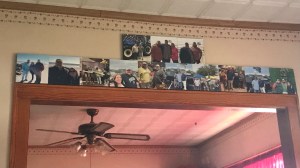
I put a few of them above the woodwork of the entrance from our living room to the dining room. They are in plain view from our chairs in the living room. My wife and I catch ourselves gazing at them and then get to reminiscing about the times and places of the photos. These wonderful Mixtiles have become containers. I’m excited to put up more around the house. I should become a Mixtiles ambassador. I wonder if there is such a thing?
Anyway, we need to remember that time is a container and places are containers. While travel is a great disruptor for new memories, we don’t have to go anywhere new. It could be something inspiring we heard at a conference. I sometimes remember where I was sitting when someone told me something inspiring or important news. We must not forget that we play a role in filling the time and place containers of others. Let’s fill those containers with positive and inspiring memories.
Every Little Detail Matters

In a planning meeting for a future gathering yesterday I was reminded of two very important words: “everything speaks”. Two simple words, but huge implications. It’s all about impact and we need to remember that everything speaks, always! I’m pretty sure Walt Disney gets credit for the “everything speaks” philosophy. And, you don’t have to spend very much time at a Walt Disney World theme park to figure it out. Just like trash cans every so many steps and the fact that Franklin Delano Roosevelt in the Hall of Presidents wears polio braces under his trousers. The details matter! My wife and I experienced a Disney Resort and the Disney Theme Parks for the first time past fall and we both commented on the fact that it was not just the big “wows”, but all the little things that added up. For example, I was amazed at how any time there was a question, someone just happened to be there to answer it.
I have friends who are Disney fanatics and I understand that for Disney the return trip is key. Therefore, they have truly empower their team to make decisions and be servant leaders to enhance the guest experience to the fullest. If you noticed that the word “truly” was in bold, that was no accident. I experienced organization where empowerment is talked about a lot, but never really practiced. Your empowered to do what your told. Have you noticed, places like that don’t retain their employees either? What’s interesting is that if we’re doing the right things we don’t need to talk about it, why? Because everything speaks! Most people don’t even notice all the little things at Disney, but we would if they were not there – so, we don’t need to be told they are there because those little things are speaking. Those we serve only notice what we do when we don’t do it.
Every detail of the experience with you or your organization is saying something about you and your organization. Those you are serving may not consciously know or understand every detail, but subconsciously clues to our culture and the community we have formed are being communicated. One of the key points from my planning meeting that I leave you with is that for the work we do in developing and serving others we need to have an experience mindset, not a task mindset. It is important that we actualize everything so none of the little things get missed. Remember, everything speaks.
Building Memories
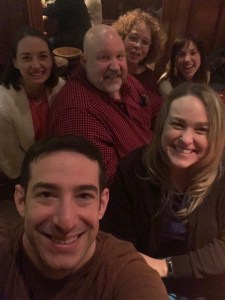
Those that know me know that my son and I are very close. You also know that he is in college six hours away. Furthermore, you know that any time I get to spend time with him is precious and I always leave in a funk for a few days (okay, sometimes weeks) after spending time with him. Now, all of that said, I am super proud of him and this is the way it is supposed to be. He is supposed to be creating his own life. Still, our time with him is precious and I love when we get to do things and go new and old places with him.
It is so awesome to get the call, “Hey, do you and mom want to come down to the conference basketball championship game? We’re all going and thought you might want to come.” My answer: “Yes!!!” Your son invites you to anything, the answer better be yes. I have always valued the time spent with Heath. We have always called it building memories. Ever since he was born he has gone everywhere with me. And, every time we all go places together more memories are built and the more I miss him when Hope and I have to leave him.
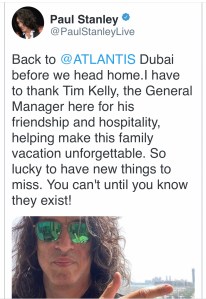
This morning I read a tweet (see photo) from Paul Stanley that was super insightful and put it all into perspective. After referencing the family vacation he had been on he said, “So lucky to have new things to miss. You can’t until you know they exist!” Wow, this is part of building memories! You can’t miss something you never knew existed. I’m so blessed to be able to build those memories and things to miss, with my family. It is a privilege that I do not take lightly.
It is true, travel is a great disruptor and place to find new things to miss, but some of the biggest things don’t involve travel. I love when Heath is home and we all eat together. Or, my all time favorite: going to the barn together.
Think about how you might find new things to miss with those you serve outside of family. For example, last week I was invited to dinner (thanks Megan) at Old Ebbitt Grill while at a conference in Washington D.C. I was so excited to be invited, but my first thought was that I was kind of tired from the day’s events. Then, I thought, “No, I love Old Ebbitt and haven’t been there in a few years and most importantly I want to spend time with these friends and new acquaintances.” Needless to say, I went and had an incredible time reconnecting and making new friends. In fact, no surprise, but myself and three others were the last to leave from our big group. New things to miss! New friends to miss! Old friends that I hadn’t spent time with side by side (literally) at a restaurant laughing and sharing with since before the Pandemic. I am now missing all those friends but am so glad we built those memories.
Relationships are the key to everything. Let’s all be “looking for new things to miss.” Let’s all be “building memories” with our families and those we serve.
Stop Look & Listen

I have always tried to imagine myself more as a helper instead of leader. Hopefully this keeps me grounded and lowers the power differential between myself and those I serve. We must remember that the people we serve or those seeking help are in a position in which they must be able to trust in our knowledge and guidance. Ken Blanchard told us that “When your people are your focus, they know they are part of a team and are motivated to give you their best efforts” (Blanchard & Conley, 2022, p. 41). This was a great reminder in Simple Truth #14, “The Best Use Of Power Is In Service To Others”, in Simple Truths of Leadership: 52 Ways To Be A Servant Leader and Build Trust, Making Common Sense Common Practice by Ken Blanchard and Randy Conley.
People need to feel safe and secure before they can bring their best selves to the workplace and in order to be able to do their best work. If left to itself, the power differential can get in the way of those we serve sense of safety. Building relationships is key here. I once had someone remind me that we need to lead like we are at a railroad crossing – stop, look, and listen! Which in turn enables us to learn how to be best help those we serve.
Nuanced Complexity

The word Nuance means very subtle or little difference between the two things. So, when someone asks you to give or make a nuanced report of something, it means to make a detailed, verified, acknowledged, and characteristic report. Opening day for Major League Baseball (MLB) ⚾️ is this week, so my eyes and attention have been turned to America’s Pastime. That means my attention has also turned to my beloved Cincinnati Reds and Reds Beat. Mark Sheldon made a comment in his Reds Beat Newsletter that jumped out at me. I have always loved his work and wish I could go to a Reds game with him sometime. The first paragraph welcomed us back to the newsletter and then in the second paragraph he wrote:
“One great change from the past two years is reporters are allowed back inside the clubhouse. Hopefully this translates to better reporting from me and more enjoyable reading for you. Talking to players, the manager and coaches means more candid answers to questions and more depth to information. It should also bring something that is difficult to achieve on Zoom and impossible to get on social media — nuance.”
Mark Sheldon
Did you catch that? More candid answers and more depth – those allow for nuance. Sheldon is so right, nuance is difficult, not impossible, in a virtual platform and I continue to hone that skill daily. Nuance is not easy to notice, but as Sheldon points out very important to telling the whole story. In learning, real depth comes from individuals exploring their own views first and then placing them within the context of their organization. The depth of learning comes from the heuristic nature of nuance.
One of the leadership strategies I teach about is the need to move away from the old industrial model which uses binary questions that are yes/no or one right, one wrong answer. Sheldon’s point of nuance in an in person locker room interview is well taken. We imagine when he asks a question and the player pauses. Right then we know the answer is not a simple question with a binary answer. The in person interaction allows for both in the conversation to have that psychologically safety where to explore their own views first and then place them within the context of their team or organization. This is not to say it can’t be done on Zoom and we should continue to work at being able to provide the ethos for nuance, but it is much more effective in person.
My point here is how important a more nuanced approach can be. Getting rid of the binary approach allows us to put everything into context. And…context matters. Always! Ask any of us a question and there will be nuanced complexity. The nuances are not always easily seen, which is Sheldon’s point, but if we want to know the whole story we must seek to uncover the complexity of emotions, relationships, history, patterns, values, politics, and power dynamics.
What Does Success Look Like?
“They’re not sure how to please their boss, how to behave around their teammates, or what a good job looks like” (Blanchard & Conley, 2022, p. 39). Ever been there? I’ll bet many of you reading this have experienced this. Or, after listening to a leader pontificate about all her great values have someone lean over to you and say, “All talk! She doesn’t actually do or live out any of that.” I have experienced this all first hand and it’s not a good place to be. We all need and deserve to know what the expectations are and what success looks like. In fact, that is one of my favorite questions to ask: “What does success look like?” And, as we work shoulder to shoulder with those we serve, we need to model the expectations. As a teacher, principal, and superintendent I always said, and still do, that our students will live up to our expectations – so, let’s set them high and model them.
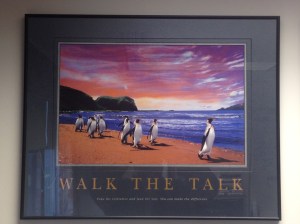
Then in Simple Truth #13, “You Get From People What You Expect”, in Simple Truths of Leadership: 52 Ways To Be A Servant Leader and Build Trust, Making Common Sense Common Practice by Ken Blanchard and Randy Conley reminded us that expectations are so much more than words. We were also reminded that “You must walk your talk, or your words are meaningless” (p. 39). This really resonated with me as I have always been such a believer in modeling by walking the talk and walking the walk. In fact I have a picture in my office of penguins walking the talk. I used it as the feature photo of the blog post Walking The Talk! and am using it again for this post because it means so much to me and is such an important reminder. We need to paint a very clear picture for all those we serve, by walking the talk, of what success looks like.
Where Do We Put The First Brick?
During our final session of the National Association of State Boards of Education (NASBE) 2022 Legislative Conference, Scott Palmer of the Education Counsel, told the story that his grandfather said he could build a bridge if someone told him where to place the first brick. Then, he asked the panel he was moderating to tell where they would place the first brick as we continue recovery from COVID and redesign education. For me, this is about stopping the throwing of bricks at each other. Let’s have the difficult conversations and get it figured out for our scholars.
We all need to be rethinking what the opportunity to learn means. My first metaphorical brick, however, is that we need to find every child. Now, in our 514th day of the Global Pandemic, we have many students that have become anonymous. We need to find every child and make sure we are giving them the opportunity to learn. Then we need to take an integrated systems approach to:
- integrate all outside experiences the scholars have.
- we need to rethink the time and place of learning.
- we need to consider the time and place of learning.
- we need to consider the different paradigms for opportunities to learn.
- we need to provide critical experiences for all our students.
- we need to take into account the ecology of a young person’s experiences;
- all the adults that students experience and interact with.
- the other students in their lives.
- the extracurricular and other activities outside the traditional school day.
I continue to say that school is no longer just a place. We need to shift the system to meet the needs of every kid, not have the kids shift to meet the needs of the system.
I’ll leave you with this thought: Whatever we want to be true for our students has to be true for their teachers, including experiencing safety, belonging, and purpose in the community of school.
 Byron's Babbles
leave a comment