Telling The Full Story

“Leaders erode trust when they spin the truth rather than being transparent in their communication” (p. 101). This from Randy Conley in Simple Truth #38: “Tell The Truth. Always. It’s That Simple.” in Simple Truths of Leadership: 52 Ways To Be A Servant Leader and Build Trust, Making Common Sense Common Practice, Ken Blanchard and Randy Conley. Conley also told us that sometimes leaders don’t tell the full story and reminded us that “…telling half truths is telling half lies” (p. 101). I’ve always believed that transparency translates into highly productive and effective organizations and work communities. Encouraged transparency eliminates confusion and builds trust.
Forbes defined transparency as “the practice of being open and honest with others, no matter how challenging it might be. For both personal and professional relationships to thrive, you need to eliminate the stigma that comes with being straightforward.” Organizations which emphasize community create a sense of belonging and foster transparency while reducing feelings of isolation. I don’t like to talk transparency without talking clarity. There are times when every piece of information cannot be shared, but clarity can be given. Transparency serves efforts to operate with greater clarity.
Aligning Behavior With Speech

“Talking about what you are going to do is easy; actually doing it is what builds trust with others” (p.99). Randy Conley said this in Simple Truth #37: “Your Actions Speak So Loudly I Cannot Hear What You Are Saying” in Simple Truths of Leadership: 52 Ways To Be A Servant Leader and Build Trust, Making Common Sense Common Practice, Ken Blanchard and Randy Conley. Walking the talk is so important. I have a picture in my office of penguins that says “Walk the Talk: Take the initiative and lead the way. You can make a difference.” As Randy also told us: “When your behavior aligns with your speech, you are complete, whole, and acting with integrity” (p. 99). I have blogged about this before in Walk The Talk!
“You can’t build a reputation on what you are going to do.” ~ Henry Ford
When we actually “walk the walk,” we take action and demonstrate what we’re saying by doing the things we talk about. When we take responsibility to come up with solutions to problems, and when we do, we are leading by example. It’s about accountability; a culture of accountability is the best culture to have. It’s about seeing it, owning it, solving it, doing it.
The Entire Arc Of The Experience

It has been said that endings have a disproportionate influence on any narrative. So, why do endings disproportionately influence our memory for an entire experience? Nobel Prize-winning psychologist Daniel Kahneman distinguished between the experiencing self and the remembering self. He concluded that we experience as events and life is happening but we remember based on the ending. Our narratives thus become either successful or unsuccessful.
“All’s well that ends well.”
William Shakespeare
In the way that we think, William Shakespeare was right, “all’s well that ends well.” The problem is this leaves out the “middles.” We must take into account the entire arc of the experience. This means we need to reflect on all the benchmarks in a story or memory. For example if I reflect back on my mom’s stroke with only it ending in her death, I miss reflecting on some of the most incredible moments spent with my mom at the hospital.
As leaders and humans we must be careful of over emphasized endings. Think about the way a fiction novel ends very differently than a biography. We don’t script our endings to any of life’s or our organizations’ happenings. Those stories are messy and have lots of points of interest and context along the storyline continuum. By reflecting on the entire arc of the experience we can learn so much from all the stories we are living. Instead of just the “ends” we need to be highlighting points from the “middles.”
Blind Ambition

“I hope our lives don’t get in the way of his ambition.” This was a line from Staff Sergeant (later Sergeant First Class) Zeke Anderson (Terence Knox) to 2nd Lieutenant (1st Lieutenant from the start of season 2) Myron Goldman (Stephen Caffrey) in the great series Tour of Duty. The show that ran from 1987-1990 (58 episodes) examined politics, faith, teamwork, racism, suicide, fragging, terrorism, civilian deaths, sexuality, drug abuse during the Vietnam War. The episode I was watching last night was about the blind ambition (obsessive ambition) of a superior officer giving orders to do things just to make numbers and himself look good. His huge personal ambition was guiding his actions. His ambition kept him from listening to to Zeke, who new what needed to be done. In the end, many men needlessly died. I have blogged about this recipe for disaster before in Passion at Ambition’s Command.
I was thinking about this episode when reading Simple Truth #36: “People Will Forget What You Said, People Will Forget What You Did, But People Will Never Forget How You Made Them Feel (Maya Angelou)” in Simple Truths of Leadership: 52 Ways To Be A Servant Leader and Build Trust, Making Common Sense Common Practice, Ken Blanchard and Randy Conley. Randy Conley told us that “…if people don’t believe you truly care about them, you won’t earn their trust” (p. 95). By not listening to those on the ground, or street level as I like to call it, the superior officer was not respecting or giving the consideration due those he served. Everything he did and anyone he helped was dependent on what he could get out of it, or what power could be derived. We need to be careful of letting ambition for success as defined by celebrity, power, and greed overpower our purpose for significance that includes caring for and gaining the trust of those we serve.
Expect Mistakes

Over the past three weeks I’ve had a small construction project going on at my house. It has been fun because my contractor is a friend who I coached baseball with and I also taught his daughter in school. We’ve talked about every day that I have been home and we’ve even added a few things to the project from our conversations. Yesterday he finished the project and he came over last night and we just sat and visited.
My post is about something that I learned from Bruce that we can apply to most of our contexts. I had decided some posts that we had left bare needed to be wrapped. So, I took it upon myself to get the materials and do the job. On the first of five that I did I made a couple of errors. Not very noticeable, but still mistakes. By the fifth post I was at near perfect craftsmanship. The next morning I pointed out my work and the couple of mistakes.
What Bruce told me was profound: “You have to expect mistakes.” He told me that if you focus on never making a mistake, you actually will make more mistakes. Now, the kind of mistakes we were talking about were not like the ones where the wrong mix of concrete was used, thus threatening the integrity of a project. To prevent those types of mistakes protocols and redundancy processes need to be put in place. In my case, however, I needed to put a notch in the wrap to allow space for the mounting bracket on the post. I made the notch about a half inch to big.
Bruce told me that instead of just getting the right amount material for the project I did, he would have gotten a little extra, expecting that errors might occur. If they don’t, you just return the material. To be clear, he was not advocating that making mistakes was not to be avoided. What he was saying was that we must face the reality that mistakes do happen. He suggested that we need to plan for them. He also added that while it can be natural to want to avoid blame and embarrassment, this is only counterproductive to moving forward. Playing the blame game at the worksite as each contractor and trade contractor points the finger at someone else only wastes precious time in coming up with a suitable solution. Owning mistakes and finding quick solutions is the key here.
The moral of this story is that we put all safeguards in place to eliminate mistakes, but we also need to expect them. If we live in fear of making mistakes or make those we serve fearful of making mistakes, we are setting ourselves and others up for making more mistakes.
Remember To Care First

I’ve got a good friend that always says, “if your the smartest person in the room, you need different people in the room.” I always reply that I want to be the dumbest person in the room.” I believe we are saying the same thing – we want to be surrounded by creative and innovative people who have expertise in the space we are working in. in Simple Truth #35: “People Don’t Care How Much You Know Until They Know How Much You Care” in Simple Truths of Leadership: 52 Ways To Be A Servant Leader and Build Trust, Making Common Sense Common Practice, Ken Blanchard and Randy Conley, Randy reminds us, “Demonstrating care and concern for others is the quickest and easiest way to build trust” (p. 93). And, don’t forget, it must be genuine care and concern.
I was reminded of this during an elementary teacher focus group I was conducting this week as part of a strategic planning process I am facilitating for a school corporation. The teachers were very clear about the fact that their principal, “I’m supported”; “Family first, Kelli [principal] really does practice this”; “We are checked in on, Kelli cares about us”; and, “Open door policy, Kelli is accessible.” It was clear these teachers respect their principal. These we’re all great reminders that caring must come first.
Hope Is Not A Four Letter Word

I got to spend quite a bit of quality time in the tractor cab yesterday and spent it listening to Serius XM Octane. They were doing a Shinedown radio day featuring the band, Shinedown. It was an incredible day with the band members telling great stories about experiences crafting their art & staying current. The stories they told were such great leadership lessons. Several times I stopped and jotted down notes. One Shinedown song, Hope (from their new Planet Zero album), prompted this post.
The line “Hope’s not a four-letter word” really got me to thinking how, in many cases it has become a four letter word. But the song also says, “You can be twisted but still optimistic; Be the black sheep but not a statistic; May not know who you are; But you know what you’ve got; So hang on to the absurd; Hey, have you heard? Hope’s not a four-letter word.” That’s pretty good advice. As a believer that specific futures are not inevitable, therefore we need to work toward the change, goal, newly redefined self, or world we want. Hope is worth thinking about because the plausible and desirable ways the future can unfold are practical. We have become addicted to narratives of despair about how “the other side always wins” and “things just keep getting worse” that we tend to blind ourselves to positive trends or downplay our role in being able to bring about positive change.
Shinedown told us in Hope that we should be “Counting the elephants here in this room.” There are things in the world going in the right direction, and there are things trending in the wrong direction. We need to use those “elephants” and have learning conversations to illuminate the right direction. Hope is not a strategy, but it is an attitude and core value that can empower us. We have an obligation, as Hope told us, to “Put on a happy face; Make a scene and leave a permanent trace; Show me that rebel inside; Where the leader of the revolution resides.” Remember, “hope” is not a four letter word.
What You See Is What You Get

Loved this statement from Randy Conley: “It’s not hard to be authentic; all you have to do is be yourself” (p. 91). He went on to say, “Authentic leaders display humility, admit what they don’t know, walk their talk, own up to their mistakes, and do what they say they will do” (p.91). Can you imagine a world where everyone lived by that credo? Randy Conley told us that many leaders treat relationships like games in Simple Truth #34: “A Relationship With No Trust Is Like A Cell Phone With No Service Or Internet – All You Can Do Is Play Games” in Simple Truths of Leadership: 52 Ways To Be A Servant Leader and Build Trust, Making Common Sense Common Practice, Ken Blanchard and Randy Conley.
In my experience, when a leader is genuine, we know what to expect, and the opportunity to build trust begins. Trust is built through daily and consistent action. Bottom line is, the leader’s integrity becomes predictable. I try to model loving those we serve. An authentic leader is all heart. We must lead with compassion, kindness, and understanding of others. Truly authentic leaders consider what if feels like to walk in others’ shoes. Trust and safety are essential to a sense of belonging, and we all have a need to belong. Without this sense of belonging, we feel that our very survival is threatened. To create this belonging we must display humility, admit what we don’t know, walk our talk, own up to our mistakes, and do what we say we will do.
Be Like Potatoes Not French Fries
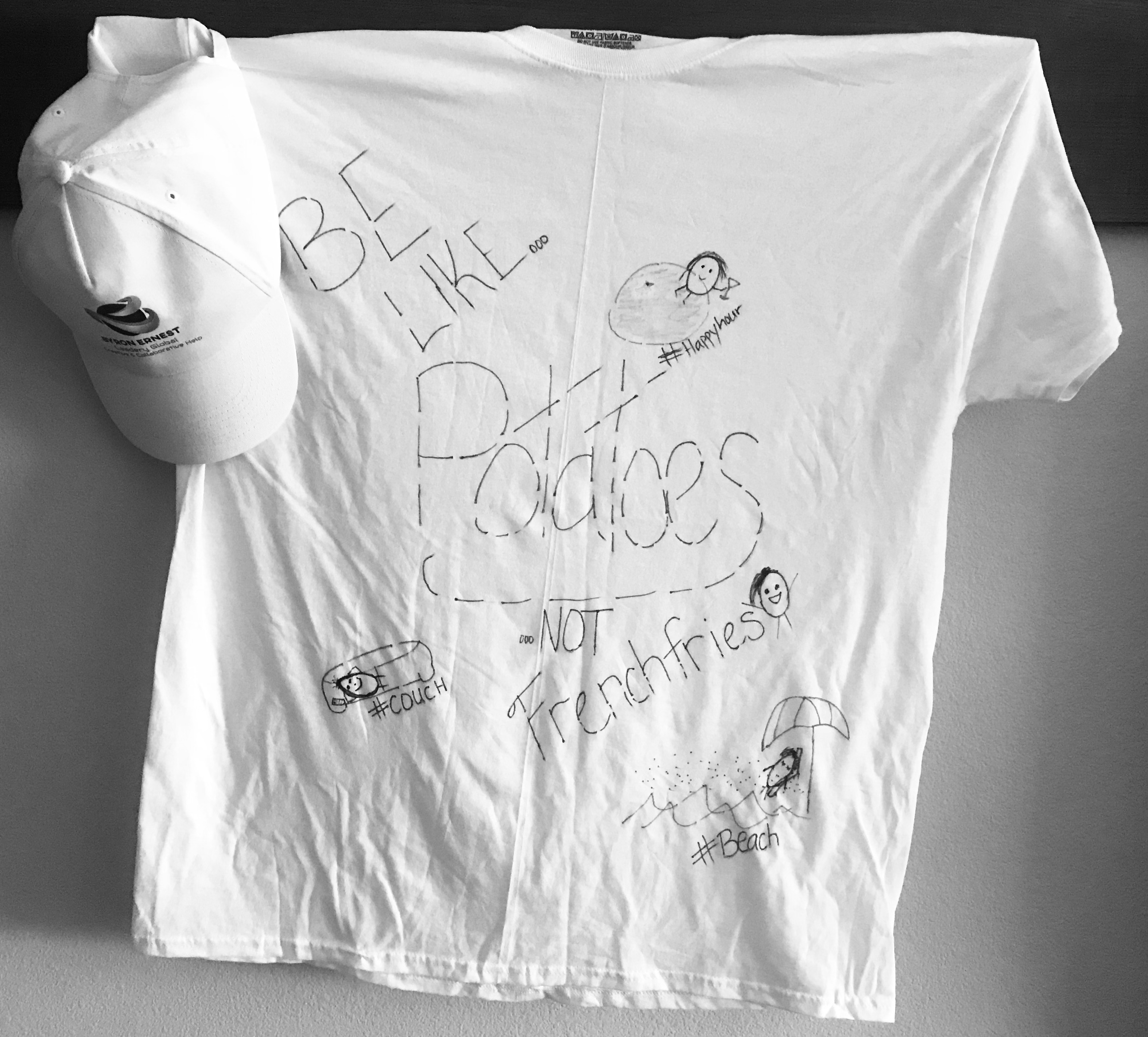
This week, a breakout group who was developing a self-care club t-shirt (see featured picture) as part of a project for a professional development I was facilitating came up with an incredible theme: “Be Like Potatoes, Not French Fries.” This was an interesting metaphor and not something I had heard before. The thought was to do everything possible to be a whole person and not processed/fried pieces. The theme was really pretty genius and I couldn’t stop thinking about it and what it meant to be a like a potato. When I studied the shirt I found it was okay to sometimes just relax and be a couch potato. Sometimes it is okay to take part in a happy hour or spend time on the beach (hard for me on a daily basis, but I was facilitating in Florida).
The point was that we don’t have to spend every moment processing and transforming every moment like becoming a French fry. To be the whole person and stay like the potato we need to make sure and schedule time for what another group called “Self Care A La Carte. Check out their list of a la carte self care items on their t-shirt:

These were educators I was working with and one of the important things we discussed was the importance of focusing on self so we could effectively focus on others. As educators we provide support, how well we provide that support depends on how well we take care of ourselves. Here are some tips for having a good day:
- Get one important thing done
- Plan your perfect daily timetable
- Listen to a great music playlist (of course this should include some KISS songs)
- Go for a walk
- Leave your bad mood at home
How will you take care of yourself?
Fearmongering Leaders

“I’ve observed many leaders manage people through fear and intimidation” (p. 89). Randy Conley said this in Simple Truth #33: “Fear Is The Enemy Of Trust” in Simple Truths of Leadership: 52 Ways To Be A Servant Leader and Build Trust, Making Common Sense Common Practice, Ken Blanchard and Randy Conley. Unfortunately, we have all probably experienced it. Conley also rightly pointed out that this fearmongering can take many forms. Many times this undesirable behavior is triggered by the leaders own fear and inadequacies. Leading from fear can create a toxic culture in which people play safe, avoid mistakes and lay low in effect creating an organization that does not grow due to mediocre performance and unrealized potential. I have experienced leaders leading by fear and it caused a profound impact on whether people in the organization felt connected, cared for and empowered, or pushed aside, constrained to make decisions and held back to voice their opinions. I’ve even experienced people getting yelled at for bringing up something they had observed or heard someone asking. The leader doing the yelling failed to recognize the importance of the perception in the field she was be made aware of. All she did was cause the person getting yelled at to say later, “I’m never giving her a heads-up again.” Clearly, the empress did not want to know she had no close! A team had been created that would do things they knew would fail because they no longer wanted to say anything for fear of being berated. Not a good community to be building.
The other thing I have noticed about fear-based leaders is that the best and brightest don’t advance. One, the bad leader does not want an “A” person to possibly be showing them up, so they advance “C” and “D” people. Instead, projects and promotions go to those who have “drank the Cool-Aid” and embrace the toxic culture and agree with whatever the leader says. Our job as leaders is to make those we serve feel secure. It is also important for us to love those we serve by keeping them safe and supporting them.
 Byron's Babbles
leave a comment