Remaining Significant and Inspiring Others

I continue to get a great deal of thought inspiration from reading Amor Towles’ great book, Table for Two. The latest point Eve made when speaking of Charlie was, “He was shifting from the life of doing to the life of remembering.” This really made me think about how we need to stay significant as we go through the different phases of life and reinvent ourselves. As a person who really never wants to retire I think about this a lot. In fact, I have blogged about this before in Significance: Impacting Outside Yourself. I am now in my seventh decade and I do a lot of remembering and using past experiences to inform new challenges. I DO NOT, however, want to stop doing. I just believe that “doing” looks different at different phases in our life. As we age and transition from a life of doing to a life of remembering, it’s important for leaders to focus on sharing their wisdom and knowledge with others.

One way to remain significant is through coaching and mentoring younger generations, writing books or articles, giving speeches, blogging, or even starting a podcast or YouTube channel to share their experiences and lessons learned. By staying engaged with the world and continuing to make a positive impact, leaders can remain significant and continue to inspire others.
Celebrating Things Yet To Be Done

I’ve got to admit, I am not a very big fan of lists, but I do make and use them. Particularly “to do” lists, so I don’t forget things I need to do. I did find it inspiring, however, when in Table for Two by Amor Towles’ Eve said, “A list is a celebration of things not yet done.” That was a great perspective. Really, we should see our to-do lists as being like a compass, helping us navigate through the sea of tasks.
Instead of focusing on what we haven’t done yet, we should see our list as a roadmap of exciting opportunities and experiences to look forward to. It can be a celebration of potential growth, learning, and new achievements waiting to be accomplished. Embracing the unknown can bring a sense of anticipation and motivation to accomplish new goals and dreams. Let’s celebrate all the great things we have yet to do.
Our Need For A Niche

This week during my continued reading of Amor Towles’ latest and incredible book, Table for Two, I came across a discussion of “niches.” Eve makes the comment, “You can’t beat a man who has a niche.” This really is true that we all need a niche. Having a niche is so important because it allows us to focus on our unique strengths and interests, which can lead to greater fulfillment and success. By specializing in a particular area, we can stand out from the crowd, build expertise, and make a meaningful impact in our chosen field. It also helps to differentiate ourselves from others and attract specific opportunities that align with our skills and passions.
Finding our niche can be a process of self-discovery and exploration. Our niches may/will change over time. It is part of our evolving and growth over time. We need to consider our unique perspectives, passions, and our expertise. For myself, I call these passion bubbles. Ultimately, finding our niche is about aligning our skills and passions with a unique market need or opportunity. It may take time and exploration, but the effort can lead to a fulfilling and significant career.
Opportunity To See More Opportunities 
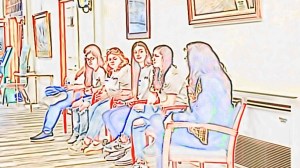
One student said, “This program and the teachers give us the opportunity to see more opportunities!” When I heard this student on the Student Advisory Committee of the Vision Corner Learning Center in Union City, Indiana say this, I wanted to jump up and cheer. Randolph Eastern School Corporation is giving students the opportunity to see more opportunities – is that not what education is all about. It means that when a student is open to new experiences, perspectives, and possibilities, they are more likely to recognize and take advantage of opportunities that come their way. Then, teachers encouraging and creating space for the students to be curious, adaptable, and proactive, enable the students to expand their horizons and make the most out of their educational journey and future career prospects. This all goes hand in hand with and is part of students learning to learn.
We can best provide opportunities for students by creating a positive and inclusive learning environment that encourages curiosity, critical thinking, and creativity. They can incorporate hands-on activities, real-world examples, and group projects to allow students to explore different perspectives and enhance their problem-solving skills. Additionally, teachers can provide mentorship, guidance, and support to help students navigate challenges and seize opportunities for growth and development. Ultimately, fostering a collaborative and engaging educational atmosphere can empower students to maximize their potential and discover new possibilities for success.
Leadership and Virtue

Because of some studying and research I am doing I had occasion to reread Candide by Voltaire. I love Voltaire’s satire that highlights the absurdity of blind faith and the dangers of excessive optimism or pessimism. One passage jumped out at me yesterday where Candide said to Cacambo: “You see, my dear friend, how fleeting the riches of this world are; there is nothing solid but virtue.” Candide made the statement after he and Cacambo left El Dorado and lost 100 of their 102 sheep and most of their fortune. Candide makes known to us his optimistic philosophy by offering this view of the situation, Cacambo counters with a pessimistic view, ever the optimist, Cacambo replies that they still have two sheep left and enough treasure to make them wealthy.
“You see, my dear friend, how fleeting the riches of this world are; there is nothing solid but virtue.” ~ Candide

Most, if not all, of the challenges Candide incurred were moral and ethical issues. He was right; riches are fleeting, but our virtue must remain on solid footing. At a time when corruption and depravity are becoming the norm, we need leaders who hold themselves accountable to serving with integrity and humility. It has been said that there can be no leadership without virtue. I believe this to be correct.
Other lessons to be learned from Candide by Voltaire include the importance of maintaining optimism and resilience in the face of adversity, questioning societal norms and authority, and the idea that true happiness may be found in simplicity and living in the present moment. One of the things that always becomes paradoxical for me while studying Voltaire is that Candide serves as a mere conduit for the attitudes and events that surround him. His opinions and actions are determined almost entirely by the influence of outside factors.
The Changes Life Puts Us Through

I’ve been pondering lately about the changes life puts us through and how we grow from them. Those changes are sometimes imposed on us, but also chosen by us at times as well. As leaders, we are confronted with multiple complex challenges every day. New knowledge, skills, strategies, and mindsets are just some of the changes we need to impose on ourselves. One thing is for certain; with so many paradigm shifts occurring in the world today, changes in our lives will occur.
We can grow from the changes life puts us through by focusing on personal development and self-improvement. This can involve reflecting on our experiences, learning from them, and using them to become a better version of ourselves. It’s also important to maintain a positive mindset and resilience in the face of challenges. Finally, seeking support from others, such as friends, family, or a therapist, can help us navigate difficult times and emerge stronger on the other side.
Big Thinking Leadership

I can’t stop thinking about the lyric, “In a world where I feel so small, I can’t stop thinking big” in the song “Caravan” on the Clockwork Angels album by Rush. This is such a powerful statement and I love intellectual lyrics in rock music. In this concept album, the lyrical writer, the late Neil Peart, traces a young man’s life and demonstrates an arc to the pursuit of greatness. Caravan is very deep, referencing both Voltaire and Tocqueville.
“In a world where I feel so small, I can’t stop thinking big” ~ Caravan by Rush

This was discussed by Geddy Lee, the frontman, bassist, and keyboardist for Rush, in the awesome book, My Effin’ Life. The lyrics suggest a feeling of insignificance in a vast world, yet a determination to think and dream big despite that feeling. It conveys a sense of overcoming obstacles and pursuing ambitious goals in the face of challenges and uncertainties.
“We must cultivate our own garden.” ~ Voltaire
In Voltaire’s Candide, the main character embarks on a journey filled with adventures, challenges, and philosophical reflections., in the song “Caravan” by Rush, the lyrics could suggest a sense of embarking on a journey or quest filled with passion and determination. Both works explore themes of perseverance, resilience, and the pursuit of personal growth despite obstacles and hardships. The idea of a road lit by fire in the song could symbolize the inner fire or drive that propels individuals forward on their own journeys, much like Candide’s quest for meaning and enlightenment in Voltaire’s novel.
“One might say that sovereigns in our time seek only to make great things with men. I should want them to think a little more of making great men; to attach less value to the work and more to the worker, and to remember that a nation cannot long remain strong when each man is individually weak, and that neither social forms nor political schemes have yet been found that can make a people energetic by composing it of pusillanimous and soft citizens.” ~ Tocqueville in Democracy in America
Tocqueville, in Democracy in America, emphasized the importance of focusing on the character and qualities of individuals, rather than just the accomplishments or work they produce. He believed that society should prioritize the development of great individuals who can contribute positively to society, rather than simply valuing the material outcomes of their work. This reflects his broader concern with the cultivation of virtuous citizens in a democratic society. Even though we are small in this big world, we need to remember that each of us affects the world for those around us.
The Designated Study Space of The Studiolo

It is interesting that the idea of a private retreat to disconnect from our hectic worlds and for intellectual activities remains the same as in the Renaissance period. This week while reading Amor Towles’ latest and incredible book, Table for Two, studiolos were discussed in relation to paintings and art work. I found that a studiolo is a small room used as a study private retreat, typically found in a Renaissance palace or mansion. It was described as a room of one’s own. Really the precursor to the den, office, study, woman cave, or man cave. It would seem we have always needed our space. These rooms were often decorated with artwork, books, and other items to inspire intellectual pursuits and creativity. They were used by scholars, artists, and nobility as a quiet space for reflection and contemplation.
Machiavelli described the studiolo to a friend, by writing:
“When evening comes, I return home and go into my study. On the threshold I strip off my muddy, sweaty workday clothes, and put on the robes of court and palace, and in this graver dress I enter the antique courts of the ancients and am welcomed by them. . . . Then I make bold to speak to them and ask the motives for their actions and they, in their humanity, reply to me. And for the space of four hours I forget the world, remember no vexations, fear poverty no more, tremble no more at death: I pass into their world.”
Leonardo da Vinci, The Literary Works of Leonardo da Vinci, 1: 56, no. 23.

I have a space like this in my house. What I enjoy in it are all the little things that people have given me or that I have obtained while traveling that remind me of great friends, events, family, and places. Sometimes I catch myself looking at something and I am taken back to that place and my friends I have made there. For example, as I write this post I am looking up at a gift (see the featured image of this post) I was given while on my most recent international trip to Dubai. This piece means a lot to me because I went everyone on this plate with the individual who gave it to me. I love that Towles’ book, that I find to be all about relationships, reminded me how important keeping all our relationships front of mind is. I, for one, am bad about letting some of the people who I have been close to drift away when not in close proximity on a regular bases. I have gotten better, but need to continue to get better. The things in our studiolos can help as reminders of this.
As I stated earlier, the concept of a studiolo has evolved into modern home offices or personal libraries. People still create spaces in their homes for intellectual pursuits, creativity, and quiet reflection. Having a designated space for personal reflection and intellectual activities can be beneficial for mental health and productivity. It provides a sanctuary from the distractions of everyday life and allows for focused thinking and creativity. Having a studiolo or similar space can help us decompress, recharge, and enhance their overall well-being.
Relentless Determination and Perseverance

The song “Sleep When I’m Dead” is an anthem for those of us who have bold visions, think outside of normal paradigms, and want to keep learning and forging ahead every day. Autumn Kings nailed it on the head with this song. As a person who often uses the idiom of not sleeping till I am dead, this song really resonates with me. Allow me to share some of my favorite phrases from the song:
- “They counted me out”
- “They told me to stop”
- “Everyone’s talking; Addicted to gossip; But I can’t be bothered”
- “I will not bow; I will not break”
- “They tell me that I’m in over my head”
- “But I can’t be tamed”

I love this song! I love this group! Earlier I described this song as an anthem. What did I mean? The attitude of this song is one of never giving up, not worrying about what others say, and constantly striving for our own next steps, making this song an anthem of determination and forging ahead. The song signifies a mindset of relentless determination and perseverance. It suggests that we need to be so focused on our goals and passions that we are willing to sacrifice rest and comfort in order to achieve them. It embodies a spirit of resilience and drive to keep pushing forward despite any obstacles or challenges that may come our way.
Connecting On An Emotional Level

This past week I ended up in a fascinating conversation about “emotional contagion.” Emotional contagion is an important human trait because it allows us to connect with others on an emotional level, understand their feelings, and empathize with them. Elaine Hatfield (1993) defined emotional contagion as “the tendency to automatically mimic and synchronize expressions, vocalizations, postures, and movements with those of another person’s and, consequently, to converge emotionally.” This is not always viewed as a positive thing, but could help to build strong relationships, foster teamwork, and creating a sense of unity within a group or community. We must also be aware that emotional contagion can also influence our own mood and emotions, leading to a positive or negative impact on our mental well-being. This ability to share and transfer emotions plays a crucial role in social interactions and overall human behavior.
Emotional contagion is also an important concept to consider in our role as a leader as well. Leaders need an understanding of emotional contagion because it can have a significant impact on the dynamics within their team or organization. This includes the leader’s relationships with others. When leaders are aware of how emotions can spread among their team members, they can better manage and influence the overall emotional climate in the workplace. By being attuned to emotional contagion, leaders can create a more positive and supportive work environment, enhance communication and collaboration among team members, and ultimately improve overall productivity and morale.
By understanding emotional contagion, we can can help others effectively address any negative emotions or conflicts that may arise, preventing them from escalating and affecting the team’s performance. In essence, by understanding and leveraging emotional contagion, leaders can foster a more cohesive and successful team dynamic.
Reference
Hatfield, E., Cacioppo, J. T., & Rapson, R. L. (1993). Emotional contagion. Current directions in psychological science, 2 (3), 96-100.
 Byron's Babbles
leave a comment