Imagine A Place Where Everyone Is A Leader!
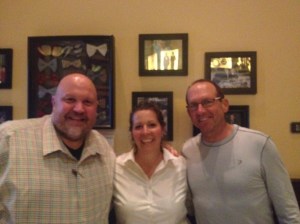
Greatest Waitress Ever Jenn Becknell With David Marquet and I!
Earlier in the week I had the incredible honor of having dinner with my friend and leadership “idol” David Marquet. David is the author of Turn The Ship Around and developer of Intent Based Leadership™. He is making a cross country bike ride with a group and had a rest layover in Indianapolis, so it enabled us to get together. In a later post I will probably talk more about our great conversation and all the insight I gained from this great man, but for now I want to tell you about our dinner and the insights we gained.
David has a great thing he likes to do when at a restaurant – let the waitress pick his entrée’s. I knew this so I suggested we do this for our meal. I was hoping he would agree even though we were at my very favorite restaurant and Indianapolis icon Harry and Izzy’s. David agreed immediately and gave our waitress, Jenn Becknell, his intro that he is a control freak and that part of his treatment is to let the waitress pick his meal. I have to set you straight though; David is not a control freak and is the inventor of Intent Based Leadership™. He is anything but a control freak. Anyway, he gave the waitress his one boundary and I told her that I really didn’t have any boundaries except maybe not being the fondest of chicken.

Harry & Izzy’s Shrimp Cocktail!
At first Jenn looked at us a little funny and was a little taken aback, but quickly warmed to the idea. We could then very quickly tell that she was going to have fun with this. I was so impressed with David because when asked about a drink he even told Jenn to pick his wine. Now that is Intent Based Leadership™ at its best. We had truly empowered Jenn to serve us and put the best foot forward for Harry and Izzy’s for my friend who was from Florida and eating there for the first time. Long story short, it was the best and most enjoyable meal I have ever had. We had no idea what Jenn would be bringing us and each time she came out with something different it was incredible. Keep in mind we didn’t even look at the menu. We started with the signature Shrimp Cocktail, of course. I am going to ask Jenn to add a comment to this blog and tell you what she brought us out to eat. The point is, however, that as David and I walked back to my truck we both commented that there was no way we would have picked as great a meal as Jenn did. Particularly, we would not have picked the bread pudding dessert that just put us in heaven to end the meal.
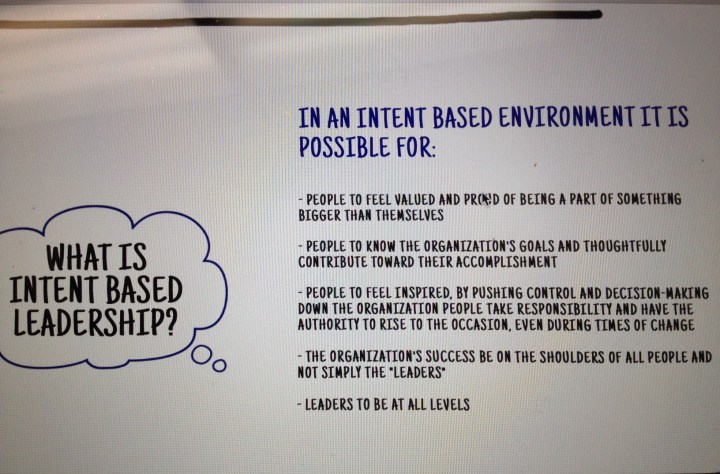 So what does it mean to practice intent based leadership? I have included a slide here from David Marquet’s website that gives all the important points of intent based leadership, but I believe there are two that really apply here for both Jenn Becknell and Harry and Izzy’s. First of all it is obvious that Jenn has been empowered to: “Feel inspired, by pushing control and decision-making down the organization people take responsibility and have the authority to rise to the occasion, even during times of change.” Jenn certainly rose to the occasion and was a tremendous ambassador for Harry and Izzy’s. Thus providing David and I the time of our lives. This was such powerful evidence as to why intent based leadership works.
Furthermore, Harry and Izzy’s are modeling that, “the organization’s success should be on the shoulders of all people and not simply the top “leaders” of the organization.” It is clear that this top Indianapolis restaurant has empowered their entire staff to “make it so” for customers. I can tell you a large portion of Harry and Izzy’s success is due to the great staff! Harry and Izzy’s is about great food, but is even more about the experience. Do your people feel valued and proud of the work they are doing for your organization?
Killer Whale Leadership
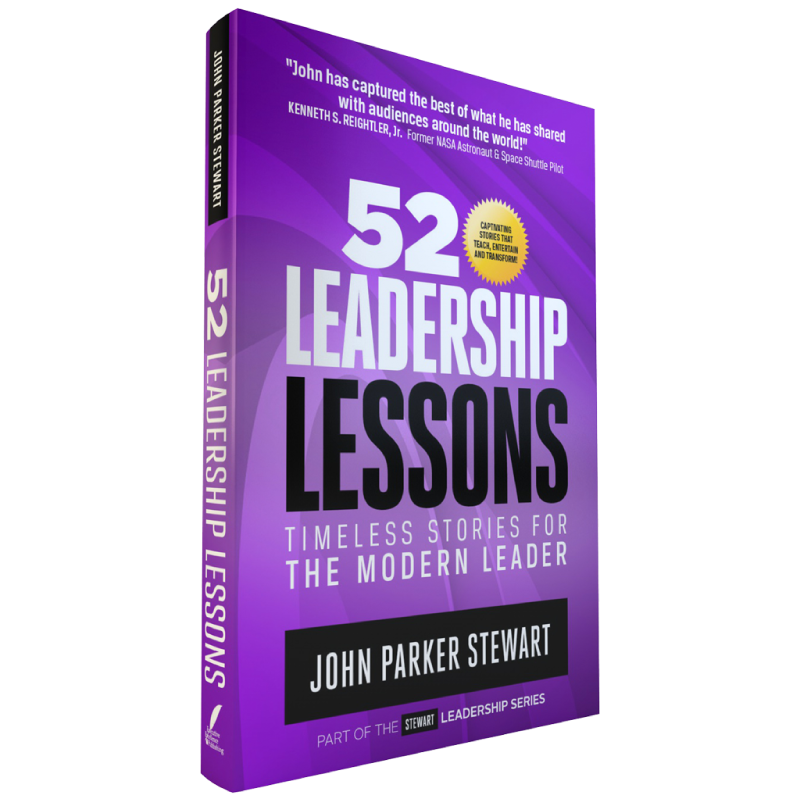
 I am so excited to be bringing you another post inspired by the great book 52 Leadership Lessons: Timeless Stories For The Modern Leader by John Parker Stewart. Lesson #5 was entitled “How To Train Your Killer Whale.” In this story, Stewart, told us how trainers of Killer Whales will spend up to three years training before even getting in the water with these incredible creatures weighing six tons and measuring in at 26 feet. The amazing part is, though, that once a trust is built the relationship between whale and trainer is a thing of beauty. Trainers get to know the whales and a relationship is built as they begin to work together. I believe this is a powerful metaphor to us as leaders. Trust is not something you can go to a workshop, learn, and suddenly have. In fact, I laugh when I see workshops advertising trust building and relationship building. You simply cannot do that in a workshop. Are you telling me that the person you really don’t know that well that catches you in the falling backward game that all of those workshops have you do will catch you when everything falls apart back at your organization? She may or may not, but I want the person I have formed the relationship with and built the trust to know she has my back. Additionally, I want her to know that I have her back.
“When there is mutual trust, there will be quality performance.” ~ John Parker Stewart
So, how do we build this trust with our people? I believe it is working shoulder to shoulder with those we lead. You can only build true trust in the context within which you work. Here is my list of how leaders build trust:
- Being competent. It is very important for everyone to see that we know what we are doing.
- Walking the Talk and Walking the Walk. Do we do what we say and say what we mean? Do we live our own and the organization’s core values?
- Be passionate about what we do.
- Be self aware and show behavioral integrity.
- Care about those you lead.
- Wanting the best for others, even to the point of recommending them for another job that might take them away from you.
- LISTEN!
- We must have perspective and understand the context of our people and organization.
- Manage direction and work, not people. Lead people.
- Say thank you and give credit where credit is due.
- See beyond self.
Effective leaders nurture and grow trust in many ways. How do you build trust with those you work with? Here’s what I’ve learned: leaders who build trust are magnets for the best talent, ideas, and contributions.
Leading in the Fog

I love my OnStar system in my truck. In addition to the visual and audio turn by turn, I like being told where I am in relation to reaching my destination. I was reminded how important this is in Lesson #4, Vision in the Fog, in 52 Leadership Lessons: Timeless Stories For The Modern Leader by John Parker Stewart. The story of Florence Chadwick was told in this lesson. The basic gist of the story was that the first time she attempted the 26 mile crossing she failed because of a heavy fog. In 1952 she made her first attempt to swim across the saltwater channel from Catalina Island to the California Coast. She quit within a mile of completion because she did not know where she was. How many times this happened to us? On her second attempt, Chadwick was able to complete the swim successfully. Even though there was another heavy fog on her second attempt, Chadwick said she was successful because she focused on an image of the coastline in her mind. This image made it possible for her to keep her “mind’s eye” on the prize. So, how do we keep what happened on Florence Chadwick’s first attempt at swimming the channel from occurring in our own life or the lives of the organizations we lead? How do we keep from getting close to a goal and maybe quitting right before success can be realized?
“Do not let the fog of daily minutia obscure the grandeur of your goal.” ~ John Parker Stewart
Every person has reached a point in his life when he wanted something very badly, but he was discouraged and ready to quit. We’ve all had things we strongly desired, but we’ve all failed in reaching some of those goals. Some would call this being faced with the choice between continuing to fight a “hopeless” battle or allowing yourself the relief of giving up. I would argue that no battle is “hopeless.” I believe we get stronger each time we don’t quit. Each time we continue fighting, we get a little more assurance that we can hold out and achieve the things we want to achieve. Had Florence Chadwick just fought a little longer during her first attempt at the saltwater channel she would have made it. As leaders we must also provide assurance that we know where we are going. We must serve as a lighthouse in the fog.
Therefore, it is important for us to have a clearly defined target. We must also create benchmarks so, like OnStar giving destination updates, we will know where we are in relation to achieving our personal and organizational goals. Stewart told us in 52 Leadership Lessons: Timeless Stories For The Modern Leader that we must visualize what victory looks like. This will keep us going when we meet any type of resistance. Plan and work toward your goal. Show persistence. Don’t recognize failure. Ignore failure. Keep fighting. Persist until you win. Prepare to win by mitigating risks and distractions.
What will you do the next time you meet an obstacle? What will you use as your OnStar for reaching your destination? As a leader, how can you be the OnStar turn by turn service for your organization?
Creating or Draining Energy?
 This post is an excerpt from the introduction to Leaders Ready Now: Accelerating Growth in a Faster World.
Instead of creating energy, your processes are draining it.
The fastest, most powerful learning experiences convert fear and uncertainty into pride and wisdom. Consider several examples:
- A young, inexperienced leader takes on an assignment to lead a team of people older and more experienced than she.
- An operations executive is suddenly given responsibility to run the IT function, which he knows nothing about.
- A new CEO faces a sudden market crisis that requires a major strategic and cultural shift in direction.
Big first-time challenges like these administer a shock, instantly bringing the leader to attention. It’s a jolt of uncertainty that carries a current of doubt; but with effort, discipline, and support, that doubt transforms into action and movement. Ultimately, if and when the challenge is conquered, a backward glance leaves the leader with confidence and insight that can be applied to the next challenge. It is in conquering difficult assignments such as these that leaders become ready to take on bigger leadership roles.
The challenge is scaling this concept beyond isolated, reactive incidents and creating a repeatable dynamic that causes entire cadres of leaders to become ready. For most organizations, scale becomes structure, but structure without energy kills acceleration. It’s not uncommon for management to roll out learning initiatives to groups of anywhere from 10 to 10,000 people, after which those new processes become burdened with guidelines, meetings, documentation, mandatory events, and progress checks. Participants—often the company’s busiest people—work diligently to make time for a process that has many moving parts but little connection to what they view as mission critical. Soon, what was built to generate the energy of growth dissolves into apathy and annoyance at processes that seem (and may well be) devoid of business importance.
It is not the process itself that is failing—it is the absence of energy to fuel it. Without energy, any processes you put in place will be unsustainable. How to rally the initiatives? By reexamining the architecture of your acceleration efforts and rewriting the rules of the game so that more is at stake, more is to gain, and all the players have a clearer understanding of their roles and how they will have an impact on success. You must be far more aggressive in the use and application of your existing approaches, setting bigger development targets for more people earlier in their careers.
*****
Matthew J. Paese, Ph.D., is Vice President of Succession and C-Suite Services for Development Dimensions International (DDI). Matt’s work has centered on the application of succession, assessment, and development approaches as they apply to boards, CEOs, senior management teams, and leaders across the pipeline. He consults, coaches, speaks, and conducts research around all those topics and more.
Audrey B. Smith, Ph.D., is Senior Vice President for Global Talent Diagnostics at DDI. Audrey’s customer-driven innovation and global consulting insights have helped shape DDI’s succession, selection, and development offerings, from the C-suite to the front line. She has been a key strategist and solution architect, encompassing technology-enabled virtual assessments and development aligned to current business challenges.
William C. Byham, Ph.D., is Executive Chairman of DDI. He cofounded the company in 1970 and has worked with hundreds of the world’s largest organizations on executive assessment, executive development, and succession management. Bill authored Zapp!® The Lightning of Empowerment, a groundbreaking book that has sold more than 3 million copies. He has coauthored 23 other books, including seminal works on the assessment center method.
The Leadership Journey
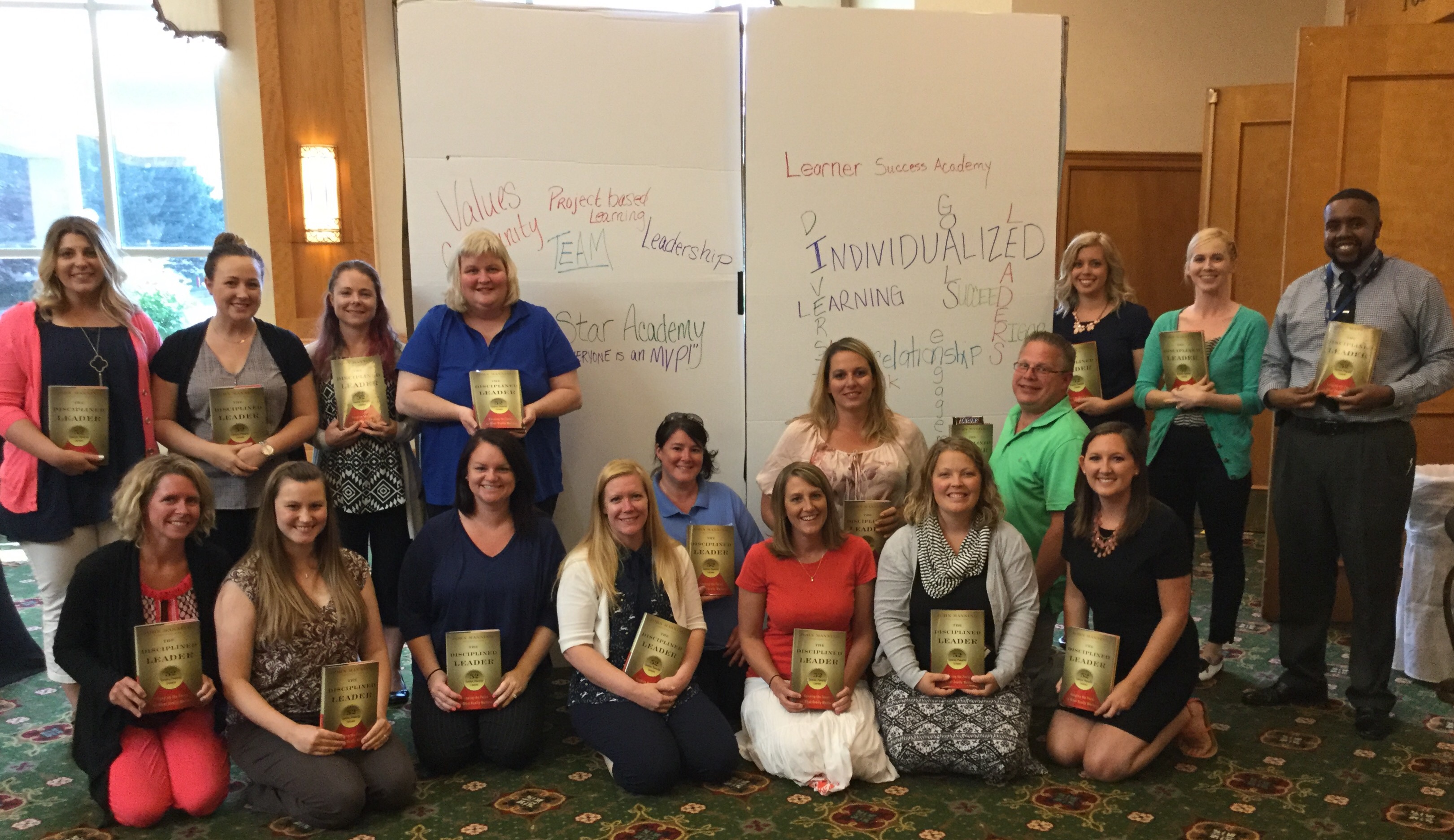
Unprecedented levels of complexity and unpredictability are part of our current world, particularly in education. If we are to continue to effectively lead organizations, transform schools, or assist others in creating positive change in their lives, or in the lives of others, we need adaptable and proven tools and practices to utilize now and well into the future. Leadership development, mentoring, and coaching provide the ability to be flexible and relevant no matter the situation and time – in other words adjusting to the current context in real-time. These leadership growth and development opportunities are valuable and effective methods for assisting others in discovering what they need to thrive to be happy, healthy and motivated.
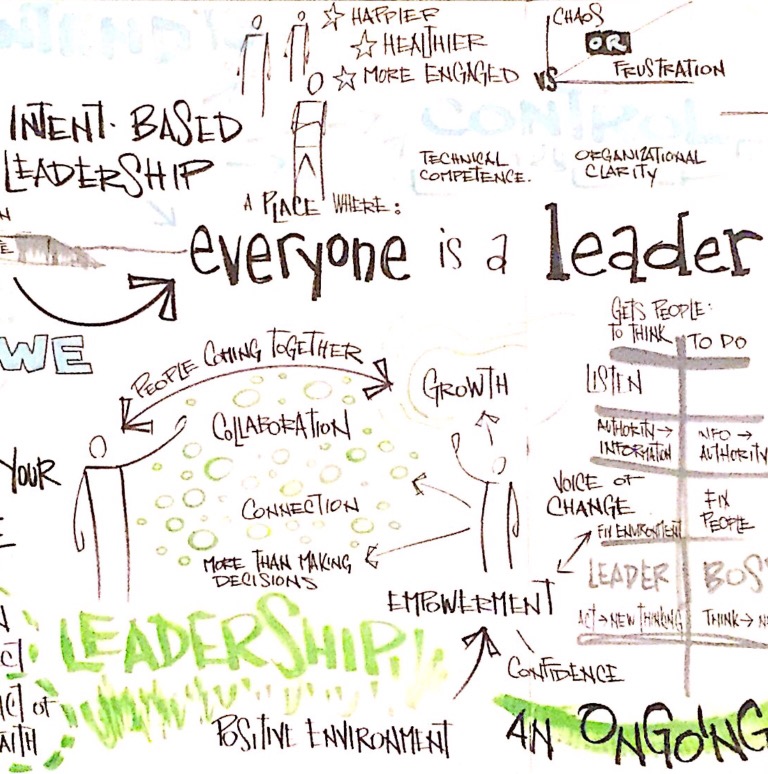 Our Focused Leader Academy (FLA) at Hoosier Academies Network of Schools provides leadership skills the ability that are flexible and relevant no matter the situation and time. We want to inspire with valuable and effective methods for assisting our teacher leaders in discovering what they need to become focused and disciplined leaders. What we are attempting to do is enhance growth of the pre-frontal cortex of the brain, thus increasing the teacher leaders resilience, creativity and belief in self. If we do it right our developing leaders experience making decisions that honor their own values and true potential ultimately living the life they have only imagined. In turn this puts him/her in a position to change the lives of the students we serve.
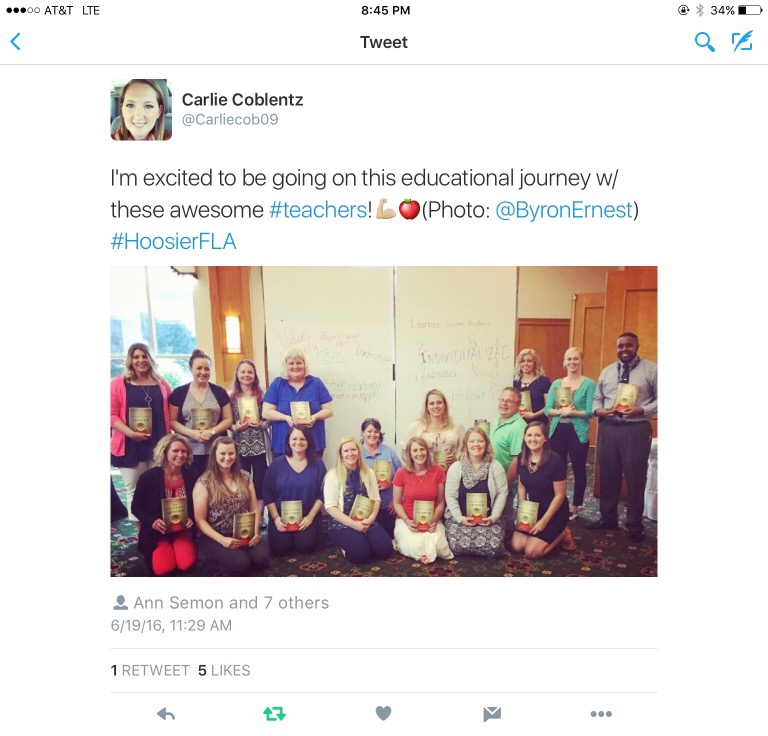
 It was exciting to see a tweet from one our FLA participants, Ann Semon, after session yesterday. She said, “What an inspiring day with @ByronErnest today. Excited for the leadership journey. #HoosierFLA” I’m so glad Ann recognizes this is a journey. Then another tweet from Carlie Coblentz stated, “I’m excited to be going on this educational journey w/ these awesome teachers!” Again, I’m thrilled that Carlie recognizes this as a journey.
 I’m pretty pumped we are using John Manning’s (2015) The Disciplined Leader as our book for leadership blogging and guide of our vital few again. As Manning (2015) stated, “Your leadership path is like a present. Whether you chose the path intentionally or ended up on this journey by accident, you are receiving an opportunity that not everyone gets in life. However, with this gift of Disciplined Leadership comes a unique responsibility. We believe that responsibility is to ‘pay it forward,’ helping others grow by sharing your knowledge and wisdom” (Kindle Location 2692). My most rewarding moments, and times when I’ve felt most significant, have been about helping people in a meaningful way, particularly helping grow those I’ve worked alongside. I appreciate John Manning’s partnership in making this journey of creating disciplined leaders possible.
 Through our Focused Leader Academy, our teacher leaders are discover powerful leadership competencies, tools, and techniques to assist others in broadening their vision of self. They are learning methods for disbanding limiting beliefs, embracing expanding beliefs, recognizing barriers, stretching potential, shifting behavior, holding people accountable and much more. Our teacher leaders are experiencing rigorous training as well as energizing experiences that are broadening their perspectives and enhancing their creativity while working with fellow employees, peers, students, and families.
Leadership Farm Team Pipeline
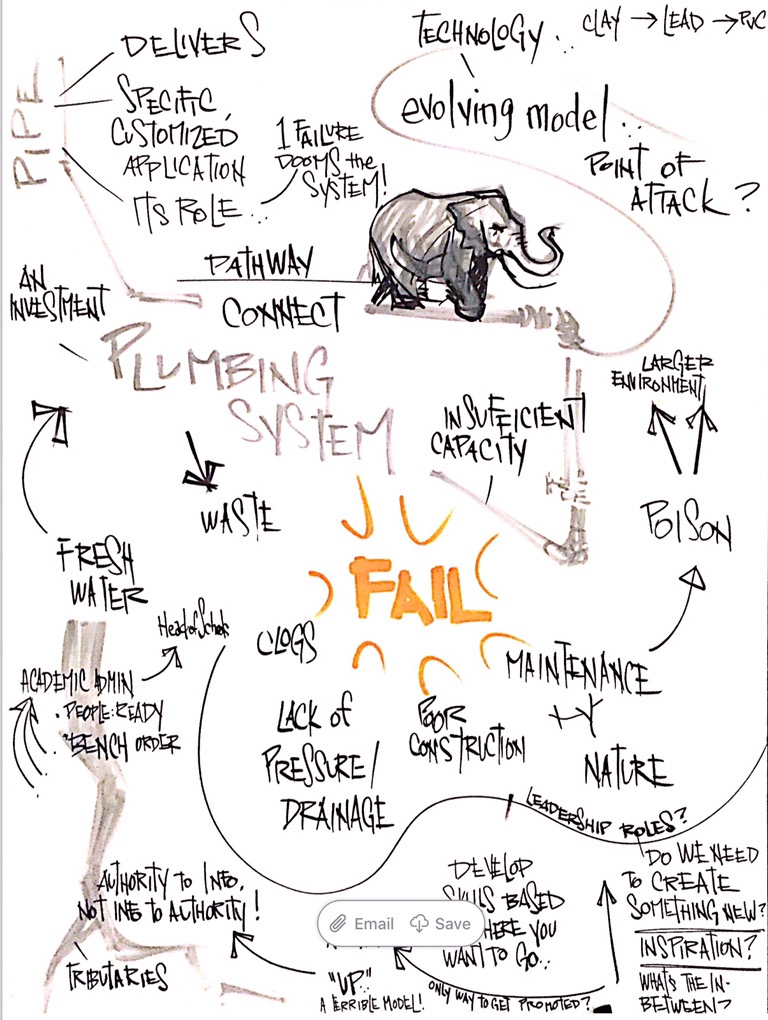
Our Graphic by Mike Fleisch from the Leadership Pipeline Content
Could there be any more vital leadership task to a school, organization, or business’s long-term health than the choice and cultivation of its future leaders? I don’t think so! But, while organizations maintain meticulous lists of candidates and create spreadsheets of those who could at a moment’s notice step into the shoes of a key leadership position, an alarming number of newly minted leaders fail spectacularly, ill prepared to do the jobs for which they supposedly have been prepared. Developing a deep and enduring bench strength can only be accomplished by approaching succession planning as more than the mechanical process of updating a spreadsheet. I believe the organizations, including schools that do this best combine two practices: succession planning and leadership development. This creates a long-term process for developing the talent roster across their organizations. You could compare this to a minor league baseball team’s function, including the vital and fundamental goal: getting the right skills in the right place.
Let’s explore this minor league example for a minute, because it is a good one. The major league club’s player development goals must co-exist happily, and profitably I might add, with the local owners and operators of a minor league club. It is also important to note there are also some areas of shared responsibility between the major and minor league teams’ responsibility for player development. The major league team determines which 24 players will be on the minor league team. Again, the major league team makes all the decisions about who comes, goes and gets moved up through the system. Major league clubs keep close watch on their farm teams, sending scouts and front-office staff to watch games and keep stats on players; all of which contributes to the future progression of the players. A pretty intense development pipeline, don’t you think? Here’s the key though: players are developing while, well, playing the game. Novel and intuitive idea, but how many leadership development programs are done by watching PowerPoints? We must treat our leadership pipelines like a minor league baseball program.
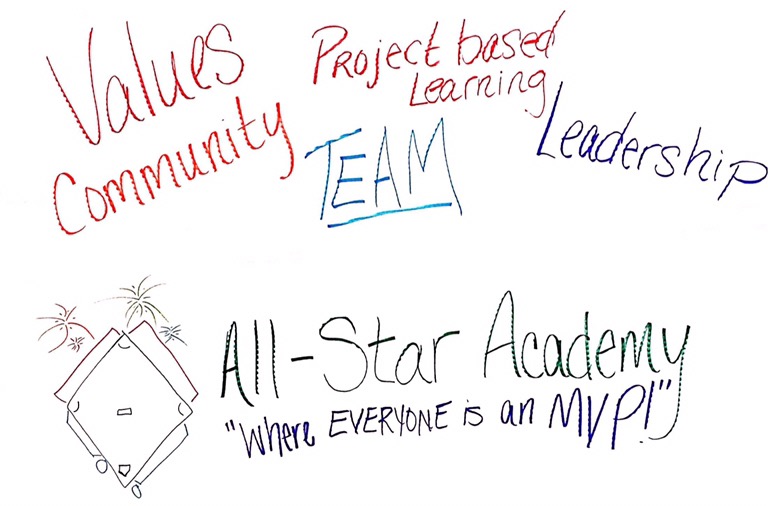
Focused Leader Academy Team Illustration From Yesterday’s Discussion
Let’s dive just a little deeper into this minor league pipeline approach. Nearly every baseball player in the MLB started in the minors. Players start low and work their way up the ladder of minor league levels (sometimes skipping a level or two) until they get to the Major Leagues. The rate at which players advance can be vastly different in each case. Each team of the MLB has their own network of minor league teams (sometimes called “farm teams” or “farm leagues”) which are used for player development. Players start low and work their way up the ladder of minor league levels (sometimes skipping a level or two) until they get to the Major Leagues. The point is, these players have very individualized plans (what I call hyper-personalized) to get their skills developed to major league quality. Again, and remember, this is while actually playing the game in a highly competitive market. There have been a handful of players to skip the minors and go straight to the big leagues, but this is very, very rare. Only 2 players in the last 15 years have done it (Mike Leake in 2010 and Xavier Nady in 2000).
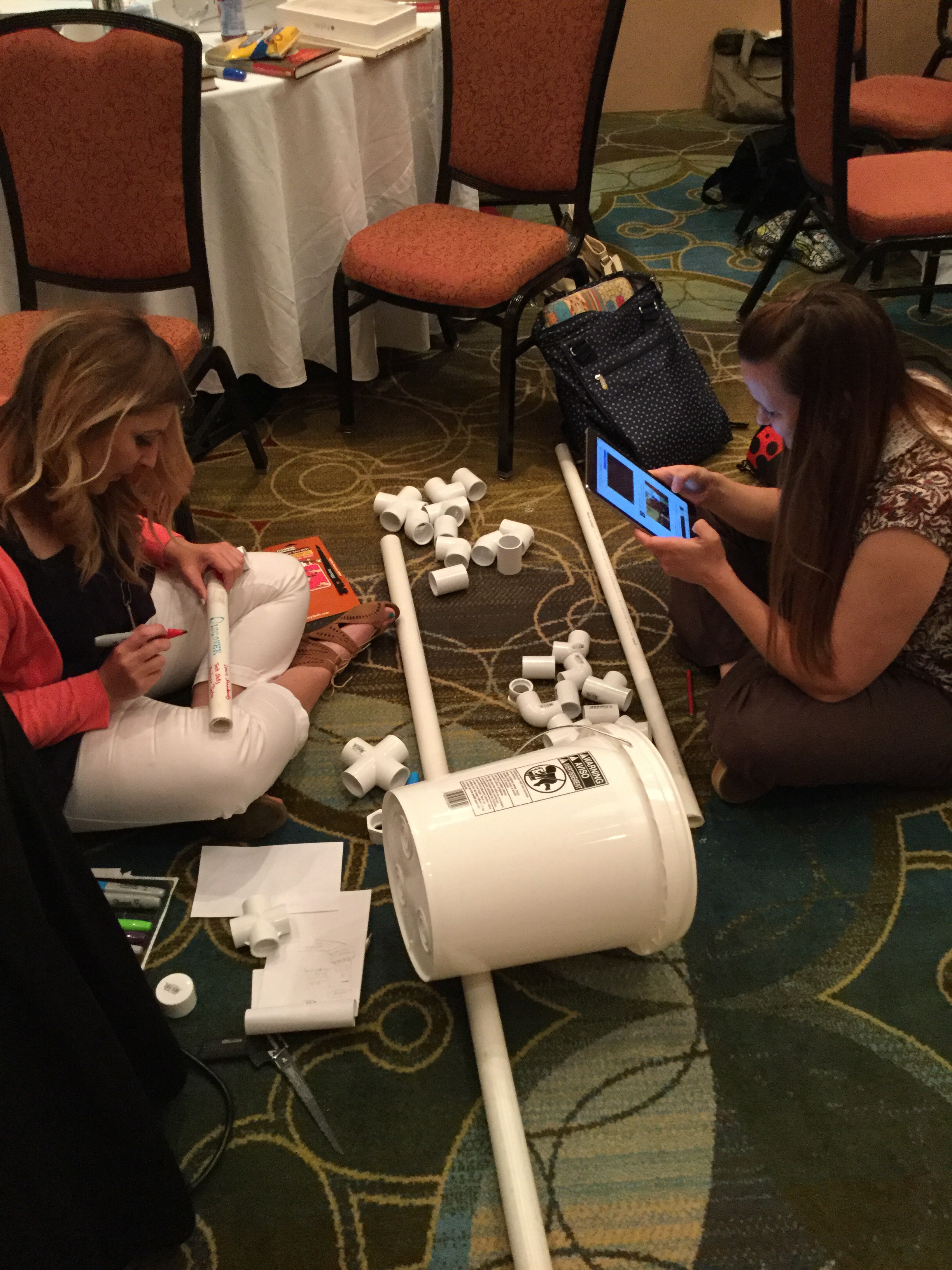
Focused Leader Academy Participants Designing & Building A Leadership Pipeline Model
Organizations, especially schools, need to learn from these minor league development “farms” and make sure they are growing their own in real time. We discussed this very point yesterday at our first session of our second cohort of our Focused Leader Academy. As you will recall, last year we started the Focused Leader Academy at the Hoosier Academies Network of Schools. This is an employee development and engagement program. The idea is that great minds and great motives still matter. Teachers with school leadership aspirations have the opportunity to become part of a cohort which will take part in monthly leadership training and be part of supervised leadership projects of the school. Cohort size is at least 15% of teacher leaders per year. The Vision is: Leadership will be born out of those who are affected by it. The Mission is: Leadership will appear anywhere and anytime it is needed. Our Theory of Action is: If we empower our teachers through leadership skill development…Then we will have teacher leaders ready to contribute to the success of Hoosier Academies Network of Schools and be an important part of our talent/leadership pipeline.
 We all know that leaders grow leaders. This why I have taken it as my personal charge to develop, grow, and improve our Focused Leader Academy. As Matthew Paese, Audrey Smith, and William Byham stated in their latest book that launches next week, Leaders Ready Now: Accelerating Growth in a Faster World, “Everything you need to accelerate the growth of leadership is already inside your organization(2016, p. v). I am such a believer in this statement. I always say that context matters – and it does. This is why I believe organization’s need to make this work their personal responsibilities, not hire someone else to do it. How in the world could someone else know what the needs are? To do this we must push less-experienced leaders into broader, more formidable assignments. The whole premise behind our Focused Leader Projects. Additionally, I love task forces because these can become, in my opinion, what Paese et al. call Acceleration Pools© (2016). These experiences enable us to get leaders ready with real time development and coaching in the same way the minor league baseball teams do it I described earlier. Task forces and projects also give us the ability to deploy future leaders to key assignments. In fact, we recently lost a person in a key role and instead of filling immediately we put four teacher leaders in the role as what have become affectionately known as BAs (Byron Appointees).
Appointing BAs really turned out to be an incredibly successful move. By conquering difficult assignments, these teacher leaders have become ready to take on bigger leadership roles. I now plan to make BAs a common part of what we do along with our task forces, Focused Leader Academy, and Focused Leader Projects. Paese et al. also taught us, “The challenge is scaling this concept beyond isolated, reactive incidents and creating a repeatable dynamic that causes entire cadres of leaders to become ready” (2016, p. vii). This is why I, as the leader of our network of schools must take responsibility for this.
Finally, for this accelerated growth (Paese, et al., 2016) we must create an environment where our developing leaders experience fear, excitement, anxiety, and experimentation. For rapid growth we must create real time, real work experiences of:
- Fear
- Excitement
- Worry
- Anticipation
- Terror
- Thrill
- Anxiety
- Experimentation
- Risk
- Possibility
These feelings then generate energy and accelerated learning (2016). Are you taking responsibility for your leadership pipeline farm team or leaving it to some off the shelf product or leaving it to some paid organization to do for you? I would suggest to you to take responsibility yourself and get the thrill and inspiration of this important leadership responsibility.
Pulling Together
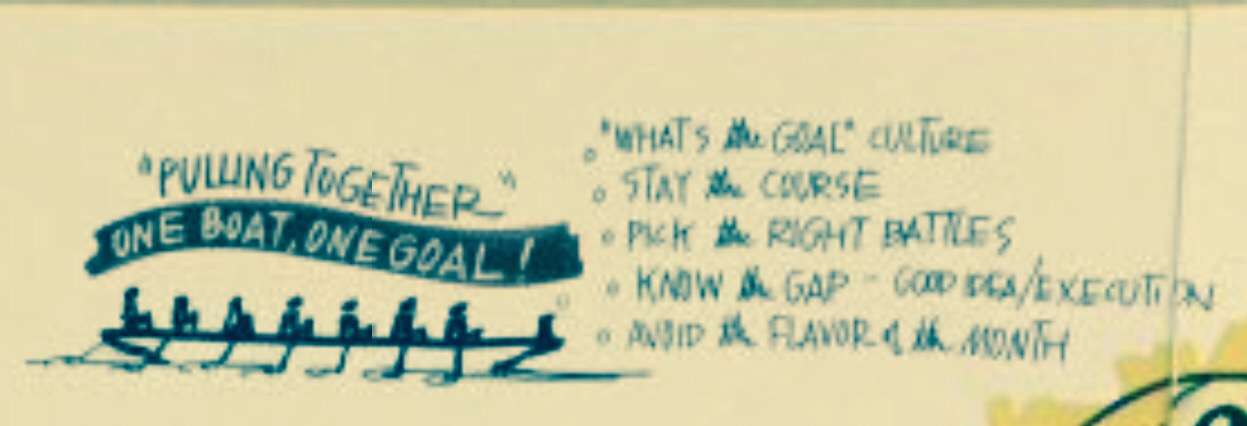 I’m so excited I just started reading 52 Leadership Lessons: Timeless Stories For The Modern Leader by John Parker Stewart. As you know, I love books that are broken into 52 lessons. These lessons allow me to reflect and the blog each week. This week’s lesson was entitled “Baboons and Impalas” and dealt with how our differences make us fit together better. Stewart taught us that the baboons are watchmen for the impala and the Impalas stir up insects for the baboons. This is a great relationship that benefits both. Now, let’s relate this to our context as leaders. Turning a group into a team is one of the biggest challenges leaders face. We find ourselves leading groups of very diverse individuals in complex projects and tasks. We don’t always get to hand pick our team, but rather we often inherit teams and all of their past baggage. Whatever the state of the group, we all need team skills. It seems easier and more comfortable to work with people of similar styles, thinking and background, but diversity brings a richness to a team. Leaders and team members should value, encourage and reward diversity.
Ralph Waldo Emerson said, “No member of a crew is praised for the rugged individuality of his rowing.” Effective teams do not encourage heroes or superstars. They look for ways to maximize their resources and build on each other’s strengths and diversity. Therefore, we need to:
- Develop a what’s the goal culture.
- Stay the course.
- Pick the right battles.
- Know the gap – good ideas/execution.
- Avoid the flavor of the month.
Effective leaders embrace differences, respect disagreement, honor those who question processes and direction, and doesn’t surround himself or herself with “yes” people. As Stewart taught us, “When selecting others to be on a team with you, choose unlike yourself.” Create a balanced team by thinking of the baboon and the impala.
Everyone Is A Leader
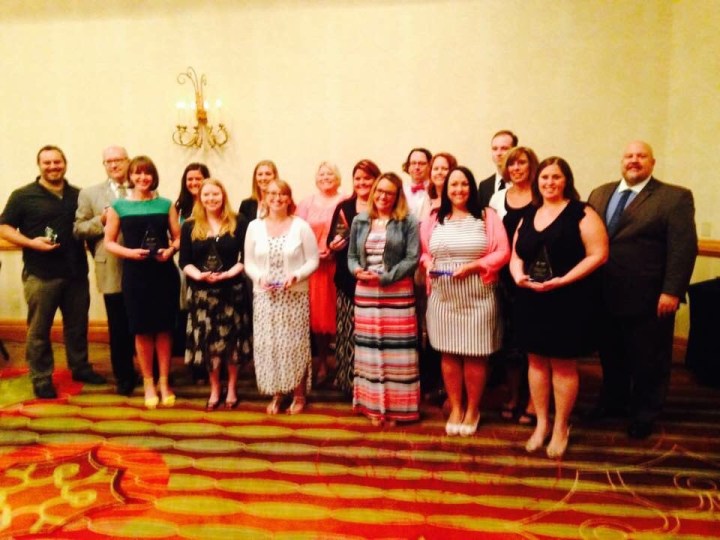
Focused Leader Academy Cohort #1
I am finally in for the evening and sitting down for some reflection time with my computer blogging. What a day! This morning we graduated our first cohort of teacher leaders from our Focused Leader Academy. Then we had our commencement exercises for our Hoosier Academies Network of Schools 2016 graduates. This post is about our celebration breakfast for our Focused Leader Academy. 
We had an incredible program recognizing our teacher leaders and an outstanding program by Andy Worshek of Turn the Ship Around! He is an expert on Intent-Based Leadership. Andy served in the navy for 24 years, and achieved the rank of Master Chief. Assigned to the nuclear powered submarine USS Santa Fe with Captain David Marquet and imagines a workplace where everyone engages and contributes their full intellectual capacity, a place where people are healthier and happier because they have more control over their work—a place where everyone is a leader.
 Great Leadership creates an organizational culture that spawns generations of additional leaders throughout the organization. Which is exactly what we are doing with our Focused Leader Academy. With this program we are embracing continual learning as the primary activity of the organization. Andy taught us today that most people don’t quit the job, they quit the people. This really hit home as a leader of leaders. Andy discussed that instead of thinking about leaders and followers we need to think about having leaders and leaders. In order to do this we must move authority to information instead of information to authority. In other words, in a highly functioning organization the authority to use information is kept at what I call street level so it can be used effectively. In a school that means with teachers. Make no mistake, however, when shifting this model, we have an obligation to make sure that those we are empowering have the technical knowledge and skill to handle this authority. Otherwise, Andy taught us this would lead to chaos. Furthermore, for intent based leadership to work there must be organizational clarity. This is clarity is one of the things I am very proud we spent a great deal of time working on this past year as a school and with our Focused Leader Academy.
“Don’t move information to authority, move authority to the information.”
― L. David Marquet, Turn the Ship Around!: A True Story of Turning Followers into Leaders
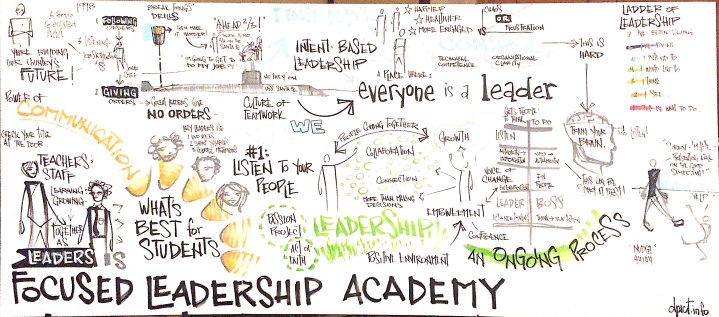
Another eye opener for me was the idea of needing to change the environment, not the person. People’s behaviors depend on the environment. If you manipulate the environment, you manipulate behaviors. Since the earliest times, humans have needed to be sensitive to their surroundings to survive, which means that we have an innate awareness of our environment and seek out environments with certain qualities. The culture and environment of an organization can facilitate or discourage interactions among people. Additionally, the environment of an organization can influence peoples’ behavior and motivation to act.
“When a flower does not bloom in your garden, you fix the environment in which it is growing. You do not fix the flower.” ~ Alexander den Heijer
 Too many organizations believe that “leadership” is a noun based on someone’s title. I believe, however, that leadership is a verb based on someone’s actions. By that definition, everyone is a leader. If we believe everyone is a leader then effective leadership helps to unify a culture, and a collaborative culture made up of leaders and leaders can solve just about anything. Now, that is an ideal environment where everyone is a leader. Organizations should realize that leaders permeate the organization. I believe the role of a leader is to find and develop other leaders – in essence, to multiply ourselves. We must intentionally look for people displaying leadership behaviors and create a process for developing the next generation of leaders. I believe that the Focused Leader Academy has done that for us.
Vital Leadership Learnings
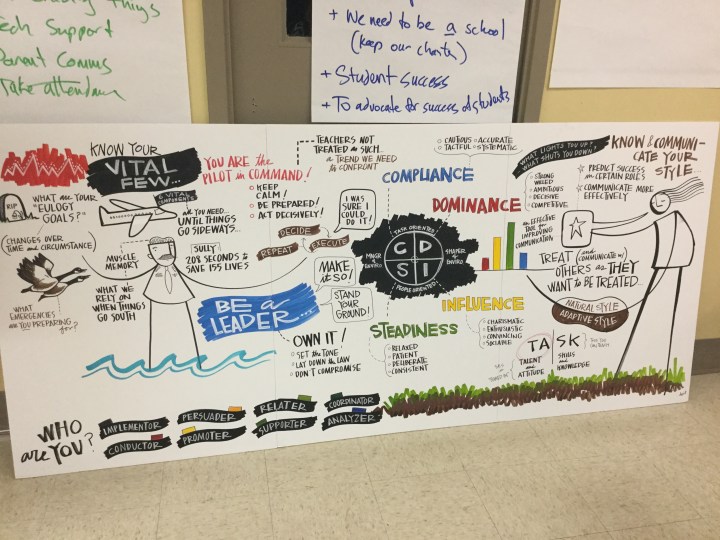
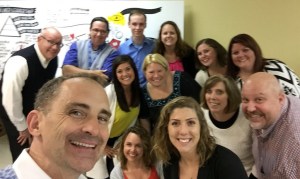 A couple of weeks ago we had the honor of having Will Pemble from MAP Vital Factors Solutions work with our Focused Leader Academy on being disciplined leaders. This day was set up by John Manning, author of The Disciplined Leader (2015). As you know from previous posts, our Focused Leader Academy read the book, that is set up in 52 lessons, and blogged about each lesson. We then had a discussion about what we felt were the vital few leadership focuses we needed more work on for each section of the book and overall. Really, that pre-exercise was an incredible discussion and experience. It was very interesting to hear the individual vital few from the FLA participants and then hear the discussion of narrowing down to the group’s vital few. This allowed for a rich discussion about how individual vital leadership skills affect the vital few of an organization.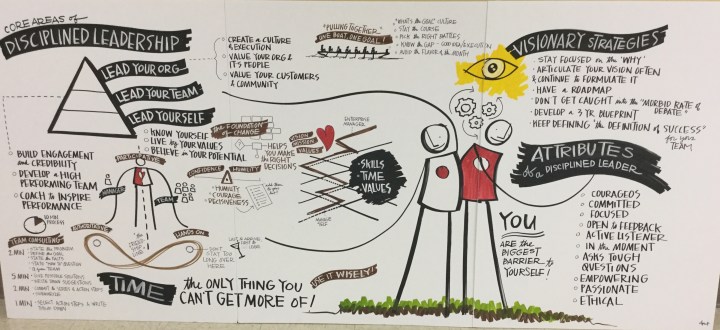

Here are our Focused Leader Academy Vital Few (I have included the lesson number from the book, in case you want to check it out and follow along):
Part 1:
Our top 2 were…. #4 Know Yourself and #13 See Mistakes as Opportunities. Then we were torn between #14 Listen More, Talk Less and #11 Drop Defensiveness.
Part 2:
Our top two were…. #30 Empower Employees and #37 Advocate for Your Team. Then we settled on #31 Give Effective Performance Feedback because we knew what we were getting ready to embark on with redesigning our entire performance evaluation system. We also had #26 Honor Your Commitments high on our list.
Part 3:
Our top three were….#39 Develop a “What’s the Goal?” Culture, #43 Put More Weight on “Why?” and #46 Avoid the Dangerous Gap Between Good Ideas and Execution. We also had a strong feeling for #51 Keep Ethics Strong.
So then we went back and voted to come up with our TOP THREE VITAL FEW…
Part 1: #13 See Mistakes as Opportunities
Part 2: #30 Empower Employees
Part 3: #39 Develop a “What’s the Goal?” Culture
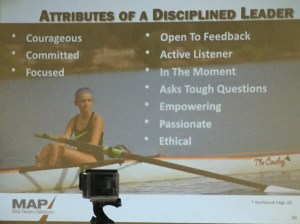
 Will Pemble started out our workshop by have us develop a list of all the qualities of a disciplined leader. Here’s our list:
- Runs toward a challenge
- Decisive
- Listener
- Reflective
- Active participant
- Clear values that the leader sticks to
- Loves what he/she does
- Commitment
- Communicator
- Risk-taker
- Willing to be uncomfortable
- Willing to suffer (What’s your suffer score? How much are you willing to suffer for something?)
- Willing to fail… a lot
- Learner
- Accepting
- Courageous
- Focused
- Empowering
- Open to feedback
- Passionate
- Ethical
- In the moment
- Asks the tough questions
Pretty awesome list, huh? Of course, if we could all be great at all those, we would be the most incredible leaders ever. Well, I’ve got some work to do…I don’t know about you. I’m guessing we all have some work to do.
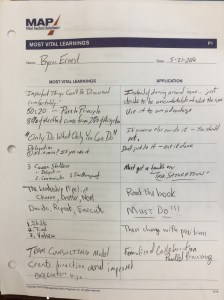 We had a cool sheet that we kept individually during the day that was titled: “Most Vital Learnings.” I really liked having this sheet that had spaces for 10 vital learnings (see photo). In keeping with the vital few mantra of The Disciplined Leader, I have selected my vital few most vital learnings. Here they are:
- “Important things can’t be discussed comfortably.” Instead of dancing around issues, we need to decide to be uncomfortable and hit the issue head on and solve it.
- “Pareto Principle”… 80:20 – 80% of the effect comes from 20% of the system. We need to use this to our advantage. We must focus on the vital few and ignore the trivial many.
- Decide, repeat, execute. Need we say more? This is definitely a vital few.
As you can see, our experience with the book, The Disciplined Leader, and Will’s great facilitation of our workshop was incredible. It was also incredible to be back together with Sita Magnusun doing our graphic facilitation for this program. I first met Sita at my first Harvard University class and have been both blown away by her work and continue to believe in graphic facilitation as a component of effective facilitation of learning. Two of her graphics are posted here.
The Vital Few of Extending My Reach to Lead
 I just completed the book The Disciplined Leader by John Manning (2015). There will be two more posts about the experience of the book, but this post deals with my vital few (three) from Part III of the book – Extend Your Reach The Responsibility to Lead Your Organization. One thing that really resonated with me in this section of the book was the idea that leading our organization is about extending my leadership reach beyond myself and our team to a degree that’s much further from me yet still critically connected to my organization’s center: me. Extending my reach also means having an alignment of values and people.
My vital three for Part III are (I have included a link to my original post on each lesson):
- Develop a “What’s the goal” culture https://byronernest.wordpress.com/2016/04/03/whats-the-goal/
- Put more weight on “why” https://byronernest.wordpress.com/2016/04/21/leaders-ask-why/
- Cultivate Curiosity https://byronernest.wordpress.com/2016/04/24/leading-curiously/
 HOW can your leadership be both spread and focused? This is a critical tension faced by many companies with multiple operations. One of the keys to putting strategy into action is to have everyone in the organization understand her role in carrying out the goal. I believe this is the first step to extending our leadership reach. So, as I look at my role of developing great teacher leaders it is important for me to define and organize high-impact teacher-leader roles that can allow great teachers to have a far greater effect on vastly more students, teaching peers, and the culture of excellence we are building for the organization. State and district education leaders must ensure that schools have the support they need to design and implement high-impact teacher-leader roles.
I also want my reach as a leader to encourage our team members to be curious. Curiosity as it applies to leadership will always lead to creativity and innovation. Curious leaders will not be content to keep doing things the same way over and over. A curious leader will look at things from multiple perspectives, continuing to ask questions. Being curious is simply being eager to learn and to know; to be enthusiastically inquisitive. Curious leaders are always moving forward. Curious leaders are not afraid of failure. In fact, curious leaders know that “failure” is the prerequisite to success. Curious leaders know that you will never know how far you can go until you go too far – I call this swinging the pendulum.
If we are truly committed to growing leaders in our organizations, we must find ways to extend our reach. What are you doing as a leader?


2 comments