Failure Is An Option

This past weekend, while at the World Dairy Expo, a business person made a comment to me that was intriguing. She said, “Failure is an option.” This caused me to pause because we more often use the phrase “Failure is not an option” associated with NASA Flight Director Gene Kranz and Apollo 13 – even though that is more of a movie line than real quote from Kranz. While both phrases can be useful from a mindset perspective, let’s look at the context being used this weekend when it was said that “failure is an option.”
The phrase, in the context she was using it served as a reminder that adapting to new technology, new genetic research, evolving consumer demands, new techniques, and new equipment is essential for growth, continual improvement, staying relevant, and being profitable. Embracing change, even when it involves facing challenges or setbacks, allows us to learn and innovate. Failing to learn and innovate not only makes failure an option, it makes failure inevitable. Viewing these experiences as opportunities rather than obstacles can motivate us to stay curious and engaged with the world around us. It encourages a mindset where we are open to learning new skills and exploring new possibilities, ultimately leading to greater success in both personal and professional realms. We must recognize that not exploring new possibilities will enable failure to be an option.
Succeeding And Failing Just Enough

In my daily reading this morning I came across the phrase, “he succeeded and failed just enough.” This phrase in Bond of Union: Building The Erie Canal and the American Empire by Gerard Koeppel really intrigued me. It made me wonder if there is a sweet spot of successes and failure in life. If so, what is it? Furthermore, how would we plan for that? In the context of the book, Koeppel meant the person in question had a mix of successes and failures, and in just the right balance to end up being successful. But how do we determine the right balance? It implied that they achieved some level of success, but also experienced failure. Really that probably describes all of us. Those involved in getting the wild idea of the Erie Canal approved, get the funding, do the engineering (remember, engineering didn’t even exist yet) had to be willing to fail a lot.
That willingness to fail was just the ticket and necessary for their growth or learning. There were people who thought these people proposing the canal were lunatics. I know I have proposed ideas along the way that made others believe I was crazy. But when you think about what the canal did for our country and the commerce of the east, we realize how important it is to have these crazy people who are willing to fail. The construction of the Erie Canal had a transformative and positive impact on both local communities and the nation as a whole.

The construction of the Erie Canal had numerous positive effects on both local and national levels. Firstly, the canal revolutionized transportation and trade by providing a direct and efficient route for goods to be transported between the Great Lakes and the Atlantic Ocean. This significantly reduced shipping costs and time, boosting economic activity and facilitating the growth of cities along its route. Additionally, the canal opened up new opportunities for settlement and development in the Midwest, as it allowed for easier access to previously isolated areas. It also played a crucial role in fostering cultural exchange and communication, as people from various regions came together and shared ideas and experiences. Furthermore, the Erie Canal became a model for infrastructure projects in the United States, inspiring the construction of other canals and railroads, ultimately contributing to the nation’s overall progress and industrialization.
So let’s not forget trying to find a sweet spot between success and failure that can contribute to the overall progress or development of those things we are passionate about and move us toward fulfilling our purpose.
In The Midst Of Our Failures

You all know I love rock music and enjoy studying the bands made up of incredible artists. Yesterday, I heard Archetypes Collide for the first time – AWESOME! This is a band I am going to be paying attention to and would love to meet and have a conversation with. The song I heard was ‘What If I Fall’. It was a great song with some super-meaningful lyrics that really made me think about how we deal with failure – our own and the failure of others. The chorus is a leadership lesson: “What if I fall and waste away the life that I have made?; What if I fail and let down everyone who trusted me?; Why does holding on feel so wrong?; It’s weighing down on me; What if I fall and lose everything?” Listening to this song really made me think about my own fears and have me contemplating how to remove those fears from others. We all encounter obstacles, fall/fail, and need to learn how to rise again. We also need to teach those we serve the skills required to pick themselves back up after reaching for a major goal but falling short.
Frontman of the band, Kyle Pastor, said of the song, “I’ve always had a deep rooted fear of letting my friends and family down… Even though I know they’ll love me in the midst of my failures, the anxiety of it all buries me and pushes me further away from them. I hope this song can be an anthem for those who feel that same burden” (Paul Brown, Wall of Sound). This really is a burden for most of us. If we’re honest we all have anxiety for failing. We need to be careful not to equate failure to being less worthy to ourselves and others. We need to create growth mindset cultures where falling and failing is seen as learning and growing. That culture also needs to embrace falling and it not be letting someone down.
There is actually a name for fear of failure: atychiphobia. One of the signs of this is partly what the song is about; fearing people will think differently of us if we fail. We also worry we are letting others down. Again, though, if we create a growth mindset culture, failure won’t be seen as letting anyone down, but as a learning moment. We need to adopt an attitude of failure being an opportunity to learn. I realize it is a whole lot easier to say all this than actually put it into practice, but I love that this song calls out our anxiety. Fear of failure is very real for each of us. It can can us to avoid risk, lose our creativity, and our ability to innovate. We must all make sure all those in our care know that their stumbles will not let us down. And, give ourselves grace for our own moments of learning.
Fantasy Experienced As Reality
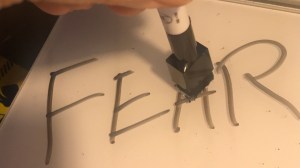
Fear is one of the most basic emotions and can be healthy when warranted. Different people have different fears – because they think different thoughts. Fear can hold us back and prevent us from moving forward. We must learn how to control our fear instead of letting our fear control us. Fear was the topic again this week in Chapter 40, “The Other Side Of Fear” in Mindset Mondays with DTK by David Taylor-Klaus (DTK). DTK starts out by asking, “What is the cost of letting fear stand in your way?” He also taught us that outside of something that would cause us mortal danger, being afraid just tells us what we are afraid of is something we care about.
“Fear doesn’t exist anywhere except in your mind.”
Dale Carnegie
I loved the FEAR acronym DTK used in this chapter – Fantasy Experienced As Reality. He told us that our brains don’t know the difference between perceived reality and what is happening in real time in the real world. In fact he wrote of brain research where, when monitored, many of the same brain areas were used when a pianist actually played a song or imagined she was playing. So, literally, fear is just in our heads. But, to me this is about visualizing success. Isn’t this why we do dress rehearsals? Isn’t this why we do walkthroughs or scrimmages prior to the actual game? Isn’t this why we visualize what success looks like, or feels like? I believe it was William Arthur Ward who told us, “If you can imagine it, you can achieve it. If you can dream it, you can become it.” Our aspirations are our invitations to set new goals, attempt new tasks, dare to travel uncharted courses. Let’s face our fears and visualize the success that is ours.
Recipes For Success

Obviously, no matter what you do, there is never a guarantee for success. We just use recipes and practices to increase our chances of success. Basically, we follow “recipes for success.” In other words, a number of good practices that we have either discovered for ourselves through trial and error, or others. All this popped into my mind as I read Chapter 38, “Own Your Mistakes,” in Mindset Mondays with DTK by David Taylor-Klaus (DTK). DTK taught us in the book the we need to own up to our mistakes or our credibility is undermined. By owning up to and hopefully learning from our mistakes, we become trustworthy and human.
As a believer in having a growth mindset, I began to think about the difference between a mistake and failure. In doing some research I found that the difference is in the learning, which to me is a big part of the “owning up to it” advice of DTK. Then I turned to Seth Godin who said, “A mistake is either a failure repeated, doing something for the second time when you should have known better, or a misguided attempt (because of carelessness, selfishness or hubris) that hindsight reminds you is worth avoiding” in The Difference Between A Failure and A Mistake. He went on to say, “A failure is a project that doesn’t work, an initiative that teaches you something at the same time the outcome doesn’t move you directly closer to your goal.” Guilty as charged. Using Godin’s definition, I’ve made lots of mistakes and failures.
We all make mistakes. Do not forget that mistakes are behaviors, just like experiments. We must clean up after them and own them. Failures are outcomes and all about the learning. Don’t make the mistake (pun intended) of not learning from our actions.
Living Is Having A Past Full Of Mistakes
 The other day as I was having dinner with a good friend I was talking about some mistakes I had made. He said, “Byron, part of living is having a past full of mistakes.” Wow, how true this is! And, how impactful it was to hear from this. As a person who never worries about failure and tries to learn from every mistake, it was huge to talk this out.
The thing to remember and tell ourselves, however, is that the mistake was not on purpose. We didn’t misunderstand circumstances or miscalculate a situation on purpose. Would we forgive someone else? Sure! So we need to remember to forgive ourselves too, and fail forward. This all doesn’t qualify if the mistake or failure was while taking a risk. That is the nature of risk taking and is necessary.
Then, we just need to do everything we can to fix the mistake. That may mean talking to someone, coming up with a better solution, or letting someone else help out. I always say to others, “There’s nothing you can screw up bad enough that the sun won’t come out tomorrow. And, if it doesn’t, it won’t matter anyway.” Remember, we are human and not infallible.
Finally, we need to take the position that we will be smarter next time. We need to learn from mistakes. Just as others have had amnesia about our past mistakes, we need to have amnesia about others. This is truly having compassion.
 Byron's Babbles
leave a comment