Do Not Forget The Small Talk

I have finished two great books this week that have caused me to do a great deal of thinking about how we communicate with each other and how, now on day 351 of the global pandemic, we need to be communicating with others. Pre COVID we had ample opportunities to casually chat with our colleagues. Now, much of the time we pop up on a screen and must talk to everyone, or not at all. In A Gentleman In Moscow by Amor Towles, the protagonist, The Count Alexander Ilyich Rostov, exclaimed “We all have many small details about ourselves that we can put together to make a mosaic of who we are.” These small details are important to relationship building. The Count used conversation to elaborate on the smallest of details. Even in our virtual interactions we must build in time (or let it happen organically) for small talk. This does not mean asking a single question that everyone in the group must answer – that is not small talk.

Growing up we raised a lot of White Pekin Ducks. It was always interesting to me that when a group of ducks got separated from each other, once they got back together there was a great deal of chattering and quacking like they were getting caught up on all the latest news. It was amazing to watch and listen to this loud interaction. Boy would I have loved to speak White Pekin Duck. Ducks are like us, very social. In fact, they do not like to be alone and should never be raised as singles. I believe we have found how much we are like that. Therefore, I always like to get on to virtual gatherings I facilitate about 15 minutes early and will leave the room open for a short time afterward. This mimics the time that we all do small talk before and after meetings. This gives us a chance to sort through what was called “our vast catalog of casual questions” in A Gentleman In Moscow. This needs to be unstructured time to be worthwhile. Many leaders have real trouble just letting this happen naturally.
As chair of board for the National Association of State Boards of Education (NASBE) I have had to get comfortable with meetings starting a little late (maybe 10 minutes) because participants from all over the country are Zooming in and want to talk about the personal things we would all talk about if in the literal room together. Clearly, there is a balance to reach, but if I didn’t allow for this it would be irritating to the members. We must create space for small talk.
If we use the interrogatives for conversation, we can learn so much about those we serve. Sharing a space is not always sharing an experience. Allowing space for small talk will also allow for us to, as Beverly Kaye and Sharon Jordan-Evans told us in the sixth edition of Love ‘Em Or Lose ‘Em to “Ask so you don’t have to guess.” These interactions help us to understand how to love those we serve. I love how The Count did it in A Gentleman In Moscow. He used the phrase “So tell me…” Don’t you love it when someone starts with “So tell me…” instead of “Let me tell you…”?
Finally, if you’re one that needs a little more structure, ask questions that those gathered will have an opinion about. But, don’t forget, you may not have the same opinion. This is okay and fun. Let’s not forget just how important small talk is to really knowing those we are associated with.
Flavors of Motivation

I loved chapter 26 in Mindset Mondays With DTK by David Taylor-Klaus (DTK) entitled “Seek to Build” this week. He started with “There’s the flavor of motivation that’s irritation, a move away from something; and the flavor that’s inspiration, a move towards something” (p. 193). I had never really thought about motivation in this light, or flavor if you will (pun intended), before. The bottom-line here is, however, that both being motivated by irritation or inspiration can both create positive ends. As a creative innovator, I thought about being motivated to create change because of the irritation of the thing, policy, or procedure that needed changing. This is a good thing. It’s why, many times, products get improved. Conversely, inspiration does the same thing. I am reminded of some of the blog posts I was motivated to write in the last week came from the inspiration of books I am reading.
Therefore both ways of being motivated can be powerful for us. Many times the two flavors of motivation are blended together like a chocolate and vanilla twist ice cream cone. As DTK taught us, “Judging inspiration as good energy and irritation as bad energy deprives you of a valuable source of motivation. Don’t vote. Both flavors of motivation propel into action” (p. 194)! So, use the energy created by the flavors to create positive change in all you do and for all those you serve.
Focusing On Our Why

This week’s Mindset Mondays with DTK lesson in Chapter 25 was entitled “Discover Your Why.” David Taylor-Klaus (DTK) was pointing out how important it is to find our “why.” When finding our “why” DTK taught us that “It’s something you have to sit still and ponder until it becomes clear to you” (p. 188). This made me think back to when I was a kid and I would take a magnifying glass on a sunny day and focus the sunlight on a piece of paper, burn a hole in it, and catch it on fire. The magnifying glass is the metaphor for our “why”; focusing our energy like my magnifying glass focusing the sun’s energy.
The power of our “why” is similar to the energy of sunlight focused through a magnifying glass. The Diffused sunlight provides warmth and energy for plant photosynthesis, but when its energy is concentrated—as through a magnifying glass—that same light can set fire to paper. Focus that energy even more, as with a laser beam, and it has the power to cut through steel. As DTK said, “That [our “why”] awareness is brilliant energy available to you to create something new, something next, something more” (p. 190). Our “why” means something as powerful to our lives as my magnifying glass and laser beam metaphors.
Explore And Heighten On President’s Day

Interestingly, the holiday we celebrate today is officially Washington’s Birthday, not President’s Day. In 1971 when Congress passed the Uniform Monday Holiday Law, Washington’s Birthday (February 22) was moved to the third Monday in February. This put the holiday in between Abraham Lincoln’s birthday (February 12) and Washington’s. It also gave us another three day weekend – the intent of the Uniform Monday Holiday Bill. There was a push to change the name from Washington’s Birthday to President’s Day, but that did not pass – we just all call it President’s Day.
As I take a moment to reflect on this day, I remind myself of advice I give to others: study humans, not heroes. I believe this is important in teaching history and civics as well. While we have the advantage of hindsight when studying the past, always remember those who lived it, did not. One of my favorite authors, David McCullough, put it this way, “Nor was there ever anything like the past. Nobody lived in the past, if you stop to think about it. Jefferson, Adams, Washington—they didn’t walk around saying, ‘Isn’t this fascinating, living in the past?’ They lived in the present just as we do. The difference was it was their present, not ours. And just as we don’t know how things are going to turn out for us, they didn’t either. It’s very easy to stand on the mountaintop as an historian or biographer and find fault with people for why they did this or didn’t do that, because we’re not involved in it, we’re not inside it, we’re not confronting what we don’t know—as everyone who preceded us always was” (McCullough, February 15, 2005, in Phoenix, Arizona, at a Hillsdale College National Leadership Seminar on the topic, “American History and America’s Future.”). We need to remember that history was not created in a vacuum and could have gone a bunch of different ways.
As we reflect on our Founders and past Presidents we need to remember they were human beings, just like us, with flaws, sins, and both terrible and good qualities. We’ve had leaders do some terrible things and we need to study those things and call them out to make sure and not repeat them. We also need to learn, grow, and continue to improve and get better. In the world of improvisation there are the five syllables “explore and heighten.” This is where we usher in our imagination, where ideas are born, where our power finds its source, and where we discover what’s waiting for us. I believe this to be the genius of our American community. We know everything can and should be improved upon. So, on this day of reflection, let’s renew our resolve recognizing our errors of the past and continued improvement for making the world a better place for ALL.
Leading The Michelli Way
I am a huge believer in intersectional learning. This is the learning that can be accomplished from the commonalities and complexities of different industries, businesses, and organizations. I have always been a fan of Dr. Joseph Michelli’s work and books. He has knocked it out of the park with his latest book, Stronger Through Adversity: World-Class Leaders Share Pandemic-Tested Lessons On Thriving During The Toughest Challenges. This book is the encyclopedia of intersectional learning. I am only about 25% through the book, but have learned and reflected on so many things. I have read all of his books, and I have to attribute many of the ideas I have implemented over the years started from the learning I have done from his books.

My goal with this post is to pay it forward and invite all of you to learn from Dr. Michelli. If you are one who likes to learn from others and then apply that learning to your own context, then his work is for you. He has studied and chronicled, in-depth, the many companies he has worked with, improved, consulted, and learned from. Let me just give you one example from the book. Let’s begin with this quote:
“a responsibility alongside other hospitality brands to ensure all travelers who decide to book an all-inclusive getaway will feel confident that they’ll have a safe, comfortable, and memorable experience. Each and every resort or hotel brand needs to stay true to its unique value proposition in the market, yet abide by a common denominator of strict hygiene and safety protocols. Health and safety have always been top priorities among travelers, and now they are key determining factors in a consumer’s decisions to travel.”
Carolyne Doyon, President and CEO of North America and the Caribbean at Club Med
I don’t care what industry you are involved in, the learning here applies. Take the words “hotel or resort,” “traveler,” “travel,” or “hospitality” and change them to those that apply to your organization and the statement applies. When I think of both my policy making and leadership roles in education this statement really applies.
I talk about the value proposition that Doyon speaks of in my leadership training all the time. As a believer in school choice, I believe every school must have a unique value proposition. In other words, why should families choose your school to attend? No doubt, the pandemic has even created new, what I call, competitive advantages.
We have had to contemplate bringing students back and opening schools, keeping students and teachers safe, how to do virtual education or some combination of virtual and in person education effectively, and how to still hold ourselves accountable for the learning and outcomes ALL students we serve deserve.
Dr. Michelli’s book is so timely because we are still working on all this. I was just in a briefing today on the Biden administration’s priorities in education and these items are being contemplated. We need to use the learning from all sectors to help us learn and navigate our course. Stronger Through Adversity gives us the actions of many great leaders. I wish we could have a summit of all the leaders to create action plans for all of us. Maybe he’ll let me pick a couple of leaders and invite me to do one of his podcasts with him. I can dream, can’t I?
As I said at the beginning, this post is intended to serve as my paying it forward for you to check out this great book and the learning that can be gained from Dr. Michelli’s work. Check it out!
Sharing Smiles Even If They Are A Little Harder To See

“Sharing smiles even if they are a little harder to see.” I heard this yesterday on the video that was shown prior to taking off on my flight to Atlanta. If you watch closely you can tell when someone is smiling. I was reminded this morning how important it is to still smile, even when our mask makes them a little harder to see. I walked into a school in Georgia this morning that I have not been in since last summer and a teacher I know said, “I would know that smile anywhere.” I said, “How do you know I was smiling?” She said, “You can always tell; you just have to pay attention.”
I started paying attention and you can tell. In fact the person’s whole face changes and their eyes light up. So, don’t forget: keep sharing smiles even if they are a little harder to see.
Great Collaboration or Great Competition

I am reading the great book Founding Brothers: The Revolutionary Generation by Joseph J. Ellis right now and he spoke of the “odd couple” of the revolution being Thomas Jefferson and John Adams. Both were very different in their tactics and personalities, and were unlikely friends. Before Washington’s presidency, they collaborated to solve multiple political issues. Then, as Ellis put it, the “great collaboration” turned into the “great competition” because the two intimate friends soon found themselves running for the presidency against each other. Probably no relationship in this country’s history carries as much baggage as that of John Adams of Massachusetts and Thomas Jefferson of Virginia.

This got me to thinking about the age old topic of how much competition is healthy. Pursuing individual goals alongside others can, at times, lead to counterproductive behaviors that can be harmful to both sides. This sense of competition can shift teammates (let’s consider Jefferson and Adams teammates of our democracy) focus from improving themselves or the vision of the organization to defeating a pseudo-opponent, which can lead to sabotaging behaviors. We saw these sabotaging behaviors in the case of Adams an Jefferson and I’ll bet you have seen this happen to others or yourself.
In a work setting, having read extensively about this topic, I believe in providing individualized performance statistics can help reduce competitiveness as well as its negative consequences. Competition at its best helps us to be better. At its worst, it can create unhealthy self-comparison or judgment. I am not advocating for doing away with competition. I am, however, advocating for us to not let collaborators becoming competitors stifle progress, both for the individual and the organization. Competition can actually change our world view. Never forget, everybody in an organization has something to say and undoubtedly has some value to contribute. Do we see the world as a place to grow and collaborate with others?
Where Do You Want To Rise Up Next?
The title of Chapter 23 in Mindset Mondays With DTK by David Taylor-Klaus (DTK) is “Rise Up.” This caught my attention and immediately made my mind go to my friends in Alter Bridge and their great song “Rise Today.” When the first sentence in the chapter was “In our house, we like to use rock & roll life style as a metaphor,” I knew we had serendipity.

DTK told us in this chapter that no matter what happens we must step up and put on the best show possible. This made me reflect on the fact that we have the opportunity to change the world every day. As it says in “Rise Today,” “Yeah, oh yeah; I want to rise today; And change this world; Yeah, oh yeah; Oh, won’t you rise today; And change this world?”
I blogged about this song before in “How Do We Change This World?” DTK told us in this chapter there are so many opportunities when things are far from perfect and that every obstacle is an opportunity. So let’s choose to show up and step up! “Oh won’t you rise today
And change this world?”
Somebody Did It For Me
Leaders motivate us to go places that we would never otherwise go. They are needed both to change organizations and to produce results. In any organizational climate, good leadership is perhaps the most important competitive advantage an organization can have. Amazingly, followers of leaders are just as powerfully driven to follow as leaders are to lead. Great leaders have a way of supporting others to grow and become more productive. Great leadership means putting people in the right place at the right time and then letting them thrive there.

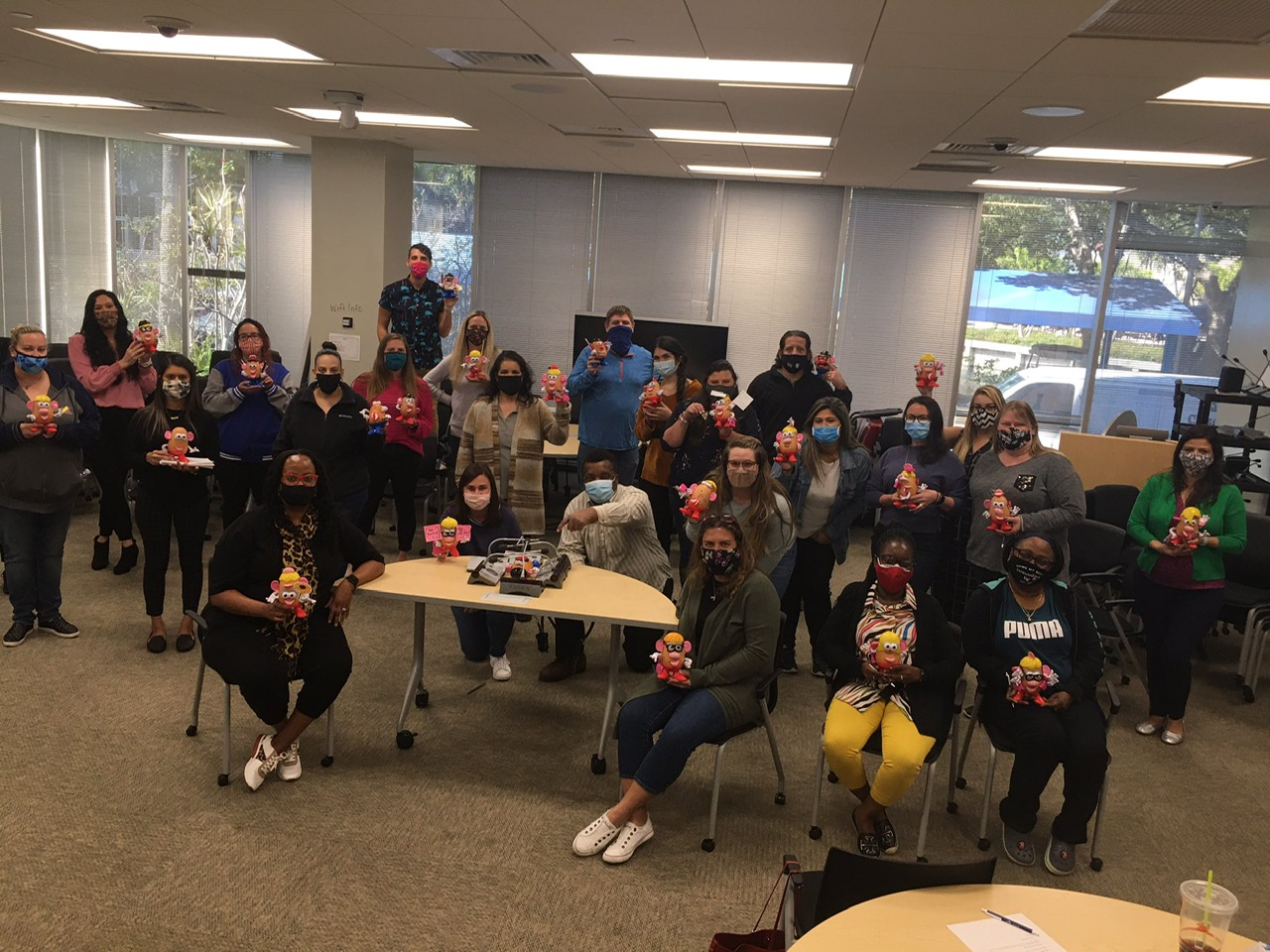
Yesterday, during our south Florida gathering of 3D Leadership participants, we did an activity that I love to do called “Who Am I As A Leader Now?” We use Mr. and Mrs. Potato Heads to do this and participants build their Potato Head to represent themselves, at that moment, as a leader. It becomes such a powerful reflective time. Then, we gathered in a big circle and shared out. All of the share-outs were so meaningful, but one phrase really caught my attention that a participant ended with, represented by a Potato Head arm placed backward, “Somebody did it for me.” This really struck me because it is so true. Everyone has a “somebody did it for me” story. And this fit so nicely with the work we were going to do later around John Maxwell’s 5 Levels of Leadership. Helping others develop into all they can be are those “People Development” and “Pinnacle” levels of great leadership.

It’s always inspiring to be in a room of educators because developing young women and men into all they can be is what we do. We get to provide that “somebody did it for me” story for many. But, let’s not forget that as leaders we have an obligation to be finding ways to provide those “somebody did it for me” stories for those in our organizational communities. It really comes down to being a servant leader. As I listened to all the stories and reasons for the Potato Head designs I was in awe of all the collective expertise in the room. This group of leaders truly wanted to be the best at serving others. Now, as I write this post I am reflecting on those in my life that have been that “somebody that did it for me” person. There have been a lot, and I would even say this group of south Florida educators “did it for me” yesterday. All of this reflection made me go back and reflect on a blog post I did back in 2013 where I reflected on those who had been a servant leader to me along the way and, in some cases, throughout my entire life. Check out my post, Matthew 20:26 on Being A Servant Leader to learn more about my journey and those who have “been there” along the way.
As we try to make some sense in this pandemic stricken world, I, and I believe all the other participants, needed to hear the stories of others – how they got where they are and how they are dealing with all things related to the global pandemic. We really developed a bonded sense of we are in this together, and while we all may be separated by only a few miles, or hundreds of miles we can all be kindred spirits and part of something bigger than ourselves to into great leaders providing “somebody did it for me” moments.
How about you? Who has provided those “somebody did it for me” moments in your life? And, who are you providing “somebody did it for me” moments for?
“I am what I think that you think I am”

“You will become way less concerned with what other people think of you when you realize how seldom they do.”
~ David Foster Wallace
In Chapter 22 entitled “What You Think They Think” of Mindset Mondays with DTK by David Taylor-Klaus (DTK), he told us “…people are generally not thinking of or even about you, they’re generally thinking of themselves” (p. 169). I loved this chapter because it points out something that we all do and all need to stop doing – worrying about what others think. DTK pointed out that we can’t control what others think, and what they think of us is none of our business. And, don’t forget; more than likely they’re not even thinking of you anyway. If we just remember they’re probably not even thinking of us, we can become freed of negative thinking.
“I care not what others think of what I do, but I care very much about what I think of what I do. That is character!”
~ Theodore Roosevelt
We need to worry about measuring up to ourselves, not others. It is an irrational and unproductive obsession to worry about what others think. Sociologist Charles Cooley put it this way: “I am not what I think I am and I am not what you think I am; I am what I think that you think I am.” Part of this is because we are placing undue importance on external validation, so much so that we sometimes place more emphasis on the commendation or disapproval we receive than on our actual actions. We need to do things, say things, and ask things that make sense to us. Let’s not worry about others, but care very much about what we think of what we do.
 Byron's Babbles
leave a comment