Leading By The Courage To See

I finished reading the fourth book in The Five Towers series, The Yellow Tower, by J. B. Simmons, a couple of weeks ago but came across a few more notes I wanted to process from the reading. One of the things Cipher (the protagonist) was told was, “It takes courage to see.” This suggested that seeing beyond the surface requires bravery and introspection. This also implied that truly understanding oneself and the world involves confronting uncomfortable truths, acknowledging vulnerabilities, and facing fears.

This kind of insight often demands stepping outside of our comfort zone and challenging prevailing beliefs or perceptions. By highlighting the need for courage in gaining deeper understanding, Simmons, through Cipher, was emphasizing the transformative power of awareness and the importance of personal growth.

I’m reading The Upside of Disruption: The Path To Leading and Thriving In The Unknown right now and author Terence Mauri explained that courage is not innate and can be developed. In fact, he suggested we can sharpen our courage by listening and eliminating our preconceived notions. In a program I was facilitating a week ago, a school principal made the comment, “We need to listen, even when it hurts.” So true!
Another sentence the same paragraph in The Yellow Tower that I first quoted in this post is, “The Healer shows those who serve the most in Yellow how to heal, and those who lead the most how to see.” By stating that those who serve in Yellow (associated with warmth, optimism, and connection) learn to heal, it suggested that service to others can lead to personal growth and emotional resilience. It implied that through acts of kindness and support, we can foster healing, both for ourselves and those we help.
Furthermore, the idea that leaders learn to “see” indicated that leading with influence involves empathy and awareness. We, as leaders, must look beyond our own perspectives to understand the needs and experiences of others. This kind of insight is vital for fostering teamwork and collaboration.
Service and leadership are enriched by a deeper understanding of human connections, ultimately leading to a more harmonious and effective community.
“Burro”wing In And “Mining” Some History

Yesterday I had the opportunity to spend the morning on Lake Havasu in Arizona. It was absolutely glorious. Lake Havasu is a large reservoir located on the Colorado River, straddling the border between California and Arizona. The lake was created in the 1930s by the construction of the Parker Dam (I’m going there today), it serves as a vital water supply for irrigation and municipal use in the region. Lake Havasu is famous for its recreational opportunities, including boating, fishing, and swimming, making it a popular destination for tourists and outdoor enthusiasts.

The area also features the iconic London Bridge, which was relocated from England by Robert P. McCulloch, who founded Lake Havasu City, adding to the lake’s unique charm and cultural significance. I blogged about the London Bridge in Leading Like McCulloch Moving The London Bridge. Lake Havasu offers one of the most picturesque landscapes I’ve ever experienced.

Just as I thought I had seen it all, I spotted burros along the banks of the lake (see the featured photo this post for the picture I took). In doing some research I found out that these burros are direct descendants of the burros used in the gold and silver mines in the mountains and canyons in the area. When the mines were shut down, the miners liberated the burros and they have thrived here in the wild ever since. Amazing!
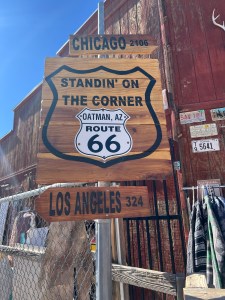
Then I learned of the burros living along Route 66, particularly in Oatman, Arizona. Of course, it was time to make the hour trek up Route 66 to Oatman. Boy am I glad I did. Oatman, Arizona the people, and the burros there are wonderful.

I never would have dreamed I would be taking selfies with descendants of mining burros!

These burros hold a significant place in local history and culture. Here are a few reasons I found are why they are important:
- Historical Background: As I said earlier, the burros are direct descendants of the pack animals used by miners during the gold rush in the early 1900s. When mining declined and ceased all together, the burros were liberated, and they adapted very well to the wild environment.
- Local Symbol: The burros have become a symbol of Oatman and its Old West charm. Their presence contributes to the town’s unique character and attracts tourists, making them an integral part of the local economy. Let me tell you from experience it is UNIQUE! And again, I loved the people, the town, and the burros!
- Wildlife Management: The burros represent a connection to the region’s wildlife heritage. They are now considered part of the local ecosystem, and their management is essential to balance their population and the environment.
- Tourist Attraction: Visitors along Route 66 and to Oatman often enjoy feeding and interacting with the burros, making them a key part of the tourist experience. This interaction helps promote awareness of the town’s history and the importance of conservation.
- Cultural Significance: The burros have been woven into local folklore and stories, enhancing the cultural tapestry of Oatman and reflecting the spirit of the American West.
For me, the burros of Oatman are not just animals; they are iconic representations of the town’s history, tourism, and cultural identity.
Leading Like McCulloch Moving The London Bridge

I am so excited to be in Lake Havasu City, Arizona right now. This has been a place I wanted to come to for quite some time. I wanted to see the London Bridge. At this moment I am looking out my hotel window at the bridge and Lake Havasu. I have always been impressed with the story of Robert P. McCulloch buying the London Bridge and moving it to Lake Havasu City, AZ.

In 1968, American entrepreneur McCulloch purchased the London Bridge, which had been spanning the River Thames since the 19th century, as part of a vision to create a tourist attraction in Lake Havasu City, Arizona. After acquiring the bridge for approximately $2.5 million, he meticulously disassembled it brick by brick, numbering each piece to ensure its reconstruction in the Arizona desert. The bridge was reassembled and opened to the public in 1971, becoming a celebrated landmark that drew tourists and contributed to the economic development of the region. McCulloch’s unique initiative exemplified his belief in creating meaningful attractions that intertwined history with modern life.

This story offers several important lessons for leaders:
- Vision and Innovation: McCulloch had a bold vision of transforming an unremarkable desert town into a tourist destination. Leaders can learn the importance of thinking outside the box and pursuing innovative ideas that may seem unconventional at first.
- Risk-Taking: This project was a significant financial risk. Leaders should recognize that calculated risks can lead to substantial rewards, and embracing uncertainty can often result in groundbreaking outcomes.
- Community Engagement: McCulloch’s decision involved not just a business venture but a commitment to enhancing the community’s identity and economy. Leaders should prioritize engaging with their communities and considering their needs and aspirations in decision-making processes.
- Long-Term Thinking: Moving a historic structure like the London Bridge wasn’t just about immediate gains; it was about creating lasting value for future generations. Leaders can learn the importance of long-term planning and sustainability in their initiatives.
- Marketing and Branding: The bridge became and continues to be to this day a symbol of Lake Havasu City and a major tourist attraction. Leaders can understand the power of branding and how unique projects can enhance a location’s visibility and appeal.
- Cultural Appreciation: By relocating a significant piece of history, McCulloch demonstrated an appreciation for cultural heritage. Leaders should recognize the value of preserving and celebrating heritage as part of their community’s identity.
Tyranny And Power Of The Self

I’m now fully engrossed in the fifth book of J. B. Simmons’ The Five Towers Series, The Black Tower. The Black Tower was really the Purple Tower until evil ambition for power removed all color and it became black. The protagonist, Cipher, spent time learning about the evils of ambition for power without a purpose for good. During a conversation about the strong, even if evil, rising to power in the Black Tower, Jade told Cipher, “Then take power yourself and change it…” Jade smirked at the irony of her words. Cipher then responded, “Maybe I will.” Then Cipher thought to himself, “She’s partly right, but wrong too. It’s what we do with power that matters, not power itself” (p. 147). This is really pretty profound to think about – power itself mattering less than how it is used.
History tells us how true this is with many examples. Throw in unbridled power being driven by selfish ambitions and it is a recipe for disaster. We must recognize, however, that power is always at play in any organization or community. Additionally, power is difficult to observe in action.

The mantra in The Black Tower was “The strong shall rise.” This is purely blind ambition for power – the dark side of power we often see in leaders and organizations: politics and game playing. But…power is the means and mechanism by which we get things done. It is all about how we earn and use the power we have. Power is used best astutely. Power is used best strategically. Power does not need to be used in a visible or explicit way to be effective. Remember, the best use of power is difficult to observe.
Another comment Cipher made was, “I yearned to have power, to create something that changed the world, even if it meant bending others to my will. It was tyranny of the self, not justice” (p. 338). There is so much to unpack here in this quote. The Black Tower gives us examples of power in its narrowest of spheres of influence. Academically this would be called legitimate power. This is positional power of authority. Again, this power has very little influence. As Cipher realized, this is power for power’s sake; or purely ambition and pride. There is no real purpose.
Conversely to positional power we have personal power – referent power. With this power the individual earns the respect and admiration of others. This leadership is driven by purpose rather than ambition. So many times we play power off as a bad thing, but power is what gives us the ability to cause a psychological change in behaviors, beliefs, values, and goals of others. Without purpose, that power is driven by ambition and becomes “tyranny of the self.”
Genius Needs Community

I love it when books I am reading become interrelated without there being an intentional connection of my reading them at the same time. I had read the incredible book The Mythmakers: The Remarkable Fellowship of C.S. Lewis and J.R.R. Tolkien by award winning author, John Hendrix, while reading The Five Towers Series by J. B. Simmons. Interestingly, as is obvious by the title, The Mythmakers is about the relationship between C. S. Lewis and J. R. R. Tolkien and Simmons was heavily influenced by Lewis and Tolkien. Simmons was inspired by hearing The Chronicles of Narnia read to him as a child.

I had the opportunity to be with John Hendrix this week to hear the process behind the creation of his The Mythmakers graphic novel at the Marion E. Wade Center at Wheaton College. Which, by the way, Mythmakers is like nothing you’ve ever read before – it’s brilliant. One of the points Hendrix drove home at the end of his presentation was, “Our work gets better in community.” As he pointed out, without the fellowship of Lewis and Tolkien we don’t get to read about Narnia or Middle-earth. Hendrix stressed that we all need community and our own Inklings.

Then, the next day as I was reading in The Yellow Tower, by J. B. Simmons, Cipher (the protagonist) was told “Genius requires company to truly thrive. I’m sure you have figured out by now that your friends here are no coincidence.” This reemphasized the importance of collaboration and community in the creative process that Hendrix had explained the night before. Then I had the thought that it really was no coincidence that the unlikely friendship of Tolkien and Lewis happened. Think about the unlikely coincidental meeting of others in your own life.

Here are some key takeaways that I had from this idea of genius requiring company:
- Collaboration Enhances Innovation: Genius isn’t just an individual trait; it flourishes when ideas are exchanged and developed through interaction with others. This suggests that diverse perspectives can lead to greater creativity and breakthroughs.
- Support Systems: Genius needing company implied that even the most brilliant minds need support from peers, mentors, or a community to nurture ideas and refine talents. This highlighted the value of relationships and networks in personal and professional growth. I really want to for form my own Inklings!
- Shared Knowledge: Engaging with others allows for the sharing of knowledge and experiences, which can inspire and challenge us to think differently and expand our horizons.
- Encouragement and Motivation: Surrounding ourselves with creative and innovative individuals can provide the encouragement needed to pursue ambitious goals. This support can be crucial in overcoming obstacles and self-doubt.
- Collective Growth: Genius is portrayed as not just an isolated talent but part of a larger tapestry of human endeavor.
This all reinforces the idea that societal progress relies on collaborative efforts rather than individual brilliance alone. The world needs community!
Learning To Grow

Yesterday, I started reading, The Yellow Tower, by J. B. Simmons. This is the fourth book in The Five Towers series and it appears the theme of this tower will be about knowledge and understanding (we’ll see if I’m right). In his first days at the Yellow Tower Cipher is told, “Learn to grow your crop and you do well.” I believe the statement “Learn to grow your crop and you do well” can be interpreted metaphorically. It suggested that mastery of one’s craft or the development of skills is essential for success. Just as a farmer must understand the nuances of agriculture—such as soil, weather conditions, and crop cycles—to yield a good harvest, we must cultivate our talents, knowledge, and emotional well-being to thrive in life. I’m loving the agricultural metaphor.

Cipher’s Yellow Tower conversation reminded me of Candide’s statement at the end of Voltaire’s Candide: “‘All that is very well,’ answered Candide, ‘but let us cultivate our garden’” (Pangloss & Candide). Voltaire’s writing had Candide highlighting the importance of practical action and personal responsibility in the face of life’s challenges. When Candide suggested “let us cultivate our garden,” he was emphasizing the value of focusing on tangible efforts rather than getting lost in philosophical abstractions.
This has also been a through-line throughout The Five Towers series. This theme aligns well with the idea that personal development and community contribution require effort and active participation. Instead of waiting for a better world or relying solely on lofty ideals, Candide and his companions decide to take control of their own destinies through hard work and cultivation. Cipher has also been learning in the towers he has visited so far that having a purpose bigger than ourselves and combining our knowledge and powers is the way to significance.
Using Tolkien’s Leaf By Niggle As A Guide To Living With Significance

This past week I did research at The Marion E. Wade Center at Wheaton College for a book project related to my Scholar In Residence Program at The Kilns. I had the opportunity to sit down and visit with Dr. Jim Beitler, Director of the Wade Center, the Marion E. Wade Chair of Christian Thought, and a Professor of English at Wheaton College. I have gotten to know Dr. Beitler through the Wade Center’s Continuing Scholars Program. He is an amazing individual and I much appreciated his making himself available to me.

When we were done visiting I asked Dr. Beitler to pick something for me to read while here at the Wade Center this week. He almost immediately asked if I had read Leaf By Niggle by J. R. R. Tolkien. I said “No.” He gave me a brief description and later that day I read it. Wow! I really believe Dr. Beitler had gained enough background from our discussion and what I had sent him as background to the project I am working on that he knew I needed to read Leaf By Niggle. This short story was just what I needed to get in the right frame of mind for a few days of research, studying, and writing. Dr. Beitler had served as an Inkling for me. I hope at some point I can be an Inkling for him.

Before digging in any further, let’s examine Tolkien’s genius in picking Niggle for the protagonist’s name. According to Merriam-Webster “niggle” is a verb meaning “1. a. Trifle; b. to spend too much effort on minor details; 2. to find fault constantly in a petty way.” As a noun Merriam-Webster defines “niggle” as: “a trifling doubt, objection, or complaint.” Hopefully, you are not one that finds yourself “niggling” but I am sure we can all relate to falling into this trap at some point.
Leaf By Niggle by J.R.R. Tolkien impacted me with several profound lessons, primarily centered around the themes of purpose, creativity, and the nature of life. Here are some of my key takeaways:
- The Importance of Purpose: The story reflects on the journey of life and the importance of having a purpose. Niggle is an artist who feels compelled to create but is often sidetracked by trivial concerns. I was also reminded that we must control our passion. His journey emphasizes that having a focus and dedication to one’s work can bring fulfillment, even amidst distractions.
- Embracing Imperfection: Niggle’s struggles with completing his painting serve as a metaphor for the larger struggle of life. It highlights that perfection may be unattainable, and it’s important to embrace the process of creation rather than fixate solely on the outcome. The innovation Niggle was creating with his art was serving as a disruptor to society on a great level.
- Selflessness and Service: As Niggle is forced to help his neighbor, he learns the value of selflessness and caring for others. This transformation illustrates how acts of compassion can lead to personal growth and fulfillment.
- The Afterlife and Legacy: The conclusion of the story suggests a vision of the afterlife where one’s true contributions and efforts are recognized. It serves as a reminder that our actions and creations have lasting significance, and they may continue to grow and flourish beyond our immediate understanding.
This last point (#4) about legacy and lasting significance is an important one. I know I wish I would have learned much earlier in life that being significant is much more important than successful. Maybe there needs to be the success (money, accomplishments, position, awards), in order to be in a position of being respected, renowned, and listened to. But we must then know when to examine what we are becoming or have become to become significant in leaving our legacy.
We should not wait for the “journey,” in Niggles case, what I believe was a metaphor for purgatory, but a continual self examination of our lives and the legacy we are leaving. Socrates taught that, “An unexamined life is not worth living.” We need to realize that from the start we are creating significance and a legacy. I believe Tolkien was describing his own writing journey of The Lord of The Rings through Niggle in this story. In contrast to C. S. Lewis who could put his images to paper very quickly, Tolkien was much slower, agonizing over every detail, trying to make it perfect. Neither author, at the time, could have any idea of the legacy they would leave.
Overall, Leaf By Niggle invites reflection on the meaning of creativity, the value of kindness, and the impact we leave behind, encouraging readers to find balance in their pursuits while remaining open to the needs of others.
You’re Enough

I have been researching and writing all week at Wheaton College at the Marion E. Wade Center in Wheaton, Illinois. I’ve been staying in Naperville, Illinois at the Hotel Indigo Naperville, which is the inspiration for this post. This hotel truly understands the customer experience. From checkin to the comping of meals and drinks to preferred parking this place has treated me better than I deserve. This hotel deserves ⭐️⭐️⭐️⭐️⭐️s!

This morning when I walked into Indigo’s Plank Bar & Kitchen the servers who had taken care of me all week already had coffee and tomato juice waiting on me. I asked what they would have done if I had switched to orange juice. They said they would have cried. This is just one example of the customer experience being provided here. It might seem trivial that I am excited about tomato juice and being acknowledge by name (if you recall there was a guy named Norm who thought that was cool), but these are so important to belonging. As a founder of a professional service firm, I understand that the customer experience is no trivial matter.

I was then asked if there would be anyone joining me, or just me like other mornings. I said just me and my server smiled and said, “You’re enough.” With a funny look on my face, I said, “Many would agree with you.” She said, “No. No. I meant that as a positive compliment.” Of course, I had to think about that phrase, which I guess could be taken negatively, but think about being told “You’re enough.” That’s pretty amazing. I found myself reflecting on all the great people in my life who are “enough.”
I get that the phrase “You’re enough” can be interpreted in several meaningful ways. Each of those ways is very personal and carries its own depth and resonance. Here are a few thoughts that come to mind:
- Self-Acceptance: It serves as a reminder that we don’t need to change who we are to be worthy. Embracing our true self—flaws and all—can foster a sense of confidence and contentment.
- Reassurance: In moments of doubt or insecurity, hearing “You’re enough” can be comforting. It reassures us that we are sufficient for the challenges we face and that our efforts have value. We need to remember to give others this same reassurance. Maybe we need to say “You’re enough” more often.
- Limiting Comparisons: This phrase encourages us to stop comparing ourselves to others. Recognizing that everyone has their unique strengths and weaknesses can help alleviate feelings of inadequacy.
- Encouragement for Growth: It suggests that while striving for improvement is valuable, it’s important to acknowledge our current self as worthy. We can pursue growth without feeling that we must first become “more” to be deserving of love and respect. We particularly need to help our young people understand this.
- Emotional Support: This phrase can also come from a place of empathy and support, reminding us that we are valued by others regardless of our accomplishments or failures.
- Mindfulness: It encourages a focus on the present moment. Accepting ourselves as enough can lead to a more mindful approach to life, promoting a sense of peace and gratitude.
- Foundation for Relationships: Recognizing that we are enough can enhance our relationships by allowing us to connect authentically with others, rather than seeking validation through them.
Each interpretation carries profound implications for personal growth and emotional well-being. Did any of these resonate with you? Remember: you’re enough!
Leading With Righteous Resolve

I loved the new season opener of FBI: International last night. I am going to miss Agent Forrester (Luke Kleintank), but as a Chicago P.D. fan I also love the Fly Team’s newest member, Jesse Lee Soffer, as Supervisory Special Agent Wesley “Wes” Mitchell. At the end of the Season 4 premiere, Mitchell told Special Agent Cameron Vo (Vinessa Vidotto) that he loved her “righteous resolve.” He told her to never lose it because it was hard to get back.
This really made me think about what having “righteous resolve” means. I believe it is about having a strong determination to do what is morally right or just, even in the face of challenges or adversity. It embodies a commitment to ethical principles and a conviction to pursue justice, truth, or fairness.
Here are some key aspects of righteous resolve:
- Moral Conviction: It stems from a deep-seated belief in what is right or wrong, guiding us to take action that align with our values.
- Courage: Righteous resolve often requires courage, as standing up for what is right may involve facing opposition, criticism, or personal sacrifice.
- Persistence: It involves a steadfast commitment to pursue goals or ideals, even when the path is difficult or the outcome uncertain.
- Inspiration: Acts of righteous resolve can inspire others to take similar stands, fostering a collective movement towards positive change.
- Social Justice: Often associated with activism, righteous resolve can drive efforts to address social injustices and advocate for the marginalized or oppressed.
FBI: International always reminds me of the complexity of ethical decision-making. Navigating complex moral dilemmas, making choices that reflect our values is not always easy or straightforward. We need reminding that prioritizing ethical considerations over personal safety or career advancement is sometimes where our moral compass points us.
We’ve Got To Develop

“Your résumé is not long enough, but let’s make one tonight.” I don’t know whether this was actually said to a backup quarterback this past weekend, but I heard talk of it. Regardless, I love the thought of this. How many times have individuals been told they just don’t have the experience. I hear this a lot in education. New teachers are told, “we want to hire someone with experience.” I get it; I did it. But as I grew as a leader I realized it was my responsibility to help those just getting started, build their résumé’s.
After one of the postseason major league games this past week, Alex Rodriguez commented, “You’ve got to develop.” This is so true. He was speaking of coaches and players coming up through the ranks and being given the opportunity to grow and develop. Baseball is a great example to look to for this development. The real genius of baseball is the variety of player development systems.
This “farm system” makes use of technology, physical and emotional development, and coaching. It’s really a residency program that is available throughout the career of a player. One of the best examples is when a player is injured, many times they are sent to the Triple A team while rehabbing. I wrote about the great value of this type of system in Leadership Farm Team Pipeline.
It would be great if we did, but we don’t have to be that elaborate. It is all about providing support. Just like the support I offer when mentoring/coaching teachers coming from industry. Who, by the way, become some of the greatest teachers I work with – they are teaching the students about things they have actually done and academic standards they have actually used. Let me tell you, that engages students.

As I was reading The MythMakers: The Remarkable Fellowship of C. S. Lewis and J. R. R. Tolkien this week I was also reminded of the development power of friendship, relationships, and gathering of colleagues for discussion, support and criticism. Author, John Hendrix, said it this way “When the circle of the Inklings was familiar and the fellowship intimate, it suited Tolkien and Lewis well. As leaders of this unruly academic rabble, they were perfect compliments. And their remarkable connection was always the guiding star.” We all need these connections for our own personal growth and development. I
In all likelihood, without The Inklings and the Lewis – Tolkien friendship we might not have ever had The Hobbit, Out of the Silent Planet, The Lord of the Rings, or pondered where Narnia came from. Tolkien, even knowing Lewis’s résumé wasn’t long enough introduced him to his publisher with glowing reviews. Now that’s a literary “farm team.”
We can all use our own form of “farm team” and résumé building. That can come in many forms, but we all need to think about those who need our friendship and support.
 Byron's Babbles
1 comment