Rebuilding with Resilience: Nurturing the Spirit of Hope and Renewal

You ever had your spirit broken by someone, something that happened, or something someone said? Pretty sure we would all answer a resounding “Yes!” to that. I know I have. There might even be things we’ve not got that spirit back from. But it doesn’t have to be that way. I was reminded of something a mentor early in my career told me: “Your spirit can be easily broken, but it can also be repaired.” Noticed, she didn’t say “easily” repaired. Because it is not easy. She was reminding me, however, that resilience and hope are powerful and our spirit can be repaired.
While life’s challenges and setbacks may deeply affect us, they do not have to define us forever. Our spirits have an incredible capacity for healing and growth. We are reminded to stay hopeful, to nurture our inner strength, and to believe in the possibility of recovery and renewal, even after difficult times. No matter how tough things get, there is always potential for rebuilding and becoming stronger than before.
Belonging Versus Fitting In

On Monday of this week I had the opportunity to work with a group of very astute fourth graders. We were discussing what it was like to be a leader as a fourth grader. One of the students said, “There’s a difference between fitting in and belonging. When you’re belonging, you’re feeling like yourself and when you’re fitting in, you might not really be yourself.” I loved this because it is so true. The main difference between belonging and fitting in lies in authenticity and acceptance.
Belonging is about feeling accepted for who we truly are. It means we’re valued and included because of our authentic self—our personality, values, and unique qualities. When we experience belonging, we feel comfortable being ourselves and can develop genuine relationships. I was excited that the students realized this is the kind of environment we must strive to create. We all have a need to belong and we all have an obligation to lead by creating an ethos of belonging.
Fitting in, on the other hand, often involves changing or adjusting ourselves to meet others’ expectations. It’s about conforming to certain norms or standards to be accepted, which might mean hiding parts of yourself or sacrificing your individuality. I always wonder, who created all these social norms we think we need to conform to.
I am proud of these fourth graders for reminding us that creating environments that foster belonging helps us grow, build trust, and form meaningful connections. Conversely, emphasizing fitting in can lead to pressure to conform, which may prevent others from expressing their true selves.
Leading As A Mentor

Last week I had a person who had sat in on some of my past leadership workshops, not as a participant but a passerby and got caught up in what we were doing, tell me he was now using what he learned from me on a daily basis as a leader. I was both honored and intrigued by this. So, I had to ask what he had learned. He told me he was inspired on my insistence that every leader needed to hold those they serve accountable while also inspiring both personal and professional growth. He said, “You taught me that every leader should serve as a mentor and role model to those they serve.” I do believe and teach that every leader should strive to be the best mentor possible.
Leaders should be mentors because they have the experience, knowledge, and perspective to guide others through their professional and personal growth. By serving as mentors, leaders can help develop the skills and confidence of their team members, fostering an environment of continuous learning. Organizations thrive when leaders develop other leaders, not just followers.
Mentorship also builds trust and strong relationships, which can improve collaboration and morale. Ultimately, when leaders invest in their team’s development, it creates a more engaged, capable, and motivated workforce that benefits the entire organization. Team members who feel guided, not just managed, are more loyal and engaged. Mentorship makes leadership complete and more human centered.
Mentorship is the key for leaders to develop other leaders!
Being Kind

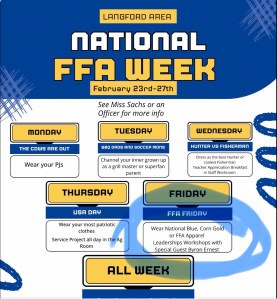
This past week I had the opportunity to be in Langford, South Dakota for National FFA Week. The Langford Area School District FFA Officers had the great idea to provide leadership workshop sessions designed for every grade level in the school. Their amazing agriculture teacher/FFA advisor and National FFA Teacher Ambassador, AnnaMarie Sachs, made the students’ idea a reality. I’m also very proud that the students requested that I be the provider of all these sessions. I’d had the opportunity to work with some of the Langford FFA members at National FFA Convention, so they had experienced my work.

I shared on social media last week that I am always inspired by the leadership dispositions that young people always seem to have for leadership. The Langford students really inspired me. Remember the show Are You Smarter Than A Fifth Grader? Let me tell you, I met some pretty smart fifth graders last week that I wish I could have some adults I know learn from. One fifth grader really impressed me with her Play-Doh creation that was to represent her as a leader. She made the word “Kind,” using a heart to dot the “i” (see photos). Very cool!
I asked her to talk about her creation. She said that she believed she was a leader because she tried to be kind to everyone. She also stated that she believed that if everyone would just practice being kind the world would be a better place. Pretty smart fifth grader, don’t you think? Are you as smart as this fifth grader?
“Be kind whenever possible. It is always possible.” ~ Dalai Lama

As an advocate of loving those we serve as a leadership attribute, this fifth grader made me reflect on what being kind really means. Being kind means genuinely understanding the impact our words and actions have on others. Another word that gets used a lot when defining being kind is “helpful.” I love this because providing help covers so many things. Being kind or helpful is about going that extra mile for others.
Now, taking this discussion a little deeper, I want to describe being kind as a vital leadership attribute because it fosters trust, loyalty, and a positive environment where team members feel valued and respected. Kind leaders are able to build strong relationships, which encourages open communication and collaboration. When leaders show genuine kindness, they inspire others to follow suit, creating a culture of empathy and mutual support. This not only enhances morale but also motivates individuals to perform their best, knowing they are appreciated and understood. Ultimately, kindness in leadership helps cultivate a cohesive and resilient team capable of overcoming challenges together.
Pag-unawa

At the end of March and the first week of April I am going to be in Manila Philippines for the FLUXX 2026 Asia Conference. It will be my first time in the Philippines and I will be delivering the opening keynote. To prepare, as I do for all my work globally, I am studying the Filipino culture. What I am learning is how the culture of the Philippines lends itself to some amazing leadership attributes. For example, the Filipino word “Pag-unawa” translates to “understanding” or “comprehension.” As a leadership attribute, it plays a vital role in fostering effective and empathetic leadership within the Philippine cultural context. Here’s how “Pag-unawa” can be a powerful tool:
- Empathy and Compassion:
Leaders who practice “Pag-unawa” genuinely care about the concerns, feelings, and circumstances of their team members. This empathy builds trust and loyalty, which are highly valued in Filipino culture. - Respect for Hierarchy and Relationships:
In the Philippines, relationships and respect for elders or authority figures are important. “Pag-unawa” encourages leaders to understand the cultural nuances and social dynamics, allowing them to navigate hierarchies respectfully. - Promoting Collaboration:
When leaders demonstrate understanding, they foster a collaborative environment where everyone feels heard and valued. This aligns with the Filipino value of “pakikisama” (smooth interpersonal relationships) and “kapwa” (shared identity). - Conflict Resolution:
An understanding leader can address conflicts diplomatically by appreciating different perspectives and finding harmonious solutions, which is essential in maintaining peace, unity, and an environment of trust. - Cultural Sensitivity:
“Pag-unawa” encourages leaders to appreciate cultural traditions, practices, and values, enabling them to connect more deeply with their community or team. - Developing Unity and Loyalty:
Leaders who show genuine understanding can inspire loyalty and collective effort, reinforcing “bayanihan,” or communal spirit, prevalent in Filipino society.
“Pag-unawa” promotes a compassionate, respectful, and culturally sensitive approach that resonates well within the Philippines’ social fabric. I’m glad I’ve learned this Filipino way of creating an inclusive environment where people feel understood, valued, and motivated to contribute their best.
Seeing Beyond the Surface: Father Brown’s Wisdom on Insight and Perception

People often try to fix something without fully understanding what the real problem is. We may notice symptoms or surface-level details and jump straight to solutions, but unless we identify and understand the core problem—what’s truly causing the difficulty—our efforts might be misguided or ineffective. In G. K. Chesterton’s Father Brown Story “The Point of a Pin,” Father Brown said, “It isn’t that they can’t see the solution. It is that they can’t see the problem.” This highlighted a common mistake in reasoning: focusing on solving the wrong issue.

Father Brown’s insight emphasized the importance of careful analysis and perception, encouraging us to look beyond initial appearances and identify the true nature of a situation before rushing to solve it. In the context of G. K. Chesterton’s stories, it reflected his appreciation for insight, empathy, and the value of perceiving beneath the surface to find truth.
We All Matter

G. K. Chesterton wrote in the Father Brown Story “The Quick One”, “You see, it’s so easy to be misunderstood. All men matter. You matter. I matter. It’s the hardest thing in theology to believe.” Those words made me think about my own value in being human centered and belief that every human matters and has potential. From Chesterton’s words we can learn that misunderstandings are a common part of human experience, and that recognizing everyone’s inherent dignity is crucial.

The quote emphasizes that every individual matters—yourself, others, and even those we might not fully understand—highlighting the importance of empathy and humility. It reminds us that believing in the worth of all people, despite misinterpretations or differences, is a profound challenge but also a vital aspect of moral and spiritual growth. Ultimately, it encourages us to see beyond surface misunderstandings and appreciate the intrinsic value in every person, fostering compassion and deeper connection.
The Agreement Between Agreement and Disagreement
I finished G. K. Chesterton’s Autobiography this past week. It was a great read that prompted a lot of deep thinking and several blog posts. It was interesting to me how Chesterton’s discussions about very specific philosophical or religious doctrines caused me to think about applications in everyday life. One such discussion was about unity and universality. Now, I am not qualified to discuss those differences and similarities, but I found it curious how Chesterton described those with the two views. He said, “The agreement we really want is the agreement between agreement and disagreement. It is the sense that things do really differ, although they are at one” (p. 350). I love this because if you think about it, many issues are that way. We need to find the agreement between agreement and disagreement.

Chesterton used an example of satisfying the unity vs. universality question by quoting Catholic writer, Coventry Patmore: “God is not infinite; He is the synthesis of infinity and boundary” (p. 350). This suggested a nuanced understanding of the divine. Instead of viewing God solely as an endless, boundless infinity, Patmore proposed that God embodies both the limitless and the limited aspects—the infinite and the boundary or limit. It is the nuance of this example I believe we can use as inspiration for approaching many issues – looking for the agreement between agreement and disagreement.
Continuing with Chesterton’s example of Patmore’s view, God’s nature includes not just the vastness and boundlessness associated with infinity but also the presence of boundaries, limits, or structures that define and give shape to that infinity. It emphasized that divinity encompasses both the unbounded and the bounded, integrating the infinite nature of God with specific identities, attributes, or boundaries that make the divine comprehensible and relatable.
This is such a perfect example of the nuanced nature of many disagreements because it highlights the idea that God’s greatness isn’t just about boundless infinity but also includes the necessary boundaries that give meaning, structure, and harmony to that infinity. It’s a philosophical perspective that seeks to balance the concept of the divine as both grand and personal, limitless yet defined.
Beyond the Mirror: G.K. Chesterton’s Wisdom on Vanity and True Self-Understanding

In the Father Brown story “The Chief Mourner of Marne”, G. K. Chesterton described the character of Maurice Mair saying, “He was far more friendly and popular; but his success had made him live in a house of mirrors” (p. 313). This is a very apt metaphor to illustrate how success can distort a person’s perception of themselves and reality. Chesterton often used vivid imagery and metaphors like this to critique vanity, ego, or superficial values that can accompany success. It suggested that success, if not tempered with humility or clarity, can trap a person in a distorted self-image, preventing genuine self-awareness or growth.

In a house of mirrors, reflections are repeated endlessly, often distorting or exaggerating features, making it difficult to see the true form or substance. Similarly, when someone becomes very successful, they might become obsessed with their own image, achievements, or perceptions, leading them to lose touch with reality or become self-absorbed. They might see only flattering reflections of themselves, rather than their authentic self, which can distort their understanding of who they really are. We must always look beyond the mirrors and see our true self.
Leading With Humility
I know the following is a long quote from G. K. Chesterton’s Autobiography, but I hope you will read it because it is profound. Here it goes:
“Anyhow, it is true that both the happy hedonists and the unhappy pessimists were stiffened by the opposite principle of pride. The pessimist was proud of pessimism, because he thought nothing good enough for him; the optimist was proud of optimism, because he thought nothing was bad enough to prevent him from getting good out of it. There were valuable men of both these types; there were men with many virtues; but they not only did not possess the virtue I was thinking of, but they never thought of it. They would decide that life was no good, or that it had a great deal of good; but they were not in touch with this particular notion, of having a great deal of gratitude even for a very little good. And as I began to believe more and more that the clue was to be found in such a principle, even if it was a paradox, I was more and more disposed to seek out those who specialised in humility, though for them it was the door of heaven and for me the door of earth” (p. 346).
Did you catch that humility was the door of heaven and the door of earth to Chesterton? I love this paradox and believe the virtue of the paradox is both!
Chesterton was reflecting on a deep appreciation for humility and the recognition of its true value. When he says he was “more and more disposed to seek out those who specialised in humility,” he suggested that he admired people who practiced humility, perhaps seeing it as a virtue that opens the door to higher understanding or spiritual fulfillment (“the door of heaven”).
At the same time, he contrasted this with his own perspective—“for me the door of earth”—implying that, for himself, humility is more grounded, humble, and connected to the real, tangible experiences of everyday life (“earth”). Essentially, Chesterton was acknowledging that humility is a universal virtue—one that can lead to spiritual heights—but also recognizing his personal connection to it as something rooted in the practical and the earthly realm. That’s what I have come to love about Chesterton – he was able to combine the practical of everyday life with the spiritual. Let’s face it; that is what we all have to do every day.
In sum, the quote highlights the difference between aspiring towards spiritual ideals and maintaining a humble, grounded view of oneself in everyday life. A really great leadership lesson!
 Byron's Babbles
leave a comment