Distress Patterns
 “Unfortunately, you don’t just have people on your staff; you also have distress patterns. The art of managing people includes the challenge of managing their distress patterns; people are very different from their distress patterns.” This statement by Dorothy Stoneman, President, YouthBuild USA is so true. Leading a school staff or any other group involves managing irrational distress patterns in other people, stress in yourself, and attacks on you. Being mindful of these distress patterns will enable you, as a leader, to navigate your organization.
I am a major believer in the power of context. With distress patterns, context certainly matters. Everyone experiences negative and positive feelings. The tendency to respond to a certain type of situation with a specific emotion, the intensity of our emotional responses, the ways in which we express our feelings, the balance between positive and negative feelings, and the duration of a particular emotion are all characteristic of each person as an individual. People differ, then, in regard to the inner experience (feeling) and in the outward experience (behavior) of emotions. I am learning how important understanding these distress patterns is. We all have behavior patterns and attitudes rooted in painful past experiences.
Sometimes these distress patterns undermine our ability to lead or function as a team. You can tell a distress pattern when you see one because it is behavior that is repetitive, that occurs whether or not it is appropriate for the situation, whether or not it achieves positive goals, whether or not it hurts other people or oneself. It is not flexible; it almost always occurs under certain circumstances. What we have to realize as leaders is that behind every distress pattern is a past experience that causes a repetitive or unproductive behavior develop. What I learned from Dorothy Stoneman is, “it is always useful to separate people from patterns, never blaming people for patterns they happen to have, always relating to the people rather than the patterns.” Remember, these patterns come from their past personal and professional experiences.
As turnaround school leader I have experienced these distress patterns related to the culture of the organizations. Lack of trust, self serving leadership patterns, divisiveness. personal attacks or other negative behavioral patterns can be major detriments to developing a positive environment. Sometimes leaders are criticized not based on the decisions made, but on the distress patterns experienced in the past. Fair and unfair criticism, including attacks, will come to anyone who takes the visible leadership in any situation. It’s part of the territory. We need to stand up for anyone willing to take, in good faith, for good purposes, the stress of being in charge.
Informational Vs. Transformational Learning
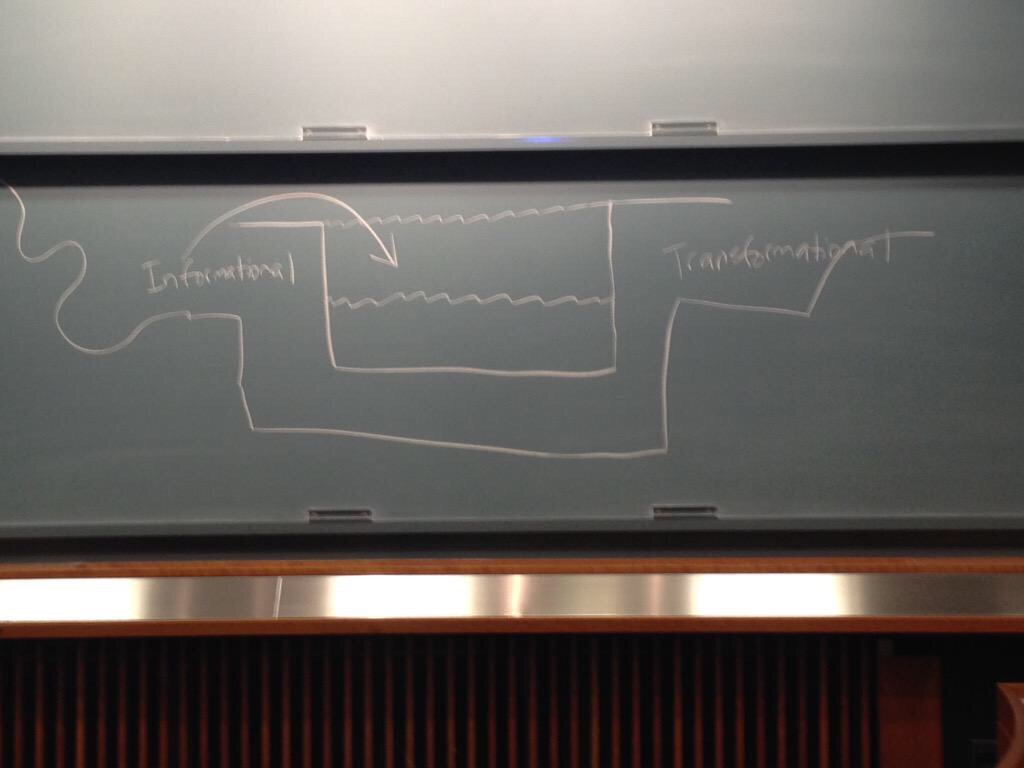 I was so impressed by the closing comments of Joseph Zolner today to conclude our learning at the Inner Strengths of Successful Leaders program at Harvard University. Joseph Zolner is Lecturer on Education and Senior Director of the Harvard Institutes for Higher Education at the Harvard Graduate School of Education. To conclude he drew a vessel on the board (see photo insert) and told us this was the vessel of the mind.
Joseph then proceeded to tell us there were two types of learning: informational and transformational. The first type is that which we use as a lower level form of learning. We are just gaining new information. In other words, informational learning will only fill our vessels so full. We need the second type of learning, transformational, in order to stretch our learning. The unique quality of human beings is our ability to think flexibly about new situations, comparing them intelligently to all past experiences, and then to do something that is uniquely appro- priate, bringing about desired objectives.
Transformational learning provides us with new ways of thinking. This can actually change the form of the vessel of the mind. In fact this new stretch, and extending of our thinking actually give us more room in the vessel of our mind for greater and more magnificent thinking. Think about the student who says to their teacher: ” I was confused before you started…Now I am confused at a higher level.” We need, as lifelong adult professional learner, to stay appropriately confused!
Don’t forget to add some transformational learning opportunities to your professional growth plan.
Values In Action: Viva VIA!
 Yesterday at Harvard University I had the opportunity to learn from and work with Jerry Murphy, former Dean of the Harvard Graduate School of Education. He is doing exciting work around the idea of ‘Dancing In The Rain.’ His idea is he wants us to flourish as a leader. The ‘Dancing In The Rain’ metaphor comes from wanting us, as leaders, to have an upbeat and realistic way of living in stressful times. I have actually played in the rain and I can tell you it is an upbeat experience. Jerry is currently writing a book on this and I cannot wait till it is published. Trust me, it will be a must read!
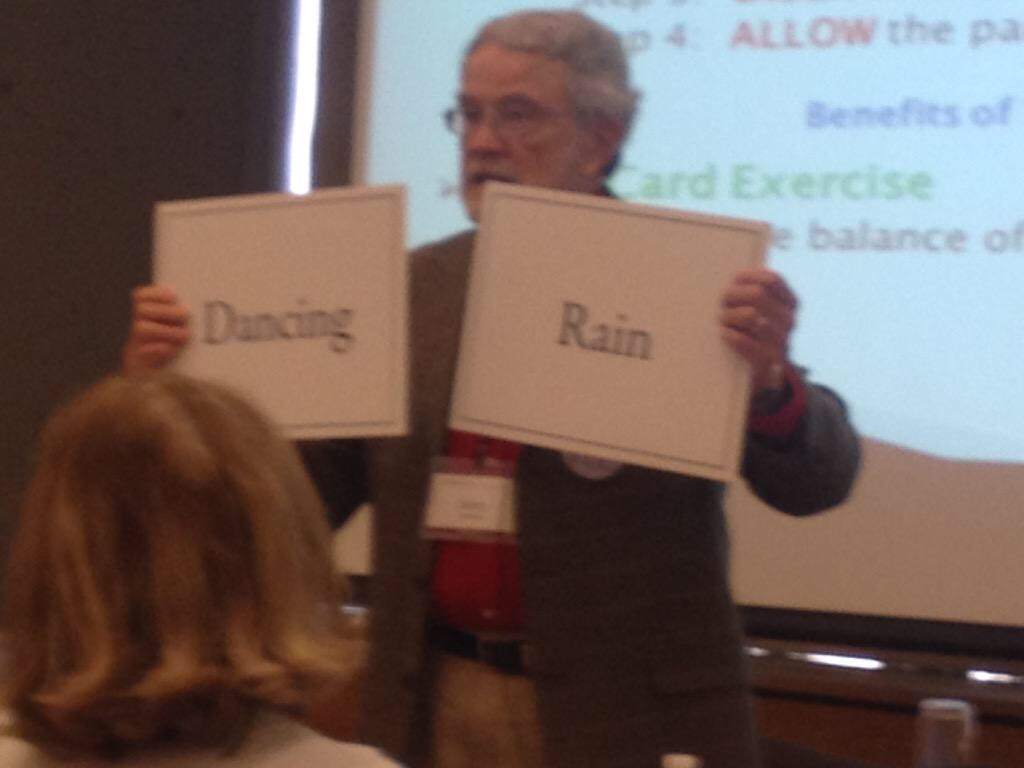 Jerry Murphy has developed a framework called ‘MY DANCE.’ Without going into much detail in this post, I would like to just share the framework.
MY DANCE FRAMEWORK:
Step 1: M – Do what MATTERS
Step 2: Y – Say YES to here and now
Step 3: D – DISENTANGLE from upsets
Step 4: A – ALLOW the pain life brings
Step 5: N – NOURISH myself
Step 6: C – Practice Self-COMPASSION
Step 7: E – EXPRESS feelings wisely
This post is really about Step 1: M – Do what MATTERS. It is the idea that what really matters are your core values. We cannot let our circumstances or discomforts that are thrown our way hijack us from what is important to us. During our time with Jerry Murphy he had us do an exercise called, ‘The Retirement Party.’ For this exercise you first imagine yourself retiring and you are attending your retirement party. Secondly, you spend a few minutes writing down four or five things that you like for people to say about your values as a trustworthy leader.
As you can imagine this exercise caused a great deal of reflection for me. I would like to share my points that I would want people to be able to say about me. Here are the four I cam up with:
1. Byron is just the kind of guy you are glad he is your friend and he has added value to your life because he has helped you grow.
2. Byron pulled me and enabled me to get to the places in my life I wanted to be. He has helped me be all I can be.
3. Byron certainly ‘Walked the Talk.’
4. Byron was able to bend in the breeze and navigate difficulties.
5. Byron was a lifelong learner.
This is not an easy exercise because sometimes you have to discover your values instead of just pulling them out of the air.
Then came the most powerful part of the exercise. He had us pick one of the statements that we wrote and think about if we were really doing and acting on that value. Then, we were to develop and action plan to truly carry out that value for everyone I serve as a leader and translate the value into action. Jerry call this Viva VIA! VIA – Values In Action. In fact he created buttons that he gave each of us. I have included a picture of the button here in this post.
My action step was for value number two: Make sure I do all I can for every staff member I serve according to their goals and professional growth plan. Sometimes it is easy to work with just a few, particularly those who are most aggressive with their own personal professional growth plans. I need to make sure and collaboratively identify those areas where the faculty I serve need to be pulled up to reach the goals they desire. This exercise really reminded me to lead my life shaped by what matters most to me. In other words what make me come alive and inspires me to lift those up which I serve.
We must remember that our values give meaning, purpose, and resolve to everything we do. As leaders, we must have a commitment to take action, even when it hurts. No matter how big the storm, the sky is big enough to handle it. Much like our storms as a leader, we must be big enough to handle them.
Bending In The Breeze: Being A Mindful Leader
 Today, while learning to be a more mindful leaders while at Harvard we did a meditation exercise looking out the window. This exercise was done in the Gutman Library at the Harvard Graduate School of Education during a session of Inner Strengths of Successful Leaders. I looked out and saw the tree that I have included a picture of in this post. It was a little windy out and the tree was gently bending in the breeze. It made me think about how as mindful leaders we must bend as the winds of difficulties blow in our everyday lives. I have seen wind break a tree that does not bend while leaving others that bend untouched.. After every windstorm there are broken branches scattered everywhere. I think, just like a tree we have a choice to either bend or break, or duck behind a windscreen.
While I agree with the observations regarding flexibility, resilence, and being adaptable. There is a fact that everyone must recognize. The tree that is highly flexible must also be rooted deeply or in a forest where the root systems intertwine and provide additional strength. A high rise building that moves up to 9 meters at the top requires a very strong foundation. A person who can bend with the circumstances must have core values and mindsets that are deeply rooted. Sometimes we need to take our mind for a walk, which was the whole purpose of the meditation at the window. We need to be aware of those things that are serving us well.
When we have difficult meetings, phone calls with difficult people, or are thrown difficult circumstances (which we will be) we need to take a mindful moment. In this mindful moment we are bending like the tree in the breeze. We need to be aware, take a moment to breathe, and show some compassion for ourselves. Also, in difficult situations we must recall what matters most to us as leaders. Another great leadership skill to remember is that when you feel the impulse to explain, LISTEN! Remember, act out of your values.
Furthermore, don’t try to get rid of difficulties, but build a bigger playing field so your values can be brought to the forefront. The leadership reality is that we will get overwhelmed. When thrown, we need to ratchet down the reaction just like the tree bends in the breeze. When thrown, our bend will be listening, looking inside to explore patterns and identify where we might be wrong, and take responsibility.
Finally, mindful leaders are poised. When we practice mindfulness we are able to bend with difficulties because of our presence and clarity to know what is happening. A great quote is, “What you resist persists.” Think about it; if the tree resists the wind and does not bend, it will break.
 Byron's Babbles
1 comment