Getting Nowhere!
 I learned about a creature that I didn’t know much about in Lesson #9 of 52 Leadership Lessons: Timeless Stories For The Modern Leader by John Parker Stewart. The lesson used the analogy of the Processionary Caterpillar. You know how I love analogies and this one is a good one for what happens in all organizations at some time or another. These cool little creatures feed on pine needles. The interesting part is, though, that they travel like a train with their eyes half shut, head to tail fitted right against each other. So, wherever the first one goes (let’s call her the leader) the others go blindly. Are you getting the analogy here? According to the lesson, you can place them in a circle and it can take up to 10 hours for them to realize they are going nowhere. Again, are you catching the powerful analogy?
“Don’t become processionary. Question the status quo. Work smarter, not harder.” ~ John Parker Stewart
We all have become Processionary Caterpillars at some time or another. Either as the 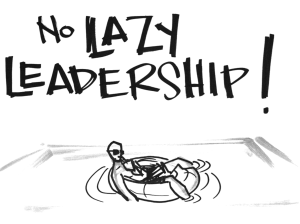 leader, or one of the followers. This is something I have called Lazy Leadership. You can read about it here. The big thing to keep in mind here is to avoid blindly, without question, performing tasks the “way it has always been done,” with no regard on how to improve or change for the betterment of the organization. I actually was discussing this last night at one of our family events after I had spoken to some of our teachers about ways to improve some processes. Our teachers are very talented and knowledgeable, and we need to continue to find ways to tap into that knowledge gained. We can then take that knowledge and improve as a learning organization.
 If we find ourselves resembling the Processionary Caterpillar more than we would first think or want we need to make adjustments. If you fear that you share some of the style of the Processionary Caterpillar, here are some questions Stewart suggested to ask:
- Why are we doing this?
- Don’t answer with, “That’s the way we have always done it.”
- Don’t ever do something because, “We’ve always done it that way.”
We need to avoid mistaking activity for accomplishment. We do not want to act like the Processionary Caterpillar. We possess an intelligence that enables us to be different from all the lower forms of life. Be all you can be by learning from the pitiful Processionary Caterpillar. My takeaway is that we need to assume there is always a better way. That does not mean we redo everything, or we would never get anything done, but we do need to question the status quo. Remember, if better is possible then good is not enough.
Everyone is Watching!
 One of my leadership heroes, John Wooden, was a great coach and an amazing person of true character. One of many of his quotes was:
“The true test of a man’s character is what he does when no one is watching.” ~ John Wooden
While I totally agree with this quote, I also believe that leaders need to remember that everyone is watching as decisions are being made. This past week I have had several situations happen where I have had to make decisions and take action knowing that everyone is watching. Honestly, I was was very aware that everyone was watching and was actually taking this into account. It seems to me that a leader’s character and core values are tested most when EVERYONE is watching and it is in that environment that many leaders fail the test of true character and walking the walk. I wish Coach Wooden was still alive to ask him if: Perhaps character and great leadership is better defined by what you do when everyone is watching, just as much as it is when no one is watching?
Whether we know it or not, people are paying attention. The way we act today, influences how we all act tomorrow. And those actions influence others – whether they know it or not. Whether we’ve chosen to recognize it yet or not, we are an example to others by the actions we take and decisions we make – for ourselves and those around us. Either of how to act or how not to, or how we walk the talk of what we say we believe in. In this sense we are all leaders and you know I believe everyone is a leader. Every choice we make, big and small, is a chance to lead. We are either an example of high standards and what’s possible, or another contributor to the complacency. I have been preaching, for example, in our schools that we must tighten the ship and make every decision based on what is best for students. Therefore, my decisions this week have had to be with this in mind, knowing everyone is watching and using the metric of, “Is he tightening the ship?” Remembering this unavoidable principle has always helped make decisions quite clear for me. If my actions (or inactions) aren’t something I’d want those I lead to take, then they probably aren’t what I need to take.
We must even pursue the decisions and actions we cannot make or do today because this makes it a lot more likely to pursue it tomorrow. And as others notice, it enables them to do the same. Remember, everyone is watching. We must realize that we all are a personal example of what’s possible to someone, or a whole group of someones – however small and subtle those decisions and actions might be on a day-to-day basis. They add up. And to be that same example for those around us. For the people you might not realize are watching… because someone and everyone always are.
My actions and your actions are training ourselves and others. Are we living up to our organization’s vision, mission, and core values? Are we living up to our own personal core values? Everyone is watching! What will they see us do next?
Work Like a MacBook
 I catch myself saying, “We need to work more like a MacBook” all the time. I am such a believer in the streamlined and simple approach that Steve Jobs gave the world when designing Apple™ products. It is the same surface level simplicity with back-end oomph (OS) that I want for the schools that I lead. To me a streamlined process means fewer errors and delays. I touched on this some in my 2012 post Lead “Like a MacBook Pro.” Click here to read that post. In that post, the comment is made, “With a Mac what used to take three or four steps with a pc will only take a single step with the Mac!” That’s really how I believe everything should run in an organization.
So, why would we not want the organizations we lead to have all the features I believe Apple™ products bring to the table? Here are a few of the top ones:
- Easy/automatic integration between devices (iPhone, iPad, MacBook)
- Streamlined, single step processes
- Home/individual content creation is excellent (iMovie and Garage Band specifically)
- Joyful buying experience and after sales care
- Very high build quality, premium materials and components, and generally great customer service when an error does occur
Think about it. If we achieved these things in the organizations we lead, there could not help but be great things happening.
It gives me great angst when there are times when the process involves one person doing something or collecting information only to pass that information to someone else to enter somewhere else – Why do we do this to ourselves? Many work processes are developed on an ad hoc basis out of necessity and become the standard model for getting work done. In many cases, there is already collective wisdom within your organization on how to improve the work flow, but it is extremely difficult for any one person to make a change in a work process without the opinions and involvement of other employees and leaders. Great leaders request input about streamlining efforts from anyone in the work-flow chain. Seek their opinions about how to improve efficiency.
One thing that I try to pay close attention to is how employees improve their own part of the process. Many times people will naturally streamline their own portions of a work flow, simply to defeat tedium. This is not a bad thing, but sometimes this streamline for an individual causes extra processes somewhere else. Rule of thumb: Aim to make the work flow efficient, but not your people. This will in turn create efficiency for the organization and ultimately all of those you lead and not just a select few. Implementing streamlined work flow improvements, starting with the obvious low-hanging fruit that is a usual part of any work flow process is a great place to start.
Take a look at the processes, reporting protocols, and all the work your people and organizations do and see if there are ways you can streamline like a MacBook to a single step instead of two or three.
Career Readiness for All?
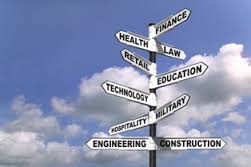 I had the privilege of meeting and hearing from Dr. Nancy Hoffman of Jobs for the Future yesterday at our fourth Panel to Study Alternatives to the ISTEP+ Program Test. Our objective of having Dr. Hoffman was to discuss how we assess career readiness under the Every Student Succeeds Act (ESSA). I really saw a great deal of the value in the information she was presenting to us and wanted to share. Here are some facts she started with:
- The unemployment rate among Hoosiers age 16 to 19 year old is about 15%.
- Missing out on jobs during the late tees can have negative effects throughout a person’s working life.
- A young person who doesn’t get work experience between 16 and 19 is missing a major developmental experience.
- The economy suffers because of the above bullet points.
I was also struck by the idea of disconnected youth: those who are not in school or working – “have lower wages and marriage rates, higher incarceration and unemployment rates, worse health, less job satisfaction, and eve less happiness as adults than people who did not experience youth disconnection. Just as early successes breed optimism, early setbacks plant the seeds of hopelessness.”
“It’s not just about young people: The economy needs prepared young people.” ~ Dr. Nancy Hoffman
- Far too many young people complete a postsecondary degree/credential.
- STEM fields hold promise; employers struggle to find skilled employees.
- High school is not working for far too many young people
- Careers increasingly require postsecondary education and work readiness skills and experience.
- Education workforce, and economic development are inextricably connected.
“In my utopia, all high school students would have a structured work experience – just as 70% of young people do in Switzerland.” ~ Dr. Nancy Hoffman
Indiana is ahead of most states in having a law requiring career readiness activities starting in elementary school. Indiana has a career readiness definition which includes all students. Additionally, Indiana has career exploration courses. We provide Career and Technical Education (CTE) dual enrollment and we have strong CTE results.
Here are some questions that states need to be asking and addressing:
- What is the state’s definition of career readiness?
- Does the state want to focus on all students or exclusively CTE students?
- Are college and career preparation the same or different?
- How should various options be valued and weighed?
Too Tall Leadership

Leadership, an act or series of acts that moves people in a certain direction can no longer be displayed by a lone giant or heroic individual. As you know I believe that leadership can come from anyone who displays leadership as an occasional, discrete act of influence, anywhere and at anytime necessary. Yes, a leader must provide direction, but the person at the so-called ‘top’ isn’t the only person who can provide it. More importantly, this is not the only person that should be providing it.
 Many times, and wrongly I might add, we consider that the ideal leader has vision, charisma, integrity, emotional intelligence, an inspiring delivery and sterling character. But if there are leaders who don’t fit this image, then we cannot use our ideal to define leadership in general. Too many times we make leaders out to be giants. Providing direction is still a core role of leadership. However, leaders can provide only a portion of it. Leadership can also be provided by all employees, where its meaning shifts from deciding new directions to influencing others to accept a new direction.
In this week’s entry, Lesson #8, titled “Two Friends and a Giant” in 52 Leadership Lessons: Timeless Stories For The Modern Leader by John Parker Stewart the topic was the large Sequoia Redwood trees. The story was about the Chickaree and the Wood Boring Beetle. Both use the Sequoia cones as food sources and this allows new trees to grow. In other words the big giants need others to step up and be part of carrying on the species. It takes the team to make this all work.
“As soon as you are too tall to let a small one help you, you are doomed to extinction.” ~ John Parker Stewart
Leadership does not have to happen from giants at the top. Leadership shown by outsiders or bottom-up does not entail occupying a particular role, being a certain type of person, or using positional authority to make decisions. It means creating an environment where everyone is a leader. When, what I call a ‘street level’ innovator, promotes a new product to management, leadership is shown bottom-up. I believe that information should flow up as opposed to the other way around. Decisions need to be made as close to ‘street level’ as possible. We need to find direction regardless of its origin. Everyone is a leader, so anyone with a better idea can influence change.
The Leadership Tower: A Classic Jenga Model
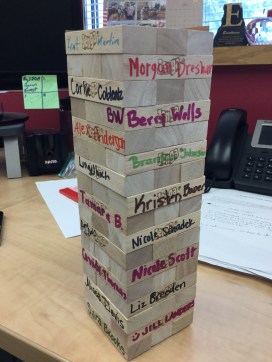 I recently got a very cool gift from a group of Hoosier Academies Network of School’s teachers. The teachers took Jenga® pieces, signed them, and then glued the tower together. This was such an appropriate and appreciated gift because of how much we use the Jenga® theme, and the fact that they built something to give to me. For those that know me well, know that I am a believer in creating models and building when do professional growth activities. In other words, I strive not to use technology and presentations. I was deeply moved by the gesture and have picked a special place in my office for this.
You all know what Jenga® is, right? That’s the game where you start with 54 wooden pieces stacked in 18 alternating rows creating a stable tower. Every move from that point on destabilizes the tower as pieces are removed from inside the structure to place them on top growing it taller and taller until it eventually topples. Many times when we play we just pull pieces till someone (the loser) makes the tower fall. As I looked at the tower I had been given, I thought about the powerful metaphor Jenga® is as a leadership model. I have blogged about it before in Jenga Masters Leadership. Click here to read the post. This time as I was viewing the tower I thought of a new aspect. I viewed the tower as a model of change and strategy decisions.

As a leader, are you building towards a cohesive vision for the future of your organization? Or, are you just pulling blocks out and placing on top of the tower, hoping the structure does not topple over?
Being A Multiplier
 Lesson #7 in 52 Leadership Lessons: Timeless Stories For The Modern Leader by John Parker Stewart was titled “Chains and Ribbons.” It was the story about how circuses used to restrain elephants by putting a chain on their leg attached to a stake at a very young age when the chain and stake would actually restrain them. An adult elephant could easily pull up the stake, but he has been conditioned that he can’t. In other words he had been conditioned to the restraint. This can happen to those we lead too. If we chain our people down, they get used to the restraint and then their innovation, creativity, collaboration, and self-motivation go away.
Employees who don’t self-start, make decisions on their own, give input, get feedback, and grow as people with purpose, eventually suffocate under micro-management and lose the will to contribute meaningfully. Top-down bosses are notorious for killing intrinsic motivation. Then, good employees are turned into order takers. These same employees then tend not to exercise one of the better traits that we want in those we lead – being a self-starter. Great leaders are present and in the moment. They don’t need to talk over others to get their point across.
Great leaders care less about flaunting their own IQs and more about fostering a culture of intelligence in their organizations. Under this type of empowering leadership these leaders become “multipliers.” Employees don’t just feel smarter, they become smarter. I believe in shifting the responsibility for thinking from myself to those I lead. As a multiplier I work at taking the time to understand the capabilities of each individual I lead so that I can connect employees with the right people, the right opportunities, and hyper personalize their personal growth. This enables an organization to build a virtuous cycle of attraction, growth, and opportunity.
Are you restraining those you lead? How can you empower your people to collaborate in a culture of excellence that encourages dissent, growth, innovation, and creativity? Go out and be a multiplier by explicitly giving people permission to think, speak, and act with reason.
My New Leadership Talent: Spinning Plates!
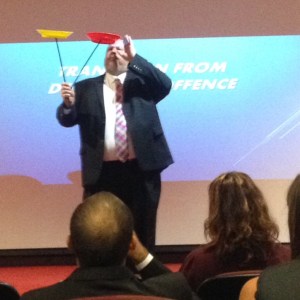 Coming to grips with the multiple parts to any organization is invaluable for leaders trying to keep their people and priorities in balance at a time when cultural and leadership change sometimes seems an existential imperative. Just as a circus performer deftly spins plates or bowls to keep them moving and upright, so must leaders constantly intervene to encourage the sorts of behavior that align an organization with its top priorities. Masters in this circus manipulation art can barely keep 100 plates spinning at a time. How many plates can any harried player-manager handle? Typically, less than a dozen.
Today, for the first time in my life I did a plate spinning act for our entire school staff. I had been using the metaphor for a few months now because of all of the things we have going on. In fact, I would many times just make a motion like I was spinning a plate. Therefore, I decided in my opening session that I would spin plates. For being my first time it went very well – I think. I even used the act introduce our newest administrators by passing them a poll with a spinning plate as an act of passing the torch, so to speak. The plates really represent all the facets, initiatives, paradoxes, parts of an organization a leader must be focused on. Spend to much time on one plate and the others fall. Left too long without attention, they run out of energy, start spinning out of control, and may come crashing to the floor. Personal development, coaching, performance management, addressing team dynamics, and reinforcing objectives are all forms of plate spinning. The leader must find the exact right balance.
Embracing the paradoxes can be uncomfortable. Yet the act of trying to reconcile these tensions helps leaders keep their eyes on all their spinning plates and identify when interventions are needed to keep the organization lined up with its top priorities. I believe approaching leadership much like plate spinning makes it possible to avoid the frustration of many leaders I’ve witnessed, who pick the extremes by either trying to stifle complex behavior by building powerful and rigid top-down structures, or by looser, more laissez-faire styles of management that expose the messy realities of human endeavor. Far more centered and high performing, in my experience, are those leaders who welcome the inconvenient contradictions of organizational life.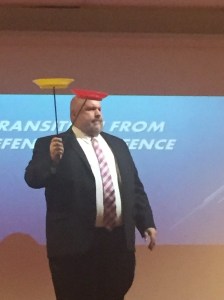
This is why I am such a believer in engagement and empowerment of everyone on the team. With an intent-based leadership philosophy where everyone is a leader, all individuals have a role in keeping the plates spinning. Empowerment is fundamentally an individualized equation, or what I call hyper-personalized. What might make one employee engaged might turn off the next person – we, as leaders, must be able to read these turn-ons and turn-offs. There are many variables that can impact any one person’s engagement, and the mix is individually unique. You can’t just become a better plate spinner. You have to find ways to keep the plates spinning on their own.
Indiana Assessment Vision
 Yesterday, we had our third legislative panel meeting studying alternatives to the ISTEP Program Test. This is part of our working toward the assessment plan under the Every Student Succeeds Act (ESSA) for Indiana. One of the things we worked on yesterday was the vision statement of the group. Using suggestions from panel members, the panel legislative staff came up with the following draft statement:
“Indiana looks to design an assessment system that is student-centered and provides meaningful and timely information to educators and parents on both a student’s on-grade proficiency level and growth toward Indiana’s College and Career Ready standards. The assessment needs to be viable, reliable, research-based, and meet the requirements of both state and federal law, while meeting the needs of all students across Indiana.”
Now, being the vision guru I am, I immediately realized it did not meet the 35 words or less rule of thumb. I did, however, quickly underline what I thought were the most important parts of the vision statement that our panel needed to do to meet the needs of our students, families, and schools (I have underlined above). Here are the points:
- student-centered
- meaningful
- timely
- information to educators and parents
- on-grade proficiency level and growth
I suggested we eliminate the last sentence, “The assessment needs to be viable, reliable, research-based, and meet the requirements of both state and federal law, while meeting the needs of all students across Indiana.” because I do not believe it is at all visionary to be valid, reliable, researched based and meeting the letter of the law. We have that obligation to Indiana and the federal government through ESSA. We don’t need a vision for that.
So, my proposed vision statement would be:
“Indiana looks to design an assessment system that is student-centered* and provides meaningful and timely information to educators and parents on both a student’s on-grade proficiency level and growth toward Indiana’s College and Career Ready standards.”
You will notice the * with student-centered. I believe we should have a definition for student-centered following the vision statement. For me, that definition could be:
*A Student-centered assessment system, which includes student performance, academic growth, and multiple measures, sets challenging items and tasks that are intended to encourage deep learning and create a sense of high expectations and mutual accountability.
Then, I believe it is even more important to develop a set of belief statements associated to this process. I took pieces from what individuals submitted as vision statements to make a list of possible belief statements. I really believe that many of what panel members submitted were belief statements, not vision statements. This was a good things because we should have belief statements guiding our work.
Here is the list I came up with:
- New assessment must be implemented with fidelity
- Timely results
- Empowers students, parents, educators, and administrators
- Includes college and career readiness metric
- Meets the needs of all students
- Cost effective
- Accurately assesses students’ learning and growth over time
- Takes less time away from instruction and learning
- Equity for all students in how they take the assessment (technology/modality)
So, put all together, here’s what my draft would look like:
“Indiana looks to design an assessment system that is student-centered* and provides meaningful and timely information to educators and parents on both a student’s on-grade proficiency level and growth toward Indiana’s College and Career Ready standards.”
*A Student-centered assessment system, which includes student performance, academic growth, and multiple measures, sets challenging items and tasks that are intended to encourage deep learning and create a sense of high expectations and mutual accountability.
Indiana’s new assessment system must:
- be implemented with fidelity.
- provide timely results.
- empower students, parents, educators, and administrators.
- include college and career readiness metric.
- meets the needs of all students.
- be cost effective.
- accurately assesses students’ learning and growth over time.
- take less time away from instruction and learning.
- provide equity for all students in how they take the assessment (technology/modality).
Because ESSA requires us to have a summative assessment in grades 3-8 and a high school component our conversation must shift from all the chatter about whether wanting to test or not or whether it is right to test. Really, that is irrelevant. What is important is that we make sure all of our stakeholders understand “why” assessment is happening and exactly how the data will be used. I believe we are on the right track to developing a vision and belief statements that can drive this work. I would love to hear feedback on additional belief statements or edits to make the belief statement suggestions better.
Leaders As Non-Conformists
 This morning I just started reading the incredible book, Originals: How Non-Conformists Move the World by Adam Grant. As a card carrying non-conformist I am really taking in all the stories and research in this book. It also goes right along Lesson #6 in 52 Leadership Lessons: Timeless Stories For The Modern Leader by John Parker Stewart. This lesson titled “Hooks and Loops” was about George de Mestral. Ok… be honest, do you know who he is? Or, what he is famous for? I didn’t until I read this lesson.
George loved to hike, but hated coming back with burrs stuck all over his clothes. He decided one day to study the burrs under a microscope and discovered that they were made up of little hooks that would, well, hook the fabric of your clothes. He was struck by the idea that he could create a hook and loop fastener out of fabric. Long story short, everyone thought he was crazy and even ridiculed him about his idea. He finally found a French fabric maker to help him manufacture a prototype. His original prototype did not hold up to continual use, but then after more research and trial he learned he could treat nylon with infrared light and it would hold up under use. He then combined the words “velvet” and “crochet” to, yep you guessed it, name the product we all use today – Velcro®.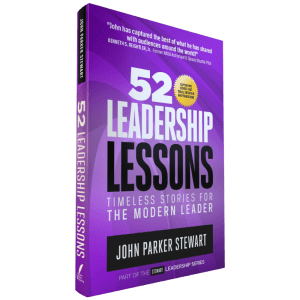
“The reasonable man adapts himself to the world; the unreasonable man persists in trying to adapt the world to himself. Therefore all progress depends on the unreasonable man.”
~ George Bernard Shaw
We are all faced with opportunities dressed up as problems or challenges. How we deal with those opportunities is up to us. I prefer to run toward those challenges and face them head on. Think about it – George de Mestral found a tremendous opportunity that literally changed the world in an annoyance during hiking.
“We are continuously faced with opportunities disguised as insolvable problems.”
~ John Parker Stewart
- What do our people need in order to resolve challenges?
- Who is the best qualified to help those we lead?
- What is our attitude toward new ideas that are non-conformist?
- What is our attitude when faced with opposition to our own ideas?
 Byron's Babbles
leave a comment