Who is Our Chief State School Official?
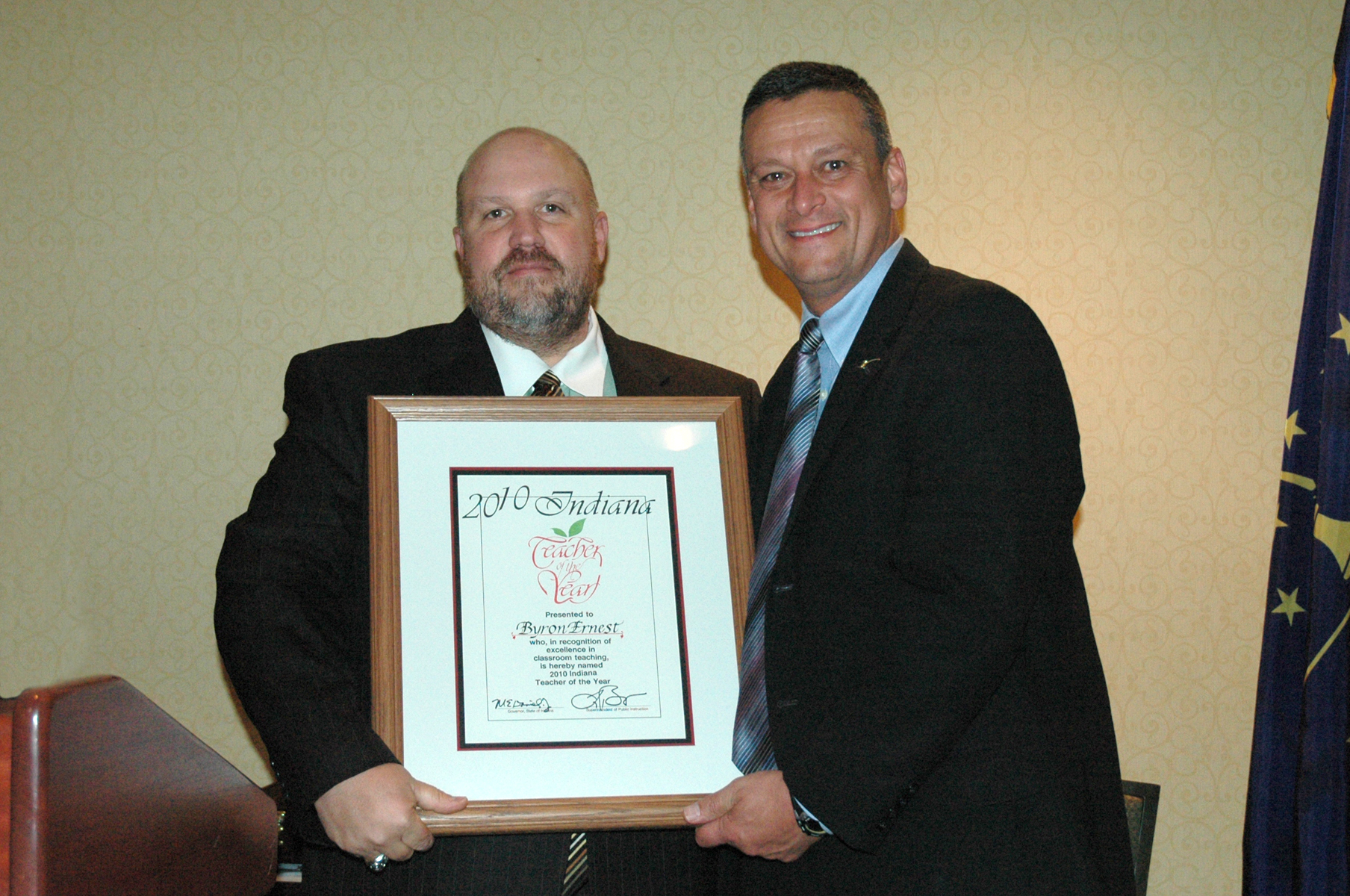 This past week there was an article in Education Week entitled, Who is Your Chief State School Officer? It was a great article and talked about how state departments of education are needing to become more resource and tool oriented. It went on to talk about some state’s view their department of education as too compliance-oriented. I firmly believe that the Indiana Department of Education is taking huge strides to become more of a resource to all school corporations in the state of Indiana.
For this post I want to share who I believe our chief state school official, or State Superintendent of Public Instruction, is. This past Tuesday I had the honor of introducing Dr. Tony Bennett, our State Superintendent of Public Instruction, for his State of Education Address. I believe my introduction speaks to who I believe our chief state school official is. Here it is:
I had the opportunity this summer to hear Condoleezza Rice speak. She said, “Today’s headlines and history’s judgment are rarely the same.” As I listened, I thought about how true this is. Then my thoughts turned to the man I am introducing this evening. Dr. Bennett is a leader with real vision and who can transform that vision into meaningful strategies for students.
History is beginning to record the success of education reform that first of all recognizes effective teachers and administrators. 2011 and beyond will be the greatest years ever to be a teacher leader in Indiana. The initiatives being implemented under Dr. Bennett’s leadership recognize me as the professional I am. I will be evaluated for my first priority of high student performance and achievement. Additionally, my role as a teacher leader creating a positive school environment that facilitates student learning will also become an important part of that evaluation. This truly will allow me to grow professionally by putting students first.
Furthermore, great school administrators like mine at Lebanon Community School Corporation now have the independence to make decisions that, as an effective teacher, will enable me to put students first. Good leadership includes teaching and building relationships. Under Dr. Bennett’s leadership, the Department of Education is building those relationships by taking a proactive role in being a key resource for school corporations in implementing Indiana’s education reforms.
Families now have options regardless of circumstance. Another part of Condoleezza Rice’s speech reminded me of Dr. Bennett’s vision. She said, “It doesn’t matter where you came from, but where you are going.” We cannot say this, however, if we can look at your zip code and know what kind of education you will receive.
Years from now, I believe history will speak favorably of Indiana’s comprehensive education reform. The best leaders make their promises under the public scrutiny of their followers. Then they keep them. I for one am proud that Dr. Bennett has kept his promises and given all schools the freedom to innovate, respond to students’ needs, and put all students first.
The first time I heard Dr. Bennett speak, I said to myself, “This guy gets it!” In October of 2009, I was blessed to get to know him personally…Since then, the man I saw as a tremendous educational leader has become my mentor, my coach, and—most important—my friend in the best, the rarest, and highest sense.
Please stand and join me in welcoming to the podium our Superintendent of Public Instruction – Dr. Tony Bennett.
Kids Don’t Have R’s & D’s Stamped on Their Heads
 Yesterday I had the opportunity to be part of Secretary of Education Arne Duncan’s Welcome Back to School Education Bus Tour 2011. Probably the greatest part of the day was that I spent it traveling with Indiana’s Superintendent of Public Instruction, Dr. Tony Bennett and his Press Secretary, Alex Demron. Now, before you react because of politics notice I am being bipartisan here and including lessons learned from both political parties. In fact my favorite Dr. Bennett quote of the day was, “Kids don’t come to us with R’s and D’s stamped on their heads.” In fact let’s just call that Lesson #1. I would like to share four other lessons I learned from my day yesterday with these great leaders.
Lesson #2 – Consistency
First of all I have to start by telling you that traveling with an elected official might be one of the most rigorous and invigorating things you can do. We literally went from event to event to event to event, and on and on. I even ended up doing some interviews as well. Pretty cool stuff when I stopped and thought about all of the great things that were happening in education reform. The first observation I want to share is that I have never met a leader so consistent in what he believes and how he delivers that message as Dr. Bennett. This is a leadership characteristic that we all can learn from. He is so passionate and has researched the subjects of his vision and strategy so much that no matter what question is asked of him the message is always the same.
 Lesson #3 – Pushing Boundaries
Effective leaders push the boundaries and transform vision into meaningful and hopeful strategy. One topic in Secretary Duncan’s speech really jumped out at me having spent time this past June in China. He talked about, with vivid examples, of how our students now complete globally for both jobs and college acceptance. This was obvious to me as one of the Tuesday’s that I was in China 10 million students were taking the university entrance exam. I was told that less that half would make the cut and less than 20% would be able to go to China’s universities because of space. If I do the math correctly that leaves about 4 million top Chinese students to compete with U.S. students for top spots in our colleges and universities. Secretary Duncan recognizes this disparity and is working hard to devise solutions.
Lesson #4 – Walk the Talk
“Putting Students First” is not just a catch phrase for Dr. Bennett, he has made the hard choices necessary to make 2011 the greatest year of educational reform in the history of both our state and nation. He and Secretary Duncan are unified in their stance that ALL children can learn. Yesterday during Secretary Duncan’s speech in Merrillville, IN I tweeted the following points that the Secretary made: “Poor kids can learn,” “education is the key to raising wages and lowering unemployment,” and one of my favorites “We must recognize that all students are our students.”
When these two leaders say they are “Putting Students First” it is not just “Talk,” they are “Walking the Talk” to do the necessary tough work of education reform. As Dr. Bennett said yesterday, “Good is not good enough and education reform is tough, tough work!”
 Lesson #5 – We Must Have the Tough Conversations
I am a huge believer in all of the things that make for a functioning learning organization. David Garvin said that a learning organization was, “an organization skilled at creating, acquiring, interpreting, transferring, and retaining knowledge, and at purposefully modifying its behavior to reflect new knowledge and insights.” In order for this to happen their must be inquiry and even discourse. These tough conversations are where lessons are learned. This includes being blunt and totally transparent. As Dr. Bennett said yesterday, “We may disagree on issues, but as we have the tough discussion we will come up with a great solution both can agree on.” It is evident that both Secretary Duncan and State Superintendent Bennett are willing to have the tough conversations.
I hope we all can learn from the examples set by these two great leaders. I believe history will speak favorably of the comprehensive education reform being implemented through the leadership they are exhibiting. Even though Dr. Bennett has an R stamped on him and Secretary Duncan has a D stamped on him they are working in bipartisan concert to “Put Students First.” Remember, as they do – Kid’s don’t have R’s and D’s Stamped on their heads!
You Want Me To Do What? Teach?
 I try to read two books per week as part of my own personal professional development. One of the books I read this past week was The Seed: Finding Purpose and Happiness in Life and Work by Jon Gordon. This was an incredible book that I read in two sittings because once you start you can’t put it down. Then yesterday I had two individuals who regularly read my blog say that they really liked my book reviews. I promptly replied that I had not been doing any book reviews, and then I realized as they explained that generally my blogs revolve around something I have read. Amazingly, this made me realize just how powerful my two books a week are to my growth.
One statement that Gordon made in this book really jumped out at me and made me realize how important we all are in the roles we are meant to play. He said, “I’ve learned we are all teachers and students, and a life touches a life that touches a life.” So for this post I would like to share how it came to be that I would be a teacher. Some of you have heard me tell this story publicly many times, but it truly is a course of events that revolved around a teacher, Dr. Hobart Jones, and a student – me. Here’s the story.
My teaching career did not begin with the same story that many teachers share. I did not have an epiphany when I said to myself, “I want to be a teacher.” My journey as an educator began during my sophomore year at Purdue University when Professor Dr. Hobart Jones pulled me into his office and asked if I had ever considered teaching. When I said, “no,” he explained that he saw a talent in me for educating and wanted me to double major in Animal Science and Agricultural Education. It is amazing how someone like Dr. Jones can make a huge impact on someone’s life. His inspiration and personal interest helped me to deal with the challenges of a double major, making my 27 year educational career possible. Without Dr. Jones’ personal interest in my abilities, I probably would have missed this opportunity. It is his example of true caring that I strive to emulate every day of my teaching career.
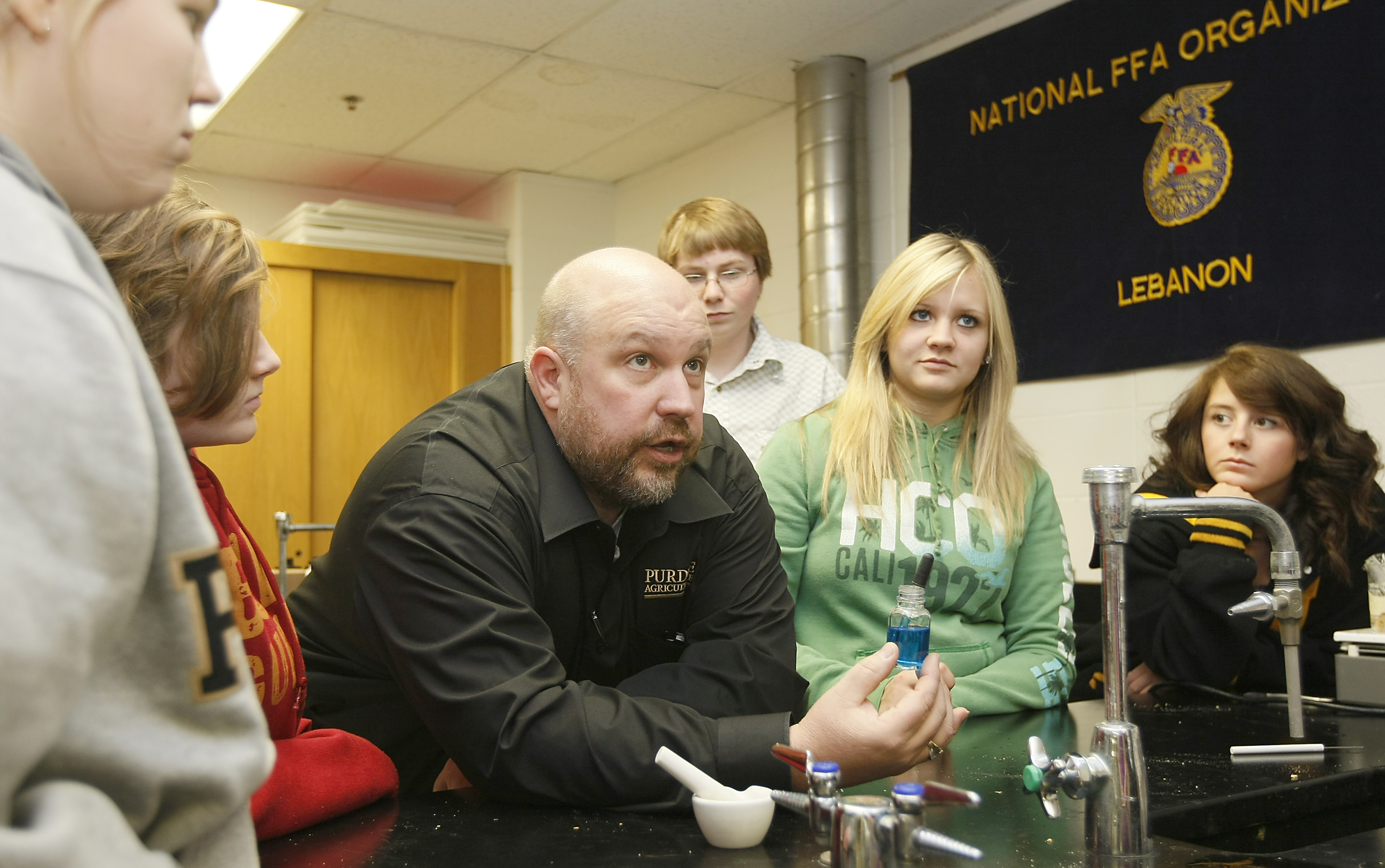
A narrative of my professional career would not be complete without mentioning my latest chapter, starting the Agriculture Department at Lebanon in 2004. As an optimistic risk taker, the opportunity to start a program where no program existed was just that – a tremendous opportunity. It has been exhilarating to start a program, establish the facilities, and lead the team in building a program that now has 584 students enrolled. It has also enabled me to teach rigorous Purdue University dual credit courses in Advanced Life Science. As the department head of three other young teachers, less than 20 years of combined experience, I have learned how to be a true servant leader. In other words, as Gordon suggested, a life touches a life (Dr. Jones to me), a life touching a life (me to the teachers I mentor), and a life touching another life (me to all the students I facilitate learning with every day).
Remember to take full advantage of all the opportunities to touch the lives you come in contact with!
As You Go, So Go Those You Lead
 I was listening to WIBC radio on my way to school, as I always do, this week. One of the guest sports commentators made a comment that caused me to do some thinking. The comment was, “As Peyton Manning goes, so go the Colts.” In other words it was going to be a tough year for the Colts until Peyton returns. This got me thinking about my own role as a teacher leader and department head at my school. What would I want to happen if suddenly I was not around tomorrow?
Now, please don’t take this as me putting down the Colts for not having someone ready to just step into that role because that is not the point at all. The statement by the commentator made me think back to something that I learned from reading the work of John Maxwell. He talked about leading in a way you can be replaced. The idea is that you have been a servant leader in such a way that others have been lifted up to a level where they could actually replace you.
I realize this would be extremely tough to do in the case of Peyton Manning but we can learn from the fact that the other quarterbacks under Peyton are certainly learning from their experience. I am sure my fellow Boilermaker, Curtis Painter, has learned a great deal from working with Peyton Manning. Still, we can reflect on our own situations and think about the people we work with. Are we developing their talents in a way that they could replace us. If we are truly servant leaders, wouldn’t the goal be that if we were gone tomorrow everything would continue seamlessly?
In fact, as Max De Pree said in Leadership Jazz, “leaders have to be vulnerable, have to offer others the opportunity to do their best. Leaders become vulnerable by sharing with others the marvelous gift of being personally accountable.” De Pree also talked about how leaders work to bring the special and creative gifts out in others.
This has really caused me to reflect and determine what I would want said about me if I could not return to school on Monday. I would hate for someone to say “As Byron Ernest goes, so goes Lebanon Community School Corporation.” I would rather have those I have worked with, coached and mentored say, “Wow, because of my time spent with Byron, I am ready the the next big steps and responsibilities that come my way.”
Hopefully, this will cause you to think about becoming vulnerable to those you serve!
Connecting, Extending, & Challenging
 In education Connecting, Extending, and Challenging are so much more than just words. They are crucial to 24/7 learning and teaching students to learn to learn. I believe in 24/7 learning. We have to facilitate an environment where our students’ learning continues outside the school day – EXTENDING.
We must also challenge our students to learn and explore new concepts and take on new and exciting projects – CHALLENGING. Let me give you an example. My students just completed a project that I believe models Connecting, Extending, and Challenging – Operation Home Grown.
Following a series of soil chemistry and plant growth lessons n my Advanced Life Science Plant & Soils class, my students made a CONNECTION to organic and sustainable agriculture. They decided to extend their learning outside the classroom and proposed to use 2 acres of our Outdoor Agronomy Lab to grow organic sweet corn.
This CHALLENGED my students to learn how to grow organic sweet corn and come up with a plan for selling it. Not as easy as it sounds. They were challenged with a lack of rain.
Success was realized for this group of students this past weekend when they picked the first of the corn and sold out of 52 dozen ears of sweet corn in less than two hours. When we facilitate learning for ALL students of ALL ages we must remember to Connect, Extend, and Challenge them.
Autonomy – Professional Growth Must Be Personal
 For me to get two posts done in one week is unheard of but after some discussions related to my post: Autonomy – A TALL Order I was inspired to write this post. A great example of what I mean when I say professional growth must be personal was a great learning experience I had a couple of weeks ago.
I had the opportunity to be involved in a professional development in Washington, D.C. at the Smithsonian Postal Museum called, Mission Possible: Reimagining the 21st Century Classroom. This was a joint initiative of the Smithsonian Institution and Pearson Foundation. For one thing I was really intrigued by the title because I’m always amazed at how we tend to title everything to read that we are moving into the 21st Century. I hate to inform all those folks, but we are already into the 21st Century by 12 years. So, the title Reimagining the 21st Century really seemed appropriate – And, it was!
In reflecting on the workshop I tweeted several times that it was the best professional development I had ever been involved in. And, I stand by that claim. Why was it so great? Here’s a list: the great facilitators, the great teachers who attended with me, the best photographer/videographer ever, Postal Museum, the D.C. experience, and ME.
Here’s why I say ME. Any time I am asked to be a part of a workshop or professional growth opportunity I always try to put myself in the frame of mind that I am going to get as much out of the experience as possible. An example of this related to this week of learning for me was Twitter.
Before this workshop, I had not yet begun the Twitter adventure. Prior to the workshop I got an email stating that we should create a Twitter account that we would be using during the workshop. This was the nudge I needed – I am now addicted. I am learning so much from the people and organizations I am following. Also, I have grown so much professionally by, A. Needing to keep my posts under 140 characters (a tough project for me); and, B. Making the posts meaningful in the broader context that everyone who is following me reads them in – in other words, I want to make my posts meaningful. Notice the autonomy here; the workshop did not teach me about Twitter, but was the tipping point to get ME to grow professionally. Note, I am still the one ultimately responsible for my professional growth.
Here are some other major points that were developed during this wonderful event:
-The great part about using social media in education is a student’s work becomes important to others. Students love this.
– Students must be coached to critically review all sides of an issue.
– We must facilitate active learning where all students have a voice.
– Teachers approach lessons with a specific objective, but we must coach to allow learning to be iterative
– In education, its not about the tool/technology, but what you are going to have the students do with the tool/technology.
– The goal is to create 24/7 learning for our students.
– Effective teachers connect, extend, and challenge their students!
– The three C’s of education: Communicating, Collaborating, & Creating
– We must all learn to be Strategists
… – And many, many more!
I think you get the idea. Anyway, next time you go to a workshop remember that a large percentage of the success of your professional growth starts with you! We all need to put ourselves in the frame of mind that events happen every day that can be professional growth moments! So, make your professional growth personal!
Autonomy – A TALL Order
I’ve read two great books in the last week,Drive: The Surprising Truth About What Motivates Us and The Modern Meeting Standard: Read This Before Our Next Meeting. These two books caused me to reflect on a process I had the opportunity to develop and champion at Lebanon High School called TALL – Tiger Academy of Lessons Learned.  Allow me to share the process (it’s not a thing or initiative, it’s a process) in this week’s post.
In the last three years many changes have been made in the way our school-wide professional development activities are planned, organized, and presented. The primary concern was that teachers should have ownership of the professional development process – Autonomy.
The Lebanon High School staff meets two times per month for professional development in Tiger Academy of Lessons Learned (TALL) groups. TALL was started in the spring of 2009. TALL is modeled after the U.S. Army’s Center for Army Lessons Learned (CALL) (Garvin, 2000). It is a process with no hierarchy, which has teachers working in groups of like interest and knowledge to learn new techniques, study research, try new practices/technology, and discuss professional literature. Any teacher may propose a topic to be addressed and groups form according to the appeal of the topic. As Pink (2009) said, “As organizations flatten, companies need people who are self-motivated. That forces many organizations to become more like, er, Wikipedians. Nobody sits around trying to figure out how to “motivate” them. That’s why Wikipedia works. (Kindle Location 452).
Groups meet formally every other week during time set aside in the morning, and report in diary form to our common computer drive. Groups can form and dissolve as necessary. Members are also able to freely switch groups as the need arises. Many groups meet outside of the normal school day to work. All individuals and groups had total autonomy (Pink, 2009) to pick their topics and groups they work in.
TALL has enabled the development of communities of practice in our school. One advantage of this process is that it provides a forum where teachers learn from each other. Teachers, according to their needs, choose TALL groups. This strategy enables teachers to use the group genius created to improve teaching skills and acquire best practices from each other, thus improving student achievement. Another important facet of TALL is that it includes the entire staff. All principals, support staff, and teachers are involved as equal participants. The groups with principals have learned to discuss sensitive topics and share opinions without fear of repercussion. TALL has helped our school by moving our staff toward an environment of risk taking and trust.
Another important outcome of TALL has been the opportunity for cross-curricular collaboration (Dufour, 2008) or development of learning organizations (Garvin & Edmondson, & Gino, 2008; Garvin, 2000) between all teachers. Garvin (2000) defines the learning organization as, “an organization skilled at creating, acquiring, interpreting, transferring, and retaining knowledge, and at purposefully modifying its behavior to reflect new knowledge and insights” (p. 11). Becoming a learning organization is an important component of our school’s culture change toward improved student achievement and performance (Warnick & Thompson, 2007).
References
DuFour, R. D. (2008). Revisiting professional learning communities at work.
Bloomington, IN: Solution Tree.
Garvin, D.A., Edmondson, A.C., & Gino, F. (2008). Is yours a learning
organization? Harvard Business Review, 86(3), 109-116.
Garvin, D. A. (2000). Learning in action: A guide to putting the learning
organization to work. Boston, MA: Harvard Business School Press.
Pink, D. H. (2009). Drive: The surprising truth about what motivates us. New York,
NY: Riverhead Books.
Warnick, B.K. & Thompson, G.W. (2007). Barriers, support, and collaboration: A
comparison of science and agriculture teachers’ perceptions regarding integration of
science into the agricultural education curriculum. Journal of Agricultural Education,
48(1), 75-85.
Reverse Mentoring

- 2010 Wyoming Teacher of the Year
I realize that the buzz word has changed from mentoring to coaching, but I have been advocating reverse mentoring for quite a while now, so I am not changing terminology. In my field of teaching, it seems that everyone is hung up on the tradition that experience equals qualifications and effectiveness. Even though this might be true in some cases, I propose that mentoring goes both ways. In other words teachers with less experience may be more effective teachers and have knowledge/skills to share with those of us with more years experience.
In fact, I’ll be the first to tell you that I would not be where I am today without the learning that has occurred from those with less years experience, but with skills, knowledge, and abilities far exceeding my own. For example, I would not have near the skills using technology to enhance student learning if it were not for a former student, Matt Ladd, who served as our technology guy at my high school. Now, amazingly, I am looked to as a leader using technology. Make no mistake, there were many others, including my students who played a role in moving me into the 21st Century. Just one example of Reverse Mentoring at its best.
The picture I chose for this post is very special because it is of a teacher with nine years experience that I, with 27 years experience, learn from every time I am with. I was blessed to get to know Christina Mills, 2010 Wyoming Teacher of the Year, two years ago during my year as Teacher of the Year. She is amazingly talented and effective in the classroom, and I value every chance I get to be around her. I was thrilled last week when I was a part of the Smithsonian Institution and Pearson Foundation’s Mission Possible: Reimagining the 21st Century Classroom in Washington D.C. and through the door walked Christina. Neither one of us knew the other was going to be there. This four day conference provided plenty of opportunity for learning; much of which came from collaborating with Christina.
So if you are reading this with many years experience in your field, do not forget that those with less years experience may just have more experience in areas you need mentoring. Or, if you are reading this and have limited years experience do not forget you have valuable knowledge to share with those of us with more years. The goal should be to learn from each other. I guess I should call it Two Way Mentoring – learning from each other.
Teaching vs. Pouring Espresso
I was reading Onward during a time when our State Superintendent of Public Instruction, Dr Tony Bennett visited my classroom. He is very inspiring and has led so many great changes in Indiana Education. I shared this with him, and now I would like to share it with my blog readers. I believe you will find that this comparison of teaching to a successful business model fits right in with Dr. Bennett’s initiatives of “Putting Students First.”
Here is the excerpt adapted from Onward:
Pouring espresso (Teaching) is an art, one that requires the barista (teacher) to care about the quality of the beverage (education). If the barista (teacher) only goes through the motions, if he or she does not care and produces an inferior espresso (student) that is too weak or too bitter (not ready to compete), then Starbucks (teaching) has lost the essence of what we set out to do 40 years ago (in 1635): inspire the human spirit. I realize this is a lofty mission for a cup of coffee (education), but this is what merchants (teachers) do. We take the ordinary – a shoe (boy), a knife (girl) – and give it (them) new life, believing that what we create has the potential to touch others’ lives because it (their lives) touched ours.
Adapted from Schultz, H. (2011). In Onward: How Starbucks fought for its life without losing its soul (p. 4). Thousand Oaks, CA: Sage.
21st Century Leaning Lab Podcast
During a special episode of the 21st Century Learning Lab podcast, Meri Carnahan spoke to me about my experiences, both locally and nationally, as Indiana Teacher of the Year and how technology has become an important part of my classroom.


3 comments