Serendipity Mattered
 This week while continuing to read Great Society: A New History by one of my favorite authors, Amity Shlaes, I found the shortest sentence in the book: “Serendipity mattered” (p. 188). Serendipity has always been an intriguing word to me that I have had trouble understanding because I here it being used in different ways. But when used in the context of Shlaes book, in a two word sentence it made perfect sense. The sentence “Serendipity mattered” really drove home the point she was trying to make and really made the lightbulbs come on for me.
 In other words, there needs to be serendipity for innovation to occur. So what is serendipity? As I said earlier, I have trouble understanding it fully, but I know that when conditions are right for it, great things happen. Serendipity is said to happen by simple chance. An opportunity that comes about by a chance occurrence. Therefore, we must create the opportunities for these occurrences. This was the point that Shlaes was making in the book. The Fairchild Semiconductor company realized they needed innovation. They also realized that looseness of hierarchy drove innovation. Thus, “Serendipity mattered.” It is also why we need to beware of the current tides toward any of the Great Society’s socialistic tendencies. This will stifle the serendipity that is so needed.
 I touched on serendipity in my blog post Alternative Truths back in 2017, but only to say that we need to be intentional to create space for serendipity to occur. Therefore, I needed to study a little more. Research led me to find that our use of the word serendipity comes from The Three Princes of Serendip. The musician and poet, Amir Khusrau wrote this Persian tale in 1302. The tale is about King Jafer and his three sons. He wants them to have the best education in the kingdom. The King believed that great book learning needed to be combined with a real world context. Wow, I preach that all the time! In fact, I wrote a book, The Hand In The Back Of The Room, about it!
Anyway, the king gave each of the boys a horse and told them to go discover. The boys relished and took advantage of this experience. They learned from being on a journey of taking in real world experiences. Then in 1754, Horace Walpole coined the word serendipity in a letter. He described serendipity, by referring to the tale of the three princes, as making discoveries, by accident and sagacity, of things which they were not in quest of. He was excited about this word because there was no word to describe the discovery of something you are not looking for. It was really accidental sagacity.
Then comes the question, how do we create space for serendipity to happen. It probably won’t work to get everyone a horse, but I’m certainly up for it. Think about all the great inventions and innovations that have happened by accident. We need to remember in all this that creation precedes innovation. We need to provide ourselves and others varied routines and time for serendipitous moments to occur. It is why the story of the king sending the princes on a horseback adventure is so important. They’re heads were clear and they were just observing. Think about it; it’s why just taking a walk to clear your brain can bring creative thoughts and solutions. I do this a lot when facilitating teacher leader gatherings. I will tell them to split into groups and take a walk and discuss… They always come back refreshed and with great thoughts and ideas.
Leaders, including political leaders, need to recognize the important role serendipity plays in creativity, innovation, and even relationship building. Interestingly, in my research I found having lunch together as a strategy for encouraging serendipity. I blogged about having lunch together in Let’s Have Lunch Together, but not from the angle of serendipity.
We need to start looking for more serendipity to happen and create space for it. We might not be looking for something specific, but we need to be tuned into a channel of infinite possibilities. Think about it; this blog post was inspired by a two word sentence. It must have been serendipity!
❤️ Kids Having Ownership!
 This past week I had the honor of doing a day long professional development for teachers from all schools corporations in Elkhart County, Indiana. I am representing Noble Education Initiative carrying out this customized professional development. This was part of an ongoing Project Based Learning partnership created by Horizon Education Alliance to bring business/industry and education together to best educate students. I love doing professional development workshops, particularly when they are on topics that I am passionate about. Project Based Learning (PBL) is one of those topics. It is also energizing to be with a group of educators who are very engaged. Groups like this always remind me and validate what Gallup® finds teachers value in question 12 of the Gallup Q12 Index©: “In the last year, have you had opportunities to learn and grow?” These teachers have been given this opportunity and very much value the opportunity, and are taking advantage of the opportunity to learn and grow.
The group last week was both passionate and engaged. We started the day with what I called “Level Setting.” I had them work in pairs to talk about their PBL experience now that we were half way through the school year. I wanted them to talk about what they had learned, “wow” moments, what they still had questions about, and what they still needed help with. They were to represent this on a tear sheet and put it up on the wall. Here are a few of the tear sheets that were put up:


Did you see the comment “❤️Kids Having Ownership”? That’s what this is all about. The next few paragraphs will dig into that a little deeper.

Aubri Mosness with her students
We then had everyone individually do a gallery walk and pick one thing that stood out to them. This was an awesome discussion when the group came back together. There were questions like, “who wrote… I would like to know more,” or “I had that same experience because…,” or “I am so glad you wrote that because that same thing happened to us, and we are still trying to figure out…” You get the idea. One comment really stood out to me during this discussion; It was by Goshen High School Teacher, Aubri Mosness. She said, “I have felt the transition from me doing most of the work to the students doing most of the work. At first I was a little uncomfortable because I felt like I was doing much, but then I realized how much the students were getting out of it.” I was so excited by this. This is such a revelation in teaching. Great teaching should have the students doing most of the work. She was truly facilitating with a student managed classroom and the students have student agency and choice.
Then, at lunch Ms. Mosness’ students presented to the whole group and business/industry representatives that had joined us, on their project and I led a little Q&A. The students were incredible. During the presentation Ms. Mosness commented, “When I give my students too much, too much information, too much guidance, I am taking away opportunities for learning.” This was a drop the mic opportunity as far as I was concerned. The students all concurred. I then asked the students to give a thumbs up or thumbs down on the following question: “School work should look more like real work?” All six students gave me a thumbs up. Our students deserve to learn in an environment that is facilitated in a real world and relevant context.
 These students were giving first hand testimony affirming the research I did for my book, The Hand In The Back Of The Room: Connecting School Work To Real Life.” In the book I talk about that the hand in the back of the room was mine, and probably yours too, that was raised wanting to know why I needed to learn what I was being taught. In other words school work must be connected to real life. This is why PBL is so great. Using PBL teaching principles will make school work look and feel like real work. In other words, the question from “the hand in the back of the room is answered as to why she needs to learn what she is being taught. When teachers are allowed to make student learning the ultimate test of facilitation of learning, then instruction improves to produce better learning. The results of my research showed improved achievement/performance in science when students are taught in a relevant context. For me that context was agriculture, but there many other real world contexts to be used. This is why the partnerships with business/industry is so important for our students. The challenge to all of us in education is to find ways to make learning visible by connecting school work and real life for the students we serve.
If I Were In A Snow Globe
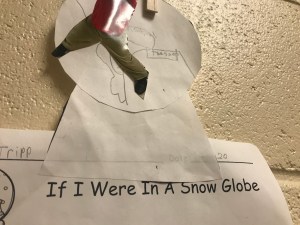 So today as I was visiting with teachers and students at our host school for 3D Leadership, Coweta Charter Academy, in Senoia, Georgia I came across a really cool writing prompt: If I Were In A Snow Globe. It was very interesting to read the student responses. Then I got to thinking, how about I write to the prompt? Here is my essay:
If I Were In A Snow Globe
Here I am in this very beautiful, pristine, and tranquil globe. Everything is perfectly in its place. Of course, my snow globe is a beautiful farm scene with a modest white farm house and three barns. There are snow covered fields and pastures with Jersey dairy cows. When you look inside the barns you see perfectly stacked round bales in a pyramid. You will also see a blue New Holland tractor backed into the barn awaiting its next task.
As much as I am loving being in this snow globe there just is no magic. No excitement. I need someone to shake my snow globe. Won’t you please shake my snow globe? Only then can there be a shift in the experience – some excitement. Snow flying landing on the roofs and on the backs of the cows making an exciting, beautiful, and ever changing experience. I just can’t imagine having to be in this snow globe with out someone shaking it up. For the magic to happen I need shook up. I wish I could get out of this snow globe and shake it. How beautiful it would be!
Lesson Of Shaking It Up
I hope you enjoyed my essay. Here’s the deal: the magic only really happens when we either get shook up, or we shake things up. The shake allows for new possibilities and new beauty. By shaking the snow globe we can create change instead of being a victim of it. So, next time you are getting shook up, take some time to recognize the magic of the shake. Or better yet, give yourself or your organization a transformative shake. How about you share your “If I Were In A Snow Globe” essay?
Let’s Have Lunch Together!
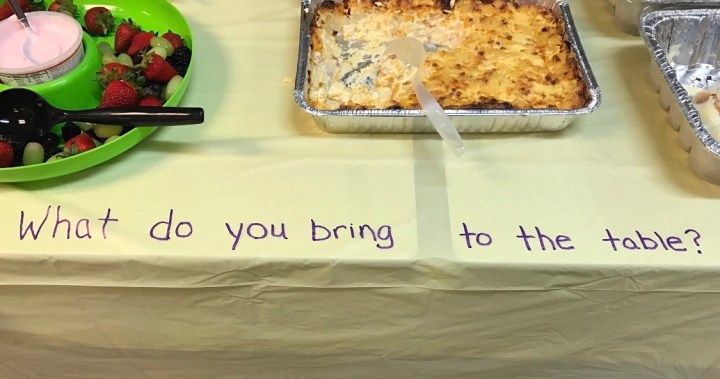 Last night we started our third cohort of 3D Leadership in Indiana. Hard to believe we have started our third year. Just seems like yesterday that I began putting the curriculum together for this program. Last night as we were discussing relationship building as a function of leadership, one of our participants, Sarah Medve, shared a story that really touched me and the rest of the group.
Sarah said she realized that she needed to do a better job of building relationships. Sarah also realized that she was missing out on building work friendships and collaboration because instead of taking time to eat lunch with coworkers she was making copies, grading papers, or any of the many other tasks of the day. This great teacher leader explained she has begun making sure all her tasks are done at other times so she can stop and eat lunch with others. Then Sarah told us she had fun eating lunch with others and did not want to miss it. Wow! This is a big deal!
We all do it, though. Work through lunch or sit alone and check emails. Sharing meals together, however, builds relationships. Eating together provides time to get to know each other and encourage cooperation through informal communication. Eating lunch together also increases productivity because it widens our perspectives. Eating together is a powerful act.
Researchers at Cornell University argued that eating lunch together has a much more positive effect on organizational community than the artificial activities that many organizations use like rope courses and things we call team building activities. These things are sometimes offsite and require a lot of energy. The Cornell study showed that employees (in the case of this study – firefighters) make fun of and do not see any value in them (Kniffin, et al., 2015).
This insightful story from our teacher leader reminded us all of the benefits of commensality. Coworkers that eat lunch together feel more like family and build friendships. So, we need to learn from our teacher leader, Sarah Medve, and make time to eat together with fellow teachers and staff. Why? Because, as Sarah so insightfully told us, it is fun and she feels closer to her coworkers. The rest of us leaders need to think more about providing opportunities for employees to eat together and do away with the manufactured and trite team-building exercises.
 You might be interested to know that after our gathering we all went to Jockamo’s and had dinner together. It was so much fun and we learned a lot about each other. It was nice to put into practice what we were learning in 3D Leadership. I know I left feeling much closer to the group.
REFERENCE
, J. (2015). Eating Together at the Firehouse: How Workplace Commensality Relates to the Performance of Firefighters, Human Performance, 28:4, 281-306,DOI: 10.1080/08959285.2015.1021049
Success In Aspirational Terms
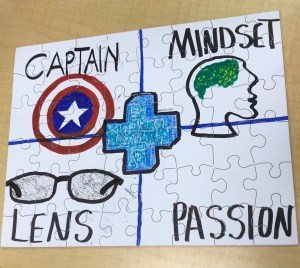 This past week I heard a person say that “success should be measured in aspirational terms.” The more I thought about it, the more I like it. In education I believe we need to think more aspirational in the way we prepare students. In other words looking beyond just credits and a diploma to the outcomes of what a student should be able to do now and be capable of learning to do later.
Let’s use an example that gets used a lot – welding. It is short-sided to think that having a student be in the single pathway of learning to fuse two pieces of metal together is enough. Don’t get me wrong, good careers await the student, but that’s not aspirational enough. This is why I believe in achieving multiple pathways. A student with aspirations for welding should also be studying computer science. Computers have become an indispensable part of welding processes. Computer, and even artificial intelligence, are required for the execution of many welding operations today. We can only imagine this need for knowledge of computer science will increase. Industry is telling us that welders will need knowledge of lasers, computer program, robotics, artificial intelligence, materials engineering, and systems integration to advance.
With the increased demand for highly skilled and technically sound workers, our students will need to shape their careers around multiple areas of expertise. This aspirational approach will enable their lifelong learning and ability to be agile to a ever-increasingly fast changing world.
We need to be deliberately aligning our student’s aspirations and abilities. The scene in the movie “The Martian” where it doesn’t look like it will end well for astronaut Mark Watney he sends this message to be relayed to his parents:
“Tell them I love what I do and I’m really good at it. And that I’m dying for something big and beautiful and greater than me. Tell them I said I can live with that.” ~ Mark Watney, played by Matt Damon, in The Martian (2015)
Try and tell me that’s not aspirational. We all need to find what we love and what we are good at. It’s not either or, and we need to help students find that balance as well. Some would say that aspiration is magical thinking. I don’t believe it is a magic trick to strategize about the future, help students invent themselves and us reinvent ourselves, push upscale, and keep a growth mindset. Without deep thought and planning about measuring success in aspirational terms, it just becomes a vacuous platitude, or “thing,” as I like to say. But taken in the context of enabling the future, career/skill agility, and student outcomes, measuring success in aspirational terms becomes about being prepared for what we don’t know we need to be prepared for.
Questions?
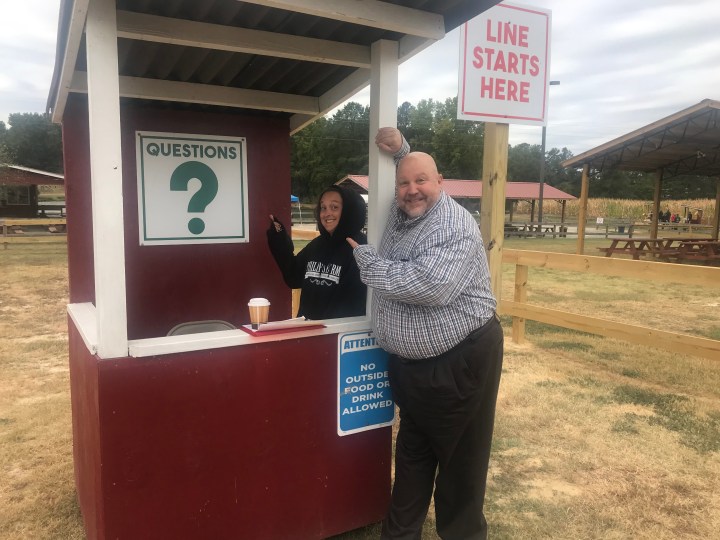 Yesterday at our North Carolina 3D Leadership gathering we went to Phillips Farm pumpkin patch in Carey, North Carolina to get pumpkins for an activity. The activity is not the focus of this post. The focus is on a booth set up at the farm for answering questions. The kiosk literally had a question mark sign on it with the word “questions” (see picture). Everyone in our group was immediately struck by the feeling of being put at ease knowing that we had a person and place specifically designed to answer any and all of our questions. What a simple sign and simple concept!
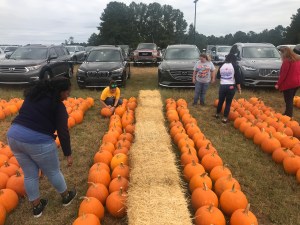 The young lady at the kiosk was able to answer all our questions and get us set up to get everyone the chance to pick out their very own pumpkins. She even gave us a Dum Dums sucker, telling us that no question was too dumb to ask. But the part that continued to amaze us was how comfortable that sign made us feel when entering the area. There was no anxiety trying to figure out where to go or what to do.
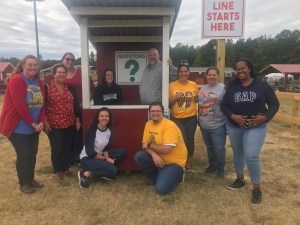 We then began to discuss how we should make kiosks in our schools during parent events or back to school events to make families comfortable asking questions. The question mark sign had empowered us to ask questions. It gave a very different feeling than if there would have been a sign that said “information” or just people standing around to answer questions. It was just comfortable – there is no other way to describe it.
This reminded me of the research that has been done in schools on surveys of climate and culture. Research tells us that if we were only able to ask one question on a survey the most important one would be, “How comfortable are you asking questions in your class?” If students are comfortable asking questions the schools is most likely on an upward trajectory. Therefore, we need to make our classrooms comfortable places for inquiry and empower our students to ask lots of questions.
In fact, as leaders, we need to make every environment we facilitate a safe place to ask questions. Think about the last meeting, professional development session, or gathering that you didn’t feel comfortable asking questions. Miserable, wasn’t it? Then, think about the times when no question was a dumb question and there was a free flow of inquiry. Makes us feel very empowered and comfortable, doesn’t it?
So, let’s start staffing “Questions?” kiosk both literally and figuratively, and creating empowerment through comfort in asking questions.
Less “Why” and More “How To”
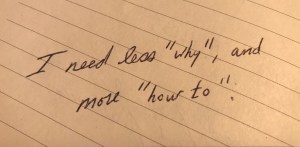 Recently, I was sitting in on some teacher professional development sessions and I looked over at a teacher’s notes and saw that he had written, “I need less ‘why’, and more ‘how to”. This really struck me because I had just interrupted an earlier session to see how many really thought they would be able to jump right in and do the task being trained on – some thought they could, but many wanted to try it and then have someone ready to help them. Having spent most of my career in the classroom I knew it was one thing to have been shown how to do something, and then actually doing it when there were 30+ young scholars staring you in the face was a lot tougher thing.
After seeing this note, I began to think about whether we had become so enamored with always explaining the “why” that we were missing the mark on the “how”. Clearly in these trainings we were for at least one participant. This struck home with me because I believe in my own world I get a lot of “why”, and then there are very few who really understand the “how”. As you will find later in this post, we need both.
I told the teacher after the session that I had seen his note and was interested. He told me it was not being critical, but he needed more time on how to do some of the tasks than so much time on why. I told him this made total sense. Really, the why should be about the vision in a quick statement of the importance and not a dissertation, or what turns into a chance for the presenter to pontificate and gain self gratification. Many times, I have found, this is because the person presenting does not understand how to do the task very well themselves.


Think about it from a school perspective; if I spend an hour telling you how important taking accurate attendance is each period for high school students and why each period will be analyzed and rolled into the daily attendance, but then don’t spend the majority of the time making sure you understand the management program (technology) and how to use it, I have failed you. Also, we would need to make sure you understand the best practices of taking proper attendance at the beginning of the period and then updating for individual circumstances that happen during the period. I believe you get the idea, but it has become to easy and “cool” to just spend time on the “why” because that is the latest buzz phrase – “gotta tell them the why.” I’m cool with that, but make sure I understand “how to” too!
How about you? Do you need less “why”, and more “how to”?
Teacher Leader Shape-Shifter


This morning I did a session for our Teacher Academy where I had the teachers pick a toy from a bag of lots of different cool toys. I gave them two minutes to play with the toy and then they had to report out how the toy related to their classroom, serving students, and them personally. This is a great reflective activity that really makes participants think. Then, of course, these reflections really get me thinking and I end up writing blog posts like this one.
One of the teachers chose a Slinky® and while reporting out she described herself as a shape-shifter. She stated that she needed to adjust and adapt according to student needs. This was genius. I have always tried to inspire team members to be continually comfortable shape-shifters. I am such a big fan of fluid change; whether that is organizationally, personally, or in the classroom. We need to be comfortable with the one thing that is constant – change.
Here’s the deal: as leaders, teacher leaders, and organizations, we must be comfortable with an ever-changing skin; no matter what we call it. Whether we call it change, changeover, conversion, metamorphosis, mutation, shift, transfiguration, transformation, translation, transmutation, transubstantiation we must have the resilience that shape-shifting brings to be successful. I would suggest that leaders and teachers must become adept at negotiating multiple, sometimes divergent, identities. We must be adaptive because everything we do during the day as teachers is situational – it shifts from context to context.
In other words we all need to use our portfolio of attributes, skills, and experiences to arrange, re-arrange, and adapt to meet the needs of our current situation. The concept of shape-shifting implies a sense of individuality and free agency in making choices, removed from constraints. By creating her own meanings for curriculum and leading of learning, the teacher who inspired this post, will be able to apply it within the context she is teaching. We then need to be able to demonstrate the resourcefulness and ability to change as contexts change.
Shape-shifters can be seen as innovators, rebels, or even a compromiser, but I see this as an important adaptive leadership trait. I do believe that shape-shifting also allows us to push away from the status-quo way of doing things and adapt to changing needs.
Leading With A Touch Of Quirkiness
 I finished the awesome book Joyful: The Surprising Power Of Ordinary Things To Create Extraordinary Happiness by Ingrid Fetell Lee yesterday evening. It is such a great book that really opened my eyes as to the ways I am already creating joy and need to continue, and the external environments I need to be creating to give rise to inner joy for both myself and others. Two parts of the book had a big impact on me: the idea of playful design bringing joy and not being bound by convention brings joy. Those that know me very well at all know that these are two things that I put into practice almost every day.
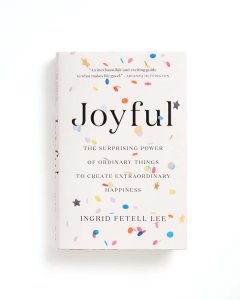 Ingrid Fetell Lee taught us to not feel bound by convention; break the mold and bring joy to the world. I believe it is about being a divergent thinker; the ability to generate novel ideas and conjure up multiple solutions to a problem. This is about being creative and thinking outside the box. This celebrates creativity. I have watched this way of operating bring joy to groups doing the divergent thinking and have felt the joy myself when conjuring up new and exciting ways of doing things. I believe we are very guilty in education right now of promoting the idea of one correct answer. This is really promoting when using high stakes summative tests. I get that at some point there has to be convergence of ideas but I believe we take the joy out of learning by not allowing for enough divergence – both in our educational systems and in the workplace. We tend to reward the students who work hard, like learning, are rule followers, but are not going to break any molds or create anything wowful.
Interestingly, childhood creativity has been shown to have a higher correlation to adulthood success than IQ. So, maybe we should create systems in our organizations and schools that value creative, interesting, and innovative answers, rather than the “right” ones. I also believe this mold-breaking thinking allows us to better question ourselves. This gives us the opportunity to be more comfortable with the idea that what we thought we knew could be wrong. This kind of thinking can position us well in our learning, work, and personal lives.
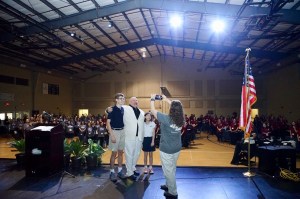 We were also taught in Joyful that being a little quirky and even bring joy. I proved this yesterday when I emceed our Impact Georgia back to school event. I wore my white linen suite that is a little out of character for me. I must say I was looking pretty fly. The look was just enough different from my usual that I believe it brought joy to others which made me feel joyful as well. I also added to the quirkiness by asking a teacher to come up on stage, and I quote myself here, “Take a selfie of us. Make it look like I am holding the camera.” This was of the things I really learned from the book is that joyfulness can be found in some of the most obscure and little things.
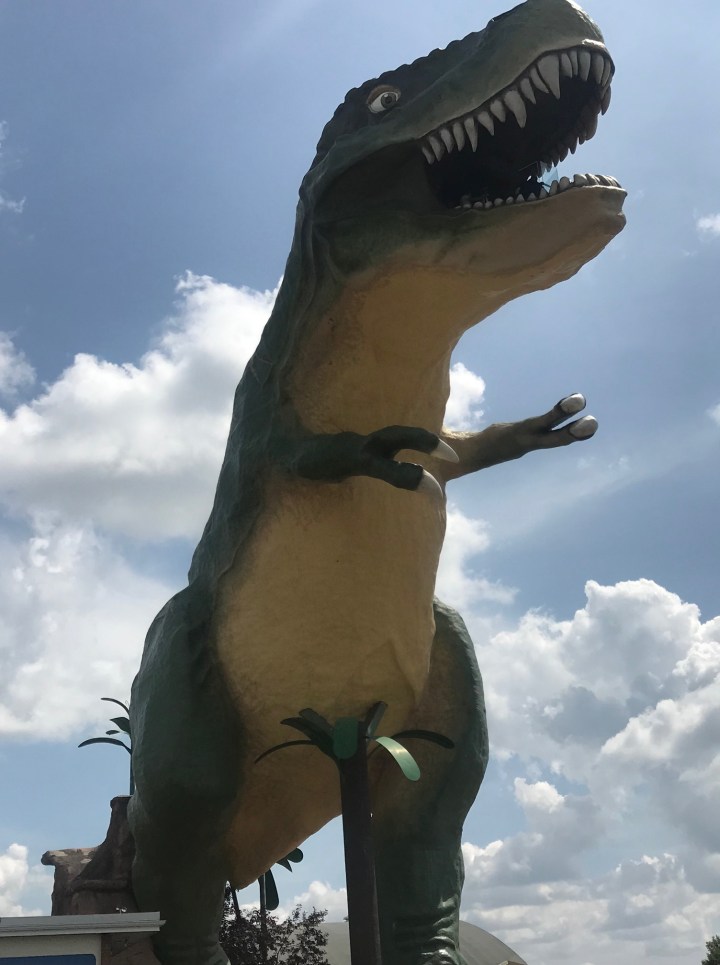
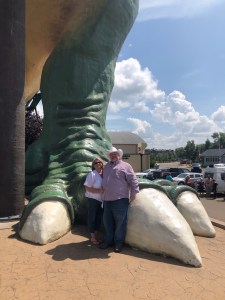 I even think about a couple of weeks ago when we were in Alberta, Canada and went to see the worlds largest dinosaur in Drumheller, Alberta, Canada. It was super quirky, but the quirkiness made it so much fun and it brought so much joy that it keeps bringing joyfulness when we look at the two pictures included in this post.
Go ahead and embrace your quirkiness and celebrate creativity!
Experiencing, Not Attending For Learning
 As I travel home this evening from what was an incredible journey to Calgary, Alberta, Canada, I am reflecting on all that my family and I saw and experienced, all that I learned at the 2019 International Research Conference, and can’t help but reflect on yesterday’s 50th anniversary of the first moon landing. A week ago yesterday we began this excursion and a week ago today attended the Calgary Stampede. What we found is that one does not attend the Stampede, one experiences the Stampede. Through this experience I learned about invented traditions. These Invented traditions are activities that are actually recent but are accepted by the public as having a particularly long and resonant history and as representing something essential about a nation’s character, values, and identity–arose from a widespread effort to justify the nation state, royal dynasties, and national boundaries by linking them, often tenuously and sometimes even falsely, with the past. These invented traditions spring from the need to reconcile constant change in the modern world with the desire for stability and traditional understandings about society.
We found that the Calgary Stampede has evolved over the decades in response to economic and political dynamics and the perceived need to maintain a vibrant balance between nostalgia for the past and celebration of the economic and ideological promise of the future. Successful cities have managed to brand themselves through identification with their annual festivals. We found that the brand lived up to the hype. One of the things I learned from experiencing and studying the Calgary Stampede is Americans cherish individualism and individuality above community. Canadians have exactly the reverse set of political priorities. This is not to say one is right and one is wrong; it is just to say that I learned some cultural differences along the way. We made some great friends while at the Stampede.
 I can’t help but also reflect on all the great scenery, nature, and natural beauty we had the opportunity to see and experience as well. The Canadian Rockies are awesome, and we had the opportunity to experience them from as far south as Waterton Lakes National Park and as far north as Lake Louise in Banff National Park. This all reminded us, as a family, of how important sustainable development is to making sure future generations will be able to enjoy and learn from these natural beauties like we did. We must work hard to meet the needs of our present generation without compromising future generations ability to meet their own needs.
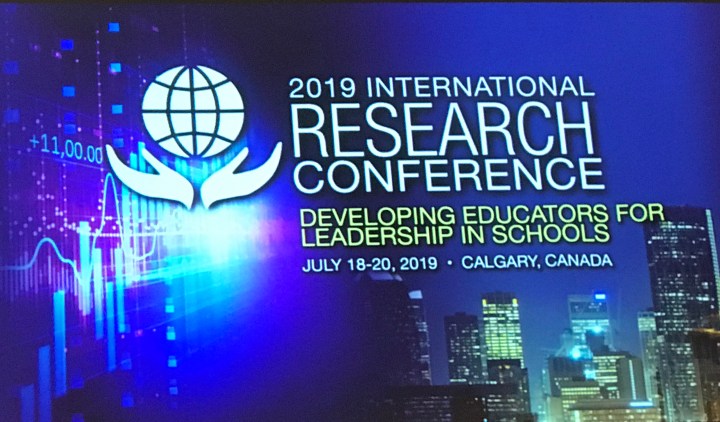 This was also discussed during the 2019 International Research Conference. Dr. Gerald Farthing, Former Deputy Minister Of Education Manitoba Department Of Education reminded us to act locally, while knowing what’s going on globally. I was honored to speak at the conference on discovering, developing, and distributing great leadership. It was awesome to visit from individuals from around the world to discuss current education issues and the innovative solutions to opportunities. We must find ways to end our preoccupation with the industrial and factory models of just “doing school”. The gap between what we call education in schools and learning that happens from being a part of society is widening. We must redesign our learning environments if we want to engage our students in the learning process. Learning needs to be 24/7, and not confined to a physical space we call school.
 Yesterday, as I reflected throughout the day on the 50th Anniversary of the landing of Apollo 11 on the moon, and those first steps, I was struck by all the ways we could relive the history. For example, Neil Armstrong’s Spacesuit was at the Smithsonian Castle yesterday and I was in Canada, but I took an in-depth 3D tour of the suit using Smithsonian’s new 3D Digitization site for doing interactive tours. You can also take an up close and in-depth 3D look at the 1903 Wright Flyer. It is such a great thing that the Smithsonian is doing. Every person can learn from and take part in Smithsonian exhibits without physically being on site. Think of the possibilities of this. I can remember saying, “Wow, everyone should experience the great learning that goes on at the Smithsonian’s many museums.” They can! Opportunities like this begin to take away the effects of zip code or socioeconomic status. Every child really can experience the Smithsonian. By leveraging the technology the Smithsonian is able to let their researchers tell their stories to the world and allow students to take a quest of discovery.
For me, I am going home with a renewed commitment that we must quit just having students attend and “doing school”. We must enable them to experience learning and go on a quest of discovery.
 Byron's Babbles
1 comment