Grounded in the Present: Embracing the Power of Being Where Your Feet Are
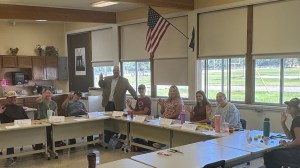
This week I’ve had the honor of being in Clyde Park, Montana at Shields Valley High School doing leadership development for high school students involved in FFA, BPA, student council, volleyball, basketball, and football. It has been a great week working with the students around the theme of “Everyone Is A Leader.” As is always the case, I am being inspired by the students as much as they are by me. One of the students, FFA officer Andrew Long, made the very profound comment on our first morning together that, “we need to be where our feet are.” This fit so well with our discussion of leading from where we are and that everyone is a leader and very quickly became a theme we kept coming back to.
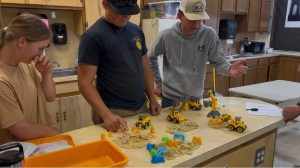
The phrase “we need to be where our feet are” means to fully focus on and be present in the current moment or place. It encourages mindfulness and paying attention to our immediate surroundings, rather than being distracted by past concerns or future worries. Essentially, it’s a reminder to stay grounded and engaged with what’s happening right now.
The leadership lesson from the phrase “we need to be where our feet are” is the importance of presence and mindfulness in leadership. As a leader, being fully engaged in the current moment allows us to better understand our team’s needs, make thoughtful decisions, and respond effectively to challenges. It encourages leaders to listen actively, be attentive to details, and prioritize the task at hand, rather than getting distracted by future uncertainties or past mistakes. Ultimately, it promotes authentic leadership rooted in awareness and connection, fostering trust and clarity within our team.
Experiences Over Experience

Today during a discussion with National FFA Teacher Ambassadors about who we influence and how we influence others, a teacher commented that sometimes she worried she lacked influence because others viewed her as not having enough years experience. This teacher is going into her third year of teaching and went on to say she has had a lot of experiences that others with more years of experience have not had. Did you catch the distinction here? I loved this and it is something I have always told teachers I’ve coached or mentored: Experiences trump experience!
While the number of years someone has spent in a field can give a general sense of their exposure, it doesn’t necessarily reflect the depth, quality, or relevance of their experiences. Considering the actual experiences of others allows us to understand their challenges, problem-solving approaches, and lessons learned in specific situations. This deeper insight helps us evaluate their true expertise and adapt their knowledge to our own circumstances more effectively. Ultimately, focusing on meaningful experiences fosters more genuine learning and growth than simply counting years.
Navigating Challenges

This weekend, for the finale summit trip of “THE Leadership Academy” program I facilitate for Hamilton Heights School Corporation, I named one of the activities, Navigating Challenges. The idea was that, just like a captain who must navigate navigate through changing waters, leaders can also learn to adapt to unforeseen challenges. The activity literally involved having a lunch celebration on a riverboat. Little did I know just how great that three hours was going to become.
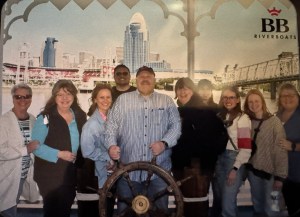
As we boarded the BB Riverboats flagship, the Belle of Cincinnati, the captain greeted us and checked us in. This really impressed us, but it was a Captain’s Lunch Cruise, after all. Here was the leader of the ship personally checking every person in. Those that know me won’t be surprised that I got into a conversation with the captain. The conversation led to us to being invited to visit the captain on the bridge. By now I was giddy – we had been invited to the bridge! I also set a goal of wanting to blow the ship’s horn.

After a wonderful lunch celebrating the group, enjoying the beginning of the cruise and Banjo Bob’s narration and music for a little while we ventured to the bridge. I called up to the captain and he gave us permission to climb to the bridge. Here we were, where it all happens – the navigation and steering of the ship. Our entire group was so eager to learn about everything. Our Captain generously discussed each piece of navigational device and each steering component. We were at the nerve center of the ship.
There on the bridge I viewed the rope used to make the ship’s horn blow. First, I must remind you of a Byron Rule: “The answer is always no, until you ask.” So I asked the Captain if I could blow the horn. He said, “No, there has to be a reason to blow the horn.” The captain then proceeded to give us an incredible lesson. He told us that when facing adverse conditions or an obstacle we must, “deal with it.”

Participants in our group asked questions about how our Captain dealt with it. He told us the key was to adapt and overcome. I asked again if I could blow the horn. He didn’t answer. The Captain proceeded to give us a strong leadership lesson on using our decision-making skills to effectively navigate adverse conditions. Here area few of the notes I jotted down while he was teaching us:
- Assessment of Situations: The captain continuously monitors weather patterns, river conditions, and any potential hazards. Accurate assessment helps in making informed decisions.
- Communication: Clear communication with the crew is essential. The captain must convey instructions, maintain morale, and ensure everyone understands their roles during challenging times.
- Calm Under Pressure: A good captain remains calm and composed, which instills confidence in the passengers and crew. This helps prevent panic and promotes rational decision-making.
- Strategic Planning: The captain develops contingency plans, identifying safe routes or alternative actions to take if conditions worsen.
- Teamwork and Delegation: A captain relies on their crew, delegating tasks efficiently and encouraging collaboration to ensure all hands are on deck.
- Experience and Training: Drawing on previous experiences and training, the captain uses lessons learned from past situations to guide their current actions. The Captain even explained how he would create scenarios for himself to prepare for adverse conditions, obstacles, or equipment failure/malfunction. This impressed us because he was not relying on someone to do this for him.
- Use of Technology: Utilizing navigation tools and technology to gather real-time data helps the captain make better decisions.
- Flexible Decision-Making: The captain must remains adaptable, ready to change tactics as new information emerges or conditions evolve.
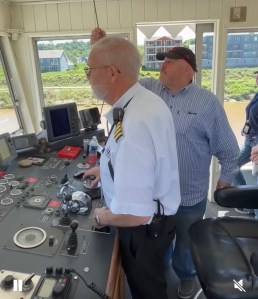
The Captain concluded by saying, “Don’t let it get to you because you have peoples lives at stake.” What a lesson on navigating challenges, changing waters, and adverse conditions to ensure the safety and success of the voyage. Just then he stated that we were coming upon another vessel approaching us from the opposing course. The Captain stated that on his command I could give the horn a five second blast (see photo). I got my wish! Don’t forget, the answer is always no until you ask.
Leading By Making Room for Other People’s Ideas
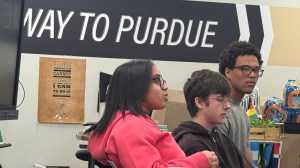
Yesterday, I had the opportunity to spend the morning at Purdue Polytechnic High School here in Indianapolis. We were there as part of the National Association of State Boards of Education’s High School Transformation State Network. There are six states that are part of the network: Washington, Missouri, California, New York, Kentucky, and Indiana. Of course, I was in my element – in classrooms spending time with students. We joined a chemistry class and I could not help myself but to take over a lesson on pH. As a former Ag Science teacher, pH, measuring the free hydrogen ions and hydroxyl ions, is a pretty important concept. Once a teacher always a teacher!
We also had a panel of students speak to us and spend time answering questions and offering advice. One student made a comment that really impressed me. She said, “I have learned to make room for other people’s ideas.” Wow, there was a future leader in the making. There are a lot of adults who have not figured that out.
Making room for other people’s ideas embodies a key principle of great leadership: openness to collaboration and inclusivity. Here’s what it means in the context of effective leadership:
- Valuing Diverse Perspectives: Great leaders understand that diverse viewpoints can lead to better decision-making and innovation. By making room for others’ ideas, we encourage a rich exchange of thoughts, which can enhance creativity and problem-solving.
- Fostering Collaboration: When leaders invite contributions from their team members, we create a collaborative environment. This not only boosts morale but also strengthens team cohesion as everyone feels valued and heard.
- Encouraging Engagement: Making space for others’ ideas promotes engagement and ownership among team members. When individuals see that their opinions matter, they are more likely to invest themselves in the outcomes of their collective efforts.
- Developing Trust: Leaders who are receptive to new ideas build trust within their teams. Team members are more likely to share their thoughts and take risks when they know we respect and consider their input.
- Adapting and Learning: Leaders who embrace others’ ideas demonstrate a willingness to adapt and learn. This flexibility is crucial in dynamic environments where solutions often require input from various sources.
It was great to be reminded yesterday by a young high school leader that making room for other people’s ideas is essential for fostering a positive and productive organizational culture, ultimately leading to greater success.
The Gift of Imagination

On Saturday, I wrote about Our Gifts & Force Multipliers. Today, as I think about all of us being gifts I consider George MacDonald’s view on imagination. He believed that everything of us humans must have been of God first. MacDonald said, “We discover at once, for instance, that where a man would make a machine, or a picture, or a book, God makes the man that makes the book, or the picture, or the machine. Would God give us a drama? He makes a Shakespeare.” I love this from from MacDonald’s essay, “The Imagination: Its Function and its Culture,” because it suggests that God created us all as gifts. MacDonald believed God created us in his own image to imagine all the things we do.
“We discover at once, for instance, that where a man would make a machine, or a picture, or a book, God makes the man that makes the book, or the picture, or the machine. Would God give us a drama? He makes a Shakespeare. Or would he construct a drama more immediately his own? He begins with the building of the stage itself, and that stage is a world–a universe of worlds. He makes the actors, and they do not act,–they are their part. He utters them into the visible to work out their life–his drama. When he would have an epic, he sends a thinking hero into his drama, and the epic is the soliloquy of his Hamlet. Instead of writing his lyrics, he sets his birds and his maidens a-singing. All the processes of the ages are God’s science; all the flow of history is his poetry.” “The Imagination: Its Function and its Culture” by George MacDonald first published 1867 in A Dish of Orts
MacDonald asserted “The imagination of man is made in the image of the imagination of God.” He suggested that human creativity and imagination reflect a divine quality. MacDonald believed that just as God is the ultimate creator, humans, being made in His image, possess the capacity for creativity and imaginative thought. We are gifts – every one of us! This idea emphasizes the notion that our ability to envision and create—whether through art, literature, or innovation—is a gift from the divine. MacDonald believed that the act of imagining something new is not merely a human endeavor but also a way to connect with the divine nature of creation.
MacDonald described imagination as the faculty that allows humans to give form to their thoughts, creating images and ideas that can be expressed in various ways. MacDonald suggested that our creative power highlights the significance of imagination in our capacity to create and understand the world around us.
Our Gifts & Force Multipliers
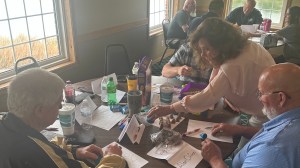
Yesterday, I did an all day professional development gathering for Wabash River Career and Technical Education and we did an activity using kinetic sand beach castle building. The idea was to develop a project-based learning lesson and create a rubric. When sharing out their great innovations, one instructor and owner of Thompson’s College of Cosmetology, Deanna Kindsvatter, referred to the other members of her project team as “gifts.” For example she said things like, “And Ron was a gift because he knew how to…” I don’t think I’ve ever heard teammates referred to like this. We should, however, consider our teammates and those we serve as gifts.
This made me reflect on a concept I think about in leadership a lot – force multiplication. A force multiplier is really a military science term referring to factors or combination of factors that allow personnel or weapons to achieve more than by themselves alone. In Deanna’s case she was highlighting the different positive impacts of the others in her group and amplifying the efforts of the team, leading to enhanced overall performance and success. Thus, she was acknowledging them as force multipliers.
It was so great to hear Deanna acknowledge others as gifts and it made me ponder how do we make sure we create environments for all our gifts to thrive and we ourselves serving as gifts to others. Here are some thoughts on being gifts and creating force multipliers:
- Empower Your Team: We must delegate responsibilities and trust our team members’ gifts. By empowering them, we multiply our effectiveness through their contributions.
- Cultivate Collaboration: We can encourage teamwork and collaboration among our team members and those we serve. When we work together we can achieve more than any individual could alone, creating a multiplying effect.
- Leverage Technology: Utilize tools and technologies that enhance productivity and communication. This can streamline processes and enable or teams to work more efficiently.
- Develop Others: We must invest in the growth and development of our team members. By mentoring and coaching them, we’re equipping them with skills that elevate the entire team’s performance.
- Build a Diverse Team: A diverse team brings different perspectives and ideas, providing a deep set of gifts, which can lead to innovative solutions. This diversity can amplify our team’s overall capability.
- Communicate Vision: Clearly articulate a shared vision and goals. When everyone is aligned and understands the bigger picture, it directs energy and resources more effectively.
- Foster a Positive Culture: Create an inclusive and supportive environment where team members feel valued. A positive culture enhances morale and motivation, leading to greater productivity.
Good Is Good

I was listening to a YouTube interview of one of my favorite artists, Amy Lee, and she made the comment, “Good is good.” I used to make a similar comment, “Good teaching is good teaching.” These thoughts emphasize the idea that something is inherently good, valuable, or worthy on its own merit, without needing further justification or comparison. We might teach using different styles or strategies, but good teaching is still good teaching. Lee’s point was that even though she doesn’t like country music, the genre doesn’t matter because “good is good.” She was suggesting a recognition of the intrinsic quality or positive nature of something, reinforcing the idea that goodness exists independently and should be acknowledged as such.
Amy Lee was a great person to prompt my reflections here because of her powerful and emotive voice, that has captured the attention of audiences worldwide. As I said, she is one of my favorites. Throughout her career, Amy has been praised for her artistic vision, profound lyrics, and ability to convey deep emotion through her music. In addition to her work with Evanescence, Amy has pursued various solo projects, collaborations.
As I reflected on the interview, I recognized that sometimes we, as leaders, overcomplicate situations or decisions. The phrase she used emphasized that goodness can be straightforward and should be appreciated for its inherent value, encouraging us to simplify processes and communications. No matter what we produce or what service we provide, we must have a clear understanding of what constitutes ‘good’ within our organization or community. This clarity can guide decision-making and align our efforts toward shared values.
Cultivating A Student’s Wisdom and Imagination

I was asked a question this week as to if the needs of all students can be met by career and technical education (CTE) courses. The individual asking the question also wanted to know about valuing career technical courses just as much as their academic courses and not viewing them as just another elective. First, I must point out that I believe every path matters for students and the needs of students can, and should, be met by the path best suited for the individual student.
My answer to the question was an emphatic, “Absolutely!” I went on to give examples and referred back to points I had made in my book, The Hand In The Back Of The Room. Teaching science through the context of agriculture employs inquiry-based teaching methods allowing teachers to expand students’ science skills and help mold lifelong learners.
Students who lack a connection with the relevance of science and math create a challenge for education and reinforce the need for core subjects to be taught in a relevant context. Career and technical education courses and programs offer this opportunity. The context of agriculture, for example, allows students to see, touch, smell, feel, and understand in a way that is meaningful to them. Learning in a relevant context allows students to use both wisdom and imagination.
Practice Makes Permanent

Last week during one of my Focused Leader Academy gatherings we did an activity around “mantras” as part of our core values series. We all have a mantra whether we know it or not. Those things we believe in and the values we always act on. Others we serve even develop mantras that they use when describing us. Mine, from when I was a principal, was “Make it so!” I always wanted everyone in the school to be empowered to think through what they needed so when they told me what they intended to do I could say, “Make it so!”
One of the participants at Silver Creek School Corporation last week, Grant Condon, was really engaged in this activity and it even created a productive struggle for him. He knew what he valued and what he believed he displayed as a teacher leader, but was having trouble putting it all together – he wanted to get it right. He asked if he could take the development of his mantra as homework. The teacher in me was loving it; he was asking for homework. I love it!
True to his word, Grant did the homework and sent his thoughts to me. His work on the mantra was outstanding and I asked his permission to share. 🎤 Get ready for the mic drop, because his response is a great lesson for us all. Here it is:
Good morning,
I have been thinking a lot about the mantra that I could not decide on during our last meeting on Wednesday. I wanted to focus on effort for it, which I am, but I think I was too set on having the word “effort” in it. The more I thought about it, the more I realized that I already know of the perfect one, and it doesn’t have the word “effort” in it.
When I was on the 5th grade basketball team we had two coaches. One of them was my dad and the other was the dad of one of my best friends. The two of them taught us a lot of fundamentals and foundations of basketball, but they both used the same quote all of the time. In life, you hear a lot of people that say “practice makes perfect”, but they made a twist to that quote that I really like. They always told us that “practice makes permanent”.
I love that for my mantra because it goes right along with giving effort. If you practice by sitting there and doing nothing, then that’s what you are going to bring to the table during a game(or test). Developing habits is what we do in practice. I like to think of classwork and homework as the practice, and the tests/quizzes as the game. When students won’t ask questions, pay attention, or even attempt the work given to them, that is practicing poor effort that will become permanent habits.
I am sure that I have plenty more that I could say about this topic, but I will save that for another time!–
Grant Condon
Silver Creek Middle School
8th Grade Math
Reflexivity And Curious George

Yesterday, I had the opportunity to do a workshop for our National FFA Teacher Ambassadors of the National FFA Organization at the National Association of Agricultural Educators’ Annual Convention that is a part of the Association for Career and Technical Education annual conference here in beautiful San Antonio, Texas. It has been a great week of learning, renewing friendships, and making new ones. For me it’s about always being curious. In fact, that is what our workshop was about: “Engagement Begins With Being Curious.”

Of course, there had to be a through-line using Curious George. Which also meant I had to get into character. Emoni White, Program Specialist, Educational Development on the National FFA team, even made sure I was able to truly be “the man in the yellow hat” and transformed herself into Curious George (see featured photo). It is great to work with people like Emoni who want to be curious and help me be curious about making sure we do great workshops and making sure the proper supplies are made available.
As I was listening to the reflections from our wonderful ambassadors yesterday, it made me reflect on what being curious is all about. It also made me think about reflexivity in leadership. Reflexivity, the unsettling comfortable viewpoints, is an important aspect of leadership. By challenging established norms and encouraging critical thinking, leaders can foster an environment where team members feel safe to voice diverse perspectives and question the status quo. This process may initially create discomfort, but it ultimately leads to deeper insights, innovation, and growth.
Leaders who embrace this discomfort contribute to a culture of continuous improvement and adaptability, which is essential in today’s rapidly changing world. They demonstrate that it’s okay to reassess beliefs and approaches, creating space for meaningful dialogue and collaboration among team members.
Curious George is a great example to illustrate reflexivity in a lighthearted way. The character of Curious George embodies a natural curiosity and an eagerness to explore the world around him. His adventures often lead him to situations where he needs to think on his feet, reassess his approach, and adapt to new challenges.
For leaders, this kind of mindset—much like that of Curious George—can encourage openness to learning from experiences, whether they lead to success or unexpected outcomes. Leaders who model curiosity and a willingness to learn from mistakes can foster a culture where team members feel safe to try new things, share their ideas, and engage in meaningful discussions about how to improve and innovate.
Reflexive leaders are often seen as more authentic and trustworthy. Their willingness to acknowledge mistakes and learn from them can strengthen their credibility and foster a sense of safety within the team. Finally, When leaders model reflexivity, they promote a culture of learning within their teams. Team members feel empowered to reflect on their own practices, leading to innovation and growth.
 Byron's Babbles
2 comments