Out of Kilter

We had a gathering of our Carolina’s 3D Leadership Program today and, as is always the case, I was inspired and learned a lot from the group. Last week I blogged about the activity where I showed the group the picture of a spider web that I had taken in the barn that morning to the group to prompt a discussion. You can read about Leaders Weaving The Web here. Today I switched up the prompt just a little. Here it is: On Day 247 of the Global Pandemic, relate the journey you are on to the picture. The picture was the photo featured in this post minus the target and dart. After having some time to discuss in small breakout groups, they came back with some very insightful points for discussion. This post includes all of their points except one: the picture looks as though we are looking through a filter. I will address that point in a separate post.
Looks Like a Target
It was commented that the web looks like a target. I loved a comment that was made that even though the world has been thrown “out of kilter” (this, from one of our participants, is so much better than saying unprecedented times), we still have much to accomplish for our students. We must still be meeting our educational targets for our students and developing them as a whole person. In other words we need to be very careful about what things we have paused that turn into permanent pauses. Some pauses need to be made permanent, but we really need to match what decisions we make to the targets that need to be achieved for our students.
Looks Like Broken Glass
One group of participants said the web looked like broken glass. This was a reminder that we must keep going. This reminded us that there has been a great deal of positive innovation brought by the pandemic. Also, we discussed that the pandemic cannot be used as an excuse to lower expectations. Our kids deserve effective instruction and like was said earlier we must continue to lead them to their learning targets.
Looks Fragile
The group pointed out that everyone is very fragile right now, but there is strength in the web. We need to make sure we are serving like the silk of the spider web connecting all the small, important pieces together for our students, families, and those we serve. We need to continue connecting ideas, which in-turn creates the beautiful masterpiece. Even though the web looks fragile, we need to remember that much of the strength of the spider web comes from its elasticity.
It turns out that a key property of the silk in the spider web that helps make it so robust is something previously considered a weakness: the way it can stretch and soften at first when pulled, and then stiffen again as the force of the pulling increases. Now that is a great metaphor for during this time of being out of kilter. We are being pulled and we need to soften and allow for being stretched, which will then allow us to stiffen and become strong for those we serve. Markus Buehler, an associate professor of civil and environmental engineering (CEE) at MIT, has done extensive research on spider webs says this about the web: “It’s a very flaw-tolerant system.” We need to also assume this “flaw-tolerant” position when dealing with students or those be serve.
Hopefully this being out of kilter is preparing us for a new phase of greatness in education, business, and our lives. With each day of the pandemic my hope is that we are assuming an attitude of preparation. I know I am very different today that I was 247 days ago. I’d like to think that most of those differences land in the positive column. Let’s keep moving forward – onward and upward!
The Education Catapult
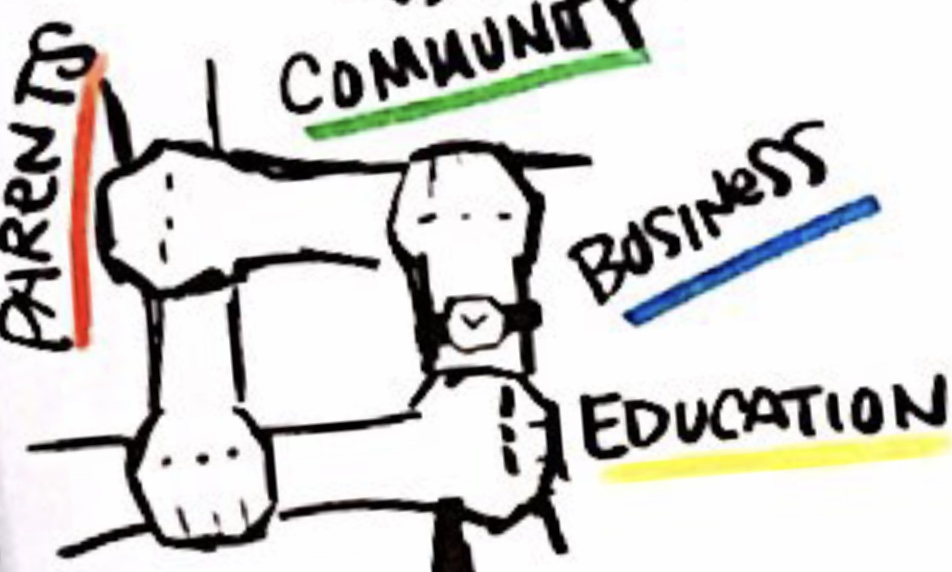
Last evening I had the opportunity to do some of what I call #LearningTogetherApart. Yesterday was Day 245 of the Global Pandemic and the webinar was entitled “Post-Election 2020: Charting a Path Forward in Education.” The webinar was put on by The Hunt Institute and the National Association of State Boards of Education (NASBE), which I am chair of the board for, was one of the partner organizations involved in making this conversation possible. Other partners were The School Superintendents Association, National Association of Elementary School Principals, National Association of Secondary School Principals, and National School Boards Association. And, what a great conversation it was. The panel included The Honorable Margaret Spellings, Former U.S. Secretary of Education (2005-2009), President & CEO Texas 2036; The Honorable Arne Duncan, Former U.S. Secretary of Education (2009-2015), Managing Partner, The Emerson Collection; Chancellor Richard A. Carranza, New York City Department of Education (2018-Present); and Superintendent Alberto Carvalho, Miami-Dade County Public Schools (2008-Present). As you can see this was quite the lineup of experience and expertise in the room.

Another highlight yesterday was receiving the new book Beyond The COVID – 19 Pandemic from authors Pradeep K. Kapur and Joseph M. Chalil. I am so glad that I started reading it in the space between the end of the work day and the webinar. In the preface of the book there are six questions posed for the global community to contemplate (p. xxi-xxii):
- What sort of changes are required at the policy level to cope with such pandemics in the future?
- How do we better equip global organizations to evolve for dealing with the challenges ahead?
- Do we need to think of setting up new organizations to replace the WHO and the UN?
- Can we have new paradigms for healthcare?
- How do we create reserves and stockpiles of essential healthcare supplies? Where will the money come from when the budgets are already under great stress?
- How do we get the global economy back on its feet?
As you can see, these are pretty good guiding questions and even though these are not education specific questions they could be great guiding questions for any conversation. Really, the answers to these questions need to involve education in every answer. The authors point out that the pandemic is the biggest disruption to our county in 100 years. In having studied the 1918-1920 pandemic, I am amazed that we are experiencing and struggling with many of the same issues we had then. I can’t wait to immerse myself into the book as these authors dream big and have offered solutions that are possible if we just reach political consensus and carry through to implementation (a core value of how I try to serve as a policymaker on the Indiana State Board of Education).
The panelists last night were also using their experience to dream big. I want to touch on a few thoughts they had by referring back to tweets I made during the conversation. Allow me to pick a highlight or two (or three) from each of the participants using tweets. You can check out all the tweets at @byronernest or by going to #ElectionEd2020. Here we go!
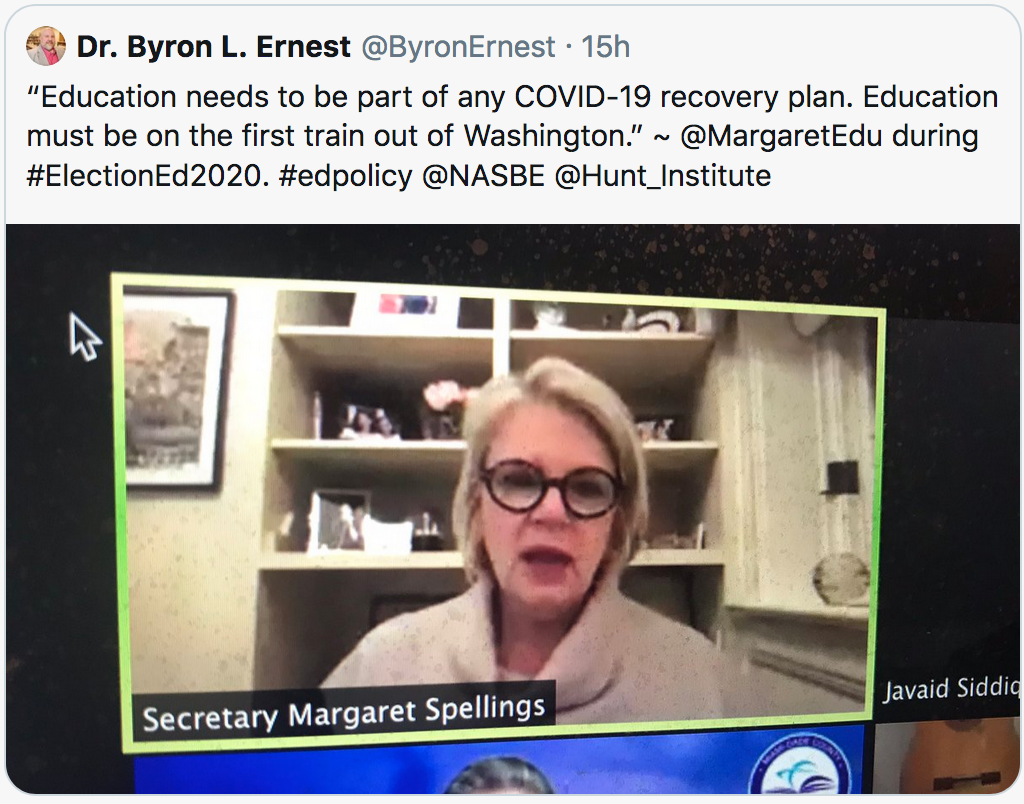
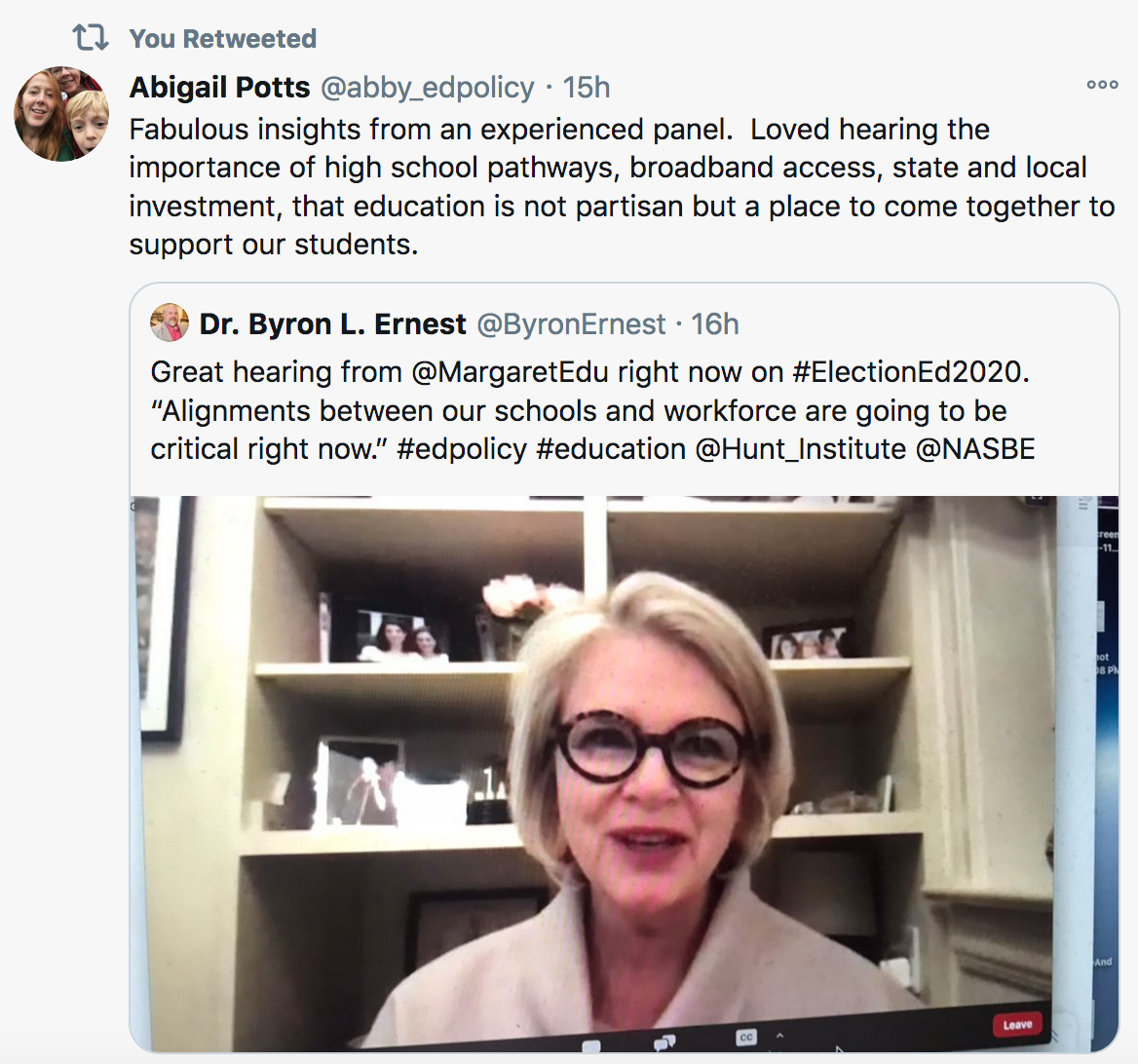
Secretary Margaret Spellings reminded us that education must be a major component of any pandemic recovery plan. As she said, “Education must be on the first train out of Washington.” And, she also reminded us that in order for there to be economic recovery, education must be involved. As a person who believes so much in the involvement of business/industry in education it gave me hope when she suggested that “Alignments between our schools and workforce are going to be critical right now.” This also includes continued alignments with higher education for all of dual credit, dual enrollment, Advanced Placement, internships, and work-based learning opportunities. We cannot let the pandemic take these away from our students. These opportunities provide for some of the greatest outcomes being afforded our students. I loved that Abigail Potts, NASBE’s Director of College, Career, and Civic Readiness, retweeted my tweet on this with comments that added the importance of our high school pathways, broadband access, and state and local investment. And, Abby pointed out in that tweet that education is not partisan but a place to come together to support our students. Thanks for the tweetversation (yes, I just made up a word), Abby!
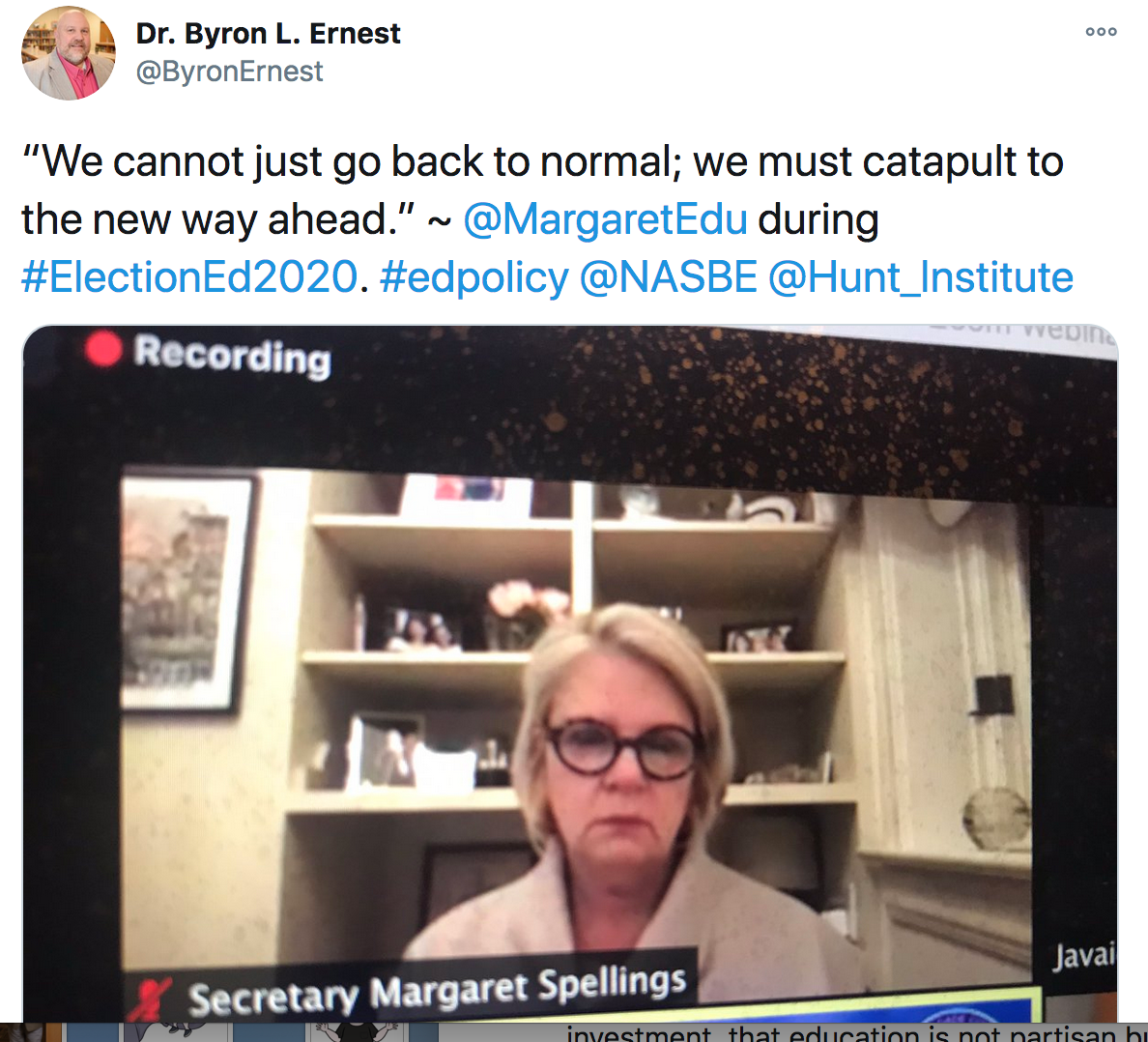
Additionally, I have to add in one more insight from Secretary Spellings. She reminded us that “We cannot just go back to normal; we must catapult to the new way ahead.” I love the way she put that. I have continued to say over and over we have to take what we have learned and apply it and never look back. “Catapult” was the best term that could have been used for this. Go back to the questions posed in Beyond The COVID – 19 Pandemic and put them into the context of education and that is exactly where Secretary Spellings is suggesting we need to go.
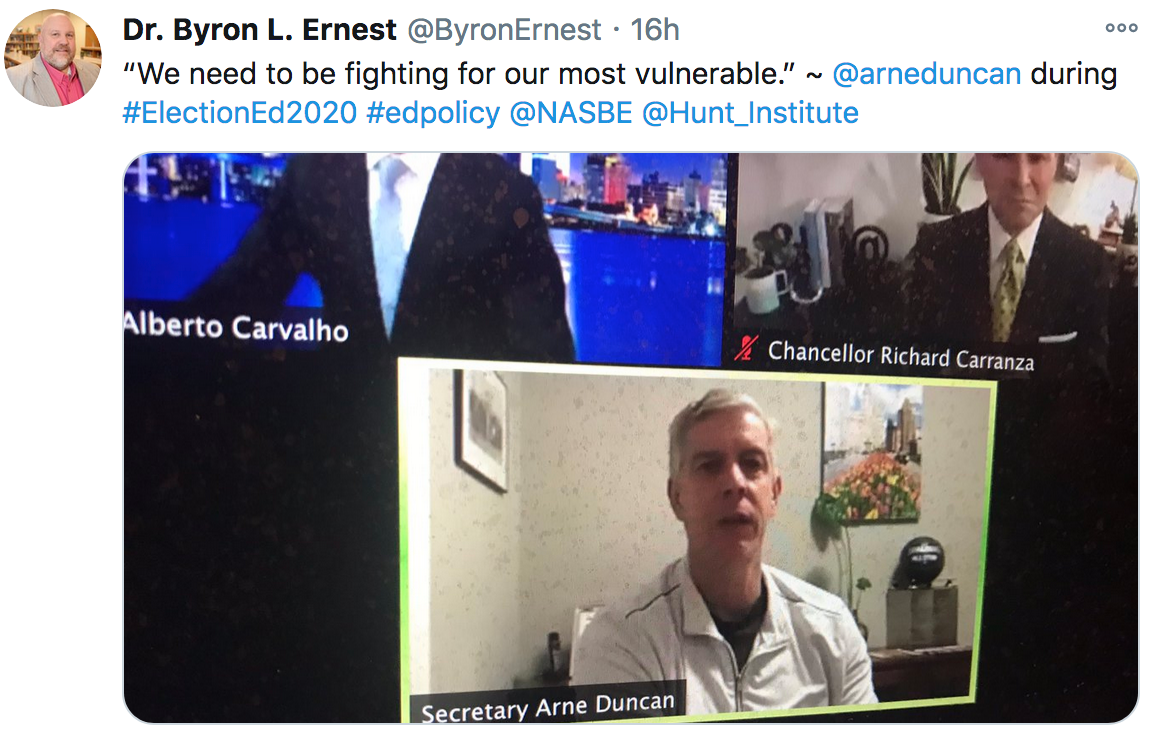
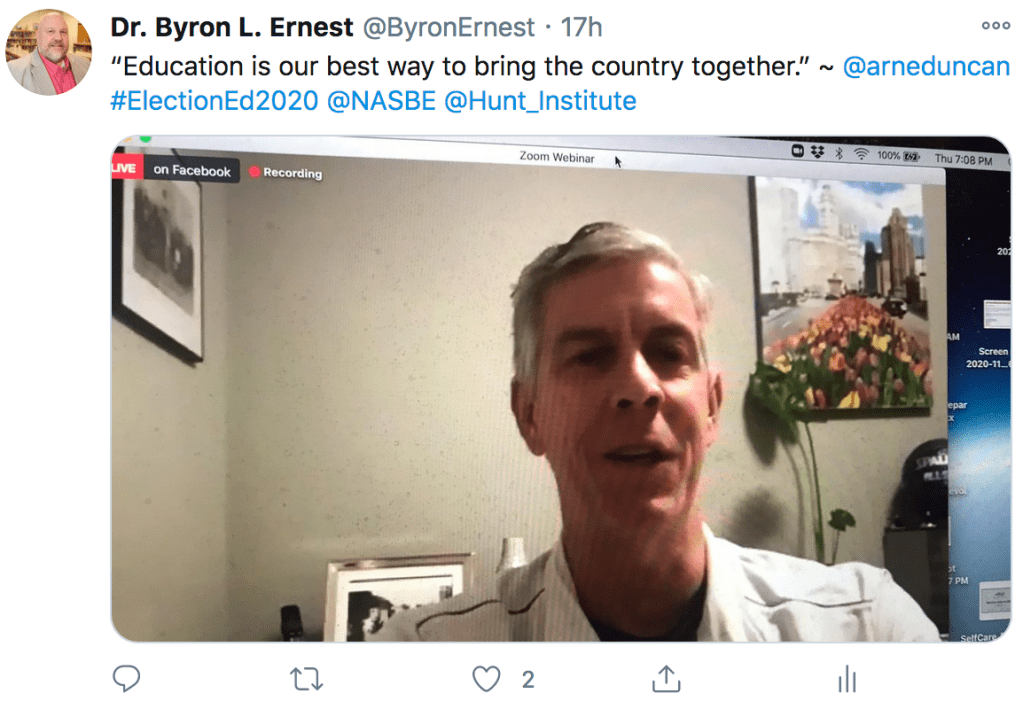
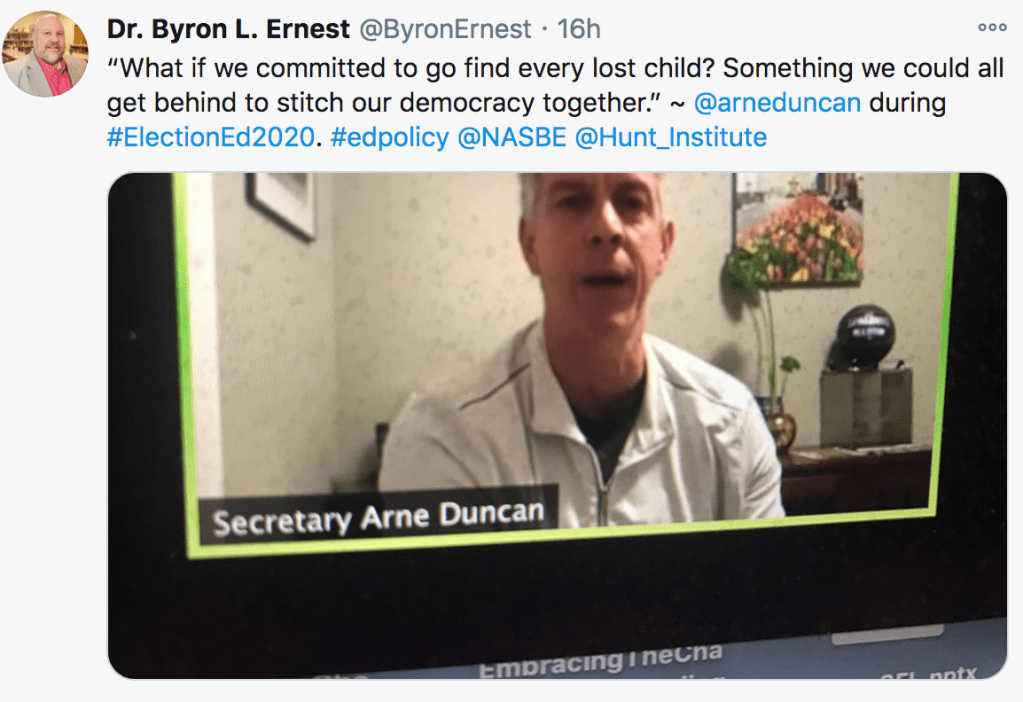
I got to know Secretary Arne Duncan during my service as 2010 Indiana Teacher of the Year. He is so passionate about doing what is right for ALL children. In fact he made this clear when he said, “We need to be fighting for our most vulnerable.” I’ve also been impressed with the non-partisan way in which he views education. He also reminded us that “Education is our best way to bring the country together.” He firmly gave us a call to action for stitching our democracy back together. He posed the question, “What if we committed to go find every lost child?” Wouldn’t it be great if we could reach some consensus on a vital few things we could all work on and begin our evolution dealing with educational challenges? Secretary Duncan finally reminded us that, “We need need a healthy debate/conversation, putting aside political ideologies, based on data. We need the courage to do some things differently.” Well said!
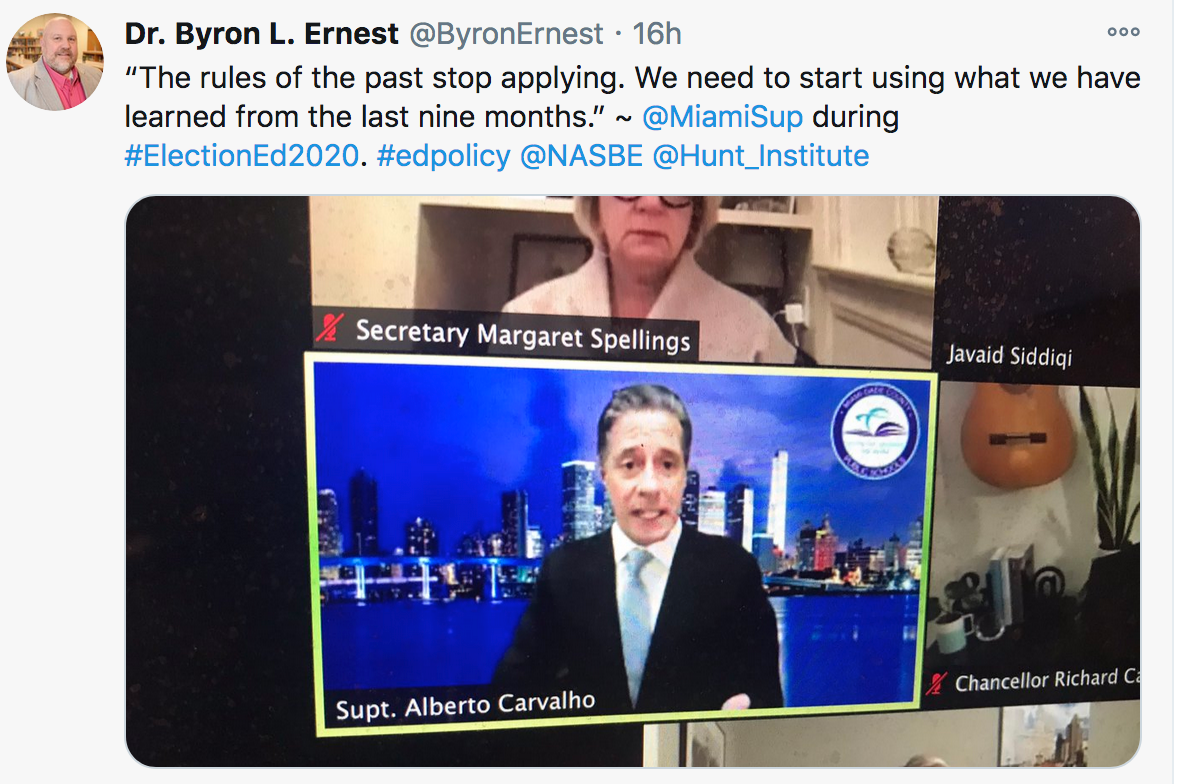
Superindent Carvalho and Chancellor Carranza brought great perspective to the conversation from street level at the school. Superintendent Carvalho taught us that “The rules of the past stop applying. We need to start using what we have learned from the last nine months.” Providing education to ALL children has been a continuing challenge for families, schools, local, state, and federal governments, and leaders around the world. To answer the challenge we have tried and need to continue to try different paradigms to equity in learning for all. In my opinion we must develop a system by which we are developing the whole child in every child. Also, we must develop an ethos that sees the potential in every student. As a policymaker I use the test question of “Will this policy reduce inequity, maintain inequity, or increase inequity?” to inform my decisions. As I listened to these two school leaders I thought about how, after 245 days, we really need to assess what to de-prioritize and what needs to be prioritized.
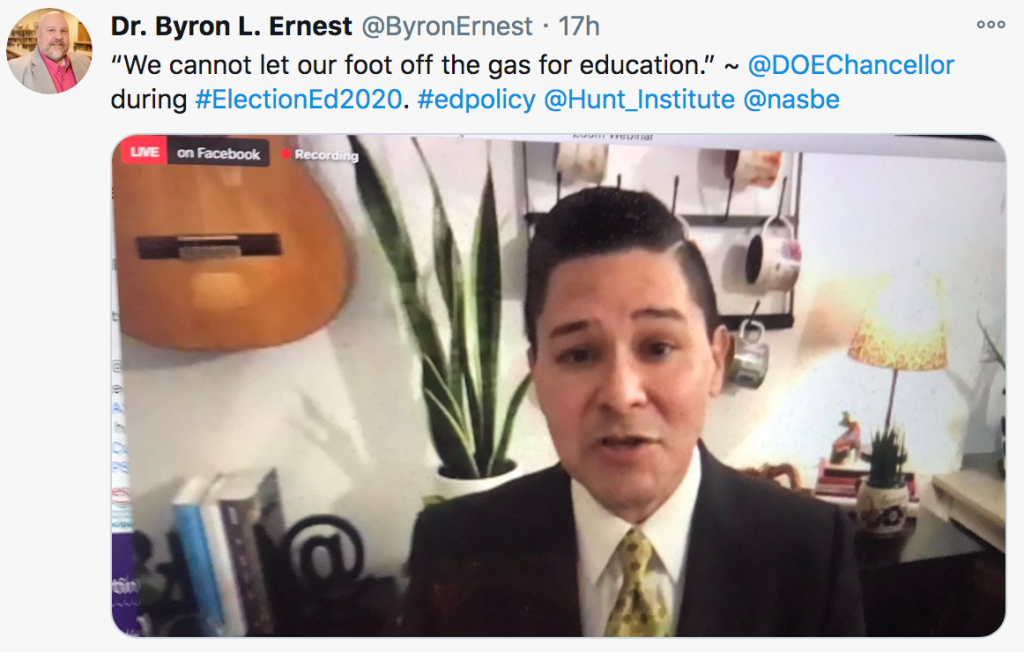
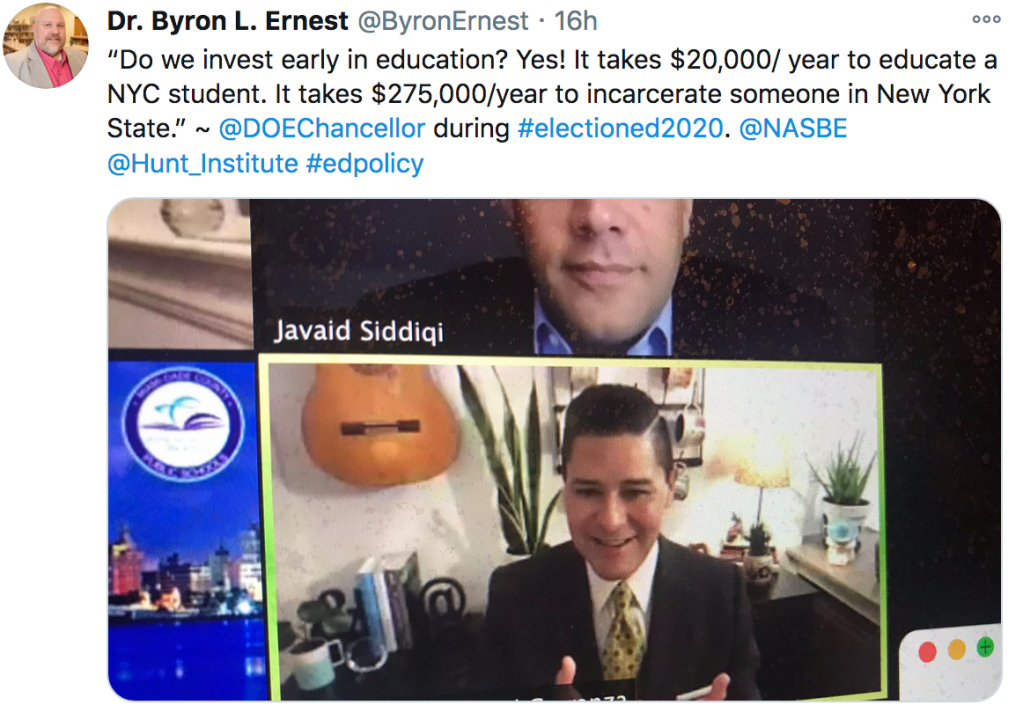
Chancellor Carranza warned us to not “let our foot off the gas.” Some might argue that in some areas we need to put our foot on the gas, but those are the areas that Secretary Duncan told us we need to all get around and start working together on. When speaking of early childhood education and education funding in general, Chancellor Carranza gave a very real example by asking and answering his own question: “Do we invest early in education? Yes! It takes $20,000/year to educate a NYC student. It takes $275,000/year to incarcerate someone in New York State.” This was a reminder to us all how important an investment education is. And, let’s not forget the economic impact of having students prepared for our ever changing workplaces. Additionally, I think a lot about how we need to identify all the reasons for our students’ learning struggles. This goes beyond having devices and internet access. It takes us into the support structures in place or not in place for the student. We must have the whole portrait of student if we are create the ideal environment for learning.
As you can see, this was quite the discussion and I’ve only scratched the surface. This truly was a conversation, not an interrogation around defining the challenges and how to best disrupt education with the exponential learning we have done during the pandemic.
Spreading The Wealth

Over the weekend a teacher leader asked me how her principal should be deciding which teachers should get development opportunities and be empowered. I said, “That’s easy; all of them should be getting those opportunities.” As I learned from Kim Scott, author of Radical Candor, everyone has potential. Everyone should have empowerment and opportunities for development. Really, our teacher leaders should all have individualized development plans. Therefore, everyone should be in development mode and be empowered to lead from where they are. Everyone is a leader, so leadership should happen whenever and from wherever it is needed. We need to be very careful to not fall in the trap of “earned empowerment.” In other words only empowering the chosen ones who someone thinks has earned it. This might yield empowering and developing 10% at best. I blogged about this in Earned Empowerment is Dangerous.

Then tonight I was reminded how important it is to have the whole team empowered and ready for action. In the first quarter of the New Orleans Saints big 38-3 win over the Tampa Bay Buccaneers, quarterback Drew Brees had thrown completed passes to nine different receivers. At the end of the first half he had thrown completions to 12 different receivers. That is a big deal. Think about how much more successful the Saints are with that many empowered targets.
So, we probably better take a page from the Saints playbook and empower and develop everyone. Think about it; if we are able to empower all of our people with projects and responsibilities, aren’t we really expanding the capacity of our organization. Really, mass empowerment equals capacity building. This in turn means leadership development of our teams. It also allows us to tap into all of our resources and expertise, which can lead to achieving amazing results.

Great leadership is shifting from telling everyone what to do, to empowering and developing everyone to be ready to come up with the best and brightest ideas and solutions that have ever been thought of before. This will give you a receiver core for big wins like Drew Brees and the Saints.
Leaders Weaving The Web
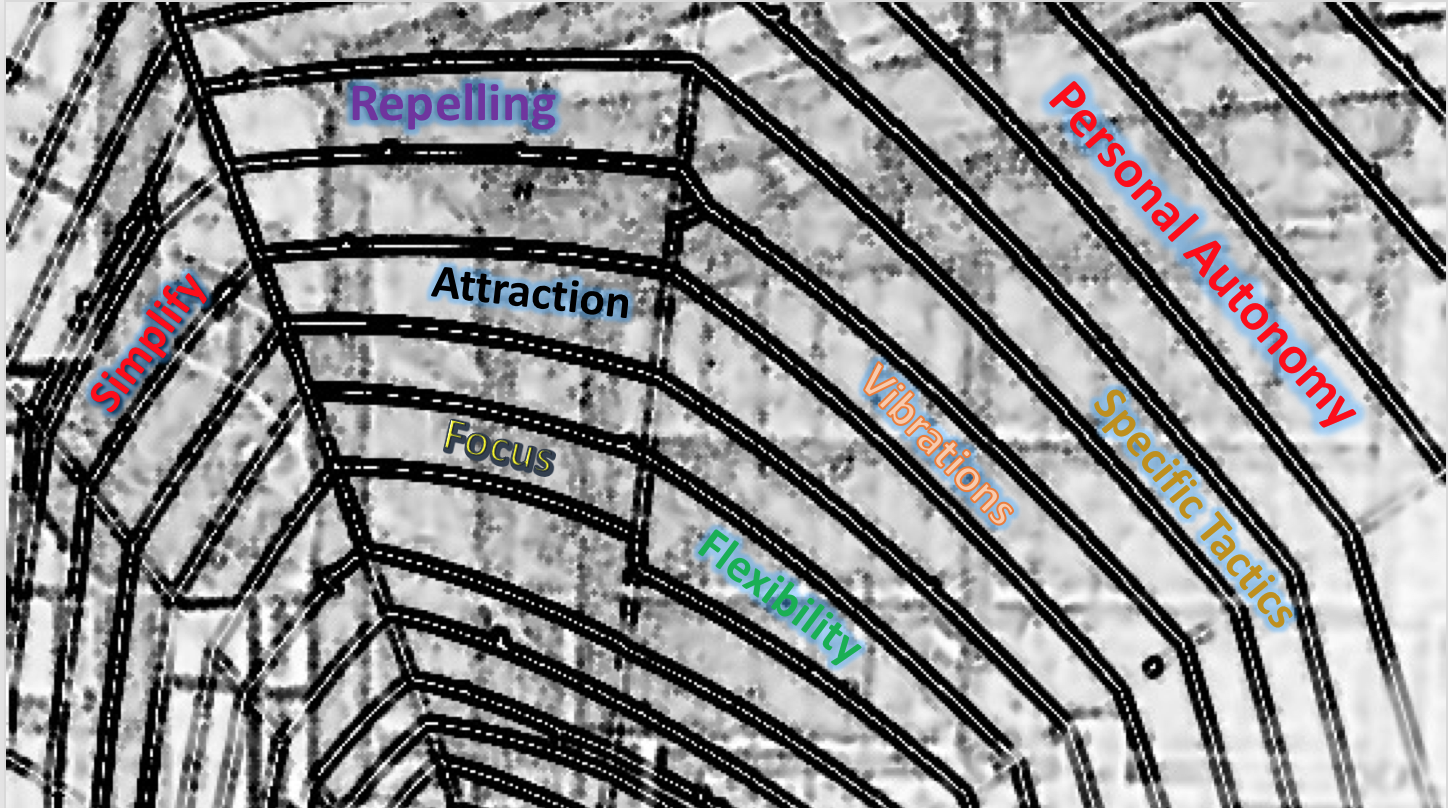
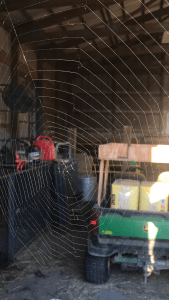
This morning when I went out to do the morning feeding I saw a very beautiful spider web as I went in the barn. It was so awesomely constructed I had to take a picture and then I got the inspiration to use it in a 3D Leadership Gathering I was facilitating for our Florida participants today. I had them relate the spider web to their leadership development during the last 240 days of the Global Pandemic. A great way to describe leadership is to compare the construction and function of a spider web. Just like each strand of web is carefully woven in just the right places for a spider to capture what’s necessary for it to survive, an effective leader also weaves attributes that attract and nurture those the leader serves. Each strand of that web is a specific tactic the leader can use to engage and influence.
We discussed the vibrations that happen when something touches or gets caught in the web. These vibrations go quickly through an organization so communications should be chosen carefully. A leader should have a meaningful feel of what is going on at the ground in the organization, and that he or she should want to be in touch with the whole organization through effective representatives, reports, liaisons, collegiality, and partnerships within the organization. Leaders should constantly work towards enabling their organizations to become intricately woven groups of people in harmonious partnership.
We Voted!
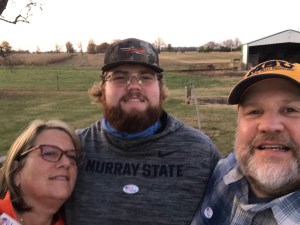
Today was a very special day. First off, it was Election Day; a very special day for our democratic society. It was even more special because my son, Heath, chose to come home from college to vote in person. It was his first National election he was eligible to vote in. He wanted us to go as a family. Of course, I was excited to have him home and I was proud he wanted to go together to vote. From a young age Heath always went in to vote with me before we went on to school and then would proudly wear his “I Voted” sticker into school. He was such a cool kindergartner!
This got me to thinking about how much our children learn about civic responsibility from their parents and other adult role models. Heath has always seen me take the ballot seriously and we even discussed the school board and judge candidates. I’m proud that Heath understands his role and civic responsibility in the local, college, state, national, and world communities he lives and belongs.
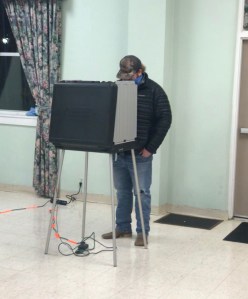
In doing a little studying on the topic I learned that, “Civic engagement during adolescence predicts adult volunteering and voting. Furthermore, civic engagement during adolescence can promote positive developmental outcomes, particularly for marginalized and at-risk youth” (Middaugh, Clark, & Ballard, 2017, Pediatrics, 140). This really got me thinking about the civics experiences we need to be giving our children and students. They need to be given opportunities for civic engagement. These need to be project-based so the students are actually engaged in real world community experiences.
Bottom-line: parents who involve kids in elections raise civic leaders! By involving our children and our students in civic engagement and exposing them to the voting process teaches them real-life lessons in democracy, and it helps show our communities and country that families matter and have a powerful voice.
An Invitation
“It is such an honor to be part of a community of citizen leaders who seek conversations by showing up through invitation rather than mandate, and the diverse gifts of each person are acknowledged and valued. Together we will answer the question, ‘What can we create together?’ so students of all backgrounds and circumstances are prepared to succeed in school, work, and life.”
~ My remarks on October 22, 2020 when accepting the gavel as Chair of the National Association State Boards of Education Board (NASBE) of Directors
The remarks above come from the personal core values I have developed from being a student of Peter Block. Peter Block’s name is synonymous with “Community” and he literally wrote the book on it: Community: The Structure of Belonging. I first became acquainted with Peter through my great friend Mike Fleisch. Mike kept telling me that everything I believed in was aligned with Block’s values as well. Mike told me I just had to read the book, Community, and that I would learn so much from Peter Block. So, I began reading and studying, and have since had the chance to visit with Peter Block a couple of times. The bottom line is that everything we do is as part of a community whether it is an organization, neighborhood, city, country, or world that works for all. We need to take our membership in these organization, truly belong, and then be accountable for the leadership of making communities great to be part of.
So, my post here deals with an organization, the National Association of State Boards of Education (NASBE) – let’s call the organization a community. A week ago I took the helm as Chair of the Board of Directors and I reflected back on how I really came to be so involved and belong in this organization. It all happened because of one of the most powerful tools that Peter Block says we have in a community in the power of the invitation. The question becomes “Whom do we choose to invite into the room?” In our case as an organization made of state boards of education and their members, that’s who we want to invite, right?
“If the artist is one who captures the nuance of experience, then this is whom each of us must become.” ~ Peter Block
(Block, 2008, p. 9)
That is where my story begins. Shortly after being appointed to the Indiana State Board of Education back in 2015, fellow board member, Gordon Hendry, personally invited me to attend the NASBE New Member Institute. Peter Block would remind us how powerful the invite is “because at the moment of inviting, hospitality is created in the world” (Block, 2008, p. 117). Gordon told me about NASBE and how valuable the organization would be to my development as a board member and how awesome the New Member Institute is. Here’s the deal: any new state member can go to New Member Institute. But, here’s the big deal: Gordon Hendry had asked me to attend and raved about how great it was. How could I refuse? I couldn’t abdicate my responsibility to the communal structure. I registered and I attended. I didn’t just attend, however, I became a part of the fabric of NASBE and was woven into the fabric of a collective community of great citizen leaders from all over the United States, including Guam.
This transformation from thread to fabric happened because another group from Delaware (without consulting me, I might add) nominated me during the Institute to serve as the New Member Representative to the Board of Directors. First of all, how cool is that? Quite an honor coming from my new east coast friends. Secondly, how cool is it that an organization has a new member sit on their board? What a way to truly get to know customer needs, right? Anyway, the members from Delaware nominated me and a day later somehow I was elected to serve on the Board of Directors (and there were even three other candidates). The rest is history or history that is still being written. I served two years as New Member Representative, then two years as Secretary-Treasurer, then a year as Chair-Elect, will serve this year as Chair, and then next year my final year on the Board will be as Past-Chair.
Again, what a ride that is still running. Here’s my point in all this: none of this would have happened without the invitation from Gordon Hendry to be at the “table” and then the Delaware delegation further weaving me into the social fabric by nominating (a form of invitation) me as a New Member Representative on the Board. Peter Block taught us that, “To build community, we seek conversations where people show up by invitation rather that mandate, and experience an intimate and authentic relatedness” (Block, 2008, p. 93). We need to have diversity of thinking, dissent encouraged and valued, and the gifts of everyone valued.
Our NASBE community is an asset-based community that is continually evolving because of the tremendous aptitude of our members. Together we continue to advance education equity and excellence for students of all races, genders, and circumstances by answering the question, “What can we create together?”
What do you have going on, and who do you need to invite? Go ahead and bring some more hospitality to the world!
Knowing The Water

Yesterday I assumed the role of Chair of the National Association of State Boards of Education (NASBE) Board of Directors. The day before, in a meeting, I was introduced with the byline that in 24 hours I would be taking the helm. I’m not sure why, but I shivered a little at this. I even said, “I’m not sure what to think about that.” Then, our NASBE Northeastern Area Director, Dr. Audrey Noble (Delaware State Board of Education member) who is an avid boater/sailor said, “You’ll be fine. The key to success at helm is about knowing the water, and you know it well.” She had made a powerful statement there and had said a lot.
Later, as I reflected on that interaction, I remembered an awesome story that came out of World War II. And, of course, the story involves the great leader and 34th President of the United States, Dwight D. Eisenhower. The story goes that he went to the tent where his soldiers were mapping out a location for the troops to cross a river. Eisenhower pointed at a spot on the map and said, “We will cross here.” One of his troops said, “We cannot cross there, Sir.” Eisenhower asked why not. They told him they were not sure how deep the water was. Eisenhower pointed to his dampened pants leg and said, “It is this deep.” Clearly, he “knew the water.” Eisenhower had taken the time to actually get his feet wet and know where he was sending his troops.

Leadership by example and working shoulder to shoulder with those you serve continue to be the most successful forms of leadership. These concepts can take many different forms, but is expressed well with the phrase that is on a picture that hangs in my den, “Walk The Talk.” Walking the talk is one of my core values. It really speaks to the fact that our character is our legacy. If we say we believe or will act in a certain way, then our actions should prove that. I blogged about this in Walk the Talk!
A helmsman relies on his knowledge of the water he is in, visual references, GPS, other technological tools, and a rudder angle indicator to steer a steady course. Leading in an organization is no different. One must “know the water.”
Shine Brighter
Today in Chapter 8 of Mindset Mondays With DTK, David Taylor-Klaus (DTK) used Marianne Williamson’s classic poem Our Greatest Fear to point out we should “Play Bigger.” There is the greatest question ever in her poem: “…who are you not to be?” As Williamson makes very clear; we are designed by God to be brilliant, gorgeous, talented, and fabulous. The wonderful part is that “brilliant, gorgeous, talented, fabulous” looks different on each one of us. Therefore, we must go out and BE! We must BE brilliant, gorgeous, talented, fabulous in carrying out our bold purpose in life. Here is the poem:
OUR DEEPEST FEAR
By Marianne Williamson
Our deepest fear is not that we are inadequate.
Our deepest fear is that we are powerful beyond measure. It is our light, not our darkness that most frightens us.
We ask ourselves,
“Who am I to be brilliant, gorgeous, talented, fabulous?” Actually, who are you not to be? You are a child of God.
Your playing small does not serve the world. There’s nothing enlightened about shrinking
so that other people won’t feel insecure around you.
We are all meant to shine, as children do. We were born to make manifest the glory of God that is within us.
It’s not just in some of us; it’s in everyone.
And as we let our own light shine, we unconsciously give other people permission to do the same.
As we’re liberated from our own fear,
our presence automatically liberates others.

My favorite part of the poem is: “We are all meant to shine, as children do. We were born to make manifest the glory of God that is within us. It’s not just in some of us; it’s in everyone.” You heard that, didn’t you? “Everyone,” yes, “everyone.” We all get to shine! Think about those who have inspired you the most. You’ve probably noticed that these are people who are tapped into something bigger than themselves – the ones who leave us craving that same feeling for ourselves. So what is the difference between you and that extraordinary individual? I got news for you – NOTHING. Stop playing small, and shine.
How can you play big and shine even brighter?
Don’t Overlook The Brilliance Of Our Students
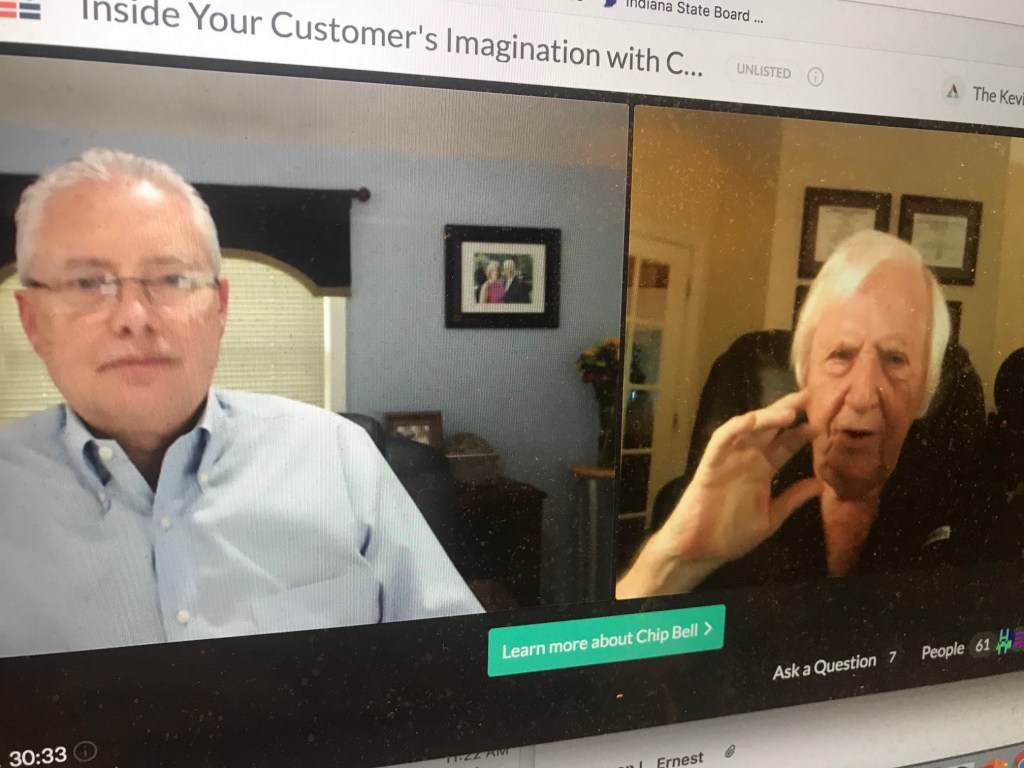
I’m still getting caught up on my reflection of the lessons from Kevin Eikenberry’s Virtual LeaderCon last week. This post is about Chip Bell’s response to my question about where education and the students we serve fall into the realm of the work he has put together in his latest book, Inside Your Customer’s Imagination: 5 Secrets For Creating Breakthrough Products, Services, and Solutions. The first thing he said was, “We must treat students like customers, not consumers.” There is brilliance in our students that so many times gets overlooked.

I asked Chip to go into a little more detail about treating students like customers and not consumers. To this he stated that we have board meetings and where are the students (I’m excited that many states have put students on their state boards of education – I’m still working on Indiana)? But, local school boards should think about student members in some capacity, too. He also asked us to think about where the student was when we were having planning meetings. Chip explained that everything we do should “have our customer’s fingerprints all over it.” He used the example of when we coach little league baseball we tell the kids to “be the ball.” We need to be telling our students to “be the customer.” And, then letting them be the customer. Chip believes our students should be partners along with our students’ families. He promotes student-staff partnership initiatives.
Chip Bell reminds us that customers can give us our best next idea. We should be asking the question, “What is something no-one else has ever thought of?” This discussion reminded me that the words “customer” and “consumers” are often interchangeably used and are easily confused with one another. While students are consumers and the ultimate user of the product, we need to treat them like customers – the person buying the product. We need to think of our students as a final customer– these are the customers who buy the product for their own need or desire. This kind of thinking will help us to better individualize education for every student.
We must innovate. Listening to our students will help us to do this. We can’t keep offering the same thing over and over and over again. We owe it to our students to be authentic. As Chip told us during Virtual LeaderCon, “Authenticity wins every time.”
Precisely What Students Need

Yesterday I had the opportunity to spend the morning at Heartland Career Center with the Mark Hobbs, Director; Lori Dubois, Precision Agriculture Specialist; and, most importantly, students of the new Precision Agriculture Program at Heartland Career Center. I say I was at Heartland Career Center, but actually the bulk of our time was spent 15 minutes from the school in the field.

We were out on McKillip AgVenture land learning about seed genetics and the start to finish process of their seed corn operation. Last week the students had sorted seed corn as it was being harvested. This is just one of many partnerships that has been formed so that students can get real world and relevant content for learning.

This all took me back to my days as an Agriculture Science Teacher and our partnerships with AgReliant Genetics and our students doing real research for the company in our school greenhouse alongside geneticists. As I always say, “School work must look like real work.” I talk about that a lot in my book, The Hand In The Back Of The Room.
I am passionate about this program and have had the opportunity to be part of many of the planning meetings, served as a champion, have helped remove obstacles along the way, and helped make connections where I could. One of the many things I love most about this program is that it was developed shoulder to shoulder with business and industry. The very businesses that will be hiring students from this program, helped design the program. Novel idea I know, but you’d be surprised how often this does not happen. Students are able to leave this two year program with an Unmanned Part 107 Drone Certification, Chemical Applicator License, and a Class A Commercial Drivers License (CDL).

Yesterday, I had the opportunity to experience drone flying first hand. In fact this was the very first time I had ever flown a drone. We’re not talking some toy drone, but a commercial drone like would be used in precision agriculture businesses. I was shocked at how quickly I was able to learn to fly the drone. The students did an incredible job of teaching me. Here are two videos of me piloting the drone:
This two year program of study prepares students for careers that bridge the gaps between agronomy, agriculture, machinery management, and data analytic sciences caused by the rapid evolution of high-speed sensor agricultural technology. This is all stuff that fascinated me. We even got into a discussion about artificial intelligence, which is an area I have been exploring with some of the work I have been doing with SMART Factory League, globally.
This program is truly making school work look like real work! Well done!


1 comment