Developing & Supporting Our Students: Future Identity Versus No Future Identity
On Monday I had the opportunity to dig deep into adolescent development and how this plays into future aspirations, beliefs, and behaviors of our students. I was introduced to identity development by Dr. Mandy Savitz-Romer of the Harvard Graduate School of Education. She advocates that articulating aspirations and expectations, forming and maintaining strong peer and adult relationships, motivation, and goal setting should become a part of our DNA in education.


Mandy has so much knowledge in adolescent development and how to advance student success. In fact, she has quite literally written the book on it. We were given her new book this week, Fulfilling The Promise: Reimagining School Counseling to Advance Student Success. I am almost done with it and have to say it is awesome. I am sure you will be seeing blog post from me about the book in the near future.
 There was also the opportunity on Monday for learning from Roberto Gonzales who is the preeminent academic expert on undocumented immigrant youth and the struggles they face. It was great to spend time with him because he has spent time with these youth getting, as he called it, “a worm’s eye view.” He understands how these issues play out in real-life. Most powerful for me was the idea of our undocumented immigrant youth straddling two worlds: neither from here or there. No one should have to live like that. Additionally, it was so powerful to gain an understanding, and I still have a huge amount to learn and understand, of the undocumented youth’s transition to “illegality.” As Roberto taught, illegality is not a noun but a verb as undocumented students move from protected to unprotected. I really needed this learning and can’t wait to read his book, Lives in Limbo: Undocumented and Coming of Age in America (University of California Press).
 Then, if that was not already a lot of learning in one day, there was Dr. Anthony Abraham Jack. He wrote the book, The Privileged Poor: How Elite Colleges Are Failing Poor Students. Our interactions with students matter. I was struck thinking about how some of our engagement strategies favor a selected few – the students we like, that impress us, and we know. What about making sure we have the chance to know all students, not just the ones that are inherently comfortable interacting with teachers. We need to help all understand how to do that. One way he advocates for is office hours. But not like we have always done office hours. Office hours need to be collaboratively with students understanding exactly how they work. Students also need to be comfortable in asking questions and bringing anything to office hours.
As I did for Sunday’s learning this week in Thriving Students, here is my top 30 list of takeaways from the day of learning:
- Information ≠ Action
- A
college goingfuture identity - Dimensions of identity: groups, roles, self concept.
- Marshaling: how do we use our resources.
- Throwing forward: seeing oneself in the future.
- Self-efficacy is the belief in the ability to accomplish a specific task.
- Self-efficacy is domain specific.
- We all have the ability to build self-efficacy.
- What shapes self-efficacy?
- Mastery of experience
- Vicarious learning
- Social persuasion
- Affect
- The “why” students go to college is very important.
- There is a big difference between wanting to go to college and someone telling you they want you to go to college.
- Motivation = Goals + Beliefs
- Students need to be better planners for obstacles. We need to be their GPS and give them three different routes.
- Control of Thoughts + Control of Emotions + Control of Behaviors = Self Regulation To Attain Goals
- Many students straddle two worlds; they are neither from here or there.
- We need to pay attention to how issues play out in real life.
- We forget how powerful having an I.D. card is to a person.
- Access is not inclusion.
- Beware of unwritten curriculum – the unwritten rules of getting along in an institution.
- We need to teach students how to interact with teachers and faculty.
- Doubly disadvantaged = Lower Income + Attended Public School
- Privileged Poor = Lower Income + Attended Private School
- Secondary school and college officials disproportionately reward proactive engagement strategies. Instead of who deserves reward, it becomes who we like, who we know, and who impresses us most – not necessarily the deserving students.
- Impress upon students it is more than normal to ask for help.
- It is smart
- It is expected
- It is rewarded
- We must inspire students to build an inter-generational support network.
- There is a difference between building a network and networking.
- Language matters.
- We need to make explicit what is now hidden to our students.
- We need to make basic things accessible and digestible for our students.
- We need to partner with families and promote our parents as super heroes.
Think about how great our country’s education system would be if we were able to make all 30 items above values that were in the DNA of our system and not just desired practices or boxes to check?
Thriving Students
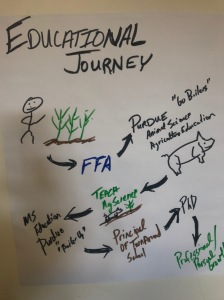 I have been learning at Harvard University this week on post-secondary success. As an exercise to help myself digest all of the information and make some sense of the learning, I like to come up with a top list from each day. This day’s (Sunday, June 23rd) learning came from Mandy Savitz-Romer and Francesca Purcell, and included learning about post-secondary gaps and opportunities and the data and trends behind public policies to increase post-secondary success.
One of the things that really jumped out at me from the reading and learning was the introduction of the Thriving Quotient. I was very interested in the thought and reality is that we always want to measure student success primarily in terms of academic performance and persistence to graduation. I became enthralled when reading “The “Thriving Quotient”: A New Vision for Student Success” by Laurie A. Schreiner, where she introduced this assessment tool. Thriving students are academically successful and also believe themselves to be part of a community and psychological well-being. These things make it possible for the student to get the most out of their educational experience. The thing I like about Academic Thriving is that it goes beyond what I call compliance – attending class, doing homework – going through the motions. In the Thriving Quotient, Academic Thriving students are psychologically engaged in the learning process. What really resonated with me about this was that the idea of making a connection between what the student already knows or is interested in. This connection to relevant contexts helps the student be an engaged learner and THRIVE.
The Thriving Quotient also includes Intrapersonal Thriving. This thriving is about the student having a healthy attitude toward themselves and the learning process. Additionally included is Interpersonal Thriving. We can’t truly thrive without relationships. So, time spent on the Thriving Quotient and so much other discussion on Sunday led to the following top 20 list of things learned:
- Learning with and from each other from different sectors.
- Pull don the walls and step outside our lanes.
- We have to get the singular narrative out of our mind.
- Sometimes we are creating a narrative for students that does not fit their why, or what is best for them.
- Actions of students do not match their aspirations.
- Only 10% of students that drop out of college had below a “C” average.
- Student problems vs. institutional problems
- We highlight student problems, but sometimes instead of highlighting problems, we need to change the process.
- With multiple pathways available to students, we need to make sure we are sorting in a way that is about best fit, not about other factors.
- We need to get better at moving from thinking about student success in terms of just quantitative box checking like graduation rates, number of applying or accepted to college, and test scores by moving to the idea of students THRIVING!
- We can’t think of college as just one singular thing because there are many different outcomes from many different types of colleges.
- The highest stakes tests students take are the placement tests once in college. Then, in some cases, we waste the students’ time in developmental education.
- We must find a way to scale up the things that work!
- A college credential is a solid investment that will pay off over time.
- More likely to give back to the community and vote
- Higher levels of personal well-being (health, et cetera)
- Higher earnings and tax payments
- What is it that the adult wants, versus what the student wants.
- Adults always think we know best, but many times we don’t know all the options, or nor does the student know all the options.
- “College is not for everyone, but it is for everyone that looks like you when you are a school.”
- We maybe need to think about amending the 14th amendment of our constitution to include higher education.
- We are nearing universal enrollment in college. What does this mean?
- A
college goingfuture identity.
As you can see, there was a lot to digest after a single afternoon of work. If any of these statements resonated or made you think, please comment here on this post.
Strategic Urgent Action

My son Heath’s Pin Oak Tree
Fostering Innocence
Recently, in a meeting, someone made the comment that we need to create places where innocence is fostered for our children. This really got me thinking about how we do this both with our own children and the students we serve in our schools. The notion of innocence refers to children’s simplicity, their lack of knowledge, and their purity not yet spoiled by mundane affairs. Such innocence is taken as the promise of a renewal of the world by the children. One of the most delightful things about children is their sense of innocence and wonder, yet helping them maintain that sense of wonder can be challenging in our sophisticated, hurried society.
Knowledge Ruining Innocence
This rapid and early gain of knowledge by our children is quite the paradox. We all know that knowledge is powerful, but when children learn the wrong things to early it can really be detrimental. Vast amounts of knowledge and information is readily available to our children, and we, as parents, want our children to have this knowledge because we believe it will help them grow and compete. However, this same knowledge can ruin their innocence.
What Can We Do?
Have fun. Build time into your schedule to allow for silliness, downtime, and play.
Leverage nature. Children are instinctively attuned to the wonders of nature. We do not have to prompt students to enjoy playing in the mud, seeing the beauty of flowers, watching kittens play. I love the idea I heard one time of planting a family tree and then having family time at each season change to note changes in the tree. My family has a Pin Oak tree that my son brought home from school when he was in the fourth grade that we use for this. In fact, I blogged about this tree in Lesson Of A Pin Oak. Now, it is a beautiful iconic part of our yard (pictured in this post).
Reading together. This is so important and can still be done with high-schoolers. I chose to read the same books my son had to read for school. Wow, what great conversations this spurred for he and I. All I can say is, “try it.”
Use technology wisely and discreetly. Children should not be burdened with information that is too adult in nature. They have neither the cognitive nor social-emotional skills to process this information.
Family events. Or, family events where the children bring a friend. We do a lot of family activities and my son and I have always done Dad and Lad events/trips. The beauty of these is that we control the content.
This is way too complex an issue to solve with a blog post, but I believe we all need to be reflecting on creating places of innocence. Most importantly we need to be mindful of what our children are being exposed to and give them more age appropriate choices.
Angry Teachers
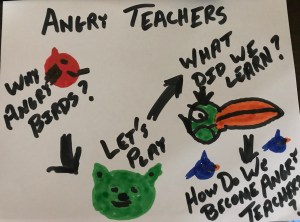 If you follow my blog you know that I am a fan of Angry Birds; both the game and the movies. I have blogged about Angry Birds on four different occasions: Teaching Like Angry Birds, Angry Birds University, The Angry Birds Effect, and “I’m Not A Leader!” ~ Red. Now I am adding a fifth post about this Rovio Entertainment created phenomenon that I love to use as a guide to great teaching and leadership.
This week I did a professional development for Mevers School of Excellence on student engagement. I have been working with this school’s teachers on professional development by customizing a series of professional development units using teacher walk through data and student data. These teachers are phenomenal and deserved a great finale to the year long work we have been doing. So, this professional development unit was titled “Angry Teachers.” Catchy, don’t you think? We certainly don’t want our teachers to be angry, but we do want them teaching using the principles employed by Rovio that have made this game such a phenomenon. The only homework prior to the evening’s professional development was to have the Angry Birds Classic game downloaded on one of their devices.


I led off with the statement, “Everything you need to know about teaching you can learn from Angry Birds.” I think some were skeptical, but I really do believe this statement. Then, of course, I had them play the game with the volume turned up and take notes about what they learned. Needless to say, they had so much fun. I had them take notes on what they were learning that could be applied to great facilitation of learning. Here is what we talked about:
- Make it easy to start the task.
- Show, don’t tell.
- Give useful and immediate feedback.
- Make it easy to recover from failure.
- Complicate the task gradually.
Think about it; if a teacher is getting just those five things done he or she is on the way to providing great facilitation of learning. Then after playing a little more I broke them into groups and had them develop the learning even further. Here are the graphic representations of their learning the 10 groups came up with:
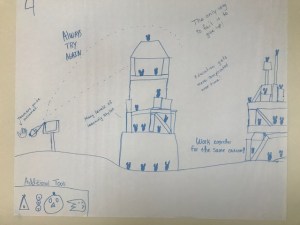
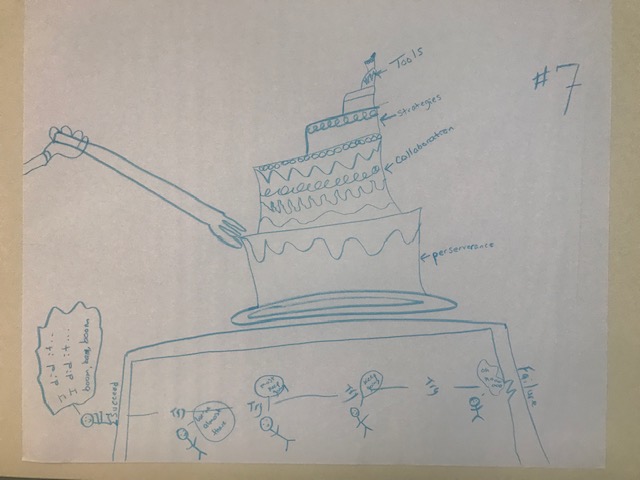
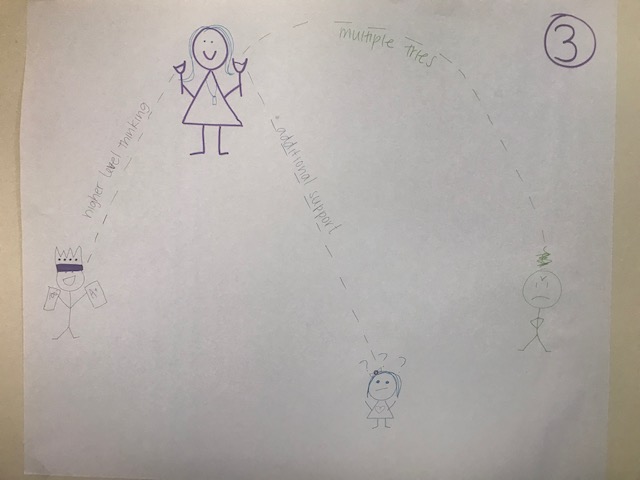
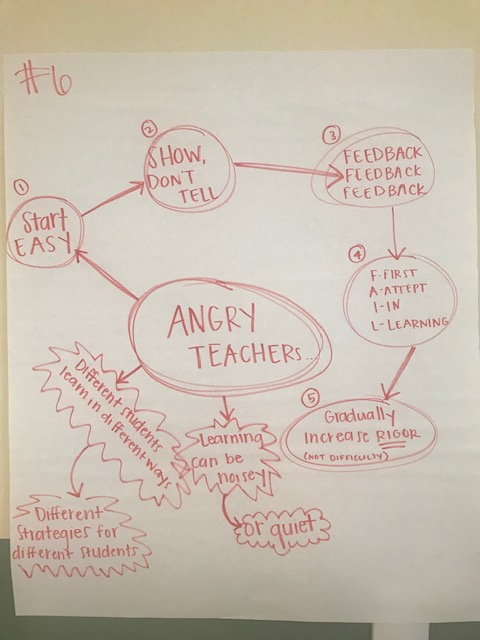
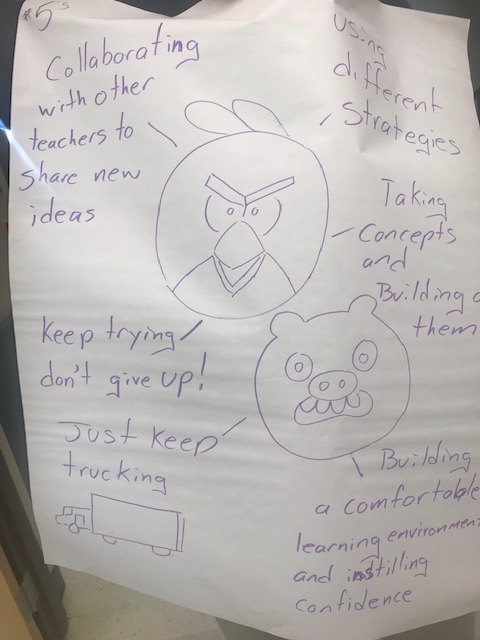
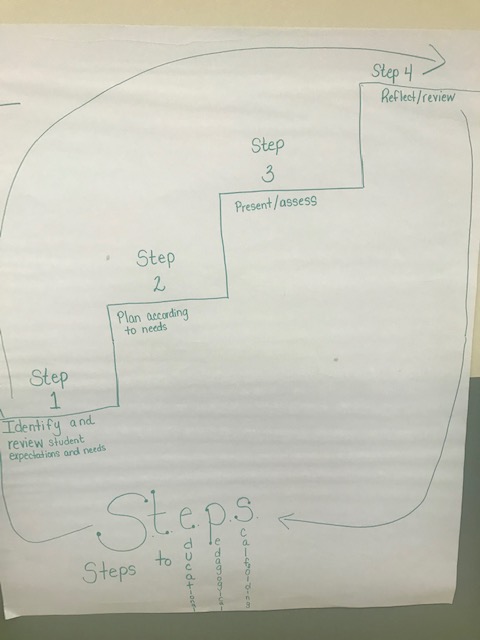
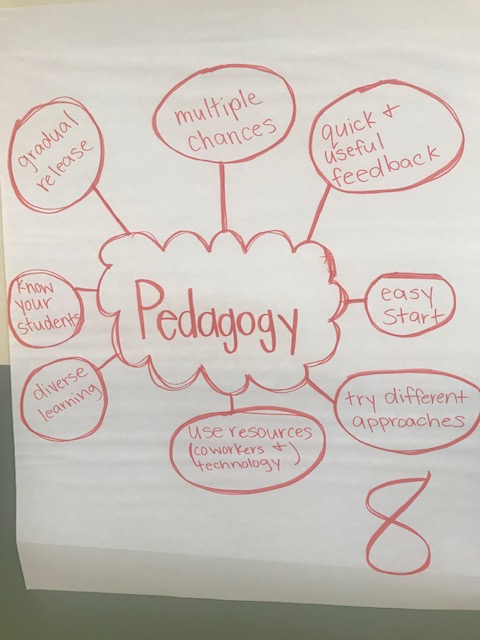
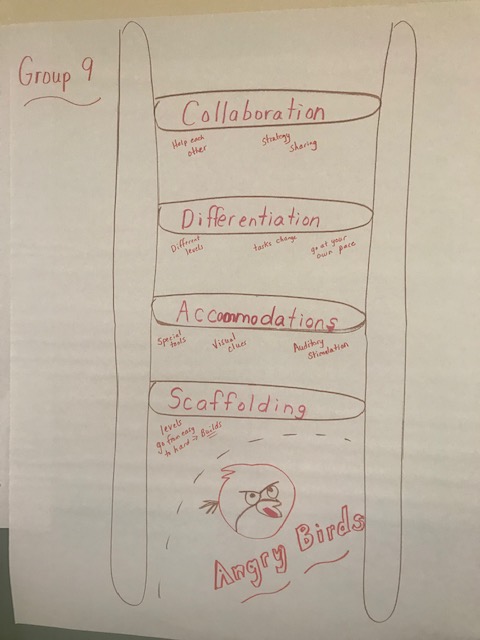
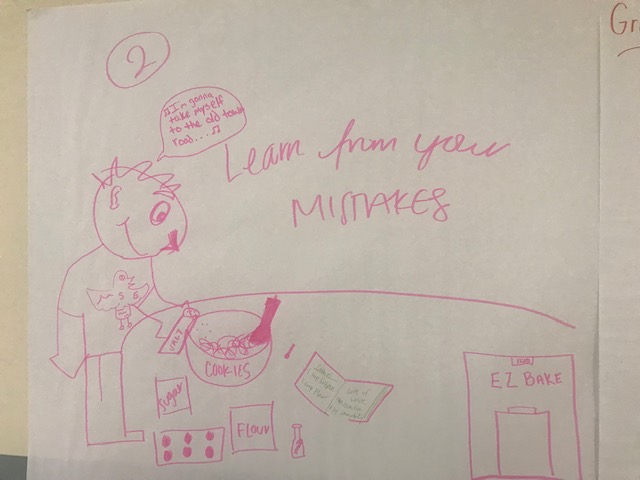
Pretty amazing work! Now, consider the following:
1. Angry Birds involves practice without penalty.
2. Angry Birds offers the opportunity to constant feedback.
3. Angry Birds inherently teaches that different tools have different purposes.
4. Angry Birds has a built in mechanism for knowledge transfer.
5. Angry Birds rewards perseverance.
6. Angry Birds gives no time limit.
No wonder we are all addicted to this game! Now if only we could ensure that our
classrooms are always safe spaces to practice new strategies, offer students a range of possibilities for how to succeed in their learning, give our students constant feedback, and support knowledge transfer within and among our courses. So, do you agree? “Everything you need to know about teaching you can learn from Angry Birds.” Our students deserve us to be “Angry Teachers!”
Durability of Expectations
 In a meeting I was a part of this week we developed a phrase that has caused me to do a lot of thinking: “Durability of expectations.” Our work was in the context of thinking about student success, outcomes, and what the profile of an Indiana high school graduate should look like. I like to combine all of this and talk about student success outcomes. Success looks different for all students and some students have not really had an opportunity to have success modeled for them or even know what success can look like. I have often said that it is ludicrous, in some cases, to ask our students what they want to be or do in life because they have not had the opportunity learn what all is out there. That is why I believe it is so important to make sure we are doing a great job of career exposure, career exploration, and career navigation for all students. We need to career coach our kids.
Success: “Knowing what one wants in the world and knowing how to get it.” ~ Dr. Felice Kaufman
We must make sure we are giving our students the opportunity to innovate, be creative, and take risks. This will help them to persevere, adapt, and develop a growth mindset and begin to understand lifelong learning. We need to help our kids understand what is out there and that getting where they want to go will be a non-linear process in many cases. Most of the career paths those of us in the baby boomer age are characterized of having relative stability. The career paths for today’s students are now times of discovery, restlessness, and exploration. The last I read, boomers will switch jobs 11 times during our lifetime, but millenials and younger will not only switch careers but change entire career trajectories. Therefore, the modern career trajectory isn’t necessarily a climb to a destination, but rather a continuum.
 We will need to offer solutions to our students that help them understand and give them the opportunity to skill, re-skill, and up-skill as they embark on their non-linear career paths. This is why I am such a believer that we must begin to identify the transferable skills our students. These skills, according to employers, hold much more weight than the traditional way of looking at academic records or even work history. Life is not linear, it is more like a Jungle Jim, so we need to make sure we are facilitating learning for our students that gives them the transferable skills to have durable expectations of what they can do. In other words, our students can have a lasting expectation that they have the skills to start and understand how to stay skilled to make the desired career moves that become available. Even if our students take a non-linear path in life, if they have credentials and transferable skills they will have what is needed to provide the on and off ramps to whatever career moves come available. This will give durability to the expectations our students have as they move through life and professional careers.
The old adage that you can’t connect the dots looking forward, you can only connect them looking backwards is true, but we need to give our students the ability to zigzag. By preparing students through career coaching, exploration, work based learning, and transferable skills and credentials we will add durability to the expectations of our students and their parents. We have an obligation to make sure our students are prepared to see and be prepared to seize the opportunities no matter how unconventional or surprising.
Teaching Like Angry Birds
 I am not a big game player on my phone, but I love Angry Birds. I have blogged about this game twice before in The Angry Birds Effect and Angry Birds University. Just in case you aren’t familiar with Angry Birds, it’s simple: the pigs have stolen the birds’ eggs. This has made the birds angry. Therefore, they allow you to slingshot and catapult them into the pigs’ fortresses. The birds love every minute of it.
The thing that still amazes me about Angry Birds is that a person can download the game and be playing in 10 seconds. You are given small pieces at a time in a way that makes it possible to master a level in 30 seconds. In education we call this chunking. I always wonder why we can’t create learning management systems (LMS) in education the same way. Instead the first thing that has to happen with a new LMS is to take a training on how to use. With Angry Birds this is done real-time as you go.
In Angry Birds the learning is paced and is scaffolded just like in a great classroom. Once you develop foundational skills you are given new birds with different abilities. At the same time different scenarios are introduced. This is a very engaging and developmental path to mastery.
 The game also has a very well structured star ⭐️ system. And remember you are able to play over and over making improvements to reach mastery. We need to operate more like this in education. Players are also able to earn badges. I love the way schools are adding badging to their e-portfolios.
 Another very cool addition is that of tools that can be used. These tools include an earthquake, a scope, extra power sling shot, bombs, and more. These really teach creativity and problem solving because you only get so many. Therefore, the player must decide the right time and how best to use these limited resources.
As you can see, Angry Birds supports many learning principles and best practices. Rovio just continues to make improvements. I last blogged about Angry Birds in 2014 and this game continues to improve and be a relevant example of how to lead learning.
We’re All Unique
 Thanks a lot Mr. Kibblewhite by Roger Daltrey
My rating: 5 of 5 stars
The author of this book, Roger Daltrey, was the founder and lead singer of The Who, one of the great British bands of the ’60s and ’70s and arguably one of the most influential bands of rock and roll development. This book grabbed a hold of me right from the start and kept me engaged right to the end. I felt as though I was there for the Nazi bombing of Britain as Daltrey was born in 1944. Peacetime followed but the food rationing and lack of opportunities followed for his young childhood. Daltrey tells all and there are certainly lessons to be learned. One statement he made early in the book really struck me. After being expelled by the headmaster of his school, Mr. Kibblewhite, whom the book is titled after, Daltrey says, “If anyone had ever once sat me down and explained that school was for me, not the teachers or the system, and there were reasons why I should stick at it, it would have been totally different. But no one ever did” (p.21). As a leader in education this really hit me like a ton of bricks. Unfortunately, it is true that some do lose site that schools are students, not the teachers or school systems themselves. I was motivated to blog about this in School Is For The Student: https://byronernest.blog/2018/11/18/s…
At the end of the book as Roger Daltrey reflects now, later in life, that his school principal was wrong to tell him he’d never do anything with his life he said: “We’re all unique. We all have our own unique lives. But seeing my life like that, I just felt overwhelmingly lucky. In the middle of this strange out-of-body experience, I said to myself, ‘Would you ever imagine the things you’ve done?’” (p. 238). Why do educators do that?
Daltrey leaves us with great lessons we all can use, no matter our profession. He said, “You can’t be mediocre. A band can be either terrible or brilliant. There is no middle ground. So you have to make tough decisions.” This lesson pretty much applies to anything.
Daltrey may be 74, but he’s still causing a sensation along with Pete Townshend as original members of the group who still tour. He’s also causing a stir with this great book that was released this past October, 2018. You should check it out.
~ Dr. Ernest
School Is For The Student
 I am reading an incredible book right now by Roger Daltrey, the frontman of The Who. As you know, I love rock music and am so intrigued by those who have artistic talent and took the risk to make it big. And, make it big The Who did…The Who is arguably one of the most influential formative influences during the development of rock and roll 🎸. I’m only half way through the book and now I want to meet Roger Daltrey. Oh…the places he has been and the things he has done!
“If anyone had ever once sat me down and explained that school was for me, not the teachers or the system, and there were reasons why I should stick at it, it would have been totally different. But no one ever did.” ~ Roger Daltrey, frontman for The Who in his book Thanks A Lot Mr. Kibblewhite: My Story/Roger Daltrey.
This post is about a statement in the book and the reason for the title. Mr. Kibblewhite was Roger Daltrey’s Principal who kicked him out of school. So…he’s thanking him? That really made me think. But then Daltrey wrote this statement: “If anyone had ever once sat me down and explained that school was for me, not the teachers or the system, and there were reasons why I should stick at it, it would have been totally different. But no one ever did” (Daltrey, 2018, p. 21). I haven’t been able to get this statement out of my mind ever sense.
 Did you catch what he said? That someone should have explained that school was for HIM, not the teachers or the system. Part of the reason no one ever sat him down and told him this, is because we forget it, or never believed it to start with. School exists for the students. Period. Not for the teachers or the system.
Schools are such complex and contested institutions in my country 🇺🇸 and globally. While every member of our society is promised a good education, there are ongoing inequalities that are fueled by race, class, and gender. Somehow, I believe education failed Roger Daltrey. Now I get that he did things that caused the expulsion – he divulged those in the book. But, again, I go back to the statement I can’t get out of my mind, “If anyone had ever once sat me down and explained that school was for me, not the teachers or the system, and there were reasons why I should stick at it, it would have been totally different. But no one ever did.” Daltrey needed to know the “why” and no one ever took the time to tell him.
Now you can argue that had he not been kicked out of school that any number of the 100 different paths that Daltrey would have taken wouldn’t have led to The Who. You are probably right, but how many other students are lost that don’t have the grit of a Roger Daltrey? For some, then, schools are seen as a means for learning and mobility; for others they are “sorting machines” that maintain social inequality. I believe we need to make sure that schools are student centered and not school system centered.
I have said it many times that many of the things we have done around holding schools accountable have forced us [schools] to make decisions in order to make the school look good without any regard to what the students need. We have it backward. If our students are successful and achieving the outcomes necessary for postsecondary success, then certainly, the school has done its job. It’s really about considering questions of relevant academic content, methods of teaching, ways of learning, and overall educational aims.
Another statement Daltrey made in the book was, “There was the maths teacher who hated me because I hated maths. I just couldn’t get it to go into my brain. I don’t know why they don’t work out which kids are good at maths and let them get on with it and which ones aren’t and give them a break. We still haven’t worked that one out today. It’s mad.” (Daltrey, 2018, p. 15). What he is really saying is why didn’t anyone ever make math real for him? Why was school work not made to be like real work. Daltrey went on to say, “Obviously it helps in life if you can add up a few numbers but I could do that. How else do you think I managed to work out how much we were being ripped off when The Who started making proper money in the 1970s?” (p. 15). Think about if math would have been taught in the context of managing a band. We must make education relevant for our students. Otherwise, we will lose them.
Our schools are effective only when we refocus on meeting the individual needs of students rather than the needs of the education system or the broader society. We must have our students ready to be a part of and function in a global economy and society. Remember, school is for the student.
Reference
Daltrey, R., 2018. Thanks a lot Mr. Kibblewhite: my story / Roger Daltrey. New York, NY. Henry Holt and Company.
Teacher Leadership
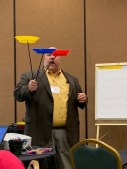
 This week I had the chance to do a couple of sessions on Teacher Leadership at the Impact CSUSA 2020 Conference that Noble Education Initiative put on. In the session we discussed creating a shared leadership model and engagement pipeline. I even did a plate spinning show to represent how hard it is to spin all the plates we need to as leaders. If we empower teacher leaders, we can spread out the load and keep all the plates spinning. We must create a supportive community where everyone helps to spin the plates. By the way, I can only keep three going at once, but brought others up and we were able to have all six plates that I have going at once. Another one of my metaphors!
 First, let’s start by answering the question, “What is teacher leadership?”Here’s the definition I have always liked: “Teacher leadership is the process by which teachers, individually or collectively; influence their colleagues, principals, and other members of the school community to improve teaching and learning practices with the aim of increased student learning and achievement.” (York-Barr & Duke, 2004, p. 287) During the workshop, participants came up with a list of teacher leadership roles. Here is there list:
 I also laid out a seven step process for growing teacher leaders:
- Realize teacher leadership is essential
- Recognize teacher leadership as a teachable skill
- Recruit teachers to become teacher leaders
- Build leadership capabilities among teachers
- Nurture leadership qualities in teachers
- Empower teacher leaders
- Provide ongoing professional growth opportunities for teacher leaders
Of course it wouldn’t be a session by me without there being model making, innovation, creativity, and creations. First, I asked the question, “Why is building a great teacher leadership pipeline more like chess than checkers?” We had a great discussion in both sessions about this. We discussed how in checkers there are very limited moves and you can’t the checkers cannot be promoted until they reach the other side of the board – we believe everyone should lead from where they are. We discussed how chess is about strategy and a longer term overall play. I’m sure you get the idea.
I broke the participants into groups of four or five, gave them a chess board, pipe cleaners of all sizes, colors, and even with glitter, glue sticks, masking tape, little eyes, fuzzy balls of all sizes, and straws. I then told them that there objective was to replace the traditional chess pieces with ones that represented the ideal chess game for building an amazing pipeline of teacher leaders. I’ve got to tell you, it was amazing to watch them. Even more amazing were the descriptions of the chess pieces and and the discussion. Following are pictures of some of the games created:
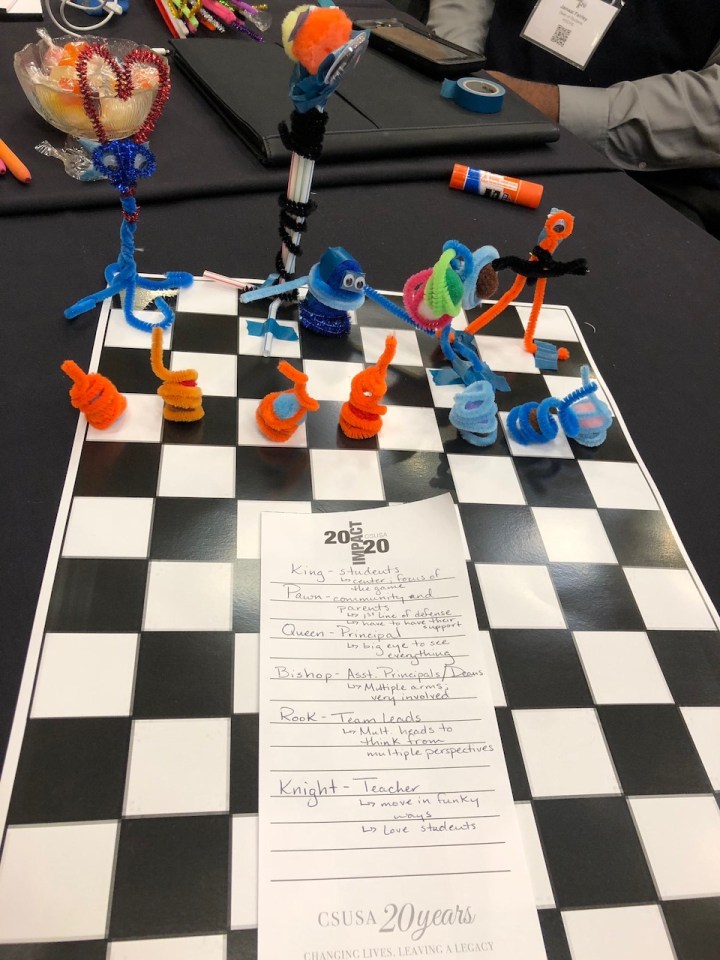

Finally, we created a list of attributes for effectively developing teacher leaders. Here’s our list:
- Results-driven
- Standards-based
- Job-embedded
- Differentiated
- Linked to learning needs (student and teacher)
- Collaborative in nature
- Sustained over time
- Discipline-focused/Content rich
- Reflective
- Evaluated
How are you doing at developing your teacher leaders?
Using A Different Runway To Help Students Take Off To New Heights
 This morning as I was trying to fly home from Charlotte, North Carolina, the pilot came on and said there would be a slight delay. Because of the storm that was Hurricane Michael, we were going to have to use a runway that they usually do not use. He told us we would be using the runway going to the northeast, whereas typically the north/south runways are used. They would need 15 minutes to recalculate takeoff speeds, routes when in the air, et cetera. I was cool with it as long as we got in the air, headed north, and away from the storm.
As you know, I love metaphors, analogies, and similes; so here we go: I compared this to how, as teachers, we must constantly be making adjustments. We are constantly having to recalculate for our students and use new runways. We regroup students based on data, we spiral in new material based on mastery, we develop ways to maintain the proficiencies already mastered. Adjusting and recalculating instruction also means providing more opportunities for students to learn successfully based on information you gather such as their interests, work habits, motivation and learning styles and academic performance. Doing this on a consistent basis helps refine instruction so they can succeed.
Great teachers are those who know their students abilities, know the students proficiency of standards, and then use that information to determine how and what they will teach. They use educational standards and differentiation to guide instruction, while constantly focusing on 1) what the students know, and 2) what objectives (or steps) they need to take) to fulfill their goals. They focus on what the students can do today. How about you; Are you recalculating for a different runway for the success of your students?
 Byron's Babbles
3 comments