Being Who We Want To Be
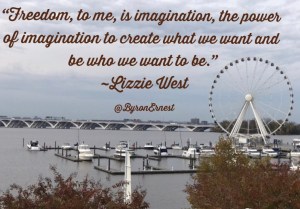 I just had another Lizzie West quote impact me. In this one, West said, “Freedom, to me, is imagination, the power of imagination to create what we want and be who we want to be.” This made me think about all our students, both high school and post secondary, coming out into the Gig Economy. We often talk about how our students will need to create their own job titles, create their own jobs, or adjust to jobs yet not out there, but this is more true today than ever. We must provide the environment for our students to imagine and then create who and what they want to be.
“Freedom, to me, is imagination, the power of imagination to create what we want and be who we want to be.” ~ Lizzie West
Our high school and college graduates of today are entering the workforce of the Gig Economy. The Gig Economy is made up of consultants, independent contractors, freelancers, side-giggers, and on-demand workers. Gig Economy workers make up approximately 30-40% (depending on what source you use) of the U.S. workforce right now. Alternative and flexible work arrangements have been increasing, but with the COVID-19 Pandemic these may become the norm.
Therefore, I get concerned that most high school and college graduates still receive a transcript instead of a portfolio. This plays to my belief we need to worry more about transferable skills and less about courses. Our students will need to be able to identify the skills they have acquired and then be able to market them. Developing portfolios begins to do this and gives them a usable product from their education.
Additionally, we need to be teaching the skills required of the Gig Economy. According to Fast Company there are four essential skills needed in the Gig Economy:
- Critical thinking and logic
- Human Resources
- Finance
- Marketing and communication
Gig Economy professionals must also be able to:
- Match personal skills to problems that need solved.
- Direct themselves.
- Ask good questions before devising a solution.
- Learn, learn, and learn some more.
Our students will need to develop a strong sense of self. They will also, now more than ever, need to be able to answer their own “why” of their learning. Understanding this “why” will help them imagine what and who she/he wants to be.
Whether It’s Spinning Plates or Juggling Balls, We Can’t Afford To Drop Either For Our Kids!
 Remember, This Is a Marathon: We Want You To Still Be In The Race At The End Accept, Acknowledge, Ask, Adjunct Teaching, Advice
We need to take time to reflect on what it means to truly form a partnership between schools, teachers, and parents and consider how we can shift our practices in ways that will extend well beyond this crisis. I had the tremendous opportunity and honor to be a part of an event hosted by Kevin Eikenberry of The Kevin Eikenberry Group this past week. It was titled ‘Juggling Balls You Can’t Drop: How To Be Successful Parent, Employee, Teacher (And Spouse) Without Going Crazy. Kevin had asked me if this was an important and timely topic, and I very quickly responded with, “Absolutely!” Then it became important to pick a great teacher to be a part of the project that was doing an awesome job of supporting parents and students. Kevin left that job to me and I could not be prouder of who I picked. I had worked with Katty Pacheco, 2nd grade teacher at Renaissance Charter School at Boggy Creek in Florida, before on webinars for teachers and knew enough about the support she is providing parents right now in this time of remote learning to know she would be a great choice. And…she certainly proved me right. The parents on the Live With Kevin event really appreciated her comments and advice. It was such a great event. If you missed it, here is the link to watch the event and see materials provided from the event: Juggling Balls You Can’t Drop: How to be Successful Parent, Employee, Teacher (and Spouse) Without Going Crazy.
 I decided to do this post to share not only the link about, but to share out the thoughts I have developed prepping for the event. I’m coming up on a month of working from home and as long for many of the schools I work with being transitioned to remote learning. During these unprecedented times we all are doing the very best we can. I had the opportunity to present to the SMART Factory League global event last week too, and I will be posting my thoughts on things we need to be thinking about moving forward. One thing we need to keep in mind is what my friend and great author, Nora Bateson, said in Small Arcs of Larger Circles: Framing Through Other Patterns: “No one is qualified to talk about uncertainty. You cannot get a degree in it yet, to the best of my knowledge” (location 437/3376, Kindle Ed.). While learning virtually has incredible potential, the very piecemeal efforts are not a very good substitute for real classrooms, in most cases. The school closures across the country have real consequences for our students academically.
Schools are the cornerstones of most communities and play a role that goes far beyond academics. Our schools support the nutritional, social and emotional well-being, and other health considerations of our children. This situation has many parents overburdened trying to support their child’s education the best they can. There will be gaps in education and students behind as a result of this COVID-19 Pandemic, but we must work to learn from this experience and be ready when the call comes to re-enter our schools. All of our focus cannot just be on making sure every student has internet access, even though that is an important consideration.
Accept that you are our students’ most consistent teachers, and right now you are their only in-person teachers.
- Remember to differentiate, just like your child’s teacher would. Students who tend to be independent self-starters will thrive in a more unstructured environment. Without “wasting” time on commuting to school and having recess or dead time between class periods, they will likely become increasingly productive. Other children may require more guidance and outside motivators to continue to thrive academically.
Don’t change everything that you are doing (bring old routines to your new normal)
- Acknowledge that being a working parent from home is the most challenging
- Do not reinvent your schedule (at least to the extent you don’t have to)
- Create a daily and weekly calendar (include daily routines)
- Set boundaries and even assign roles for everyone
- This can include assigning childcare and “adjunct teaching” time for family members
- Schedule breaks in and some time for unstructured fun
- Virtual play-dates for kids and adults
- As an adult have something to look forward to at the end of the day (eg. Virtual happy hour, cooking the evening meal, family movie night, go for a drive or walk)
- Zoom (or whatever platform is being used) lunch for the kids. Suggest to your child’s teacher that students have a set lunch time and all the students sit down and eat with their cameras and mics open.
Don’t be afraid to ask
- We need to lean on our village now, more that ever (eg. Parents, kids, teachers, community members)
- Ask your teachers for resources, ask your teachers for a weekly schedule, ask your teachers for help
- Ask your teachers for a weekly “office hours” for parents to explain what will be happening that week or the next week and anything parents need to know to be successful adjunct teachers.
Your kids will give you good advice
- This is a chance to give kids a chance to be leaders of their own learning
- Ask what resources they like best
- Let your children be a part of developing the daily and weekly schedule
- Give your students agency and choice
Accept that things are not going to run 100% smoothly and we are not all going to be our 100% productive selves.
 Byron’s Book Recommendation:
The Power of Showing Up: How Parental Presence Shapes Who Our Kids Become and How Their Brains Get Wired by Daniel J. Siegel and Tina Payne Bryson
Resources:
Noble Education Initiative Learning Hub:https://www.nobleeducationinitiative.com/services/learning-hub
The Smithsonian Institution: https://www.si.edu/collections & https://www.si.edu/openaccess &
https://airandspace.si.edu/anywhere
Time For Kids: https://time.com/tfk-free/
Khan Academies Kids:https://learn.khanacademy.org/khan-academy-kids/
Educating Students To Improve The World
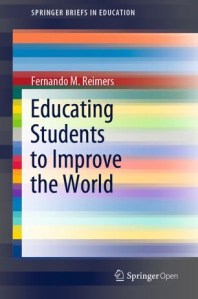 The book Educating Students to Improve the World, written by Harvard Professor Fernando M. Reimers, presents an inspiring and bold vision of how schools should be organized to cultivate a range of skills and dispositions that effectively educate students to make the world better. The book is unique in the breadth of the scholarship it integrates and in how it builds a sensible model to understand the process of educational change that honors the multidimensionality of the process. It is, at the same time, a very scholarly book, an erudite treaty of the field of global education, and a very practical book, a book that makes sense to those in the business of leading schools and school systems.
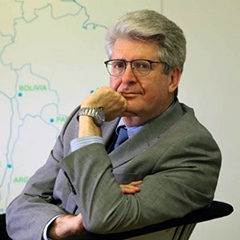
Professor Reimers
The idea that the book contains is simple, yet holds remarkable potential to transform education around the world. The big idea the book contains is that public education, as an institution of the Enlightenment, was meant to be global since its creation, but the obvious global nature of many of the challenges facing humanity requires that education becomes intentionally global. Professor Reimers argues in the book that formal education should be aligned with audacious and hopeful visions for a more inclusive world, such as those contained in the Universal Declaration of Human Rights or in the United Nations Sustainable Development Goals. Such alignment involves defining what kind of competencies would actually help students care about and have the skills to make a difference in advancing a more inclusive and sustainable world. With such clarity on the expected learning outcomes for students, the curriculum would then map backwards an instructional sequence to gradually support students in a rigorous process of development of such competencies.
But the merit of this book goes beyond articulating why education should help students develop a sense of purpose, aligned with ambitious purposes of building a better world, it then explains how structuring effective education programs requires that the process of change is advanced multidimensionally, reflecting a cultural, psychological, professional, institutional and political.
The ambitions of the book are considerable, to bridge an evident schism between the scholarship and practice of global education. The book is an intellectual tour de force tracing the history of global education to the very creation of public education systems, and integrating research reflecting a variety of disciplinary perspectives in support of a conceptual framework in service of more coherent and effective educational practice.
Enhancing the credibility of the ideas in the book is not just the fact that the book is well researched and crafted, but that it builds on a long practice of the author actually doing the very things this books recommends should be done to develop a relevant curriculum. Professor Reimers invented an approach to take bold goals, such as the United Nations Development Goals, and translate them into student learning outcomes, and then curriculum and pedagogy. It’s a simple and intuitive idea, but it had not been done before.
It is the combination of the powerful idea that education should be aligned with ambitious goals for inclusion and sustainability with a theoretical model of how to structure efforts to translate that idea into changed educational practices that makes this book unique. It is not surprising that since it was published, as an Open Access resource by Springer, a week ago, the book has already been downloaded 24,000 times.
The book can be downloaded here https://www.springer.com/gp/book/9789811538865
❤️ Kids Having Ownership!
 This past week I had the honor of doing a day long professional development for teachers from all schools corporations in Elkhart County, Indiana. I am representing Noble Education Initiative carrying out this customized professional development. This was part of an ongoing Project Based Learning partnership created by Horizon Education Alliance to bring business/industry and education together to best educate students. I love doing professional development workshops, particularly when they are on topics that I am passionate about. Project Based Learning (PBL) is one of those topics. It is also energizing to be with a group of educators who are very engaged. Groups like this always remind me and validate what Gallup® finds teachers value in question 12 of the Gallup Q12 Index©: “In the last year, have you had opportunities to learn and grow?” These teachers have been given this opportunity and very much value the opportunity, and are taking advantage of the opportunity to learn and grow.
The group last week was both passionate and engaged. We started the day with what I called “Level Setting.” I had them work in pairs to talk about their PBL experience now that we were half way through the school year. I wanted them to talk about what they had learned, “wow” moments, what they still had questions about, and what they still needed help with. They were to represent this on a tear sheet and put it up on the wall. Here are a few of the tear sheets that were put up:


Did you see the comment “❤️Kids Having Ownership”? That’s what this is all about. The next few paragraphs will dig into that a little deeper.

Aubri Mosness with her students
We then had everyone individually do a gallery walk and pick one thing that stood out to them. This was an awesome discussion when the group came back together. There were questions like, “who wrote… I would like to know more,” or “I had that same experience because…,” or “I am so glad you wrote that because that same thing happened to us, and we are still trying to figure out…” You get the idea. One comment really stood out to me during this discussion; It was by Goshen High School Teacher, Aubri Mosness. She said, “I have felt the transition from me doing most of the work to the students doing most of the work. At first I was a little uncomfortable because I felt like I was doing much, but then I realized how much the students were getting out of it.” I was so excited by this. This is such a revelation in teaching. Great teaching should have the students doing most of the work. She was truly facilitating with a student managed classroom and the students have student agency and choice.
Then, at lunch Ms. Mosness’ students presented to the whole group and business/industry representatives that had joined us, on their project and I led a little Q&A. The students were incredible. During the presentation Ms. Mosness commented, “When I give my students too much, too much information, too much guidance, I am taking away opportunities for learning.” This was a drop the mic opportunity as far as I was concerned. The students all concurred. I then asked the students to give a thumbs up or thumbs down on the following question: “School work should look more like real work?” All six students gave me a thumbs up. Our students deserve to learn in an environment that is facilitated in a real world and relevant context.
 These students were giving first hand testimony affirming the research I did for my book, The Hand In The Back Of The Room: Connecting School Work To Real Life.” In the book I talk about that the hand in the back of the room was mine, and probably yours too, that was raised wanting to know why I needed to learn what I was being taught. In other words school work must be connected to real life. This is why PBL is so great. Using PBL teaching principles will make school work look and feel like real work. In other words, the question from “the hand in the back of the room is answered as to why she needs to learn what she is being taught. When teachers are allowed to make student learning the ultimate test of facilitation of learning, then instruction improves to produce better learning. The results of my research showed improved achievement/performance in science when students are taught in a relevant context. For me that context was agriculture, but there many other real world contexts to be used. This is why the partnerships with business/industry is so important for our students. The challenge to all of us in education is to find ways to make learning visible by connecting school work and real life for the students we serve.
Success In Aspirational Terms
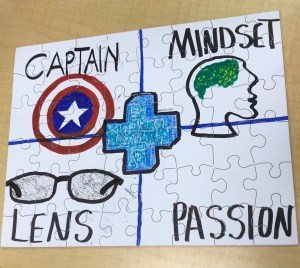 This past week I heard a person say that “success should be measured in aspirational terms.” The more I thought about it, the more I like it. In education I believe we need to think more aspirational in the way we prepare students. In other words looking beyond just credits and a diploma to the outcomes of what a student should be able to do now and be capable of learning to do later.
Let’s use an example that gets used a lot – welding. It is short-sided to think that having a student be in the single pathway of learning to fuse two pieces of metal together is enough. Don’t get me wrong, good careers await the student, but that’s not aspirational enough. This is why I believe in achieving multiple pathways. A student with aspirations for welding should also be studying computer science. Computers have become an indispensable part of welding processes. Computer, and even artificial intelligence, are required for the execution of many welding operations today. We can only imagine this need for knowledge of computer science will increase. Industry is telling us that welders will need knowledge of lasers, computer program, robotics, artificial intelligence, materials engineering, and systems integration to advance.
With the increased demand for highly skilled and technically sound workers, our students will need to shape their careers around multiple areas of expertise. This aspirational approach will enable their lifelong learning and ability to be agile to a ever-increasingly fast changing world.
We need to be deliberately aligning our student’s aspirations and abilities. The scene in the movie “The Martian” where it doesn’t look like it will end well for astronaut Mark Watney he sends this message to be relayed to his parents:
“Tell them I love what I do and I’m really good at it. And that I’m dying for something big and beautiful and greater than me. Tell them I said I can live with that.” ~ Mark Watney, played by Matt Damon, in The Martian (2015)
Try and tell me that’s not aspirational. We all need to find what we love and what we are good at. It’s not either or, and we need to help students find that balance as well. Some would say that aspiration is magical thinking. I don’t believe it is a magic trick to strategize about the future, help students invent themselves and us reinvent ourselves, push upscale, and keep a growth mindset. Without deep thought and planning about measuring success in aspirational terms, it just becomes a vacuous platitude, or “thing,” as I like to say. But taken in the context of enabling the future, career/skill agility, and student outcomes, measuring success in aspirational terms becomes about being prepared for what we don’t know we need to be prepared for.
Leading With A Touch Of Quirkiness
 I finished the awesome book Joyful: The Surprising Power Of Ordinary Things To Create Extraordinary Happiness by Ingrid Fetell Lee yesterday evening. It is such a great book that really opened my eyes as to the ways I am already creating joy and need to continue, and the external environments I need to be creating to give rise to inner joy for both myself and others. Two parts of the book had a big impact on me: the idea of playful design bringing joy and not being bound by convention brings joy. Those that know me very well at all know that these are two things that I put into practice almost every day.
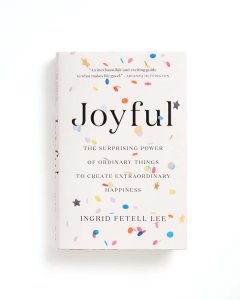 Ingrid Fetell Lee taught us to not feel bound by convention; break the mold and bring joy to the world. I believe it is about being a divergent thinker; the ability to generate novel ideas and conjure up multiple solutions to a problem. This is about being creative and thinking outside the box. This celebrates creativity. I have watched this way of operating bring joy to groups doing the divergent thinking and have felt the joy myself when conjuring up new and exciting ways of doing things. I believe we are very guilty in education right now of promoting the idea of one correct answer. This is really promoting when using high stakes summative tests. I get that at some point there has to be convergence of ideas but I believe we take the joy out of learning by not allowing for enough divergence – both in our educational systems and in the workplace. We tend to reward the students who work hard, like learning, are rule followers, but are not going to break any molds or create anything wowful.
Interestingly, childhood creativity has been shown to have a higher correlation to adulthood success than IQ. So, maybe we should create systems in our organizations and schools that value creative, interesting, and innovative answers, rather than the “right” ones. I also believe this mold-breaking thinking allows us to better question ourselves. This gives us the opportunity to be more comfortable with the idea that what we thought we knew could be wrong. This kind of thinking can position us well in our learning, work, and personal lives.
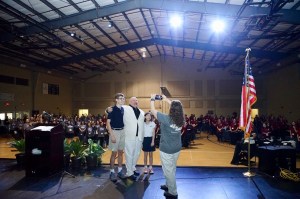 We were also taught in Joyful that being a little quirky and even bring joy. I proved this yesterday when I emceed our Impact Georgia back to school event. I wore my white linen suite that is a little out of character for me. I must say I was looking pretty fly. The look was just enough different from my usual that I believe it brought joy to others which made me feel joyful as well. I also added to the quirkiness by asking a teacher to come up on stage, and I quote myself here, “Take a selfie of us. Make it look like I am holding the camera.” This was of the things I really learned from the book is that joyfulness can be found in some of the most obscure and little things.
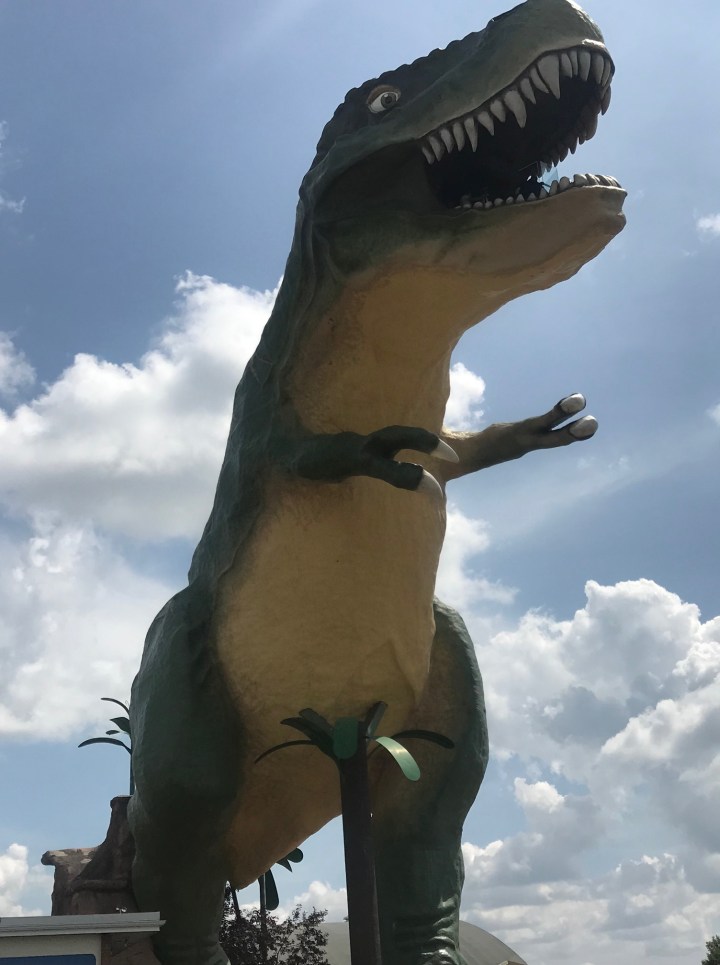
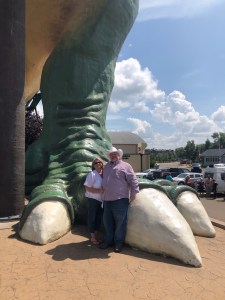 I even think about a couple of weeks ago when we were in Alberta, Canada and went to see the worlds largest dinosaur in Drumheller, Alberta, Canada. It was super quirky, but the quirkiness made it so much fun and it brought so much joy that it keeps bringing joyfulness when we look at the two pictures included in this post.
Go ahead and embrace your quirkiness and celebrate creativity!
Experiencing, Not Attending For Learning
 As I travel home this evening from what was an incredible journey to Calgary, Alberta, Canada, I am reflecting on all that my family and I saw and experienced, all that I learned at the 2019 International Research Conference, and can’t help but reflect on yesterday’s 50th anniversary of the first moon landing. A week ago yesterday we began this excursion and a week ago today attended the Calgary Stampede. What we found is that one does not attend the Stampede, one experiences the Stampede. Through this experience I learned about invented traditions. These Invented traditions are activities that are actually recent but are accepted by the public as having a particularly long and resonant history and as representing something essential about a nation’s character, values, and identity–arose from a widespread effort to justify the nation state, royal dynasties, and national boundaries by linking them, often tenuously and sometimes even falsely, with the past. These invented traditions spring from the need to reconcile constant change in the modern world with the desire for stability and traditional understandings about society.
We found that the Calgary Stampede has evolved over the decades in response to economic and political dynamics and the perceived need to maintain a vibrant balance between nostalgia for the past and celebration of the economic and ideological promise of the future. Successful cities have managed to brand themselves through identification with their annual festivals. We found that the brand lived up to the hype. One of the things I learned from experiencing and studying the Calgary Stampede is Americans cherish individualism and individuality above community. Canadians have exactly the reverse set of political priorities. This is not to say one is right and one is wrong; it is just to say that I learned some cultural differences along the way. We made some great friends while at the Stampede.
 I can’t help but also reflect on all the great scenery, nature, and natural beauty we had the opportunity to see and experience as well. The Canadian Rockies are awesome, and we had the opportunity to experience them from as far south as Waterton Lakes National Park and as far north as Lake Louise in Banff National Park. This all reminded us, as a family, of how important sustainable development is to making sure future generations will be able to enjoy and learn from these natural beauties like we did. We must work hard to meet the needs of our present generation without compromising future generations ability to meet their own needs.
 This was also discussed during the 2019 International Research Conference. Dr. Gerald Farthing, Former Deputy Minister Of Education Manitoba Department Of Education reminded us to act locally, while knowing what’s going on globally. I was honored to speak at the conference on discovering, developing, and distributing great leadership. It was awesome to visit from individuals from around the world to discuss current education issues and the innovative solutions to opportunities. We must find ways to end our preoccupation with the industrial and factory models of just “doing school”. The gap between what we call education in schools and learning that happens from being a part of society is widening. We must redesign our learning environments if we want to engage our students in the learning process. Learning needs to be 24/7, and not confined to a physical space we call school.
 Yesterday, as I reflected throughout the day on the 50th Anniversary of the landing of Apollo 11 on the moon, and those first steps, I was struck by all the ways we could relive the history. For example, Neil Armstrong’s Spacesuit was at the Smithsonian Castle yesterday and I was in Canada, but I took an in-depth 3D tour of the suit using Smithsonian’s new 3D Digitization site for doing interactive tours. You can also take an up close and in-depth 3D look at the 1903 Wright Flyer. It is such a great thing that the Smithsonian is doing. Every person can learn from and take part in Smithsonian exhibits without physically being on site. Think of the possibilities of this. I can remember saying, “Wow, everyone should experience the great learning that goes on at the Smithsonian’s many museums.” They can! Opportunities like this begin to take away the effects of zip code or socioeconomic status. Every child really can experience the Smithsonian. By leveraging the technology the Smithsonian is able to let their researchers tell their stories to the world and allow students to take a quest of discovery.
For me, I am going home with a renewed commitment that we must quit just having students attend and “doing school”. We must enable them to experience learning and go on a quest of discovery.
Teachers As Designers
 Yesterday, I started my day by spending time at Fort Calgary. Fort Calgary is the exact location where the city of Calgary, Alberta, Canada started. The fort, originally name Fort Briseboise, was built as the post for the North-West Mounted Police in 1875. Then when the railroad came west, Calgary began to grow and the rest is history.
The location was chosen because of of the confluence of the Bow and Elbow Rivers. In fact Calgary got its name because of being a location of a great water source. Calgary is named after Calgary Bay on the Isle of Mull, Scotland. It was originally thought to mean “clear running water” but has since been defined as “bay farm,”
After this learning time, I was back over at the 2019 International Research Conference discussing teachers as designers and leaders at Mount Royal University. We were discussing the Double Diamond Design Approach pictured here: With this model we must first find the right problem or topic. Then we use convergence to bring the topics, partners, and education entities together to decide subject matter and activities and then divergence to get the day-to-day pedagogy developed. As we discussed the model, I got to thinking about Fort Calgary and what a great tool this historic site could be for education. The site certainly has needs for support and volunteerism. Therefore, the schools could:
- Determine needs of Fort Calgary
- Determine what needs could be supported by the education entity
- Use convergence to bring all parties in the partnership to determine the scope of the project and learning
- Finally, use divergence to break the learning and work down into the day-to-day bites
 We don’t want people who just do school. We must figure out how we teach and facilitate learning with our students by radically collaborating in our communities. Additionally, we must make sure our very traditional school leaders recognize the great facilitation of learning this radical collaboration creates. We must shift from the compliance factory model of school to education as facilitation of learning. We do this by connecting and collaborating, which enables us to be adaptive, intertwined, interactive, and diverse. How about you? Are you leading learning, or just doing school?
Scaling Partnerships In Education & Telling Our Story
 I’m so sad to be sitting at the airport because I hate leaving Harvard University. I always learn so much from my friends at the Harvard Graduate School of Education. As always, my thinking as stretched, what I thought I knew challenged, and new creative and innovative ideas developed. As Dr. Mandy Savitz-Romer said last Sunday, “You may not leave here with complete closure, but with new questions.” That is learning at its best! My description for my learning this week is that I have been “coached up!”
 Today’s learning was just as great as the rest of the week. I loved doing a case study on a partnership with the Nike Innovation Fund for improving Oregon student success. Dr. Monica Higgins did a great job of facilitating the case study and I learned a great deal about scaling the impact of public private partnerships. This learning was followed up by a great session by Dr. Irvin Scott on story telling and its importance to teaching and leadership.
As I have done all week in Thriving Students, Developing & Supporting Our Students: Future Identity Versus No Future Identity, and Changing The Narrative For Our Students, I compiled a top 20 list of the things I learned today. Here is my list:
- It’s not just if we do partnerships, it’s how we do partnerships.
- Partnerships should match the core values or mission of the partners.
- Partnerships are great ways for industry to understand education and for education to understand industry.
- It is very important to analyze both sides of all partnerships.
- Partnerships are a psychological contract.
- Everything’s not always explicit (context, risks, et cetera).
- In partnerships everything is not always spelled out.
- Move partnerships from individual to individual to organization to organization. This plays to sustainability.
- Open communication is key to partnerships, even when things go wrong.
- Agenda items versus surface level just for show.
- Eliminate hidden targets in partnerships
- Partnerships need an exit strategy so the innovation can be sustained without the partner.
- Partnerships should be mutually beneficial, with beneficial up for debate.
- In partnerships:
- Make implicit explicit
- Have clarity of roles and limitations
- Have flexibility built in
- Have mutual goals, timelines, and milestones
- Is the voice of the student heard in the partnership?
- You never want to scale until you know you have something that works.
- Need to decide to scale deep or scale out.
- Everyone has a story of how they got where they are. What is your trajectory?
- We need to be warm demanders for our students.
- We need to give an academic press to our students.
- You can’t lead if you don’t read.
- Why story/narrative in leadership?
- Stories are fundamentally human…
- Stories build connection…critical for leaders…
- Stories bring data alive…
- Stories capture what is possible…
Changing The Narrative For Our Students


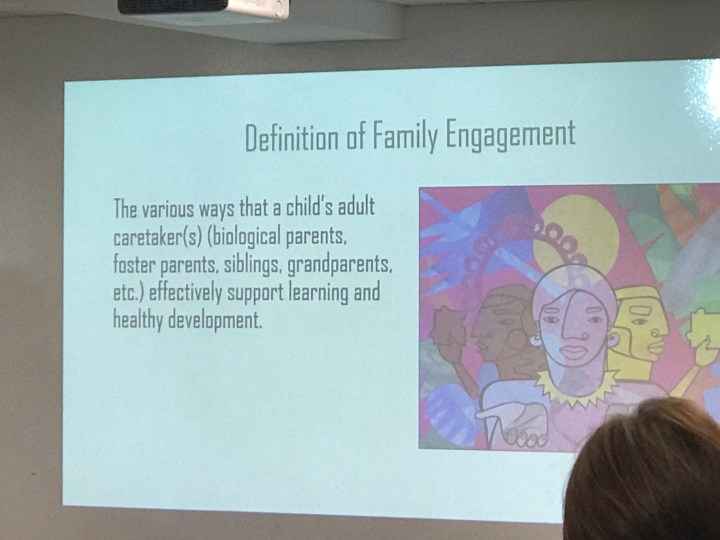
Yesterday was another powerful day of learning at Harvard University. It started out with Liya Escalera walking us through changing the narrative, valuing the cultural wealth of our underrepresented students in order to achieve equity. Additionally, she taught some great asset-based approaches to leading for student success. The best part was how she had us start this session. She had us reflect on situations in an educational setting that made us feel unwelcome and then reflect on a situation that made us feel welcome. This was a great way to get us in a mode of thinking about changing the narrative for our students. Liya also worked us through asset based communication. Below is a slide that does a great job of showing what our discussion included:  Then we spent time digging into family engagement and making families true partners with Stephany Cuevas of Harvard University. We know that students with engaged families:
- Exhibit faster rates of literacy acquisition
- Earn higher grades and test scores
- Enroll in higher level programs
- Are promoted more and earn more credits
- Adapt better to school and attend more regularly
- Have better social skills and behaviors
- Graduate and go on to higher education
 The learning did not stop here. We then spent time with Daren Graves diving into issues of race with intentionality. This was very powerful learning. We discussed how racism can happen without it being intentional. In education we must be diligent in monitoring the areas where we see disparate racial outcomes or impact:
- Curriculum
- Groupings
- Assessment
- Relationships with students and faculty
- Relationships with the community
- Recruitment/Retention
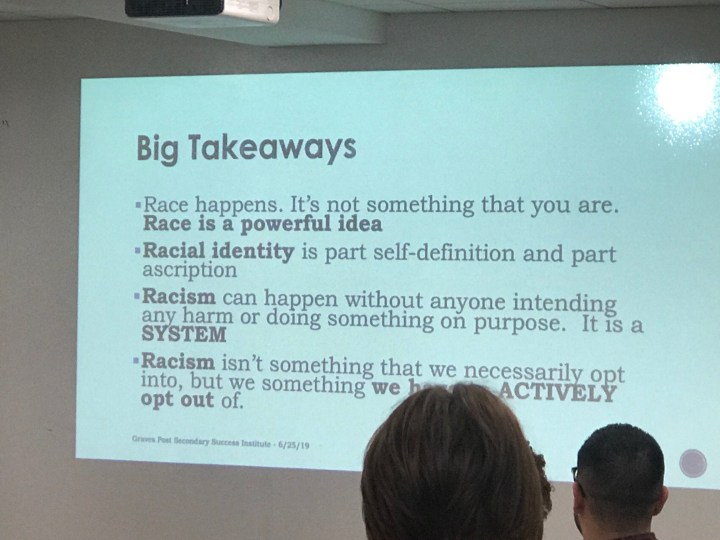 Just like in Thriving Students and Developing & Supporting Our Students: Future Identity Versus No Future Identity here is the top 30 list from our Tuesday learning:
- Reflect on a situation in an educational setting that made you feel unwelcome.
- Reflect on a situation that made you feel welcome.
- Asset-Based versus Deficit-Based Communication
- It is a bad habit to not look at all our communication through a critical lens.
- What is the problem? The problem is not our students.
- Is the problem that our students aren’t post-secondary ready, or that our education system is not student ready?
- Cultural competence will not cut it. We need to be highly skilled, not just competent.
- We need to make sure all schools are student ready.
- Google Translate™ is a good thing, but must be edited, or those reading will feel disrespected.
- We need information to go to parents as well as the students.
- We need to offer parents parents questions to ask their students.
- Our families are collaborators.
- We need to have parents presenting to parents.
- Have parents talk to each other.
- Students need to be thought of as part of a family, and then the family as part of all the practices of the school.
- Staff needs to view families as collaborators and partners.
- Staff Relationships With Parents + School Knowledge = Family Engagement As Confident Partner
- Staff needs to think of themselves as mentors to their parents.
- Family engagement is a way of thinking, not a practice.
- Family engagement is a value, not just a practice.
- There is no gene for race. Science saved the day!
- Race is an idea.
- Race is not culture.
- Race is something that happens, not something we are.
- It’s not about doing well in school, it’s about doing school well.
- Racism is usually pretty mundane.
- A system that confers privilege and produces disparate outcomes on the basis of race.
- historically-based systems
- actions/beliefs/policies/practices/conceptions
- confers visible and unacknowledged privilege
- Sometimes we set students up for failure by trying to not set them up for failure.
- Start with implicit biases, then move to structural biases.
- Racism can happen without anyone intentionally wanting it to happen.
 Byron's Babbles
leave a comment