Diagnosis, To Strategy, To Implementation
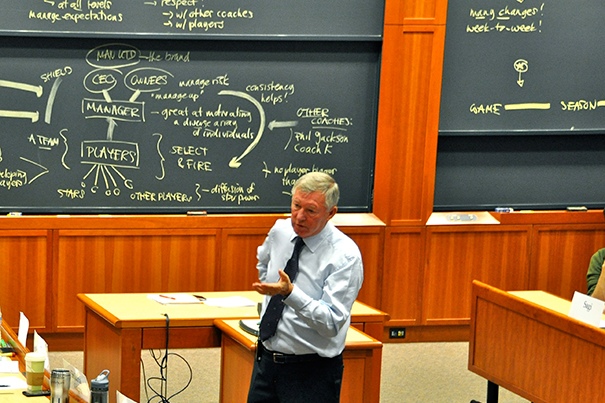
I spent this week in the classroom at Harvard University learning to be a more effective turnaround school leader in the Harvard Graduate School of Education program for School Turnaround Leaders. This was a program made up of an outstanding curriculum with the learning being facilitated by incredible Harvard faculty and other expert facilitators. Part of my homework for this evening is to do a Learning Synthesis of the week. Then I will be doing an elevator speech to my classmates.
As I reflected I was reminded of a post to this blog I made last August on the eave of the first day of school in my turnaround journey. I called it ‘Twas The Night Before. In the post I had a letter I had written to the students, parents, and community. Here it is again:
“Make It Happen”
Well here we are the Saturday before school starts at Emmerich Manual High School. As the new principal of one of the state’s turnaround academies I am so excited to finally have students here on Monday morning. I am so excited about our ADVANTAGE: Putting Students First!
For this week’s post I would like to share with you the letter I put in our first newsletter that will be given to the students on Monday. Here it is:
Hello Emmerich Manual High School students, parents, and community stakeholders,
It is with great excitement and anticipation that I write this first entry in our school newsletter! On Monday, August 6, we officially begin our partnership for the critically important task of providing highly effective learning for the students of Emmerich Manual High School. I am grateful that I have the opportunity to serve as your Principal. I want you to know I am excited to be taking this journey with you.
As a teacher my mission statement was always “to be a steward of high student achievement and performance through rigor, relevance, and relationships.” These will continue to be cornerstones that I believe are very important to highly effective teaching for our students. I would also add the fourth “R” of “Results Driven.” If we truly put our students first we will be victorious in this endeavor together and our students will win the results of high student achievement and performance and being college and career ready.
In my office I have a picture titled “Make It Happen.” The inscription reads: “Greatness is not where we stand, but in what direction we are moving. We must sail sometimes with the wind and sometimes against it – But sail we must, and not drift, nor lie at anchor,” by Oliver Wendell Holmes. This picture has a brass plate with the inscription: Emmerich Manual High School Advantage: Putting Students First, additionally, the picture is matted in such a way to have signatures put on it. I am having all staff sign this picture as a reminder that everything we do will be driven by putting our students first.
This is going to be a very exciting year. We have an incredible staff and enthusiastic and well-prepared teachers that will be facilitating engaging learning for our students. Also, I cannot wait for our athletic seasons to start, especially with the return of football.
Please know I am proud to be serving as your principal; this will be an exciting journey as we sail toward putting the students of Emmerich Manual High School first!
Positively,
Byron L. Ernest, Principal
As I read that letter I reflected on what we accomplished this past year. We certainly changed the culture and the instructional core. Are we where we need to be? – absolutely not. This week I have learned, however that we must continue to be tight on expectations.
Here are 71 quick points of reflection on my learning:
1. We must develop results oriented systems
2. When schools fail it is systemic
3. Never blame people, make it a systems problem
4. Be a thoughtful leader and step into the balcony and watch the dance going on
5. SOB – Safety, order, and basics
6. In turnaround schools, the focus is on the improvement of student and teacher learning
7. The three important parts are: teacher, content, and student – fuss with any one of those and it effects the others
8. Provide a common language
9. Connect the action to the result
10. Make the implicit explicit
11. Diagnose critical or weak links in your improvement
12. Cut out the clutter
13. Make sense of current initiatives
14. Many times turnaround schools have the problem of having too many resources
15. There is a ceiling on what people can do and learn
16. Strategy must be developed in partnership
17. Bunches of resources do not give you more capacity
18. Take the emphasis off compliance and put it on results
19. Know when things don’t feel right and know when to quit, turnaround, and the costs of keeping going
20. Prepare your teams for the appropriate “summits” and milestones
21. What makes a great leader – restraint
22. If you are going to build a great team, don’t you want their ideas?
23. You have to remember, you are not a leader of a project, but of people
24. Social and emotional learning skills are learned and developed over time
25. As the people who know the students best and are most accountable for their success or failure – teachers are the best suited to identify and assist them
26. Every child has an “emotional bank.” We must make more deposits than withdrawals.
27. Most schools are structured around the school savvy student, but most of our students are not school savvy
28. It’s an access gap, not an achievement gap
29. What is our mindset? What do we really think about our students?
30. We need to be CLEAR about what we want to build in our students – CONFIDENCE, LEADERSHIP, EFFORT, ACADEMICS, RESILIENCE -CLEAR
31. College must be a dual education process – PARENTS & STUDENTS
32. We have to learn to deal with students who come to us with luggage that we did not necessarily help pack
33. Culture is a pattern of basic assumptions
34. “Treaty of Mediocrity” – If I don’t give you much effort, then how can I expect much back in return?
35. Every organization has a power structure – either implicit or explicit
36. We’ve never tried to educate as many students at as high of a level as we are now
37. Does “belief” or “practice” need to be changed first?
38. New learning is based on prior learning…Prior learning is based on experience
39. The quality of an education system cannot exceed the quality of your teachers
40. The main influence on student achievement is the teacher
41. The most powerful place to learn teaching is when you are teaching
42. Teachers teach the way they were taught
43. The task predicts the performance
44. Students learn to do the tasks we ask of them
45. Elmore’s four questions on educational core when observing a classroom: What is the teacher saying and doing? What are the students saying and doing? What is the task the teacher has set for the students? If the student did everything the teacher asked them to do, what would the student leave the classroom knowing how to do?
46. Think about the conditions school leaders need to put in place to make teachers more effective
47. If it doesn’t hit the classroom, it doesn’t matter
48. If you don’t read fluently, you lose comprehension
49. Every teacher in the building must become a reading teacher
50. I don’t care how you read Shakespeare (print, electronic, audio, et cetera)… All I care is that you read Shakespeare!
51. To turnaround a school you must make true structural change
52. Teachers must be watching each other
53. Schools need to be teaching students how to ask the right questions
54. Kids might be “digital natives,” but they are not “digital citizens.”
55. Every school should be using Skype
56. We must harness technology for our students
57. Do not have an “anti” campaign without having a “pro” campaign
58. We are what we repeatedly do. So… Excellence is a habit
59. We need to measure what we value
60. Most people are concerned about their position, not the impact of their position
61. Teams need an effective model of communication, a collaborative conflict resolution model (there will be conflict), and a jointly agreed upon work models to be effective
62. A group of smart people does not make a team
63. Many times people we work with come to us with a limited set of perceptions and a limited set of skills
64. The elephant rule: Old history that is still causing bad feelings
65. CBD: Consult before you decide
66. GBD: Give the other person the Benefit of the Doubt
67. Always give the other person/group a way to save face
68. Most people are concerned about their position, not the impact of their position
69. We must negotiate change, not impose it
70. Communication, relationship, interests, options, legitimacy, alternatives (BATNA – Best Alternative To a Negotiated Agreement), and commitments
71. Negotiate interests, not positions
As I continue the important work of a Turnaround Principal I am reminded of something Albert Einstein said: “The formulation of the problem is often more essential than its solution, which may be merely a matter of mathematical or experimental skill.” This week has enabled me to continue to formulate the problems and frame them in a way that our school can collaboratively devise solutions!
I Used To Think…But Now I Think…
During my time at the Harvard University Graduate School of Education this week I was provoked, stretched, and made uncomfortable while exploring the principles of effective pedagogy and school design for the future. I was part of the Learning Environments for Tomorrow program. At the end of our week Daniel Wilson, of the Harvard Graduate School of Education, posed the following sentence/reflection question for us to spend 15 minutes writing about: I used to think…But now I think… I thought this was a splendid way to end a conference with some self reflection! Not to mention the fact it would make a great post to my blog. So, here is my reflective free writing:
I used to think in the same paradigm of the past that we would modernize, remodel, or build a new building that in 60 years (which is how old the average school is today) from now others would say: “This is such an old school that needs to be redesigned for the 22nd Century Learner (bet you haven’t heard anyone talking about them yet, but remember we are already 13 years into the 21st Century).”
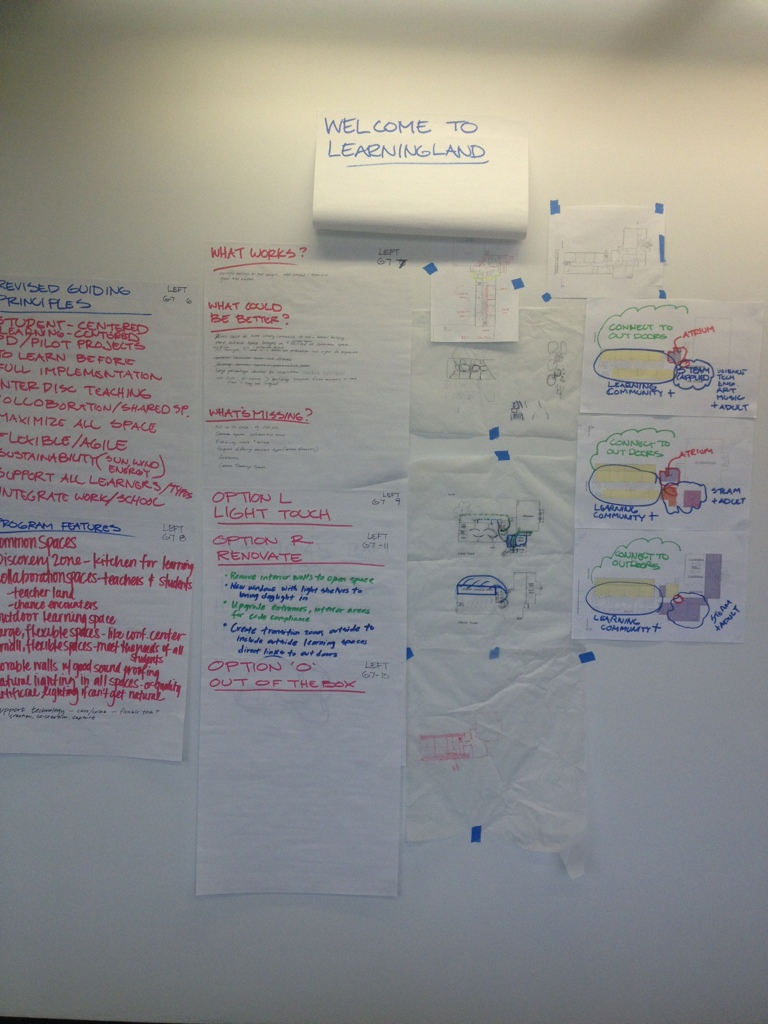
But, I now think (actually, I know) that we need to design spaces that take into account the principles of student centered learning, learning centered, professional development and pilot projects, interdisciplinary teaching, collaboration, shared space, maximizing all space, flexibility, agility, sustainability (sun, wind, & energy), supports all learning styles and types, and integrated the community and school.
And now, I also think (actually I know) we need to use architectural and learning theory, emerging technologies, environmental sustainability, child and adult collaboration, and community engagement to create “AGILE” learning facilities that can be flexed into the 22nd Century without taking millions, or even billions of dollars to sustain or modernize in another 60 years.
The photo in this post is of the visual work process of the Design Team Project my classmates and I created. We called it LEARNING LAND! Sounds like a fun place to be, huh?
Notes On Servanthood

Yesterday I blogged a post entitled Rushmorean Servant Leadership Today during my study time I came across the notes I have pictured above. These notes were from John C. Maxwell’s The Maxwell Leadership Bible.
“Leaders add value by serving others” (p.814).
“Lead others by serving not bossing them” (p. 814).
“People don’t at first follow worthy causes; they follow worthy leaders who promote worthwhile causes. People buy in to the leader first, then the leader’s vision. Listeners filter every message through the messenger who delivers it. You cannot separate the leader from the cause he promotes” (p.286).
As leaders these are important points for us to reflect and act on!
References
Maxwell, J. C. (2007). The Maxwell leadership Bible. Nashville, TN: Thomas Nelson Publishing, Inc.
Rushmorean Servant Leadership

Christ’s Entry Into Brussels
James Ensor
I was prompted today to write about servant leadership; or really leading from where you are. Really I guess I am combining three important concepts to leadership here, but I believe they are not mutually exclusive. First, I believe leaders must be servants, not title holders. Second, I believe everyone must have the ability to lead from where they are, and finally, I believe we must use Christ’s model and lead from the middle.
Let’s explore my three thoughts. As leaders we lose the right to be selfish. Leadership is about serving others, not wielding power because of a title. Great leaders please others, not themselves. The great leaders I admire add value to others’ lives. We should also, as effective leaders, emulate Christ’s model. Finally, as a servant leader we must remain life-long learners and teachable. As the saying goes, “Leaders are Learners.”
Every day when I walk into school, I remind myself that it is not about me. It is about everyone else that I serve. My goal is to make myself the most dispensable person in the building. Imagine how effective our team will be if every person is empowered and has been given the personal, professional growth to lead, educate, and operationalize everything in our high school.
Additionally, I believe we must lead from where we are. I am a card-carrying believer that every person in our high school is a leader – from the person who empties the trash to the students, the teachers, and right to me. I learn from someone in those groups each and every day. Wheatley (2007) promoted a more unstructured style of leadership, which promotes self-organization. She contended that most leaders use control and imposition rather than a self-organizing process (Wheatley, 2007). I believe the more control is imposed on people and situations the more they are made uncontrollable. Wheatley (2007) considered self-organizing systems to have the capacity to create for themselves the aspects of organizations that we thought authoritarian leaders had to provide. Therefore, it is important for leaders to create a culture where individuals are free and the need to create is met (Wheatley, 1992, 2007).
We really need to move from leader-centered organizations to leadership-centered organizations. There must, in my opinion, be a sharing of leadership responsibilities. Schultz (2011) asserted that by flattening the hierarchy and moving toward a shared leadership model, positive outcomes result from a reciprocal influence between leaders and followers. This is the concept I mentioned as my third concept of Christ’s model of leading from the middle. Schultz (2011) recommended sharing leadership with others. This is really important on two fronts – 1. I want everyone in our organization to be empowered to provide leadership anytime they see a need; and, 2. I want to be leading from within right along side everyone, not out in front where I can’t see what is going on. From the middle I can help pull people along and can also help push. Effective leaders are hands-on and operational giving them the situational awareness necessary to be curious, learn, and take action.
I included the image of my favorite painting in this post – Christ’s Entry Into Brussels, by James Ensor. I was first introduced to this painting when I read Leading Change: Overcoming the Ideology of Comfort and the Tyranny of Custom by James O’Toole (1995). This book is displayed in my office as one of the top five literary influences on my life. In this book O’Toole introduces the idea of values-based leadership that he calls, Rushmorean Leadership. Based off of the leaders chiseled into Mount Rushmore. As O’Toole said: “I prefer to think of the four as the best representatives of a school of values-based leadership dedicated to democratic change” (O’Toole, 1995, p.21). It is important to think about how all four Presidents led: they listened to others, encouraged dissenting opinion, empowered authority to their subordinates, and led by example instead of power, title, manipulation, or coercion.
Now, back to the painting by Ensor. If you enlarge it you will find Christ in the middle where we always find Christ, among us. Look close at the painting and you will find him in the middle of chaos, just like most of us lead in every day. Remember, he led by becoming one of us and teaching us among us. He would not have had to do this, but it was the only way. He led by example, he listens, and he empowers us each and every day to be the best we can be to serve. Take a moment and reflect on your role as a servant leader. Would O’Toole call you Rushmorean? Are you leading from the middle like Christ?
References
O’Toole, J. (1995). Leading change: Overcoming the ideology of comfort and the tyranny of custom. San Fransisco, CA: Jossey-Bass.
Schultz, D. (2011). Sharing leadership. Leadership Excellence, 28(2), 16-17.
Wheatley, M.J. (1992). Leadership and the new science: Learning about organization from an orderly universe. San Francisco, CA: Berrett-Koehler Publishers, Inc.
Wheatley, M.J. (2007). Finding our way: Leadership for an uncertain time. San Francisco, CA: Berrett-Koehler Publishers, Inc.
Proverbs 29:18
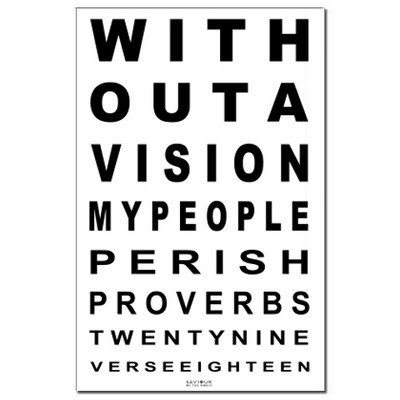 For the second week in a row I am going to reference a Bible verse. I received an email from one of our teachers this week thanking me for the leadership I have been providing. I really appreciated the email, but also appreciated the reminder of what it says in Proverbs 29:18: “where there is no vision, the people perish but blessed is he who keeps the law.” It was great to see this reference in his email.
I love references to Proverbs because I read a chapter a day, as there are 31 chapters. Perfect for a daily reading. I learned this from reading Steven Scott’s The Richest Man Who Ever Lived: King Solomon’s Secrets To Success, Wealth, and Happiness.
This reference was so appreciated because I believe having a vision is so important. More important than the vision is the action. You can plan and visualize all you want, but until you “do” nothing happens. We have a vision for a great school for our students and are working very hard to provide that.
Mind Vs. Brain
 I just finished reading Walter Isaacson’s Einstein. Besides being a great read, I learned so much from reading this book. From an educator’s perspective I found it amazing that Einstein always believed that he had no special talent – he was just as he said, “passionately curious.” This points to the important fact that we have a tremendous obligation to help our students develop and find their curiosity. Einstein posited that the brain was wired and set up as it was, but we all have the ability to develop the mind.
It is important for us to develop and create minds that question. Individuals with intuition and imagination are crucial to our future. The locksmith of the atom and universe also realized that power without wisdom is deadly. The events of the time that Einstein lived was proof of this. Along with developing the free mind and curiosity we must have tolerance and humility. Einstein was a very humble man and we can all learn a lot from his example!
Twas The Night Before!
“Make It Happen”
Well here we are the Saturday before school starts at Emmerich Manual High School. As the new principal of one of the state’s turnaround academies I am so excited to finally have students here on Monday morning. I am so excited about our ADVANTAGE: Putting Students First!
For this week’s post I would like to share with you the letter I put in our first newsletter that will be given to the students on Monday. Here it is:
Hello Emmerich Manual High School students, parents, and community stakeholders,
It is with great excitement and anticipation that I write this first entry in our school newsletter! On Monday, August 6, we officially begin our partnership for the critically important task of providing highly effective learning for the students of Emmerich Manual High School. I am grateful that I have the opportunity to serve as your Principal. I want you to know I am excited to be taking this journey with you.
As a teacher my mission statement was always “to be a steward of high student achievement and performance through rigor, relevance, and relationships.” These will continue to be cornerstones that I believe are very important to highly effective teaching for our students. I would also add the fourth “R” of “Results Driven.” If we truly put our students first we will be victorious in this endeavor together and our students will win the results of high student achievement and performance and being college and career ready.
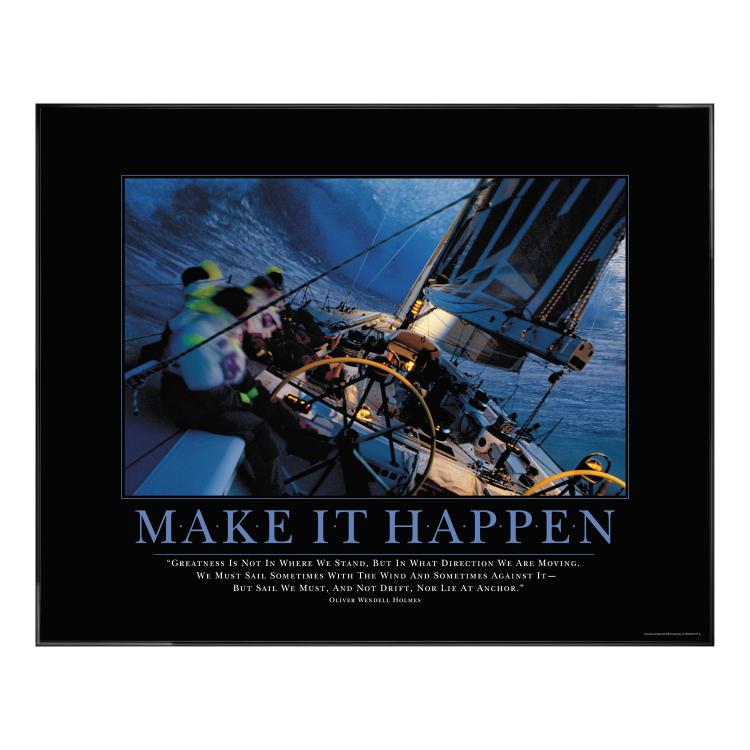
In my office I have a picture titled “Make It Happen.” The inscription reads: “Greatness is not where we stand, but in what direction we are moving. We must sail sometimes with the wind and sometimes against it – But sail we must, and not drift, nor lie at anchor,” by Oliver Wendell Holmes. This picture has a brass plate with the inscription: Emmerich Manual High School Advantage: Putting Students First, additionally, the picture is matted in such a way to have signatures put on it. I am having all staff sign this picture as a reminder that everything we do will be driven by putting our students first.
This is going to be a very exciting year. We have an incredible staff and enthusiastic and well-prepared teachers that will be facilitating engaging learning for our students. Also, I cannot wait for our athletic seasons to start, especially with the return of football.
Please know I am proud to be serving as your principal; this will be an exciting journey as we sail toward putting the students of Emmerich Manual High School first!
Positively,
Byron L. Ernest, Principal
What If Teaching Was Our Most Important & Valued Profession?
 Great teachers build nations. Great teachers provide the inspiration for highly engaged and effective learning. They awaken and raise our children’s expectations. Great teachers also inspire creation through tapping into students’ imaginations that lead to discovery. They shape our next generation of great decision-makers.
Let’s be clear, teaching is hard work done correctly. Most high level professions are. So again, let’s be clear teaching is a high level profession. As I reflect on my career, my choosing to be a teacher was a very deliberate choice based on the mentoring of a college professor (teacher).
My teaching career did not begin with the same story that many teachers share. I did not have an epiphany when I said to myself, “I want to be a teacher.” My journey as an educator began during my sophomore year at Purdue University when Professor Hobe Jones pulled me into his office and asked if I had ever considered teaching. When I said, “no,” he explained that he saw a talent in me for educating and wanted me to double major in Animal Science and Agricultural Education. It is amazing how someone like Dr. Jones can make a huge impact on someone’s life. His inspiration and personal interest helped me to deal with the challenges of a double major, making my 27 year educational career possible. Without Dr. Jones’ personal interest in my abilities, I probably would have missed this opportunity. It is his example of true caring that I strive to emulate every day of my teaching career.
Teaching is a high level profession and we need to become very deliberate in recruiting students into this profession. Only the best will do for our children. As Superintendent of Public Instruction, Dr. Tony Bennett says: “What if Indiana’s most important work was also our most valued work?” In closing I would like to share a video I was part of making with the Indiana Department of Education in honor of Teacher Appreciation Week entitled: What if? To view the video click here.
Pelican Leadership Lessons

Brown Pelican who became our fishing friend as my son and I were cleaning fish!
I just returned from our annual spring break trip to Destin, Florida. We literally live on the beach for eight days. One of my favorite things about beach life are the Brown Pelicans. Every year I am amazed by these majestic birds and the lessons we can learn from them.
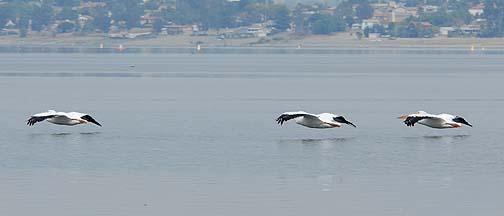 The most amazing thing they do is fly in cooperative “u” and “v” shaped groups. They do this to drive the fish to shallow water. Many times they will beat their wings on the surface of the water to drive the fish. So, like many species they collaborate to catch their food. We can learn from the Brown Pelican that without collaboration, the group/team does not succeed.
It is also amazing to watch these birds fly in a straight line. It is really cool to watch them fly right over the surface of the water. The lead bird will go up and down with the ebb and flow of the waves just above the surface. All the other birds follow in a perfect rhythmic wave. We as leaders need to also make this smooth adjustment to the ebb and flow of our daily happenings. 
Additionally, Pelicans fly in a “V” pattern. Flying this way reduces drag and saves energy (actually up to 20%). Don’t you think collaborating saves 20% of our energy as well? Even more interesting is the fact that the lead bird in the “V” has to work the hardest by breaking through the air where there is the most resistance. Sound familiar? But wait, the Pelicans have figured out this leadership challenge as well. The lead bird does not stay at the point of the “V” for very long. It drops back to let another bird lead so it can rest and have leadership renewal.
This is a very smooth transition that happens in flight. In other words, biological stress necessitates this constant transition. More importantly, every Pelican in the “V” can lead. Can you say that about everyone in your organization? Does everyone have the opportunity or feel the need to lead?
Think about it. For us, biological stress also dictates we need to rest and be renewed. Also, collaborative organizations are healthier when the hierarchies are flattened and leadership is distributed.
I am particularly excited that in Indiana, part of our new teacher evaluation system involves the teachers’ ability to provide school leadership. When effective distributions of leadership occurs all teachers are better able to lead from where they are. Leadership must occur from all levels.
Next time you need a visual reminder of leadership – Look to the Pelican

Loving the scraps we were throwing him!
The Angry Birds Effect
 I used to talk about the “Nintendo Effect.” The reason why kids of all ages love and get hooked on video games is because of the great educational best practices these games employ. These best practices are: student-centric instead of monolithic, immediate feedback, actionable feedback, the opportunity to immediately go back and re-try, and the ability to collaborate and watch others play and learn from them. You would have to agree, all of these are important to learning whether you are a p-16 learner, business executive, or pro-football player. Right?
I have now changed my phrase, however, from “Nintendo Effect” to “Angry Birds Effect.” This change is not just to keep me more in tune with the times, but the fact that Angry Birds does a better job of combining all the best practices than Nintendo ever could. For those reading that have never played Angry Birds let me give you a little tutorial. Basically, you are presented with Angry Birds and a sling shot and your job is to destroy green pigs who are sheltered by very creative structures in a variety of settings. This game, designed by the Finnish game developer Rovio Mobile, was first designed for the Apple IOS system in 2009.
Each level starts with the number, types, and order of birds predetermined. If all the pigs are defeated by the time the last bird is used, and you improve your score three times the next level is unlocked. Basically, standards mastery! Upon completing each level, players receive one, two, or three stars, depending on the score received. I want to make sure you understand here, I can play as many times as needed to get all three stars – a little different than the way most students are graded today. Players may reattempt unlocked levels as many times as they wish in order to complete them successfully or to earn additional points or starts. 
Angry Birds has many of the components that should be incorporated into great student centric curriculum and lesson planning or development of corporate training programs. The way most schools do feedback right now is by grades and “when the grades are handed out, the privilege of feeling successful is reserved only for the best students. By design, the rest experience failure” (Christensen, Horn, & Johnson, 2011). Let’s take a look at the best practices we can learn from Angry Birds:
1. Early in the game, the single Red Bird is the only one available-basic knowledge.
2. Players advance at their own pace.
3. Mastery is required to advance – You must have cleared a level three times with score improvement each time before moving on.
4. As the player advances, new levels are introduced.
5. The player can move ahead and clear levels beyond the one they are presently in, but not too far.
6. Different contexts are portrayed (deserts, gem mine, city at night, et cetera) to make it interesting and relevant to the player.
7. The player is given new tools (different types of birds) to use as he/she advances and unlocks higher levels.
8. Immediate feedback is given. The player knows the score immediately.
9. Ability to go back and retry and review any level any time.
10. The next level is always “just above” (Christensen et al., 2011) the players ability. Not too far above, but “just above.”
Let’s dig into this concept of “just above” a little deeper. Christensen et al. (2011) asserted, “There is mounting evidence that students’ learning is maximized when content is delivered “just above” their current capabilities – not too much of a stretch, and not too easy. Customization to the “just above” level for each student is much easier to achieve in software than in the current monolithic delivery of most schools.” This adds a whole new dimension to differentiated instruction and modifying learning according to the way students learn. Remember, this is true for adult learners as well.
So let’s recap what we can learn from Angry Birds. We must provide a learning environment that is student centric, not monolithic (Christensen et al., 2011); we must provide immediate and actionable feedback; we must provide the students with the ability to go back and keep trying and editing till mastery is achieved; and we must introduce material “just above” where each individual student’s capabilities are.
Next time you are planning a lesson, developing a training program, planning a practice, or whatever your profession has you teaching others; think about the best practices of Angry Birds.
Reference
 Byron's Babbles
1 comment