New World Global Leadership
 “We know this much. The world is not going to be dominated by any one great power. For Americans that’s going to be a very difficult thing to accept. Most of us still see a world – the world of 1960 – in which America was the only great power, and the only functioning economy.” (Peter Drucker in Maciariello, 2014, p. 134) These were the words of Peter Drucker in 2004 and I think he was spot on. In fact, I believe we still don’t fully understand the new world we live in. Drucker also said, “So we Americans will have to learn that it is going to be a very different world in which different values must coexist (Maciariello, 2014, p. 134).” I really believe that sometimes we proceed as if the United States is the world, when in reality we are part of the world.
We are going to have to learn to be effective change agents of a global future. We will need to create our own future, rather than trying to predict the outcome of all these global forces (Maciariello, 2014). Whether the global demands become threats or opportunities will depend on our competence. The forces of a global society cannot be left to market forces or any one sovereign nation. Today’s lesson from Peter Drucker furthers my belief that leaders in education must make a commitment to moving global education forward. Engagement is the key to having teachers lead this movement in global education.
 Global education is not just about economics, it has to be about citizenship and global awareness. Therefore, kids need skills to navigate globally. Furthermore, kids need skills to navigate a shrinking world. The world is getting smaller and kids need the skills to navigate globally. Hanging world flags and doing multi-cultural days with different ethnic foods does NOT make students globally competent. We must begin to use the ABCs of global immersion: Academic Achievement, Bilingualism/Biliteracy, and Cultural Competance. We must create intentional/strategic curricula for global education and competancies, not just a few activities.
The skills and insights students can gain from interacting with people of different nations and cultures is critical as America engages more intensely with an increasingly global marketplace and interdependent world. As an educational leader, I must lead the charge to help the students I serve to have a high quality global education program. A great global education program is multi-faceted, fully job imbedded professional development for the teachers, and has transdisciplinary themes. Finally, I believe all students have the right to deep global competency! How will you help to develop a sense of urgency around global education?
Reference
Maciariello, J. A. (2014). A year with Peter Drucker: 52 weeks of coaching for leadership effectiveness. New York, NY: HarperCollins Publishers.
Educating Outside The Walls
 I spent Monday and Tuesday of this week at the Indiana State House with a group of our teachers. Our mission was to demonstrate to our state legislators how virtual education really works. We set up in the House Committee rooms and had our teachers facilitate learning for our students from there. Many legislators came down and spent time with our teachers and we really appreciated the opportunity to share. At stake, right now, is a bill (HB 1001) that came out of the house calling for 100% funding for all schools. When the bill went to the Senate the amount was reduced back to the present level of funding of 90% for us, as a virtual charter school. I absolutely believe that our school, Hoosier Academies, should be funded at 100%. I believe all schools serving Indiana’s students should be funded equally at the 100% level.
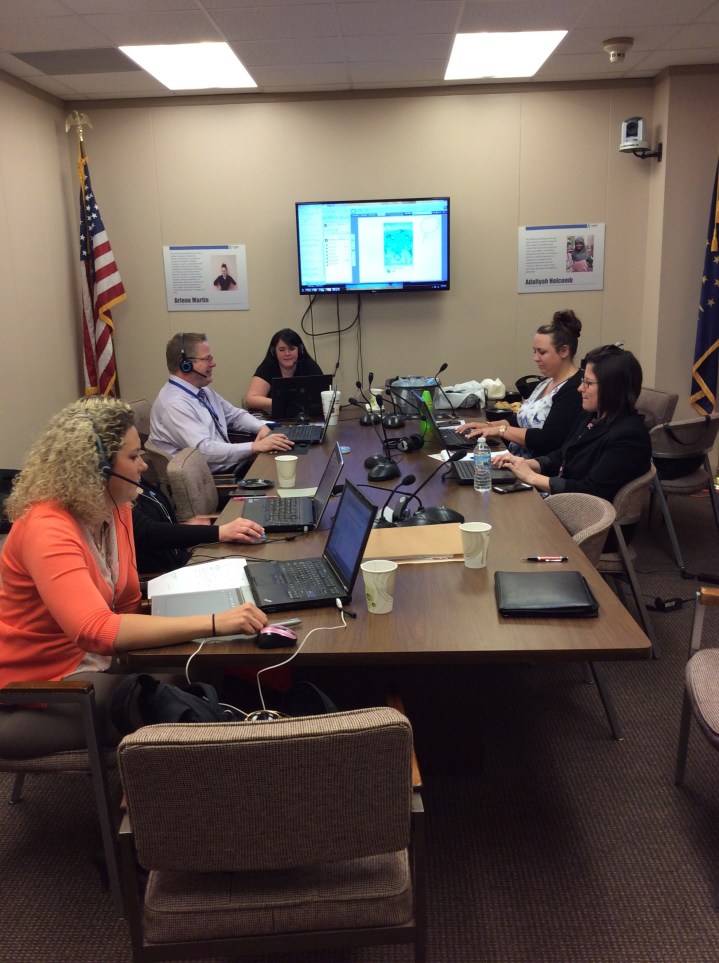
Hoosier Academies Teachers Teaching In Room 156A Of The State House
 Representative Dave Ober, from Albion, said it best this week in a tweet: “The education philosophy in Indiana is that money follows the child. We need to make that commitment clear.” I have blogged about leading with certainty and clarity before (click here to read), and I consider this leading with both certainty and clarity. I had the opportunity to visit with Representative Ober this week and he certainly understands what is at stake. He is displaying his commitment to ALL Indiana students. In my personal growth time this morning I was reading David McCullough’s Truman. McCullough stated that former President Harry S. Truman hated the words “progressive,” “liberal,” and “reform.” Truman wanted everything to be “Forward Moving.” To have our schools and education to be “forward moving” there needs to be 100% funding for all schools, regardless of type.
One of the issues about funding right now relates to virtual schools. Let’s dive into the virtual thing. Really, virtual education is very “forward moving,” as Truman would have said. I hope we can all agree that all students can learn and that all students learn differently. If that is the case, then why would we think that all students learn best in a building with walls and a roof? We need to think “outside the walls.” Having just spent time with my Smithsonian Institution friends in Washington D.C. this past week, I can tell you they embrace the fact that not all students will be visiting, or even have the means to be able to visit within the walls of their museums. In fact, the Smithsonian Institution wants you to take advantage of visiting virtually. Truly, the Smithsonian Institution is equal access to everyone. EVERYONE!
I’ll give you an example: The Wright Flyer, on display in the Smithsonian National Air and Space Museum, was scanned using a 3D laser, which produces a highly detailed and accurate image of the object. The 3D Wright Flyer exhibit is part of the Smithsonian Institution X 3D Collection, which provides a very detailed look at objects. The 3D Explorer allows visitors to rotate the objects on the screen and includes guided tours. The X 3D Collection provides access to many of the Smithsonian Institution’s 137 million objects of which only one percent is on display at any one time in the 19 museums, nine research centers, and the Smithsonian National Zoo. This is very “forward moving” and is in line with the Smithsonian Institution’s core mission – “The increase and diffusion of knowledge.” The Smithsonian Institution is certainly thinking “outside the walls” to provide extensive public outreach and educational programs.

Image Of The Wright Flyer From The X 3D Collection
Just like the Smithsonian Institution, we in the virtual education world, are serving as pioneers and trailblazers in online and blended education. We continue to learn how best to navigate innovative ways to deliver content and facilitate engaging lessons for students. Our “forward moving” and “outside the walls” approach includes a data-driven academic plan, increased professional development for our teachers, individualized learning plans for all students, strengthened family and stakeholder engagement, and a targeted credit recovery program.
A key to the success of any organization is understanding what makes it distinct. At Hoosier Academies we are distinct because we are carrying out, as called for in the state constitution, education equally open to all and by all suitable means. We know in our case what makes us unique is the fact that students served by Hoosier Academies are able to be fully online (statewide in all 92 counties) or have the option to go to our hybrid schools (face to face two days a week and online the other three) in Indianapolis. What also makes us distinct is that we have a 67% mobility rate. We must embrace the fact that in many cases we are a short term solution to many of our students. This mobility may be because of health issues, bullying, differentiated learning needs, or students who have special circumstances such as being an Olympic gymnast. For many students we are the only available choice in a state that embraces school choice. I believe we are beginning to make progress because we have begun to answer the question of what what makes us different and really owning it. This realization has only come about because of really asking and listening to the students and parents of the students we serve about what they believe we should be trying to accomplish for them. We have a long way to go, but are making progress.
This discovery has come about from stories, for example, of the family whose daughter has been with us through 6th, 7th, and 8th grade, because of being bullied at her local school, but, is going to try going back to her local high school next year. Another family, who I visited with recently in Gary, has their children enrolled in Hoosier Academies because they are scared to have the students walk to school. We also have students with medical conditions that do not allow them to be enrolled in a traditional setting and who are flourishing in our modality. Another story comes from our starting a National Honor Society this year and how the parents of a student with Down’s Syndrome who was inducted stated that there was no way their daughter could have ever been as successful, academically or socially, in a traditional setting. These stories are anecdotal and qualitative proof that Hoosier Academies is an interim solution for many families. We are a place for students to go for whatever length of time the parent believes is necessary. Furthermore, more than one-half of parents of high school students and one-third of elementary students will choose this option to catch their child up academically.
The internet has changed the way people accomplish so many things, including the education of their children. Thanks to technological advances, students aren’t limited to learning in a traditional classroom environment. Many parents are choosing virtual schooling as a viable educational choice that provides a range of benefits. Virtual schooling provides the same opportunities for children and teens, allowing them to use technology to learn and grow in the familiarity and comfort of their home environments. Online school programs may also provide students with more of the personal attention they need. Teachers are often better able to focus on each student’s unique needs and provide a more customized approach to learning. In a perfect world, no child would ever face bullying or other social struggles in school. In reality, however, many children deal regularly with bullies and troubling social interactions that make learning nearly impossible. Many students we serve also face classroom-learning challenges because of their own behavioral or emotional needs. Online learning modalities allow students to learn in a safe and secure environment that is free from the social and behavioral concerns typical of traditional classrooms.
Again, if we truly believe all students learn differently we need to embrace the fact that students will need individualized learning environments as well. Let us be “forward moving” in our continued improvement of all learning environments for tomorrow!
Spirit of Performance
 Drucker believed that the spirit of performance in an organization is led by leaders who are committed to getting the right things done (effectiveness) and doing the right things (efficiency) (Maciariello, 2014). These leaders must posses integrity of character, a vision for the organization, and focus. They must also be able to lead change. Drucker called those who could lead change agents “disturbing elements” (Maciariello, 2014). A disturbing element in an organization is a leader who seeks to change its culture and practices to prevent bureaucratic behavior from settling in. These leaders bring energy and spirit to the organization.
Drucker also believed that the purpose of an organization is to “make common men do uncommon things” (Maciariello, 2014). We all hire from the same pool of common people. Face it, we are all just common people. Why do some achieve greatness in the companies, organizations, and schools they work for? Because there has been at least one leader in that institution who prodded people to develop, improve, innovate, and sustain the spirit of performance. Organizations must see being entrepreneurial and innovative as a duty. As such, organizations must develop their people to be entrepreneurial and innovative. This ca be accomplished with “conscience” activities. Those activities that remind the organization what it should be doing and what it isn’t doing.
Those leaders who provide the sustaining spirit for an organization are forever watchful for bureaucratic tendencies allowing people to drift into repetitive routines and lose focus on primary results. I was really reminded in this week’s lesson, how much all of this really deals with people. It deals with hiring the right people and then providing the right opportunities and a culture of performance. Furthermore, it is important to remember that decisions that affect people, their placement and pay, promotion, demotion, and severance, must represent the values and core beliefs of the organization. As businesses, organizations, and schools, innovate and evolve there will be people who are just not the right fit. This poor fit may be because of skill level, personality or any number of things. Drucker teaches us this is natural. We must work to make conscience decisions about how to get them the professional development they need, help them understand the gap in fit, or come to an understanding together that it is just not in the best interest of either party to continue. I liked the suggestion by Maciariello (2014) that we should always ask the question, “What can they do?” Many times there are adjustments that can be made.
Are you providing the spirit of performance in your organization?
Reference
Maciariello, J. A. (2014). A year with Peter Drucker: 52 weeks of coaching for leadership effectiveness. New York, NY: HarperCollins Publishers.
Leading Together By Working Together

We are increasingly moving towards multinational, transnational organizations that are held together by two factors: control of mission and strategy, and enough people who know and trust each other. Distributed leadership and a flattened hierarchies are key to accomplishing this. In this week’s lesson on Peter Drucker, and example of how the Coca Cola Argentina division had to make a decision that was right for helping the people of Argentina, but not good for the bottom line of the company based in Atlanta Georgia (Maciariello, 2014). Coca Cola understood that performance measures for foreign subsidiaries should be adapted to local political and economic realities.
As leaders we must learn to balance having a bold vision with what to do next. We must also learn to lead together by working together. Everyone in the organization must understand the values, objectives, and expectations of the organization. This is why it is important to build a team that is competent. Empowerment without competence is chaos. Wherever you sit in the organization, there is many times a tendency to wait for others to lead. We need to create an environment where everyone in our organizations can lead from where they sit.
Trust-based relationships must replace command and control mechanisms as coordinating mechanisms. This will allow effective leaders time to perform important duties. We must create enough autonomy for our teams to meet the local realities they face. Maciariello (2014) closed this week’s lesson by posing a great question that we all, as leaders, need to answer. Does your organization have resilient trust networks, that allow individuals to transfer information to and from one another?
Reference
Maciariello, J. A. (2014). A year with Peter Drucker: 52 weeks of coaching for leadership effectiveness. New York, NY: HarperCollins Publishers.
Leading Beyond The Walls
This 12th week reading in A Year With Peter Drucker (Maciariello, 2014) may have resonated with me more than any yet. Drucker was a fan and student of the Federalist Papers. As a student of Patrick Henry you all know I am a believer in state’s rights and the 10th Ammendment to our nation’s constitution which reads: “The powers not delegated to the United States by the Constitution, nor prohibited by it to the States, are reserved to the states respectively, or to the people.” I believe Drucker took the last part of that Ammendment very seriously. We as leaders have a responsibility to provide leadership and be involved in government and civic organizations.
Drucker argued that while each organization should fulfill its primary mission, it should seek to “lead beyond borders.” (Maciariello, 2014). We, as leaders are responsible for our institutions and be concentrated and focused on them, but Drucker believed we must be focused on the community as a whole. In his first year as governor of California, Ronald Reagan used 200 top CEOs, as volunteers on sabbaticals from their companies, to solve the budget crisis. Reagan said, “For every problem their are 10 people waiting to volunteer if someone could give them the lead and show them where they can be useful.” We, as leaders, need to also be seeking areas where we can provide insight and be useful.

Leadership and management of businesses was where Drucker began, but his first love, I believe, was the management of nonbusinesses like hospitals, churches, and schools. He was very involved with social sector management and leadership, particuarly with non-profits. He found these interesting because it is very difficult to define what the results should be. How do you define the results of a school, for instance? This is a very important question that I believe is yet to be answered. Drucker would have said it is my responsibility, as a school leader, to lead beyond the walls of my school and help to solve this question. I also believe it is very important to be involved civically and be an agent of social change. Drucker defined civic responsibility as: “giving to the community in the pursuit of one’s own interest or of one’s own task.” (Maciariello, 2014, p. 100)
Results are more difficult to define for social sector organizations, like schools, than for business organizations. This is because the social sector institutions are involved in changing lives of individuals for the better. Results must be more than merely good intentions, but must also be tailored to fit the organization. We must be acutely aware of the importance of defining results in terms of our own mission and effectively manage the fulfillment of that mission. This is why I believe schools should have a role in determining the accountability metrics of their individual school. Each school will be stronger the more clearly it defines its objectives. Organizations are more effective the more yardsticks and measurements there are against which the performance can be appraised. Our product we are producing in schools is a changed human being. We are human change agents. Our product is a child that learns.

Some questions for pondering from this week’s lesson are:
- What needs are your organization meeting as a part of your primary mission?
- How effective and efficient are you in carrying out your mission?
- How effective are you at changing lives for good?
- Are you leading beyond the borders of your organization/business?
- Are you mentoring other leaders or managers?
Reference
Maciariello, J. A. (2014). A year with Peter Drucker: 52 weeks of coaching for leadership effectiveness. New York, NY: HarperCollins Publishers.
Stretching The Vessel of the Mind

It is hard to think about the brain and learning without reflecting on Albert Einstein. Reading Walter Isaacson’s book, Einstein, causes one to think about whether every individual has the ability to develop and use his or her brain in the way Einstein did. From an educator’sperspective I found it amazing that Einstein always believed that he had no special talent – he was just as he said, “passionately curious.” This points to the important fact that we have atremendous obligation to help our students develop and find their curiosity. Einstein posited the brain was wired and set up as it was, but we all have the ability to develop the mind (Isaacson,2008). This reinforces the belief that every student can learn. It is important for us to develop and create minds that question. Individuals with intuition and imagination are crucial to our future.
So, how do we develop a student mind that is curious, questions, and has imagination? If learning was as simple as pouring the pitcher of knowledge into the empty vessel of a student’s brain then all education would require was a person to speak didactically on a subject, and students would listen and gain the knowledge themselves. Unfortunately, learning takes a lot more than merely listening to an authority speak, regardless of his expertise and reliability.
There are two types of learning: informational and transformational. The first type (informational) is that which we use as a lower level form of learning. We are just gaining new information. During the learning process this informational learning is placed in short term, or what is also known as immediate memory. Immediate memory acts as a temporary site whereinput is briefly stored until the brain decides whether to erase the memory as unimportant or toprocess the memory. To use the metaphor of the pitcher of knowledge filling the empty vessel used earlier, informational learning will only fill our vessels so full.
We then need the second type of learning, transformational, in order to stretch our learning (Mezirow, 2000). The unique quality of human beings is our ability to think flexibly about new situations, comparing them intelligently to all past experiences, and then to do something that is uniquely appropriate, bringing about desired objectives (Taylor, 2007). When educators facilitate this type of learning the brain is stimulated to put the information learned into working memory where processing of the information begins. In order to engage the working memory the students must begin to work with and actively use the information learned. By engaging the working memory by using the learned knowledge the long term memory then creates meaning enabling the student to make sense of the material. Ron Ritchhart promotes thinking through the use of “thinking routines” (Ritchhart, Church, & Morrison, 2011). These routines then help teachers to establish a classroom culture that supports thinking (Ritchhart, 2014). Relating lessons to real-life situations, and being enthusiastic creates meaning for the students. We must know our learners’ backgrounds so that we can relate to the student’s past learning and allow the learner to understand and make sense of the material being presented.
Transformational learning provides us with new ways of thinking (Taylor, 2007). This can actually change the form of the metaphorical vessel of the mind. In fact this new stretch, and.extending of thinking actually gives more room in the vessel of the mind for greater and more magnificent thinking. Creating lessons using real-world contexts that the student can beenthusiastic about and make sense of immediately can do this. Think about the student who says to their teacher: ”I was confused before you started…now I am confused at a higher level.” This is not to say that educators should teach by confusing students, but students do need to be appropriately confused. In order to achieve this stretching of the vessel of the brain, teachers must facilitate learning is such a way as to use all parts of the students brain by including reading, writing, verbal processing and images in lessons and other modes of learning. Because the mind is tethered to what our bodies are doing and the senses being used, educators must be cognizant of making sure that our students’ bodies and brains are in sync.
Many educators believe it is important to teach students to think. These same educators teach thinking (reasoning skills and problem solving skills) skills, which are important, but if we want students to use these skills we will need to do more than just teach the skills. Research shows that motivation, values, cultural context, and alertness to opportunity are factors important to developing intellectual behaviors (Boix-Mansilla & Jackson, 2011). These factors make up thinking dispositions, which are important characteristics of good thinkers. To become educated and worthwhile citizens, our students must learn a wide range of skills. Brain research must continue to be linked to facilitation of learning. We must use what we know about the brain to effectively engage students so they are motivated, creative, and understand the relevance to their personal lives.
References
Boix-Mansilla, V., & Jackson, A. (2011). Educating for global competency: Preparing our youth to engage the world. New York: Asia Society.
Fischer, K, & Immordino-Yang, M.H. (2008). he Jossey-Bass reader on the brain and learning. San Francisco, CA: John Wiley & Sons.
Isaacson, W. (2008). instein: His life and universe. New York, NY: Simon & Schuster Paperbacks.
Mezirow, J. (2000). Learning as transformation: Critical perspectives on a theory in progress. San Francisco: Jossey Bass.
Ritchhart, R. (2014). Creating Cutlures of Thinking: The 8 forces we must master to truly transform our schools. San Francisco: Jossey-Bass.
Ritchhart, R., Church, M., & Morrison, K. (2011). Making thinking visible: How to promote engagement, understanding, and independence for all learners. San Francsico: Jossey-Bass.
Taylor, E. W. (2007). An update of transformative learning theory: a critical review of the empirical research (1999-2005). International Journal of Lifelong Education, 26 (2), 173-191.
Effective Leaders Make Effective Decisions
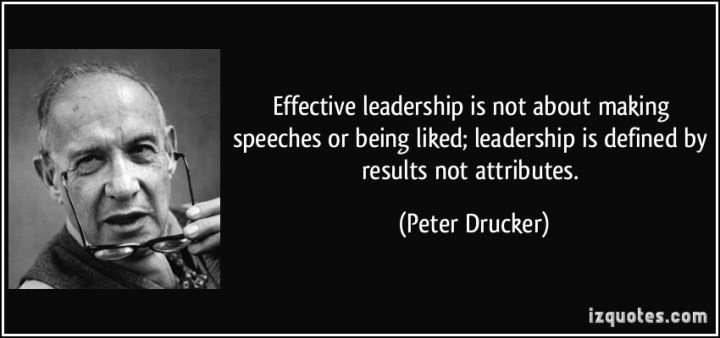
“Leadership is lifting a person’s vision to higher sights, the raising of a person’s performance to a higher standard, the building of a personality beyond its normal limitations.” ~ Peter Drucker
Drucker was confident that people could be taught to be effective executives (managers), but wasn’t as sure we could teach other to be leaders. Interesting, however, in the week 11 reading in Maciariello’s (2014) book he talked about how Drucker believed the climate in the organization needed to be right for leaders to develop and emerge. “Nothing better prepares the ground for such leadership than a spirit of management that confirms in the day-to-day practices of the organization strict principles of conduct and responsibility, high standards of performance, and respect for individuals and their work (Drucker in Maciariello, 2014, p. 79).” I wrote in the margin of the book, “So if the operations and processes are in place and being executed effectively, then leaders can grow and emerge.” I really do believe this is true. I have a saying I use in school turnaround and transformation and that is: “We need to become a REAL SCHOOL.”
The question you will ask next is, “What is a REAL SCHOOL?” My answer is quite simple: “A real school is one that has its operations and processes in place and being managed by an effective individual and team to make sure that the normal day to day activities (eg. Safety procedures, student handbook components, discipline, financial processes in the case of a school) are being carried out efficiently and effectively. I was very blessed to have just such a person in my first turnaround school. Don Burton was our Assistant Principal of Operations. Let me tell you, without him the school would have never come off the “F” list. He was the operations manager dream of a lifetime. The great part about Don was he managed the operations flawlessly and implemented our processes with the best interest of our students and staff in mind.
Mr. Burton’s awesome abilities and work ethic then allowed the teachers to teach and me to do the numerous activities as a building leader: establishing a vision, defining the mission, making sure that resources are applied to the right tasks, making effective decisions, implementing and following up on these decisions, taking criticism, keeping track of and navigating the legislative and governmental affairs, and working diligently to maintain a functioning board of directors. Imagine trying to do this in a disfuctional organization. Believe me this is not an easy task, nor did we have it perfect, but Don had us in a great place. There is a reason why schools fail, and one of the commonalities of the schools that need to be turned around is the disfuctionality and lack of the right operational practices to make it a “real school.” I’m sure you could tie common operations and practices that would make businesses and organizations “real businesses” and “real organizations.” I am positive education is not alone in this.
Again, I cannot say enough how much credit for our success goes to Don Burton. He enabled the day to day operations to go smoothly which then allowed me, and him, to grow as leaders. This truly allowed the environment to be right for leadership growth. Don certainly grew, as he now is leading a middle school in Arizona as a principal. I consider Don a dear friend and I always said we never had to schedule time, we were always catching up before or after school or on the weekends. It was just such a natural relationship. Therefore, I really think Peter Drucker’s belief that teaching someone to be a leader is very hard, if possible at all, is warranted. More importantly, however, is the lesson he has taught us that if the operations, processes, and day to day activities of the organization are highly functioning, the leader has the chance to learn and grow. In other words, the conditions must be right for growth.
I believe this point is even driven home further when we look at one of the most important attributes of leading effectively – effective decision making. Making effective decisions depends on the definition of the problem being faced and thus the appropriate conditions that have to be met for the decision to be effective. Drucker taught us that these are always the two critical issues in decision making (Maciariello, 2014). It would very hard to define or know the appropriate conditions for a decision to be effective in a disfunctional organization, operationally. I know that without the sound operational practices Don instilled in our school that I would not have been able to make the decisions I was able to, of which many turned out to be the right and effective decision.
So, as you look at growing leaders and great schools, businesses, and organizations, look first to what your definition of a “REAL” school, business, or organization is. Then make sure you’ve got the right team to manage the operations effectively.
Reference
Maciariello, J. A. (2014). A year with Peter Drucker: 52 weeks of coaching for leadership effectiveness. New York, NY: HarperCollins Publishers
Until Every Child Is Well

I was struck this week while at Harvard University by the story of Boston Children’s Hospital’s vision/mission: Until Every Child Is Well. Really, I guess it would be more of an anthem, as Sally Hogshead would call it. What an anthem it is, though! Think about how simple and abstract “Until Every Child Is Well” is. In my studies this week I was reminded how important it is to make sure that our vision, or anthem, is broad enough to enable us to change as the world changes. What a simple, yet powerful statement Boston Children’s Hospital has made. Who could argue with, “Until Every Child Is Well?”
If we were to write it the way Joseph Michelli taught me, using the word “Wowful,” it would be “Wowful Child Wellness.” Regardless, both statements allow for cutting edge theories of action and strategery. I was also reminded this week of the 1942 Harvard MBA graduate, John Fisher, who was the CEO of Muncie, Indiana company Ball Corporation (you probably know them for Ball Jars). He worked for the company starting in 1941 and was CEO from 1970 to 1981. After World War II the glass jar business was booming, but later Fisher purchased and developed an aerospace business. Everyone thought he was crazy, but it led to the development of the plastic water bottle. I’ll bet you would agree that was a pretty savvy move. When asked about the shift from glass at a Harvard reunion, he stated that their vision had nothing to do with just glass, it was, “we want to be the best container company.” Again, simple, broad, abstract, and agnostic. John Fisher had learned well from his Harvard MBA. He learned you must exploit your present capabilities, but you must at the same time explore. We must learn about the future quicker than anyone else.

So, since my personal wow statement is “Delivering Wowful Educational Leadership” and my anthem is “Energetic Change Agent,” I set out reflect on what these two statements should be for my school; given my learning this week. Remember the goal is to be simple, broad, abstract, and agnostic. Let’s define agnostic. The dictionary defines agnostic as: a person who holds the view that any ultimate reality is unknown and probably unknowable; broadly one who is not committed to believing in anything being for sure. Think about that for removing all barriers of thinking things will stay status quo or need to be done the same way.
Here’s what I came up with:
Delivering Wowful Learning
Until Every Child Graduates
I would welcome your feedback on these two statements. It would be great to here how you would change them. These statements allow us to change as the world changes to do what the Indiana State Constitution says in Section 8 where it states: Section 1. Knowledge and learning, general diffused throughout a community, being essential to the preservation of a free government; it should be the duty of the General Assembly to encourage, by all suitable means, moral, intellectual scientific, and agricultural improvement; and provide, by law, for a general and uniform system of Common Schools, wherein tuition shall without charge, and equally open to all. It is important to pay particular attention to the statement, “by all suitable means.” We have a constitutional obligation to make our delivery of knowledge and learning to our students distinct and effective. I love the statement, “by all suitable means.” That is simple, broad, and abstract.
Schools have growing alternatives for delivering education. Choices range from presentations and discussions in the classroom to online, blended, and hybrid courses. As facilitators of learning, teachers will increasingly turn the process of teaching and learning into a partnership, with students and teachers constantly learning from each other. Self- learning will be seen as a bonus— and encouraged. Also, think about the online world where the greatest minds are just a click away and readily available. This open access has tremendous possibilities for many of our US underserved populations as well as third world countries. Pretty exciting, don’t you think?
I encourage you to take some time and think about your school or organization vision, mission, and anthem. Does it allow you to be nimble and change as the world changes? Remember: Leaders need to be consistently inconsistent. We have to constantly explore who we are and what we do!
President’s Day With Woodrow Wilson
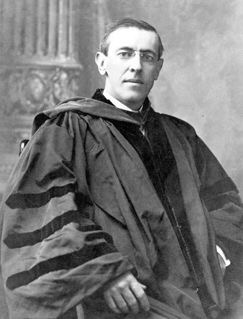 On this President’s Day I want to reflect on a president who I have always been very intrigued with. Our 28th President was a successful academic who took a different path to the White House than Presidents before and after. Woodrow Wilson attended college at what is now Princeton University, studied law at the University of Virginia, and earned a Ph.D. from Johns Hopkins University. Wilson is our only President to have a doctorate. He later taught at Princeton, and became president of the university in 1902. As a scholar he was the leading political scientist of his day. As an academic president, he transformed Princeton into a leading university. Wilson was President of Princeton from 1902-1910.
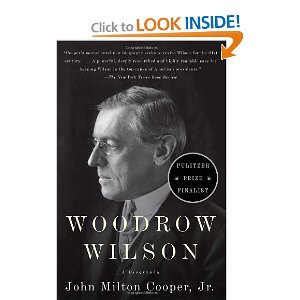
John Milton Cooper Jr. described Wilson this way in his book Woodrow Wilson: A Biography: “Boldness and thinking big marked Wilson all his life, and those qualities helped make him the only president who rose to the top in two professions entirely removed from public affairs.” Woodrow Wilson’s experience as a transformational leader at Princeton is what I believe prepared him for political office. He was “a dynamic reformer” as Governor of New Jersey from 1910-1912. As President of the United States he led the country into and through World War I.
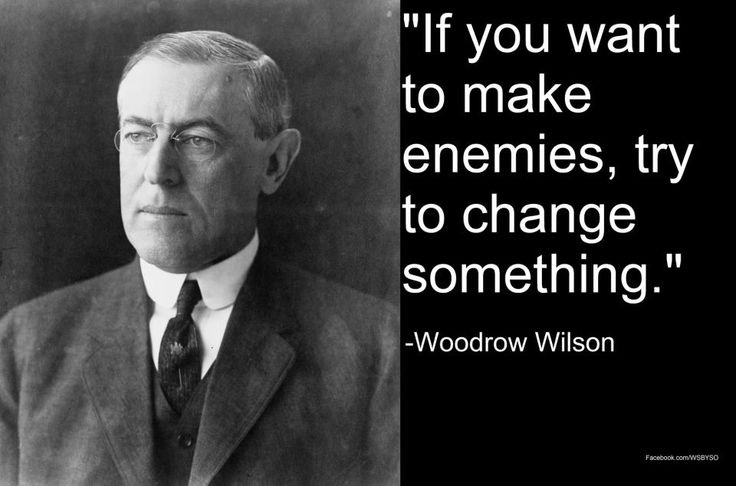
Leaders like Woodrow Wilson advance the cause because they see what others do not and are willing to move toward that vision. As Wilson said, “I would rather fail in a cause that would ultimately succeed, than succeed in a cause that would ultimately fail.” Such work calls for boldness. Wilson also said, “Do not follow people who stand still.” As we come to the end of President’s Day, let’s think about these questions: Are you moving to transform your organization or cause social change? Where do you need to be more bold?
Education: Exploiting Knowledge
 “Education will become the center of the knowledge society, and schooling its key institution.” This quote by Peter Drucker in May of 2004 has proven so true as we begin 2015. Week 4 of A Year With Peter Drucker: 52 Weeks of Coaching for Leadership Effectiveness by Joseph A. Maciariello (2014) deals with the idea that education is a key to economic development. As I was reading this week’s lesson I couldn’t help but remember what the late H. Dean Evans, former Indiana State Superintendent of Education, used to say about this related to taxes. I had the honor of working for Dr. Evans, and he would say: “The way to raise taxes is to provide great training and education and then everyone will have great jobs and be paying more taxes.” A pretty basic, but true concept. I realize, however, and he did too, that this is a very complex issue to solve.
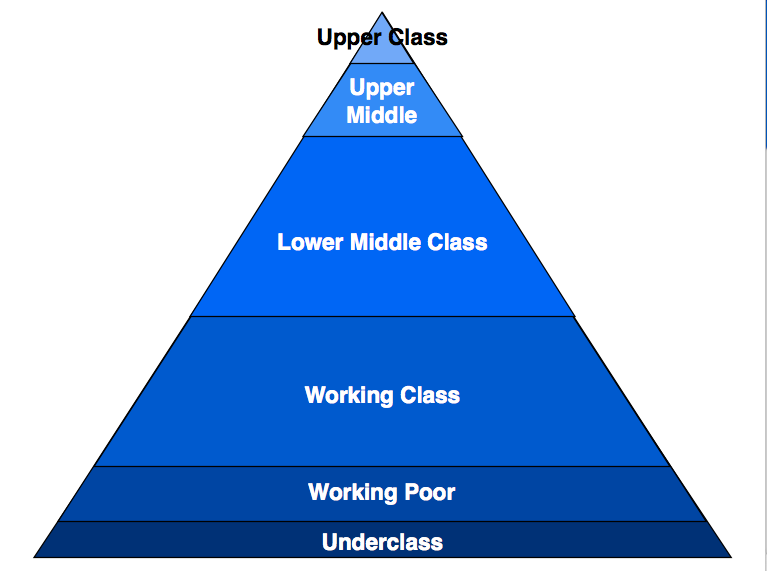
The lesson this week started with a story about E-Veritas Trading Network in Manila, Philippines. Bottom line is this company trained knowledge workers to develop an entire electronic trading system to deliver quality and safe food to their people at a low cost they could afford (Maciariello, 2014). In other words, they created human capital within people at the bottom of the economic and social pyramid so they could develop rapidly and escape poverty. There is evidence all over the world that through education and management training, those at the lower levels of the social and economic pyramid can be lifted up. People globally can be helped to be sheltered from corruption from being involved in small-scale local economic activity.
For another example we can look to South Korea. Within 25 years after the Korean War, Korea became a highly developed country. They did this by using the universities and colleges of the United States for management education of their people. Then when their students returned home all of that knowledge was shared and assimilated into their businesses and economy (Maciariello, 2014). Maciariello argued it is much more effective and efficient to provide resources for educating present and future leaders of a developing country than providing financial aid (Maciariello, 2014).
This concept is equally true domestically in our own country. It is no secret and is widely accepted that the practice of investing in employee development is the most beneficial practice an organization can partake in. This is why the habit of continuous learning is so important. We must be teaching our students how to learn, because the practice of continual learning will be very important to their generation. It is interesting to me how education and knowledge acquisition has really jumped to the forefront of American politics. This jump has even surpassed over the importance of property and capital acquisition that dominated the Age of Capitalism.
Two questions that need to be answered for learners of all ages, whether P-16 or adult professional, are: What mix of knowledge is required for everybody? and What is “quality” in learning and teaching? Can you imagine if we could come up with these answers in a way that everyone can agree on? Interesting, many businesses and organizations have. Maybe at the P-16 level there needs to be more autonomy to evaluate what quality looks like for the students served.
I was moved by this 1993 quote from Peter Drucker: “No country, industry, or company has any ‘natural’ advantage or disadvantage. The only advantage it can possess is the ability to exploit universally available knowledge (Maciariello, 2014, p. 32). Think about how much more universally available that knowledge is today than when Drucker wrote that. Have you and your organization made learning a lifelong habit? It is never too late to start. Don’t forget the two questions that must be answered for all learners in the previous paragraph and I would add a third: How do the individuals in your organization and you yourself learn? We all learn differently so make sure to differentiate for those differences. Have a great week!
Reference
Maciariello, J. A. (2014). A year with Peter Drucker: 52 weeks of coaching for leadership effectiveness. New York, NY: HarperCollins Publishers.
 Byron's Babbles
leave a comment