The Power of Relationships: Lessons on Building Meaningful Connections

Last Friday I had a teacher leader who has been through one of my leadership development programs with me, share that she is now in a masters program and she realized while doing some reflecting during a course that she had never had a very effective coach, mentor, or facilitator of educational leadership or instructional effectiveness until me. Now, I must admit I blushed a little, tried to play it off, but was also very proud. Of course, all of you that know me know I could not resist asking a question. My question was simple: “Why do you think that is so?” Her answer was also very simple: “Our relationship!” She went on to say, “You take the time to really build relationships with everyone you work with. You know me and you know what I need.” Wow! That really made me proud because I do believe relationships are the key to everything.
In an ever-changing world, where change is constant and competition fierce, one timeless skill stands out as a cornerstone of being significant: relationship building. I want to use this post to emphasize the profound impact that genuine relationships have on personal growth, professional success, and community development.
Why Are Relationships So Important?
At their core, relationships are the foundation of trust, collaboration, and mutual respect. I teach that strong bonds created through authentic connection lead to greater influence, improved teamwork, and a more fulfilling life. Whether in leadership, teaching, business, or personal spheres, the ability to cultivate meaningful relationships is essential.
Key Principles from my Leadership Philosophy
- Authenticity and Integrity: This underscores the importance of being genuine. Authenticity fosters trust and encourages others to open up, creating a positive environment for growth and collaboration.
- Active Listening: This highlights that effective leaders and relationship-builders listen more than they speak. Truly understanding others’ perspectives enables stronger connections and better problem-solving.
- Empathy and Compassion: Empathy allows leaders to connect on a deeper level. I teach that demonstrating sincere concern for others’ well-being enhances loyalty and inspires collective efforts toward common goals.
- Consistency and Follow-through: Building trust requires consistent actions. I want to stress here that reliability and accountability reinforce relationships over time.
- Value Others: Recognizing and appreciating the strengths and contributions of others cultivate a sense of belonging and motivation.
The Impact of Strong Relationships
Investing in relationships yields dividends far beyond immediate gains. Strong connections can:
- Foster innovation through diverse perspectives
- Accelerate personal and professional development
- Enhance organizational culture and morale
- Enable communities to thrive collectively
In a world driven by rapid change and digital interactions, the human element remains vital. I hope my insights here will remind us that leadership and success are ultimately rooted in our ability to build and nurture meaningful relationships. By practicing authenticity, active listening, empathy, consistency, and appreciation, we can create bonds that uplift us all.
By valuing authentic relationships and leading with integrity, we not only elevate our own success but also cultivate vibrant, supportive communities where everyone can thrive. Let’s strive to lead with authenticity and a heartfelt respect for those we serve and work alongside.
Soaring High: Embracing the Learning Journey to Master Kite Flying and Leadership

I love watching people flying kites on the beach. In particular, I love watching children having fun flying kites on the beach. Yesterday morning I looked on while a youngster had the productive struggle of learning to fly a kite. And, by the way, I am a big believer in productive struggle as a best practice for teaching and learning. The child’s parents were helping, but I’m pretty sure they were learning to fly a kite for the first time too. Of course, all of this led to an analogy.

Just like a child learning to fly a kite, someone stepping into a leadership role often faces uncertainty and challenges initially. The child’s productive struggle—feeling the wind, adjusting the tail, experimenting with different angles—mirrors how a new leader learns through trial and error, gaining confidence and skill over time. And a cool thing happened; all of the sudden the kite caught the wind just right and it was game on. Even from a distance I could tell the young person had that “Oh crap” moment of “It’s flying, now what do I do?” It was so much fun and so inspiring to watch. By the way: I’m pretty sure Orville Wright had that same “Oh Crap! I’m flying! Now what do I do?” moment on December 17, 1903!

Both situations emphasize the importance of patience, perseverance, and a willingness to learn. The child never once gave up when the kite dipped or struggled against the wind; instead, I could tell they were learning to read the conditions and adapt. Similarly, a leader who admits they don’t have all the answers (practices being vulnerable) and remains open to growth can develop resilience, wisdom, and better decision-making skills.

In essence, this analogy reminds us that embracing the discomfort of not knowing everything upfront allowed both the child and us as leaders, to develop competence, confidence, and a deeper understanding of our environments. It’s about valuing the journey of learning and trusting that with effort and openness, mastery—whether in flying a kite or leading others—is achievable.
Celebrating Creativity: How Street Performances Enrich Communities and Inspire Joy

I spent this week in Nashville, Tennessee at the annual conventions of the National Association of Agricultural Educators (NAAE) and Association for Career and Technical Education (ACTE). It has been an incredible week and I love spending time working with the National FFA Teacher Ambassadors. On Wednesday evening we took the ambassadors to Sixty Vines on Broadway for dinner. While walking down Broadway to the restaurant I spotted three young street performers playing the drums – five gallon buckets. I immediately decided I would ask to join. I was welcomed to the drum (bucket) line. Check out the featured photo.
I had done this before when in New Orleans, Louisiana. Check out Drumming Up Relationships to read about that experience. I love learning these kids’ stories.
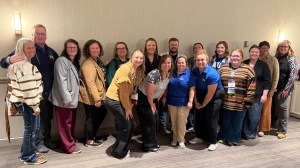
Most people walk by and laugh, maybe throw a little change in the bucket (literally), but I always see humans. Those humans are being and they have a story. These young people were utilizing everyday objects creatively to produce music and entertain others, turning simple items into instruments.
Additionally, these young people were learning resilience and determination. Often, street performers face challenges and uncertainties but continue to pursue their passion and livelihood despite obstacles. These young people are really entrepreneurs. Their entrepreneurial spirit, showcases how initiative can lead to earning and recognition.
I worry, however, when I see the kids on the street what everyone else is thinking or what needs they might have. I also worry about those who do not understand their culture looking at them as a public nuisance. I worry about the kids who have talent but no other creative outlet, but the streets. I encourage you not be I just keep walking past but take a moment and talk to the young people. Better yet, sit down with them, pick up a bucket, and channel your inner Phil Collins!
Leading Like Admiral William McRaven

I was so impressed by Admiral William H. McRaven’s keynote yesterday morning at ExcelinEd’s National Summit on Education. He began by saying, “If you are not a person of character, you will struggle in leadership and will really struggle leading in a crisis.” With this comment he really grabbed my attention. I was also reminded of how Angela Duckworth had defined character the day before in her great keynote: “Character is all the things you habitually do, think, say, and feel that are good for others and good for you.” Having encountered leaders in my career that lacked character, all this really resonated with me. To me, character is the “walk” part of “walk the talk.” Character encapsulates how we act and what we do. Whereas, “talk” is the values part of “walk the talk.” Those leaders I mentioned earlier talked a big game of values, but then we never saw the actions, or character. We cannot just say we will do the right thing, we have to actually know what the right thing is and do the right thing. Character is all about our habits. Thus why Admiral McRaven said the leader without character would struggle, especially in a crisis when our character really shows.
“The truth will always, always, always, come out.” ~ Admiral William H. McRaven

Admiral McRaven also shared leadership lessons from his great book, Conquering Crisis: Ten Lessons To Learn Before You Need Them. He outlined five key leadership components:
- Assess: we need procedures for getting facts and evaluating the quality of the information. We need a group of trusted advisors – what McRaven called a Council of Colonels. This is an advisory group that will speak the truth to power.
- Report: I love what the Admiral said here: “Always tell the truth, the whole truth, and nothing but the truth.” Also he told us to, “Use truth and transparency to show you understand the problem.” This helps us to personify the crisis.
- Contain: one point Admiral McRaven made here that really stood out to me here was to, “slow the pace of the crisis with one strong decisive move directed at the fastest-moving concern.” This involves us, as leaders taking control of the crisis and dictating the tempo.
- Shape: we need to actively influence situations and control the narrative. The Admiral told us to, “weaponize the truth.” He urged us to, as leaders, mold the circumstances and perception of the crisis so our organizations come out stronger on the other side, rather than just surviving it.
- Manage: This point said it all: “Reinforce your actions with a resource heavy approach to dictate the tempo and shape the outcome.” In other words, as I stated in the beginning paragraph of this post: “walk the talk”.

I love that in a conversation after his keynote with Jeb Bush, Admiral McRaven discussed the need for leaders to be humble and have the humility to listen and learn first. He discussed having a great team around him so he finish this sentence: “I need to understand…” I’ll conclude this post by saying that Admiral McRaven is one of America’s great and iconic leaders. His record shows him to be a man of character who has walked the talk and walked the walk.
Needed Therefore Belonging

I am a huge believer in “belonging.” Whether it is students in our schools or adults in our organizations, everyone needs to belong. This “belonging” is central to our engagement. When we believe that our presence and contributions matter, we feel more connected to our community—be it a classroom or a broader social environment. This sense of connection fosters trust, safety, and acceptance, making us, whether a student or adult, more comfortable to express themselves and participate actively. As a result, we develop a stronger sense of belonging, which enhances their confidence, motivation, and overall well-being. In essence, when we feel needed and appreciated, we are more likely to feel that we truly belong, supporting our growth and success.
Also, let’s not forget that along with love, belonging is on Maslow’s five tier hierarchy model of human needs. While we used to think of this hierarchy more linearly than we now know it to be, Maslow showed love/belonging to be right after physiological and safety needs. We now know that we seek multiple needs simultaneously.
Yesterday at ExcelinEd’s National Summit on Education, Angela Duckworth told us that “Every student needs to be needed.” 🎤 I loved this and thought it was a drop the mic moment. Angela Duckworth meant that every student should feel valued and important—that their presence and contributions matter. When students feel needed, it boosts their confidence, motivation, and sense of belonging, which are essential for their growth and success. She emphasized the importance of fostering environments where students recognize their importance to others, helping them develop resilience and a positive sense of self.
As leaders, let’s make sure everyone belongs!
Leaders Try Crickets
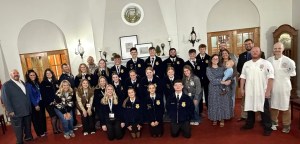
This past Wednesday night I worked with students at our annual “Dinner With A Story” during National FFA Convention, at Ulen Country Club. Chef Nick Townsend and I did this for students from Montana, Kansas, and Indiana. This is something I love doing on the Wednesday evening of convention each year. We used the FFA Convention theme of “Empower” as our throughline for the story. It was such an incredible evening as we served students a four course dinner, one of which included oven roasted crickets on salad wraps. 🦗 Yes, you heard me right – crickets. We always have something that is a little outside of the norm.
The students had some insightful reflections during the story/meal. As they said, trying new foods like crickets can contribute to feeling empowered in several meaningful ways. It encourages stepping outside of your comfort zone, which can boost confidence and foster a sense of bravery. Making a conscious choice to explore unfamiliar foods also reflects a willingness to embrace new experiences, cultivating curiosity and adaptability.
Additionally, the students recognized that sometimes not trying new foods because of preconceived notions is similar to not empowering someone due to stereotypes or biases. In both cases, assumptions prevent us from seeing the full potential—whether it’s discovering delicious, nutritious foods or recognizing someone’s capability and value. Challenging those preconceived beliefs allows for growth, open-mindedness, and the opportunity to experience positive change, whether it’s expanding your palate or fostering understanding and empowerment in others.
Trying new foods can be a metaphorical and literal act of self-empowerment by challenging perceptions, broadening horizons, and reinforcing your ability to make conscious, adventurous choices.
Learning System


Yesterday, during a leadership development gathering we got into a discussion about developing a coherent “high-quality learning system.” We then talked about defining a learning system. Here is what I came up with:
A high-quality learning system is a structured framework designed to facilitate effective education by incorporating key components that enhance the learning experience. It is differentiated to meet diverse learner needs, responsive to feedback and changing circumstances, relevant to real-world applications, transferable across contexts and disciplines, rigorous to ensure depth and mastery of content, and usable by learners to apply knowledge confidently in practical situations. Together, these elements create an environment that promotes meaningful, adaptable, and enduring learning outcomes.
A few other elements of a high-quantity learning system that I subsequently considered for addition were:
- Consider the development of the adults facilitating learning. This would be andragogy – the method and practice of teaching adult learner.
- Making sure an environment, with the necessary supports, is created so students belong.
- Provide a supportive learning ecosystem – culture, family, community, resources
All of these considerations should help lead to a responsive learning environment.
Change Leadership: The Iceberg Analysis and Perception Versus Reality
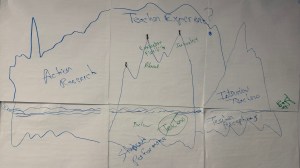
Back in August, a group of leaders and I got to do a presentation on next steps in a change leadership case study. Our task was to make a pitch promoting next steps using one of the five key tools of change.
The five key tools of change are:
- Problem statement;
- Stakeholder mapping;
- Iceberg analysis;
- Causal loops;
- Iteration and testing.
Our team chose to use an iceberg analysis. The iceberg analysis is a key tool in change leadership that helps identify underlying issues that are not immediately visible. Just like an iceberg, only a small part is seen above the surface, while the larger, more significant concerns lie beneath. By exploring these hidden aspects—such as underlying beliefs, assumptions, and cultural patterns—leaders can address root causes of challenges, fostering meaningful and sustainable change within our organizations’ systems.
In the context of the case study we were given, we chose to expand the metaphor of the iceberg (which is the point of this post) even further by creating a bigger iceberg (see the featured photo to see my graphic recording of the presentation) that encompasses the original. Sometimes we consider the iceberg as what we see above the surface and imagine is below the surface, but sometimes the iceberg is bigger than what we see above and below the surface. We called this perception versus reality.
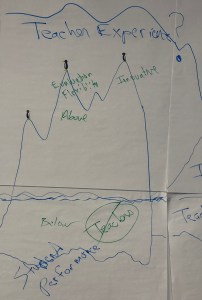
All the data in the case study we were using, which was related to systems change in a school educational system, had been collected qualitatively using administrator perceptions. We wanted to know if the positive perceptions held by administrators was reality for the teachers. Check out our graphic perceptions/realities in the photo inset (don’t miss our penguins).
This iceberg analysis that includes perception versus reality is such an important part of change leadership. Does perception meet reality? Great leaders care whether perception is reality. In the context of the case study, we needed to know if all the changes being made in this school’s systems were being experienced by the teachers in the same way as the administrators perceived them to be. Furthermore, this speaks to another key tool of change, stakeholder engagement. The teachers are an important internal stakeholder in the community that was being formed in the case study school.
Our Portable Assets: Skills and Reputation

Something I believe is important for young people and adults alike to understand is that our skills and reputation are portable assets. These qualities are valuable resources we carry with us across different situations, careers, or environments.
Skills are like tools in our personal toolkit—they can be applied in various roles or industries, making us adaptable and versatile. Our reputation, which is built on trust, credibility, and how others perceive us, can also follow us from one job or community to another, often opening doors and creating opportunities.
We must remember and make sure that our students and young adults understand that both skills and reputation are assets that aren’t tied to a specific place or time; they can be transferred and utilized wherever we go, helping us succeed and grow regardless of the particular circumstances.
Don’t Let Others Limit You
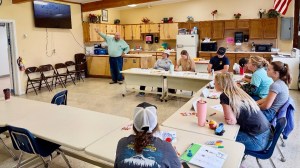
This is another post inspired by the students at Shields Valley High School in Clyde Park, Montana. I was in Montana all this week doing a student leadership development event. These students were very engaged and thoughtful. I took lots of notes from their thoughts that inspired me. I’ve already blogged about this event once in Grounded in the Present: Embracing the Power of Being Where Your Feet Are. Another great comment made by a student was “You are not limited by other people.” I loved this because so many times we let others limit us by letting them influence what we are doing, by telling us what we should be doing, by letting our parents live vicariously through us, telling us we can’t do something, negativity, or other ways.
We stopped a moment to discuss this comment. These students were very cognizant of how others can limit us. We can all learn several valuable lessons from thinking about not being limited by other people. Here’s how:
- Empowerment and Self-Potential: We are encouraged to recognize that our abilities and potential are within our own control. External opinions or doubts shouldn’t define what we can achieve.
- Resilience Against Negative Influences: We often face peer pressure or criticism. This phrase reminds us that we are not confined by others’ perceptions, allowing us to stay true to our vision and values.
- Independent Thinking: It promotes confidence in making decisions based on our own judgment instead of being overly influenced by others’ expectations.
- Encouraging Innovation: When we understand we aren’t limited by others’ beliefs about what’s possible, we’re more likely to pursue creative ideas and initiatives.
- Fostering a Growth Mindset: Recognizing that limitations aren’t imposed by external sources motivates us to focus on our personal growth and continuous improvement.
Overall, these high school students gave us a powerful reminder for to trust ourselves, embrace our unique strengths, and not let external judgments restrict our personal journey.
 Byron's Babbles
leave a comment