Leading Through The Lens Of Opportunity
 This past week I had a leader I am working with on a project say to me, “I am having trouble looking at this project through three different lenses.” My immediate response was don’t look through three lenses; just the one you were made a part of this project for. There are others on this committee that can work through the other lenses. It really got me thinking about whether we, as leaders, should look at things through multiple lenses or only one.
The most effective leaders I know approach problems through the single lens of opportunity. I had an incredible mentor and friend early in my career that always called problems “opportunities.” That has stuck with me ever since. The best leaders are the best problem solvers. They have the patience to step back and see the problem at-hand through broadened observation; circular vision. These great leaders see around, beneath, and beyond the issue/problem (opportunity) itself. They see well-beyond the obvious and see opportunities.
I also believe it becomes crucial to become a convener and let the wisdom of the crowd/community take over. This creates an environment where everyone’s concerns, points of view, ideas, and solutions are freely expressed. This community structure welcomes efficient cross-functional collaboration and problem solving. This also eliminates silos and allows individuals lead through the lens of their expertise.
Great leaders seek out and convene lifters and high-potential leaders within the organization or community to reap the benefits of open-mindedness that leads to more innovation and initiative. We should invite people together and name the possibility about which we are convening. I also believe we must specify what is required of each and what lens they should look through should they choose to be a part of the opportunity.
Reflections Of A Leader
 In my most recent post, The Leadership Symphony, I mentioned that I had just finished the great book 52 Leadership Lessons: Timeless Stories For The Modern Leader by John Parker Stewart. This book was truly 52 lessons that made me think about my own leadership and how to practice continuous improvement and honing of those skills. This is a book that prompted reflection and thought on my own leadership style and that style’s impact on those I lead.
Additionally, many of the lesson prompted ideas for blog posts. Here is a link that will take you to a run of all of them: https://byronernest.blog/?s=john+parker+stewart. All the lessons were easily adaptable to the real life leadership situations I was and am experiencing. As a guy who believes everyone is a leader, I love the Lead Now!™ model that is used to guide this book. As leaders we have a responsibility to create purpose and deliver excellence. Furthermore, if we intend to have those we serve leading from where they are we must continually develop others, as well as ourselves. Finally we must lead change.

 The four quadrants were developed using data from 360° leadership feedback, so it is no wonder that the lesson caused a great deal of reflection and self inflection. The stories in this book and the thoughts provoked enable the leader not to observe leadership, but to hone and develop leadership skills. These lessons increased my awareness of how I am perceived, and how I can make adjustments. As leaders we have scores of experiences from which to draw learned knowledge. I believe it is important to develop a habit of stopping the action occasionally to reflect and write about what happened, what worked, what didn’t, and what am I learning – thus my blog. I believe we have, literally, thousands of learning experiences. Without some type of guided reflection we lose thousands of learning opportunities. What are you doing to guide your reflection and continuous leadership improvement?
The Leadership Symphony
 Well, I have come to the end of another book. Actually this is the completion of my 84th book this year. My goal is 87. It has actually taken me a year to complete this book as it is divided in 52 distinct lessons. I have tweeted about many of them. I will do a post about the book as a whole and include the posts, but for now want to post thoughts on the 52nd lesson. In lesson #52 entitled “What Makes A Symphony” in 52 Leadership Lessons: Timeless Stories For The Modern Leader by John Parker Stewart he tells us how the conductor brings individual musicians together to form the playing of the symphony.
“A symphony consists of polished performances from many sections that become a unified whole. If not played together it is merely a cacophony of disconnected sounds.” ~ John Parker Stewart
This chapter really resonated with me as a believe in shared, intent-based, leadership. Everyone is a leader and has a part. But, there still must be a leader who is conveying the shared vision and making sure the musicians, in the case of a symphony, have the necessary professional development to do their part.
 This point was driven home this morning in the last general session of the annual conference of the National Association of State Boards of Education (NASBE). The keynote was delivered by Dr. Pedro Noguera. He is the Distinguished Professor of Education at the Graduate School of Education and Information Studies at UCLA. His research focuses on the way in which schools are influenced by social and economic conditions, as well as by demographic trends in local, regional, and global contexts. In his keynote, Dr. Noguera gave five strategies for successful school leadership:
- Shared leadership
- Concerted effort to obtain buy-in around the strategy
- A coherent strategy focused on student needs
- Differentiated professional development
- Follow through, examining the evidence, sticking with it
“Only a clearly communicated perspective, directed by a wise and capable leader, results in a magnificent performance. ~ John Parker Stewart
The big takeaways for me and relations to this 52nd lesson were the idea of shared  leadership, coherent strategy, and differentiation. As I said earlier, every person in an organization is a leader. As in a symphony, every person has an important part no matter their job or instrument. Additionally, in a symphony everyone needs to be playing from the same musical score, or strategic plan. And, finally, since everyone one plays different instruments or has different jobs or is playing/working at a different level of proficiency, the development must be differentiated.
The bottom line is that shared leadership an drive change. If, as a leader, we are the conductor, we must bring everyone together sharing the leadership of a coherent strategy. We know, for example, in schools we must invest in teacher leadership by developing leadership pipelines. This involves cultivating structures, processes, and mindsets for shared leadership. We must also prioritize and enhance instructional leadership skills. What are the priorities of your industry or organization?
Leading With Style
 In lesson #51 entitled “Fantastic Or Flop” in 52 Leadership Lessons: Timeless Stories For The Modern Leader by John Parker Stewart the story of 1968 Olympic record breaking gold medalist in the high jump, Dick Fosbury was told. The moral of the story was not the gold medal or breaking of a record; it was his unorthodox style. Everyone (including his coaches) wanted him to change his style. He would not because he knew his style was right and fit him. Now, his “Fosbury Flop” is the most accepted style for the high jump still today.
“Your style is your own. Don’t worry if it’s not traditional, if it is right for you.” ~ John Parker Stewart
This story really resonated with me as a guy who has a little different leadership style. Let’s face it, not everyone is ready to accept full on intent-based leadership or convening large numbers of stakeholders. But, as John Parker Stewart says:
“You’re style is your own. Don’t worry if it’s not traditional, if it is right for you. We must know ourselves and be true to ourselves.” ~ John Parker Stewart
We must then use our talents, skills, and values to continually improve and hone our style of leadership. Sometimes we just need to take a moment to evaluate the way we lead, so we can define ways to improve or adapt to our organization’s changing needs. So much of what effective leaders do is nurture others. Wise leaders cultivate their staff members’ leadership skills, both to ensure support in carrying out and sustaining change and to establish a network of rising leaders to fill future positions. So, no matter what our style we need to make sure we are developing others. For me, the inclusion of others is such an important part of leading. Effective leaders know where they need to go, but they also know that they must invite others to assist in the journey. That journey is where we need to let our style shine through.
Feeling Your Leadership “Vibe”

Sophie and I w/the Pear Tart
I had the honor and incredible pleasure of going out to eat this evening with my fellow National Association of State Boards of Education (NASBE) board of directors. We went to Seven Lamps in Atlanta, Georgia. Seven Lamps has an awesome selection of craft food and drinks. The restaurant’s unique name comes from a book length essay, The Seven Lamps of Architecture, by English art critic John Ruskin. The “lamps” refer to the seven principles of architecture: sacrifice, truth, power, beauty, life, memory and obedience. That essay alone will turn into a complete other study for me.
Those who know me know that I love it when our server enjoys and wants to pick the meal. Well, let me tell you, Sophie was just that kind of server. When I pushed the menu away, and asked Sophie if she would just do the picking her whole face lit up and I knew we were in for a treat. She said, “Byron (she had already figured out my name and was using it), I am feeling your ‘vibe’.” Lobster roll and shrimp for appetizer, Salmon for the main course, and pear tart for dessert. Yep, she was feeling my “vibe”! It was awesome!
 Now, the food was incredible and Chef Drew Van Leuvan is stellar, but bottom line is it was Sophie who made the evening complete with her ability to feel the “vibe”. I know I have blogged about this before, but I believe how a server handles doing what Sophie did tonight – picking everyone’s meals for them – is a sign of great technical skill and leadership. She clearly knew every dish, drink, appetizer, dessert, and whatever else on the menu inside and out. She had clearly tried everything and knew the intimate taste, cooking method, and ingredients of each. Clearly, Seven Lamps creates an environment where the team members get the technical knowledge to truly server their customers. This was the first key to Sophie’s success.
 Then, Sophie exhibited great leadership by accepting the responsibility and risk, with enthusiasm I might add, of picking our meals for us. It is amazing to me how many times I have done this and I have never had a choice made for me that I did not like. Sophie explained how each dish was prepared and even brought others in different roles in the restaurant over for us to meet. I’ve heard it said, “If you want to flourish, choose how you show up.” Sophie showed up tonight to flourish, and I can guarantee you she shows up every night to flourish.
Our inner thoughts and attitudes radiate through facial expressions, body language, tone, and language.This would be our “vibe”. Sophie was giving off the “vibe” that told me that she believed these things about herself:
- I showed up to serve
- I am glad to be here
- I am having fun
- I am competent and knowledgeable
- I am making a difference
- I do a good job
She was giving off a pretty good “vibe”, don’t you think? What “vibe” do you give off to those you lead?
 I did have to ask Sophie what “vibes” I was giving off. She explained that she was picking up that I was curious, adventuresome, and ready to try and learn about something new. Guilty! She could not have gotten my “vibe” any more correct. And…what better place to practice being curious, adventuresome, and ready to try and learn something new than in a restaurant you’ve never been to in a city 567 miles from home? The key is to align our behaviors with the “vibe” we want to send.
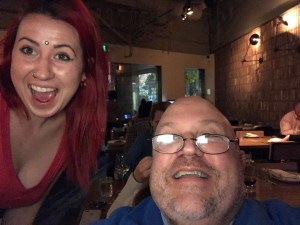 Tonight at Seven Lamps I learned from Sophie that understanding our own “vibe” and the “vibe” of those we serve allows us to be greater, more effective leaders. We need to keep learning more about ourselves and others. We need to keep trying new things. Finally, we need to keep honing and combining our passions with our skills – this will empower and maximize our potential.
How’s Your Attitude?
 This post by Mark Nation originally appeared on www.nationleadership.com.
“Life is 10% what happens to you and 90% how you react to it.” – Charles R. Swindoll
I’ve noticed that when I say “Hi” to some people I pass by these days, they’re more than likely to use a popular street-speak reply that sounds more like, “Howru” Or, “’Sup.” Note the absence of a question mark. They’re not asking. Feeling not so much acknowledged as texted, it’s easy to feel a bit saddened, or even annoyed, at the lack of any real interaction. It’s phony caring, a leftover from preceding generations that used to go, “How are you?” meaning, I care.
If caring among strangers is endangered, years ago I devised a fun solution to keep it alive. With many folks I meet, both friends and unknowns such as waitpersons in restaurants or service personnel who work on my house, I play a sort of game. I ask the person, “How’s it going?” Whatever their answer, I assign it a number.
If the person says “Okay,” then I listen for the tone of their voice, and say, “Sounds like about a Six.” Getting right away that I’m putting their attitude on a Zero-to-Ten happiness scale, they either agree thoughtfully, or say, “No-o, I’d say a seven; maybe even an eight.” So, some truly self-upgrade my rating. If, to my query they answer, “Great!” and I know they mean it, then my answer is, “Wow! Is that a Nine, or a full Ten?” And we laugh, sharing our mutual satisfaction in their happiness report.
Why on earth would I take the occasion to “number” people’s moods?
Several reasons:• People appreciate someone’s actually taking the time to tune in to their feelings.
• Some will choose to open up and share information about circumstances in their lives.
• It gives them instant feedback on what they’re putting out into the world.
• It invites them to upgrade their own feelings on the spot.
So, more than just a game, it’s actually a way to share the power of a famous observation made over a century ago by psychologist William James:
“The greatest discovery of any generation is that a human can alter his life by altering his attitude.”
One theory in psychology research suggests that we all have a happiness “set-point” that largely determines our overall well-being. We oscillate around this set point, becoming happier when something positive happens or the opposite, afterwards returning to an equilibrium point.
But this set-point, to a certain extent, can be reset. Although our general mood levels and well-being are partially determined by factors like genetics and upbringing, roughly 40 percent of our happiness is within our control. In fact, a large body of research in the field of positive psychology has shown that happiness is a choice that anyone can make.
So, how’s your attitude? How are you?
••••••••••••••••••••••••••••••••••••••••••••••••••••
Mark Nation is a globally-recognized management expert, leadership consultant, executive coach, author, and speaker. He is personally driven to discover what makes individuals, teams, and organizations amazing—those elements which power the heart and soul of individuals and businesses worldwide. His new book, Made for Amazing: An Instrumental Journey of Authentic Leadership Transformation, helps people to identify and optimize their unique talents.
Tuning in to Your Life
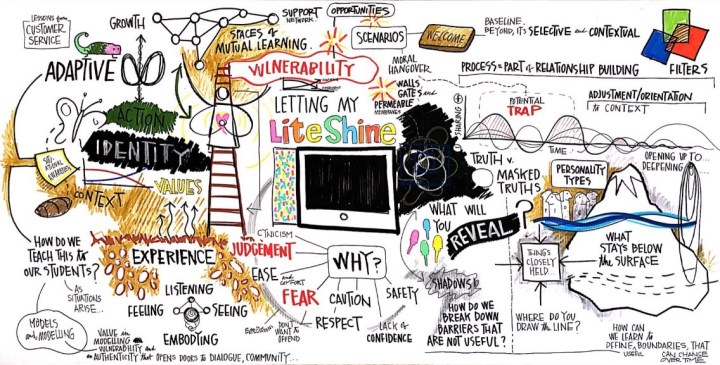 Super excited to have this guest post from Mark Nation. I just read his new book, Made for Amazing: An Instrumental Journey of Authentic Leadership Transformation. It is amazing!
 I met a woman who didn’t sing until she was forty because her kindergarten teacher told her before a performance, “Just move your mouth, dear.” How horribly tragic. The truth is, this woman had a wonderful voice, and it was clear she loved to sing. Who would have known she was silenced for decades, refusing to believe she possessed an incredible gift that was literally dying to be released?
Maybe you are one of those who say, “I have no musical ear,” or, “I can’t carry a tune,” because, like my friend, somewhere along the line you’ve come to mistrust the lyrical, melodic expression of yourself. To you, I would say, Stop! Listen to me! There is something critically important I need you to understand.
Not to believe in the music you came to play is not to believe in yourself.
You are not only musical, you are a musician, a melody-maker. Like all of us, you have a special song to sing; it’s the way you “do yourself,” the way you come across to others, the way you live your existence. Perhaps you have not realized it nor thought about it this way, but you are a vital part of a grand symphony, the harmonious expression of life.
Music is the beat of your life, the unique vibratory algorithm embedded in all you do and all you are. There is music in your voice, music in your face, music in your soul, in your thoughts, and in every throb of your heart. It can be a boisterous dance, a march, a sonata or even a lullaby. It’s not only okay for your music to change over time—it’s necessary, and beautiful. It’s you.
Everything you do expresses the one-of-a-kind melody that you bring to life.
Decide now to believe that you not only love music, but love making it. Explore this song of yourself. Take more pleasure in its expression, and follow the melody to see where it takes you. This is your journey, and your music. Therefore, you owe it yourself to develop your craft and take good care of the sounds you release into the world. We are all waiting for the song you bring, for we are your fans. Please don’t deprive us of those notes which only you can add to the harmony of life. Join in now.
**************************************************************************************
Mark Nation is a globally-recognized management expert, leadership consultant, executive coach, author, and speaker. He is personally driven to discover what makes individuals, teams, and organizations amazing—those elements which power the heart and soul of individuals and businesses worldwide. His new book, Made for Amazing: An Instrumental Journey of Authentic Leadership Transformation, helps people to identify and optimize their unique talents.
No Expiration Date On Success
 We hear or say the phrase, “It’s never too late” all the time, but do we really mean it? Or, do we just say it? Additionally, we talk about being life-long learners, but would we really still mean it at age 65? In Lesson #50 entitled “65 Years Young” in 52 Leadership Lessons: Timeless Stories For The Modern Leader by John Parker Stewart tells the story of Harland Sanders. We know him best as Colonel Sanders of Kentucky Fried Chicken.
“I’m still learning.” ~ Michelangelo at age 87
Let’s get to know the man behind the phrase “Finger Lickin’ Good” a little better. Colonel Harland Sanders was born on a farm outside the town of Henryville right here in my own great state of Indiana on September 9, 1890. The Colonel first prepared meals for truck drivers at an old family dining room table wheeled into the front of his Corbin, Kentucky, service station in 1930, fried chicken was not on the menu. After Duncan Hines put his restaurant that Sanders later open across the street from the service station, in his 1935 road-food guide, the colonel began to perfect his fried chicken secret recipe of 11 herbs and spices. This was in 1939 – he was age 49.
Then, in 1952 Pete Harman, who was a friend of Colonel Sanders who operated one of the largest restaurants in Salt Lake City, Utah, became the colonel’s first franchisee. Harman came up with the “Kentucky Fried Chicken” moniker and pioneered the restaurant’s famous bucket container. It wasn’t until Sanders was age 65 that he incorporated Kentucky Fried Chicken and began signing up new franchisees. He used is $105-a-month Social Security check to begin his franchise businesses. In 1964 at the age of 74 he sold Kentucky Fried Chicken and in 1968 at the age of 78 started another restaurant in Shelbyville, Kentucky. Wow, it really isn’t ever too late.
“There is no expiration date on our ability to succeed.” ~John Parker Stewart
Remember this: however old you are, there is an abundance of wonderful things waiting to happen for you. If you have the right attitude, you will not let them pass. Go out there and keep learning and succeeding!
Leading Like Mission Command
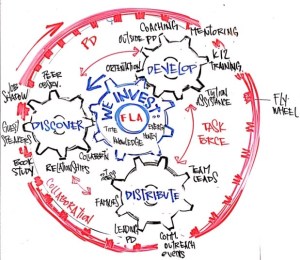 The ability to influence a group of people to accomplish a common goal takes
great leadership. At our first Harvard LILA virtual meeting of the year, last month we discussed many principles and one that stuck out to me was the idea of the US Army’s Mission Command. The principles of mission command are a guide to build and influence an organization to achieve common goals over time. The principles of mission command are: build cohesive teams through mutual trust; create shared understanding; provide a clear commander’s intent; exercise disciplined initiative; use mission orders; and accept prudent risk. Leaders cannot just execute these principles at that crucial time when the need is greatest, they need to already have a solid foundation built within the organization.
The core of a credible leader is competence, which in turn builds confidence in and from the team. People do not follow incompetent leaders, at least not knowingly. Needless to say that trust is the most important thing a leader can have, along with the team trusting each other but, without competence all of the trust is for not. Competence begins with personal and professional development. This includes the honing of skills for the profession or mission. Great leaders also develop the competence of those they serve. This in turn should result in a competent organization which is creating results.
Another important component of Mission Command is the presence of the leader on the ground next to the troops. In order to set the example, we must be shoulder to shoulder with those we serve. This will give us the first hand knowledge of the welfare of our team. Additionally, it enables us to share in the hardships and dangers of the team members we serve. It would be very tough to be competent without having a first hand view of what is going on. This first hand knowledge is also crucial for trust to exist. Many times it is the unremarkable actions of a leader that can build trust. These events might be things like a leader’s unexpected visit, an unspoken gesture of appreciation or concern, or the leader filling in for a missing team member.
“Some commanders used a helicopter as their personal mount. I never believed in that. You had to get on the ground with your troops to see and hear what was happening. You have to soak up first-hand information for your instincts to operate accurately. Besides, it’s too easy to be crisp, cool and detached at 1,500 feet; too easy to demand the impossible of your troops; too easy to make mistakes that are fatal only to those souls far below in the mud, the blood, and the confusion.” ~ Retired Lieutenant General Hal Moore in his book We Were Soldiers Once…and Young
Leaders must strive to collect the necessary knowledge from many different sources in order to make the right decision. This is why shared understanding is so important. This shared understanding can be as basic as leadership cultivating effective teamwork, which requires that team members share key understandings of their roles, of what a team is, and how to work together. Leaders must strive to collect the necessary knowledge from many different sources in order to make the right decision. This means that we must have our teams is a state of shared understanding.
This really becomes a centralized to decentralized system of leadership. Centralized leadership concentrates the power to one place. Decentralization, as a type of organizational structure, allows daily operations and decision-making responsibilities to be handled by middle and lower-level team members out and within the organization, allowing top management to focus more on major decisions. In other words, allow those closest to where the data is being produced, or what I call street level, make the decisions. Team members can be empowered by having more autonomy to make their own decisions, giving them a sense of importance and making them feel as if they have more input in the direction of the organization. It also allows them to make better use of the knowledge and experience they have gained and implement some of their own ideas. This distributed leadership is very important and should be intentionally used in organizations share the responsibility and not have everything fall on one leader. As was stated in our LILA session, “This allows leaders to solve the way they see fit.”
Flaw-Tolerant Leadership
 This morning while feeding in one of our pastures I came across the most beautiful spider web. There was a dew on, which accentuated the detail and geometry of the web. It was so cool I took a picture and have included it in this post. I tweeted that the spider web either had a geometry or leadership lesson in it. Here is the leadership lesson.
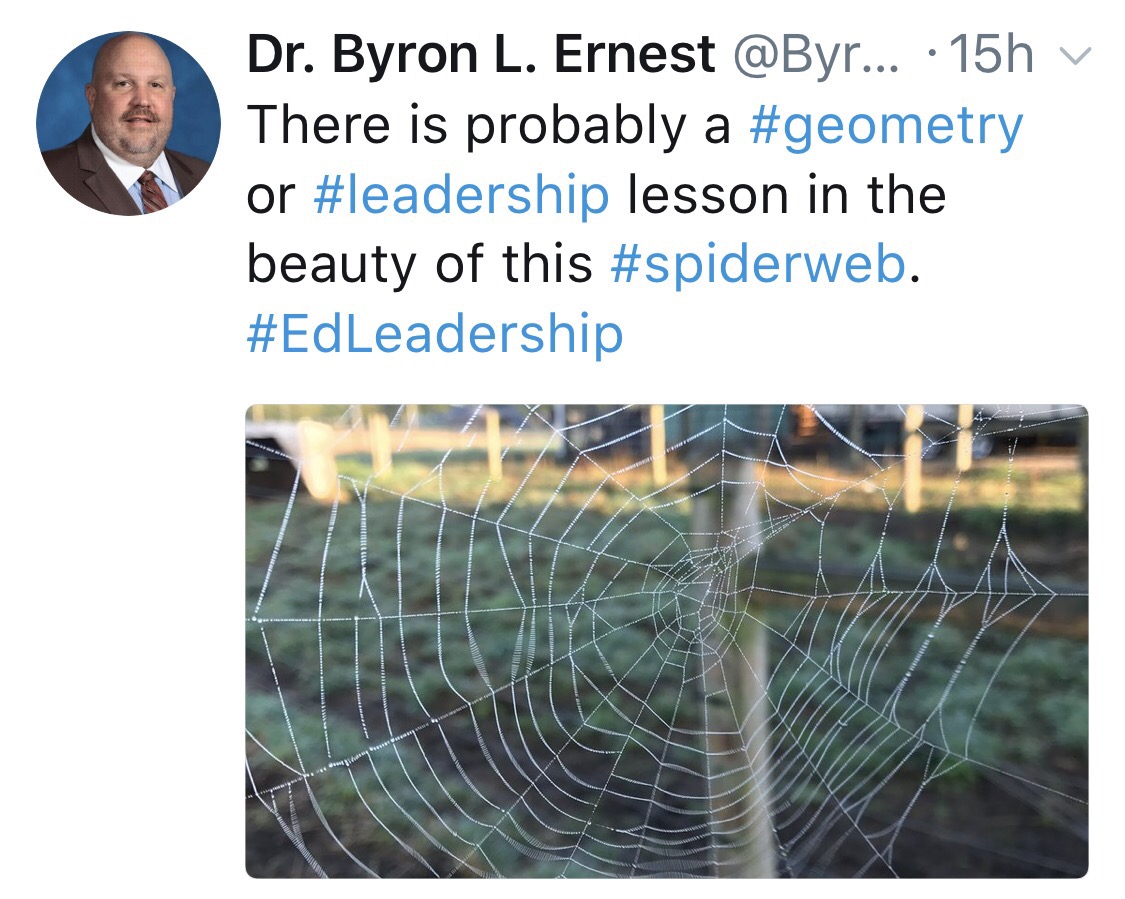 In researching spider webs just now I came across the research of Markus Buehler, an associate professor of civil and environmental engineering (CEE) at MIT. Buehler has analyzed the complex, hierarchical structure of spider silk and its amazing strength. His research shows that on a pound-for-pound basis, it’s stronger than steel.
Working with CEE graduate students Steven Cranford and Anna Tarakanova, and Nicola Pugno of the Politecnico di Torino in Italy Buehler found that a key component of spider silk that helps make webs robust is something previously considered a weakness: the way it can stretch and soften at first when pulled, and then stiffen again as the force of the pulling increases.
Additionally, these researchers found that spider webs typically only fail or get damaged in small areas. This makes it easy for the spiders to make repairs. If you’ve ever looked closely at a spider web, it still functions even with damage. This what Buehler described in this way: “It’s a very flaw-tolerant system.”
This made me think about leading in a flaw-tolerant way and creating a flaw-tolerant organization. We talk about encouraging taking risks and encouraging failing quickly, but have we made our organizations flaw-tolerant? We need to make sure we are set up like the spider web to have localized failure/damage without it being catastrophic.
We are beginning to accept the value of failure in the abstract. In other words we have learned, at least that corporate policies, processes, and practices. Conversely, it’s an entirely different matter at the personal level. Everyone hates to fail.
In order to create a flaw-tolerant system, more effective and interdependent upon the decisions made by each departmental leader. We need to be like the spider web and weave our teams together so we can sustain failure or small damage and be able to quickly make local repairs without missing a beat.
Is your organization flaw-tolerant?
 Byron's Babbles
leave a comment