Got Experience?
 Here’s a question for you: Are skills directly proportional to years of experience?
While I agree that experience will give you more expertise in subject matter, people skills, and well-roundedness—I believe that all these are not necessarily causal of years of experience. Nor do I believe years of experience always correlate with exceptional performance. So what’s my idea of proper experience? It’s having had enough time in the field to see the results caused by your own decisions and workflow. Actually, that can be done in a short amount of time. Conversely, I have known individuals with a great many years experience who really hadn’t grown or improved much. In my field of education, I have known new teachers with little experience in terms of years that were much more effective facilitators of learning than some teachers with many years experience.
This was the topic of Gem #6 entitled “27 Years Of Genuine Growth Or 1 Year Repeated 27 Time” in 52 Leadership Gems: Practical and Quick Insights For Leading Others by John Parker Stewart. In this lesson Stewart taught us that strong leaders seek new opportunities to continually develop and hone their skills. Weak leaders just keep doing the same things and embrace the status quo.
“Make each additional year in your work one of genuine learning and growth.” ~ John Parker Stewart
I view experience as the sum of a few factors: time working, experiences survived, the nature of the role and responsibilities, and potential lessons learned. Really, there is no magic number of years to this. It is about learning from your experience and the idea of continuing to practice and improve. It is not about the difference between experience and not enough experience, but about has it been the right experience. Then it really boils down to what have we been learning from the things we have been doing.
So, do you have x number of years experience, or x number of years doing the same thing over and over?
Four Causes of Unproductive Meetings and What to Do About Them
 Four Causes of Unproductive Meetings and What to Do About Them
By Dick Axelrod
Originally published on dickaxe.cayenne.io
- Unclear Purpose
Meeting participants are unclear about the purpose of the meeting or what they want to accomplish. Before holding a meeting, ask yourself what you want to be different for yourself, the participants, and the organization as a result of holding this meeting. Make sure you share this purpose with the participants. If you are a meeting participant and don’t know or understand the purpose of the meeting ask, “What is the purpose of this meeting?” at the beginning of the meeting. Then ask yourself, “What can I contribute to make this meeting productive?”
- Unclear Roles
It is amazing to find out how many attend meetings where they don’t know why they are there or what is expected of them. We see many leaders who invite people to the meeting because they might provide a different perspective. However, these participants do not know that is what is expected of them. They attend the meeting not knowing why they are there and consequently feel the meeting is a waste of time.
- Decision-Makers Not Present
When the meeting participants are not empowered to make decisions, everyone feels their time is wasted. While participants may have fruitful discussions, they must then take their work product to the decision-makers who were not part of the discussion and who may not understand the reasons why recommendations are being made. This additional layer of bureaucracy wastes everyone’s time. Empowering meeting participants to make decisions or having decision-makers present will eliminate this added bureaucracy.
- Unclear Decision-Making Process
We have watched many groups flounder because the decision-making process is unclear. They don’t know whether they are being asked to learn about a decision that has already been made, provide the leader with feedback, or be part of the decision-making process. Clarifying the decision-making process prior to starting the discussion saves time and energy.
***************************************************************************************
 More about Dick Axelrod
Dick and is wife Emily Axelrod are pioneers in creating employee involvement programs to effect large-scale organization change, and co-founded the Axelrod Group in 1981. Dick is also a lecturer in University of Chicago’s Masters in Threat and Response Management Program, and a faculty member in American University’s Masters in Organization Development program. Dick and Emily created the Conference Model®, an internationally recognized high-involvement change methodology.
Together, Emily and Dick are frequent keynote speakers and co-authors. Their latest book is Let’s Stop Meeting Like This: Tools to Save Time and Get More Done it outlines a flexible and adaptable system used to run truly productive meetings in all kinds of organizations―meetings where people create concrete plans, accomplish tasks, build connections, and move projects forward.
Plus + / Delta Δ
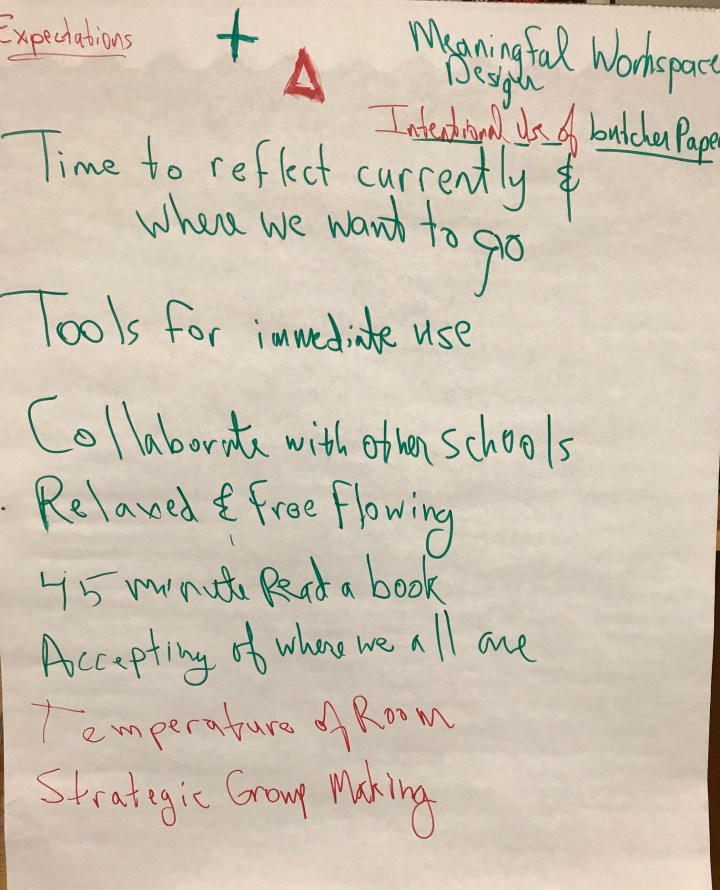 One of the tools I learned from my work in the Advanced Educational Leadership Program at the Harvard Graduate School of Education was how to do a Plus + / Delta Δ session at the end of a convening. I appreciated learning this from Dr. Liz City from Harvard University. She does this at the end of any convening or class I have been involved with. I have found this to be one of the greatest way to really find out what has gone well and what has not.
Here is how it works: At the end of the day or session we put up a board and put a + and a Δ on it. Then open it up to the group to give the positives from the day and the areas of improvement needed. I have found it to be a much more valuable experience if I do not start with positives or negatives and then switch to the other. The way I run the session both +s and Δs can be given together and not in any order. This way of doing it allows for pluses to be thought of when thinking about a delta and visa versa. As the discussion ensues all comments recorded in writing up on a foam board (see blog post picture).
I really believe this model does a couple of important things for the convened community. One big thing this process does is help to bring trust. Nothing can be off the table to bring up. More importantly, once a delta is on the table it is up to the leader/facilitator to make adjustments for the next convener. Or, if it is a plus, how do I, as facilitator continue to make sure this is a plus in the future. The second thing I believe happens using this way of collecting feedback is the depth of the information received and the amount of information. Let’s face it, getting surveys back is tough.
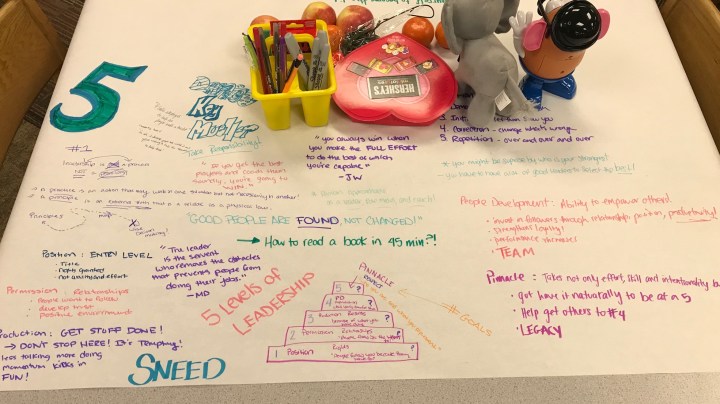
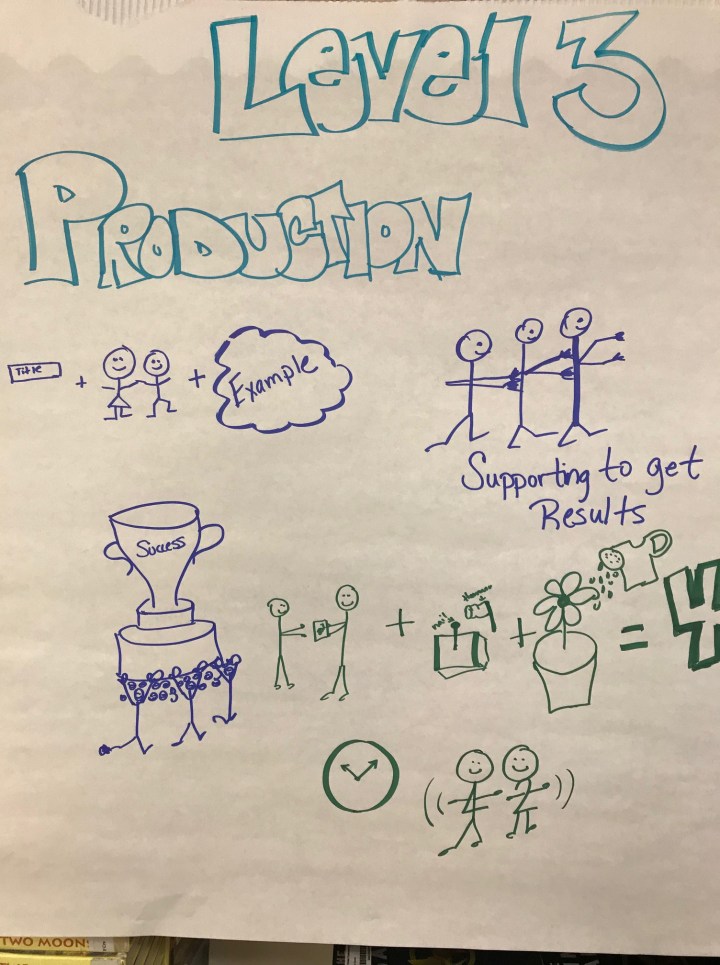 Furthermore, let me give you an example of the great information that a +/Δ session can give at the conclusion of a convening this past weekend. I always have butcher paper and crayons on the tables for participants to take notes, draw, doodle or whatever helps them learn. This convening was no different. The group of teacher leaders and school leaders I was working with were very much into graphic recording, both on the tables and when reporting out from small group work (see inset photos).
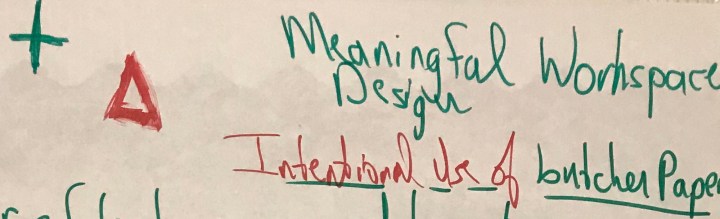 During the Plus / Delta session a participant said, “I have one that is both a plus and delta.” I said, “Great, lets talk about it.” She went on to say, “I really like the butcher paper and I took lots notes and made graphic. I really consider it a big plus.” She went on to say, “However, I wish we could use our doodles, notes, and graphics in a more intentional way.” I asked, “What do you mean by that and how could we do that?” The participant said, “Maybe we could do a gallery walk at different times during the day and reflect on the work of our fellow participants.” How cool was that! Participants taking ownership of making a convening designed for them better. It doesn’t get any better than that! I would argue that we would have never got to that level of discussion in a survey. Needless to say, we will build in intentional activities to learn from the butcher paper captured work of our participants. Exciting stuff!
I would encourage you to find your Pluses + and Deltas Δ.
 Byron's Babbles
leave a comment