Doing More With Less: Avoid Fake Work

Doing More With Less: Avoid Fake Work
By Rodger Dean Duncan
In a question-and-answer session following a recent speech, I was asked the following question: “How should we respond when we’re constantly asked to do more with less?”
My answer might not have been particularly comforting, but it was honest: “The challenge to do more with less is industry agnostic,” I said. “Virtually everyone everywhere is being given that challenge. And I expect that will be an ongoing mantra far into the future.”
Judging by the expression on the questioner’s face, I suspect that wasn’t what he wanted to hear.
But I wasn’t finished. The good news, I told him, is that the “do more with less” challenge presents a golden opportunity for smart, proactive people.
 Most anyone can do less with more. That’s a no-brainer. Doing more with less requires strategic sorting of priorities. It’s fairly common for business people to tell me that in their organizations “everything is a priority so, therefore, nothing is a real priority.” That’s the equivalent of saying you’re too busy driving to stop and get gas.
One of the most useful ways to sort priorities is to launch a relentless search for fake work.
Fake work is work that’s not explicitly aligned with the strategies and goals of the organization.
Now let’s be clear. Most fake work is not deliberate. Most fake work is perfectly well intended. People who engage in fake work—and that’s most of us at least some of the time, and some of us most of the time—just don’t notice that what they’re doing is not producing intended outcomes.
It’s not that people doing fake work aren’t busy. They’re often very busy. But they mistake activity for results. And working hard is not a barometer, because you can work very hard and still be building a road to nowhere.
You might be doing fake work because you were told to do it. You might be doing fake work because you’re rewarded for doing it.
Fake work thrives when needed results are not clearly and thoughtfully articulated. Fake work thrives when people don’t honestly challenge the value of their activity.
Companies often set expectations, write job descriptions, and review performance in ways that actually promote fake work. This means you can follow directions, complete your assignments, and even get promotions—while spending most of your time on fake work.
Here are some warning signs that people in your organization may be building a road to nowhere:
Of course there are lots of other signs on the road to nowhere. You could make a list of your own.
Most people don’t want to do fake work. Most people want to feel that they’re making positive contributions to meaningful accomplishments.
Remember: Fake work can be invisible because it often masquerades as real work. (Real work is critical activity that explicitly aligns with key goals and strategies.) In this age of everyone trying to do more with less, it’s more important than ever to identify fake work, eliminate as much of it as we can, and replace it with real work.
Here are five quick tips for focusing on real work:
When you’re asked to do more with less, regard the challenge as an opportunity. Your strategic approach to priorities will set you apart from the complainers and establish a positive example.
That should come in really handy at promotion time.
 ***********************************
Rodger Dean Duncan is bestselling author of LeaderSHOP: Workplace, Career, and Life Advice FromToday’s Top Thought Leaders. Early in his career he served as advisor to cabinet officers in two White House administrations and headed global communications at Campbell Soup Company. He has coached senior leaders in dozens of Fortune 500 companies.
Leading Like Theodore Roosevelt
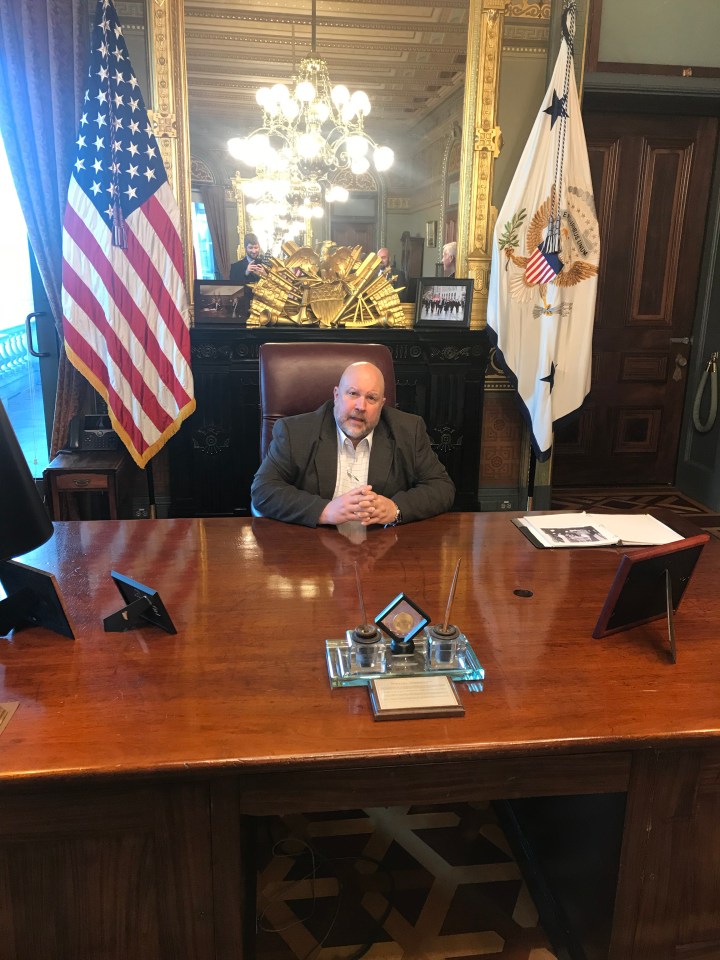 Yesterday day I had the opportunity of a lifetime while visiting the offices of our Vice President, Mike Pence. Our Vice President has offices in the Eisenhower Executive Office Building (EEOB), which is located next to the West Wing of the White House. In addition the Vice President has an office in the West Wing, on the Senate side of the Capitol Building, and Vice President Pence has one on the House Of Representatives side in honor of his service in Congress.
 When we were taken into the Vice President’s Ceremonial Office in the Eisenhower Executive Office Building I was struck by an extra large desk at one end. Then we were told it was Theodore Roosevelt’s desk when he was Secretary Of The Navy and President Of The United States. The desk was no longer extra large, it was larger than life! I was standing next to the desk of one of my heroes, Teddy Roosevelt! You know, one of the guys on Mount Rushmore!
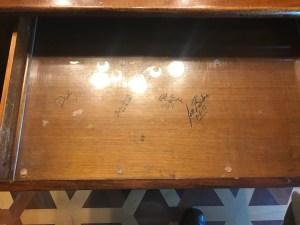 Of course, and this will be no surprise, I asked “Can I please sit at the desk?” The answer was, “Yes.” So, now I am sitting at the desk of Teddy Roosevelt and the many Vice Presidents who have signed the inside of the top drawer (see picture). Again, I am sitting at the desk of President Teddy Roosevelt! Then I look in the drawer and see the signature of Vice President Joe Biden, who also used this desk, and a leader who I greatly respect and had the opportunity to spend time with. What an experience! Thank you Vice President Pence for the opportunity!
This experience was yesterday and I still can’t get it out of my mind. I have been reflecting on why Theodore Roosevelt is such a hero. Theodore Roosevelt is recognized as a transformational leader. He defined numerous aspects of leadership that we now take for granted in the presidency as well as in private life. His inspirational vision about the economy, industry, environmental protection, and the National Parks system is still influencing our great country to this day. He had a remarkable ability to communicate his vision, not only through his well-crafted words, but even more through his indelible example. Roosevelt’s well-publicized, courageous exploits in Cuba in the brief but deadly Spanish-American War of 1898—the fateful days he viewed as the linchpin of his life—are perhaps the most apt symbol of his leadership. Roosevelt, mounted on horseback in front of his troops, showed the way—asking others to “come” rather than saying “go” in the words of his friend Henry Cabot Lodge—putting himself at risk, making himself accountable, giving more of himself than he would ask of others. I have always said that we must walk arm in arm with others, even pulling them along at times, instead of pushing!
“Reading is a disease with me.” ~ Theodore Roosevelt
Theodore Roosevelt was very curious and was continually learning. He was a voracious reader, but the book, the classroom, formal education, were far from the only venues for learning in his opinion. These forms of learning had produced many of what he called the “educated ineffectives.” Roosevelt believed in combining the life of ideas and the life of action. This was central to his project of self-creation as a leader. He was practicing project based, interdisciplinary learning.
As soon as any man has ceased to be able to learn, his usefulness as a teacher is at an end. When he himself can’t learn, he has reached the stage where other people can’t learn from him. ~ Theodore Roosevelt
Interesting this had been brought up in the great session at the ExcelinEd National Summit on Education Reform by Andreas Schleicher with what he described as “some things are caught not taught.” This is what work based learning and project based learning is all about. We must be immersed in a relevant learning environment.
 Theodore Roosevelt believed that learning is an ongoing project of self-creation – personal professional growth. He offered his life as a template for anyone who would seek to re-create themselves.
It’s amazing what effect sitting at a desk can have. Who’s desk would you like to be sitting at?
A Focus on What Is Working
 The following is an excerpt from Building Resilience with Appreciative Inquiry by Dr. Jeanie Cockell and Dr. Joan McArthur-Blair
A Focus on What Is Working
By Dr. Jeanie Cockell and Dr. Joan McArthur-Blair
In a problem-based world, it is very challenging to keep a leadership focus on what is working. We believe that focusing on what is working matters as a practice that builds appreciative resilience. Leaders are bombarded by problems every day. A focus on what is working pulls them out of that mindset of problem- and deficit-based thinking to begin to see what is right and what is good inside a team or an organization. Joan worked for a president who made this a practiced part of her leadership. She started every meeting with the question “What do we have to celebrate?” As Joan and other leaders in the room shifted their mind-set to uplift the stories worth celebrating, the entire feeling in the room shifted. The thinking shifted from “We have problems” to “Yes, we have problems needing to be solved, but we also are doing some things right.”
 This particular leader had several catastrophic events occur within the organization in a short period of time. Joan always noted that she started every conversation during those very difficult times with some version of celebrating the skills of the people handling those events.
Focusing on what is working inside a team or organization builds resilience for the individuals and the group by constantly reinforcing a drive to be excellent, not because of fear, but because their successes are celebrated. Celebrating what is working is like depositing resilience into an emotional bank account for later use. This bank account helps leaders deal with uncertainty, fear, and stress. In a crisis, a leader can tell others, verbally or through action, that their jobs, livelihood, and reputation are on the line, or they can share what is working well and uplift the drive of people to repair and rebuild.
It takes a conscious and mindful effort to focus on what is working. It takes the practice of pausing and thinking through the situation from multiple perspectives and asking powerful questions. This practice is easier in hopeful times, and we suggest that these are the times to begin the practice. If leaders practice a focus on what is working in hopeful times, they will find it much easier to do when a crisis arises. It is difficult to focus on what is working in times of despair, yet it is possible if one has practiced in times of hope. As leaders move through the element or state of despair, it is very difficult not to assign blame, seek justice, dole out retribution, or withdraw. In forgiveness, one must hold what is working close to one’s leadership heart, because a focus on what is working and forgiveness are linked together. Without leaders focusing on what is working or on what is possible, forgiveness cannot happen.
Focusing on what is working well is a practice that trains leaders to seek out the appreciative stance and, in doing so, discover what can be built on and taken into the future.
***********************************
About the authors
Dr. Jeanie Cockell and Dr. Joan McArthur-Blair, co-presidents of leadership consulting firm Cockell McArthur-Blair Consulting, are the co-authors of Building Resilience with Appreciative Inquiry. The veteran consultants’ latest book explores how leaders can use the practice of Appreciative Inquiry to weather the storms they’ll inevitably encounter and be resilient.
Forgiveness: Rising Again
 The following is an excerpt from Building Resilience with Appreciative Inquiry by Dr. Jeanie Cockell and Dr. Joan McArthur-Blair
Forgiveness: Rising Again
By Dr. Jeanie Cockell and Dr. Joan McArthur-Blair
How do we put down the burden of nonforgiveness when carrying it seems so justified? There are so many experiences in organizations that seem unforgivable. People who are otherwise good betray others, become in one’s eyes untrustworthy or incompetent. In the larger world, there are acts that are perpetrated in hate and anger that seem undeserving of forgiveness.
When we first began the journey of exploring building resilience with appreciative inquiry, we wondered about what it is that opens the door to the possibility of returning to a state of hope, however transient that might be. We deeply understood that the practice of hope and a hopeful view offered the ability to find hope in the tiniest of places. In finding that hope and a hopeful view greater resilience could be created. We also recognized that tapping into strengths and capabilities in times of despair was a powerful sustaining force.

As we read, thought, and worked with leaders, we began to recognize another element at play in resilience: forgiveness. It wasn’t something that just happened along the way. Leaders decided to enter into the state of forgiveness with grace and power so that they could move themselves and their organizations forward. In the appreciative resilience model, forgiveness is the most difficult element to practice, because in organizations, the thinking often is that people should be punished, removed, or banished. In forgiving self and others, a leader chooses to be in a state of acceptance of what is and begins to move forward from that place.
Forgiveness offers a place where dialogue can begin and change can take place. Practicing forgiveness is very challenging because of the sheer will it takes to enact. Forgiveness is a conscious act that requires one to examine one’s leadership and deeply forgive failures—others’ and one’s own. As one interviewee stated:
Forgiveness is one of the fundamental necessary things we need to have happen in our lives. I wish I had more. I wish forgiveness came easier to me. Forgiveness is very important. In any human system, you are going to have a problem with someone else. Somebody’s going to do something that offends you, or you misperceive and it is offensive to you; whatever it is, you see it as a slight or an attack, and if you hold on to that, you really can’t move forward in a human system together.
It is only through forgiveness that we literally have our minds changed and can see the possibilities before us. Forgiveness is a means of moving toward hope and sometimes of just living with what is unchangeable in our leadership lives. Forgiveness creates a space for leaders to let go of anger and hurt and look forward with realistic expectations.
**************************************
About the authors
Dr. Jeanie Cockell and Dr. Joan McArthur-Blair, co-presidents of leadership consulting firm Cockell McArthur-Blair Consulting, are the co-authors of Building Resilience with Appreciative Inquiry. The veteran consultants’ latest book explores how leaders can use the practice of Appreciative Inquiry to weather the storms they’ll inevitably encounter and be resilient.
That’s A Little Too Far Out There!
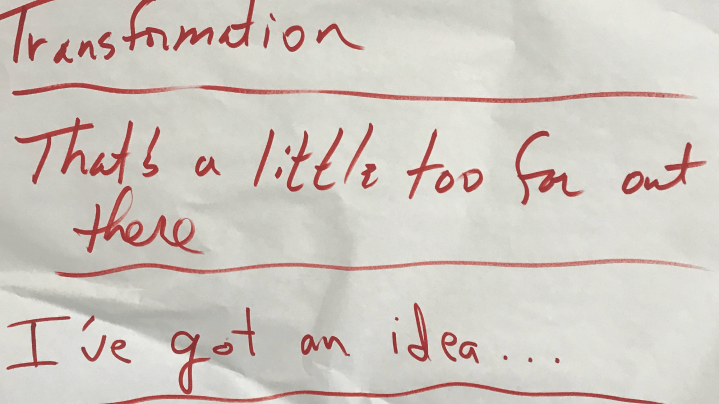 This past weekend, at our Carolinas 3D Leadership gathering, I was recording comments during a planning discussion for a project they were working one. It struck me that at one point they went from talking transformation to the comment, “That’s a little too far out there.” I’m thinking to myself, “Uhm…if it’s going to be transformational, it probably needs to be out there.” I’ve always believed, and I we often see this; the idea that seems crazy at first turns out to be the idea that propels the organization forward or enables the desired transformation.
 As I see it, passion, purpose, and capacity are the only requirements for coming up with and participation in “way out there” ideas. And, once the freedom to try out new ideas becomes ingrained in employees’ behavior, it can spread and transform the entire culture of your organization to be nimbler and more creative.
We need to create environments where we can challenge the status quo as if no one’s judging you. If being open and willing to try out new ways of working isn’t practiced and encouraged in the culture at the top of the organization, how anyone ever have the courage to voice their ideas?
The secret to truly agile and innovative organizations is this: they encourage and invite new ideas from all levels and see leaders at every level. So, next time you have that idea that might just go too far, voice that “crazy” idea regardless of your title or level; lead from where you are!
Puzzling Leadership
 As you know, the first step in putting a puzzle together is to look at the picture on the box to see what the completed puzzle will look like. As a leader, we need to have a vision (picture) of the final product, and what it is you are trying to accomplish. But, what happens when the puzzle pieces are blank and there is no picture on a box?
It is extremely difficult, if not impossible, to put a puzzle together if you do not know what the picture looks like. It is also difficult to be a good leader if you do not know what you are trying to accomplish. But, if there is a vision and plan the leaders can create the picture and paint the picture one puzzle piece at a time.
 I witnessed this yesterday at our Carolinas gathering of our Noble Education Initiative 3D Leadership Program. Our theme for the day was “Setting The Leadership Table.” The main activity of the day involved telling the story. The only catch was that participants had to tell the story by planning and doing a luncheon telling the story of the North and South Carolina schools with the decorum, appetizers, salad, main course, and dessert. There was a budget provided and the participants had two hours to plan, go get supplies, prepare the food, decorate the room, and have their story ready for stakeholder guests to arrive for the luncheon. Here was the agenda for the day:
 I loved the planning discussion that ensued. Here are phrases and things that were said that jumped out at me during the discussion:


 Now, back to the puzzle metaphor. The participants decided to use a puzzle through line for the luncheon. Genius! Here’s the cool part; the same rules of making a puzzle applied to leadership and successful completion of the project. Here are the steps:
Step #1-Have a vision, know what you want to accomplish
Step #2-Get to know your group members. Interestingly, we talked about this in our “what did you learn” time afterward. It was discussed that the event would not have been near as successful back in January when the group came together for the first time.
Step #3-Identify leadership qualities you will need to be an effective leader
Step #4-Follow the guidelines
Step #5-Understand your importance, where you fit, and what you have to offer. This was a topic many reflected on following the luncheon.
 So, here’s the deal: everyone had responsibilities and had to complete a puzzle piece and write the story for their school’s part of “Team Carolina.” I also was asked to complete a piece of the puzzle representing Noble Education Initiative’s (NEI) role in the puzzle of support for the Carolinas.
 What we found was that creating the puzzle pieces for our puzzle used the same leadership principles needed for forming an effective team. When forming a group of individuals into a team, you must first figure out the following:
- Strengths, What are the individual strengths of each one? How can the strength of one, build up the weakness of another?
- Shape, What does each individual bring to the table as far as expertise and knowledge? Just like a puzzle piece each one will have something to share to the greater picture or vision your trying to create.
- Edges, Which individuals define the shape and scope of your vision? There will be some that will have definitive edges that will build the foundation of your team, therefore making the picture clearer to all who view it.
- Odd shapes, Which individuals appear, at first , not to fit into the picture? There will be those that don’t look like they are going to fit or add value to our vision or picture. Sometimes, these are the very pieces that end up truly fitting in and adding a lot of value to the team, making the overall picture clearer.
As I watched the participants put their pieces together and tell their school’s story, they did a great job of keeping the overall picture in view. So many times we lose focus on the overall picture and what do we do? We start to panic and cram pieces together. This is when we are no longer leading but are dictating and mission creep begins to take over. Or even worse, we begin to lose puzzle pieces, and we all know what’s it’s like to put a puzzle together with missing pieces.
The beautiful thing is, that when we do get all the pieces together we have created a beautiful picture, a real team (not just a bunch of individuals), and a true network of schools. How is your organization’s puzzle coming together?

“Big Boy” Leadership
 This week I went to Nashville, Tennessee with a group of great colleagues from Noble Education Initiative to put on a day of professional development for Trevecca Nazarene University. The day was amazing, and there was some great learning that went on. Really it comes down to being student centric – whether that student is a college pre-service teacher or a pk-k-12 student in our schools. We must deliver our best each and every day.

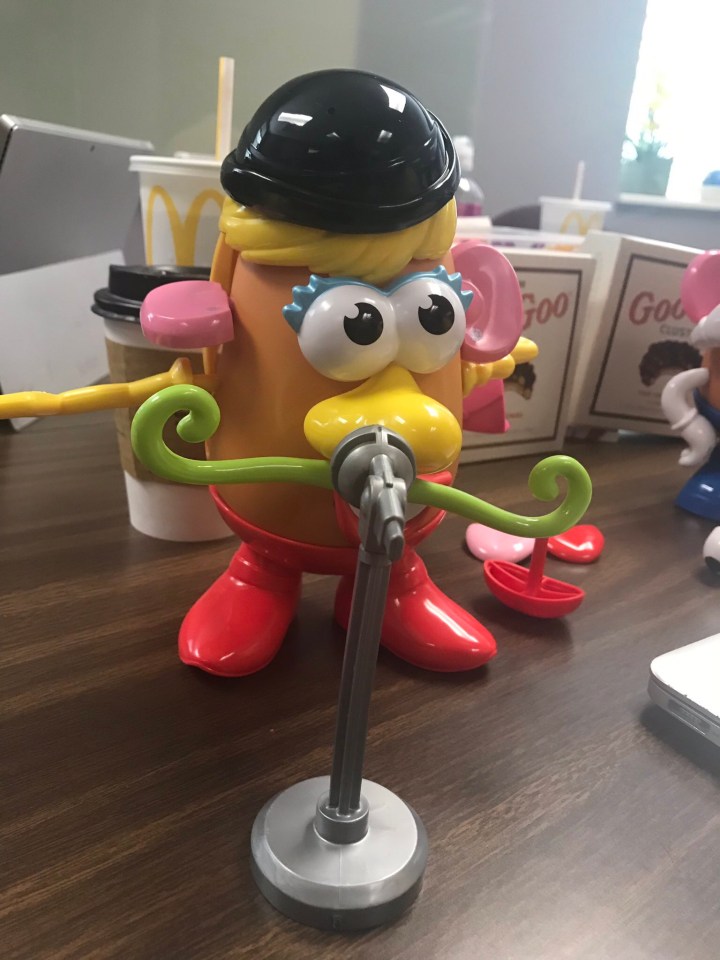 Our professional development covered the topics of “A Day In The Life Of Our Indy Schools,” Social Emotional Learning, Restorative Justice, and our Eight Step Process for Continuous Academic Improvement. Plus, we started the day with Mr.& Mrs. Potato Heads and participants making their Potato Heads answering the question: what does education look like on you? At the end of the day, participants had the opportunity to reflect and change their potato head answering the statement: now I look like this. Here is the agenda we used for the day:
 On the way down to Nashville we saw signs for Frisch’s Big Boy. Since all six of us seemed to have some affinity or fond memories of going to Frisch’s Big Boy, it was decided that is where we would eat on the way home. Needless to say, I was excited because there is just no better hamburger than the Super Big Boy.
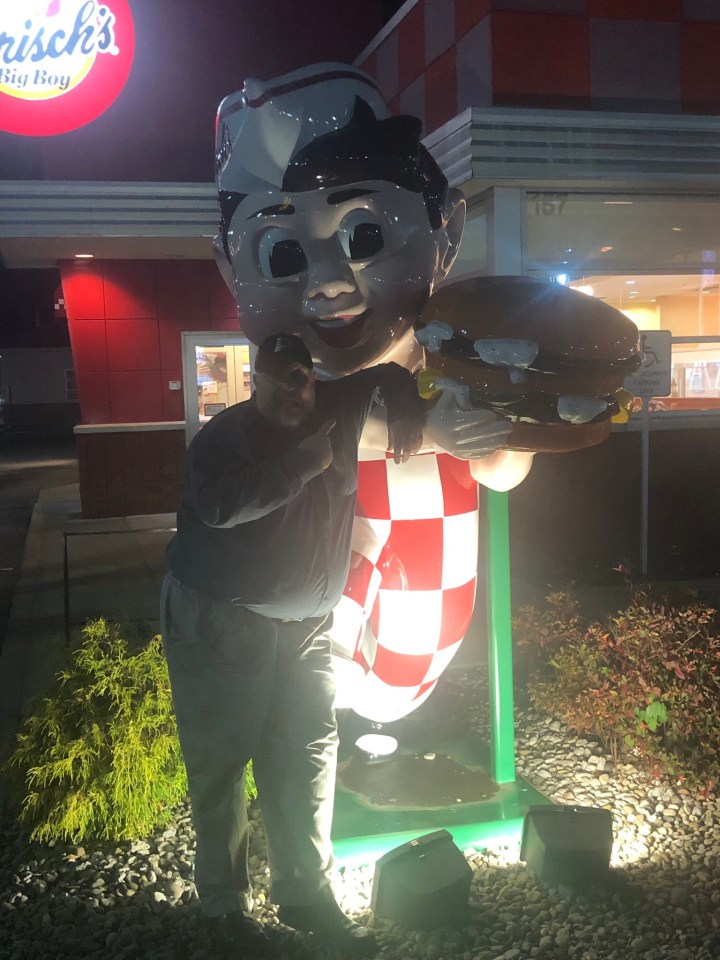
On the way home it became quite fun searching for our Big Boy location. Of course, I became “Big Boy” because I am a “Big Boy.” And…I couldn’t wait to get my picture taken with the iconic Frisch’s Big Boy. In fact, the group was so kind to buy me one of the “Big Boy” banks. It is now a treasured item on my desk.
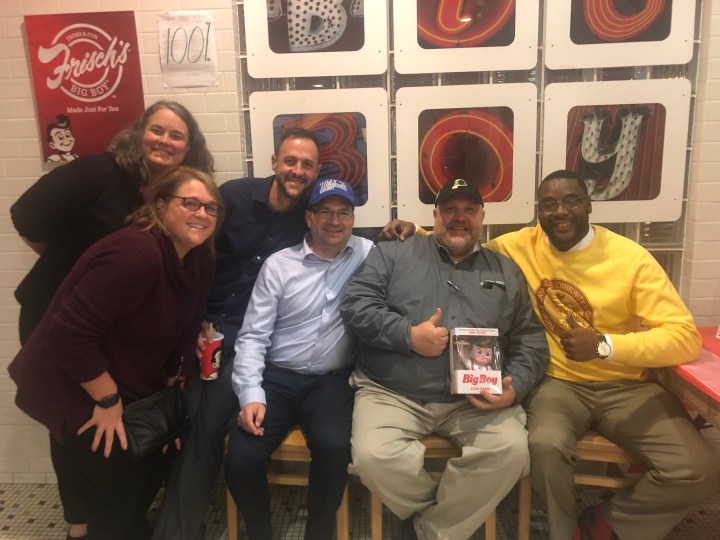 Then I got to thinking about the principles and core values that guided Dave Frisch, the founder of Frisch’s Big Boy restaurants. He founded on the idea of great food, a great work environment that was fun for employees, and a place of integrity. Who could argue with this?
As I did a little Big Boy studying. I found that Frisch’s Restaurants, Inc. use the value of being “Guest Centric.” Being in the field of education this was interesting to me because we use the term “Student Centered” a lot. I like the “guest centric” terminology better, however, because it refers to internal and external guests. The internal guests are employees. Frisch’s wants to provide its best service and support to its employees. I’ve always said in education we need put teachers first so we can put students first. I love that Frisch’s says, “We will be our best every time by delivering our best and being guest centric to our internal and external customers.” I believe this speaks to empowerment, engagement, and professional growth and development of staff, regardless of the industry we are in.
Frisch’s also has a core value of treating everyone as family (employees and customers), too. Their restaurants have a very diverse workforce and customer base. Frisch’s supports each team member through teamwork, coaching and development, fair treatment, and mutual respect.
Do you practice “Big Boy” leadership?
Leading With Clarity
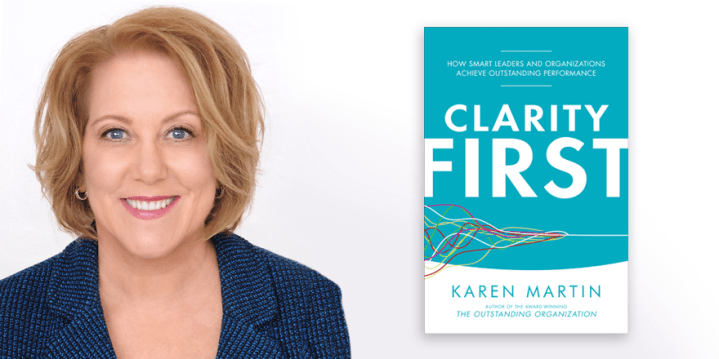
 Clarity First: How Smart Leaders and Organizations Achieve Outstanding Performance by Karen Martin
My rating: 5 of 5 stars
Clarity is so important in today’s world where we need to be constantly changing, resisting the status quo, and having agility for meeting our stakeholders’ needs. This book teaches us that clarity requires a highly focused effort for a person to give clarity to others in the form of clear communication. This clarity must also be seen in the living of the vision, mission, and core values of the organization. Clarity is also explained In this book as something you receive from others when they communicate clearly with you. I have said many times that, as leaders, we can’t always give certainty, but we must always provide clarity. This great book shows us the way to providing this clarity.
Teacher Leadership
 This week I had the chance to do a couple of sessions on Teacher Leadership at the Impact CSUSA 2020 Conference that Noble Education Initiative put on. In the session we discussed creating a shared leadership model and engagement pipeline. I even did a plate spinning show to represent how hard it is to spin all the plates we need to as leaders. If we empower teacher leaders, we can spread out the load and keep all the plates spinning. We must create a supportive community where everyone helps to spin the plates. By the way, I can only keep three going at once, but brought others up and we were able to have all six plates that I have going at once. Another one of my metaphors!
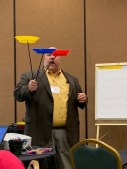 First, let’s start by answering the question, “What is teacher leadership?”Here’s the definition I have always liked: “Teacher leadership is the process by which teachers, individually or collectively; influence their colleagues, principals, and other members of the school community to improve teaching and learning practices with the aim of increased student learning and achievement.” (York-Barr & Duke, 2004, p. 287) During the workshop, participants came up with a list of teacher leadership roles. Here is there list:
 I also laid out a seven step process for growing teacher leaders:
- Realize teacher leadership is essential
- Recognize teacher leadership as a teachable skill
- Recruit teachers to become teacher leaders
- Build leadership capabilities among teachers
- Nurture leadership qualities in teachers
- Empower teacher leaders
- Provide ongoing professional growth opportunities for teacher leaders
Of course it wouldn’t be a session by me without there being model making, innovation, creativity, and creations. First, I asked the question, “Why is building a great teacher leadership pipeline more like chess than checkers?” We had a great discussion in both sessions about this. We discussed how in checkers there are very limited moves and you can’t the checkers cannot be promoted until they reach the other side of the board – we believe everyone should lead from where they are. We discussed how chess is about strategy and a longer term overall play. I’m sure you get the idea.
I broke the participants into groups of four or five, gave them a chess board, pipe cleaners of all sizes, colors, and even with glitter, glue sticks, masking tape, little eyes, fuzzy balls of all sizes, and straws. I then told them that there objective was to replace the traditional chess pieces with ones that represented the ideal chess game for building an amazing pipeline of teacher leaders. I’ve got to tell you, it was amazing to watch them. Even more amazing were the descriptions of the chess pieces and and the discussion. Following are pictures of some of the games created:
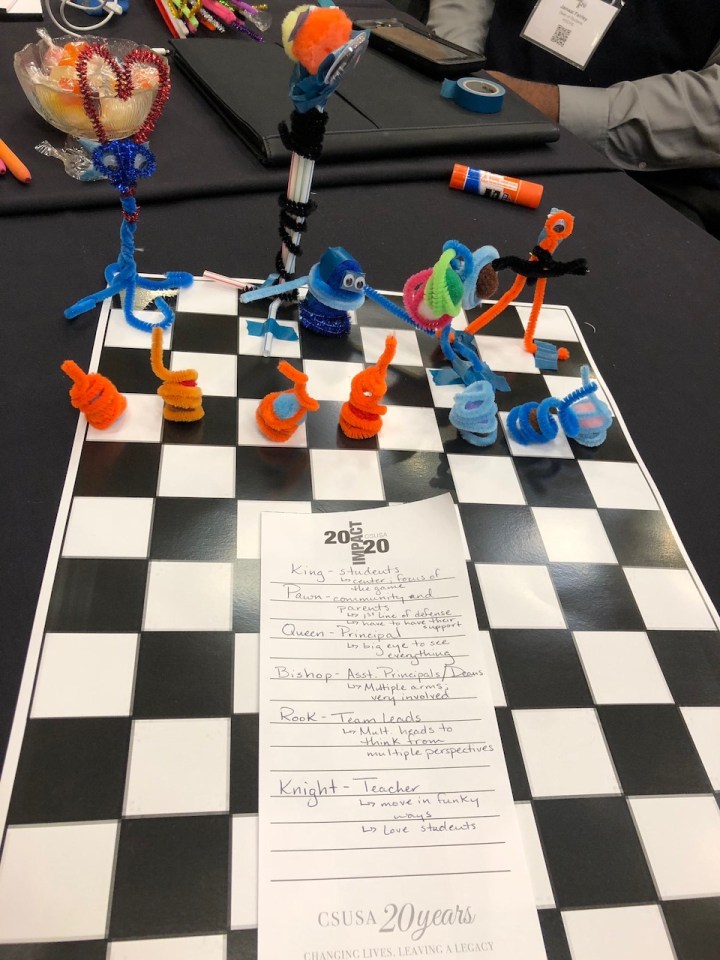
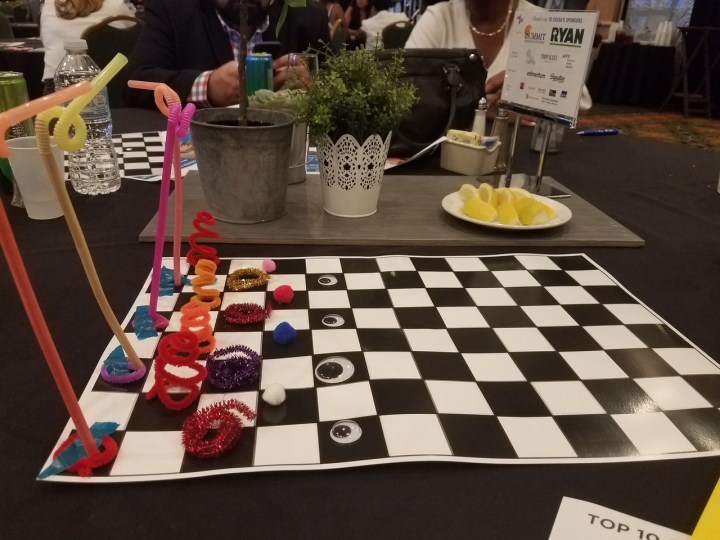
Finally, we created a list of attributes for effectively developing teacher leaders. Here’s our list:
- Results-driven
- Standards-based
- Job-embedded
- Differentiated
- Linked to learning needs (student and teacher)
- Collaborative in nature
- Sustained over time
- Discipline-focused/Content rich
- Reflective
- Evaluated
How are you doing at developing your teacher leaders?
What is Clarity?
 The following is an excerpt from Clarity First by Karen Martin
What Is Clarity?
By Karen Martin
The simplest definition of clarity is the quality of being easily and accurately understood. Clarity in a business context goes deeper than that, however, since it exists in multiple forms: as an organizational value, a state of being, and an outcome.
 When clarity exists as a value, individuals and the organizations they work for operate in a way that places a premium on clarity and rewards the people who seek it. In that environment leaders and team members pursue clarity in their daily activities and cultivate an expectation of clarity throughout the organization. An example of clarity as a value can be seen in Alan Mulally, the former CEO of Ford, who applauded members of his team when they called attention to drops in performance or other areas of the business that needed attention instead of staying silent.
Alternatively, organizations can operate in a way that dismisses clarity and penalizes those people who seek it. At Wells Fargo, for example, employees were fired when they tried to report wrongdoing when they saw their peers opening false accounts in order to meet new account targets. Opening unauthorized accounts was reportedly condoned by bank leadership, and employees who refused to comply or actively worked to call the practice to light were penalized.
Wells Fargo is an extreme example of how clarity might be discouraged or dismissed. More commonly, organizations are benignly ambiguous, operating with a lack of clarity because it seems to be easier and safer in the short term. Remember, ambiguity is the default stage—it is what happens automatically.
Clarity, in contrast, requires work for a person to achieve it as a state of being, and it requires focused effort for a person to give clarity to others in the form of clear communication. Clarity can also be something you receive from others when they communicate clearly with you. In this sense, clarity exists inside a person’s mind, as well as in the space between that person and another with whom he or she wants to share information.
What does clarity as a state of being look like? Clarity exhibits many qualities, the most important of which are coherence, precision, and elegance. Clarity as coherence comes through information that is both purposeful and logical. Precise information is succinct. Elegant information is crisp and easy for the intended recipient of the information to grasp.
Despite the multiple forms and multiple qualities that clarity possesses, there are also things clarity is not. Clarity is a close cousin to truth, for example, but they are not one and the same. A person or an organization can issue untruthful statements that are received as true because they have the coherence, precision, and elegance of clear communication. There is even a term for this— agnotology—coined by Stanford Professor Robert Proctor as the study of the willful act to spread ignorance or doubt.
Clarity is also a close cousin to transparency, but they are not identical either. One can be clear with the information he chooses to share while withholding some of the details. Likewise, one can believe she’s being transparent without being clear. Transparency is a noble goal in many situations, but it’s not a “one size fits all” virtue. There are good reasons why the Healthcare Insurance Portability Protection Act (HIPPA) precludes healthcare providers from sharing private patient information outside the patient’s direct care team, for example, but those reasons don’t apply to doctors writing clear orders or providing clear direction to their patient’s treatment team. Generally, though, transparency serves efforts to operate with greater clarity.
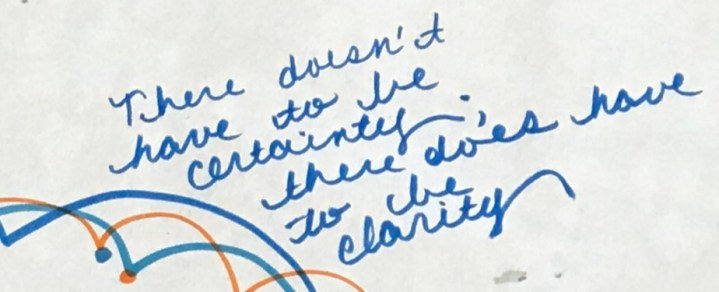
Finally, clarity is different from certainty. Certainty is not always possible, but achieving clarity nearly always is. For example, companies can’t always predict when a competing product will rob them of market share, when a natural disaster will cut off access to a key supplier, or when political priorities will shift so that what they thought was tomorrow’s concern becomes today’s crisis. But organizations can improve their predictive powers and the speed with which they respond by gathering information, interpreting it, and communicating findings clearly. In this way, both clarity and uncertainty can coexist in the same environment. Similarly, certainty is a dangerous mindset in the early stages of problem solving, but it’s essential to operate from a clear problem definition.
*******************************
Karen Martin, president of the global consulting firm TKMG, Inc., is a leading authority on business performance and Lean management. Her latest book, Clarity First, is her most provocative to date and diagnoses the ubiquitous business management and leadership problem―the lack of clarity―and outlines specific actions to dramatically improve organizational performance.
 Byron's Babbles
leave a comment