Change Leadership: The Iceberg Analysis and Perception Versus Reality
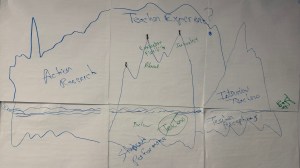
Back in August, a group of leaders and I got to do a presentation on next steps in a change leadership case study. Our task was to make a pitch promoting next steps using one of the five key tools of change.
The five key tools of change are:
- Problem statement;
- Stakeholder mapping;
- Iceberg analysis;
- Causal loops;
- Iteration and testing.
Our team chose to use an iceberg analysis. The iceberg analysis is a key tool in change leadership that helps identify underlying issues that are not immediately visible. Just like an iceberg, only a small part is seen above the surface, while the larger, more significant concerns lie beneath. By exploring these hidden aspects—such as underlying beliefs, assumptions, and cultural patterns—leaders can address root causes of challenges, fostering meaningful and sustainable change within our organizations’ systems.
In the context of the case study we were given, we chose to expand the metaphor of the iceberg (which is the point of this post) even further by creating a bigger iceberg (see the featured photo to see my graphic recording of the presentation) that encompasses the original. Sometimes we consider the iceberg as what we see above the surface and imagine is below the surface, but sometimes the iceberg is bigger than what we see above and below the surface. We called this perception versus reality.
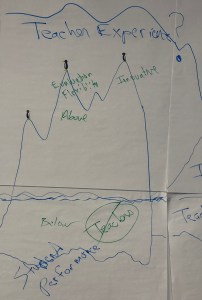
All the data in the case study we were using, which was related to systems change in a school educational system, had been collected qualitatively using administrator perceptions. We wanted to know if the positive perceptions held by administrators was reality for the teachers. Check out our graphic perceptions/realities in the photo inset (don’t miss our penguins).
This iceberg analysis that includes perception versus reality is such an important part of change leadership. Does perception meet reality? Great leaders care whether perception is reality. In the context of the case study, we needed to know if all the changes being made in this school’s systems were being experienced by the teachers in the same way as the administrators perceived them to be. Furthermore, this speaks to another key tool of change, stakeholder engagement. The teachers are an important internal stakeholder in the community that was being formed in the case study school.
Navigating Challenges

This weekend, for the finale summit trip of “THE Leadership Academy” program I facilitate for Hamilton Heights School Corporation, I named one of the activities, Navigating Challenges. The idea was that, just like a captain who must navigate navigate through changing waters, leaders can also learn to adapt to unforeseen challenges. The activity literally involved having a lunch celebration on a riverboat. Little did I know just how great that three hours was going to become.
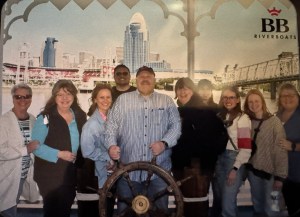
As we boarded the BB Riverboats flagship, the Belle of Cincinnati, the captain greeted us and checked us in. This really impressed us, but it was a Captain’s Lunch Cruise, after all. Here was the leader of the ship personally checking every person in. Those that know me won’t be surprised that I got into a conversation with the captain. The conversation led to us to being invited to visit the captain on the bridge. By now I was giddy – we had been invited to the bridge! I also set a goal of wanting to blow the ship’s horn.

After a wonderful lunch celebrating the group, enjoying the beginning of the cruise and Banjo Bob’s narration and music for a little while we ventured to the bridge. I called up to the captain and he gave us permission to climb to the bridge. Here we were, where it all happens – the navigation and steering of the ship. Our entire group was so eager to learn about everything. Our Captain generously discussed each piece of navigational device and each steering component. We were at the nerve center of the ship.
There on the bridge I viewed the rope used to make the ship’s horn blow. First, I must remind you of a Byron Rule: “The answer is always no, until you ask.” So I asked the Captain if I could blow the horn. He said, “No, there has to be a reason to blow the horn.” The captain then proceeded to give us an incredible lesson. He told us that when facing adverse conditions or an obstacle we must, “deal with it.”

Participants in our group asked questions about how our Captain dealt with it. He told us the key was to adapt and overcome. I asked again if I could blow the horn. He didn’t answer. The Captain proceeded to give us a strong leadership lesson on using our decision-making skills to effectively navigate adverse conditions. Here area few of the notes I jotted down while he was teaching us:
- Assessment of Situations: The captain continuously monitors weather patterns, river conditions, and any potential hazards. Accurate assessment helps in making informed decisions.
- Communication: Clear communication with the crew is essential. The captain must convey instructions, maintain morale, and ensure everyone understands their roles during challenging times.
- Calm Under Pressure: A good captain remains calm and composed, which instills confidence in the passengers and crew. This helps prevent panic and promotes rational decision-making.
- Strategic Planning: The captain develops contingency plans, identifying safe routes or alternative actions to take if conditions worsen.
- Teamwork and Delegation: A captain relies on their crew, delegating tasks efficiently and encouraging collaboration to ensure all hands are on deck.
- Experience and Training: Drawing on previous experiences and training, the captain uses lessons learned from past situations to guide their current actions. The Captain even explained how he would create scenarios for himself to prepare for adverse conditions, obstacles, or equipment failure/malfunction. This impressed us because he was not relying on someone to do this for him.
- Use of Technology: Utilizing navigation tools and technology to gather real-time data helps the captain make better decisions.
- Flexible Decision-Making: The captain must remains adaptable, ready to change tactics as new information emerges or conditions evolve.

The Captain concluded by saying, “Don’t let it get to you because you have peoples lives at stake.” What a lesson on navigating challenges, changing waters, and adverse conditions to ensure the safety and success of the voyage. Just then he stated that we were coming upon another vessel approaching us from the opposing course. The Captain stated that on his command I could give the horn a five second blast (see photo). I got my wish! Don’t forget, the answer is always no until you ask.
Leading The Enormity & Simplicity Of Change

Of change, Machiavelli told us, “It must be be considered that there is nothing more difficult to carry out, not more doubtful of success, nor more dangerous to handle, than to initiate a new order of things.” Change is ever present, and is a source of value and risk. Recognizing that change is not easy allows us to prepare and strategize for the obstacles we may face.

We were introduced to another thought on change by Astrid. Astrid is a character in Rob Hart’s great book Assassin Anonymous and at the end of the book she said: “And the enormity of what it means to decide you want to change. Both the impossibility and the simplicity of it.” This thought captures the dual nature of change—how it can feel overwhelming and straightforward at the same time. On one hand, the enormity of deciding to change implies recognizing the challenges, fears, and uncertainties that come with stepping out of one’s comfort zone. It suggests that change often feels monumental, as it can require significant effort, sacrifice, and a willingness to confront difficult truths about oneself or one’s situation.
It’s important to view change as both a daunting journey and a straightforward choice. Balancing these two perspectives can help us navigate the process with greater resilience. Understanding that change begins with a decision can empower us. We don’t need a perfect plan; just taking that first step can be enough.
Finding New Favorites

This weekend marked the end of an era for me. Last year my son graduated from Murray State University and then yesterday his girlfriend graduated from Murray State as well. We were in Murray, Kentucky for the festivities this past weekend and it gave me a chance to reflect on the last five years. We have come to love the Murray area and have several favorite places we like to visit. We went to several of them this past weekend, including:
- Mister B’s
- Bad Bob’s Barbeque
- Hitching Post & Old Country Store
- Land Between the Lakes
- Elk & Bison Prairie
- Off The Hoof
- Pattie’s 1880’s Settlement
- Murray Donuts

Hard to believe I’ve developed so many favorite during the past five years. And that’s not even all of them. There just wasn’t time for all of them on this trip. As we prepared to head home yesterday, I started to get bummed that I would not have a reason to be back in Murray to go to my favorites. Then I began to think about new adventures that still lie ahead in my son’s new hometown of Owensboro, Kentucky. In the past year we have begun to explore those. There are so many new places to go and see, like Windy Hollow Restaurant (see feature photo).
This reflection highlighted our need to be forced out of our comfortable patterns from time to time. Finding new favorite places thrusts us into unfamiliar situations. Going new places, experiencing new cultures, trying food off new menus stimulates or brain in new ways, pushing us to think differently. This encourages us to have more creative thinking. So, instead of letting myself get bummed about life changing and moving on, I am getting excited about all the new adventures ahead.
I am now more excited than ever for new and unchartered territories in both my personal life and professional life that will offer richer and even more unique experiences. Join me in embracing the making of new favorites. These new favorites will create new stories, perspectives, and wisdom that will offer invaluable insights and inspiration. What are your new favorites?
The Changes Life Puts Us Through

I’ve been pondering lately about the changes life puts us through and how we grow from them. Those changes are sometimes imposed on us, but also chosen by us at times as well. As leaders, we are confronted with multiple complex challenges every day. New knowledge, skills, strategies, and mindsets are just some of the changes we need to impose on ourselves. One thing is for certain; with so many paradigm shifts occurring in the world today, changes in our lives will occur.
We can grow from the changes life puts us through by focusing on personal development and self-improvement. This can involve reflecting on our experiences, learning from them, and using them to become a better version of ourselves. It’s also important to maintain a positive mindset and resilience in the face of challenges. Finally, seeking support from others, such as friends, family, or a therapist, can help us navigate difficult times and emerge stronger on the other side.
Being A World Changer

As you know, I am currently reading six books conceived and curated by Blake Crouch called Forward. I’ve already blogged about his first two questions that drove the series in The Unforeseen Twists & Turns and Rolling The Dice of Uncertainty. Now while reading a fourth awesome book in the series by Veronica Roth, Ark, I am contemplating the third and most difficult driving question, “How does it feel to change the world” (Crouch, 2019)? When I first started thinking about this question my mind went to individuals who had made big changes in the world that we could easily point to. You know…the ones monuments have been built to honor. It’s important to remember, however, that changing the world doesn’t always mean making grand or global changes. Even small actions can have a ripple effect and create positive change. Those ripples can and will eventually turn into change that might one day have a global impact.
When we find purpose in what we do it allows us to pursue significance over success in our chosen fields going beyond personal benefit in preparation for our world-changing. We may know if we are changing the world by reflecting on the impact our actions have on others, the solutions or innovations brought to problems, and positive influence we have on those around us.
Too many people believe that they have no power and can’t make a difference in this world. Not true! We can all make a difference in our own way. By refusing the status quo, thinking and dreaming big we can help create the environment for changing the world. We must all lead from where we are. All of us have unique talents, skills, and expertise that we need to share. Our willingness to share plays a crucial role in changing the world for the better by spreading ideas, fostering collaboration, and building a supportive community. It allows us to collectively tackle challenges, inspire others, and create a ripple effect of positive change.
Sharing can put us in a better position to change the world for the better in several ways. Firstly, when we share our ideas, knowledge, and resources with others, it can inspire and empower them to take action and make positive changes themselves. By sharing our insights and experiences, we can help others learn from our successes and failures, and encourage them to pursue their own ideas and initiatives.
Secondly, sharing allows for collaboration and collective problem-solving. When we work together and share our different perspectives and expertise, we can come up with more innovative and effective solutions to complex problems. By pooling our resources and working towards a common goal, we can achieve greater impact and change.
Furthermore, sharing fosters a sense of community and interconnectedness. When we share our time, kindness, and support with others, we create stronger bonds and build a network of like-minded individuals who are motivated to create positive change. This sense of community can provide the necessary support and encouragement to sustain our efforts and amplify our impact.
So, how does it feel to change the world? It feels like using our purpose to lead from where we are by using our purpose to make ripples by challenging the status quo, thinking and dreaming big, and sharing ourself with the world.
Being An Energetic Change Agent

As an “Energetic Change Agent” I love enabling and creating opportunities for positive change. This does not mean that I don’t occasionally resist or become uncomfortable with change. We all do! A couple of things have happened in the past few months that prompted me thinking about doing this post. Then, this week the experience described in “I Am Mad That I Liked It” brought writing this post back to the top of the list.
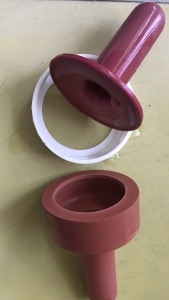
The first change that occurred is related to the bottles we use for baby calves. As you know we raise Jersey dairy show cattle. I’ve been using the same kind of bottle for years – two quart with snap-on calf nipple. Recently, the brand of bottle I use quit making the snap-on and went to a screw-on model. Check out the featured pictures and you’ll get the idea. I was really upset because I thought the snap-on model was easier to use and wash. Keep in mind, when you’re giving 10-12 bottles a day, easier makes a difference. But, after a lot of complaining and resisting it didn’t take long to realize I was wrong. The screw-on tops were easier to put on and easy to clean. Plus, there was a huge improvement in the venting. If you notice the bottle on the left is all dented and suck in. That is what happens with the snap-on bottles and we even had to stop and vent them while giving the bottle. That issue has been completely solved with the screw-on tops. Bottom-line: the screw-top bottles are better. We should have switched to them when they first came available, but no, I was sure I would not like them.

Then, another change happened that freaked me out. My dry-cleaner decided to retire and completely shut down the business. I am really picky about my shirts and like them folded and packaged – when you travel a lot like me it is easier to pack and store shirts (see picture). And believe it or not, they are not wrinkled when I take them out of the package. After much agonizing, I have found a new cleaners that I love. And while I loved my former cleaner, my new service provider has 24 hour drop off and pick-up, which is super convenient, check for missing buttons and replace if needed, and has an app for all communication. The change was good – why was I so resistant?
We are often resistant to change from one product or service to another due to several reasons. One reason is familiarity and comfort with the current product. We may be used to the people, features, functionality, and the overall customer experience. Switching to a new product or service requires us to learn and adapt to something different, which can be time-consuming and frustrating.
Additionally, there is the loyalty and attachment to a certain people, brand, and designs. We may have developed a sense of loyalty towards a particular brand, and switching to a new product or service means ending that loyalty. We might also fear that the new product may not live up to our expectations or provide the same level of satisfaction and benefits as the one we are currently using. This was certainly the case in both of my examples. Cost can also be a factor, but was not in my examples. My resistance to change came from a combination of factors like familiarity, loyalty, fear of the unknown, and laziness of not wanting to research and search for a new cleaners.
There are good reasons to try new products and services that do the same thing as the ones we are currently using:
- Innovation and advancements: New services and products often come with improved features, functionalities, and technology that may enhance our overall experience or make tasks easier and more efficient.
- Better performance: New products may offer superior performance, speed, reliability, or durability compared to older models. This was certainly the case with my calf bottle example.
- Cost-effectiveness: This was not a factor in my examples, but new products and services could be more cost-effective and energy-efficient, require fewer maintenance or repair costs, or offer better value for money.
- Enhanced compatibility, integration, and support: Switching to a new service or product might provide better compatibility with other devices, software, or systems, allowing for a smoother and more seamless experience. I now have an app to manage my dry cleaning.
- Different features and options: Exploring new services and products allows us to explore different features, customization options, or variations that may better suit our needs, preferences, or workflow.
Ultimately, embracing change and being open to new services and products can lead to better experiences, increased efficiency, cost savings, and access to the latest advancements in technology. I am not advocating to change just for the sake of change, but it is crucial to keep an eye out for the benefits that can occur listed above.
Knowing The Difference
I had the opportunity to watch an episode of The Virginian (1968, Season 7, Episode 182) recently. Trampas (Doug McClure) made a comment that really stuck with me. He said, “We need to improve the bad things, leave the good things alone, and know the difference between the two.” With so many things changing around us, I believe we sometimes forget that change for the sake of change can take away some of the great things we already enjoy. I do recognize how difficult it is at times to find the balance of promoting growth and progress while also appreciating and valuing the strengths and positives already present. Finding the right balance between change and preservation ensures a holistic approach that leads to sustainable and positive outcomes.
To “improve the bad things, leave the good things alone, and know the difference between the two” means we need to recognize and address the aspects of a situation or problem that are negative or need improvement, while appreciating and maintaining the positive aspects that are already working well. It emphasizes the importance of discerning between the two and making informed decisions on what to change and what to preserve. It is essential to recognize and appreciate the strengths and positives already present, as they serve as a foundation for progress and can provide motivation and inspiration.
Eternally Out Of Date

I am loving reading the great book, C.S. Lewis: A Life: Eccentric Genius, Reluctant Profit by Alister E. McGrath. In the book, he gives context to C.S. Lewis’ saying, “All that is not eternal is eternally out of date.” Lewis was expressing the idea that things that are not timeless or everlasting in nature eventually become obsolete or irrelevant. In other words, anything that does not have eternal value or significance will eventually fade away and lose its relevance in the grand scheme of things. I believe we must live in the present with a view toward the eternal. By viewing life this way it completely flips our priorities. Life becomes less about instant gratification and more about purpose and significance.

While it appears that Lewis believed that true wisdom and meaning could only be found in eternal truths and principles that transcend time and temporal concerns, I also believe that he was referring to being open to changes in the non-eternal. His own life took many twists and turns – even his own conversation from atheism to believing in Christ. Lewis had a deliberate intellectual strategy of open-mindedness. It has been said that Lewis had a passion for people and arguments. He could separate the person from the person’s opinion – not easy to do. Remember, if it’s not eternal it is eternally out of date! Lewis was not always this way and recognized he had to develop this ability to hear and seek to understand others’ opinions in himself. Others’ perspectives help supplement, iterate, and sometimes even change our own. Lewis understood this in both his personal and professional life, and provides an example for us to follow.
Don’t Miss A Voice

As leaders, it is important for us to ask “Who’s voice is missing?” because diverse perspectives are crucial for making informed decisions and creating inclusive environments. This question helps to eliminate “group think” and takes aim at the echo chamber. We desperately need diversity of thought, which is more important than ever, given the information silos many people live in today. Seeking the opinions and experiences of individuals who may be underrepresented or marginalized is also crucial. By doing this we can avoid overlooking important insights and ensure that everyone’s needs and concerns are taken into account.
Furthermore, including a variety of voices in decision-making processes can lead to more innovative and effective solutions. Different perspectives bring different knowledge, skills, and experiences to the table, which can lead to more creative problem-solving and better outcomes.
Additionally, asking “Who’s voice is missing?” demonstrates a commitment to equity and fairness. It shows that we value and respect the input of all individuals, regardless of their background or position. It also fosters a sense of belonging and inclusion, as people feel heard and valued when their voices are considered.
I always tell those in my leadership development programs to ask, “Who’s voice is missing?” By doing this and making sure every stakeholder is present in the development of new initiatives and change, leaders can promote diversity, inclusion, innovation, and fairness within their organizations and communities. This also eliminates the need to worry about getting buy-in on the back end. As I always say, if we say on the back end that we have to get buy-in, we have already failed. Include everyone on the front end. Are you missing any voices?
 Byron's Babbles
leave a comment