Our Gifts & Force Multipliers
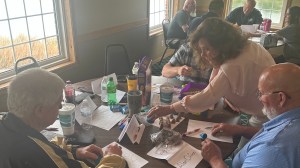
Yesterday, I did an all day professional development gathering for Wabash River Career and Technical Education and we did an activity using kinetic sand beach castle building. The idea was to develop a project-based learning lesson and create a rubric. When sharing out their great innovations, one instructor and owner of Thompson’s College of Cosmetology, Deanna Kindsvatter, referred to the other members of her project team as “gifts.” For example she said things like, “And Ron was a gift because he knew how to…” I don’t think I’ve ever heard teammates referred to like this. We should, however, consider our teammates and those we serve as gifts.
This made me reflect on a concept I think about in leadership a lot – force multiplication. A force multiplier is really a military science term referring to factors or combination of factors that allow personnel or weapons to achieve more than by themselves alone. In Deanna’s case she was highlighting the different positive impacts of the others in her group and amplifying the efforts of the team, leading to enhanced overall performance and success. Thus, she was acknowledging them as force multipliers.
It was so great to hear Deanna acknowledge others as gifts and it made me ponder how do we make sure we create environments for all our gifts to thrive and we ourselves serving as gifts to others. Here are some thoughts on being gifts and creating force multipliers:
- Empower Your Team: We must delegate responsibilities and trust our team members’ gifts. By empowering them, we multiply our effectiveness through their contributions.
- Cultivate Collaboration: We can encourage teamwork and collaboration among our team members and those we serve. When we work together we can achieve more than any individual could alone, creating a multiplying effect.
- Leverage Technology: Utilize tools and technologies that enhance productivity and communication. This can streamline processes and enable or teams to work more efficiently.
- Develop Others: We must invest in the growth and development of our team members. By mentoring and coaching them, we’re equipping them with skills that elevate the entire team’s performance.
- Build a Diverse Team: A diverse team brings different perspectives and ideas, providing a deep set of gifts, which can lead to innovative solutions. This diversity can amplify our team’s overall capability.
- Communicate Vision: Clearly articulate a shared vision and goals. When everyone is aligned and understands the bigger picture, it directs energy and resources more effectively.
- Foster a Positive Culture: Create an inclusive and supportive environment where team members feel valued. A positive culture enhances morale and motivation, leading to greater productivity.
Cultivating A Student’s Wisdom and Imagination

I was asked a question this week as to if the needs of all students can be met by career and technical education (CTE) courses. The individual asking the question also wanted to know about valuing career technical courses just as much as their academic courses and not viewing them as just another elective. First, I must point out that I believe every path matters for students and the needs of students can, and should, be met by the path best suited for the individual student.
My answer to the question was an emphatic, “Absolutely!” I went on to give examples and referred back to points I had made in my book, The Hand In The Back Of The Room. Teaching science through the context of agriculture employs inquiry-based teaching methods allowing teachers to expand students’ science skills and help mold lifelong learners.
Students who lack a connection with the relevance of science and math create a challenge for education and reinforce the need for core subjects to be taught in a relevant context. Career and technical education courses and programs offer this opportunity. The context of agriculture, for example, allows students to see, touch, smell, feel, and understand in a way that is meaningful to them. Learning in a relevant context allows students to use both wisdom and imagination.
The Second Generation

Everyone should feel satisfied and proud of the career they want to pursue. Our goal has always been for our son to make peace with his post-secondary education and career goals and, first and foremost, make himself proud. There has been quite a lot of research done studying the impact parents have on their children’s educational and career goals. I am really glad and proud of the work I have done in the policy arena to have career exploration be something that happens much earlier than the end of high school. Our young scholars need to be preparing for the next chapter of life—whether that’s higher education, industry training, directly into the workforce or another path much earlier. I also believe that parents have an influence, either positive or negative, on this. I began reflecting on this yesterday when standing outside my son’s summer internship at Cal-Maine Foods. I could not go in for bio-security reasons, but I was so proud that there stood two generations of Animal Science majors at two different universities – Purdue University and Murray State University. Check out our picture and here is the tweet I did in the moment:
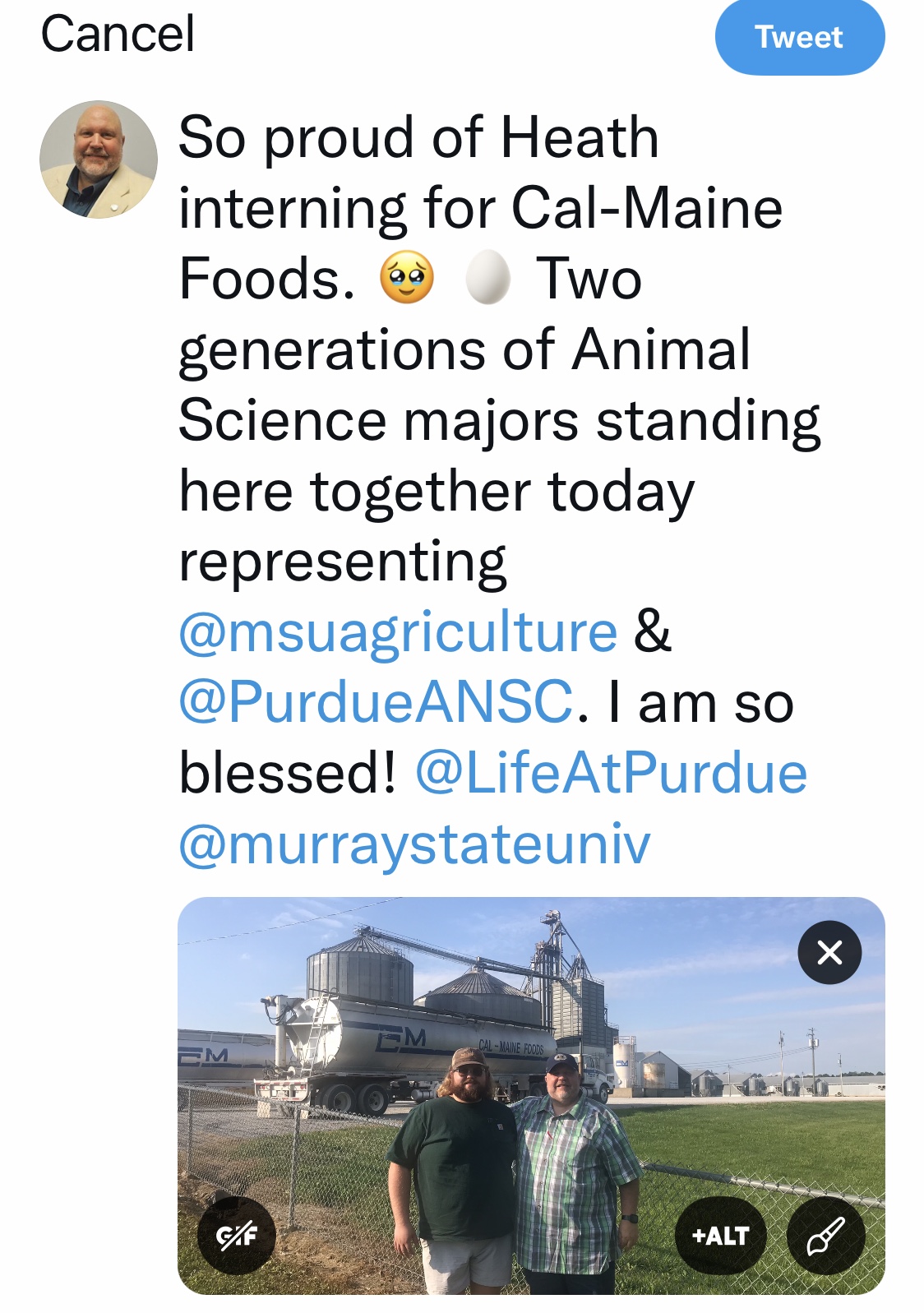
I asked Heath if he ever felt any pressure from me to be an animal science major. He answered an emphatic “no.” He did say that I had set an example because of how proud I was of having gone to Purdue and received degrees in both Animal Science and Agricultural Education. He also knows the story well of how I ended up being an agriculture science teacher and working in education my entire career. If you don’t know that story, click here. Heath also talked about all the experiences growing up on a working farm gave him. Home is where thinking ahead, dreaming big and setting goals can become normalized activities and allow all those skills to be available to our children when they come to the forks in the road. The earlier the conversations start, the better prepared they’ll be to make the best choice when that moment arrives. It’s not about applying pressure, but about being a model of making life choices that match passions and purpose.
“Sticky” Learning
 I made the comment last week that relevance makes the learning “sticky.” This really caught on and caused quite a bit of discussion. As an old Agriculture Science teacher I have preached about using relevant and real-world contexts for facilitating learning for years. In fact, I even wrote a book about it: The Hand In The Back of The Room: Connecting School Work To Real Life. This book is all about how we (four agriculture science teachers at one school) went about teaching science in the relevant context of agriculture. The great part of the story is the statistically significant impact leading learning in a relevant context had on student learning. In other words, there was proof that relevance makes learning “sticky.”
 In the book I state, “It has always been my belief that there are three worlds that a student exists and learns in; school world, real world, and virtual world. While these three worlds can be drawn as three separate circles, I believe that for true learning to take place we must, as educators, help connect the circles for them. This means finding a way to facilitate learning in a way in which the student uses real world contexts where the student plays an active role” (location 320 on Kindle). Right now, during the Global Pandemic (we are in day 165) we have some real opportunities to make use of these world colliding. I wrote about this yesterday in When Worlds Collide. I also argued in the book that, “…facilitating learning in a relevant context enables the work to be student centered and for there to be a connection made between the student’s real world and school world for learning” (location 331 on Kindle). This connection is what makes the learning so “sticky.”
“We have to make sure that all our students have access to these kinds of challenging and hands-on activities. Although much of the focus has been on the new technology that is fueling the maker movement, even more important are the values, dispositions and skills that it fosters, such as creativity, imagination, problem-solving, perseverance, self-efficacy, teamwork and “hard fun.” ~ Secretary of Education, John King Jr.
I proposed at time of writing the book and would still advance six ideas for improving learning (Ernest, 2016):
- Knowing what the end product needs to be before practicing the parts
- Study content and apply it to authentic real world predictable and unpredictable problems/issues
- Applied learning opportunities must be afforded to the students
- Students must participate in active exploration of real world problems
- There must be opportunities for students to make adult connections
- We must make schoolwork more like real work and real life.
If we intentionally use the six ideas, we will make the learning be what former Secretary of Education, John King Jr. called “hard fun.” The nature of using relevant contexts makes the learning more rigorous. I love the term “hard fun” over rigor. If our students are learning to adapt what they have learned by addressing real world situations they will be more motivated and the learning will stick with them.
The bottom line is that education can be inspiring for our students. I believe agriculture education has an important place in creating a real world context for our students to learn in. I also believe that there are many ways for cross-curricular collaboration to be done in all subjects. At the very least, we have an obligation to our students to find ways to give our students hands-on, real life lessons that answer the questions of the hand in the back of the room and make the learning sticky for our students.
❤️ Kids Having Ownership!
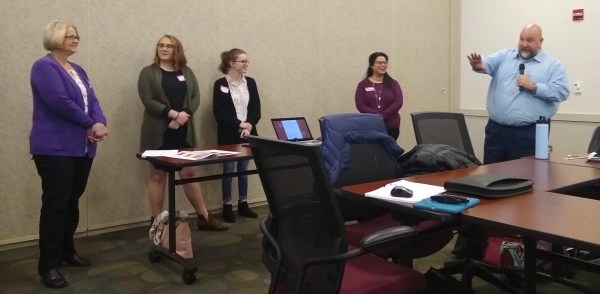 This past week I had the honor of doing a day long professional development for teachers from all schools corporations in Elkhart County, Indiana. I am representing Noble Education Initiative carrying out this customized professional development. This was part of an ongoing Project Based Learning partnership created by Horizon Education Alliance to bring business/industry and education together to best educate students. I love doing professional development workshops, particularly when they are on topics that I am passionate about. Project Based Learning (PBL) is one of those topics. It is also energizing to be with a group of educators who are very engaged. Groups like this always remind me and validate what Gallup® finds teachers value in question 12 of the Gallup Q12 Index©: “In the last year, have you had opportunities to learn and grow?” These teachers have been given this opportunity and very much value the opportunity, and are taking advantage of the opportunity to learn and grow.
The group last week was both passionate and engaged. We started the day with what I called “Level Setting.” I had them work in pairs to talk about their PBL experience now that we were half way through the school year. I wanted them to talk about what they had learned, “wow” moments, what they still had questions about, and what they still needed help with. They were to represent this on a tear sheet and put it up on the wall. Here are a few of the tear sheets that were put up:


Did you see the comment “❤️Kids Having Ownership”? That’s what this is all about. The next few paragraphs will dig into that a little deeper.
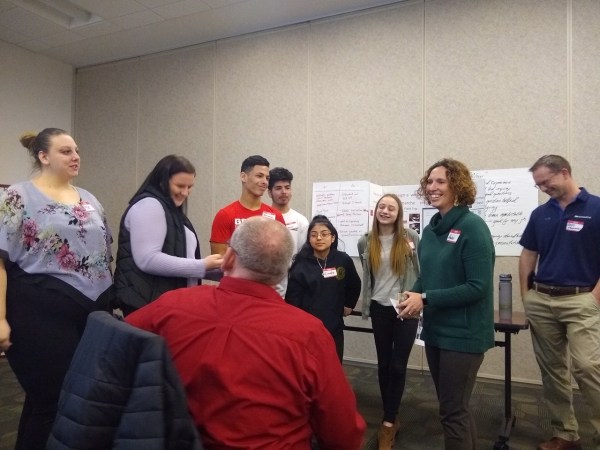
Aubri Mosness with her students
We then had everyone individually do a gallery walk and pick one thing that stood out to them. This was an awesome discussion when the group came back together. There were questions like, “who wrote… I would like to know more,” or “I had that same experience because…,” or “I am so glad you wrote that because that same thing happened to us, and we are still trying to figure out…” You get the idea. One comment really stood out to me during this discussion; It was by Goshen High School Teacher, Aubri Mosness. She said, “I have felt the transition from me doing most of the work to the students doing most of the work. At first I was a little uncomfortable because I felt like I was doing much, but then I realized how much the students were getting out of it.” I was so excited by this. This is such a revelation in teaching. Great teaching should have the students doing most of the work. She was truly facilitating with a student managed classroom and the students have student agency and choice.
Then, at lunch Ms. Mosness’ students presented to the whole group and business/industry representatives that had joined us, on their project and I led a little Q&A. The students were incredible. During the presentation Ms. Mosness commented, “When I give my students too much, too much information, too much guidance, I am taking away opportunities for learning.” This was a drop the mic opportunity as far as I was concerned. The students all concurred. I then asked the students to give a thumbs up or thumbs down on the following question: “School work should look more like real work?” All six students gave me a thumbs up. Our students deserve to learn in an environment that is facilitated in a real world and relevant context.
 These students were giving first hand testimony affirming the research I did for my book, The Hand In The Back Of The Room: Connecting School Work To Real Life.” In the book I talk about that the hand in the back of the room was mine, and probably yours too, that was raised wanting to know why I needed to learn what I was being taught. In other words school work must be connected to real life. This is why PBL is so great. Using PBL teaching principles will make school work look and feel like real work. In other words, the question from “the hand in the back of the room is answered as to why she needs to learn what she is being taught. When teachers are allowed to make student learning the ultimate test of facilitation of learning, then instruction improves to produce better learning. The results of my research showed improved achievement/performance in science when students are taught in a relevant context. For me that context was agriculture, but there many other real world contexts to be used. This is why the partnerships with business/industry is so important for our students. The challenge to all of us in education is to find ways to make learning visible by connecting school work and real life for the students we serve.
Durability of Expectations
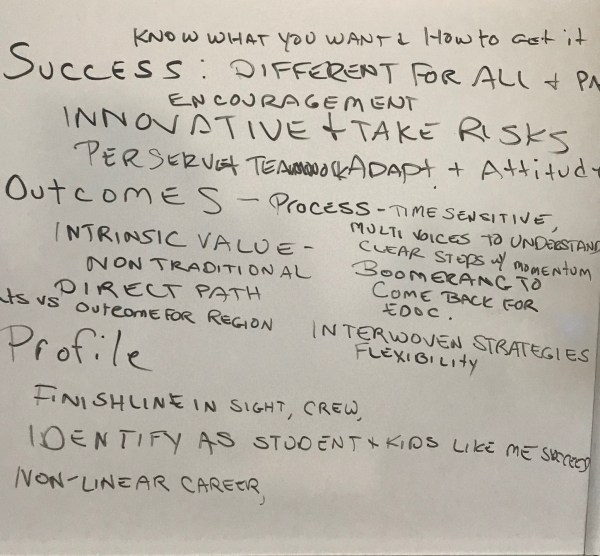 In a meeting I was a part of this week we developed a phrase that has caused me to do a lot of thinking: “Durability of expectations.” Our work was in the context of thinking about student success, outcomes, and what the profile of an Indiana high school graduate should look like. I like to combine all of this and talk about student success outcomes. Success looks different for all students and some students have not really had an opportunity to have success modeled for them or even know what success can look like. I have often said that it is ludicrous, in some cases, to ask our students what they want to be or do in life because they have not had the opportunity learn what all is out there. That is why I believe it is so important to make sure we are doing a great job of career exposure, career exploration, and career navigation for all students. We need to career coach our kids.
Success: “Knowing what one wants in the world and knowing how to get it.” ~ Dr. Felice Kaufman
We must make sure we are giving our students the opportunity to innovate, be creative, and take risks. This will help them to persevere, adapt, and develop a growth mindset and begin to understand lifelong learning. We need to help our kids understand what is out there and that getting where they want to go will be a non-linear process in many cases. Most of the career paths those of us in the baby boomer age are characterized of having relative stability. The career paths for today’s students are now times of discovery, restlessness, and exploration. The last I read, boomers will switch jobs 11 times during our lifetime, but millenials and younger will not only switch careers but change entire career trajectories. Therefore, the modern career trajectory isn’t necessarily a climb to a destination, but rather a continuum.
 We will need to offer solutions to our students that help them understand and give them the opportunity to skill, re-skill, and up-skill as they embark on their non-linear career paths. This is why I am such a believer that we must begin to identify the transferable skills our students. These skills, according to employers, hold much more weight than the traditional way of looking at academic records or even work history. Life is not linear, it is more like a Jungle Jim, so we need to make sure we are facilitating learning for our students that gives them the transferable skills to have durable expectations of what they can do. In other words, our students can have a lasting expectation that they have the skills to start and understand how to stay skilled to make the desired career moves that become available. Even if our students take a non-linear path in life, if they have credentials and transferable skills they will have what is needed to provide the on and off ramps to whatever career moves come available. This will give durability to the expectations our students have as they move through life and professional careers.
The old adage that you can’t connect the dots looking forward, you can only connect them looking backwards is true, but we need to give our students the ability to zigzag. By preparing students through career coaching, exploration, work based learning, and transferable skills and credentials we will add durability to the expectations of our students and their parents. We have an obligation to make sure our students are prepared to see and be prepared to seize the opportunities no matter how unconventional or surprising.
Using A Different Runway To Help Students Take Off To New Heights
 This morning as I was trying to fly home from Charlotte, North Carolina, the pilot came on and said there would be a slight delay. Because of the storm that was Hurricane Michael, we were going to have to use a runway that they usually do not use. He told us we would be using the runway going to the northeast, whereas typically the north/south runways are used. They would need 15 minutes to recalculate takeoff speeds, routes when in the air, et cetera. I was cool with it as long as we got in the air, headed north, and away from the storm.
As you know, I love metaphors, analogies, and similes; so here we go: I compared this to how, as teachers, we must constantly be making adjustments. We are constantly having to recalculate for our students and use new runways. We regroup students based on data, we spiral in new material based on mastery, we develop ways to maintain the proficiencies already mastered. Adjusting and recalculating instruction also means providing more opportunities for students to learn successfully based on information you gather such as their interests, work habits, motivation and learning styles and academic performance. Doing this on a consistent basis helps refine instruction so they can succeed.
Great teachers are those who know their students abilities, know the students proficiency of standards, and then use that information to determine how and what they will teach. They use educational standards and differentiation to guide instruction, while constantly focusing on 1) what the students know, and 2) what objectives (or steps) they need to take) to fulfill their goals. They focus on what the students can do today. How about you; Are you recalculating for a different runway for the success of your students?
Employers Need To Know What To Expect
 In meetings this past week a theme developed: Employers need to know what to expect. This was referring to the fact that employers need to know what to expect that students coming to work for them will know. As I have continued my work, as an Indiana State Board of Education member and Chair of the Indiana Graduation Pathways, I am spending a great deal of time with employers, learning the employee skill needs. It is abundantly clear there is a skills gap, but I do not believe it is insurmountable. I believe the answer is to identify those transferable skills and competencies that every student needs. Additionally, the transferable skills and competencies needed for specific trades need to be identified.
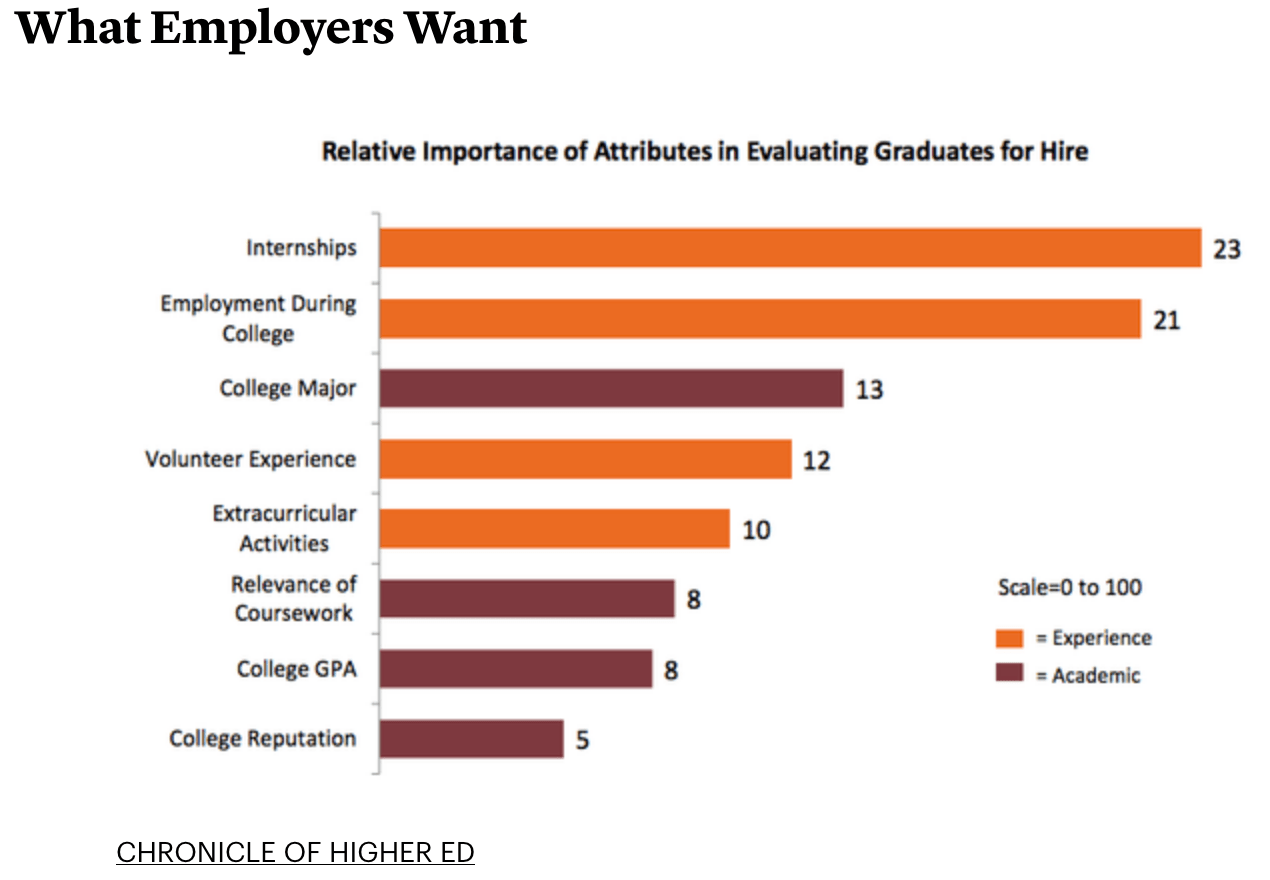
Even though the study dealt with college students, The Chronicle For Higher Education reported on a study that dealt with the question of “The Thing Employers Look For When Hiring Recent Graduates.” What the study found was that employers really value experiences outside of academics: Internships, jobs, volunteering, and extracurriculars. I have to believe this would also apply to high school graduates. From the many employers I have visited with, I would have to say that these things do apply to high school students. Maybe even more!
Below is the graph of the results from what employers want:
One of the pieces of our Indiana Graduation Pathways we were very explicit about was the need for Work Based Learning and Project Based Learning. Just so we are on the same page, Work Based Learning is an educational strategy that provides students with real-life and real-world work experiences where they can apply academic and technical skills and develop their employability skills in a relevant context. Work-based learning encompasses a wide array of learning experiences, from exposing high school students to careers through activities like job shadowing, to providing incumbent workers with specialized training. Work-based learning extends into the workplace through on-the-job training, mentoring, and other supports in a continuum of lifelong learning and skill development. I really want to highlight the point of lifelong learning. We really need to get out of the fixed mindset that the pathway everyone should take is to graduate high school and go straight to a four year college/university. This is not for everyone and Work Based Learning can help provide an avenue for our students.
Work Based Learning is at its most powerful when experiences advance along a sequential, purposeful continuum. Experiences along the continuum are increasingly personalized and aligned with specific industries and occupations, providing participants with opportunities to contextualize what they learn and build their skills and knowledge. This also can provide the employer with a pipeline of employees that have been trained in their own environment and on their own equipment. In this setting employers know exactly what they are getting.
Even beyond the Work Based Learning, however, employers need to know what to expect from the students that will become their future employees. We need to partner with employers to develop transferable skills and competencies that all students need to know. We really need to take a step back and fully develop what every high school needs to know when he/she graduates. Make no mistake, I am not saying students do not need math, English, and the other cores we always discuss, but that there is more. Employers need to know what to expect from the future employees, that are our students. We need to listen and make sure what employers expect is what employers get. Furthermore we must also make sure our students know what to expect they will be expected to know when entering the workplace.
Pathways to Success after High School
 A high school diploma no longer is the finish line—it’s now the starting line. Job growth and trends over the past 10 years have shown about 95 percent of jobs require some education after high school.
Recognizing that Indiana must offer more than a one-size-fits-all standardized test, the Indiana General Assembly took action to provide meaningful pathways for Hoosiers’ success. In the 2017 legislative session, lawmakers directed the Indiana State Board of Education to modify Indiana’s graduation requirements, ensuring students are better prepared to enter a new economy. The goal was simple: offer pathways that provide relevancy for students and better prepare them for life after high school.
Later that year, the State Board approved what is now known as Indiana’s Graduation Pathways. During this process, the State Board collaborated with national and state experts while engaging students, parents and educators on how to effectively deliver lasting value to all students through their education journey.
To complete a pathway, a student must take several actions, including fulfilling Indiana’s course requirements and completing an employability experience by applying classwork to real-world situations. This could include completion of an independent research project, participating in meaningful civic engagement or having a part-time job, apprenticeship or internship. Students must also choose a benchmark that best suits their career goals, such as taking the SAT or ACT to attend college, completing the ASVAB to join the military or earning a state-and-industry recognized credential or certification to join the workforce. Selecting and completing a pathway ensures students are better prepared to transition from high school to college, the workforce or the military.
While Graduation Pathways won’t be a requirement until the class of 2023 – this year’s eighth graders – some Indiana schools are implementing Graduation Pathways right now. In these school districts, parents and educators can have conversations with their students about an individualized graduation plan that provides students a relevant education, prepares them for the global economy fuels a desire for lifelong learning. Parents should have conversations with their local school officials to determine the implementation timeline at their child’s school.
Using Graduation Pathways allows Hoosier students to transition from high school into life’s next steps. Together, we’ll raise the bar for our state’s future workforce, so that today’s students will graduate with the relevant skills needed to compete in a global economy.
Meaningful Learning On A Lobster Boat
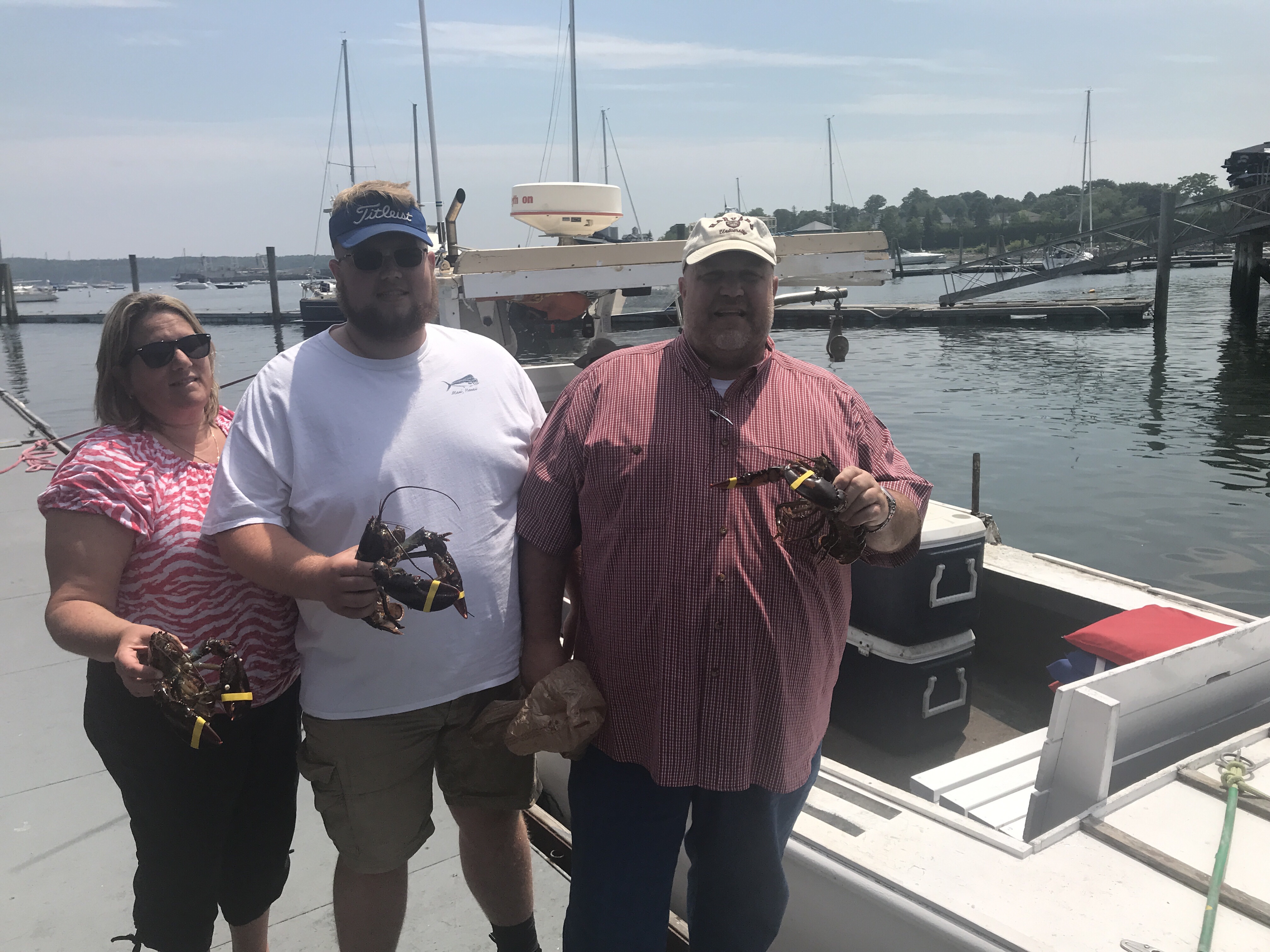 This week while spending time with the family on the coast of Maine I was reminded how important, meaningful and experiential learning experience are – for both adults and young scholars alike. I had the opportunity to get us aboard a commercial lobster boat in Rockland Harbor, Maine. Yes, this was no site-seeing cruise, it was an actual experience on the boat checking, emptying, and re-baiting lobster traps. Even though we were on vacation, I always want there to be some family learning experiences. That same morning we had stopped and spent time in Brunsick, Maine at Bowdoin College learning more about Joshua Lawrence Chamberlain. You can click here to read my blog post about that experience entitled, Independence Day Leadership Lessons From Maine & Joshua Lawrence Chamberlain.
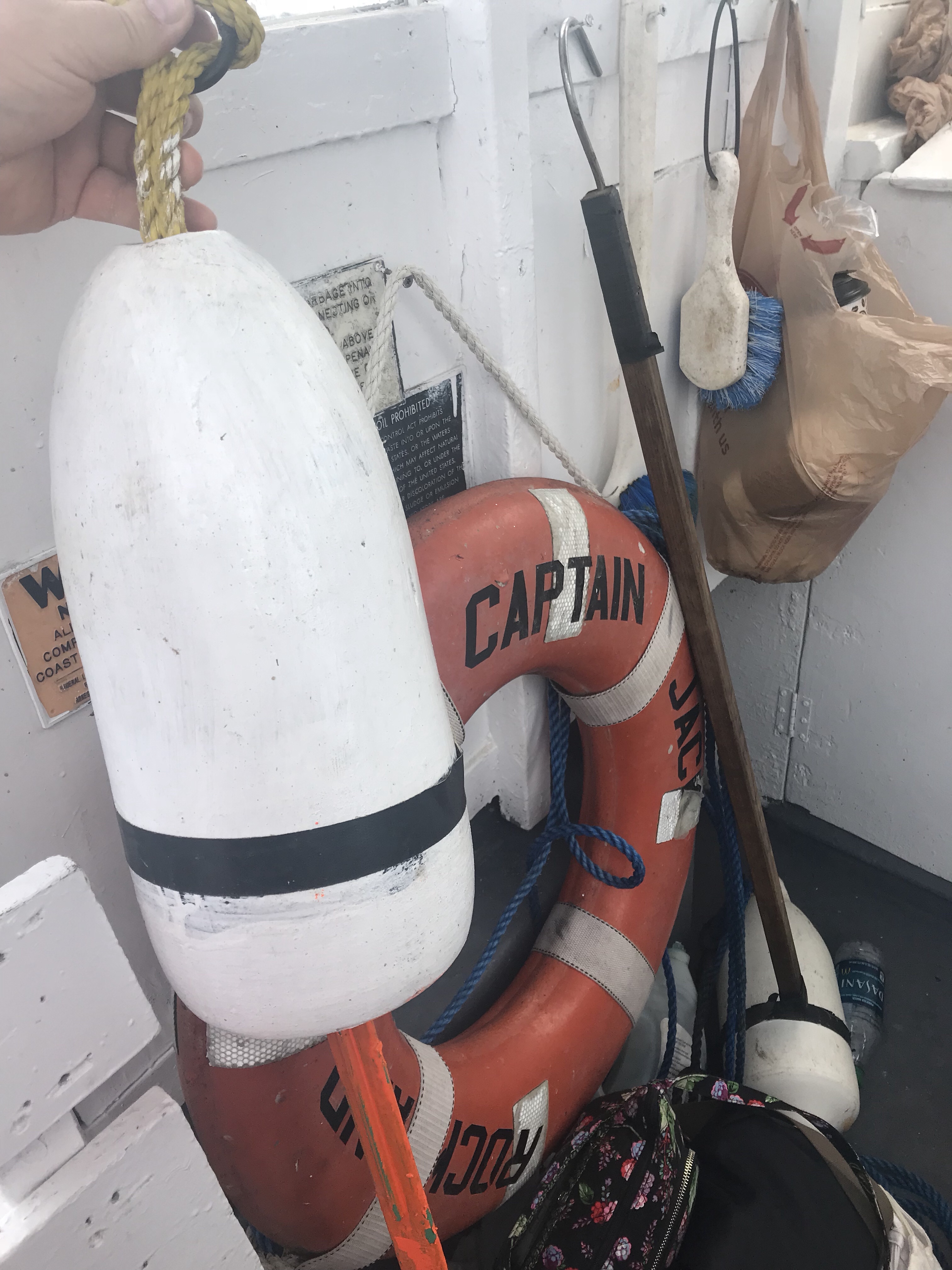 Hope, Heath, and I all love lobster, but knew nothing about how they were harvested or the industry of getting them from ocean to table. I knew a little bout their life cycle and had blogged about it in Leading Like A Lobster, but other than that I was ready to be a sponge for learning. We started off by learning that the different lobsterwomen and lobstermen have an area assigned with their special license for harvesting lobsters, and in our case, our lobsterman had the ability to put out 800 lobster traps; or lobster pots as they are often called. We also learned that each lobster boat has their own buoy colors, much like horse racing silks, to identify his or her lobster traps. We were looking for white buoys with a black stripe, and orange fin (see picture) attached to the lobster traps. We really didn’t have to look, though, the captain had the all entered in his GPS.
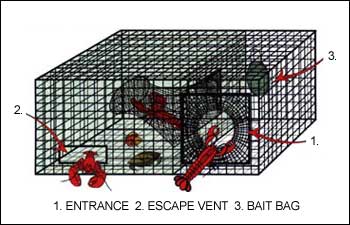
Lobster traps are interestingly designed tools of the trade. The first “room” the lobster enters is the “kitchen” where lobster-enticing bait is hung. Bait may be fresh or salted fish on a line or tied in a hanging bag. After the lobster enters the kitchen, it grabs a piece of bait with its claw and begins maneuvering towards an exit. It is difficult to go out the way it entered due to the design of the funnel. As the lobster continues seeking an exit, it passes through another funnel leading to the “parlor” or “bedroom” in the rear of the trap. Here, the larger lobsters become trapped.
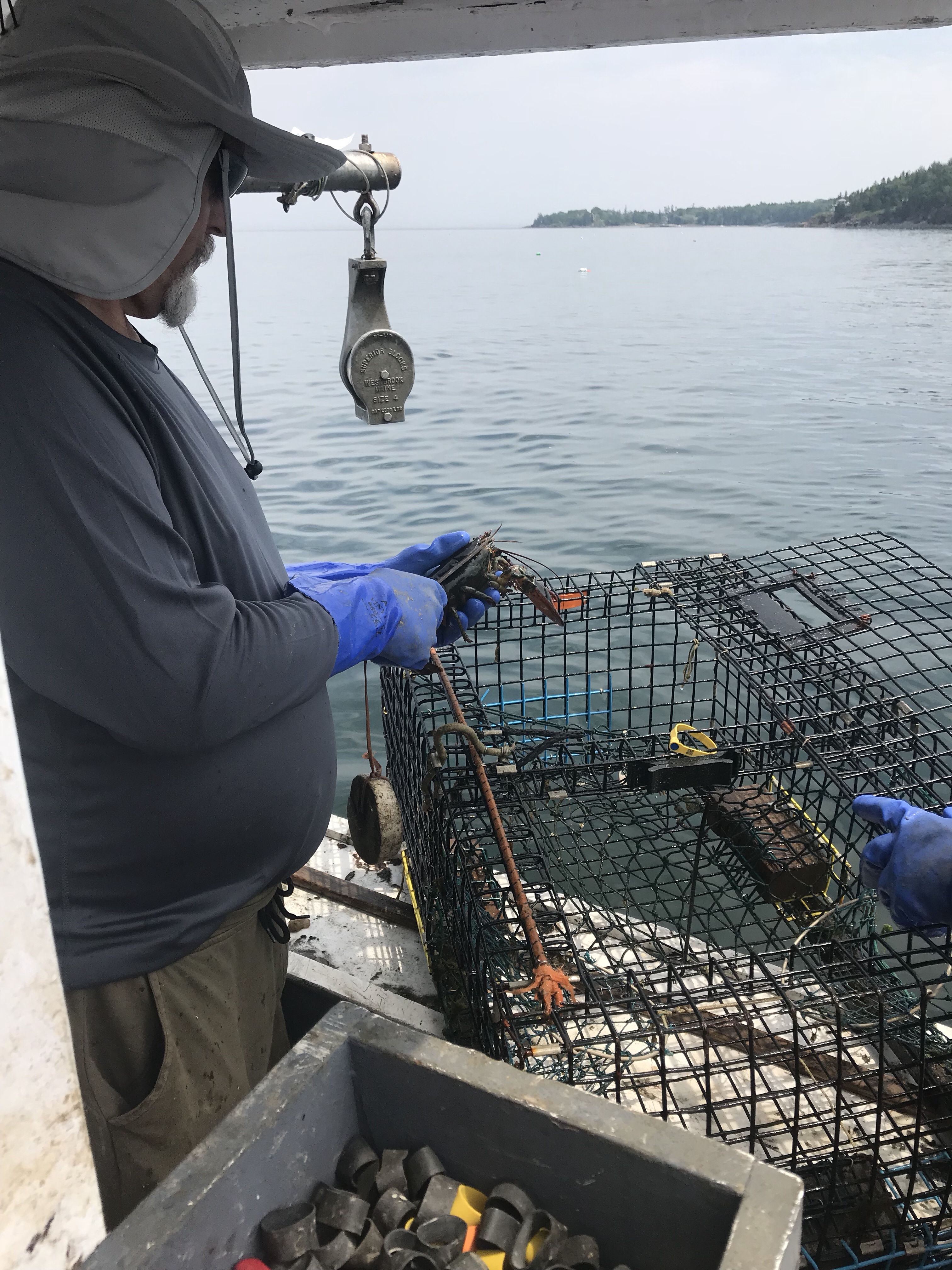 Once a buoy is located, the trap is pulled up using a motorized pulley system. Click play and see my video I made of this process below this paragraph. If lobsters are in the trap they must be measured using a special tool. Lobsters must be 3 1/4″ from the head to the base of the body (where the tail starts). Lobsters that are big enough are thrown in the holding cooler and ones that are too small are thrown back. The lobster trap is then re-baited and sent back down to the bottom. In our case we were using Herring that our lobsterman gets from his wholesaler who buys his lobsters. These are fish that have died or do not meet the grade to make to retail. Nothing is wasted out there.
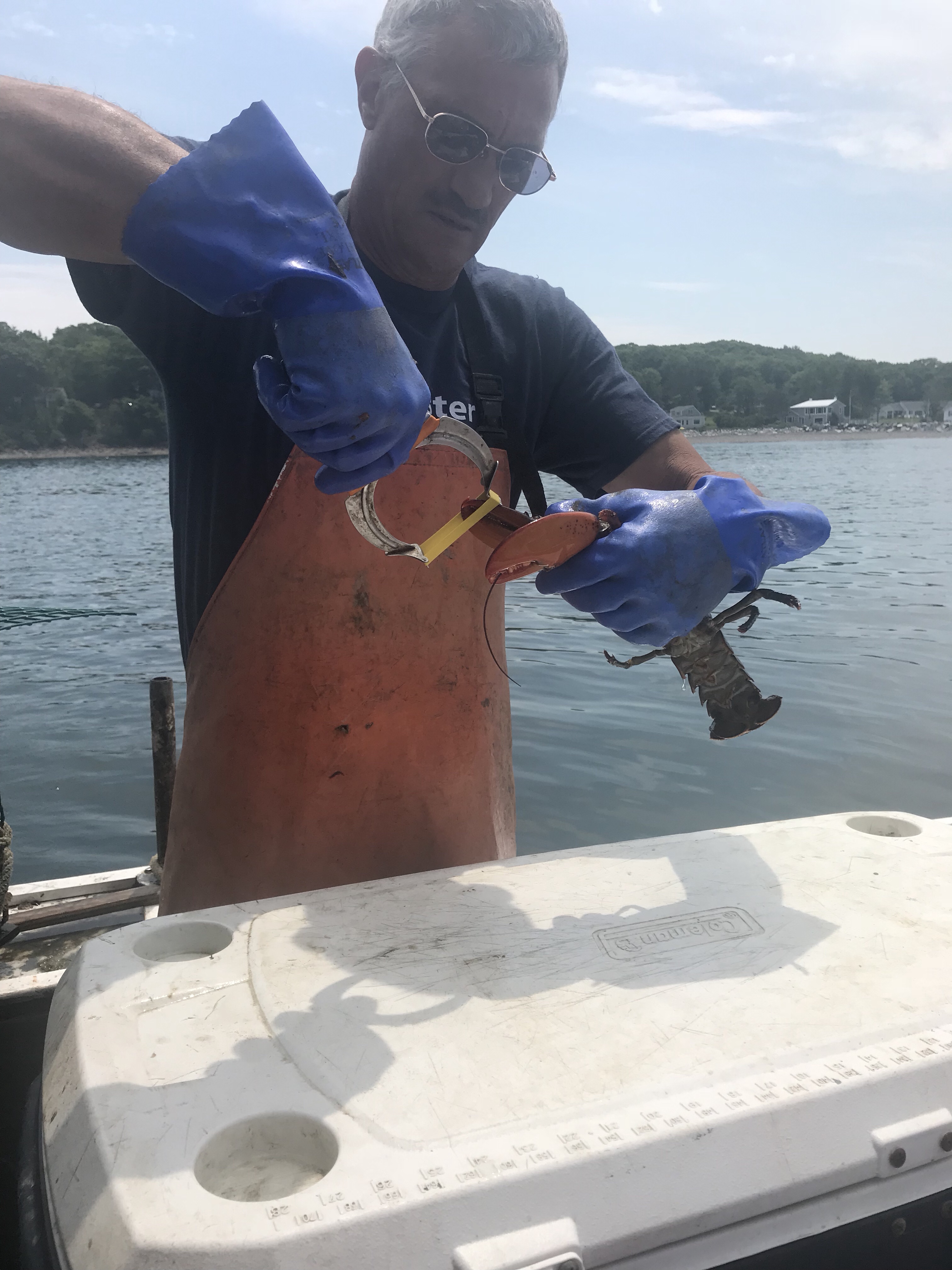 The keeper lobsters, which are usually anywhere from 1 to 1 1/2 pounds with some weighing up to 2 pounds, then have their claws bands so they do not harm the other lobsters, or us. To see the banding process, click play on the video I made of being taught how to band the claws below:
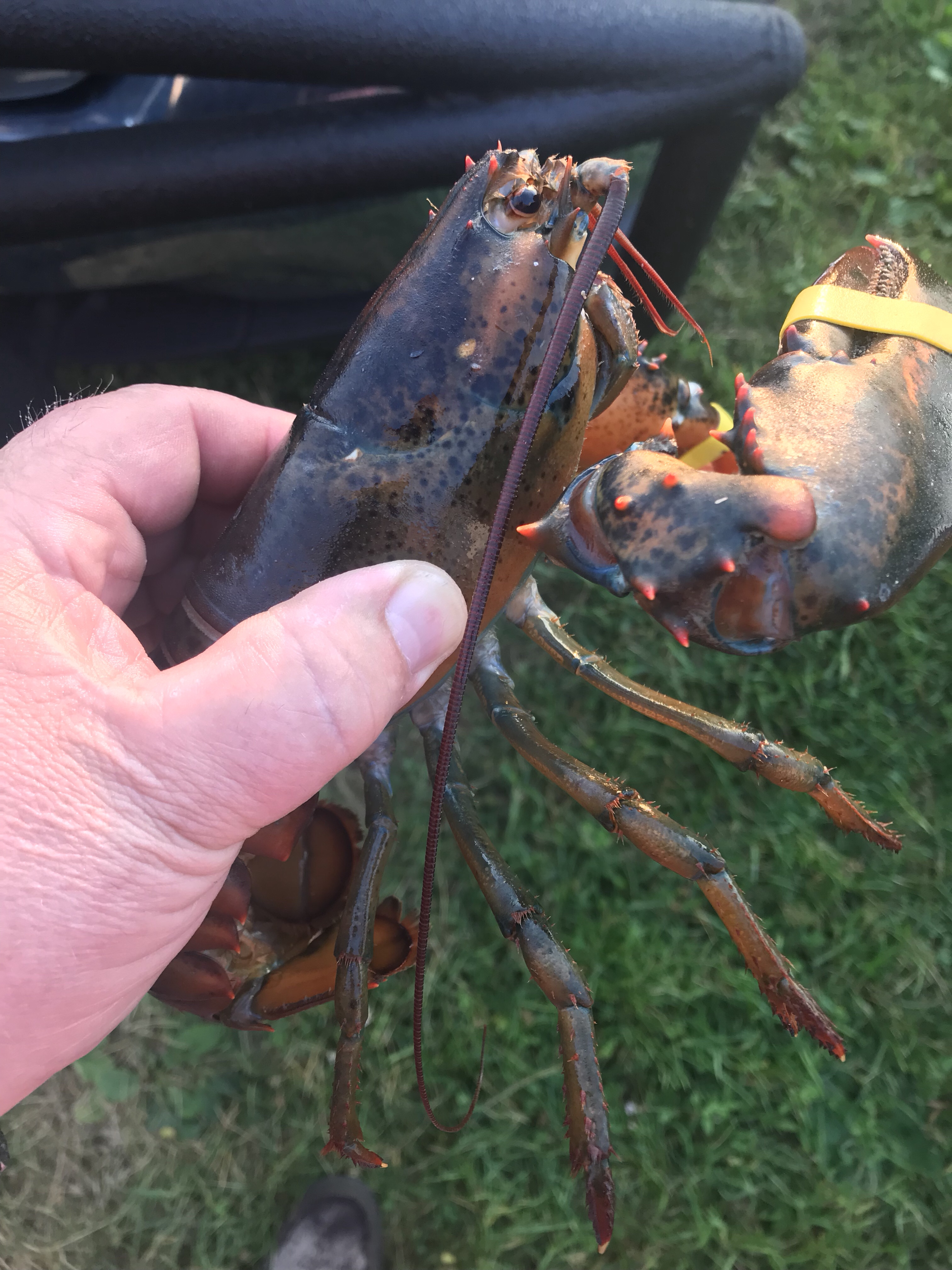 It was so awesome to be out on the water learning this business. At the time we were there the lobsters were going through ecdysis (molting). To learn about this read my post Leading Like A Lobster. We learned that those lobsters beginning the process of losing their shell to go through another growth spurt have soft shells. To see if they are hard or soft shelled you hold the lobster between your thumb and forefinger like I am doing in the picture. The hard shelled lobsters are hard as a rock. The soft shelled lobsters are soft and pliable. These soft shelled lobsters are desirable to many because the meat is much sweeter. In fact at the retail lobster places they will ask if you want soft or hard shelled lobsters. Note that the lobsters we brought home were all soft shelled. And…they were outstanding!
The lobsterman then brought his catch back to the dock after checking the traps. Our lobster tries to check about 1/3 to 1/2 of his traps every day. Many check all traps every day. The lobsters can then be sold directly to customers that come to the docks to by directly from the lobster boats (our lobsterman comes in at specific times each day, so regular customers can come and check his catch) or to wholesalers who then sell to restaurants, stores, or retail lobster outlets. Many of the wholesalers have retail outlets up and down the coast as well. The tricky part is that lobsters need to be kept alive till they are prepared. This is why lobster is expensive to buy in a restaurant or retail outlet. There is a considerable margin between buying live lobsters direct off the boat and from a retail outlet. For example, live lobsters off the boat were going for $6.00 per pound and lobster meat in the retail outlets was going for $39.99 per pound. Live lobsters at the Maine retail outlet are $15.00-25.00 per lobster. Most of the retail outlets here in Maine have live lobsters and lobster meat that has been already taken from the shell (pulled) available.
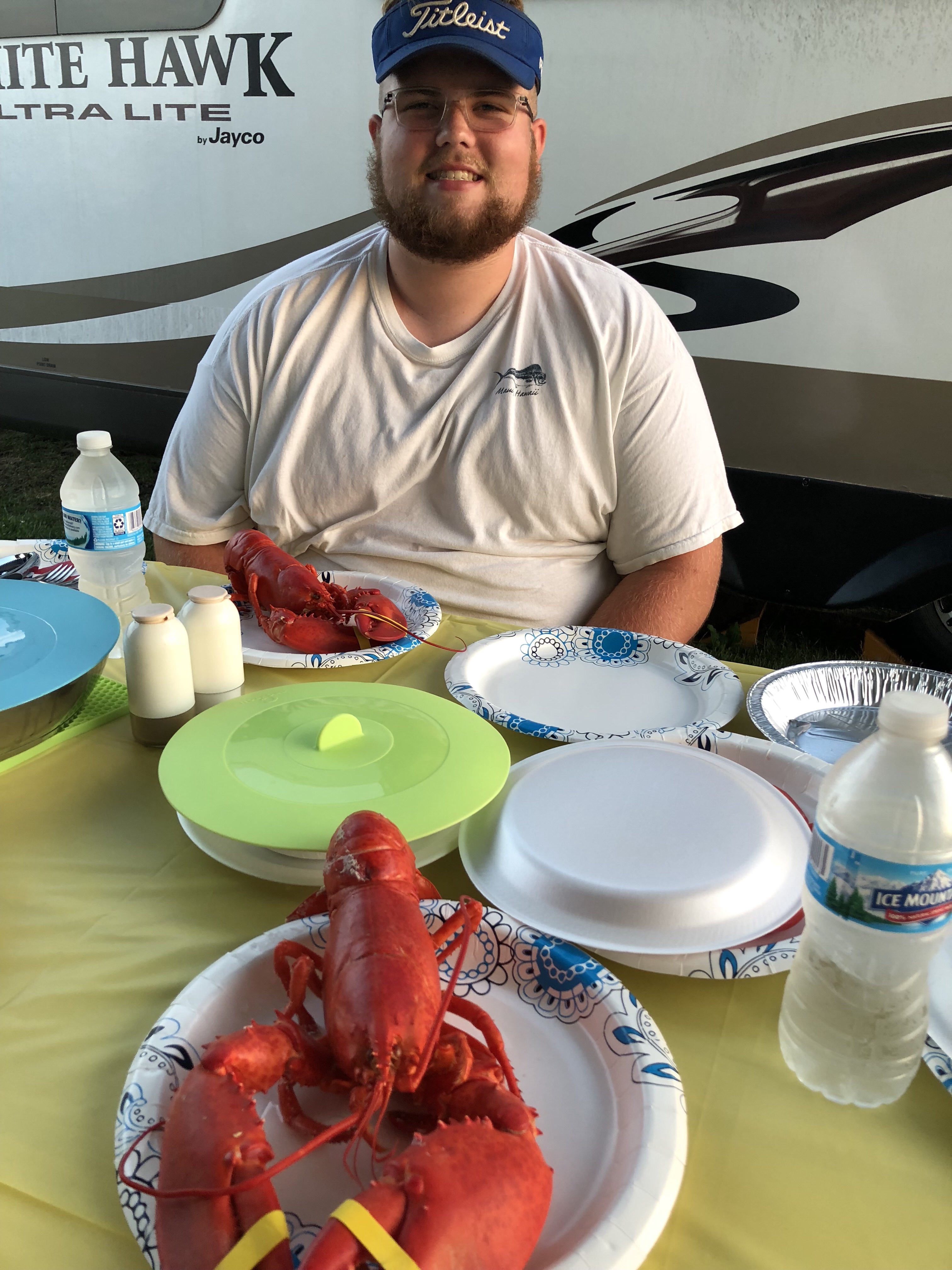 We were able to select three lobsters out of the holding cooler to bring home for our dinner. Hope steamed them perfectly, and boy were they awesome. We literally had the ocean to table experience – first hand!
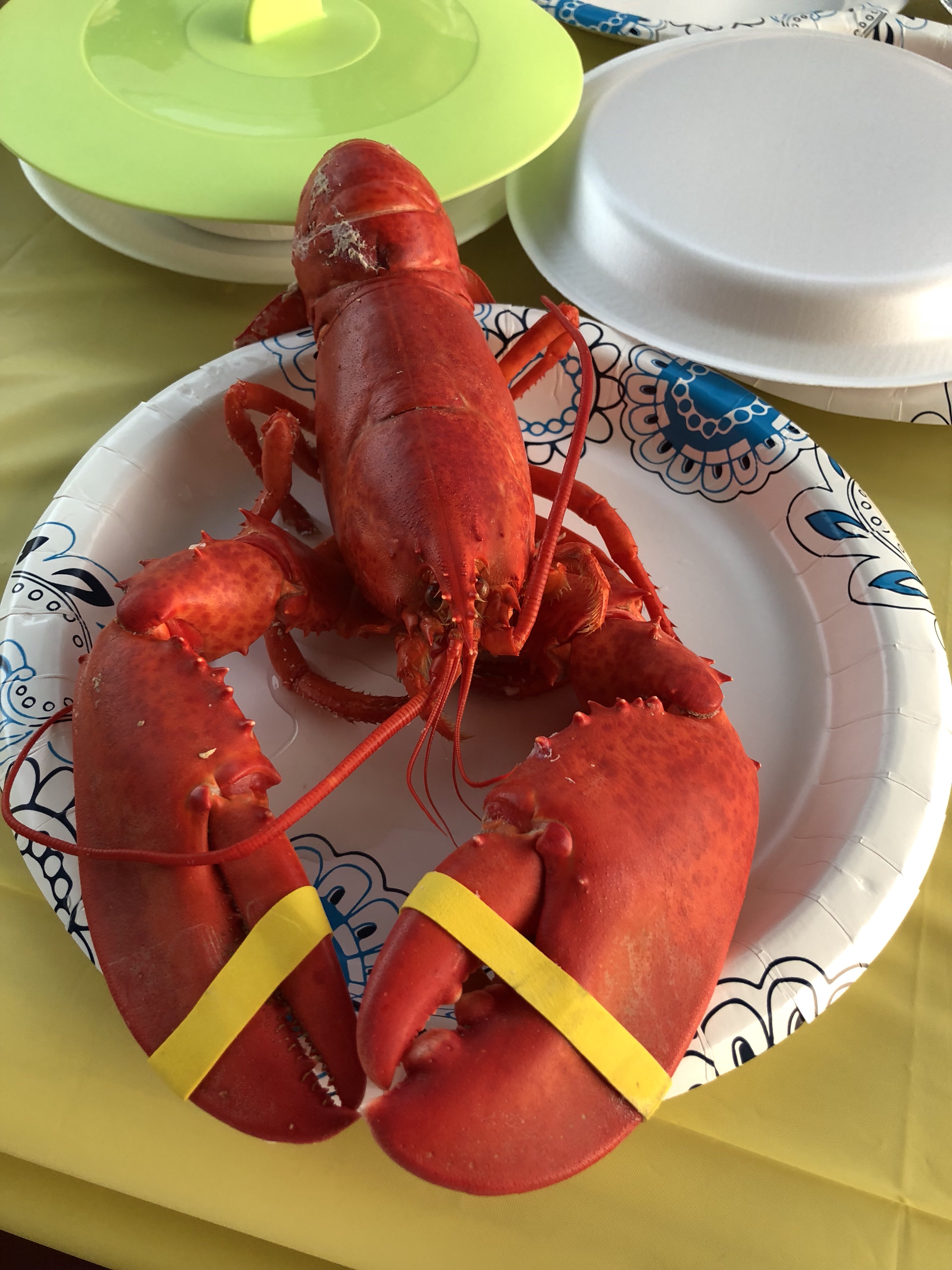 As you can see, lobstering is quite the industry. We were so grateful to have had the opportunity to spend the day serving as apprentices to the business. We learned so much more by actually being immersed (no pun intended) in the business. It is so important that we find ways for our students to have these kinds of experiences. Whether through true apprenticeship programs, or through internships, or through one day field trip type experiences like we had. Experiential and hands-on learning is so much more meaningful than any other way we can learn.
 Byron's Babbles
1 comment