The Power of Relationships: Lessons on Building Meaningful Connections

Last Friday I had a teacher leader who has been through one of my leadership development programs with me, share that she is now in a masters program and she realized while doing some reflecting during a course that she had never had a very effective coach, mentor, or facilitator of educational leadership or instructional effectiveness until me. Now, I must admit I blushed a little, tried to play it off, but was also very proud. Of course, all of you that know me know I could not resist asking a question. My question was simple: “Why do you think that is so?” Her answer was also very simple: “Our relationship!” She went on to say, “You take the time to really build relationships with everyone you work with. You know me and you know what I need.” Wow! That really made me proud because I do believe relationships are the key to everything.
In an ever-changing world, where change is constant and competition fierce, one timeless skill stands out as a cornerstone of being significant: relationship building. I want to use this post to emphasize the profound impact that genuine relationships have on personal growth, professional success, and community development.
Why Are Relationships So Important?
At their core, relationships are the foundation of trust, collaboration, and mutual respect. I teach that strong bonds created through authentic connection lead to greater influence, improved teamwork, and a more fulfilling life. Whether in leadership, teaching, business, or personal spheres, the ability to cultivate meaningful relationships is essential.
Key Principles from my Leadership Philosophy
- Authenticity and Integrity: This underscores the importance of being genuine. Authenticity fosters trust and encourages others to open up, creating a positive environment for growth and collaboration.
- Active Listening: This highlights that effective leaders and relationship-builders listen more than they speak. Truly understanding others’ perspectives enables stronger connections and better problem-solving.
- Empathy and Compassion: Empathy allows leaders to connect on a deeper level. I teach that demonstrating sincere concern for others’ well-being enhances loyalty and inspires collective efforts toward common goals.
- Consistency and Follow-through: Building trust requires consistent actions. I want to stress here that reliability and accountability reinforce relationships over time.
- Value Others: Recognizing and appreciating the strengths and contributions of others cultivate a sense of belonging and motivation.
The Impact of Strong Relationships
Investing in relationships yields dividends far beyond immediate gains. Strong connections can:
- Foster innovation through diverse perspectives
- Accelerate personal and professional development
- Enhance organizational culture and morale
- Enable communities to thrive collectively
In a world driven by rapid change and digital interactions, the human element remains vital. I hope my insights here will remind us that leadership and success are ultimately rooted in our ability to build and nurture meaningful relationships. By practicing authenticity, active listening, empathy, consistency, and appreciation, we can create bonds that uplift us all.
By valuing authentic relationships and leading with integrity, we not only elevate our own success but also cultivate vibrant, supportive communities where everyone can thrive. Let’s strive to lead with authenticity and a heartfelt respect for those we serve and work alongside.
Authenticity Matters

Authenticity is such an important leadership attribute that so often gets overlooked. Building trust requires honesty and sincerity—leaders who are authentic foster stronger connections and loyalty. The great band Set It Off has an awesome song about authenticity, “Rotten.” Here is what vocalist and songwriter for Set It Off, Cody Carson, had to say about the song:
“Our new song ’Rotten’ is about the lack of authenticity I see so often out in the world,” explains vocalist Cody Carson in a Livewire interview. “It’s about people manipulating others just because they want something from them. Then the exploiters get what they want via the synthetic sugar they’re pumping out, but eventually… it’s going to rot out their teeth and those people will see the truth.”
I love the lines in the song, “But your sugar is sweet ’til it rots all their teeth; So save the charade, and your candy-coated blade underneath.” I interpret this as a metaphor for the deceptive nature of appearances or superficial charm. Leaders should focus on genuine qualities rather than superficial sweetness, as false appearances can ultimately cause harm or erode trust. What seems appealing on the surface might have hidden consequences. Leaders need to look beyond surface-level charm to understand true intentions and impact. Offering false praise or superficial kindness might attract short-term favor, but it can damage relationships and credibility in the long run.
This song serves as a powerful reminder that superficial allure can be deceptive, and lasting leadership is rooted in authenticity and integrity.
Breaking the Cliché: Strategies for Authentic Leadership Communication

Yesterday afternoon the television came on to a Season 10, Episode 5 of Chicago PD. This was the season that Jefferson White joined the cast as Chief O’Neal’s son, Sean O’Neal. In this episode Detective Hailey Upton (Tracy Spiridakos) was having a discussion with Sean O’Neal who was at time helping them with a human trafficking case (he ended up being the human trafficker). Hailey said to Sean, “You talk in a lot of cliché’s.” Sean replied, “That’s because they’re usually true.” I’ve never been big on clichés and most of the time the people using them, overuse them, and don’t really live by them – definitely the point be made by Hailey’s comment in the show.
If using clichés at all, there needs to be a balance struck when it comes to using them. Here are a few strategies to be employed:
- Know Your Audience: Understanding the preferences and backgrounds of team members can help determine when a cliché might resonate positively or feel inauthentic or overused.
- Use Clichés Sparingly: Instead of relying on them frequently, a great communicator might use clichés in crucial moments for emphasis or connection, while otherwise opting for more original language.
- Mix with Originality: Pairing a cliché with fresh insights or personal anecdotes can give it new life and relevance, demonstrating that the person values creativity and authenticity.
- Encourage Open Dialogue: By fostering an environment where team members feel comfortable expressing their thoughts, leaders can gauge what phrases feel stale and what language inspires innovation. I’ve experienced original cliché’s that came about organically that became very meaningful and impactful.
- Adapt to Context: Recognizing the situation at hand—a motivational speech, a team meeting, or casual conversation—can help leaders decide when it’s appropriate to use familiar sayings or when to innovate. When in doubt, innovate.
- Model Authentic Communication: By prioritizing genuine expressions over clichés in their own communication, leaders can set an example for their teams, encouraging a culture of originality and thoughtfulness.
By being mindful of these aspects, and limiting the use of clichés, we can enhance our communication by be more authentic.
The Winning Combination: Real, Authentic, Fun, & Loving What We Do

Last night, one of the commentators before the Los Angeles Chargers – Cincinnati Bengals game (Chargers won 34-27) made the comment referring to Charger’s Head Coach Jim Harbaugh that, “He’s real, he’s authentic.” He went on to say, “What you see is what you get.” Finally, one of his players in an interview said, “I’ve never seen anyone who loves football as much as Coach Harbaugh does.” His point was they were always having fun because Coach Harbaugh was having fun. All this was clearly a pretty good combination for great leadership.
The phrases “He’s real, he’s authentic” and “What you see is what you get” highlight several key traits that are often associated with effective leadership:
- Authenticity: Leaders who are genuine and transparent foster trust among their team members. When leaders are true to themselves, they create an environment where others feel safe to be themselves, leading to better collaboration and morale.
- Consistency: Being authentic means that a leader’s actions align with their words. This consistency helps establish credibility, as team members can rely on them to act in accordance with their stated values and principles.
- Connection: Authentic leaders are relatable and accessible, making it easier for followers to connect with them on a personal level. This connection can inspire loyalty and motivate teams to work towards shared goals.
- Openness to Feedback: Authentic leaders are approachable and encourage open communication. This openness allows for constructive feedback, which can lead to personal and organizational growth.
- Inspiration: A leader who embodies authenticity can inspire others by demonstrating confidence and integrity. Their realness can motivate team members to strive for their best and align their personal values with the organization’s mission.
Bottom line: Jim Harbaugh’s authenticity and straightforwardness contribute significantly to his leadership effectiveness by building trust, fostering connection, and inspiring his team to achieve their goals. Harbaugh’s enthusiasm for the game creates a positive atmosphere that keeps players engaged and motivated. When a leader is genuinely passionate, it can be contagious, inspiring athletes to give their best effort.
A leader, just as a coach who enjoys the game, fosters a sense of camaraderie among players and those they serve. When others see their coach or leader having fun, it encourages team bonding and helps build strong relationships, which can enhance teamwork on and off the field or in the organization.
We can learn from Coach Harbaugh that by creating an environment where fun is a priority, a culture that values hard work while also encouraging players to enjoy the process is cultivated. This balance, along with being authentic, can lead to higher performance levels and reduced pressure.
Nautical Bluffers

Samuel Eliot Morison wrote about “nautical bluffers” in Admiral of the Ocean Sea: A Life of Christopher Columbus. He was speaking of sailors who showed a false air of confidence, particularly in high risk situations. These individuals would fake their knowledge of sailing or cover up their fear. These nautical bluffers, who still exist today, can teach leaders the importance of honesty and authenticity. Bluffing, in reality, has the opposite affect of being vulnerable. We need to be honest about our own fears and limitations and seek help when needed. Being authentic and vulnerable will more likely to earn us the trust and respect of those we serve.

Additionally, leaders can learn from the mistakes of nautical bluffers by recognizing the importance of continuous learning and skill development in order to maintain their credibility and expertise. This modeling of lifelong learning and personal growth can also be empowering to all those around you. Do you remember a time when a leader’s willingness to admit their lack of knowledge led to a positive outcome?
No Fork Is Without Twists

In my post Trails Always Offer Choices, I predicted we would probably be brought back to the quote that was the title of that post somewhere in the last half of the book and we were a couple of times and then again at the very end of the book. The quote first came about half way through Book 4 of Threads West An American Saga: Moccasin Track by Reid Lance Rosenthal. This series is absolutely incredible. I have now finished the first four books and gave them all five stars. I cannot wait for books 5, 6, and 7 to come out. The books are based upon the threads of the lives of characters from very different places, cultures, beliefs, and backgrounds that become weaved together. Interestingly, my becoming inspired by these books happened by chance, or fate, when I met Reid at Cowboy Christmas while I was in Las Vegas doing work for a client. We had a great visit, I ended up with signed copies of the first four books and the rest is history. The weaving of threads being brought together had begun.

Now, back to trails always offering choices. When losing one possible trail to an avalanche, Reuben told Johannes, “There may be no choice in trails but trails always offer choices.” After they parted Johannes said to himself, “Trails always offer choices. What did he mean by that?” Then the last sentences of the book: “There may be no choice trails,” his [Reuben] friend [Johannes] had warned, “but trails always offer choices.” Reuben then says to himself, “Ah, Viking, you forgot to mention choice is sometimes out of one’s hands. No trail is smooth, and no fork is without twists.” These books have reminded me how heavy our choices weigh on us. I am also reminded that sometimes choices really are sometimes out of our hands. Sometimes choices are life-changing. Each path we take, just like the characters in this saga, will send us on a completely different trajectory.

One thing that I have contemplated while reading the first four books in the series is the thought that many of the choices made by the characters were what was best for them, not what might be considered to be the “right” choice. Many times we don’t allow ourselves to make decisions based on “what’s best for me.” I wonder if we shouldn’t try to put ourselves in the frame of mind more often. Wouldn’t this allow us to be our authentic selves and follow our dreams?
Top Leaders Are Single Faced Not Two Faced

Yesterday I blogged about the great movie Top Gun: Maverick. In “How Do I Teach That?” I discussed the great line from Maverick (Tom Cruise): “It’s not what I am, it’s who I am. How do I teach that?” Today, I want to post about the other great line that jumped out at me. Twice during the movie two different people said to Maverick, “Don’t give me that look.” Maverick’s response is so telling. His response showed his genuineness and was very endearing, when he simply said, “It’s the only one I got.” How about that for authenticity? Pun intended here; top leaders are single-faced, not two-faced.
Two-faced leaders are actually selfish. Unfortunately we all have probably experienced the two-faced leader who projects “My desire to take all glory and not be inconvenienced is infinitely more important than your personal and professional development.” Sometimes I’m not sure that’s how they truly feel, but that’s the message being screamed from the two-faced leader to everyone.
Maverick did not forget everyone is human. In the case of flying a fighter jet their must be excellence and perfection. Yet, we all know humans make mistakes. Therefore Maverick developed pilots to, in his words, “Don’t think. Do.” Now, that mantra got Maverick in trouble at times, but he was his authentic self. He also wanted pilots he would ultimately be flying with to be able to respond with spit second accuracy without thinking.
The other thing that showed Maverick’s authenticity was his genuine concern for people. The higher ranking officers would have considered the mission a success even if the pilots had not returned. This was unacceptable to Maverick. No one was dispensable. No one! We must maintain a painfully imperfect and human working environment that embraces excellence. This allows people to do their best because they can be themselves. Remember, like Maverick, we only have one face.
1000 Blog Posts Later

I had a great friend and mentor early in my now nearly six decades who would say, “Now I’m just talking out loud here.” I always knew it was coming, but I always thought or said, “That’s the only way you can talk, or your not talking.” Of course, he was being funny and really saying that he was thinking out loud, but I think of him and that phrase often. As I write this 1000th post to my blog I contemplate the reality that blogging is really writing out loud. Blogging feels like what I would imagine extreme sports to be: more free-form, more accident-prone, less formal, and more alive.
When I first started blogging I was much more formal and tried to think of things to blog that someone might want to read. That really wasn’t very satisfying. Now my posts are based on some inspiration or something that has caused me to dig in deeper on some subject. I am approaching this more like a songwriter approaches songs. I now let the inspiration happen organically – it might be something said in a television show, lines in a novel, book topics, something someone says during a meeting or one of my workshops, or something as mundane as a spider web in the barn. It has become so much fun!
Extreme sports have several associated uncontrollable and dynamic variables, because extreme sports take place where the natural phenomena are and generally vary, like wind, snow, and mountains. These natural phenomena affect the outcome or the result of the activity or the extreme sporting event for that matter. Sound familiar? Life!
I end up writing about myself, because I am a relatively fixed point in the constant interaction with the ideas and facts of the exterior world. And in that sense, the historic form closest to blogs is the diary. But, a diary is usually kept private. Its raw honesty, its dedication to marking life as it happens and remembering life as it was, makes it a terrestrial log. Sometimes there are diaries that are meant to be read by others, of course, just as correspondence could be. I’m thinking here of the captain’s log on Star Trek, a trucker’s log book, or a flight log. But, usually diaries are read posthumously, or as a way to compile facts for a more considered autobiographical rendering. But a blog, unlike a diary, is instantly public. It transforms this most personal and retrospective of forms into a painfully public and immediate one. It combines the confessional genre with the log form and exposes the author to anyone and everyone in the touch of a “Publish Now” icon.
I just see myself as a curious individual, who likes to share what he has learned. I want to share the life lessons I’ve learned so far and learn every day. And, I want to share what I’m currently working on, what I’m currently thinking; mostly imperfect things in-progress. Blogging has enabled me to Share my thoughts and lessons learned.

I blog usually three to four times per week and I believe blogging is helpful and beneficial to share my thoughts, and lessons learned online because someone might find the lessons learned useful. These “someone’s” are many times those I lead or have the opportunity to help and serve. Therefore, it provides a constant window into the things I am doing, what I’m thinking about, things I’m curious about, new and evolving thinking, and who I am. Even if it doesn’t do that for everyone, it still serves as my journal. I go back and pull things from the archives many times per week. It is an electronic filing cabinet of my brain that is very well organized. This in a brain, I might add, that is not always well organized.
Finally, blogging is very personal for me. When I pull up a blank page to start a new post it’s like beginning a new adventure in learning. As I close, I must give credit where credit is due. Back in 2010 my good friend and great leadership guru, Kevin Eikenberry, The Kevin Eikenberry Group, suggested I needed to start blogging. Of course, I resisted. But, Jenny Pratt who was on Kevin’s team at the time and is now Director of Major and Planned Gifts for The Muny, took it upon herself to build my blog site even to the point of naming it Byron’s Babbles. Who does that? Jenny! She told me, “now you can change the name and the way I have formatted it for you later.” 1000 posts and 12 years later I have changed nothing. Byron’s Babbles is still the appropriate name today – it’s authentic and what my blog is: my organized babbles. I hope you have enjoyed my 1000th babble.
Good Leadership Is Pragmatic

Last week I was doing leadership development facilitation for our participants from North Carolina, South Carolina, Georgia, and Tennessee. This session involved developing a top 5 list of Bad Leader traits and a top 5 list of Good Leader traits. While we were voting and tallying to get to their top 5s, I thought about how the traits are really pragmatic. Take a look at their voting tallies and their top 5s:
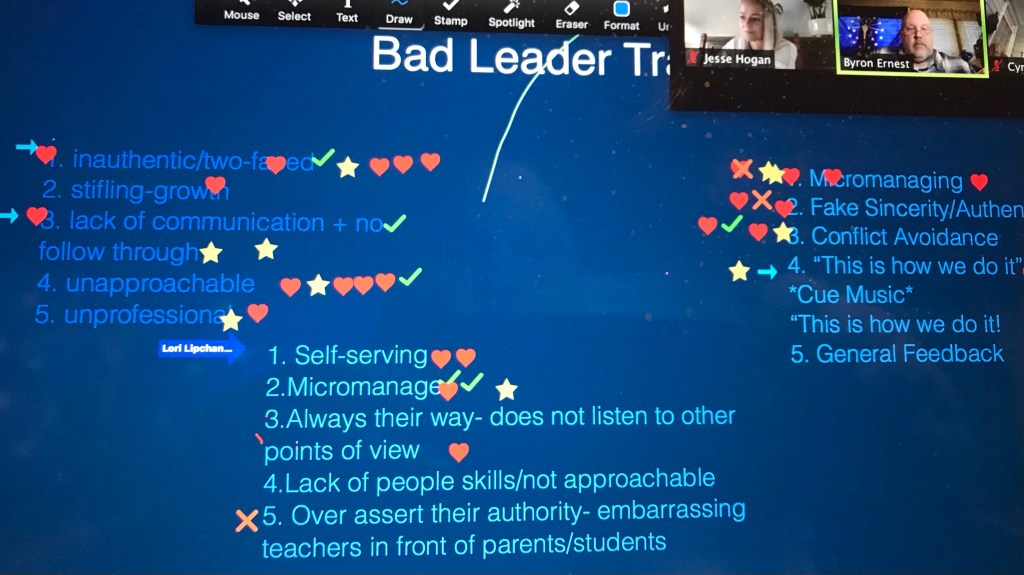


The opposite of idealistic is pragmatic, a word that describes a philosophy of “doing what works best.” From Greek pragma “deed,” the word has historically described philosophers and politicians who were concerned more with real-world application of ideas than with abstract notions. Did you catch that? Doing what works best. Being concerned with real-world application. Look at the Good Leader traits above and I think you’ll agree they involve doing what works best.
What Lies Beyond Your Imperfections?

Funny how things work out. I’m reading the great book Flawsome: The Journey To Being Whole Is Learning To Be Holey by Georgia Murch right now. Her book teaches us that being the best you you can be requires us to accept our flaws. As she said, “Your unique flaws draw people to you.” I love that and have been enlightened over the years to understand that people want me for who I am, not someone else. It is about being authentic.


So what’s funny? I’m also reading Mindset Mondays With DTK by David Taylor-Klaus (DTK). DTK’s book is is set up in 52 chapters set up to be read on, you guessed it, Mondays. This week I’m on Chapter 20 entitled Beyond Imperfections. So, some of the same stuff I was learning from Murch. DTK told us that trying to present ourselves as perfect is inauthentic. I have known organizations that have also got caught up in believing they are perfect. DTK wrote, “The fantasy that we’ll become perfect leaders, perfect partners, or perfect people is just that – a fantasy.” Remember, no organization or person is perfect. My imperfections make me, well, me.
So by recognizing our flaws and imperfections we can also find and develop our perfections. This is why I am such a believer in finding our strengths. Let’s recognize our weaknesses and grow our strengths. You be you!
 Byron's Babbles
leave a comment