Triageformational Leadership: New Hybrid Definition of Triage and Transformational Leadership
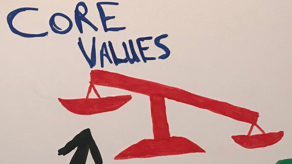 You all know how I like to make words up, so here is my latest: Triageformational Leadership. Actually, I made up the word and the definition over a year ago while in a meeting, but am just now blogging about. Does that give you any indication of how long my “want to blog ideas” list is? Anyway, here is the definition: The process of leading by core values to determine and prioritize needed changes so limited resources can be rationed efficiently and effectively to support the organization’s realization of vision and mission.
The important thing to note about triageformational leadership is that that the transformation is done by triaging by using core values. So many times this is given lip service, but not really done. By putting our core values at the forefront of our triageformational leadership we:
- determine our school or organization’s distinctives.
- dictate personal involvement.
- communicate what is important.
- embrace positive change.
- influence behavior.
- inspire people to action.
- enhance credible leadership.
- shape teaching/employee character.
- contribute to educational/organization success.
…it is clearly necessary to invent organizational structures appropriate to the multicultural age. But such efforts are doomed to failure if they do not grow out of something deeper; out of generally held values. ~ Vaclav Havel
So much goes into truly embodying what it means to be a triageformational leader beginning with the sense of community we develop within an organization. Those that I believe that would make great triageformational leaders place a high value on fostering an environment or community of collaboration. This community is balanced, diverse, and equitable. These leaders build community and culture by truly living out their own core values and the organization’s core values. Just like doing triage in an emergency situation, these leaders are prioritizing what gets done next by matching core values to the situation. This in turn brings about transformation and service oriented leadership.
Buy In From All Vantage Points
 This week I had the opportunity to present a leadership academy workshop session entitled “Buy In From All Vantage Points.” The gist of the session was how to get an entire school staff to “buy in” to a continuous education model and other important school initiative. When I was first given the title I balked a little, but then decided to leave it so I could refer to not liking the title. I don’t like the title because “buy in” to me implies that there needs to be a “sales job” done after decisions are made. In my view, decisions should be made by including a wide range of individuals so the initiative, challenge, or opportunity can be looked at from all Vantage Points©. I refer to and use this model often when discussing leading change, which is what I would have titled the session. Here is the Vantage Point© model developed by MG Taylor Corporation:
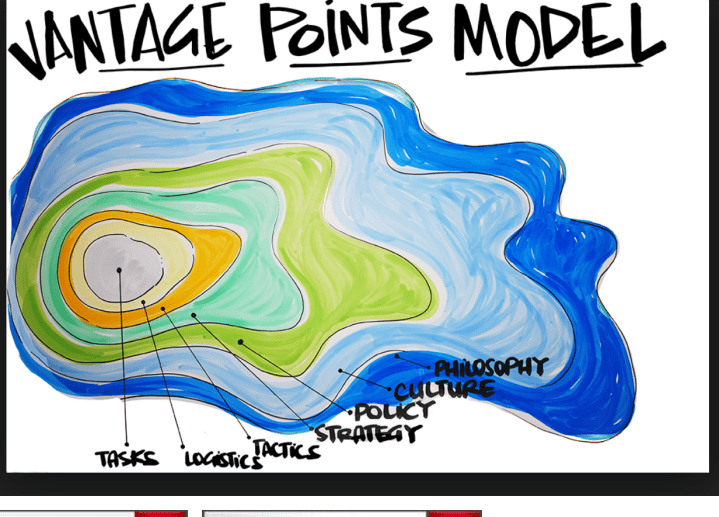
When I want people to understand how powerful using The Vantage Points© is to leading change, I like to compare it to board games. If you think about it board games have a philosophy, culture, policy, strategy, tactics, logistics, and tasks. So, I had the groups pick a board game to use as an example. The group picked Candy Land™. Then they had to discuss board game from the seven Vantage Points©.
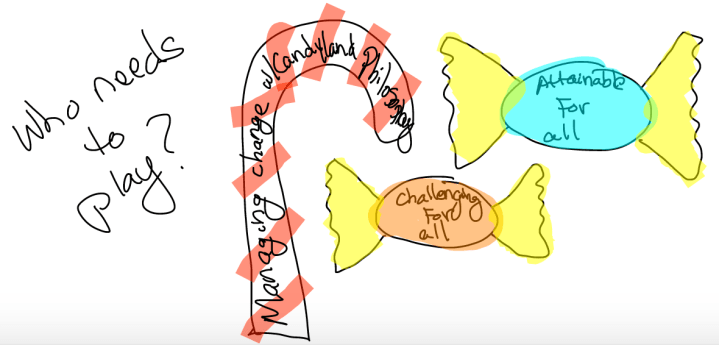
One of the groups of the two sessions I did on this did some research on the Candy Land™ board game and we learned some history. We were reminded that in the 1940s the dreaded disease of Polio struck thousands of Americans. In response to this, Eleanor Abbott, who was a victim of the disease herself, set out to develop games that would help recovering children pass the time. Milton Bradley, which is now Hasbro® began marketing the game in 1949 and is still being marketed today. Additionally, it is now available in electronic forms.
As the group made the comparison to leading change, they found that the philosophy was to be attainable and challenging to all – what we want in all education initiatives. Just like a board game, we need to give everyone a chance to play and have the opportunity to be a part of the decision making. It’s important to acknowledge that you will never convince everyone to get on board. An unfortunate truth is often that a better future for your school or organization doesn’t always mean a better situation for every individual in the end. It should, however, mean a better situation for the students we serve.
We need to always remember, when leading change, that change is always personal. Think about it; any time there is a change we all question how the change will affect us personally. As leaders, we need to be cognizant of this, and address this. By involving individuals from all vantage points we are able to help everyone, including ourselves, understand how the change will affect everyone. Leading change and new initiatives is a process, we need to use all our tools and techniques to manage the people side of change to achieve the required school or organization outcome. Effectively leading change incorporates the organizational tools that can be utilized to help individuals make successful personal transitions resulting in the adoption and realization of change.
United States Merchant Marine: The Link To American Victory
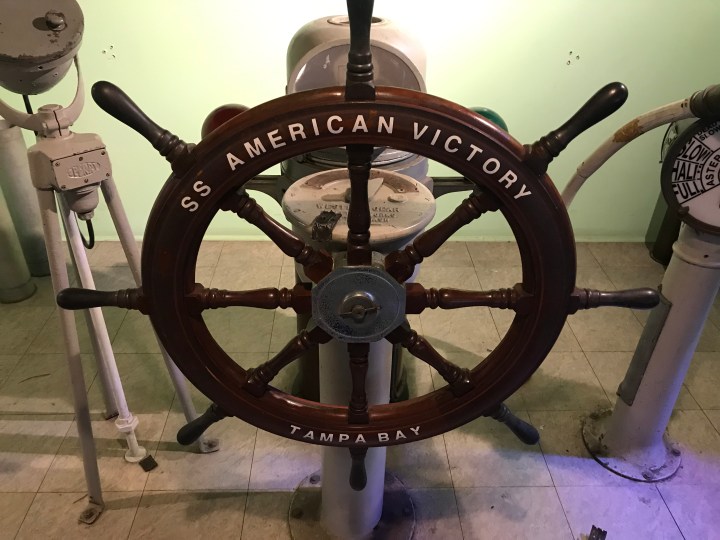 Each year I try to do a Memorial Day post honoring those who paid the ultimate price for the freedoms I love, and do not take for granted. This past week I had the opportunity to visit and tour the nine decks of the SS American Victory Ship in Tampa, Florida. I already blogged some about my visit in Where Is Your Leadership Engine Order Telegraph Set? While on the ship, which one deck serves as the museum, I stood in the wheel house, walked the deck, saw the radio and gyro rooms, sat in the mess hall, looked in crew cabins, experienced the captain’s quarters, walked the engine room deck, and so much more.
 Even as eye opening as all this first hand experience was, I really learned a lot from the attendant who took time to have a long conversation with me about the United States Merchant Marine. I have to admit I was very ignorant about this important part of our military support. The Merchant Marine is also crucial to our economy as well.
Merchant Mariners are not part of the military but do support our armed services, particularly the U.S. Navy, with cargo, fuel, personnel, and other cargo. The Merchant Marine fleet is small and includes privately owned and government owned. The SS American Victory was and still owned by the U.S. Navy. The SS American Victory saw service at the end of World War II, the Korean Conflict, and Vietnam.
The United States Maritime Administration, under the Department of Transportation, handles programs that administer and finance the United States Merchant Marine. This includes supporting the United States Maritime Service, which helps to train officers and crew on merchant ships.
Additionally, there is legislation being considered in the 116th Congress, HR 550 and S133, called the Merchant Mariners Of World War II Congressional Gold Medal Act Of 2019. This legislation would award a Congressional Gold Medal, collectively, to the United States Merchant Mariners of World War II, in recognition of their dedicated and vital service during World War II.
 After spending time on this ship, learning of the sacrifices, I, certainly on this Memorial Day morning, believe passing this legislation would be appropriate. President Dwight D. Eisenhower, who was Supreme Commander Of the Allied Forces during World War II, recognized what an important part the Merchant Marines played in winning the war when he said, “through the prompt delivery of supplies and equipment to our armed forces overseas, and of cargoes representing economic and military aid to friendly nations, the American Merchant Marine has effectively helped to strengthen the forces of freedom throughout the world.” Upon reflection, we would not have successful without this crucial link to equipment, fuel, ammunition, and the many other supplies needed.
According to statistics the Merchant Marine suffered the highest rate of casualties during World War II. Another thing my host shared was a story of American ingenuity. Before the Victory Class ship there was the much slower Liberty Class. The Liberty Class could only travel at approximately 8 knots. This was not fast enough to outrun the 12 knots of the German U Boats. We then redesigned and came up with the Victory Class that could run at 17 knots. This would allow for outrunning the U Boats. Even in war we were having to innovate and make improvements. It still amazes me to think that the SS American Victory was built in 55 days. We need to also take a moment and honor the civilians, many of who were women, for making sure everything was being taken care of back home, including getting our ships built quickly.
I am so grateful I had the opportunity to learn about the United States Merchant Marine and their part in securing our freedom. Today, on Memorial Day, we should all pause and give thanks for the ultimate sacrifice paid by so many for our freedom.
Where Is Your Leadership Engine Order Telegraph Set?
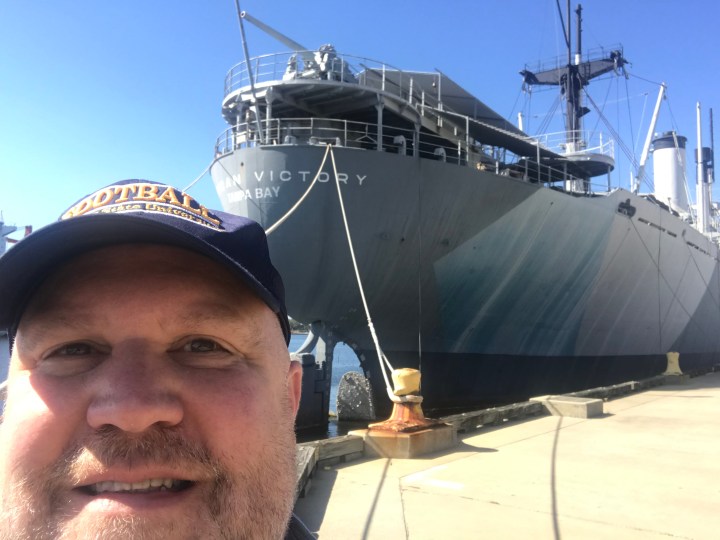
 I had the opportunity this past week to visit and tour the SS American Victory Ship and Museum in Tampa, Florida. It is an outstanding icon of America during times of war. I particularly learned a lot from the museum and the person there who answered all my questions and took the time to have a lengthy conversation with me. Before that day I really did not know much about Merchant Marine ships, how they were operated, and the relationship to the US Navy. I’m still pretty ignorant, but I am learning.
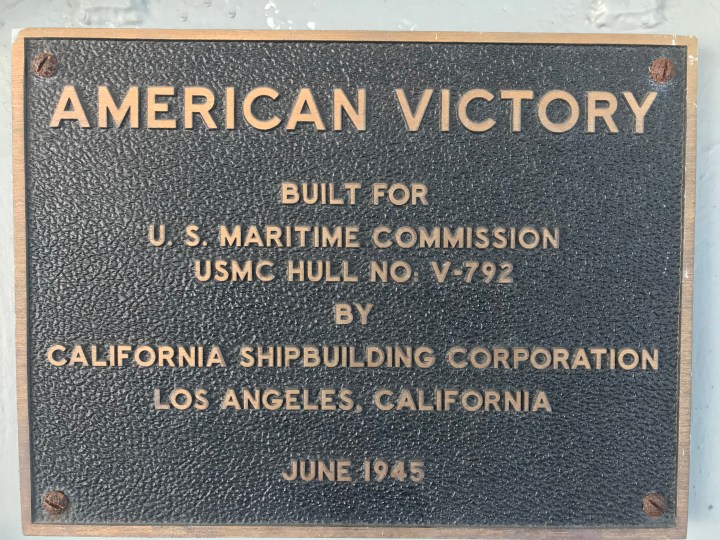 The SS American Victory was a Merchant Marine cargo ship that supplied our troops at the end of World War II, and then in the Korean Conflict and Vietnam. This ship hauled ammunition, cargo, and troops. The ship was run by the Merchant Marines, but of the crew of 62 part were US Navy personnel who manned the weapons in case of attack. This ship was launched 74 years to the day (May 24) I was there, in 1945. It only took our patriotic citizens 55 days to build the ship.
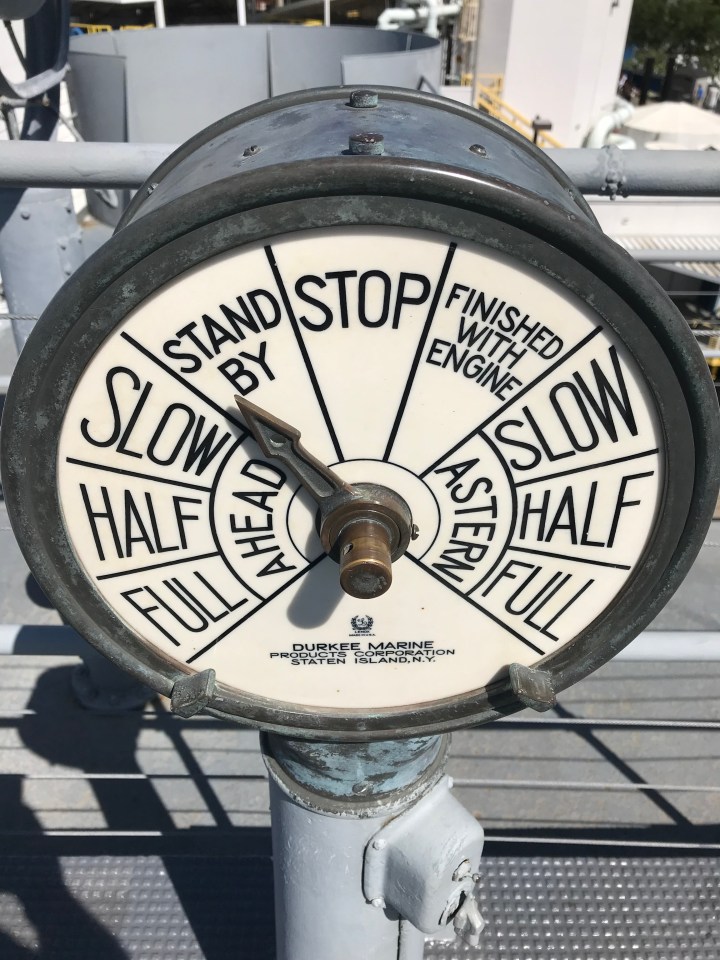
 The exhibits in the museum are awesome and I had the chance to explore the entire ship. I was especially inspired in the wheel house, or bridge, as I looked out the port hole windows and thought about the decisions leaders had to make on this very deck. Then when I went above to the outdoor wheelhouse deck I studied the Engine Order Telegraph (the featured picture of this post). I immediately realized I had found another great metaphor that I believe represents the ways many organizations, leaders, associations, and governments work. Earlier last week I blogged about metaphors in Leading By Metaphor.
 The Engine Order Telegraph, also known as an EOT, is a device that transmitted the orders from the pilot to the engine room. It has slow, half, and full for both ahead and astern (reverse). Also, it has stop, stand by, and finished with engine. As I stood there studying the EOT on a beautiful sunny day in beautiful Tampa Ybor Channel and thought about how these are incredible metaphors for leadership.
 On these older style ships the captain didn’t physically control the ship like on today’s ships. On this ship the EOT would telegraph what the captain needed and engineer in the engine room made the adjustments – slow down, open up the throttle, et cetera. I thought about how this ship would have been like an orchestra with the captain as the conductor and the deck and engine crew playing the instruments.
 As leaders we have the opportunity be a part of telegraphing full speed ahead, reversing the engines, slowing down, or stand by which I believe is analogous to status quo. I chuckled to myself that the EOT was set to stand by because I am such a status quo hater. If I was captain of a ship it would probably be hard to order stand by. I’m kind of a Rear Admiral David Glasgow Farragut kind of guy – “Damn the torpedoes, full speed ahead!” We all have to make decisions using the best intel available at the time from collaboration with our teams to enter the correct decisions into our metaphorical EOTs. We work in such a high speed environment! Therefore, we must figure out ways for professional growth of our leaders and teams on how to achieve organizational goals in the shortest time possible. We must then also find ways to provide maximum professional growth in the shortest time possible.
Therefore, we need to be ready to ring the bells for full speed ahead, just as Rear Admiral Farragut did in Mobile Bay in 1864. Had those ships not been willing to go ahead full, they probably would not be successful. I can tell you that the SS American Victory Ship and Museum team have their EOT set on full speed ahead for telling the story of the important work of Merchant Marine ships. How about you and your organization? Are you stuck in the status quo of stand by? Or will you make the call for full speed ahead?
Leading By Metaphor
 I use metaphors all the time. Sometimes I wonder if I use them too much, but this week while reading the very instructive book The Art Of Innovation by Tom Kelley I was reminded that we need to lead and innovate by metaphor. He said, “We should lead by metaphors.” Metaphors are a powerful tool. A metaphor can give us a powerful and clear image of who we want to be, what we want to learn, how we want to learn, and how we want to grow. Our metaphors serve as examples of how we want to contribute to the world.
 Metaphors also serve as reminders of what we do not want to be. I am reminded of the toy lawnmower on my desk that serves as a constant reminder of how when innovating, reforming, or leading change many let protecting their own, or their organization’s, turf get in the way. I literally say things like, “Time to get the lawnmowers out.” or we are going to need a really big lawnmower for this group.” In fact I blogged about this in The Frustrating Truth of Turf. Another metaphor I use a lot is that of going up a hill with bullets flying and turning around and everyone else is headed down the hill. Then my metaphor of just putting on the Kevlar™ and doing what is right comes into play.
If you haven’t noticed I really do talk in metaphores. So, to me you do not just need to pick one, you can pick multiple metaphors for whatever the situation. As a believer in adaptive leadership, these metaphors serve an important purpose. They, as I stated earlier, serve as powerful reminders and serve as great ways to tell a story. People you are working or collaborating with can relate to the metaphor. It makes the issue or topic relevant, and as you know, I am all about putting all learning into a relevant context. For example, when it comes to policy I use the metaphor of Patrick Henry a lot. As one of our founding fathers he stands as a lasting image of America’s struggle for liberty. He inserted himself as a leader in every protest and move against British tyranny and in the movement for colonial rights. Most of all, though, he believed in states rights, local autonomy, and very limited government.
As a believer in intent based leadership Patrick Henry serves as an important reminder that decisions should be made as close to where the data is created – local control. You can compare this to classroom teachers in a school or governments. How do we remove obstacles and let what needs to be done, done? Which then always brings a metaphor of that people use to describe my desires, “What you want would create the wild west.” Guilty as charged! But think about how much innovation and change was happening in the wild west.
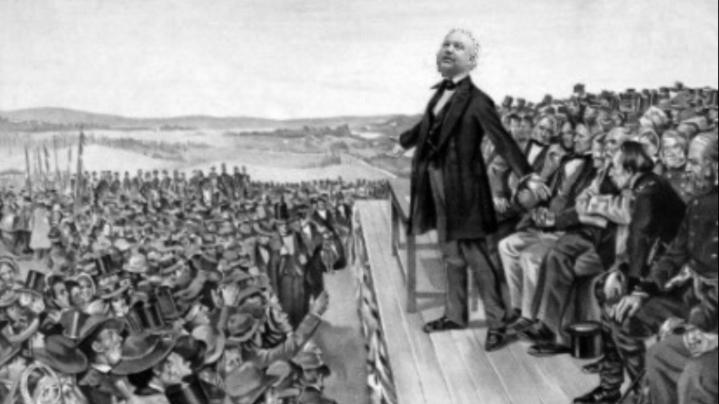
Another metaphor I have used before is that of Abraham Lincoln bringing the nation back together. In fact I use that so much that friends photo-shopped a picture that I have included in this post. It serves as an important reminder to me of how important it is to bring everyone together for a common cause and respect everyone, just as Abraham Lincoln did following the Civil War by showing respect for the confederate south. I need this metaphorical example because this unification is not always easy and I am not always the best at it. We all have a tendency to go tribal.
Kelley told us in The Art Of Innovation we should choose a metaphor for every project or everything we do. Again, they serve as such powerful reminders for us. Just like the airplane wing hanging in one of the office areas of IDEO. What metaphors do you use?
Do Others Like The Vibes You Give Off?
 I pride myself in always having a great attitude. In fact if you were to ask those that know me they would tell you that one of my mantras would be my answer to the question of how I am doing: “I don’t know how I could be any better!” And, I really do believe this.
“The ‘secret’ of success is not very hard to figure out. The better you are at connecting with other people, the better the quality of your life.” ~ Nicholas Boothman
Amazingly this fits with my philosophy of having a great attitude all the time. This is affirmed in Nicholas Boothman’s great book that I am reading right now entitled How To Make People Like You In 90 Seconds. He talks about either having a “really useful attitude” or a “really useless attitude”. I have found, as Boothman also points out in the book, it always pays to have the useful attitude. In fact he provides a great table of both useful and useless attitudes.
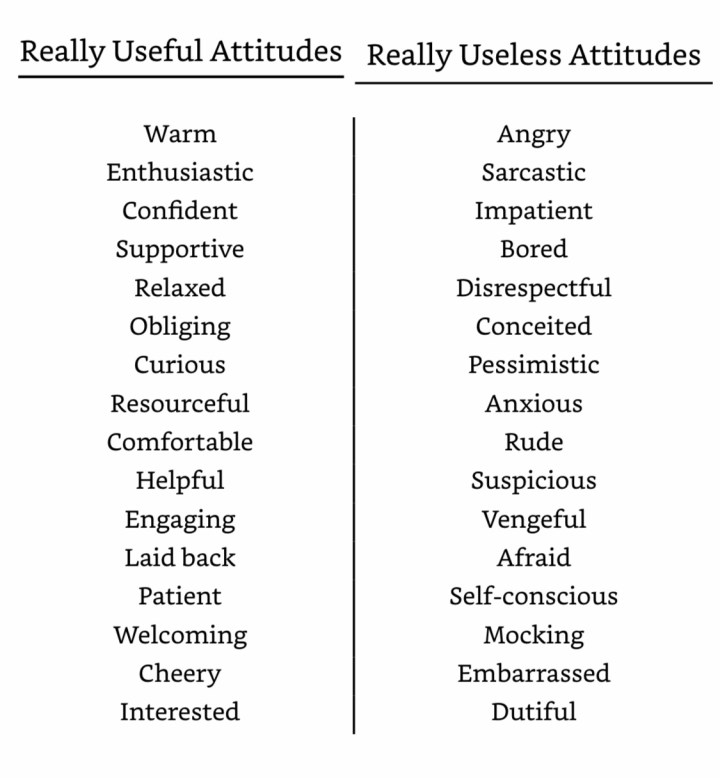
From How To Make People Like You In 90 Seconds by Nicholas Boothman
Then, yesterday when flying into Orlando, Florida I had this affirmed when I picked up my rental car. When I went to my Preferred area, the agent told me that they were out of the vehicles in the selected size I always get. I said, “Okay, let’s just figure out what you’ve got; it will be okay.” I was in A garage and she said, you know if you want to go over to B garage they’ve got one. It’s a short walk, so said “No problem. Let’s do that.” Now could have got all huffy and holier than though, but really, what would that have gotten me – nothing.
 As I was walking away the agent said, “Thanks for having a great attitude. I like your vibes you give off.” This made my day because I do try to always give off good vibes. Boothman would have been proud because I couldn’t help but take a moment and be the teacher I am and tell her about the book and what I had learned about useful and useless attitudes.
Then when I got to the other garage, I found that the first agent had called over and told them to take good care of me and give me an upgrade to a premium vehicle. So what did having a useful attitude get me? A premium ride. To be clear, however, I am not saying to just have the useful attitude to get stuff or be upgraded. I am saying, as my story proves, authentically having a useful attitude will be just that – useful. So, if we want to live a premium and top shelf life we need to always have useful attitude. What kind of vibes are you giving off?
Leading Toward Morale
 As a student of IDEO, a global design company, I was intrigued by a comment that Tom Kelley made in the great book, The Art Of Innovation: “Morale cannot be planned or created.” This is so true. I have actually watched leaders try to plan organizations out of poor morales. It never works. Either the things that foster great morale are happening, or they aren’t.
 Leading has to be so much more than just telling people what to do. It’s about building a rapport and fostering real relationship with those that are a part of the organization. Rapport in turn creates trust and then things can get things done. Unfortunately, many leaders either don’t care about morale, or have the belief that giving a pep talk every so often, having a get together or party every so often, or sending someone a gift card will build morale. While these are nice things, they have nothing to do with morale.
So what is morale? Dictionary.com defines it as: “emotional or mental condition with respect to cheerfulness, confidence, zeal, etc., especially in the face of opposition; hardship, etc.: the morale of the troops.” (Retrieved 5/22/2019 from https://www.dictionary.com/browse/morale) Employee morale describes the overall outlook, attitude, satisfaction, and confidence that employees feel at work. We can’t give an employee positive morale. As a leader, though, we do control large components of the environment in which employees work each day. Consequently, we are a powerful contributor to whether a team member’s morale is positive or negative.
When our team members believe they are part of the goals that are bigger than themselves, or their job, this contributes significantly to positive employee morale. We want to feel as if we are part of something important and contributing to success for the greater good is a real morale booster. A deep focus on serving the needs of customers, students, and families, also promotes positive staff morale. Think about this: when employees have confidence in the capability of their organization’s or school’s leadership, they tend to have positive morale.
So if we can’t plan for or create morale, what are we to do? We must create an environment of shared vision for where the school or organization is headed and is positive about the direction. In this environment employees will exhibit high morale. I we genuinely planning to make changes based on feedback, our authenticity will be apparent.
It requires a great team to steer the organization or school toward progress, and if that great team involves happy employees with high morale, the journey will be successful.
Stand Your Ground & Be The Example
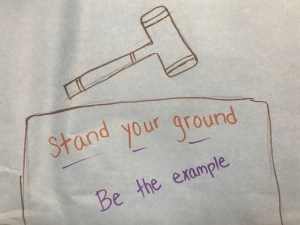 Setting an example through your own practice illustrates to others that change is a shared endeavor. True leaders are the pinnacle of what they expect from the people around them. And by setting an example, true leaders encourage their people to aim for that. By walking your talk, you become a person others want to follow. When leaders say one thing, but do another, they erode trust–a critical element of productive leadership.
Great leaders are persistent. Try, try again. Go over, under or around any hurdles to show that obstacles, what I like to call opportunities, don’t define your company or team. This will allow you to create solutions. Don’t dwell on problems; instead be the first to offer solutions and then ask your team for more.
Furthermore, being the first to change can be challenging. As a pioneer, you have to overcome resistance to the status quo. We humans get used to the way things are. Yet those who dare to rock the boat are in a position of tremendous power, and can send ripples of inspiration out to the world. Lead by example because others will become curious. Remember, our actions are much more persuasive than than our words.
What We Know, And Don’t Quite Know We Know
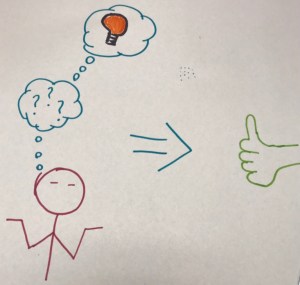 I finished a great book by David Brooks this past week entitled The Second Mountain: The Quest For A Moral Life. He used a phrase in the book that really intrigued me: “What we know, and what we don’t quite know we know.” I’ve written about not knowing what we don’t know before, but this idea there being things we don’t quite know we know is intriguing to me. At first I related it to being curious, but I believe it had more to do with our learned knowledge and experiences that give us knowledge and perspective about things yet to be learned.
“There are known knowns; there are things we know we know. We also know there are known unknowns; that is to say we know there are some things we do not know. But there are also unknown unknowns — the ones we don’t know we don’t know.” ~ Donald Rumsfeld, Former Secretary Of Defense
 Case in point: this past week I was asked to research what we needed in terms of a website to market new professional development materials and services we have for schools to buy. At first I’m thinking, “I am so the wrong person for this!” I’m not a marketer, nor web development person. Then I started doing some research and got hooked up with a great resource at a web development company, who was happy to mentor me, fill in the gaps of my research, and help me develop the right questions to be asking back with the team.
What I found was, that while I did not have much (actually none) of the technical knowledge necessary for moving this project forward, I did have valuable user knowledge of what the website needed to be like. These were the things I didn’t know I knew, but by asking questions of the right people I was learning. I found I knew some vital things crucial to product success, such as:
- Making the website fast and easily navigated.
- Make it simple.
- Make the landing page in a way that hooks readers.
- Make it about solving problems.
Just understanding these things from my own experience using websites I was able to fill in the knowledge gap with the help of the website design gurus. No matter the scale, discovering your explanatory gaps is essential for innovation. An undiagnosed gap in knowledge means you might not fully understand a problem. That can hinder innovative solutions. To discover the things you can’t explain, take a lesson from teachers. When you instruct someone else, you have to fill the gaps in your own knowledge. A couple of tips would be to explain concepts to yourself as you learn them and engage others in collaborative learning.
Next time you take on something outside your current knowledge base, think about what you already know and what you don’t quite know you know. I’ll bet you know more than you think.
Leading With Extreme Axe Throwing Finesse
 There are so many formulas that have been written about as best pathways toward great leadership. I have tried to write a few of those myself. Yesterday, our professional development team went on a team building excursion to Extreme Axe Throwing in Hollywood, Florida. Needless to say, it was a great time, but there were moments when I was struggling just to get the axe to stick. I kept getting told, “Finesse, Byron, finesse!” I had to think about what the heck “finesse” even was. So, off to Merriam Webster dictionary:
- refinement or delicacy of workmanship, structure, or texture
- skillful handling of a situation: adroit maneuvering
- the withholding of one’s highest card or trump in hope that a lower card will take the trick because the only opposing higher card is in the hand of an opponent who has already played
 As I familiarized myself with what “finesse” really meant, I began to think about how this related to my current situation at the time of throwing an axe at a target. I believe last night’s situation relates to #2. I needed to be skillful and use the techniques our axe throwing coach instructed us with. Then, as I began throwing I needed to get clever and maneuver to make it all work for me. Sometimes I threw too hard, others I was releasing early, others I kept getting told I was flicking my wrists. We can certainly relate this to leadership, don’t you think?
Check out my axe throwing prowess in this video:
Leadership, then, is an art of finesse. It’s being able to adjust and communicate in different ways, specific to each person. I don’t mean being “everything to everyone.” I just mean having enough self-awareness to know what is going to yield the best response from each person–and then having the patience to execute with that behavior in mind. What makes this mentality so difficult is that, in every capacity, it asks that you, as a leader, put yourself in a serving others mode. We must finesse away ego. We can’t just rage out of impatience, or get upset because other people aren’t working the way we want them to work. We can’t show your frustration–even if everyone else is. We can’t sit back and complain when times get tough. We must be the positive force that leads change. This art of finesse is learned through diligent self-inquiry, and constantly practicing the art of finesse and being flexible in the way you communicate and lead others.
 Leadership finesse requires that we, as leaders, constantly identify barriers and causes of struggles. Then, with relentless determination, make the best of the current reality we are in. Using my axe throwing metaphor, one barrier we have is fear of failure. Fear of failure holds us back from our dreams more than anything. The thing I was reminded from axe throwing is that we are going to fail over and over and over. During one round of throwing (10 throws) last night I did not get the axe to stick in the wood once. That’s right; my score was 0 at the end of the round. To handle this with finesse, I was reminded that if you’re, you’ll be rejected too. The key is to fail forward, where the pain of the failure is reduced by the benefit of the lessons it brings.
 Byron's Babbles
1 comment