Stand Your Ground & Be The Example
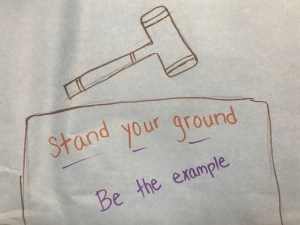 Setting an example through your own practice illustrates to others that change is a shared endeavor. True leaders are the pinnacle of what they expect from the people around them. And by setting an example, true leaders encourage their people to aim for that. By walking your talk, you become a person others want to follow. When leaders say one thing, but do another, they erode trust–a critical element of productive leadership.
Great leaders are persistent. Try, try again. Go over, under or around any hurdles to show that obstacles, what I like to call opportunities, don’t define your company or team. This will allow you to create solutions. Don’t dwell on problems; instead be the first to offer solutions and then ask your team for more.
Furthermore, being the first to change can be challenging. As a pioneer, you have to overcome resistance to the status quo. We humans get used to the way things are. Yet those who dare to rock the boat are in a position of tremendous power, and can send ripples of inspiration out to the world. Lead by example because others will become curious. Remember, our actions are much more persuasive than than our words.
Leadership Is Empowerment
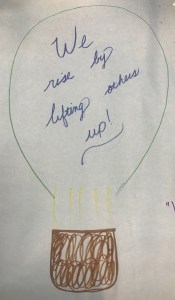 By being generous and loving, we become better leaders. Our kindness inspires others to follow in our footsteps. Humans require community in order to survive. As individuals we are week, but together we are strong. We need to strive for greatness, but we need to lift others as we rise. The goal is not to tower over our fellow humans, but rather to lift them up to where we are. If we all want to succeed ourselves, we cannot do it alone.
Leadership is empowerment. It’s lifting others up, helping them advance, and making them a part of something bigger than themselves. In short, it’s helping people to be a little closer to who they’re meant to be. Our leadership ability won’t be measured by our own advancement, but how well we advance the lives of others.
How does your leadership success measure up?
Barbie Beach Inspiration
 I am writing this post out of requests to do so. Today, I facilitated our Georgia 3D Leadership gathering at Coweta Charter Academy. Near the school is Turin, Georgia where the famous attraction Barbie Beach is located. Everyone told me I needed to go see it. Of course they knew I would. Then, they all requested that I write a blog about it. I’ve got to say I’m glad I went, but I was not particularly moved by the experience. But, the more I thought about it I found some inspiration.
This weird roadside attraction, Barbie Beach is the brainchild of Steve and Linda Quick, two longtime Turin locals. It was started in 2005 as a celebration of the 2006 Winter Olympics, that took place in none other than Turin, Italy. Basically they have taken a patch out of their yard out by the road and created a beach for a bunch of nude Barbies. I’m telling you it is creepy, weird, and kinda cool all at the same time.
It wasn’t until I tweeted about it, that I finally got some inspiration. I tagged @Barbie when I tweeted and then looked at the Barbie website and was reminded the inspiration Barbie has been to so many over the years. Barbies have helped girls realize they can be anything they want. Barbie has been celebrating woman as role models since 1959. Barbie has been breaking through the plastic ceiling and providing the inspiration for all women to break through the glass ceilings. I am inspired by the Close The Dream Gap project. Barbie is the original girl empowerment brand.
“What is the dream gap? Starting at age 5, many girls begin to develop limiting self-beliefs. They stop believing their gender can do or be anything. This is the dream gap, and this is the year Barbie begins working to close it.” ~ From the barbie.mattel.com Website
So what did this weird display in Turin, Georgia do for me? It inspired me to study the history of Barbie and be inspired by the great work they are doing for young women. Are you open to exploring the quirky, being curious, and being inspired to learn?
Welcome To Your New Addiction

What’s At Your Core (Value)?
Where to begin? There is so much I want to say! Yesterday we had a great gathering of our Florida 3D Leadership group outside Orlando at Renaissance Charter School at Boggy Creek. I love going there and spending time with this group. Yesterday’s topic was core values. We spent the morning setting the stage with some cool activities (Emoji tattoos, making graphic mantras) and discussions around core values and what they wanted to do with their lives and what they wanted their legacy to be.
Then, the coolest thing happened – Lunch!

Our lunch was delivered and catered from Fuzzy’s Taco Shop. First of all, as the truck, bright yellow, pulled up, it caught my eye out the window I had immediately seen the shiny object and was off topic. Check out the picture of the truck and you will understand what I am talking about. So, as they were setting up at one end of the room we were in, I asked one of the workers, Mariah Miller, whether she liked working at Fuzzy’s Taco Shop and if she did, why? Well, let me tell you, she jumped right into our core values discussion and said that she liked it because her boss did not act like a boss and did not want to be called a boss. He wanted to be considered a coworker.

Graphic Recording by Amy Reynolds
Then her coworker (boss), or leader, as he likes to be called came in, not having heard me ask the question. I called him over and asked him what his workers would say his mantra was (this was a core values discussion from the morning). He then basically reinforced everything Mariah had told us. We were amazed by the message that David Morales had for us in what became an outstanding extemporaneous luncheon keynote, literally.
 David explained he had ended up in Florida, via Texas, because he quit his job, and I quote, “because my core values did not match those of the company I was working for at the time.” Of course I am beaming at this point and everyone was looking at me like I had set this up, which I had not. We had discussed how individual and organization core values needed to match. I had said earlier in the day that is was just a fact that if at any point your own core values become much different from the organization you work for, that it was time to quit. He was affirming everything we had talked about earlier in the day, but with the flare of personal experience and a lot of passion.
 He then told us about looking for a job and finding Fuzzy’s Taco Shop. He told us how he cut the deal for Fuzzy’s Taco Shop to cater for the Dallas Cowboys and Texas Rangers. He told us about how he has opened 29 businesses. Finally, he explained how core values build communities of commitment. We had been discussing how core values communicate what is important, influence behavior, and inspire people to action. We had also talked about how core values enhance credible leadership. David Morales from Fuzzy’s Taco Shop had become our exemplar. We did not need to spend very much time with his employees to know he was credible.
…it is clearly necessary to invent organizational structures appropriate to the multicultural age. But such efforts are doomed to failure if they do not grow out of something deeper; out of generally held values.” ~Vaclav Havel

Graphic Recording by Amy Reynolds
Core values are what support the vision, shape the culture and reflect what an organization values. They are the essence of the organization’s identity – the principles, beliefs or philosophy of values. Many organizations focus mostly on the technical competencies but often forget what are the underlying competencies that make their organizations run smoothly — core values. Establishing strong core values provides both internal and external advantages to the organization. Clearly, Fuzzy’s Taco Shop and David Morales have mastered this.
Needless to say, we were amazed at this outstanding example of a company and it’s employees living out shared core values. Would you, your organization, or school have been able to extemporaneously keynoted our lunch today with the same level of authenticity related to core values as David Morales, Mariah Miller, and Fuzzy’s Taco Shop were able to?
Leadership Influence Formula
 The ability to influence others is crucial to a person’s success as a leader. Let’s face it, leadership is influence. All of the successful and effective leaders I have encountered developed the way they communicate and influence. After activities involving identifying Mount Rushmorean leadership influencers in their life yesterday, our 3D Leadership participants in Georgia set out to develop the top 5 list of leadership influence. This very creative group went a step further and invented a leadership influence formula.
This happened because of a lively discussion while trying to narrow the list down to five. This had taken place using one of my typical strategies of having participants fly airplanes with their personal top three influencer traits. They then glided their airplane to someone else and so on. We then compiled the list and got down to eight. As you can imagine, it got lively at this point.
 The beauty of our 3D Leadership Program is that our participants come from all positions. We have teachers, facilities professionals, principals, and many others represented. This gives us the unique ability to have all vantage points represented in a discussion. This affords us what Dr. Nicky Howe and Alicia Curtis call “diversity of thought” in their great book, Difference Makers: A Leader’s Guide To Championing Diversity On Boards. They contend that what really matters are not the visible differences between people but their unique perspectives on the world.
What I believe we are creating through our cohorts of 3D Leadership participants is an organizational culture that is committed to fostering open-ended, inclusive dialogue. It is about recognizing that every person is a rich tapestry woven together from a million threads. Participants’ age, background, experiences, abilities, job responsibilities, gender, race, family story, and many other things all matter. There is a fallacy that people who look alike have the same views. Nothing could be further from the truth, though.
 Bottom line is, this “diversity of thought” enabled us to develop a pretty cool leadership influence formula. Here it is: Innovative + Integrity + Compassion/Caring + Listen + Inspire = Leading By Example. Pretty powerful, don’t you think? As we decided, even you wanted to switch some traits out, if you were doing all the parts of this formula, you would be getting along pretty well.
Do you follow the additive value of this formula? If you follow these traits you will stack things in your favor to quickly become a key person of influence.
You’re Not a Fraud!
 Impostor syndrome (also known as impostor phenomenon, impostorism, fraud syndrome or the impostor experience) is a psychological pattern in which an individual doubts their accomplishments and has a persistent internalized fear of being exposed as a “fraud”. This definition came from Wikipedia (retrieved 4/6/2019). To start this post I needed a definition to frame the discussion. The context for this post came from a discussion during one of our Indiana 3D Leadership sessions last year and I am just getting to it on the list of topics I want to blog about. We were discussing how sometimes individuals move quickly to different positions in schools for doing good work. These aspiring leaders were concerned, however, that sometimes they have some imposter syndrome symptoms and believe they might not be as good as others think they are. At first I wasn’t sure I was catching what they were pitching, but then in studying this I have found this really is real.
For example, a perfectionist sometimes falls into this trap. Think about it. The perfectionist sets lofty goals for themselves, tend to be micromanagers, or won’t delegate at all. Then, when things aren’t perfect, he is super hard on himself. This is also the person who had to have straight A’s and the highest scores in the class. I never needed to worry about this and am certainly not a perfectionist. My dad, conversely, was a perfectionist and actually it would keep him from getting things accomplished at times. I remember when he passed away back in 1988 I found several projects not completed around the farm because he was constantly working to make whatever it was perfect. I always said it was like the old adage “measure twice, cut once.” The problem was he kept measuring to try to get it perfect and never got the board cut. Make no mistake, I loved my dad and I respect him more than anyone, but we were very different on the trait of being a perfectionist. I’m not sure I have ever worried about being perfect a minute in my life and have certainly never worried if someone didn’t think I was perfect.
Sometimes people with this syndrome want to know it all. She never believes she will know enough. Remember, to lead a highly effective group or organization you do not want to be the smartest person in the room. Learning has to be agile. There are things we will need to know tomorrow that we don’t know today. Don’t worry about trying to second guess, just be ready to learn when the need arises (which will be always).
If you’ve ever experienced imposter syndrome you need to realize that you have gotten where you are for a reason. It may have been because of your ability to produce, chance, connections, or some other factor, and that is great. Go ahead and embrace your abilities, embrace what makes you different from everyone else, and play off of your own strengths and capabilities. You are not a fraud.
Hailey’s Energy Bus
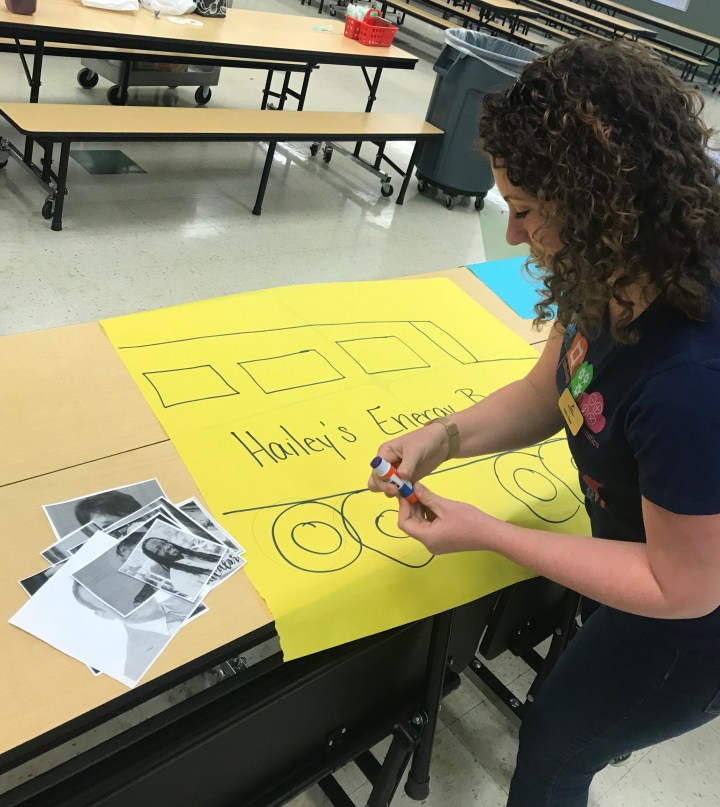 Several years ago I read the great book, The Energy Bus, by Jon Gordon. It is an outstanding book written as a fable. The book is written from the perspective of a middle manager (George) who is leading a team heading nowhere. Through a series of events he ends up riding a city bus with a positive motivation guru at the helm and a group of “energy” converts in the seats. After riding the bus for two weeks he has learned 10 lessons.
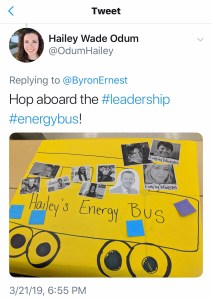 I was reminded of this book this past Thursday night while working with our Carolinas 3D Leadership participants in Kannapolis, North Carolina. The participants were working on a creative activity of putting 10 of the top influencers of leadership in their lives into a collage. Low and behold as I’m circulating I find Hailey’s Energy Bus. It immediately took me back to The Energy Bus book. Hailey Wade Odum realized that these leaders who influenced her, gave her energy. The energy to be a great teacher leader and K-5 STEM Lab instructor at Cabarrus Charter Academy Elementary School. She even tweeted, “Hop aboard the #Leadership #EnergyBus.” Jon Gordon would have been proud!
This really made me think about the ten lessons in The Energy Bus. They all applied to Hailey’s picks of her top ten influencers. Here’s the ten lessons (rules):
- You’re the driver of your bus.
- Desire, vision, and focus move your bus in the right direction.
- Fuel your ride with positive energy.
- Invite people on your bus and share your vision for the road ahead.
- Don’t waste your energy on those who don’t get on your bus.
- Post a sign that says, “No Energy Vampires Allowed” on your bus.
- Enthusiasm attracts more passengers and energizes them during the ride.
- Love your passengers.
- Drive with purpose.
- Have fun and enjoy the ride.
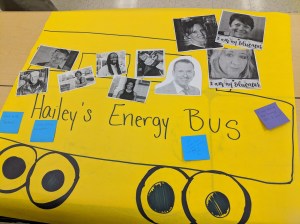 All of these rules I’m sure went into Hailey’s picks of her influencers, but in listening to her report out I believe that rules 2, 3, and 9 were pretty important in the decision. It’s all about personal responsibility. We are each responsible for the direction of our lives. And the direction of our lives is shaped by each day, each thought, and each person we use as a mentor or exemplar. If we are complacent in our lives we let others drive for us. We need to be driving our own energy bus. Have you ever felt out of control? Well, it’s time to take charge and drive your own bus. In my experience, the realization that my efforts now can reap big rewards in the future has always been very empowering.
 The other thing we spent time visiting about is that people are constantly being added to our bus. As our lives evolve and we continue to iterate and reinvent ourselves, some of our influencers will change. Unlike like the real Mount Rushmore that is literally carved in stone, our personal Mount Rushmorean leaders should be molded such to be constantly evolving. Who’s on your ENERGY BUS?
Be You!
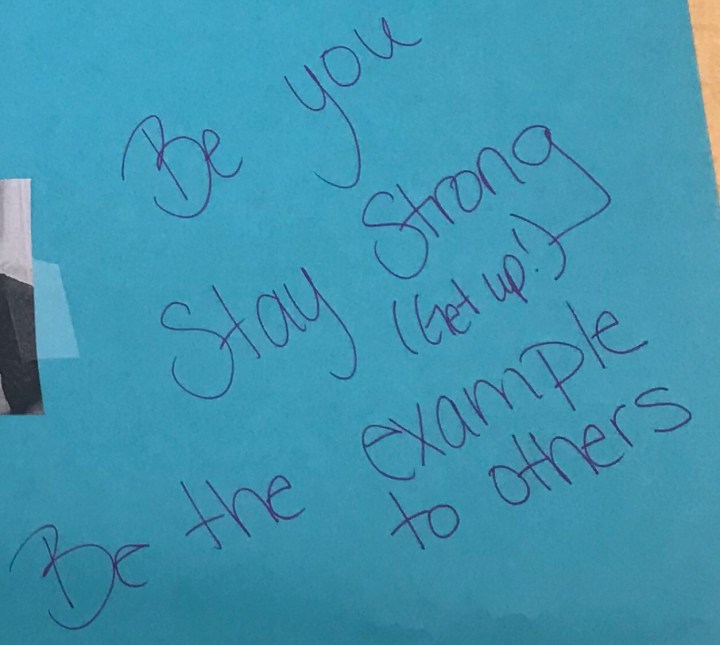 Last night at our Carolinas 3D Leadership gathering I was struck by a phrase that Stephanie Klingler, the Assistant Principal at Cardinal Charter Academy, put on one of the projects we were working on. The project was identifying Mount Rushmorean leaders and the influence other leaders have on us. Her statement was:
“Be You! Stay strong. Get up! Be the example to others.” ~ Stephanie Klingler
Super powerful, don’t you agree? If Leadership is about influence then this is the example we want to be and what we want modeled for us. It’s about being authentic and doing what Machiavelli taught us: to declare. Who we are is how we lead, pure and simple. Being a great leader is really the simple act of being you. It’s about putting your experiences and what you believe into a package that guides how you lead and the example you are. Stephanie’s statement says it all: be you, be strong, be an example, and keep getting up. It is who she is.

Stephanie is on the left with her mobile office for being a leader of learning!
If we want to lead and be a Rushmorean (yes, I made that word up) leader, then we must know ourself. Being ourself means being authentic. It is okay to be you. It’s really the only person we can be. As my friend Sally Hogshead teaches us, you need to be the best you you can be. The fascinating you! The best way to become an effective leader is to find congruence between what you think, say and do. That said, in order to become an effective leader you have to know who you are: your values, your strengths, what you stand for, why you stand for it, and what your ethics are. Then act on them with conviction and without apology. This is what I believe Machiavelli meant when he says we must “declare.”
Are you being YOU?
Leading Like Mr. Incredible
 At our most recent 3D Leadership gathering in Florida we had the participants make name tags because our group size was around 80 individuals. But you know me, I couldn’t just have them make a normal boring name tag with a name, they also had to put the name of the superhero that they would most want to be. Then during some presenting out they had to tell us why. Great activity and way to get to know others! I was blown away, however, by one person, Bradley Warren, Assistant Principal at Waterset Charter School, who put Mr. Incredible AKA Byron on his. I was honored and asked the person why and he said, “You remind me of Mr. Incredible.” I’m pretty sure he was kidding, but… So, I had to do some studying on, you guessed it, Mr. Incredible.
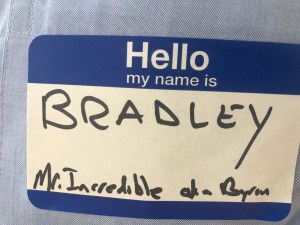 Basically my research revealed that Mr. Incredible started out like any other superhero by saving the world several times. Then I found that he and other superheroes were forced to suppress their superness (yes, I made up that word). During this time it was tough for Mr. Incredible because he was looking for ways to be great and help others. Also, during this time he got married and started a family. Sounds like a lot of us, right? This reminded me that God intended us all to be leaders, fight for what is right, to win, and to defend. I try to live up to this call every day.
The big thing that stands out about Mr. Incredible to me is the fact that for him to realize it was not all about him was that he had to end up with a real family with the real day to day challenges and tribulations we all face. In thinking about it, all of the superheroes are real people with real challenges who lead real lives. It’s easy to be Mr. Incredible, or any other superhero for that matter, when you have super powers. It’s much harder to be a dad and husband, like the real Mr. Incredible, Robert Parr, who works each day and raises kids to adulthood has to do.
“No matter how many times you save the world. It manages to get back in jeopardy again.” ~ Mr. Incredible
We all need a challenge and we all need to do our part to save the world. Whether that is in the world of education, like in my case, or wherever your passion and purpose takes you. We must all choose to lead. We need to all realize we are valuable whether we can leap tall buildings (which we can’t) or not. We can, however, make a huge difference just being who we are.
What great leadership lessons I learned from a simple name tag. Thanks Bradley, for making me evaluate and reflect on whether I am living up to the Mr. Incredible standards. Do you have any Mr. Incredible insights to add?
Displaying Leadery
 So, those that know me know I love coming up with new words. I am OK with making new words that end up getting the dreaded red hash-marked line under them (meaning it is misspelled or doesn’t exist). Today at our February Carolinas 3D Leadership gathering in South Carolina, the group came up with a new word: “Leadery”. I was all over it immediately because of my love for creating new words. Why can’t we create new words, anyway? Who is the new word police? What is the process for creating a new word? Well, I did a little studying.
It turns out any of us can create new words. In fact the term for someone who coins a new word is a neologist. If you say you knew this you are lying! Shakespeare is often held up as a master neologist, because at least 500 words (including critic, swagger, lonely and hint) first appear in his works. Experts, however, are not sure whether he personally invented them or was just transcribing things he’d picked up elsewhere. I’m guessing with his creative mind he invented them. From what I could find there are about 1,000 new words added to our language each year.
Back to “leadery”. In this case adding the ery to the end of the noun, leader, makes it an adjective. This is pretty cool because I would compare it to bravery. How many times have you heard that someone displayed great bravery? Or, she conducted herself with bravery? Or, the General led his troops with bravery? Probably a lot, right?
Well now we have a term for the act of practicing great leadership: “leadery”. Think about these potential sentences:
- She showed leadery when taking on the principalship of the failing school.
- It took tremendous leadery to do what was right.
- It took a great deal of leadery to change the culture of the organization.
- If we stay focused on self, others, and the wider world we can lead with leadery.
- She instilled leadery in the team.
There’s a good chance that “leadery” won’t become one of the 1,000 new words for 2019, but it has sure been fun to learn about the development of new words. Why not have a word that compliments “lead” or “leading” the way that “bravery” compliments “brave”?
Final question: Can it be said you are displaying leadery?
 Byron's Babbles
leave a comment