Seeing The Monster

Yesterday evening I had the treat of attending the Ken & Jean Hanson Lectureship with Aubrey Buster, Ph.D. – “Here be Dragons”: C.S. Lewis and the Construction of the Monstrous. It was absolutely amazing and I jotted down several points for further pondering. One of the points Dr. Buster made was that monsters are that which is contrary to order. She was suggesting that monsters represent chaos, fear, or disruption in society and the natural world. They often symbolize things that challenge our understanding of normalcy, morality, or the established social order.

C.S. Lewis often used monsters and mythical creatures in his literary works to serve various narrative functions. These figures can represent internal struggles, moral dilemmas, and the battle between good and evil. In literature and mythology, monsters can embody societal fears or serve as a reflection of the human psyche, representing the unknown or repressed aspects of ourselves. Another point Dr. Buster made was that we must see the monster correctly to respond correctly.
As I reflected this morning I caught that I had even created a bit of a monster in Dr. Buster. I found myself feeling inferior to her vast knowledge. Then I needed to see the monster I had created correctly and realize that she should be talking way over my head when it comes to apocalyptic monsters. Not something I have ever studied in depth. That’s why I was attending the lecture – to learn! I was letting my envy create a monster. I’m sure I could begin to rattle off subjects of my studies that Dr. Buster might not be up to speed on. The real monster in this story was me terrorizing myself. To be clear, Dr. Buster is incredible and not a monster!
Essentially, these monsters are figures that disrupt the harmony of life, prompting us to confront our fears and question our assumptions about what is considered “normal.” I loved the discussion of C.S. Lewis’s monsters in Narnia that invite readers to reflect on their own fears and challenges, making the journey through Narnia a metaphor for personal and spiritual growth.
For instance, the White Witch embodies tyranny and oppression, serving as a formidable antagonist who challenges the protagonists’ courage and faith. Her presence forces characters like Aslan, Peter, and Lucy to confront their fears and make difficult choices, ultimately leading to personal growth and revelation. As Dr. Buster taught us, there are no new monsters, just those developed from envy, lust, greed and power.
Life’s Contests

I must admit I am part of the Yellowstone phenomenon. Paramount ran a Yellowstone marathon this weekend and, of course, I got caught up watching a few episodes. Okay, a bunch of episodes. Every time I watch I hear something new that makes me think. Tonight, Beth Dutton (Kelly Dutton) said, “Life is not a contest of longevity. Life is a contest of quality.” She went on to say, “It’s the quality we get out of life and the quality we bring to the life of others.” We spend a lot of time worrying about longevity, and we must not forget the healthy side of life. We do, however, need to Ensure that we prioritize mental and physical health.
Keep in mind that longevity simply refers to long life. Quality of life is enhanced when we’re feeling good both mentally and physically. I love how Lisa Catanese, ELS, Health Writer for Harvard Health Publishing, said it in “Longevity: Lifestyle strategies for living a healthy, long life.” She said, “And that’s important because there is more to longevity than duration. Most of us don’t want to just live longer — we want to live longer while enjoying a good quality of life.” We need to consider the simple things that will bring both quality of life and longevity.
We need to value the experiences we have in life over longevity. We must prioritize experiences that bring joy, fulfillment, and personal growth. This could mean traveling, pursuing hobbies, or spending time with loved ones, rather than simply accumulating years. By focusing on all these aspects, life becomes less about how long we live and more about how well we live.
Competing Vs Collaborating

Competition can drive individuals to improve, an overemphasis on it at the expense of collaboration can hinder progress and create a less harmonious environment. I was reminded of this while watching the new Matlock television series last night. Olympia (Skye P. Marshall) told Sarah (Leah Lewis) that she was, “too busy competing and not collaborating.” Olympia was pointing out that Sarah was focused primarily on outperforming others rather than working together for mutual benefit.
The constant competition Sarah created led to stress and burnout. Sarah felt the pressure of always wanting to be ‘the best’ and missing out on the supportive network that collaboration provides. Individuals become isolated, as they prioritize their own success over building relationships and fostering teamwork.
Don’t forget, personal growth is stunted when there is no collaboration, as sharing knowledge and resources lead to better outcomes.
FIX
In my morning reading yesterday I came across an interesting observation by Charles Dickens in American Notes for General Circulation. He said, “There are few words which perform such various duties as this word ‘fix’” (p. 144). This is still very true today. Try these on for size:
- ‘Fixing’ supper
- Thanksgiving dinners with all of the ‘fixings’
- Give me a minute while I ‘fix’ myself up
- She is ‘fixing’ the table now
- The doctor fixed my…
- Got my sugar ‘fix’ for the day
The point of all this is not about the word ‘’fix’ itself but illustrates how language can evolve and adapt to reflect cultural values and practices. This reminds me of an activity I like to do with groups: ask the question, “what do you call what you push around in the grocery store to carry your groceries?” 🛒 Depending on where we are it might be a cart, grocery cart, buggy, trolley, or shopping cart. I love having that discussion because our cultural context matters. Words often carry different meanings and connotations depending on their cultural context.
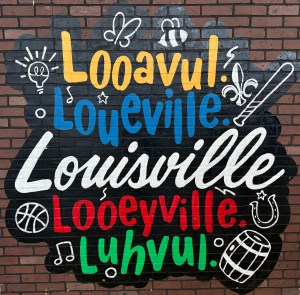
Sometimes we also pronounce words differently based on culture or where we from. For example I am in Louisville, Kentucky today. How do you pronounce Louisville? See the featured photo I took for this post. Understanding these nuances can deepen our appreciation of a culture. And by understanding and appreciating these nuances we can form stronger relationships
When interacting with other cultures, recognizing the importance of certain words can facilitate better understanding and integration. This can be especially important for travelers or those working in multicultural environments. Just as “fix” has various meanings in American English, other languages may have words that serve multiple purposes, showcasing the flexibility and richness of human communication.
No Bad Ideas

Last night there was a new episode of FBI. In that episode the team was trying to solve a case and seemed to not have any options, but Jubal Valentine (Jeremy Sisto) told the team, “No bad ideas.” Immediately the team was pop-corning wild ideas. One of which was to turn the WiFi in a building where a kidnapping victim was being held into an imaging devise.
Creating an environment where there are no bad ideas encourages open and creative thinking. It means that everyone should feel free to share their thoughts without the fear of judgment or criticism. The idea is that even if a suggestion seems impractical or unusual, it might spark another person’s imagination and lead to innovative solutions. Essentially, it promotes a collaborative environment where creativity can flourish.
The Greatness of Others

Right after their Super Bowl LIX win over the Kansas City Chiefs, Philadelphia Eagles Head Coach, Nick Sirianni said, “You cannot be great without the greatness of others.” He also referred to football being, “the ultimate team sport.” I love this idea of not being able to be great without the greatness of others. It is true of everything, not just football. None of us can claim any greatness with acknowledging the greatness of others that helped make it all possible.
Nothing happens in isolation. This made me think back to reading the 50th anniversary edition of Thomas S. Kuhn’s The Structure of Scientific Revolutions. Kuhn reminded us that discoveries and advancements do not occur in isolation or as the result of a single individual’s efforts. While he was referring to the field of science, I believe this is true for everything. As Sir Isaac Newton so aptly put it, “If I have seen further than others, it is by standing upon the shoulders of giants.” He understood we cannot be great without the greatness of others. Newton knew he didn’t dream everything up himself, but was relying on the ideas of others before him.
Everything in life is a collective endeavor. Discoveries are often the result of collaboration and communication within communities rather than solo pursuits. We build on each other’s work, share ideas, and engage in debates that drive innovation. We need others to be great and others need us to be our best to help make them great.
Appreciating The Moment

I love the Super Bowl pregame interviews. Michael Strahan interviewed Saquon Barkley on the Creole Queen in New Orleans. I perked up when I saw the riverboat because my son and I did a breakfast cruise on that boat a few years ago before a New Orleans Saints game. Saquon made a comment that really struck me. He said, “I don’t always appreciate stuff that is going on in the moment.” Well, Saquon, I would say we all have to be aware of that.
I look back at things that happened years ago and realize I didn’t appreciate the enormity at the moment. The point being that while winning the Super Bowl is the ultimate goal, Saquon realized he needed to appreciate the opportunity of being in Super Bowl LIX. We all need to remember to live in the moment and appreciate what’s going on in the moment. Good luck tonight Saquon!
Cultivating A Student’s Wisdom and Imagination

I was asked a question this week as to if the needs of all students can be met by career and technical education (CTE) courses. The individual asking the question also wanted to know about valuing career technical courses just as much as their academic courses and not viewing them as just another elective. First, I must point out that I believe every path matters for students and the needs of students can, and should, be met by the path best suited for the individual student.
My answer to the question was an emphatic, “Absolutely!” I went on to give examples and referred back to points I had made in my book, The Hand In The Back Of The Room. Teaching science through the context of agriculture employs inquiry-based teaching methods allowing teachers to expand students’ science skills and help mold lifelong learners.
Students who lack a connection with the relevance of science and math create a challenge for education and reinforce the need for core subjects to be taught in a relevant context. Career and technical education courses and programs offer this opportunity. The context of agriculture, for example, allows students to see, touch, smell, feel, and understand in a way that is meaningful to them. Learning in a relevant context allows students to use both wisdom and imagination.
 Byron's Babbles
leave a comment